Buyer Fit Snapshot
| Best fit | Printed Packaging Tape with Logo projects where brand print, material claims, artwork control, MOQ, and repeat-order consistency need to be specified before quoting. |
|---|---|
| Quote inputs | Share finished size, material target, print colors, finish, packing count, annual reorder estimate, ship-to region, and any compliance wording. |
| Proofing check | Approve dieline scale, logo placement, barcode or warning zones, color tolerance, closure strength, and carton packing before bulk production. |
| Main risk | Vague material claims, crowded artwork, missing packing details, or unclear freight terms can make a low unit price expensive after revisions. |
Fast answer: Printed Packaging Tape with Logo: Key Facts and Uses should be specified like a repeatable production item. The safest quote records material, print method, finish, artwork proof, packing count, and reorder notes in one written spec.
Production checks before approval
Compare the actual filled-product size with the drawing, then confirm tolerance on folds, seals, hang holes, label areas, and retail display edges. Reserve space for logos, QR codes, warning copy, and material claims before decorative graphics fill the panel.
Quote comparison points
Review material grade, print process, finish, sampling route, tooling charges, carton quantity, and freight assumptions side by side. A quote is only useful when the supplier can repeat the same color, closure quality, and packing count on the next order.
Printed Packaging Tape With Logo: Key Facts and Uses
The first branded surface many customers touch is often the tape, not the carton itself, and that single 48 mm strip can change how a shipment feels before the box is even opened. I have watched printed packaging tape with logo turn a plain corrugated box into something that looks planned, measured, and a little more expensive than the freight bill suggests, especially on a 400 x 300 x 250 mm shipper leaving a warehouse in Dongguan or Foshan. It is pressure-sensitive packaging tape printed with a logo, a handling cue, or a short message, and the difference is more than cosmetic: on a busy line, it helps workers spot the right roll faster, while at delivery it reinforces package branding in one of the few places buyers actually notice. On a standard 50-meter roll, the right print repeat can carry a brand across 60 to 80 cartons before the core is empty, which is a small physical detail with a very visible effect.
Too many teams assume the artwork is the whole story. Printed packaging tape with logo depends on the build behind it: backing film, adhesive, ink, and the way the print repeats across the roll. If any one of those pieces is off, the result can be smudging on recycled cartons, curling at the seam, or a logo that looks sharp on screen but muddy on a 320 mm box flap. Packaging tape sits on a small surface, yet it carries a lot of responsibility, and I have seen more than one perfectly good design get humbled by a bad adhesive choice, especially on dusty 32 ECT corrugated coming off a line in Suzhou or Ningbo. A tape spec that ignores the carton board is asking for trouble.
On factory floors, that reality shows up fast. I remember a fulfillment operation shipping about 18,000 parcels a week where the clear tape kept blending into kraft boxes, and pickers were checking every fourth carton by hand to confirm the right SKU. After they switched to printed packaging tape with logo, the team saved roughly 1.5 seconds per box because the branded strip gave them a visual checkpoint. Small number, big effect. Multiply that by 4,500 cartons a day and the labor savings stop looking theoretical, especially when a picker’s hourly wage is $18.25 and the shift runs 10.5 hours. Honestly, once the line manager saw the difference, he looked at the old tape like it had personally betrayed him.
Why does printed packaging tape with logo change the box experience?
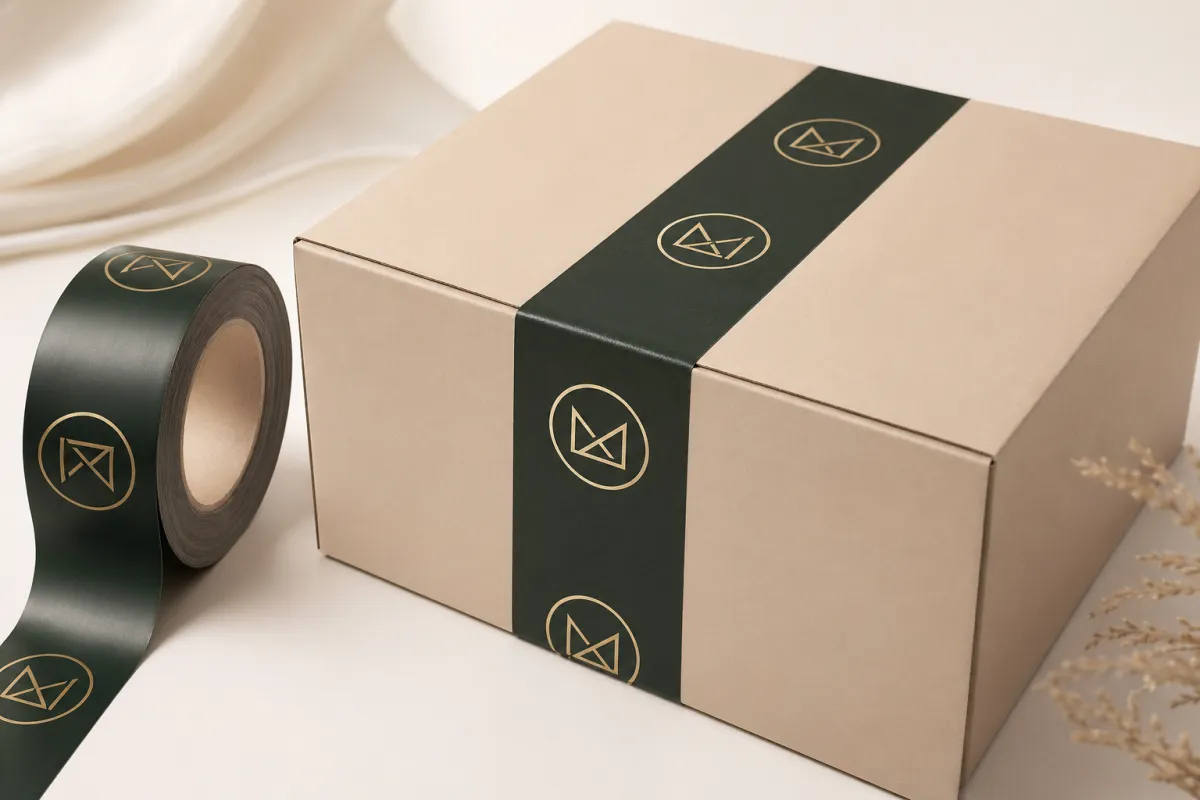
Here is the simplest way I explain printed packaging tape with logo to clients: it is a brand marker, a handling signal, and a low-friction upgrade to retail packaging all at once. A carton can be plain, but if the seam carries a 2-color logo printed on a 48 mm or 72 mm band, the box reads as intentional instead of generic. That matters in ecommerce because customers often see the tape before they ever see the product packaging inside, whether the inner pack is a 350gsm C1S artboard insert or a molded pulp tray. In one cosmetics meeting I attended in Shenzhen, the brand team had spent weeks debating Custom Printed Boxes, then discovered their first customer touchpoint was the seam seal on the outer mailer, not the rigid box inside. That was a quiet room for a minute, which is rare in packaging meetings because everyone usually has an opinion and a sample to wave around.
The box experience changes because recognition happens early. A warehouse worker can identify a return carton, a fragile shipment, or a priority order without scanning a label twice, and a customer can recognize a package from 3 feet away on a front step. Printed packaging tape with logo gives you that cue in a 48 mm, 50 mm, or 72 mm band, which is far more efficient than placing a large print on every carton flap. For brands that use standard corrugate in 300 mm, 400 mm, and 500 mm lengths, that is often the right balance between branded packaging and inventory flexibility. A single roll spec can support multiple box SKUs without forcing the team to retool the whole line.
Most packaging mistakes start with the wrong priority. Teams spend months chasing a larger print area and then ignore the part the eye sees first. I saw this during a supplier negotiation in Shenzhen where the buyer wanted full-panel artwork on the box, but their shipping line was moving 600 cartons an hour and the operators cared much more about the tape’s legibility from 2 meters away. Once the team switched to printed packaging tape with logo plus a simple 1-line handling message, the line supervisor said the boxes were “easier to trust.” That sounds soft, but in a 10-hour shift, trust reduces rework, and rework on a line can cost 20 to 40 minutes before anyone admits the root cause was just poor visibility.
Set expectations realistically. Printed packaging tape with logo does not guarantee durability if the adhesive is wrong or the substrate is mismatched. A neat logo on a weak acrylic tape can still fail on dusty recycled cartons, while a strong hot-melt formula can hold well but show less fine detail if the ink laydown is heavy. The right result depends on the tape build, not just the artwork file. I have had buyers ask why the logo looked “fine on my laptop” and then act surprised when physics showed up on the packing floor, which it always does by the first 100 cartons.
“We expected the logo to help the customer notice the box. What surprised us was how much faster the pack line became once the team could identify the right roll in under 2 seconds.”
If you are building a broader package branding system, I usually recommend pairing printed packaging tape with logo with one or two supporting elements instead of trying to do everything at once. A branded insert on 350gsm C1S artboard, a sticker, or a printed mailer can work alongside the tape, and our Custom Packaging Products page is a useful place to compare those options before you commit to a single format. The cleanest programs I have seen use one primary mark, one secondary surface, and a clear production spec sheet that does not change every Friday afternoon.
How printed packaging tape with logo is made and applied
The production chain for printed packaging tape with logo starts with artwork and ends with a converted roll, but the middle steps are where quality is decided. First comes file prep: vector logos, repeat length, color count, and the exact tape width, usually 48 mm, 50 mm, or 72 mm. Then a supplier creates plates or cylinders, checks registration, prints the design, applies adhesive and release layers if needed, and slits the master roll into finished widths. If the setup is off by even 1-2 mm, the print can drift across the seam and the entire repeat looks careless. I have sat in proof rooms in Dongguan and Taicang where someone pointed at a tiny shift and said, “No one will notice.” They absolutely notice. Buyers may not know the term “registration,” but they know when something looks a little off.
Print methods that matter
Most suppliers use flexographic printing for printed packaging tape with logo because it handles long runs efficiently and keeps costs manageable once the setup is done. Flexo is good for 1-color, 2-color, or 3-color work, and it is common when the repeat needs to stay readable at 20-30 meters per roll. Digital print can work for shorter runs or samples, but the cost per roll usually rises when the order is only 100 to 300 rolls. If you want crisp edges and predictable repeat spacing, ask how the printer manages registration and whether they can show a proof at actual scale, not just a flat art mockup. A good converter in Guangzhou or Ningbo should be able to tell you the plate count, the repeat length in millimeters, and the exact line screen used in the print.
The other variable is ink coverage. Dense solids can look bold, but they also increase drying demands and may show more rub wear if the tape is wound tightly. I visited a facility where a 4-color logo looked perfect on screen, yet the darkest blue band scuffed on contact with corrugated dust from recycled cartons. After that, the printer reduced ink density by 12% and the same printed packaging tape with logo held up far better across 8-hour packing shifts. That kind of adjustment is not glamorous, but it saves a lot of “why does this look worse than the proof?” conversations and a lot of reprint requests on Monday morning.
How it runs on a line
Application is just as important as print. Hand dispensers are fine for low-volume packing, but once a team passes about 300 cartons per day, carton sealers and semi-automatic machines become worth the conversation. The tape width, core size, and unwind direction have to match the equipment, or the roll stalls, jams, or leaves a crooked seal. For printed packaging tape with logo, I always ask whether the supplier has tested the roll on a manual H-tape dispenser and on a machine that runs at 20-30 cartons per minute. If the plant uses a 76 mm core and the machine wants a 50 mm core adapter, that detail should be resolved before anyone books freight.
One of my more memorable factory-floor visits involved a food distributor that had ordered 72 mm tape for a 48 mm dispenser. The result was predictable: creasing, waste, and one frustrated shift lead holding a roll like it had personally offended him. After the widths were corrected, the same printed packaging tape with logo ran cleanly, and they cut about 6% off tape waste in the first month. Small compatibility choices save bigger headaches than most buyers expect, and the people on the line usually know that before the procurement team does. I have seen a single wrong core size add 15 minutes of rework to an otherwise normal shift.
Key factors that affect adhesion, print clarity, and durability
Material choice changes everything. Printed packaging tape with logo is commonly made from BOPP, paper, or reinforced film, and each option behaves differently on the carton surface. BOPP is the workhorse for standard ecommerce and retail packaging because it prints cleanly, converts efficiently, and handles moderate shipping stress. Paper tape can suit lighter product packaging or more natural-looking branded packaging, especially if the goal is a matte, recyclable presentation. Reinforced tape, with fiberglass or crossweave support, is better for heavy cartons, but it is not the best canvas for fine logo detail. A typical BOPP build might use a 25 to 28 micron film with a 18 to 20 gsm adhesive coat, while paper tape often sits in the 80 to 90 gsm range depending on the fiber blend.
Adhesive chemistry matters just as much as the backing. Acrylic adhesives are popular because they age well and remain clear, but they can struggle on dusty recycled board or in cooler rooms. Hot-melt formulas grab fast, which helps on high-speed lines, though they can behave differently in heat. Rubber-based adhesives often bond aggressively to rough cartons and colder surfaces, but they are not always the first choice for every warehouse condition. In practice, I test printed packaging tape with logo on the actual carton, not a generic sample box, because a recycled flute with 35% post-consumer fiber reacts differently than a virgin kraft board from a mill in Zhejiang or Jiangsu. A spec that ignores the board grade is only half a spec.
Visibility is another technical detail that many buyers underprice. A 1-color black logo on clear tape can work well if the carton is white or pale kraft, but it can disappear on dark or heavily printed boxes. The repeat length also changes readability; if the logo repeats every 300 mm on a 400 mm box flap, the eye catches it once, then loses it around the corner. For printed packaging tape with logo, I like a repeat pattern that gives the logo at least 2 visible impressions on a standard box seam, especially when the package might be photographed during delivery or scanned by a customer service team that is checking claims later.
Environment is the final variable, and it is often the one buyers ignore until a complaint arrives. Humidity above 65%, storage temperatures below 10 C, rough box surfaces, and vibration in transit can all weaken performance. In one warehouse in Xiamen, rolls stored near an open dock absorbed moisture and the adhesive edge picked up dust before it even reached the carton. Once the stock moved to a sealed area and the supplier switched the adhesive, the same printed packaging tape with logo held through an ISTA-style transit test without edge lift. For testing protocols, I often point teams toward ISTA, which publishes transit test frameworks used across shipping operations.
If a buyer wants a sustainability angle, I also tell them to check how the substrate and liner are documented. Paper-based formats, recycled content claims, and FSC sourcing can all matter, but they need verification, not marketing language. That is one reason I encourage teams to review material sourcing with references from FSC before approving any branded packaging spec that will carry a recycled or certified claim. A supplier should be able to tell you exactly what is in the roll, down to the adhesive type and film thickness in microns. If they start waving their hands around too much, I get suspicious fast.
| Option | Best for | Typical strengths | Trade-offs | Example price level |
|---|---|---|---|---|
| BOPP with 1-color print | Standard ecommerce and retail packaging | Good clarity, fast conversion, wide machine compatibility | Not ideal for very heavy cartons | About $0.15/unit for 5,000 pieces |
| Paper tape with logo | Light to medium product packaging | Natural look, strong sustainability story | Less suitable for wet or high-friction transit | About $0.22/unit for 3,000 pieces |
| Reinforced tape | Heavy cartons and export loads | Higher tensile strength, better for rough handling | Harder to show fine art detail | About $0.29/unit for 2,000 pieces |
| Short-run digital tape | Launches, pilots, or limited campaigns | Lower setup burden, faster sample cycles | Higher unit cost at small volume | About $0.38/unit for 500 pieces |
That table is only a snapshot, but it reflects the same pattern I see in supplier quotes: the more specialized the roll, the more you pay for setup and material control. Printed packaging tape with logo is often the lowest-friction branding tool in the room, yet its performance is sensitive to 4 variables at once: carton surface, adhesive type, print method, and storage conditions. A buyer who understands those four usually negotiates better and wastes less, especially when the supplier is quoting from Shenzhen, Ningbo, or a converter outside Qingdao.
Printed packaging tape with logo pricing: what drives the cost
Pricing for printed packaging tape with logo starts with a few visible variables: material choice, adhesive formula, tape width, roll length, print colors, and order volume. A 48 mm x 50 m BOPP roll with 1-color print will usually price very differently from a 72 mm reinforced roll with 3 colors and a custom repeat. When a buyer says, “We just need something simple,” I usually translate that into 6 separate decisions, because each one moves the unit price in a measurable way. Simple is nice in theory; in practice, simple is usually a list with a few surprises hiding in it, including whether the line wants 50 m rolls or 100 m rolls and whether the core is 76 mm or 3 inches nominal.
Setup cost is the piece that catches people off guard. A first-time order may include plate charges, cylinder fees, or color matching time, and those expenses get spread across the entire run. That is why 500 rolls can look expensive while 5,000 rolls look much friendlier on a per-unit basis. In one supplier quote I reviewed from Dongguan, the first run of printed packaging tape with logo came in at $0.42 per roll at 500 units, then dropped to $0.15 per roll at 5,000 units because the setup cost no longer dominated the math. That is a real difference, and it is one reason repeat orders are so much easier to budget.
Here is the comparison I give buyers when they ask whether tape branding is cheaper than other forms of package branding. Printed packaging tape with logo usually costs less than custom printed boxes, especially if the box itself is a standard stock size. It also keeps inventory simpler, because you can use the same carton across multiple channels while changing only the tape message or logo. For seasonal promotions, that flexibility is hard to beat. A brand can run one carton SKU and 2 tape variants instead of stocking 3 separate box designs, and that can free up 200 to 300 pallet positions in a busy warehouse.
There are hidden costs, too. Freight from the converter, sample approvals, rush production fees, and reprint risk all matter. I have seen buyers save $400 on unit price and then lose $650 in expedited shipping because they approved artwork without checking the repeat on a real carton. Printed packaging tape with logo is not where you want to treat proofing like a formality. A 20-minute review can spare a 2-week delay, and a rough proofing round can save someone from a very embarrassing call to the warehouse. If the converter is in Guangdong and the shipment is going by air instead of sea, that choice alone can add $180 to $260 to a small run.
To keep budgeting clean, I suggest asking for 3 quotes: standard lead time, rush lead time, and repeat-order pricing with artwork already on file. That gives you a clearer picture of what the supplier can do once the first run is approved. If you are also comparing custom printed boxes, ask for the carton cost separately so the tape and box numbers do not blur together. A good pricing conversation should show you where the 8%, 12%, or 15% differences are actually coming from, not just toss out one shiny number and hope nobody asks questions.
Step-by-step process and timeline from artwork to shipment
The order intake for printed packaging tape with logo should start with operational facts, not just a logo file. I want carton dimensions, sealing method, daily volume, adhesive preference, box surface type, and whether the team uses hand dispensers or machine sealers. I also want the brand file in vector format, ideally AI, EPS, or PDF with outlined fonts, plus color targets if the logo uses a specific Pantone reference. If the tape has to run on a 25-cartons-per-minute line, that needs to be known before artwork approval. Otherwise everyone ends up “discovering” the problem after the cartons have already piled up, which is a terrible moment to discover anything. I have seen a 5 mm placement error turn into a 2-day delay because the carton seam and tape repeat were never checked together.
Proofing is where smart teams save money. A digital mockup can show placement, but a physical sample roll tells you whether the logo survives the seam, whether the repeat is too busy, and whether the brand mark remains readable after a 45-degree fold. I have seen approvals go sideways because the buyer signed off on a flat PDF instead of a scaled sample on the actual carton. With printed packaging tape with logo, a good proof stage is not optional; it is the cheapest insurance you can buy, and it is far cheaper than a 1,500-roll reprint on a Friday.
A realistic timeline usually looks like this: 1-2 business days for file review, 2-4 business days for proofing if the artwork is clean, 5-10 business days for production, and 3-7 business days for shipping depending on route and volume. Complex work takes longer. A 3-color order with a custom repeat and special adhesive may need a full 12-15 business days after approval, while a repeat order of printed packaging tape with logo using saved plates and the same roll spec can move much faster. The difference is not the art alone; it is the production setup already being in place, especially if the converter is running flexo lines in Foshan or printing and slitting in Ningbo.
Reordering should be even easier. The best suppliers store the repeat length, color breakdown, roll dimensions, and carton test notes in a spec sheet so the next run can be triggered without a new 30-minute clarification call. That is especially helpful if your packaging design changes by channel. A wholesale order may want a stronger message, while retail packaging can keep the logo lighter and more refined. With printed packaging tape with logo, a saved spec sheet turns a 2-week back-and-forth into a 1-email reorder, and that matters when a promotion window is only 9 business days long.
Common mistakes when ordering printed packaging tape with logo
The most common mistake I see is overcrowded artwork. A logo that looks elegant on a website header can become unreadable once it is stretched across a 48 mm seam and wrapped around a carton edge. Printed packaging tape with logo needs breathing room: a logo, maybe 1 short line of text, and enough contrast to survive folding. If the design tries to behave like a poster, it usually loses on the box. A 9-point tagline is not a good idea when the tape bends over a 12 mm carton lip.
Another error is material mismatch. Buyers sometimes pick a tape because the sample feels smooth in hand, then discover it does not bond well to recycled cartons with dust, fiber shedding, or cold-room storage. I saw a beverage client lose 1,200 cartons of confidence in a single week because the chosen adhesive grabbed well in the showroom but lifted at the warehouse dock. Before approving printed packaging tape with logo, test it on the actual shipping carton, the actual dispenser, and the actual packing surface. If the warehouse sits at 8 C in the morning and 24 C by afternoon, that temperature swing should be part of the test.
Storage mistakes are quieter, but they matter. Rolls left near a loading bay in 30 C heat or stacked in a damp corner can change performance before the tape ever reaches production. I ask for storage conditions because adhesive age and film memory are real variables. The same printed packaging tape with logo can perform beautifully from a clean, climate-controlled storeroom and poorly from a humid, dusty aisle. A buyer who assumes all rolls age the same usually learns the hard way, often when a pallet of 240 rolls has already been booked into inventory.
The final error is assuming every supplier prints the same way. They do not. Some converters build around high-speed flexo, others around shorter digital runs, and some specialize in paper tape while others are better at BOPP or reinforced formats. One supplier may nail 2-color logos at 500 rolls, while another is better suited to 5,000-roll replenishment orders. If you want consistency, ask for sample photos, material specs, adhesive data, and a written repeat plan for printed packaging tape with logo. That 1-page spec sheet is more useful than a glossy brochure, and it usually saves everyone from a very awkward “this is not what we approved” email.
Expert tips and next steps for a smarter first order
If this is your first run, start with 1 or 2 carton sizes. That gives you a clean test of fit, seal strength, and logo visibility without tying up cash across 6 different formats. I have watched teams order a dozen tape variants before they had even confirmed which carton was the heaviest. A better sequence is simple: test the 2 highest-volume cartons, then expand once the performance numbers look good. For printed packaging tape with logo, control the variables first, then scale. A pilot of 500 to 1,000 rolls is usually enough to tell you whether the concept holds on the line.
Ask for samples, proof images, and a spec sheet that lists tape width, roll length, adhesive type, print method, core size, and repeat length. When a supplier shares those details, you can compare offers on something closer to truth than price alone. I also recommend asking for one physical sample on the same carton board you ship every day. A 1-day test on the real line tells you more than a 10-minute desktop review of printed packaging tape with logo. It also prevents that awkward moment where someone in procurement says, “It looked fine in the email,” which, I am sorry, is not a quality control process.
Before you finalize the order, measure 3 things: your heaviest carton, your fastest packing line, and the most demanding shipping route. Those numbers tell you whether a standard BOPP build is enough or whether you need stronger backing and a different adhesive. They also help separate nice-to-have branding ideas from what the line can actually support. If the business sends 20 kg cartons through a long transit lane, that changes the spec immediately. If it ships 1 kg retail parcels locally, the tape can be lighter and cheaper, and that usually means less waste and less stress on the team.
Then make the order move. Collect the artwork, confirm the tape dimensions, request a quote, approve a sample, and place the first run of printed packaging tape with logo. If your broader plan includes custom printed boxes, compare those against the tape so you can decide where full-panel printing is worth the extra inventory. In my experience, teams that treat tape as part of package branding instead of an afterthought get a cleaner result at a lower risk level, especially when the production site is split between a converter in Guangdong and a fulfillment center 1,200 kilometers away.
One last point: if your packaging strategy needs to speak to retail packaging buyers, ecommerce customers, and warehouse staff at the same time, keep the system simple. A 1-color logo, a clear repeat, and a well-chosen adhesive often outperform a flashy but fragile design. That is not a compromise. It is practical brand control, and it tends to age better than the “make everything louder” approach that somehow still shows up in meetings. A tape spec built around 48 mm width, 50 m rolls, and a tested acrylic or hot-melt adhesive will usually survive more real-world handling than a prettier concept that never left the proof stage.
If you want to browse complementary formats, our Custom Packaging Products page can help you compare tape with labels, inserts, and other branded packaging tools before you place a first order. The goal is not to add more print everywhere. The goal is to make every printed surface earn its keep, whether that surface is a tape seam, a mailer, or a 350gsm C1S artboard insert.
When I look at the best packaging programs, they tend to use printed packaging tape with logo in exactly the way smart operators use good tools: not too much, not too little, and always with a clear reason tied to line speed, carton type, and customer presentation. That is why printed packaging tape with logo keeps showing up in serious product packaging conversations. It is simple, visible, and useful when the spec is right, especially on shipments leaving plants in Dongguan, Ningbo, or Foshan where consistency matters more than presentation slides.
What should you know before ordering printed packaging tape with logo?
How long does printed packaging tape with logo usually take to produce?
Proofs are often ready within 2-4 business days if the artwork file is clean, the repeat length is confirmed, and the supplier already knows the tape width. Production then depends on print method and volume, so a simple 1-color reorder can move faster than a 3-color first run. For printed packaging tape with logo, a straight repeat-order is usually much quicker than a first-time order that needs samples, plate setup, or color corrections, and a standard run from proof approval to shipment often lands in the 12-15 business day range for more complex specs.
What is the minimum order for printed packaging tape with logo?
Minimums vary by supplier, material, and printing method, so there is no single standard number. A digital short run might start at 200 or 300 rolls, while a flexographic order can make more sense at 1,000 rolls or above. The key is to ask for MOQ and price breaks together, because printed packaging tape with logo often looks expensive only when setup costs are spread across too few units. A quote from 500 rolls to 5,000 rolls can change by more than 2x on a per-unit basis.
Is printed packaging tape with logo better than custom boxes?
It depends on the job. If you need flexible branding for standard cartons, printed packaging tape with logo is usually the lower-cost move. If you need a high-end presentation with full-panel artwork, custom printed boxes offer more surface area and a stronger unboxing moment. Many brands use both: Boxes for Premium launches, tape for day-to-day shipments and practical package branding, and inserts on 350gsm C1S artboard for the message inside.
Which tape material works best for heavy shipping cartons?
Heavy cartons usually need a stronger backing and adhesive combination than light parcels. Reinforced tape is often the safer choice for export loads, dense product packaging, or cartons that see rough handling, while BOPP may still work for medium-weight shipments if the adhesive is matched correctly. I always recommend testing printed packaging tape with logo on the actual carton before the full run is approved, especially if the board is recycled or textured and the shipper is moving through a hot climate like southern China or a cold dock in the winter.
How do I make my logo readable on printed packaging tape with logo?
Use high contrast, keep the design simple, and avoid tiny text that will disappear when the tape wraps around a seam. A logo that looks sharp at 100% scale in a file preview can still fail if the repeat length is too short or the tape width is too narrow. Ask for a proof on the actual carton, not just a flat artwork image, because printed packaging tape with logo has to stay readable at the pack line and at the doorstep, whether the delivery is leaving Shenzhen at 4 p.m. or arriving on a customer’s porch 3 days later.


