Buyer Fit Snapshot
| Best fit | Holiday Shipping Bags for Boutiques projects where brand print, material claims, artwork control, MOQ, and repeat-order consistency need to be specified before quoting. |
|---|---|
| Quote inputs | Share finished size, material target, print colors, finish, packing count, annual reorder estimate, ship-to region, and any compliance wording. |
| Proofing check | Approve dieline scale, logo placement, barcode or warning zones, color tolerance, closure strength, and carton packing before bulk production. |
| Main risk | Vague material claims, crowded artwork, missing packing details, or unclear freight terms can make a low unit price expensive after revisions. |
Fast answer: Holiday Shipping Bags for Boutiques: Film, Print, MOQ, and Carton Packing should be specified like a repeatable production item. The safest quote records material, print method, finish, artwork proof, packing count, and reorder notes in one written spec.
Production checks before approval
Compare the actual filled-product size with the drawing, then confirm tolerance on folds, seals, hang holes, label areas, and retail display edges. Reserve space for logos, QR codes, warning copy, and material claims before decorative graphics fill the panel.
Quote comparison points
Review material grade, print process, finish, sampling route, tooling charges, carton quantity, and freight assumptions side by side. A quote is only useful when the supplier can repeat the same color, closure quality, and packing count on the next order.
Holiday shipping bags for boutiques can look like a small line item on a December budget, but in practice they shape the first 10 seconds of a customer’s unboxing and can decide whether a $38 candle set feels like a gift or a generic parcel from the carrier hub. I still remember a plain white mailer in a Charlotte boutique that drew less attention than the sweater inside because the outer package looked like it had been chosen at 4:55 p.m. on a Friday. I have also watched a custom-printed bag with a matte finish and a simple gold logo turn a $42 scarf order into a package the customer photographed before the tissue paper even came off. That is the quiet power of holiday shipping bags for boutiques: they act like branding, presentation, and transit protection at the same time.
Holiday shipping bags for boutiques are usually polyethylene mailers, sometimes co-extruded or recycled-content film, built to move light retail orders without the cost and bulk of a carton. For apparel, accessories, flat gifts, and many beauty items, they close fast, keep dust out, and hold up against normal parcel handling at a weight that does not push postage higher than necessary. A boutique shipping 300 to 800 orders a week in November or December can store a few sleeves of mailers on one rack instead of devoting a whole wall to corrugated stock, which matters a lot in a back room that might only be 12 by 18 feet. That practical efficiency is a big reason holiday shipping bags for boutiques stay popular with stores that need speed, compact storage, and a cleaner presentation than a plain kraft bag can offer.
What makes them feel seasonal is not just red, green, silver, or metallic ink. The holiday effect usually comes from a combination of print style, film color, and restraint: a winter motif, a neat logo in one corner, a repeating star pattern, or a simple seasonal message that still looks appropriate in January if stock remains. I usually tell buyers to decide whether they want festive, elegant, playful, or minimal, because that decision affects the film finish, the print coverage, and even how much white space the design leaves around the logo. A boutique selling knitwear in Aspen may want a different look than a denim shop in Austin, and holiday shipping bags for boutiques should reflect that difference instead of forcing one generic seasonal look onto every brand.
The other reason holiday shipping bags for boutiques matter is the economics of attention during peak season. A gift order might be seen by the sender, the recipient, and a camera phone before it is opened, and that means the bag can carry brand value beyond the item itself. I have watched a customer in Atlanta send a photo of the mailer to her sister before she opened the box, because the bag looked polished enough to feel like part of the present. That kind of response is exactly why these bags often outperform tissue wrap or a plain gift bag alone: they work on the porch, in the mailbox, and in the customer’s feed, all while protecting the contents from scuffs and light moisture during the last mile.
They are different from gift bags, tissue, and folding cartons in one important way: they travel as transit packaging. A gift bag is designed to sit under a tree or on a retail counter, tissue makes the inside feel finished, and a box gives rigid structure to fragile goods. Holiday shipping bags for boutiques sit between presentation and protection, which is where most flat apparel brands live day to day. If the item is soft, bendable, and not easily crushed, the mailer usually saves time and money. If the product needs corner protection, stacking support, or a rigid display structure, I would move to Custom Shipping Boxes instead. I have seen too many buyers try to force hard goods into soft mailers, and the result is always obvious at the first delivery scan.
Another strength of holiday shipping bags for boutiques is speed on the packing table. One associate can add a garment, slip in tissue, tuck in a thank-you card, seal the adhesive strip, and apply a shipping label in under a minute once the station is set up correctly. That matters when a team is pushing 250 or 400 orders a day and every extra fold or piece of tape becomes a bottleneck. It also reduces clutter on the line, because there are fewer cartons, fewer rolls of tape, and fewer moments where a new hire stares at the printer as if it might offer moral support. For a seasonal crew working on 8-hour shifts, that kind of reduction in motion is real labor savings.
What Are Holiday Shipping Bags for Boutiques?
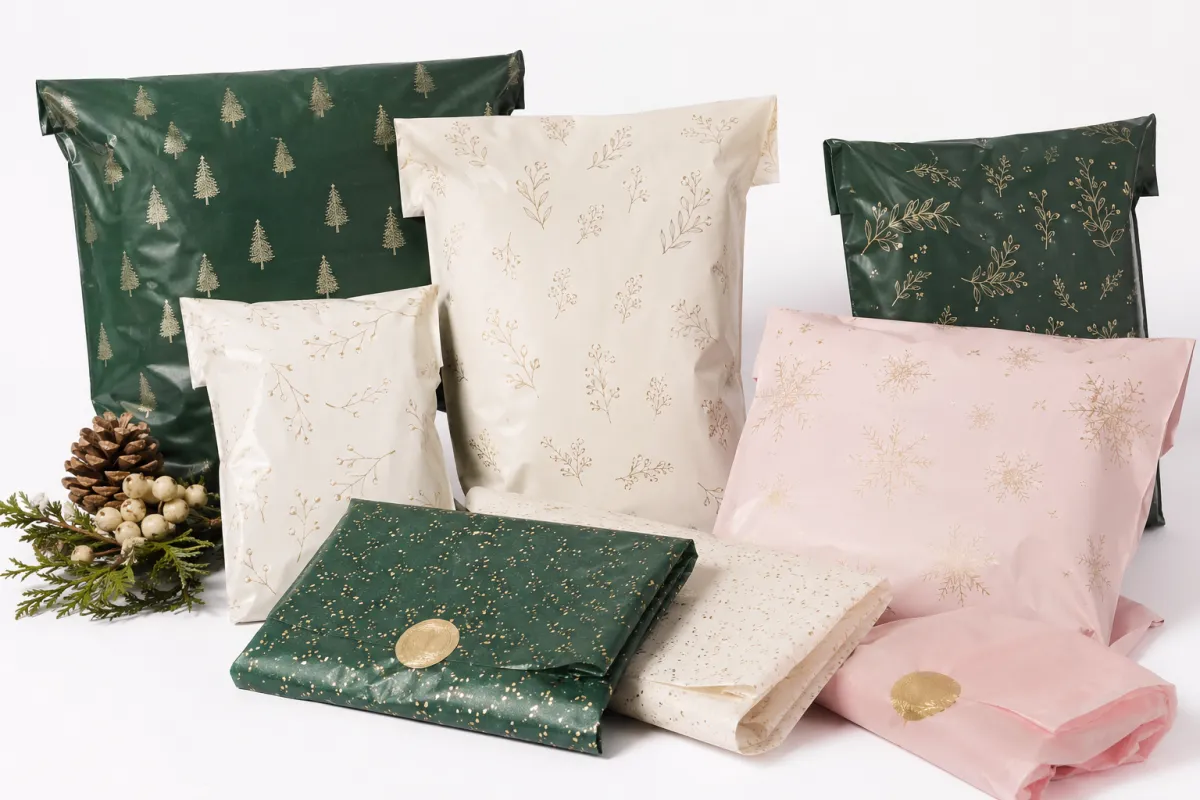
At a small fashion boutique in Charlotte, the team was using plain white mailers for every online order, and the owner said something I have heard in one form or another from Dallas to Portland: “The customer sees the bag before the blouse.” She was talking about a basic 10 by 13 inch apparel order, but the point held because holiday shipping bags for boutiques are often the first physical touchpoint between a brand and the person who paid for it. During November and December, that outer layer becomes part of the gift presentation, part of the brand story, and sometimes the first thing a customer comments on when they post the package on Instagram or send a photo to a friend.
In practical terms, holiday shipping bags for boutiques are lightweight mailers made for flat or flexible retail goods, usually in polyethylene film with an adhesive closure strip and enough opacity to keep the contents from showing through. They are commonly used for sweaters, scarves, leggings, small beauty kits, flat home goods, and accessories that already have some protection in their primary packaging. Compared with cartons, they are faster to pack, cheaper to store, and less expensive to ship for low-profile items because the parcel stays flatter. I have seen boutique teams fit an entire season’s supply on two shelving units instead of a pallet rack, which is a relief in a stockroom where every square foot matters and every floor lane seems to be occupied by something that arrived earlier than expected.
What makes them “holiday” is less about the palette and more about the message. A snowflake border, a deep evergreen backdrop, a metallic logo, or a scripted winter greeting can make holiday shipping bags for boutiques feel deliberate without turning them into cluttered wrapping paper. I usually advise buyers to choose one visual idea and execute it cleanly, because a bag that tries to be festive, elegant, and playful all at once often ends up looking like it could not make up its mind. Simple graphics also print more reliably, especially on 2.5 mil or 3 mil film where too much ink coverage can change the hand feel or make the surface feel crowded.
Holiday shipping bags for boutiques also matter because customers compare them to last year’s order, to a competitor’s unboxing video, and to the price they already paid for shipping. A repeat buyer may have a memory of a crisp matte mailer from a boutique in Nashville, and if this year’s bag arrives flimsy and oversized, the comparison happens instantly. That is why a thoughtful mailer can outperform tissue alone or a seasonal sticker on a generic bag. If the package creates a little moment of delight before the scissors come out, the brand has already earned a better emotional position, and that can matter as much as the item inside.
There is also a simple operational reason these bags are popular: they fit the packing workflow. Holiday shipping bags for boutiques work as transit packaging, which means they can move directly from the station to the carrier pickup with no extra assembly. Gift bags often need wrapping or a second container, and boxes require tape, void fill, and more table space. A mailer lets the packer move in a straight line: pick, fold, insert, seal, label, scan. That straight-line motion is worth a lot during a 6-week holiday window, especially when temporary staff are learning the process at the same time the order volume is rising.
The fit matters as much as the print. If holiday shipping bags for boutiques are too large, the contents shift and wrinkle, which can make a neatly packed sweater look tired before it leaves the store. If the bag is too small, the associate has to force the product inside, and that slows the line while stressing the adhesive closure. A good pack-out test uses the real folded garment, tissue, insert cards, and any sticker or promotion card that ships with the order. I prefer to test at least five live samples at the actual packing table in the same sequence the team will use during the rush, because a sample that looks perfect on a desk can behave very differently once a sweatshirt, a care card, and a folded return insert are all in the mix.
Holiday shipping bags for boutiques work especially well for apparel, flat gift items, soft accessories, and many beauty products that already arrive in their own protective cartons or trays. I would not use them for glass jars without cushioning, candles without padding, or ceramic items with corners that can puncture film. If the product bends and recovers, the mailer is usually a good fit. If it cracks, chips, or crushes, the right answer is almost always a box or a padded system. That sounds obvious, but every December someone tries to ship a hard product in a soft package and then acts surprised when physics keeps its job description.
One habit that pays off is to build the packing line around repeatable steps. I like a layout with product pick on the left, tissue and insert cards in the middle, bags and labels on the right, and a final scale check at the end. That setup helps holiday shipping bags for boutiques move with less friction because each motion has a place, each supply is reachable, and new hires can learn the rhythm in a single shift. When the station is intuitive, the process stays consistent even when three different associates are packing the same SKU on the same afternoon.
How Do Holiday Shipping Bags for Boutiques Work in the Packing Line?
The easiest way to understand holiday shipping bags for boutiques is to watch them move through a live packing station. A picker brings the order, the packer checks the SKU, tissue and inserts go in, the garment slides into the mailer, the release liner peels away, and the seal closes with a firm hand press or a quick roller pass. Then the label goes on, the parcel is weighed, and the carrier sees a light, flat package that is ready to move through the network. That sequence can take under 45 seconds once the table is set correctly, and I have timed it in warehouses where the clock mattered because the outbound wave reached 1,000 parcels before lunch.
I remember a warehouse in Ohio where the team packed holiday scarves, knit hats, and two-piece lounge sets for a regional boutique chain. When they switched from folding cartons to holiday shipping bags for boutiques, average pack time fell by 19 seconds per order, which might sound modest until you multiply it by 1,200 shipments over a three-day surge. That improvement came from fewer folds, fewer pieces of tape, and less motion between the work surface and the label printer. On a fully staffed floor, that kind of reduction usually means one less overtime hour per associate, which is the difference between a team that leaves on time and a team that is still staring at a growing pile of late orders at 8:15 p.m.
Holiday shipping bags for boutiques also hold up better than many people expect under normal transit handling. A good 2.5 mil or 3 mil film can resist dust, light moisture, and surface scuffing if the seal is properly engaged and the contents are not sharp-edged. The weak point is usually the adhesive strip or the seal area, not the film itself. If the adhesive is cheap or the heat seal is inconsistent, the bag can split at a conveyor edge or peel open in a sorting hub. That is why I always recommend a real handling test, not just a table sample, because a bag that survives a gentle pinch test may fail the minute it sees a sharp turn, a drop, or a rough load on a belt.
“We saved time, but we also stopped rebagging damaged returns,” one boutique manager told me after her team moved to holiday shipping bags for boutiques with a stronger adhesive strip and a 3 mil film that fit slim sweaters more cleanly.
Fit is the part buyers underestimate most often. If the bag is too large, the garment floats inside and wrinkles. If it is too small, the packer has to angle the product in, which slows the station and can weaken the seal. A proper fit test should use the exact folded size of the best-selling SKU, along with tissue, insert cards, and any promotional extras. I like to see the actual pack-out on the actual table because paper samples can flatter a bad choice for one minute, but a real cardigan or pair of jeans will tell the truth immediately. A bag that looks generous on a spec sheet can become stubborn once a 12 by 14 inch folded sweater is added.
Holiday shipping bags for boutiques work especially well for soft goods, apparel, flat gift items, and many beauty products that already have secondary protection. I would avoid them for candles without bubble wrap, glass without cushioning, or any item with a hard corner that can puncture the film during sortation. If the item can bend and recover, the mailer is usually the smartest option. If it needs structural protection, the box earns its keep. That distinction sounds simple, but the moment someone tries to ship a mug in a soft mailer, the whole idea of package protection becomes a lesson in why materials exist.
There is also a workflow benefit in standardizing the station. I usually like one lane for product pick, one lane for packing, and one lane for label application and scale check, especially during a holiday rush when temporary workers are present. Holiday shipping bags for boutiques reduce complexity because the packer does not need to fold carton flaps, run tape, or choose void fill. The result is faster training, less room for error, and fewer late-night questions about where the next sleeve of mailers disappeared to. On a floor that ships 300 to 600 orders in a shift, simplicity is not a luxury; it is the thing that keeps the line moving.
Choosing Holiday Shipping Bags for Boutiques: Materials and Finish
Poly mailer basics
Most holiday shipping bags for boutiques are made from low-density polyethylene or a co-extruded film that balances flexibility with tear resistance, and the core buying decisions are gauge, opacity, and seal quality. Gauge matters because a thinner film can save a fraction of a cent per unit, but it can also stretch more and feel less substantial in the hand. I usually look at 2.5 mil for light apparel and 3 mil for heavier knits, garments with seams that catch, or brands that want a firmer feel on the table. For a 5,000-piece run, that difference in gauge can be the difference between a bag that feels like a commodity and one that feels like it was chosen on purpose.
Opacity matters more than many buyers expect. A thin white film can show dark product outlines, and once the customer sees the silhouette of the contents, the package starts to feel less polished. Holiday shipping bags for boutiques should hide the product cleanly, especially when the order is a gift and the sender expects the outer package to look neat. Seal quality is just as important because a bag that peels open during carrier handling costs more in replacements and goodwill than it ever saved in material cost. I have seen one weak adhesive strip wipe out the advantage of a whole freight savings plan.
Finish choices that fit the brand
Clear, white, matte, metallic, and custom-printed finishes each create a different response, and the right choice depends on the product, the visual language, and the season’s inventory plan. Clear mailers can work for niche fashion pieces when the garment itself is part of the presentation, but most boutiques prefer opaque bags for a cleaner and more private look. White bags feel bright and easy to brand. Matte finishes feel more premium and less plastic-heavy. Metallic holiday designs can be strong for short campaigns, but I only recommend them when the artwork is restrained, because too much shine can make the bag feel loud instead of elegant. A little shimmer can look festive; too much starts to resemble a craft project that escaped supervision.
Holiday shipping bags for boutiques with custom print usually look best when the logo has room to breathe. A small mark in the corner, a repeating pattern on the back, or a seasonal message near the seal zone often looks more polished than a full-coverage graphic that fights with the merchandise brand. I have seen boutique owners try to fit six holiday ideas onto one mailer, then wonder why the result feels crowded in a way that no one can quite explain. Simpler print usually photographs better, especially when customers post the package on social media, and it ages better if leftover stock remains in January. A design that still looks good after December 31 is a design that did not overcommit to the calendar.
Size, fit, and what belongs in the bag
Size selection should start with the folded product dimensions, not the fantasy version that ignores the tissue sheet, insert card, and return information slip. Measure the folded tee, blouse, sweater, or scarf, add the extra paper and sticker, and then leave enough room for a straight seal without forcing the edge. If a folded sweater measures 10 by 13 inches after packing, the mailer should still allow a clean seal without buckling the adhesive area. That small bit of math affects pack speed, label placement, and dimensional weight, which is why I always ask for the actual measurements instead of a rough estimate.
Holiday shipping bags for boutiques are usually the strongest choice for lightweight, flexible products that do not need rigid structure. If a boutique sells apparel, soft accessories, flat home goods, or beauty kits that already arrive in cartons, the mailer can do a lot of work with very little overhead. If you want to compare formats across a broader assortment, I suggest browsing Custom Packaging Products and deciding whether an order deserves a mailer, a carton, or a mixed pack-out strategy. That kind of split is often the smartest operational choice, because not every SKU deserves the same package just to keep the buying calendar tidy.
For buyers who care about sustainability, recycled content and compostable alternatives deserve a real review, but they should be judged on performance, not on the claim printed on the carton. A recycled-content mailer still needs a strong seal and enough tear resistance to survive parcel handling. A compostable option still has to protect the garment from moisture during a 4-day or 6-day shipping lane. I always ask suppliers for actual material specs and, when inserts or paper components are involved, documentation from groups like the Forest Stewardship Council. For a boutique in Seattle or Philadelphia, the material story matters, but a bag that sounds eco-friendly and fails on the first carrier route helps nobody.
My honest view is that the best material choice is the one that matches the product, the brand, and the shipping lane. If a boutique ships mostly regional orders within 300 miles, a slightly heavier film may be a smart trade because the network is short and the package sees fewer handoffs. If the orders move nationwide and every ounce matters, a lighter structure may be the better fit. Holiday shipping bags for boutiques are not one-size-fits-all, and any supplier who says otherwise is probably simplifying to make the quote easier to sell. Real packaging work is messier than that, and the dock crew will remind you of it whether you ask or not.
Holiday Shipping Bags for Boutiques: Cost, Pricing, and Timeline
Pricing for holiday shipping bags for boutiques usually breaks into four parts: material, print setup, quantity, and freight. A plain white 12 by 15.5 inch mailer at 5,000 pieces might land around $0.15 to $0.18 per unit before freight, depending on whether the film is 2.5 mil or 3 mil and whether the closure is standard peel-and-seal or a stronger wide-strip adhesive. A recycled-content version of similar size may sit closer to $0.20 to $0.24. Once you move into matte custom print or metallic seasonal artwork, the unit price often rises into the $0.28 to $0.42 range depending on ink count, substrate, and finish. I have watched buyers get fixated on the unit price and then forget the rest of the invoice, only to discover that freight has a way of arriving like an uninvited cousin who brought a bill.
The table below is a cleaner way to compare holiday shipping bags for boutiques by feature instead of by sticker price alone.
| Option | Best Use | Estimated Unit Price at 5,000 | Tradeoff |
|---|---|---|---|
| Standard white poly mailer, 2.5 mil | Basic apparel and flat accessories | $0.15 to $0.18 | Lowest cost, least seasonal impact |
| Recycled-content gray or white mailer, 2.5 to 3 mil | Brands emphasizing recycled shipping materials | $0.20 to $0.24 | Better story, slightly higher material cost |
| Matte custom-printed mailer, 2.5 to 3 mil | Premium holiday presentation and repeat branding | $0.28 to $0.36 | Print setup and proofing add time |
| Metallic seasonal mailer, 3 mil | Short holiday promotions and gift-heavy campaigns | $0.32 to $0.42 | Stronger visual pop, more inventory risk if overordered |
What people miss is landed cost. A bag that looks inexpensive on a quote can become much more expensive once freight, pallet charges, rush fees, and receiving delays are added in. I have watched a buyer celebrate a $0.03 per unit savings and then lose the advantage on a $310 rush freight invoice because the shipment had to move across the country in three days from Ontario, California to Atlanta. That is why holiday shipping bags for boutiques should always be priced as delivered inventory rather than as an isolated factory number. If the math ignores the truck, the dock, and the holiday congestion in receiving, the quote is decorative rather than useful.
Lead time matters just as much as unit cost. A simple unprinted bag can move quickly, but custom print adds proofing, plate or cylinder setup, production, and transit, and each stage has its own clock. A realistic timeline often looks like 2 to 4 business days for artwork and proof review, 10 to 15 business days for production after approval, and 3 to 7 business days for freight depending on origin and destination. If the bags are crossing regions or moving through peak freight windows in November, I would build an extra week into the schedule without hesitation. I know that sounds cautious, but I have watched enough holiday schedules collapse to know that cautious is cheaper than heroic.
From a plant-floor perspective, the bottlenecks usually show up in three places: the designer waiting for final artwork, the converter adjusting the seal area, and the warehouse receiving dock that is already full of other seasonal goods. A buyer who plans only the production run and ignores receiving usually ends up with pallets parked in a hallway because the floor space was not staged in time. Holiday shipping bags for boutiques should be ordered with the whole chain in mind, from proof sign-off to carton labels to dock availability. The factory matters, but so does the part of the building where the freight actually lands.
For teams that want to validate package performance, I like to reference ISTA methods because controlled drop and vibration testing gives a much better signal than a guess from the sample room. If the mailer has to survive parcel handling, it is worth seeing how it behaves under movement, repeated vibration, and corner drops, not just under a hand squeeze. That matters for package protection, especially if a boutique sells nationwide through multiple carriers or long shipping zones. A sample that looks attractive in the conference room is nice; a sample that survives the truck lane is better.
Step-by-Step: Ordering Holiday Shipping Bags for Boutiques
The cleanest way to order holiday shipping bags for boutiques is to work backward from the first ship date and then hold every other decision to that calendar. I usually start with the shipping calendar, then the forecast, then product fit, then the print file, and finally the replenishment plan. That order cuts down on panic because every choice is tied to actual parcel volume instead of a vague idea of “holiday traffic.” Panic ordering is its own little industry, and I would rather not participate unless the building is literally on fire.
- Audit the last season. Pull order counts by SKU, bundle type, and average packed size so you can see which products actually drove volume, not just which ones looked busy in a meeting.
- Set a realistic forecast. Add the expected holiday lift, but do not guess wildly; a 12 percent increase is very different from a 40 percent increase in shipping materials.
- Choose the bag size. Test the best-selling SKUs first, because a mailer that works for tees may fail on chunky sweaters or boxed accessories that need a little extra room.
- Approve the artwork. Confirm logo placement, seal-zone restrictions, and color matches before production starts, especially if the job is running through a printer in Dongguan or Ningbo.
- Build the inventory buffer. Keep a safety stock cushion so a late promotion, flash sale, or freight delay does not empty the pallet when the season is busiest.
I learned the value of the safety buffer during a supplier meeting in Shenzhen where a boutique buyer wanted a glossy seasonal run with a narrow artwork window and a delivery date that left almost no room for error. The print was fine, but the port schedule moved by a week, then another week, and the client had to scramble for a backup plan. The buyer later told me the bags themselves were good; the failure was in the shipping plan, not the product. That is a classic holiday shipping bags for boutiques mistake, and it usually costs more than the packaging does. I still remember the look on her face when the “quick” shipment turned into a very expensive waiting game at the dock.
Sample testing should happen before a full run gets approved. Load the actual garment, fold it the way the packers will fold it, include the tissue, add the insert card, and seal five to ten samples on the real station. Then check the closure, the print alignment, the label placement, and the way the bag behaves when it is weighed on the scale. I like to have at least one person from operations and one person from merchandising review the result because the pack floor and the brand desk usually see different problems. One cares about speed, the other cares about how it photographs, and both are right in their own way.
If you are buying holiday shipping bags for boutiques through a broader packaging program, it helps to standardize the process so the team does not invent a new pack-out method for every SKU. A consistent bag size, a fixed insert card, and a standard label position can cut confusion and reduce training time for temporary staff hired for the season. It also means the holiday crew does not spend the first hour asking where the bags are, because the answer should already be obvious at the table and on the shelf.
Finally, set the reorder point before launch. I prefer a trigger around 30 to 40 percent remaining stock, because the biggest mistake is waiting until the pallet looks nearly empty. Once holiday traffic gets busy, that last quarter disappears faster than people expect. Holiday shipping bags for boutiques should be treated like any other critical consumable: if the line stops, the whole business feels it. Nobody wants to explain to the owner that the season bottleneck was a stack of mailers sitting in the wrong corner while orders piled up at the printer.
Common Mistakes With Holiday Shipping Bags for Boutiques
The first mistake is buying on appearance alone. I have seen buyers fall in love with a glittery sample from a supplier in Los Angeles, only to discover that the seal was weak and the film stretched badly on the packing table. Holiday shipping bags for boutiques need to look good, yes, but they also have to survive carrier handling, hold a clean closure, and fit the product without drama. A pretty sample that fails on the line is not a win; it is an expensive mood board that never leaves the conference room.
The second mistake is forgetting dimensional weight. A larger-than-needed bag can push a parcel into a higher shipping bracket even if the product itself is light. That is easy to miss when the team is focused on holiday presentation and not on the carrier table. If a flat blouse fits in a smaller mailer with a better seal, the boutique may save on postage and still get the presentation it wants. That is a real payoff for ecommerce shipping programs that move thousands of units, especially when a 2-ounce difference changes the bill more than anyone expected.
The third mistake is underestimating lead time. Holiday shipping bags for boutiques often need proof approval, color correction, production, and transit, and each stage can absorb several days. A boutique that plans for an order to arrive “in time” without a cushion is simply hoping the freight lane behaves itself. I have watched more than one retailer end up with a fallback plain bag that clashed with the rest of the holiday campaign because the custom run landed late. Nothing says “we planned ahead” like a premium season held together by an emergency generic mailer, and yes, that has rescued more than one December.
The fourth mistake is skipping a fit test. A bag that looks correct on a screen can behave badly with actual tissue, inserts, and folded sleeves. Sometimes the product barely fits, and the packer has to force it in at an angle, which creates wrinkles, slows the station, and can weaken the seal. A 15-minute sample pack-out can save a 15-hour headache later. I would rather look fussy during sampling than spend Friday answering questions about torn corners, crooked labels, and why the return card is trapped at the seam.
The fifth mistake is ordering too few. Once holiday shipping bags for boutiques become part of the customer experience, running out mid-season creates a visible brand inconsistency. The backup bag is often plain, oversized, or printed with an earlier seasonal design, and the customer notices the mismatch immediately. That is why I like a small overflow plan, even if it means a little extra inventory on the shelf. Extra cartons of mailers are not glamorous, but neither is explaining why the package suddenly looks like it came from a different company on a Saturday morning.
There is also a trust issue that many suppliers gloss over. If a vendor cannot tell you the material gauge, the adhesive type, or the practical difference between a film claim and an actual transit test, I would slow the order down and ask for a written spec. Good holiday shipping bags for boutiques should come with specifics, not just glossy language and seasonal stock photos. Ask for samples, ask for the film thickness, ask where the bags were produced, and ask how they were tested. You will learn a lot from the answers, especially if the factory is in Guangdong, the sample team is in Shanghai, and the freight is leaving through Long Beach.
Expert Tips to Launch Holiday Shipping Bags for Boutiques Smoothly
Keep the artwork seasonal, but not so specific that leftover bags feel outdated after a few weeks. A tasteful winter pattern, a gold accent, or a simple holiday message can stay useful longer than a date-sensitive slogan. That matters because overrun inventory is expensive to discard, and holiday shipping bags for boutiques should retain value if the launch shifts or the sale extends into January. I would rather have a design that still feels appropriate on January 14 than a clever line that expires before the wrapping paper does.
Use one packing checklist across the entire team. I like a printed sheet that spells out tissue placement, insert card count, bag size, label zone, and seal check with a simple yes-or-no box beside each item. It sounds basic, but consistency is what keeps order fulfillment stable when temporary staff show up for the surge and full-time associates are already moving fast. A one-page checklist can prevent the tiny variations that lead to crooked labels, missed inserts, and uneven presentation. It also keeps everyone from “doing it their own way,” which is a phrase that tends to make operations people age visibly.
Pre-stage the replenishment cartons near the line, not in the far warehouse corner. If a packing station uses holiday shipping bags for boutiques heavily, a two-carton buffer at the table can save several walks per hour and keep the line from breaking rhythm. That sounds small until the day the queue doubles and every extra trip costs momentum. On a busy floor, distance is labor. And if the bags are just out of reach, they somehow become mythical objects that nobody can find without three coworkers, a clipboard, and a mild argument.
Watch the first shipping week closely. I would track damage rates, average pack time, and any customer comments that mention packaging by name. If people say the bag feels too thin, too plain, or too tight, that feedback is more useful than a guess from the buying desk. Early data lets you correct the process before the biggest surge lands. I have a lot of respect for the first week because it tells the truth quickly, which is more than I can say for a lot of holiday planning meetings that drag on for 90 minutes and end with no decision.
When a boutique needs to mix formats, I often suggest a simple hierarchy: mailers for soft goods, cartons for rigid goods, and padded options for anything fragile. Holiday shipping bags for boutiques should be one tool in the kit, not the only tool in the room. If you need help building a mixed packaging plan, a quick look through Custom Poly Mailers alongside other formats can show where the bag fits best and where it does not. That kind of comparison saves a lot of awkward repacking later, especially when the holiday assortment includes both sweaters and breakable gift sets.
One last point from experience: talk to the printer before you finalize the season art. If you want a deep red on white film, ask how the ink behaves on that substrate and whether the seal area needs a blank margin of at least 0.5 inch. I have seen a nice design run right up to the closure and then disappear under the fold, which means the customer never saw the best part of the package. That is the sort of detail a seasoned converter catches early in a plant meeting in Shenzhen or Xiamen, and it is exactly why holiday shipping bags for boutiques reward planning instead of guesswork. The print can be gorgeous, but if the closure hides the whole point, the design has basically argued with itself and lost.
My practical advice is simple: measure demand, request samples, confirm the print window, and lock your safety stock before the rush starts. If you do those four things, holiday shipping bags for boutiques become a quiet advantage instead of a seasonal fire drill. Quiet advantages are my favorite kind because they do their job, stay out of the spotlight, and let the boutique look sharper than everyone else on the carrier route while keeping the packing table calm and the freight schedule under control.
What size holiday shipping bags should boutiques choose for apparel?
Measure the folded product plus any tissue, insert cards, or stickers before choosing a size, because a 9 by 12 inch tee package behaves very differently from a 12 by 15 inch sweater package. Leave just enough room for a clean seal without extra empty space that shifts in transit, and test the best-selling SKUs first because a bag that works for tees may be too tight for knitwear or bundled sets. I always like to pack the real item rather than a mock-up, because mock-ups have a polite way of lying about friction and fit.
Are holiday shipping bags for boutiques strong enough for fragile items?
They work well for lightweight, non-breakable goods like apparel, scarves, and flat accessories, especially when the film is 2.5 mil or 3 mil and the seal is strong. For fragile pieces, add inner protection such as bubble wrap, a padded insert, or a box inside the mailer, because holiday shipping bags for boutiques should not be asked to do the job of rigid package protection. If the item can snap, chip, or crush, give it a real shelter instead of hoping the exterior film will act like a carton.
How far ahead should boutiques order holiday shipping bags?
Plan to sample and approve at least 6 to 8 weeks before the first shipping date, and add more time if the bags are custom printed or produced overseas in places like Dongguan, Shenzhen, or Ho Chi Minh City. Build extra time if the artwork needs revisions, because proof review, color correction, and freight can each absorb several business days. I like a little padding in the schedule, because carrier networks rarely respect a hopeful calendar and the last thing a holiday team needs is a rushed substitute bag from a nearby stock room.
What drives holiday shipping bag pricing the most?
Quantity, bag size, film gauge, and print complexity usually have the biggest impact on unit cost. Freight, rush charges, and special finishes can change the total more than the base material price, so the best comparison is landed cost per usable bag, not just the quote from the printer. For example, a plain 5,000-piece white mailer may land around $0.15 to $0.18 per unit before freight, while a matte custom seasonal run can move into the $0.28 to $0.36 range once setup and print are added. A low quote that blooms into a high invoice is just packaging theater.
How can boutiques keep holiday shipping bags from running out during peak season?
Set a reorder trigger when 30 to 40 percent of inventory remains, not when the pallet is nearly empty. Keep a short-run backup design or unprinted fallback bag in case demand spikes faster than expected, and review daily pack counts during the busiest weeks so purchasing can react before stock gets tight. That buffer can save a lot of embarrassed phone calls, a lot of frantic warehouse searching, and a lot of late-night questions about where the next sleeve of mailers went.
Holiday shipping bags for boutiques work best when the brand treats them like a real operating decision, not a seasonal afterthought. If you Choose the Right size, spec, print timing, and backup plan, the bags support ecommerce shipping, protect the product, and make the holiday order feel like it was packed by a team that knows exactly what it is doing from the first carton to the final carrier scan.

