Buyer Fit Snapshot
| Best fit | Custom Shipping Labels for Your Brand projects where brand print, material claims, artwork control, MOQ, and repeat-order consistency need to be specified before quoting. |
|---|---|
| Quote inputs | Share finished size, material target, print colors, finish, packing count, annual reorder estimate, ship-to region, and any compliance wording. |
| Proofing check | Approve dieline scale, logo placement, barcode or warning zones, color tolerance, closure strength, and carton packing before bulk production. |
| Main risk | Vague material claims, crowded artwork, missing packing details, or unclear freight terms can make a low unit price expensive after revisions. |
Fast answer: Custom Shipping Labels for Your Brand: Material, Adhesive, Artwork, and MOQ should be specified like a repeatable production item. The safest quote records material, print method, finish, artwork proof, packing count, and reorder notes in one written spec.
Production checks before approval
Compare the actual filled-product size with the drawing, then confirm tolerance on folds, seals, hang holes, label areas, and retail display edges. Reserve space for logos, QR codes, warning copy, and material claims before decorative graphics fill the panel.
Quote comparison points
Review material grade, print process, finish, sampling route, tooling charges, carton quantity, and freight assumptions side by side. A quote is only useful when the supplier can repeat the same color, closure quality, and packing count on the next order.
The first time I watched how to choose Custom Shipping Labels go wrong, I was standing beside a cold trailer at a grocery distributor in Columbus, Ohio. Labels were curling off recycled corrugate before pallet three even cleared the dock. The cartons looked fine from ten feet away, but the scan gun kept flashing red, and that one small failure turned into about 15 minutes of rework per pallet on a night shift that already had 1,800 cases to move. I still remember the supervisor rubbing a label between his fingers and saying, "If it cannot survive the dock, it cannot survive the brand." He was not trying to sound poetic. He was trying to keep a line moving at 4:30 a.m.
That is the real job here: how to choose Custom Shipping Labels that fit your package, your warehouse, your climate, and your customer's first touchpoint. A custom shipping label is not just a sticker with a logo on it; it is a working part built for a specific surface, a specific workflow, and a specific shipping environment. If you sell in ecommerce shipping, retail packaging, or subscription boxes, the wrong choice can slow order fulfillment, jam scanners, and make your brand look careless before the customer even opens the carton. I have seen all three happen in the same week in a facility near Nashville, Tennessee, which was impressive in the worst possible way.
People usually buy labels the way they buy office supplies, which is exactly how they end up paying for mistakes twice. One client in a Midwest fulfillment center moved from a plain paper label to a glossy version because it looked cleaner on a mockup, then discovered the gloss scuffed under pallet wrap and dulled the barcode in two days. Another buyer told me she wanted "the nicest one," but after we tested three samples on dusty recycled board, the plain matte stock outperformed the premium finish by a wide margin. The matte sample was not glamorous, but it scanned at 99.6% on the first pass, while the glossy one missed enough to create a small but annoying backlog. The expensive option often wins the pitch deck and loses the dock.
The promise is simple. We will walk through how to choose custom shipping labels based on the details that actually matter on a packing line, including material, adhesive, print method, cost, and turnaround time. I will keep it practical and specific, the way I would explain it to a smart operator during a plant walk in Dongguan or a procurement manager in Manchester, because the best label is the one that stays put, scans cleanly, and still looks sharp when it reaches the doorstep. If a label can do all three, I trust it. If it can only do one, I start asking annoying questions, which is a trait that has probably saved me a few mistakes and made me unwelcome in at least two meeting rooms.
How to Choose Custom Shipping Labels: A Factory-Floor Reality Check
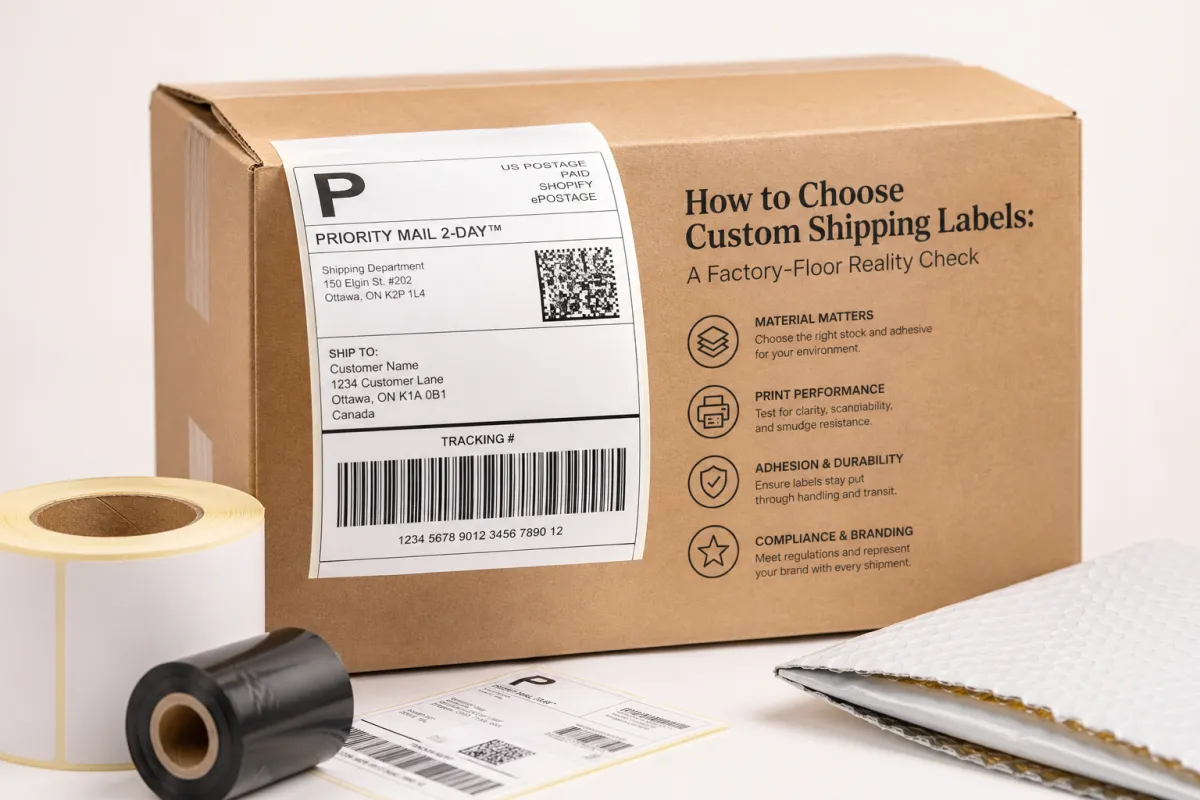
How to choose custom shipping labels starts with one uncomfortable truth: a label is only as good as the surface it touches. I learned that the hard way on a line packing frozen seafood into corrugated cases in Qingdao, where condensation turned a standard paper stock into a weak handshake. The label did not fail because the artwork was wrong; it failed because the adhesive was designed for a dry office, not a 34-degree dock with frost on the stretch wrap. I still remember peeling one off with two fingers and thinking, with real irritation, that the label had lasted about as long as a paper napkin in a seafood cooler.
That is why I always define shipping labels in plain language before I look at finish or color. A branded shipping label is a working component of product packaging and package branding, built to survive carton fiber, rough handling, humidity, and the kind of abrasion that happens when a case rubs against another case for six hours in a trailer from Memphis to Phoenix. If you are buying labels for Custom Labels & Tags, the real question is not "What looks nice?" It is "What survives the actual trip?" The first question belongs in a mood board. The second one belongs in a warehouse, ideally beside a pallet jack and a temperature log.
Most people get one thing backward: they treat the label like decoration instead of equipment. I have sat in supplier meetings where a buyer spent 20 minutes debating a soft-touch finish, then five seconds on adhesive performance. That ordering is backward. A shipping label that peels at the corner, smudges under condensation, or loses barcode contrast under a thermal printer is not a branding asset; it is a small operational problem that gets bigger with every carton. In one plant outside Atlanta, a 2% edge-lift rate became 400 manual corrections across a Friday shift. Small, yes. Harmless, no.
The best way to approach how to choose custom shipping labels is to picture the whole path from pallet wrap to porch delivery. Think about the box material, the carrier lane, the warehouse temperature, and whether the customer will see the label as part of the unboxing moment. If the label has to support branded packaging, survive scan points, and stay legible after friction and handling, then every choice needs to be tied back to that journey. I like to ask one blunt question: if the box gets shoved, bumped, chilled, and scanned six times, does the label still behave? For a label on a 32-pound carton heading through a UPS hub in Louisville, that question is not theoretical.
One of my favorite sanity checks is to ask, "What happens after the first 15 seconds?" A label that looks strong in a proof but lifts after a cold soak is a bad label. A label that prints beautifully but flakes when the box bends is a bad label. The factories I respect most, including a converter I visited outside Shenzhen and another shop in Ho Chi Minh City, test for real use first and aesthetic polish second. That mindset is the foundation of how to choose custom shipping labels without guessing. It also saves people from the ceremonial panic that starts when a whole pallet needs relabeling because someone trusted a mockup like it was scripture.
How Do You Choose Custom Shipping Labels for Your Operation?
If you need the short answer to how to choose custom shipping labels, start with the package, not the proof. Match the adhesive to the carton surface, the material to the shipping environment, and the print method to the data you need to carry. A label that works for dry ecommerce shipping in a climate-controlled warehouse can fail fast in cold-chain logistics, on textured recycled board, or in a humid receiving bay. That is why I always test the label on the actual box, under the actual handling conditions, before I approve a full run.
A reliable decision usually comes down to four checks: does it stick, does it scan, does it survive transit, and does it fit your workflow? If all four answers are yes, you are close. If one answer is no, how to choose custom shipping labels becomes a fix-it exercise instead of a buying decision. That is the difference between a label that supports fulfillment and a label that slows it down. The whole point is to reduce friction, not add more of it.
How Custom Shipping Labels Work From Artwork to Delivery
How to choose custom shipping labels gets easier once you understand the production flow, because the way a label is made has a direct impact on what it can do. The process usually starts with design file review, where a prepress team checks trim, bleed, barcode quiet zones, and whether your logo will still read clearly at 2.5 inches wide. After that comes proofing, color checks, material selection, printing, finishing, slitting or die-cutting, and packing into rolls or sheets. A straightforward digital run in Dongguan can move from proof approval to shipment in 12 to 15 business days, while a specialty adhesive order in Guadalajara may stretch to 18 business days if a second proof is needed. It sounds tidy on paper. In practice, it can feel like a relay race where one dropped baton turns into three emails and a tense phone call.
The print method matters more than many buyers expect. Digital printing works well for shorter runs, multiple SKUs, and fast design changes, especially when you need a few hundred to a few thousand pieces with different copy blocks or seasonal text. Flexographic printing makes sense for larger volumes, exact spot colors, and repeat runs where plate setup is worth the upfront effort. Thermal transfer printing shines when you need variable data, serialized tracking, or a barcode that has to stay crisp through a warehouse shift. I am biased toward whatever method keeps the workflow honest, because pretty print means very little if the label does not survive a conveyor belt and a tired operator at 4:45 p.m. on a Friday.
I remember a client with three distribution nodes in Dallas, Columbus, and Savannah who wanted every location to use the same label size but different routing codes. We settled on a thermal transfer base with printed branding in a controlled zone, and that solved a problem that had been costing them about 40 minutes per dock each day. That kind of practical compromise is exactly why how to choose custom shipping labels should start with the workflow, not the artwork. The workflow is the boss. The artwork is the guest.
Shape and format matter too. A 4 x 6 label on a 3-inch core behaves differently from a 2 x 4 sheet label applied by hand. Unwind direction determines whether the label peels cleanly in an applicator, and core size affects whether the roll fits your machine or forces a changeout every 20 minutes. Even the smallest details, like liner release and corner radius, can affect the pace of order fulfillment on the line. I have seen an otherwise solid label design become a daily irritation because the roll would not unwind cleanly on a unit built in Nashville. Nothing sharpens a warehouse team's vocabulary like equipment that keeps asking for attention.
Lead time follows the same logic. A simple stock label can move fast after proof approval, while a project with specialty adhesive, matte varnish, or multiple approval rounds often adds several days. If you are comparing label options for Custom Packaging Products, I would build in extra time for sample review and real-world testing rather than trusting a pretty digital proof. That habit has saved more than one launch from a very avoidable delay. Pretty proofs do not peel. Real labels do.
- Digital is strong for short runs, variable data, and frequent art changes.
- Flexographic is efficient for large quantities and consistent repeats.
- Thermal transfer printing is ideal for barcodes, routing labels, and serialized shipping data.
- Machine format matters: core size, unwind direction, and roll diameter can make or break application speed.
- Timeline often depends on proof approval, testing, and finishing, not just print time.
For brands that care about material sourcing, I also like to check paper options against FSC standards, especially when the label stock sits inside a larger sustainability story. If your outer packaging includes certified board or recycled content, keeping the label aligned with that approach helps the whole pack feel intentional. A 350gsm C1S artboard used for a promotional seal in Milan should not sit beside a recycled mailer and pretend to be the same thing; the texture difference is obvious in hand. The FSC site at fsc.org is a useful reference point for paper claims, and I keep it in my notes when I am aligning packaging design with sourcing decisions. Packaging decisions are a little like a dinner table: one mismatched piece can make the whole thing look accidental.
Key Factors That Shape the Right Label Choice
How to choose custom shipping labels becomes much clearer once you break the decision into five field-tested factors: surface, environment, durability, compliance, and application speed. The surface might be plain corrugate, a gloss-coated mailer, a recycled kraft carton with open fibers, or a poly bag that flexes every time someone picks it up. Each of those surfaces behaves differently, and the adhesive needs to match the real surface, not the sample sheet sitting on a sales desk in New Jersey. I cannot say this enough: the box you ship is the box you test.
Material choice usually falls into four practical buckets. Paper is a good fit for dry shipping lanes and budget-conscious programs where the label only needs to survive a short trip. BOPP is a smart step up for moisture resistance, rubbing, and a cleaner look on premium retail packaging. Polyester is the tougher option for abrasion, long dwell times, or labels that need to remain readable after rough handling. Removable stock helps when the label has to come off cleanly, but I would test it carefully because removable adhesives can behave very differently on textured cardboard versus smooth film. A label that promises easy removal and then leaves behind a sticky ghost is not a gift; it is a cleanup assignment that steals five minutes from the next order.
Adhesive selection is where a lot of projects win or lose. A permanent adhesive is the default for most shipping work, yet even that category has nuance: a permanent formula for a dry carton is not the same as a freezer-grade adhesive for cold-chain parcels. I have seen a buyer save $0.01 per label by moving to a lighter adhesive, only to lose that saving ten times over when a humid week in Miami caused edge lift and manual rework. High-tack formulas, freezer-grade options, and removable adhesives all have a place, but the job is to match the glue to the carton texture, dust level, and temperature swing. In plain English: the adhesive needs to be less dramatic than the package is.
Compliance and data clarity matter just as much as appearance. If the label carries a barcode, scan contrast has to stay clean under warehouse lighting and during carrier handling. If it includes a return address, tracking number, or carrier routing panel, that information needs space, structure, and enough quiet zone around it to keep scanners happy. I also check whether the label needs sequential numbering or variable data, because those requirements change the print method and can affect both cost and lead time. In some operations, the barcode is not a detail. It is the entire point, especially in facilities that process 8,000 to 12,000 parcels per day.
There is also a human factor that gets overlooked. The easiest label to apply is often the best label to buy, even if it is not the prettiest one in the sample stack. A roll that feeds smoothly, peels cleanly, and lands straight on the box can save real labor across a shift. If you are also planning Custom Poly Mailers or Custom Shipping Boxes, I like to think about the label as one piece of a larger retail packaging system, not an isolated purchase. The system either works together or it does not; there is very little mystery there, even if people love to pretend otherwise.
For brands that want an outside benchmark, I often point teams to the handling and transit discipline discussed by ISTA. Their testing approach is useful because it reminds you that packaging is supposed to survive vibration, compression, and drops, not simply look good in a mockup. That perspective keeps how to choose custom shipping labels rooted in real shipping abuse, where the pallet jack and the truck floor have the final say. A label does not get to negotiate with physics, and a 48-inch drop from a conveyor hardly cares how nice your logo looks.
| Label Option | Best Use | Typical Cost at 5,000 Pieces | What I Tell Buyers |
|---|---|---|---|
| Paper shipping label | Dry cartons, short transit, budget programs | $0.06-$0.09 per unit | Good for standard ecommerce shipping, but test it on dusty board before you commit. |
| BOPP label | Moisture, scuffing, premium branding | $0.11-$0.15 per unit | A strong middle ground for branded packaging that needs better resistance; $0.15 per unit at 5,000 pieces is common for matte BOPP with clean black print. |
| Polyester label | Abrasion, long dwell time, harsher handling | $0.15-$0.22 per unit | Use it when performance matters more than shaving pennies off unit cost. |
| Removable stock | Temporary applications, returnable containers, internal routing | $0.08-$0.14 per unit | Test adhesion and removability on the exact box stock, because texture changes everything. |
How to Choose Custom Shipping Labels for Cost and Pricing
How to choose custom shipping labels wisely means looking at price the way a plant manager looks at downtime: as a total system cost, not just a line item. The unit quote is only one piece. Material choice, adhesive type, print coverage, label size, quantity, finishing, and whether the label has a custom shape all affect the final number. A 2 x 4 white paper label with black print is not priced the same as a flood-coated BOPP label with a custom die cut and a matte finish, especially if the job is produced in Ningbo versus a smaller inland plant with fewer presses. And if someone tells you otherwise, they are probably trying to make the spreadsheet look prettier than the production floor.
I have sat through enough supplier negotiations to know where the hidden costs usually hide. Some methods add plate charges. Others add setup fees for color matching or special registration. Rush orders can add freight premiums that wipe out the savings from a lower unit price, and a tight approval cycle can push a job into the next press window. If you are comparing quotes for how to choose custom shipping labels, ask for the full landed cost, not just the piece price. The piece price is a breadcrumb. The landed cost is the whole meal, and it includes the truck from the factory gate to your receiving dock.
Quantity changes the equation in a big way. Larger runs usually lower the unit cost because setup work gets spread across more labels, while a small test run is useful when the adhesive or stock has not been proven in your shipping lanes. I often recommend a pilot order of 500 to 1,000 pieces before committing to 10,000, especially if the product will travel through hot trucks, cold storage, or humid receiving areas. A sample run costs less than a warehouse re-labeling project. I have watched brands save pennies and then spend dollars cleaning up the mess; the math is not subtle, and it usually shows up in labor hours rather than invoices.
There is also the issue of total cost of ownership. A label that costs $0.02 less but causes 3% mis-scans is not a bargain. A finish that looks premium but slows hand application by three seconds per box can add real labor by the end of a shift. In factory terms, the cheapest quote is not the cheapest outcome if it causes rework, customer complaints, or a second print run. That is why how to choose custom shipping labels should always include testing, not just sourcing. The cheapest label is the one you never have to touch twice.
If you are budgeting a broader packaging program, it helps to compare labels with the rest of the packaging stack. A well-chosen label can complement Custom Printed Boxes, a branded mailer, or even a simple kraft carton without adding much cost. I have seen brands spend heavily on box art and then under-spec the label, which creates a mismatch right at the carrier scan point. The whole system should feel coordinated, even if the budget is spread across several items. I care about that more than most people expect, probably because I have spent too many years looking at shipments that seemed to disagree with themselves.
One practical rule I give clients: if the quote seems unusually low, ask what was left out. It might be a lighter adhesive, a thinner face stock, fewer color passes, or a longer lead time that was not obvious at first glance. A thorough quote should explain size, stock, adhesive, print method, quantity, artwork complexity, and freight assumptions in plain language. That makes how to choose custom shipping labels much easier because you are comparing real options, not vague promises. Vague promises are cheap right up until they are not, especially if the factory is 1,200 miles away and the reprint window is only two days wide.
Step-by-Step: How to Choose Custom Shipping Labels
How to choose custom shipping labels becomes manageable once you put the decision into a repeatable sequence. I start with a package audit. What is the box made of? Is it corrugated, coated paperboard, or a flexible mailer? Where will the label sit? Will it face a chill room in Minneapolis, a humid back dock in Houston, or a delivery route with frequent abrasion? Those four questions tell me more than a glossy sample ever will. If the answers are fuzzy, I treat the whole project as a guessing game, and guessing is a terrible procurement strategy.
Next, I write a short spec list before I ask for quotes. Size, shape, adhesive, face stock, print method, color count, barcode requirements, and volume all belong on the same page. If the label needs a 4 x 6 format for carrier compliance, a 3-inch core for machine application, and a variable routing code for each location, that should be explicit from the start. Clear specs save more time than a dozen back-and-forth emails. They also save dignity, which is not nothing when three people in purchasing and one person in operations are all reading the same spreadsheet.
Then I request samples or a short pilot run. Not a digital mockup. Not a flat proof. I want the label on the actual carton, handled by the actual team, in the actual temperature range. I remember a cosmetics brand in Los Angeles whose sample looked perfect on the screen but lifted on a slightly dusty recycled mailer. The issue showed up only after the operator ran 50 boxes in a row, which is exactly why how to choose custom shipping labels should include live testing before the full order. A printer proof cannot tell you how a warehouse feels about your decision. The warehouse will tell you, loudly, and probably by lunch.
After that, I verify performance on the line. Does the label feed cleanly? Does it apply straight in one motion? Does it stay put after 24 hours? Does the barcode scan on the first pass under warehouse lighting? I also check whether the label scuffs after a quick hand rub, because that is the kind of wear customers and carriers create without noticing. If the label passes all four of those checks, then I feel comfortable moving into production. If it fails one, I want to know why before I buy 10,000 more of the same mistake.
- Audit the package for material, surface texture, shipping lane, and storage conditions.
- Write the spec with size, adhesive, stock, print method, and barcode needs.
- Request samples or a pilot run and test them on live cartons.
- Check workflow for scan rate, application speed, adhesion, and abrasion resistance.
- Approve production only after the packaging team and customer experience both pass the test.
That sequence sounds simple, but it prevents a lot of expensive guesswork. I have seen a buyer skip the pilot and then spend two weeks explaining to a warehouse team why 12,000 labels needed to be peeled and replaced by hand. If you are also building out a wider packaging program, including Custom Packaging Products around the label, the same test-first logic will save you from mismatched finishes, awkward sizing, and last-minute reorders. I would rather have a mildly awkward sample phase than a wildly inconvenient warehouse rescue mission, especially if the line is already booked for a Saturday dispatch.
Common Mistakes When Choosing Shipping Labels
How to choose custom shipping labels gets much simpler once you know the traps. The biggest one is choosing by appearance alone. I understand the temptation. A soft-touch label on a white carton can look polished in a sample kit, but if that finish reduces scan contrast or scuffs under pallet wrap, it becomes an expensive vanity choice. I have seen prettier labels cause more problems than plain ones, and that lesson has held up across food, cosmetics, and general ecommerce shipping. I have also watched a buyer fall in love with a label color that vanished under warehouse lighting in a facility near Rotterdam. Gorgeous on a desk. Nearly invisible on the line. Not ideal.
Another mistake is ignoring the environment. I once walked a cold storage facility in Toronto where labels that worked in the office failed after 20 minutes in a chilled room because the cartons picked up condensation at the handoff point. The adhesive was not bad; the context was. A shipping label needs to deal with moisture, temperature swings, long dwell times in trucks, and the occasional rough toss onto a conveyor rail. If you do not test those conditions, the label is only half-specified. Half-specified products are how people end up saying, "Why are we doing this twice?" while a pallet waits at bay seven.
People also underestimate how different a label can behave on the real package. A barcode that scans perfectly on a flat proof may fail on a slightly curved mailer seam or on a recycled board surface with loose fibers. That is why I keep saying that how to choose custom shipping labels is about the actual package, not the sample sheet. If the label has to read through a handheld scanner at a cross-dock, that needs to be verified on the exact stock you plan to ship. No amount of optimism changes the angle of a scanner beam.
Lead time is another quiet source of trouble. Artwork approval chains, specialty materials, and multiple stakeholders can add days faster than people expect. I have had supplier conversations where one missing sign-off pushed a project past the planned dock date, and the buyer had to pay for interim labels just to keep the line moving. Changing suppliers without re-testing is the same kind of risk. A new quote that looks better on paper can still fail if the adhesive, liner, or unwind direction is different from what your team already uses. It is amazing how often "close enough" becomes a very expensive phrase.
"The label that wins on a mockup can lose on the dock. Test it on the box, in the warehouse, with the people who actually apply it."
I also see brands overlook fit with the rest of the packaging system. A label that clashes with the finish on a mailer or box can make the whole shipment feel pieced together, even if the logo looks good. If you are balancing package branding, product packaging, and operational speed, the safest path is to test on real materials and not just on the screen. That is the difference between a label that looks nice and one that works. I know which one I would rather defend in a postmortem, especially if the audit is happening on a Monday morning.
Expert Tips and Next Steps for Better Label Decisions
How to choose custom shipping labels gets much easier after you build a simple reference library. I recommend keeping one folder, physical or digital, with the labels that worked on each carton, mailer, and product line. Note the material, adhesive, finish, core size, and any trouble you saw during application. After a few rounds, that record becomes more useful than any sales brochure because it reflects your actual shipping lanes, not someone else's demo. It is a little like keeping your own lab notes instead of trusting someone else's polished summary, and the difference shows up the first time a new product line launches in spring humidity.
Ask for material samples early, especially if your operation deals with hot warehouses, cold rooms, or humid coastal routes. A label that performs fine in a climate-controlled office can behave differently in a dock that sits at 90 degrees with drifting dust and pallet wrap in the air. I also like to request a small swatch of the exact face stock and adhesive combo before production, so the team can test peel strength, scan quality, and rub resistance. That tiny step has saved brands from a lot of expensive guesswork. And yes, it feels tedious for about ten minutes. Then it saves you three days, one frantic email chain, and a very awkward apology to the warehouse lead.
My final approval checklist is short but strict. I verify artwork, dimensions, adhesive, print method, barcode quality, delivery timing, and whether the label matches the packaging story the brand wants to tell. If the company is building a wider system with branded cartons, retail packaging, or a subscription mailer, I want the label to feel like part of that system rather than an afterthought. How to choose custom shipping labels stops being a procurement task and starts acting like a brand decision. That shift matters more than most teams realize, especially once the boxes are on a truck and the customer never sees the behind-the-scenes scramble.
For teams that want a more formal benchmark, I like to cross-check the label program against handling expectations used in transit testing, especially the way vibration, compression, and drop behavior are discussed by testing bodies such as ISTA. You do not need a lab full of instruments to make a better decision, but you do need enough discipline to test on the real box, with the real adhesive, before you place the full order. That is the part that separates a tidy procurement exercise from a label program that actually performs. And frankly, it is also the part that keeps me from muttering at a warehouse printer before coffee, which is a personal goal I continue to pursue.
How to choose custom shipping labels is not about chasing the prettiest proof or the lowest quote. It is about finding the label that keeps its grip, keeps its print, and keeps your team moving without interruptions. My advice is simple: test three options, watch them on live shipments, compare the numbers after 24 hours and after transit, then place the order that earns confidence on the line. That is the most reliable way I know to protect the brand and the workflow at the same time. The label should do its job quietly. If it is making itself the star of the show, something has probably gone wrong.
How do I choose custom shipping labels for different package surfaces?
Match the adhesive to the surface first, because textured corrugate, glossy mailers, and recycled boxes all behave differently. I always test on the actual package material, not a sample sheet, because a label that looks great on paper can fail on a dusty or curved surface. For difficult cartons, ask for a high-tack or freezer-grade adhesive sample before you commit to a full run, and test it after 24 hours plus another check after 72 hours. A few square inches of testing can save a whole pallet of regret.
What is the best material when choosing custom shipping labels?
Paper works well for dry, indoor shipping, while BOPP or polyester is usually better for moisture, handling, and longer-lasting durability. If the label will face abrasion, weather, or repeated contact with stretch wrap, a tougher synthetic stock is usually the smarter choice. For premium seals or decorative top labels, a heavier paper stock can be useful, but I would not use it for standard carrier labeling unless the environment is controlled. The best material is the one that survives your real shipping environment, not the one that simply looks nicest in the proof.
How long does it take to get custom shipping labels made?
Simple orders can move in 12 to 15 business days after proof approval, but custom materials, specialty finishes, or extra revisions can extend the timeline to 18 or even 20 business days. I expect more time when the label has to work with a scanner, a machine applicator, or a multi-step approval chain. Build in a buffer so you can test the first production run before you scale up. A day spent checking samples is cheaper than a week spent explaining a delay.
How much should I budget for custom shipping labels?
Pricing usually depends on quantity, material, adhesive, print coverage, and whether the label needs a custom shape or special finish. At 5,000 pieces, I often see paper labels near $0.06 to $0.09 per unit, BOPP around $0.11 to $0.15 per unit, and polyester closer to $0.15 to $0.22 per unit, depending on print complexity and freight. A lower unit price can still cost more overall if the label fails in transit or slows down fulfillment. I always budget for samples and testing, because one reprint can erase the savings from a cheaper quote.
Can custom shipping labels improve shipping speed and accuracy?
Yes, clear branding and strong barcode performance can reduce scanning issues and help teams apply labels faster. The right size, unwind direction, and adhesive can make hand application or machine application much smoother, which matters on a busy dock in places like Chicago, Savannah, or Vancouver. A label that fits the workflow reduces errors, rework, and package delays, which is exactly what most teams want from how to choose custom shipping labels. Speed is nice. Accuracy is better. Both together are the goal.
What should I ask before ordering custom shipping labels?
Ask for the exact stock, adhesive, print method, size, lead time, and freight assumptions, then request samples on the actual carton. I also ask whether the label has been tested for the temperatures, humidity, and handling conditions that match my shipping lane. That is the fastest way I know to avoid surprises when the order lands at the dock.