Buyer Fit Snapshot
| Best fit | Recycled Plastic Mailers for Ecommerce projects where brand print, material claims, artwork control, MOQ, and repeat-order consistency need to be specified before quoting. |
|---|---|
| Quote inputs | Share finished size, material target, print colors, finish, packing count, annual reorder estimate, ship-to region, and any compliance wording. |
| Proofing check | Approve dieline scale, logo placement, barcode or warning zones, color tolerance, closure strength, and carton packing before bulk production. |
| Main risk | Vague material claims, crowded artwork, missing packing details, or unclear freight terms can make a low unit price expensive after revisions. |
Fast answer: Recycled Plastic Mailers for Ecommerce: Quote Scope, Sample Proof, MOQ, and Lead Time should be specified like a repeatable production item. The safest quote records material, print method, finish, artwork proof, packing count, and reorder notes in one written spec.
Production checks before approval
Compare the actual filled-product size with the drawing, then confirm tolerance on folds, seals, hang holes, label areas, and retail display edges. Reserve space for logos, QR codes, warning copy, and material claims before decorative graphics fill the panel.
Quote comparison points
Review material grade, print process, finish, sampling route, tooling charges, carton quantity, and freight assumptions side by side. A quote is only useful when the supplier can repeat the same color, closure quality, and packing count on the next order.
Recycled Plastic Mailers for Ecommerce: A Practical Guide — I still remember standing beside a pack table in an Atlanta apparel warehouse where the team expected a recycled mailer to feel flimsy. We ran a 3.5 mil sample through the sealer, dropped it off a cart at waist height, and it behaved the way a good poly mailer should: tight seal, crisp edges, no corner blowout, no slowdown on the line. That was the moment I stopped treating recycled plastic mailers for ecommerce as a nice-sounding sustainability line and started treating them like a real operations decision with labor, freight, and damage-rate implications.
For many ecommerce teams, recycled plastic mailers for ecommerce are the first packaging change that feels grounded in operations rather than optics. They fit into the same packing rhythm as a standard poly mailer, yet they use recycled resin content instead of relying entirely on virgin plastic. Apparel brands, phone accessory sellers, subscription box operators, and small hardgoods shippers have all moved into recycled plastic mailers for ecommerce without overhauling label printers, taping stations, or training documents. That compatibility is a big reason the format shows up so often in fulfillment centers processing 500 to 5,000 orders a day, from Charlotte to Phoenix. Honestly, that is also why people underestimate them.
Recycled plastic mailers for ecommerce are not all built the same. The difference between a reliable one and a disappointing one usually appears in the warehouse first, long before it reaches customer feedback. A well-made mailer seals cleanly, resists punctures from zippers and boxed corners, and keeps moisture off the product during a rainy parcel sort in Chicago or a humid inbound lane in Houston. A weak one can split at the side seam or scuff during conveyor handling. I always tell buyers to rank the decision in this order: performance first, sustainability second, branding third. The order matters, even if the marketing team would like to pretend otherwise.
What recycled plastic mailers for ecommerce actually are
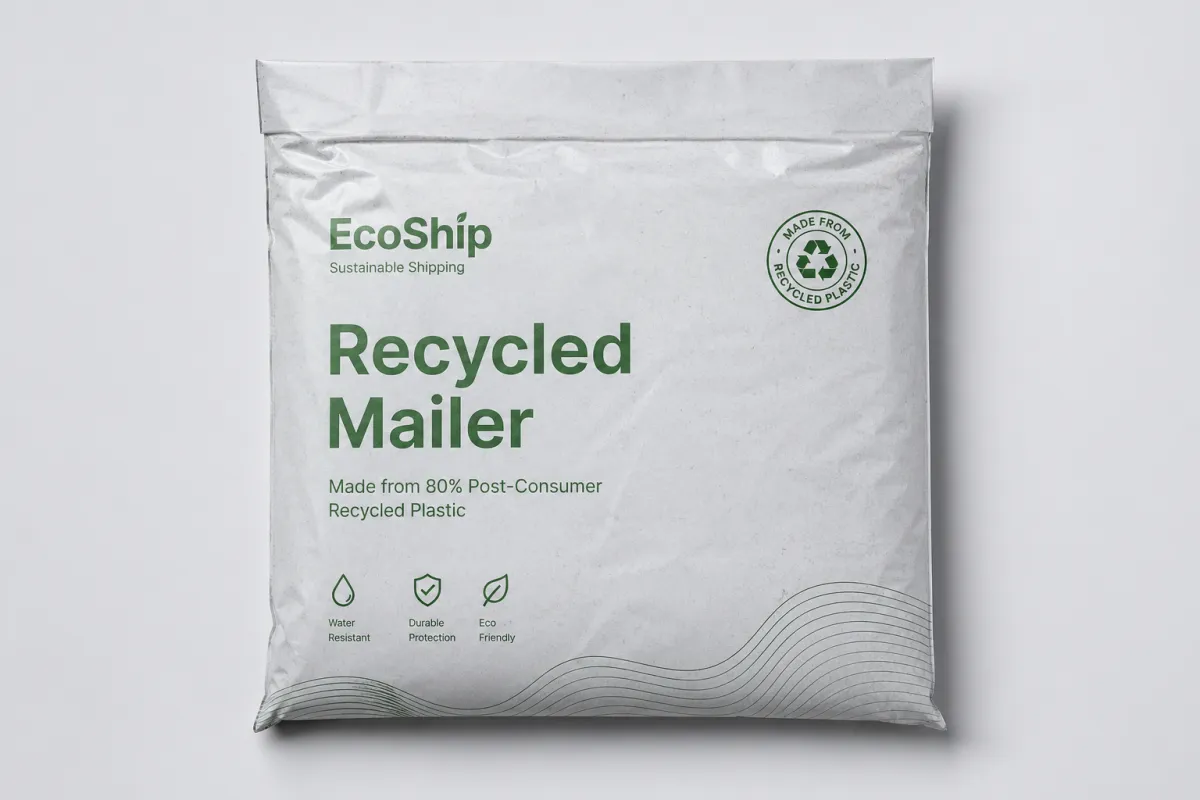
Recycled plastic mailers for ecommerce are shipping mailers made with recycled plastic content, often blended with other resin to strike the right balance between strength, flexibility, and printability. The packing motion stays familiar: load the product, peel the liner, press the closure, ship the order. The change lives in the resin stream behind the film, which may include post-consumer or post-industrial recycled material depending on the supplier and the spec. I like that part because it means the upgrade can be practical, not performative, especially when a converter in Dongguan or Monterrey is running the same bag-making lines it uses for standard PE mailers.
Recycled content and compostable claims get mixed together more often than they should, and the confusion creates headaches at the buying stage. Recycled plastic mailers for ecommerce are not meant to disappear in a backyard compost bin, and they are not automatically curbside recyclable either. Disposal depends on local infrastructure, the exact blend, and whether the mailer carries heavy ink coverage or mixed components. If you want a materials glossary, packaging.org is a useful reference point, though the real answer still comes from the film construction and the local collection rules in places like Los Angeles County or Toronto.
These mailers fit best with apparel, beauty accessories, socks, small electronics, lightweight books, and other low-fragility items that need an outer shipper instead of a corrugated carton. A 10 x 13 inch mailer can carry a folded hoodie, a pair of sneakers in a soft bag, or a boxed accessory kit without adding much tare weight. That matters when parcel charges are shaped by dimensions as much as by the item inside. If you have ever watched a shipping bill climb because a package was technically “light” but weirdly large, you know exactly why I care about this.
One mistake I see constantly is people judging the whole category by a thin recycled sample from a commodity supplier. I watched a buyer at a Kentucky contract packer pinch a sample between two fingers and reject it on sight. We packed twenty live orders, ran them through a 36-inch drop test, and the problem turned out to be a poor seam weld on the sample run, not the film itself. Material and process are not the same thing. That distinction saves a lot of drama, and occasionally saves a very loud meeting in front of a procurement team from Dallas.
"If the mailer saves us one repack per hundred orders, it pays for itself faster than the green label ever will."
How recycled plastic mailers for ecommerce are made and perform
The usual manufacturing path starts with recycled resin that is cleaned, compounded, and blended to a target melt index, then extruded into film and converted on bag-making equipment into finished mailers. On a steady line, the film comes off the blown-film tower or cast-film stack with enough consistency for the converter to hold the seal area, print registration, and gusset dimensions without chasing the gauges all day. That consistency is the whole story. Recycled plastic mailers for ecommerce can look identical in a sales sheet and still behave very differently in a live fulfillment environment, whether the run comes out of Jiangsu, Gujarat, or northern Mexico.
Blend ratio changes more than most buyers realize. A film with higher recycled content may feel slightly stiffer, show a bit more cloudiness, or print differently under white ink than a lower-content blend. None of that automatically means poor quality. It means the material is doing what recycled-content film often does. I remember a supplier meeting in Shenzhen where a buyer wanted a bright white exterior for a cosmetics launch. The first run looked too gray under fluorescent lights. We adjusted the blend, tightened the print coverage, kept the same 3.0 mil target, and the finished mailers looked cleaner without giving up line speed. I was relieved, frankly, because nobody wanted to explain “slightly inspirational gray” to a beauty customer in West Los Angeles.
The useful tests are practical, not abstract. I want to see seal consistency across 20 to 30 samples, edge split resistance with a product that has corners, abrasion resistance after a short conveyor run, and drop performance that resembles real parcel handling. If your team wants a standard reference, ISTA protocols beat a hand squeeze every time, especially for shipments that will face sortation drops, stack compression, and vibration over a 500-mile lane from Columbus to Nashville. Hand tests are fine for a gut check; they are not a substitute for actual abuse.
Printing and color change how recycled plastic mailers for ecommerce behave too. Full coverage artwork, heavy dark ink, and large white underlays can raise the visual quality, yet they also add cost, stretch lead times, and slightly stiffen the film where the ink sits. Three approaches tend to work best: a stock recycled gray mailer with a single-color logo, a custom printed white or kraft-look exterior for stronger branding, or a plain recycled mailer with a return message and a small logo for teams that care more about throughput than theatrical unboxing. I have seen a 1-color logo on a 3.5 mil gray mailer outperform a six-color design simply because the gray version moved faster through a 14-station pack line in Newark. That is not glamorous, but it is real.
Lead times deserve more attention than they usually get. Sampling can take 5 to 7 business days, artwork approval often uses another 2 to 4 days, and a custom size or print run may need 12 to 15 business days from proof approval before freight even starts. One supplier negotiation sticks with me because it turned on that exact point. The brand wanted 5,000 pieces by the first ship window, but the printer needed a clean proof sign-off before the film could enter the bag-making queue. The buyer paid a little more to protect the launch date, and that was the correct trade. Delays look abstract on a spreadsheet; they are much less abstract when 5,000 orders are waiting in a dock corner in Austin.
The conversion steps are easier to judge when they are broken down plainly:
- Resin preparation: recycled pellets are screened and blended to a target spec, often around 15% to 60% recycled content depending on performance goals.
- Film extrusion: the resin is melted and formed into film, commonly 2.5 to 4.5 mil for ecommerce mailers.
- Bag conversion: the film is cut, sealed, and fitted with a peel-and-stick closure or tear strip.
- Printing and packing: artwork is applied, cartons are counted, and the finished mailers are packed for distribution.
For teams comparing packaging formats, I usually start with Custom Packaging Products and then narrow the search to Custom Poly Mailers once product dimensions, shipping lane, and branding goals are clear. That split keeps the discussion tied to what the warehouse actually needs, which is where the truth lives anyway. It also makes room for the occasional insert card in 350gsm C1S artboard, which I have seen used well in beauty kits shipping out of New Jersey.
Are recycled plastic mailers for ecommerce worth it?
For brands shipping soft goods, small accessories, and other low-fragility items, recycled plastic mailers for ecommerce can lower pack time, cut dimensional weight, and support recycled-content goals without changing the entire fulfillment system. The catch is that they only work when the film thickness, seal strength, and size are matched to the SKU. If the mailer is too thin or too large, the savings disappear in damage, repacks, and wasted freight space. That is why the best programs treat the mailer as a production spec, not a marketing accessory.
There is also a bigger, less exciting truth here: packaging that protects the product well often has a lower environmental burden than packaging that needs to be replaced after failure. A failed shipment means more material, more transport, more labor, and a second round of customer service contact. That does not mean every recycled mailer is automatically better. It means the comparison has to include actual performance, not just the material story on the sell sheet. I have seen a “greener” package turn into a mess because it saved two grams of resin and added three minutes of labor. That math is backwards.
Key factors that affect durability, branding, and price
Thickness is the first number I check, because it influences puncture resistance, stretch, and packer confidence when a product has sharp corners or bulky edges. A 2.5 mil mailer can work beautifully for soft apparel, but once a shipment includes a boxed charger, metal hardware, or a rigid beauty kit, I usually prefer 3.0 to 4.0 mil. In one Midwest fulfillment center near Indianapolis, we cut corner splits on folded denim by moving from 2.75 mil to 3.5 mil, and the added film cost was smaller than the labor saved by avoiding repacks. That is the kind of math that makes operators quietly happy.
Size matters just as much. Oversized mailers waste material, raise dimensional weight risk, and make the package arrive looking loose. Undersized ones stress the seal line and can split at the top edge. I have seen brands try to force every SKU into a single universal 10 x 13 format, and the result was extra void space for small items plus overloaded seams for larger ones. If your catalog ranges from a folded tee at 8 ounces to a boxed accessory at 1.4 pounds, two or three sizes usually beat one catch-all spec. One-size-fits-all sounds efficient until the warehouse starts muttering under its breath during a 6 p.m. cutoff in Nashville.
Closure style changes the pace of the pack line. A peel-and-stick strip speeds things up, but the adhesive has to hold after dust, hand lotion, and warehouse temperature swings between 60 and 85 degrees Fahrenheit. Some teams want tamper evidence. Others need a tear strip for easy customer returns. If the package is likely to be reused, recycled plastic mailers for ecommerce should support that behavior with a closure that opens cleanly and reseals without frustration. Nobody wants to wrestle a bag with a box cutter like it personally insulted them.
Branding is where the tradeoffs become visible. A clean one-color logo on a recycled gray or white mailer can look sharp and intentional, while full-coverage artwork, special inks, and multiple spot colors can push the unit price up by 20% to 35% depending on order size. I once sat through a design review where the creative team wanted six lines of marketing copy, a QR code, a sustainability badge, and a campaign slogan on a 10 x 14 mailer. We cut it to a logo, a return note, and a single web address. The final piece looked better, printed faster, and cost less per unit. The room was not thrilled at first, but the mailer was. A matching insert printed on 350gsm C1S artboard would have done the heavy lifting instead of cluttering the shipper.
Supply chain consistency is the last factor, and it is the one buyers forget until the reorder lands late. Resin availability, minimum order quantities, carton pack counts, and regional freight rates can all shift pricing even when the spec sheet looks nearly identical. A customer in Texas moved production from a domestic stock program to a custom imported run, only to discover the freight savings disappeared because the new cartons were packed 100 per case instead of 200 per case. That doubled the warehouse footprint and changed the receiving cost. It is amazing how quickly a “small packaging detail” becomes a receiving headache.
If you want a quick mental model, use this:
- Higher thickness usually means better puncture resistance, but more material cost.
- Better fit reduces waste, protects the product, and lowers dimensional weight.
- Smarter print coverage improves brand presentation without overcomplicating production.
- Stronger closure design saves labor on the pack line and cuts returns risk.
Cost and pricing: what you really pay for
The quoted unit price is only part of the story. With recycled plastic mailers for ecommerce, the full bill can include setup fees, plate charges, print prep, color matching, freight, storage, and the hidden cost of ordering the wrong size for your top 20 SKUs. I have seen buyers celebrate a low $0.18/unit quote for 5,000 pieces, then lose the savings because they ordered the wrong format and had to ship a second emergency order at a higher freight rate. That is the kind of thing that turns a “good deal” into a very expensive lesson.
Here is a simple comparison that reflects the kind of pricing spread I have seen in real sourcing conversations:
| Option | Typical unit price | MOQ | Best fit | Watch-outs |
|---|---|---|---|---|
| Stock recycled mailer, unprinted | $0.09 to $0.13 | 1,000 to 5,000 | Fast turns, standard apparel, test runs | Limited sizing and weaker brand presence |
| Custom recycled mailer, unprinted | $0.12 to $0.15 at 5,000 pieces; $0.11 to $0.14 at 10,000 pieces | 5,000 to 10,000 | Right-sized programs with high repeat volume | Requires better forecasting and proof approval |
| Custom recycled mailer, one-color print | $0.15 to $0.26 | 5,000 to 10,000 | Branded ecommerce, subscription shipments, retail-aligned packs | Artwork setup and color consistency matter |
| Heavy-duty recycled mailer, multi-color print | $0.22 to $0.32 | 10,000+ | Sharper presentation, heavier SKUs, premium unboxing | Higher cash tie-up and more complex production |
The table still leaves out one important layer. A mailer that costs $0.03 less per piece can become the expensive choice if it tears one out of every 200 orders and forces a repack. On a 50,000-order month, a 0.5% failure rate creates 250 repacks. If each repack takes 90 seconds of labor at $18 per hour, that issue alone burns through $112.50 in labor, before reships or customer service tickets enter the picture. I know that number looks tiny on paper; in a warehouse in Columbus or Reno, it is not tiny at all.
I learned that lesson during a supplier negotiation for a beauty brand shipping from California and the Midwest. The first bid came back at $0.21/unit for 10,000 pieces, then the second supplier offered $0.18/unit if we moved to a slightly narrower width and one fewer ink color. That looked like the clean win. The carton counts changed the math. The narrower format created more folds, which slowed the pack line by 6 seconds per order. The brand chose the better-running mailer at the higher unit price, and the damage rate dropped enough to justify the difference within one quarter.
That is why I keep coming back to total landed cost. The best comparison includes the price per piece, freight to your dock, how much space the cartons consume, how many seconds the packer needs to load and seal each order, and how often the package survives transit without a problem. Recycled plastic mailers for ecommerce should be judged against all of that, not just the quote on the PDF. A cheap quote that causes headaches is not cheap. It is just delayed pain.
One more practical point matters when the program moves from a box to a mailer: shipping weight savings can be real. A 12 x 15 mailer can weigh a fraction of a corrugated carton and still protect a soft good, which may shave enough off parcel charges to offset a few cents of unit price. That is where the math gets interesting. It is also where the wrong size choice can quietly wipe out the benefit, especially on lanes headed to the Pacific Northwest where dimensional pricing can bite harder than the product margin expects.
Step-by-step: choosing the right mailer for your product mix
Start with the product mix, not the packaging catalog. I like to group SKUs by shape, weight, sharpness, and fragility, because a soft hoodie, a boxed charger, and a metal accessory should not all go into the same spec just because they sit under two pounds. For recycled plastic mailers for ecommerce, that grouping usually tells you whether you need one format, two formats, or a small family of sizes. A 9 x 12 mailer might cover folded tees, while a 10 x 14 or 12 x 15 format handles bulkier kits without stretching the seal line.
Next, get samples in the exact sizes you are considering. Do not test empty mailers on a desk and call it done. Pack the real items, use the real label printer, and let the warehouse team handle the sample because they are the ones who will notice if the peel liner sticks too hard, if the seam hangs up on the chute, or if the bag feels awkward at the left-hand pack station. I have seen a sample that looked perfect on a buying sheet fail because the adhesive tab sat 12 mm too close to the opening for the operator’s preferred motion in a facility outside Columbus. Little annoyances like that turn into big annoyances very quickly.
Then run a short packing-line trial. I usually want 50 to 100 live orders through the new mailer, with someone tracking seal speed, ease of loading, and whether any extra tape or workarounds show up. If the line slows by more than 3 to 5 seconds per order, the packaging spec deserves a second look. That matters a lot in a fulfillment center that pushes 1,500 orders a day, because a tiny delay scales fast. Packaging mistakes have a way of multiplying like rabbits, which is deeply rude.
After that, test transit performance with a simple internal plan. A practical trial should include drops from shoulder height, corner impact, abrasion on a cart edge, and a quick humidity check if your parcels move through rain, dock doors, or southern summer heat. If you need a formal reference, the drop and vibration structures used in ISTA-style testing are useful, even if you only run an internal version with a tape measure, a scale, and a notebook. I have seen teams in Dallas and New Jersey use the same 3-drop, 5-corner test and catch failures before the first production pallet shipped.
If your team is comparing recycled plastic mailers for ecommerce against another shipper format, run a side-by-side on the same SKU family. Ship 25 orders in the old mailer and 25 in the new one, then compare damage, customer service tickets, and pack time. That kind of test gives you an answer faster than a month of meetings. It also has the nice side effect of making opinions slightly less loud.
The final decision should balance four things:
- Protection: does the mailer survive your worst-case product and lane?
- Cost: does the landed number stay inside your margin model?
- Branding: does it look like your business, not a generic supply house item?
- Fulfillment speed: can the warehouse pack it without extra motions?
If one of those four breaks, the program will feel off even when the spec sheet looks polished. I have watched brands obsess over recycled content percentages and then discover their real issue was a poorly sized seal area that forced operators to press twice on every package. Small detail, big consequence, especially on a floor that is already running 2,000 parcels before lunch.
Common mistakes when switching to recycled plastic mailers
The biggest mistake is choosing by sustainability message alone. Recycled plastic mailers for ecommerce can help a brand tell a cleaner material story, but a mailer that fails in transit creates more waste through reships, returns, and repacking labor. A damaged customer experience does not become a sustainability win just because the material content sounded better in the sales deck. I get why people fall for that, though. The label is easier to talk about than the warehouse math.
Another common error is buying one universal size for every SKU. On paper it sounds efficient. In practice it usually means extra void space on small orders, bulky corners on larger ones, and a sloppier arrival presentation. I once reviewed a subscription brand that used a single oversized mailer for T-shirts, socks, and boxed beauty tools. Shipping costs climbed on dimensional weight, and the warehouse team wasted three folds per order just to make the product sit flat inside the bag. Nobody loved that workflow. Not the packers, not the finance team, not me.
Skipping sample testing causes the most expensive mistakes. Some teams place a 20,000-piece order after looking at a render and a quoted thickness number, then discover the adhesive is too weak for cold storage, the film is too thin near the seal, or the print scuffs after the first carton stack. A 2-week sample cycle is far cheaper than a 20,000-piece correction. That is not theory; I have watched the same fix happen twice in the same plant, once in Ohio and once in a Shenzhen conversion shop.
Over-design is another trap. Brand teams want to tell a story, and that instinct is understandable, but too much copy on a mailer can crowd the logo, make the bag harder to read at a glance, and increase print complexity. A cleaner layout with one strong brand mark, one short sustainability line, and one web address usually performs better than a full page of marketing language. The operator on the line is not the customer’s attention span. The porch photo is. If you need more storytelling, put it on an insert card in 350gsm C1S artboard and keep the shipper focused.
Return flow is easy to overlook and expensive to ignore. If the customer is likely to send items back, recycled plastic mailers for ecommerce should include a closure and tear feature that supports reuse instead of turning into a one-way package. I have seen brands lose goodwill because the return strip ripped unevenly and left the customer fighting the bag with scissors. A few extra cents in design can save a lot of friction later. I still remember one inbox full of customer complaints that basically boiled down to, “Your bag is winning.” Nobody wants that email.
For teams trying to keep the sustainability story honest, I suggest reading the disposal guidance from the EPA at epa.gov and then matching that guidance to what customers can actually access locally. A claim that sounds clean in a boardroom should still make sense at the curb, in a Seattle apartment building, or at a suburban drop-off bin two miles from the nearest store.
Expert tips for recycled plastic mailers for ecommerce rollouts
My first tip is simple: pilot one SKU family first. Do not flip the whole catalog at once unless the product mix is tiny. Start with the 5 to 10 highest-volume items, watch damage rates for 30 to 60 days, and make the decision from real pack data. Recycled plastic mailers for ecommerce work best when the rollout follows evidence, not a calendar invite from someone who saw a trend deck on Monday morning.
Keep a scorecard during the pilot. I like four columns: seal failures, transit damage, pack time, and warehouse feedback. If a line supervisor says the new mailer is easier to load from the right-hand station but awkward from the left, write that down. If the failure rate stays under 1% and the line speed stays flat, you are probably in good shape. If the adhesive lifts in humid weather, that is a different story, and you should hear about it before the next reorder. A 0.8% failure rate at 10,000 parcels still means 80 problems, which is enough to matter.
Work with the supplier on the details people tend to overlook: carton pack counts, pallet patterns, storage footprint, and whether the finished cartons are easy to open without a box cutter. I once lost half a day of receiving time because the cartons were packed so tightly that the warehouse team had to pry them open with a scraper. That is the kind of friction no buyer wants to discover after 10,000 pieces have already shipped from a plant in the Midlands or Guangdong. The receiving dock is not the place for mystery puzzles.
Use the rollout to tighten your spec sheet. Record the exact width, length, thickness, print coverage, adhesive type, and acceptable tolerance. For recycled plastic mailers for ecommerce, that spec sheet becomes the guardrail when the next reorder comes from a different plant or a different shift. If you are not strict about it, the film can drift by a few tenths of a mil, and that small change may show up as a bigger handling issue later.
During one supplier meeting, a client told me, "I do not need a hero story; I need the same mailer every time." That line stuck with me because it is exactly how good packaging programs are built. Consistency is boring. Boring keeps customer service quiet and the warehouse moving, whether the pallets come out of New Jersey, Shenzhen, or Guadalajara.
Here is the rollout sequence I recommend most often:
- Request 2 to 3 samples in the target size and thickness.
- Test the sample with actual SKUs, label stock, and pack staff.
- Run 50 to 100 live orders in a pilot lane.
- Track damage, labor, and returns for at least 30 days.
- Compare landed cost against the current shipper, not just unit price.
- Scale only after the data supports the switch.
If you want the cleanest path, recycled plastic mailers for ecommerce should be treated like any other production change: specify it, test it, measure it, then repeat the spec exactly. That is how the better plants I have worked with do it, whether they are in New Jersey, Shenzhen, or a contract pack floor in Ohio with 18 pack stations and one very tired forklift.
And when the rollout needs broader packaging support, a combination of recycled plastic mailers for ecommerce, smarter carton planning, and the right branded exterior usually creates a stronger result than any one piece by itself. That is where recycled plastic mailers for ecommerce stop looking like a trend and start functioning like a useful tool.
FAQ
Are recycled plastic mailers for ecommerce recyclable after use?
It depends on the local recycling system and the exact resin blend, so you should not assume every mailer is accepted curbside. Some communities will take certain film plastics through store drop-off programs, while others will not. If the mailer has mixed materials, heavy ink coverage, or adhesive components, that can change the answer again. I wish the answer were simpler, but packaging has a talent for being annoyingly specific, especially across cities like Portland, Denver, and Atlanta.
Do recycled plastic mailers for ecommerce cost more than standard poly mailers?
They can, but the price difference depends on resin content, order volume, print complexity, and shipping distance. I have seen a plain recycled mailer land within a cent or two of a standard poly mailer on a large run, and I have also seen a custom printed version run 20% higher. The real question is whether the added cost gets offset by lower damage, lower repack labor, or better shipping efficiency. A quote at $0.15 per unit for 5,000 pieces can be attractive if the alternative creates even a 1% failure rate.
What thickness should I choose for recycled plastic mailers for ecommerce?
The right thickness depends on product weight, sharp edges, and how much abuse the package sees in transit. Light apparel often works well in the 2.5 to 3.0 mil range, while heavier or more irregular items usually need 3.5 to 4.5 mil. The safest move is to test samples with your actual SKUs before locking the spec, and to keep the same test lane if your orders ship out of multiple regions such as Nevada and North Carolina.
Can recycled plastic mailers for ecommerce be custom printed?
Yes, most suppliers can add logos, brand colors, and messaging, but print coverage can affect lead time and pricing. One-color branding is usually the easiest place to start, especially if you want a strong look without adding much complexity to production. If speed matters more than full coverage, a stock color with a single logo can be a practical middle ground. For inserts, a 350gsm C1S artboard card is often enough to carry the story without overloading the mailer.
How do I test recycled plastic mailers for ecommerce before switching fully?
Run a short pilot using live orders, not just empty samples, so you can see how the mailer performs in real packing conditions. Track seal failures, transit damage, pack speed, and customer feedback during the trial. If possible, compare the recycled mailer against your current mailer on the same SKU set for a clean side-by-side result. I would also record freight to the dock, because a test that works in Phoenix may cost differently than one sourced through New Jersey.
For most brands, the smartest move is not to chase recycled plastic mailers for ecommerce as a slogan, but to use them as a well-specified packaging tool that protects the product, supports the pack line, and fits the margin model. Start with one high-volume SKU family, test real orders, lock the thickness and size to the product, and compare total landed cost instead of unit price alone. That sequence is plain, maybe even a little boring, but it is the shortest path to a rollout That Actually Works.


