Buyer Fit Snapshot
| Best fit | shipping skincare in poly mailers work for packaging buyers comparing material specs, print proof, MOQ, unit cost, freight, and repeat-order risk where brand print, material, artwork control, and repeat-order consistency matter. |
|---|---|
| Quote inputs | Share finished size, material target, print colors, finish, packing count, annual reorder estimate, and delivery region. |
| Proofing check | Approve dieline scale, logo placement, barcode or warning zones, color tolerance, and any recyclable or compostable wording before bulk production. |
| Main risk | Vague material claims, crowded artwork, or missing packing details can create delays even when the unit price looks attractive. |
Fast answer: Shipping Skincare in Poly Mailers Work: Film, Closure, Print, and Fulfillment should be specified like a repeatable production item. The safest quote includes material, print method, finish, artwork proof, carton packing, and reorder notes in one written spec.
What to confirm before approving the packaging proof
Check the product dimensions against the actual filled item, not only the sales mockup. Ask for tolerance on folds, seals, hang holes, label areas, and retail display edges. If the package carries a logo, QR code, warning copy, or legal claim, reserve that space before decorative graphics fill the panel.
How to compare quotes without losing quality
Compare board or film grade, print process, finish, sampling route, tooling charges, carton quantity, and freight assumptions side by side. A lower quote is only useful if the supplier can repeat the same color, closure quality, and packing count on the next order.
Tips Shipping Skincare in Poly Mailers That Actually Work
The quickest way to turn a clean skincare launch into a customer service mess is one leaking 30 ml bottle in transit. One. Not ten. Not some cinematic warehouse disaster with alarms and forklifts. Just one damp parcel that smells faintly of chamomile and regret, and suddenly your inbox fills up with refund requests before the second espresso is finished. I remember opening a test shipment and finding a vitamin C serum had painted the inside of a white mailer like a bad watercolor study. Nobody wants that call. Finance definitely does not want that call either when the average order value is $26.40 and each reshipment burns another $7.80 in postage.
That is why tips shipping skincare in poly mailers matter more than people assume at first glance. The right mailer keeps shipping weight down, resists moisture, and speeds fulfillment without making the parcel feel flimsy or cheap. The wrong setup is basically an expensive gamble with a sticky ending. A lot of brands get tripped up right there. They see a unit cost of $0.12 or $0.16 and think the story ends there. It does not. Damage rate, labor time, customer complaints, and re-shipments are part of the bill whether anyone writes them down or not.
I wrote this from the packaging side, not from a tidy spreadsheet that never met a courier van in Chicago, Dallas, or Newark. In audits, supplier calls, and claims reviews, the same pattern keeps showing up: the weakest part of the pack decides the outcome. If you want a starting point for testing formats, take a look at Custom Poly Mailers or compare them with Custom Shipping Boxes if the formula needs more structural protection than a mailer can reasonably provide. For artwork, a 350gsm C1S artboard insert or a 14 pt coated card can change the whole feel of the shipment for only a few cents, and a tamper-evident seal can improve confidence without changing the outer pack much at all.
Tips Shipping Skincare in Poly Mailers: Why It Matters
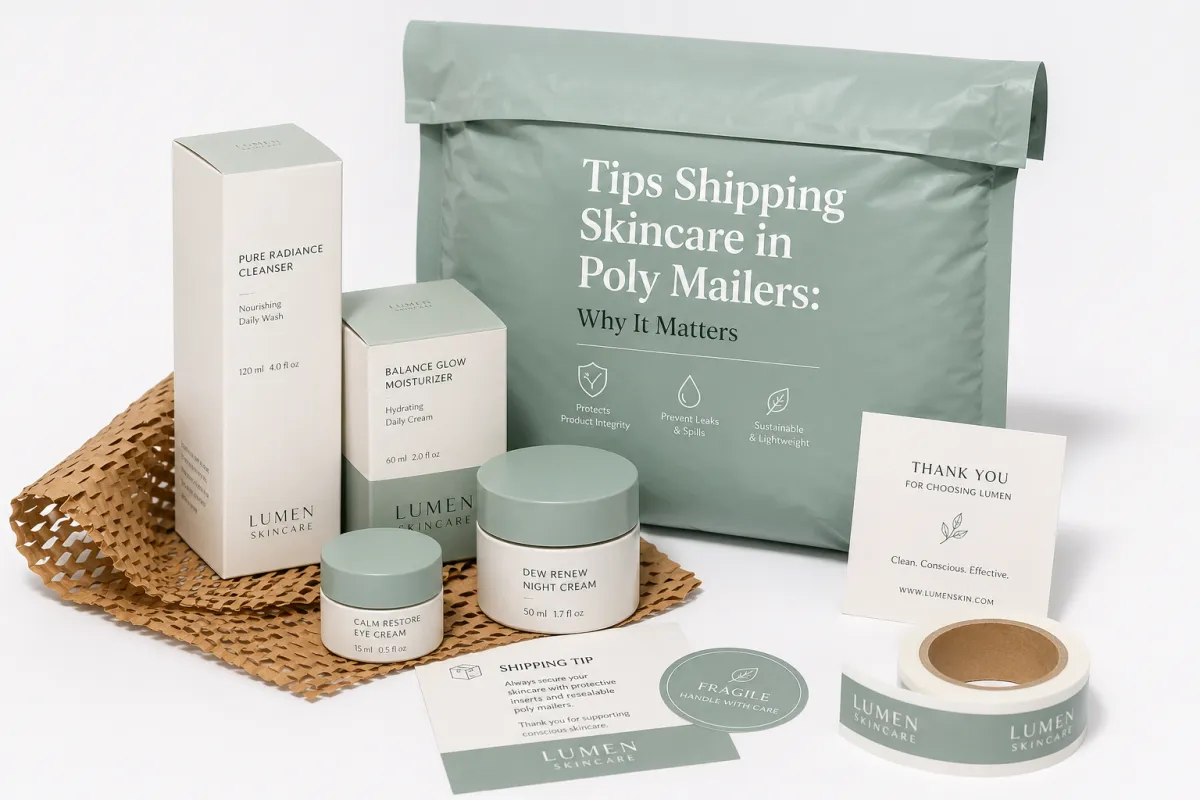
A single leaking serum does not just cost the product. It costs the shipping label, the support ticket, the labor time, and usually one very annoyed customer who now thinks your brand is a chaos machine. I once worked with a DTC skincare line moving about 8,000 units a month, and a 1.7% damage rate on a $24 serum line wiped out the savings they expected from cheaper transit packaging. The scary part was how ordinary the problem looked on paper. The parcel did not explode in some dramatic way. It just failed quietly, over and over, until the numbers got ugly.
Tips shipping skincare in poly mailers work best for products that are already stable: sealed tubes, sheet masks, sample bundles, boxed creams, and lightweight sets that do not need serious crush resistance. A 2.5 mil or 3.0 mil mailer can be perfectly reasonable for those items if the inner pack is secure. The outer mailer adds moisture resistance, keeps tare weight low, and makes fulfillment easier because it folds, seals, labels, and sorts quickly. For compact products, that can be the difference between a $5.60 parcel and a $7.90 parcel once dimensional weight starts doing its annoying little dance.
There is a line here, and crossing it gets expensive fast. A poly mailer is an outer shell, not a miracle worker. If the closure can pop under compression, if the cap can loosen during vibration, or if the liquid can seep under heat, the mailer is being asked to do a box’s job. I have seen this mistake most often with small beauty brands shipping unboxed oils in what they called a “safe enough” pouch. Safe enough was the problem. The pouch was fine. The product system was not, especially on routes through Phoenix in July or Miami in August.
“We finally fixed our damage rate when we tested the actual SKU instead of arguing about the packaging idea,” one skincare operations manager told me after a 500-unit pilot. That line stuck with me because it was the first honest sentence in a meeting that had been full of confident guesses and one too many opinions from people who had never packed a 15 ml bottle.
Branding matters too, and not just because marketing likes nice things. Opaque mailers hide the contents, reduce tampering visibility, and make a shipment feel more composed when paired with a branded insert or printed label. Customers notice that. They may not say it out loud, but they notice. In ecommerce shipping, the package is often the first physical proof that the brand pays attention. If the parcel arrives dry, intact, and flat, the customer usually assumes the rest of the operation is equally tidy. Human beings are weird like that, but it is useful weirdness when repeat purchase rates sit at 22% instead of 16%.
For a baseline on test thinking, I often point teams to ISTA, because standards like ISTA 3A and other distribution testing methods keep the conversation grounded in drops, vibration, and compression instead of wishful thinking. Tips shipping skincare in poly mailers get much stronger when the package is tested like a real parcel and not admired like a sample on a conference table in a showroom in Brooklyn.
How Poly Mailers Protect Skincare Orders
The protection stack matters more than the shell itself. Good tips shipping skincare in poly mailers start with the primary container, then a leak barrier, then a bit of cushioning or an insert if the SKU needs it, and only then the outer mailer. If the inner bottle fails, the mailer cannot rescue the order. If the inner bottle is secure, the mailer can do a respectable job against moisture, abrasion, and ordinary handling abuse over a 2,000-mile route.
Moisture resistance is a bigger advantage than most people assume. Warehouse floors get wet. Delivery routes get rain. Sorting hubs have their own mysterious weather system, apparently. A paper envelope can sag, tear, or wick moisture in minutes, while a poly mailer usually keeps its shape and protects the label better. In one supplier comparison I handled, the client wanted the cheapest possible outer pack. Fair enough. We ran 24 units through humidity exposure and a condensation simulation, and the paper option failed embarrassingly fast while the 2.0 mil LDPE mailer stayed intact. Tips shipping skincare in poly mailers are often really tips about weather and transit time, not just about plastic film.
Self-seal adhesive helps, but it has limits. It works well when the order is sized correctly, the flap is clean, and the pouch is not overstuffed. It works badly if the bag is stretched, the lip is dusty, or the contents push hard against the seal line. I have watched a packing line in Shenzhen move around 600 orders an hour until someone started stuffing mailers that were one size too small. The seal strip became a weak hinge, seam failures appeared in the first carrier scan cycle, and everyone suddenly remembered the importance of “just one more inch.” Funny how that happens in a room with 18 packing tables and one overloaded scale.
Security is another reason brands choose them. An opaque bag can hide the product, which reduces curiosity and improves tamper awareness. Add a branded sticker, a printed mailer, or an insert card, and the package still feels intentional. That combination of lower cost and better presentation is why tips shipping skincare in poly mailers show up so often in launch plans for beauty and personal care lines. The setup is not glamorous. It is, however, practical, which is better than glamorous when the parcel has to survive a conveyor belt in Atlanta at 4:30 p.m.
For brands trying to keep materials aligned with sustainability goals, a mailer can also pair with FSC-certified inserts or paper-based collateral. If that matters to your sourcing policy, the certification framework at FSC is worth reviewing before you finalize artwork, paper inserts, or outer carton content. I have seen brands win trust by being specific here instead of vague, and vague is usually where packaging claims go to become embarrassing later when a retailer asks for documentation down to the mill.
Key Factors Before You Choose a Poly Mailer
Start with the product risk profile. Is the item glass or plastic? Is it a screw cap, a pump, or a dropper? Does it contain a watery serum, a thick cream, or an oil that likes to creep into threads and make everyone miserable? The more failure-prone the container, the less forgiving tips shipping skincare in poly mailers become. A 30 ml glass dropper bottle and a 50 ml plastic lotion tube do not belong in the same decision bucket, no matter how much a sales deck wants them to. A 3-inch neck diameter bottle and a flat pouch are not cousins just because both appear on the same purchase order.
Then look at the shipment itself. A local route with two handoffs is not the same as a cross-country trip with five scan points and a weekend sort delay. Climate matters too. Summer heat softens adhesives and increases seep risk; winter cold can make some plastics brittle; wet-season routes put the outer shell under constant moisture stress. I have seen brands choose one mailer spec for every SKU and then act shocked when claims varied by region. The lanes were never the same, so why would the results be? A run to Seattle in November is not the same animal as a run to Las Vegas in June.
Size and weight math are where a lot of teams quietly lose money. A mailer that is too small can burst seams, but one that is too large creates movement, scuffing, and dimensional weight inflation. That dimensional weight charge can erase the savings from switching away from a box. In practice, I usually see the sweet spot around a snug fit with 10 to 15 mm of internal slack, depending on the SKU and whether a slim insert is included. Tips shipping skincare in poly mailers only work if the item sits flat instead of wandering around inside the bag like it pays rent. A 9 x 12 inch pouch may be fine for one bundle and disastrous for another that weighs 180 g.
| Packaging option | Typical use | Seen unit cost at 5,000 units | Protection level | Best fit |
|---|---|---|---|---|
| Plain poly mailer, 2.0 mil | Sealed tubes, flat sets, boxed skincare | $0.10-$0.18 | Moisture and abrasion | Low-fragility ecommerce shipping |
| Poly mailer, 2.5-3.0 mil | Heavier bundles, mixed kits, branded orders | $0.14-$0.28 | Better tear resistance | Moderate package protection needs |
| Bubble mailer | Smaller fragile items, light impact risk | $0.18-$0.35 | Impact plus light moisture resistance | Items that can take some squeeze but not much crush |
| Shipping box with insert | Glass, loose liquids, premium kits | $0.42-$0.90 | Highest structural protection | Fragile SKUs and premium unboxing |
Brand presentation matters too. Recycled-content film, print quality, and seal finish all influence customer perception, and customers notice more than teams expect. A plain gray mailer can feel efficient, while a branded black or white mailer with a clean logo can feel polished. That is why I encourage clients to review Custom Packaging Products as a system, not as a single item. The right outer mailer, insert, label, and closure method should all point in the same direction. If one part looks cheap and the rest looks premium, the whole thing feels off, and customers are very good at noticing “off.”
One more point: sustainability claims should be accurate. If the mailer includes recycled content, say the percentage only if the supplier can document it. If the wider packaging set uses FSC paper, say that only for the certified components. Honest claims age better than vague language, and I have seen retailer audits catch imprecise wording faster than design teams expect. Tips shipping skincare in poly mailers can support a greener story, but only if the sourcing file matches the copy. Otherwise, the story gets awkward in a hurry, especially when a buyer in Toronto asks for test reports and batch codes.
What Are the Best Tips Shipping Skincare in Poly Mailers?
Step one is SKU triage. I would group products into three buckets: low-risk, medium-risk, and box-only. Low-risk might include sealed sheet masks or boxed balms; medium-risk might include wrapped sets with a plastic jar; box-only should include loose glass or anything with a cap failure history. At the packing station, tips shipping skincare in poly mailers become operational instead of theoretical because the fulfillment team needs a clear rule set. “Use your best judgment” is not a rule. It is how mistakes get dressed up as flexibility while the claim rate climbs from 0.8% to 2.1%.
Step two is choosing the mailer spec. For many brands I have worked with, 2.0 mil LDPE is fine for flat, lightweight items, while 2.5 mil or 3.0 mil makes sense for heavier bundles or higher abrasion risk. If the packaging is being branded, print must stay legible after sorting and label application. If the product is sensitive to odor or transfer, ask for low-odor film and test the adhesive strip against your actual insert stock. Tips shipping skincare in poly mailers fail quickly if the material and the SKU are mismatched by even one small detail. Small details are rude that way, especially on a hot run from Dongguan or a high-speed domestic line in Los Angeles.
Step three is inner protection. A pump should be locked or taped. A cap should be sealed with a tamper band or a strip of tape if the format allows it. If there is any seep risk, place the product in a secondary pouch or a sealed inner bag. I once watched a client’s 15 ml retinol line survive a rough pilot only because the team added a 3-inch absorbent sheet under the bottle, which cost less than two cents per unit. That tiny change saved them from building a return process around one fragile closure. The irritating part is that the fix was so cheap. The expensive part was realizing they had not done it sooner.
Step four is the packing sequence. I like a simple repeatable order: product, insert, absorber if needed, close, press the seal line, then check for movement. If the SKU slides more than a few millimeters when the mailer is tilted, it needs a tighter fit or a different format. A package should feel compact in the hand, not lumpy or hollow. In shipping materials audits, that one-hand feel is often the first clue before any lab test starts. You can tell a lot by feel, which is inconvenient for people who want packaging to behave like a spreadsheet. A 12 x 15 inch mailer that feels half-empty is usually a warning sign.
Step five is testing. Do a shake test, a drop test, and a compression test before you run live volume. A shake test catches loose closures. A drop test catches weak seals and brittle corners. A compression test exposes overstuffed seams. If the brand is serious, I recommend testing to a method inspired by ISTA 3A or the packaging sections of ASTM D4169, then documenting the result in the same folder as the pack spec. Tips shipping skincare in poly mailers get much easier to defend internally once someone can point to actual test data instead of a confident opinion from the person who “just had a feeling.”
There is a reason these steps sound practical instead of flashy. The best package protection is usually boring at the line level and dramatic only in the damage report, because nothing leaks, nothing bursts, and nothing gets reworked. Boring is underrated. Boring keeps customer service from sounding like a fire alarm, especially when the warehouse is pushing 1,200 parcels before the 3 p.m. carrier cutoff.
What a good packing station looks like
A clean station needs a scale, a roll of tape, absorbent sheets, label stock, and one printed reference sheet with the approved SKU rules. I like seeing the approved mailer size written in millimeters, not just a vague name, because a 10 x 13 inch pouch and a 10 x 15 inch pouch can behave very differently once a pump bottle is involved. Tips shipping skincare in poly mailers stay consistent when the line can see the spec in plain numbers. If you make people guess, they will guess wrong at least part of the time. Humans are consistent that way too, whether the label is printed in Houston or assembled in Guangzhou.
Common Mistakes That Raise Damage Rates
The most expensive mistake is shipping unsealed liquids and trusting the adhesive strip to save everything. It will not. If a serum cap loosens by half a turn, the pressure change during transport can still push product into the flap, and once that happens the seal is compromised. I have seen teams blame the carrier, but the failure began at the closure, not the sorting belt. Carriers move parcels around. They do not invent physics. A 32 oz detergent jug and a 30 ml face oil do not fail the same way, but both fail when the first seal is ignored.
Overstuffing is the second big error. It feels efficient in the moment because the packer uses every inch of the pouch, but the seam load rises sharply and the mailer can split at the edge. A 30 g product in a 6 x 9 inch bag may be fine; a 130 g bundle in the same format may create a return wave. That is why tips shipping skincare in poly mailers need a weight threshold, not just a size chart. Otherwise the line keeps pretending the bag will somehow stretch a little more without consequences. It will not, and the tear usually appears at the top corner where the seal meets the film.
Skipping testing is another classic mistake. A package can look perfect on the packing table and still fail after one carrier sort cycle. I remember a brand that passed a visual check on 200 units, then saw 11 crushed corners and 4 leaks after a regional hub run. The difference was vibration, not appearance. The team had chosen based on shelf aesthetics, not distribution forces. Package protection is judged by movement, pressure, and time, not by how neat the stack looked at 9 a.m. in a fluorescent room with a coffee machine that never worked correctly.
Buying the cheapest mailer without checking gauge and seal performance is usually a false economy. A 1.5 mil bag can look fine in a sample pack and still tear when a label corner bites into the film or a box edge rubs during transit packaging. If the supplier cannot tell you tensile strength, seal performance, and thickness tolerances, the price is not the full story. I have seen a few cents saved at purchase become dollars lost in claims and rework. The invoice looks wonderful. The P&L, less so. A supplier in Ningbo might quote $0.11, while a better-performing line in Dongguan quotes $0.16 and saves three support tickets per 1,000 orders.
Another mistake is ignoring customer perception. A damaged outer bag can make even a perfect inner product feel cheap. That matters for skincare, where trust is part of the sale. Clean shipping materials and consistent folds tell the buyer the brand pays attention. That is not cosmetic fluff; it affects repeat orders. People may forgive a plain package. They do not forgive a sloppy one very easily, especially when the product costs $34 and the customer paid $6.95 for shipping.
Finally, too many brands forget to watch the return loop. If the customer support team starts seeing the same complaint twice in a month, the mailer spec needs review. Tips shipping skincare in poly mailers are only useful if the damage data feeds back into the packaging decision. Otherwise everyone just keeps acting surprised, which is not a plan. A monthly review of 50 returns can tell you more than a quarter of guesswork.
Cost and Pricing for Skincare Poly Mailer Shipping
The real cost is not the sticker price of the mailer. It is the mailer plus the insert plus the tape plus the labor plus the replacement shipment if something fails. A $0.16 mailer can be cheaper than a $0.11 mailer if the better one reduces damage by even one point and saves the team 20 minutes a day at the packing table. That is why tips shipping skincare in poly mailers should be priced as a system, not as a single line item. Otherwise you are comparing pennies in isolation and wondering why the monthly report still looks irritated.
In supplier quotes I have seen, plain 2.0 mil mailers often land around $0.10 to $0.18 per unit at 5,000 pieces, while printed or thicker 2.5 to 3.0 mil options may land around $0.14 to $0.28. A shipping box with inserts can easily climb to $0.42 to $0.90 before void fill and labor. Those numbers vary by size, print coverage, and minimum order quantity, so I would never treat them as universal. Still, the spread is wide enough that ecommerce shipping teams can feel the difference in margin within one quarter. A 10,000-unit run in Shenzhen and a 2,500-unit domestic run in Ohio will not land in the same place, even if the artwork is identical.
Dimensional weight is where the math gets interesting. A compact product in a snug mailer may save one or two billable pounds compared with a box, especially on lower-weight orders. I have watched a brand cut average shipping spend by about 11% on a three-SKU routine once they moved their flat sets into mailers and reduced parcel volume. That result did not come from magic. It came from better transit packaging and fewer empty cubic inches taking up paid space like they owned the place. On some lanes, that saving is closer to $1.34 per order; on others, it is less, but still enough to matter by month-end.
Here is the part many teams miss: hidden costs often outnumber the visible ones. Absorbent pads cost pennies, but a return label, a support ticket, and a refunded order are much larger. If your support team spends 90 seconds triaging each damage claim and the warehouse spends another 4 minutes re-shipping it, labor becomes part of the packaging bill. Tips shipping skincare in poly mailers become far more attractive when you measure the full cost per order instead of only the outer bag. It is annoying to track all of it, yes, but not as annoying as paying for preventable failures. A $0.03 insert that prevents one $18 refund is not a luxury; it is arithmetic.
My rule is simple. Build a per-order model that includes packaging, postage, labor, claim rate, and reprint cost. Then compare that model against your current pack-out, not against a hopeful guess. The brands that win are the ones that can tell me the cost per shipped order to the penny, not the ones that only know the supplier quote. I love a good quote as much as anyone, but a quote is not the same thing as a real landed cost. A landed cost includes the 6 a.m. packer, the tape gun, the label waste, and the 1.2% damage rate hiding in the background.
A practical pricing lens
If a 3.0 mil printed mailer adds $0.08 over a plain mailer but reduces damage by 1.5% on a $28 average order, the math can favor the better bag quickly. I would rather see a team spend an extra $400 on mailers and save $1,200 in claims than chase a cheaper outer shell that looks good on a purchase order and bad on the monthly P&L. Procurement may grumble a little (they always do), but claims reduction is a friendlier line item than rework. If the printed version comes from a plant in Dongguan and the proof approval-to-production cycle is 12-15 business days, that is still often faster than clearing recurring customer complaints.
Process and Timeline for Shipping Skincare in Poly Mailers
A safe rollout usually starts with sample testing, not a full switch. I prefer a small pilot on two or three top-selling SKUs, because those items generate the largest share of both revenue and complaints. In a typical setup, sampling and spec review take 3 to 5 business days, test shipments take another 5 to 7, and a full pack-out adjustment can take 1 to 2 weeks once the team settles on the right material. Tips shipping skincare in poly mailers are faster to trust when there is a timeline, not just enthusiasm and a lot of hand-waving. If the supplier is in Shenzhen or Dongguan, proof approval to finished stock typically runs 12-15 business days for standard print.
Packing speed changes after the team learns the sequence. The first day on a new setup can be slow, especially if the crew is checking flap placement and seal pressure. By day three, a trained line often moves 15% to 25% faster because the steps become muscle memory. That slower test phase pays for itself later, because a worker who knows exactly how a mailer should feel is less likely to create a hidden failure. In order fulfillment, consistency is a cost control tool, even if it does not sound glamorous enough for a presentation slide. A team in Columbus can process 800 orders a day; a week later, the same team may be at 950 without adding headcount.
Seasonality changes the setup too. Summer heat can soften adhesives and raise leak risk for viscous formulas. Winter cold can make some plastics less forgiving under pressure. Holiday volume adds more carrier touches and more warehouse rush, which means more chances for a parcel to be bent, dropped, or stacked too tightly. I have seen tips shipping skincare in poly mailers work beautifully in spring and then drift in peak season because nobody revisited the test conditions. The mailer did not change. The environment did, which is the whole point and also the whole nuisance. A November route through Minneapolis is not the same as a March route through San Diego.
Reorder points matter as the program grows. If you wait until the last box of mailers is open, you lose time for a quality check, a reproof, or a switch in gauge. I recommend a reorder trigger that leaves at least 3 weeks of safety stock for standard-volume brands and more if the design includes print. The same goes for QA checks: a quick incoming inspection on thickness, seal quality, and print alignment can prevent a bad lot from hitting the floor. Nothing like discovering a supplier shift after 2,000 units are already packed, shipped, and on their way to becoming someone else’s problem. A bad lot from a plant in Xiamen or Suzhou can be stopped in one afternoon if the incoming spec sheet is real.
Carrier cutoffs deserve attention too. A parcel that leaves the dock at 6:45 p.m. may sit through a rough sort cycle, while one that leaves at noon may move through fewer hands. That does not mean you can control every route, but it does mean timing is part of transit packaging strategy. Tips shipping skincare in poly mailers are strongest when logistics, packaging, and customer service all share the same timeline. If those teams are not talking, the package is usually the one that pays for it. A 2 p.m. cutoff in Dallas and a 5 p.m. cutoff in Seattle can produce very different damage patterns.
One client of mine saved their launch by delaying the rollout 10 business days. That delay felt painful at the time, but it gave them room to swap a 1.8 mil mailer for a 2.5 mil version, add a tamper seal to the cap, and cut claims from projected 2.4% to under 1%. The product shipped a little later. The program lasted much longer. I still think that was the right trade, even though nobody loves hearing “we need two more weeks” in a launch meeting. The alternative was a bad first impression and a support queue that would have swallowed the team.
Expert Tips and Next Steps After You Test
Run a small A/B test before you convert the whole catalog. Two or three high-volume SKUs are enough to show whether tips shipping skincare in poly mailers are saving money or just shifting cost around in a different direction. Keep one control group in the old pack, one group in the new mailer, and track damage rate, labor time, and postage side by side. If you only watch shipping cost, you can miss a labor increase. If you only watch labor, you can miss a claim spike. You need the whole picture, not a flattering corner of it. A 30-day pilot on 300 to 500 orders tells you more than a year of opinions.
Use a decision matrix. I like a simple grid with columns for liquid risk, crush risk, seal security, shipping distance, and customer impact. A boxed cleanser with a secure cap may stay in a mailer, a dropper serum may need an inner pouch and extra padding, and a glass ampoule should probably move to a carton. That matrix turns packaging choices into repeatable policy instead of warehouse folklore. Tips shipping skincare in poly mailers become easier to scale once the rules are written down, because “Joe said it was fine” is not a quality control system. Put the rule sheet on the line and make the exceptions visible.
After testing, review the outcomes with the people who actually touch the process. The packers know whether the seal strip is annoying. The support team knows which complaints repeat. The finance team knows whether dimensional weight shifted the margin. I have sat in enough cross-functional meetings to know that packaging wins usually show up in three places at once: fewer claims, faster packing, and cleaner customer feedback. That is the signal to trust. If only one metric improves while the rest get worse, the package is not really working; it is just flattering one dashboard. A 1.3% claim rate is not a victory if labor is up 18% and customers are complaining about unboxing.
If you need to broaden the packaging mix, keep the product family in view. A brand does not need one universal pack; it needs a portfolio. Some SKUs belong in Custom Poly Mailers, some in a reinforced sleeve, and some in Custom Shipping Boxes. The smartest teams use the lightest package that still protects the formula. That is usually the best way to keep ecommerce shipping lean without turning support into a damage desk. And yes, the support desk will notice the difference immediately, because they always do. They can tell the second a 50 ml cleanser starts arriving with dented corners instead of a flat, clean edge.
Here are the next steps I would recommend after your first test wave:
- Audit your top 10 skincare SKUs and mark each one by liquid risk and crush risk.
- Request 2.0 mil, 2.5 mil, and 3.0 mil samples in the sizes you actually ship.
- Run 20 to 50 live test orders with real carriers and real delivery zones.
- Track claims, postage, labor minutes, and customer comments for at least 2 weeks.
- Decide which SKUs stay in mailers, which need extra protection, and which move to boxes.
I also recommend keeping the packaging spec sheet close to the packing line. One page, one SKU rule, one approved mailer size, one seal method. That small discipline saves more time than most people expect. It also keeps new hires from improvising in ways that make the warehouse manager squint at a ruined carton and mutter things I cannot print here. A laminated sheet taped beside the scale in a 4,000-square-foot facility can prevent a lot of expensive creativity.
FAQ
Are tips shipping skincare in poly mailers enough for fragile products?
Only for low-fragility SKUs. Sealed tubes, boxed creams, and flat sample kits can work well, but loose glass or unprotected liquids usually need an inner barrier or a box. Use the product’s actual failure mode, not the mailer price, to decide. Cheap is fine if the item survives. Cheap and broken is just expensive with extra steps. A 15 ml glass ampoule is a different animal from a 40 g lotion bar.
How do you keep skincare from leaking in a poly mailer?
Lock or tape pumps and caps, place the item in a sealed inner pouch if seep risk exists, and add absorbent material when the formula is wet or oily. Then test the exact pack by shaking it and dropping it before real orders ship. I know that sounds almost too basic, but basic is often where the wins are hiding. A 2-inch absorbent pad costs pennies; a refund plus reshipment costs dollars.
What size poly mailer is best for skincare orders?
Choose the smallest size that lets the order sit flat without forcing the seam. Leave room for a slim insert or leak barrier if the SKU needs one, and avoid oversized mailers because movement creates rub damage and extra dimensional weight. A mailer should cradle the product, not give it a private little living space. For many 1- to 3-item skincare orders, a 9 x 12 inch or 10 x 13 inch pouch is a common starting point.
Is a bubble mailer better than a poly mailer for skincare?
A bubble mailer is better when impact protection matters more than weight or cost. A poly mailer is better for sealed, compact items where moisture resistance and lower shipping spend matter most. Many brands use a poly mailer with an inner sleeve as the middle ground. That tends to work nicely unless the product is determined to be difficult, which some of them absolutely are. A 60 ml cream jar with a tight cap may fit one lane and fail another.
How much does shipping skincare in poly mailers usually cost?
The full cost includes the mailer, inner protection, labor, and any replacement shipment if something fails. I have seen plain mailers quoted around $0.10 to $0.18 at 5,000 units, with thicker printed versions running higher. Track cost per order, not just packaging cost, to see the real margin impact. Otherwise you are measuring the wrapper and ignoring the bill for the mess inside. A $0.15 mailer that prevents one $19 claim is usually cheaper than the bargain option.
Done well, tips shipping skincare in poly mailers can protect the formula, reduce dimensional weight, and keep the customer experience clean without overbuilding the package. Done poorly, the same setup turns into claims, reprints, and support tickets. I have seen both outcomes, sometimes on the same product line, and the difference almost always comes down to testing, seal discipline, and Choosing the Right mailer for the SKU. If you treat tips shipping skincare in poly mailers as a packaging system rather than a cheap outer bag, the numbers usually improve fast. Start with one SKU, one mailer size, and one test route this week; if the parcel comes back dry and the bottle stays put, expand from there. That is true in a 500-unit pilot in Austin, and it is still true at 50,000 units out of a facility in Dongguan.


