Buyer Fit Snapshot
| Best fit | Sustainable Packaging for Apparel projects where brand print, material claims, artwork control, MOQ, and repeat-order consistency need to be specified before quoting. |
|---|---|
| Quote inputs | Share finished size, material target, print colors, finish, packing count, annual reorder estimate, ship-to region, and any compliance wording. |
| Proofing check | Approve dieline scale, logo placement, barcode or warning zones, color tolerance, closure strength, and carton packing before bulk production. |
| Main risk | Vague material claims, crowded artwork, missing packing details, or unclear freight terms can make a low unit price expensive after revisions. |
Fast answer: Sustainable Packaging for Apparel: What Brands Need should be specified like a repeatable production item. The safest quote records material, print method, finish, artwork proof, packing count, and reorder notes in one written spec.
Production checks before approval
Compare the actual filled-product size with the drawing, then confirm tolerance on folds, seals, hang holes, label areas, and retail display edges. Reserve space for logos, QR codes, warning copy, and material claims before decorative graphics fill the panel.
Quote comparison points
Review material grade, print process, finish, sampling route, tooling charges, carton quantity, and freight assumptions side by side. A quote is only useful when the supplier can repeat the same color, closure quality, and packing count on the next order.
Sustainable Packaging for Apparel: What Brands Need
Sustainable packaging for apparel is not a kraft box with a recycled icon and a hopeful caption underneath. I learned that on a buyer visit in Shenzhen, where a brand had trimmed $0.08 per unit from a so-called green mailer at 5,000 pieces, only to spend another $0.11 to $0.14 per order on damaged-return handling, re-picks, and customer service tickets after a week of rough parcel handling. I remember standing by the dock in Yantian while cartons rolled toward a line already pushing 1,800 units per shift, and it was painfully clear that the savings had marched straight out the back door. That is the real job of sustainable Packaging for Apparel: less waste, fewer headaches, and packaging that survives the trip from warehouse to doorstep in one piece.
The brands that get sustainable packaging for apparel right treat it like a system, not a slogan. They look at the garment, the shipping lane, the retail presentation, the carton size, the adhesive, the ink coverage, and the end-of-life path, often across two factories, one in Dongguan and one in Ningbo, because production and fulfillment rarely live in the same building. If one link in that chain fails, the claim starts to feel thin. Buyers notice that quickly, and so do customers who have to deal with torn sleeves, crushed corners, or a box that arrives looking like it lost a fight with the parcel network on a rainy Friday in Chicago.
Put simply, sustainable packaging for apparel means using responsibly sourced, recycled, recyclable, or reusable materials; reducing unnecessary mixed components; and still protecting garments from dust, compression, and transit damage. It also means right-sizing the package so you are not paying to ship air, whether that means a 9 x 12 inch mailer for folded tees or a 10 x 13 x 2 inch carton for a two-piece set. Plenty of brands miss that part because “sustainable” sounds nicer than “we cut 18% off cube size,” even though the second version usually shows up in the freight invoice and makes finance smile for exactly three seconds.
Apparel is its own animal. It moves in large volumes, it often carries dozens or hundreds of SKUs, and the product weight stays low compared with the packaging. A tiny change in board grade, mailer size, closure type, or print coverage can swing freight Costs and Waste in a big way, especially on runs of 10,000 to 25,000 units from a plant in Jiaxing or Suzhou. Sustainable packaging for apparel has to handle that reality without wrecking brand presentation or slowing fulfillment. I have watched a beautiful concept die a very practical death on the packing table because the flap was awkward and the operators hated it. The operators are usually right, especially when they are packing 900 orders before 4:00 p.m.
Not every eco-branded choice is a win. A compostable mailer that your customer cannot compost locally behaves like expensive plastic with better public relations. A beautiful rigid box that blows up dimensional weight can burn cash faster than most teams expect, and on a West Coast parcel lane that can mean an extra $0.75 to $1.20 per shipment. So this piece stays with the trade-offs, not the fantasy. If you want a starting point for common structures, I usually point teams to Custom Packaging Products or our custom printed boxes options before they start inventing a packaging science project that nobody asked for.
Sustainable Packaging for Apparel: What It Really Means
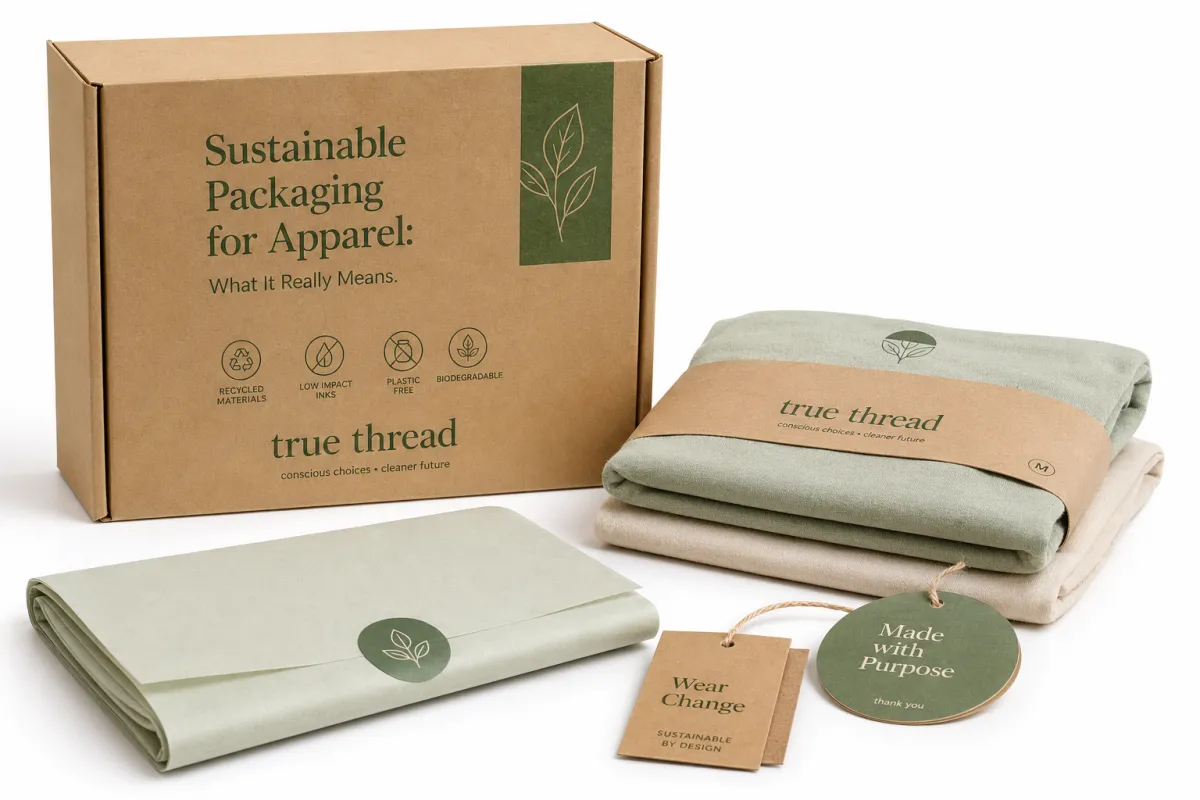
I once stood on a packing line in Dongguan while a buyer argued that a lighter mailer was better for the planet because it used less material. The line supervisor held up a denim jacket, pointed at the corner, and asked one question: “Will it rip there after a 3,200-kilometer truck ride?” That was the right question. Sustainable packaging for apparel only works if the package protects the product well enough to prevent re-ships, damage returns, and replacement freight, because a return from Los Angeles to Guangzhou is still waste even if the sample room liked the print.
In practical terms, sustainable packaging for apparel does four jobs at once. It protects garments from moisture, abrasion, and crushing. It uses responsibly sourced or recycled materials where the use case supports them, such as 80 gsm FSC tissue or a 32 ECT corrugated shipper for folded knits. It avoids unnecessary mixed components that make recovery harder. It also fits the brand so customers do not feel like they received a bargain-bin experience. Getting all four right without paying a premium for vague claims takes discipline, not wishful thinking, and definitely not a random slide deck with leaf icons on every page.
There are three layers worth separating. Primary packaging touches the garment directly, like tissue, poly bags, or garment sleeves. Secondary packaging is the brand or retail presentation layer, such as a mailer or folding box. Transit packaging is the outer carton that survives the warehouse, the parcel network, and the porch drop. Sustainable packaging for apparel usually improves fastest at the secondary and transit levels because that is where most waste and cube live. That is also where the biggest “why are we shipping half a warehouse to one customer?” moments tend to show up, especially on orders with a $48 hoodie and a $6.50 box.
Brands get tangled when they stack too many materials into one format. A recycled paper mailer with a plastic window, metallic foil, heavy lamination, and a glue line that will not separate cleanly may look premium on a render, yet it is not friendly to recovery. Mono-material designs are easier to process, and a plain fiber mailer with soy-based ink on a 300 gsm board often gets you farther than a complicated laminate. Clean fiber-based structures usually have better recycling pathways than mixed laminates. If you want strong branded packaging without the clutter, keep the material story simple and easy to explain. I have never met a customer who said, “I love this box, but I wish there were four more layers of stuff I will never be able to sort.”
Local infrastructure matters too. Recyclable is not the same thing as recycled. Recycled content is not the same thing as compostable. Reusable is not the same thing as “we hope someone keeps it.” Sustainable packaging for apparel should match the markets your customers actually live in, whether that is Toronto, Manchester, or Osaka. A package design that works in one city can be a dead end in another, and that is not a design flaw so much as a mismatch between claim and reality. If a package depends on a very specific municipal system, I get skeptical fast, especially when the claim is supposed to support a launch in 14 countries.
For reference points, I like to keep the standards conversation grounded. The International Safe Transit Association has useful material on parcel testing at ista.org, and packaging terminology and sustainability language stay cleaner when your team understands industry basics from sources like packaging.org. Standards will not design the package for you, but they do stop everyone from making claims that collapse under inspection, which is a service I appreciate more than most marketing copy, especially when the project has a three-week proof window and one legal review.
The best definition of sustainable packaging for apparel is almost boring. It is the package that reduces waste, fits the product, supports the brand image, and can be explained without a 14-slide deck full of hand-waving. The glossy version is nice. The boring version gets paid, and in my experience, the boring version also keeps customer service from muttering under their breath every Monday morning after the 7:30 a.m. ticket queue opens.
“We spent more on the return that the cheaper mailer caused than we saved on the unit cost.” That was a real client quote from a DTC basics brand shipping 12,000 units a month, and it sums up sustainable packaging for apparel better than most marketing copy ever will.
How Sustainable Packaging for Apparel Works in the Real World
Sustainable packaging for apparel works best when you design the full stack, not just the outer shell. The first decision is what touches the garment. A folded tee might need a light tissue wrap and a recycled-content polybag with a 1.5 mil film. A knit sweater may need a dust barrier and a stronger mailer. A luxury piece might justify a rigid presentation box, but only if the shipping profile supports it and the landed cost stays within the target, such as $1.20 to $1.80 per unit for the box itself. Different products need different packaging, and pretending otherwise is how budgets go sideways. I have seen too many teams try to make one package do the work of four just because it looked neat in a concept board.
Packaging design matters as much as material choice. I watched a New Jersey 3PL reject a beautiful mailer because the closure flap got weak after a hot summer truck run. The material spec looked fine on paper: 90 gsm kraft liner, water-based adhesive, and a recycled-content claim. In the warehouse near Newark, the adhesive failed after the cartons sat by a dock door for four hours at 88 degrees Fahrenheit. Sustainable packaging for apparel has to survive storage, packing-line handling, and the last mile. Paper weight alone does not save you, and neither does a fancy mockup if the glue starts acting like it has somewhere better to be.
Right-sizing is one of the fastest wins. Trim the box footprint by 10% and you may lower void fill, cut dimensional freight, and improve shelf feel at the same time. That is not theory. I have seen a mid-size leggings brand in Austin save roughly $18,000 a year by moving from three box sizes to two standard dielines and trimming excess headspace from 3.25 inches to 1.25 inches. Sustainable packaging for apparel often pays for itself through smarter sizing before anyone even starts talking about recycled content. It is one of those rare moments in packaging where the spreadsheet and the planet are on speaking terms.
Print is another place where teams overspend without getting much in return. Ink is not free and it is not neutral. Simplifying print blocks, reducing flood coatings, and using one or two spot colors can lower cost and improve recyclability. That does not mean the package has to look plain. It means the branding needs to work harder with less, maybe with a single deep green ink, a blind emboss, or a 350 gsm C1S artboard sleeve that feels intentional without a full-coverage flood. Good branded packaging feels deliberate. Bad branded packaging feels like someone said yes to every idea in the room, and then said yes again when the room got louder.
End-of-life claims need discipline. Recyclable means the structure is accepted in a recycling stream that actually exists where the customer lives. Recycled content means some portion came from recovered material, often 30% PCR or a 70/30 mix depending on the spec. Reusable means the structure can be used again without falling apart after one trip. Compostable only matters if the item meets the right standard and the local system can handle it. Sustainable packaging for apparel should state the claim you can support, not the one your designer wants on a mockup because it looks prettier in a presentation.
If you are building a retail program and e-commerce at the same time, do not force one format to do everything. A premium boutique store box and a fulfillment mailer do different jobs, and a 350gsm C1S artboard folding carton is not the same tool as a 2.7 mil poly mailer. I often split them into two specs: one for retail packaging and one for shipping. That keeps the line efficient and lets the brand keep its visual language without making the whole operation pay for a premium feature nobody sees on a porch. There is no medal for overengineering the same carton to death.
One more practical point: material availability changes. Recycled fiber mills can be tight on certain calipers, and some coatings or adhesives have lead time swings that no mood board can fix. Sustainable packaging for apparel gets easier when your design allows flexibility. If your box only works with one obscure board grade from one plant in Guangdong, your plan is already fragile. I have lost count of the number of “perfect” designs that fell apart the moment somebody called procurement and asked for a 20,000-piece quote with a 12-day ship window.
Sustainable Packaging for Apparel: Cost and Material Trade-Offs
People love asking for the greenest option and then fainting at the quote. Fair enough. Sustainable packaging for apparel can be cheap, reasonable, or annoying, depending on the format, the print, and the order size. A recycled paper mailer at 5,000 pieces may land around $0.15 per unit, while the same structure at 25,000 pieces can slide closer to $0.11 if the board is in stock and the artwork stays within two colors. A corrugated apparel box can run $0.42 to $0.88 depending on size, board grade, and print coverage. A rigid premium box is another conversation entirely, because luxury packaging rarely behaves like a budget item and never feels guilty about it.
The price changes fast. Custom printing adds setup. Specialty coatings add cost. Low minimums add cost. Oversized dimensions add shipping cost. Imported freight from Ningbo to Los Angeles can turn a sensible quote into a circus, especially if you miss the peak season booking window by a week. I once saw a brand approve a “simple” box at $0.62 per unit, only to discover the freight pushed landed cost past $0.90, with another $0.05 for inland drayage. Sustainable packaging for apparel should be evaluated on landed cost, not sample-room fantasy math. If the sample looks great but the invoice looks like an accusation, the sample did not really win.
Here is the part most teams miss. A cheaper package can create more expense if it increases damage, raises cube, or slows pack-out. I’ve seen a thin mailer save $0.03 and then trigger a 4% increase in returns on a swimwear program, which wiped out the savings in under six weeks. Sustainable packaging for apparel should reduce total waste, not just material usage. If the package fails, you pay twice: once to ship it, and again to fix the mess. And then somebody in ops has to hear about it from five different directions, usually on a Monday with a full inbox and a half-finished coffee.
| Option | Typical Unit Cost | Strength | Best Use | Trade-Off |
|---|---|---|---|---|
| Recycled paper mailer | $0.11-$0.30 | Light, printable, easy to recycle in many markets | Tees, socks, lightweight basics | Less crush protection than a box |
| Corrugated apparel box | $0.42-$0.88 | Better protection and premium feel | Premium orders, gift sets, folded knits | Higher freight cube if oversized |
| Mono-material poly mailer | $0.09-$0.22 | Low weight, good moisture resistance | High-volume e-commerce shipping | Less accepted by some customers as green unless explained well |
| Rigid gift box | $1.10-$3.50+ | Strong presentation, high perceived value | Luxury retail packaging and gifting | Heavy, bulky, and expensive to ship |
Simplifying the structure is often the biggest savings lever. One or two dielines instead of six. One closure system instead of three. One print process instead of a mix of foil, embossing, and spot UV. I have negotiated runs where removing a single insert saved $2,000 on the production order and shaved six days off the schedule, and one fold change from 0.5 inches to 0.25 inches cut board usage enough to lower the quote by 7%. Sustainable packaging for apparel rewards restraint more than decoration. That sounds a little unfair if you love embellishment, but the factory does not care about your mood board.
Ordering volume changes the math too. A custom run of 5,000 units is priced very differently from 25,000 units. I have seen recycled paper mailers priced near $0.28 each at a 3,000-unit run and closer to $0.16 at 20,000 units when the paper was sourced from a mill in Zhejiang and the print stayed within one pass. If your buying team splits orders into tiny batches, the unit cost climbs and the whole sustainability story looks overpriced. Nothing mystical there. Just manufacturing, with all the charm and none of the drama people wish it had.
If you want flexible sourcing options, I often tell brands to compare a dedicated sustainable supplier with a broader production partner like Custom Packaging Products. A specialist can be great for niche materials, but a supplier who understands structure, print, and fulfillment constraints can save you real money. Sustainable packaging for apparel is not won by the most polished sample. It is won by the best fit between spec, volume, and distribution path. I know that sounds less glamorous than a launch video, but it is a lot cheaper.
Premium still matters. If your customer receives a box that looks cheap, the brand damage can outweigh the savings. That does not mean you should spend wildly on embellishment. It means you need enough visual order to support the product, whether that is a matte black mailer with a single foil mark or a kraft box with a 35 mm branded sleeve. Sustainable packaging for apparel should feel deliberate, not stripped bare just for the sake of a talking point. Customers can tell the difference between thoughtful minimalism and budget panic.
Step-by-Step Process and Timeline for Apparel Brands
The fastest way to improve sustainable packaging for apparel is to stop guessing. Start with an audit. Pull the top 10 SKUs by volume, the top 3 shipping lanes, and the current damage or return rate from the last 60 days. I like to see product weight, pack dimensions, current material type, and any customer complaints tied to package condition, all on one sheet in Excel or Google Sheets. Without that, you are just decorating the problem, and I have seen enough decorated problems to last a lifetime.
Step 1: audit the current setup. Look at what you actually ship, not what the design file says you ship. A buyer once told me their box was standard. It turned out they had three slightly different board calipers, two closure styles, and four print SKUs hiding under the same name. Sustainable packaging for apparel gets easier when the mess is visible. If nobody knows what is happening in the carton room, you are already losing time, probably 2 to 3 hours a week in rework alone.
Step 2: write a one-page spec. Keep it simple. Include size, material, target recycled content, print limits, closure type, and any claims you plan to make. If you want FSC-certified board, say so. If you need a recyclable mono-material mailer, say that too. The more precise the brief, the fewer bad samples show up. I have seen a vague brief waste three weeks and two rounds of art changes, which is a very expensive way to learn that “please make it premium” is not a spec.
Step 3: sample and test. Do not skip this. Request physical samples and run pack tests, drop tests, and retailer acceptance checks. If you ship through parcel networks, use the actual lane and actual carton weights, like a 24-ounce folded hoodie in a 12 x 10 x 3 inch box. If you are selling to wholesale accounts, test the receiving standards. I care less about how the package photographs and more about whether it survives an ISTA-style drop sequence and still opens cleanly at the end. Sustainable packaging for apparel that fails in transit is just expensive scrap, and the warehouse will absolutely remember which carton caused the problem.
Step 4: plan the timeline. A realistic schedule is 3 to 5 business days for the audit, 5 to 10 business days for samples, 5 to 12 business days for revisions and approvals, and typically 12 to 15 business days from proof approval to production for a domestic run in places like Los Angeles or Dallas. If you are ordering from overseas, add 18 to 28 days for ocean freight and customs, with another 3 to 7 days if you need delivery to a 3PL in New Jersey. If your artwork has multiple approvals from marketing, legal, and ops, add more time again. Brands usually underestimate the human delay, not the manufacturing delay. That is where calendars go to die, usually right after someone says, “This should be quick.”
Step 5: roll out in phases. Start with one hero SKU, one shipping lane, or one region. I once helped a knitwear brand switch just its top-selling sweater line to a cleaner packaging spec from a factory in Dongguan. They measured breakage, customer comments, and warehouse speed for six weeks before scaling it across the rest of the catalog. That gave them proof and kept the risk low. Sustainable packaging for apparel works better when you earn the rollout instead of betting the entire business on one pilot. Slow is not glamorous, but it is much less embarrassing than a failed full launch.
If your current supplier cannot support testing, ask for it in writing. A lot of factories say yes to whatever sounds smart in the call, then go quiet when the production sample needs correction. Ask for certified board, a documented recycled-content declaration, and clear lead times. If the supplier also handles branded packaging and custom printed boxes, even better. One production partner who understands the whole path usually saves you more grief than three disconnected vendors, and far fewer “just checking in” emails.
Sustainable packaging for apparel also benefits from a phased budget. I like to separate development spend, sample spend, and production spend. A brand can expect sample work to cost $150 to $750 for a simple paper mailer set, or $800 to $2,500 for a multi-part box program with inserts, while production setup may absorb die fees, plate charges, or tooling. If you treat those as part of the launch cost, nobody gets surprised later. Surprise is just another word for bad planning with a nicer blazer, and packaging budgets have enough trouble without fashion metaphors making them worse.
Finally, document the result. Measure freight cube, damage rate, customer satisfaction, and packing speed. If the new format saves 14 seconds per pack-out and cuts 2% of damage, that matters. Sustainable packaging for apparel needs proof, not applause. The operations team will trust you more if you bring numbers instead of enthusiasm and a vague story about brand energy.
Common Mistakes When Choosing Apparel Packaging
The first mistake is choosing the greenest material without testing the real shipping lane. I have seen lightweight paper mailers collapse on corners, then get blamed for customer complaints that were fully avoidable on a route from Portland to Phoenix in July. Sustainable packaging for apparel is not a race to the thinnest substrate. It is a balance between protection and waste reduction. If the package fails, the supposed environmental win disappears in a pile of returns, and nobody is excited about that pile.
The second mistake is mixing too many materials. Foil, window film, laminated board, plastic ties, and a waxy coating may look expensive, but they make separation a mess. A lot of retail packaging gets overbuilt because the design team wants the full look. Then operations has to live with the fallout. I have watched a brand spend nearly $9,000 on a launch run in Ho Chi Minh City and then discover the structure was impossible to explain cleanly to customers. Sustainable packaging for apparel should make the recovery story clearer, not muddy it. If the best explanation involves hand gestures, that is already a warning sign.
The third mistake is printing everything. Every inch of ink adds cost, artwork complexity, and sometimes lead time. One client wanted a full-coverage pattern on the inside and outside of a mailer, plus a metallic ink pass and a flood varnish. We reduced it to a strong exterior mark, a single interior message, and one spot color, and the change dropped the print quote by $0.04 per unit on 20,000 pieces. Sustainable packaging for apparel does not need to be blank. It does need discipline, and maybe a little restraint from the person who thinks every empty corner is a missed opportunity.
The fourth mistake is trusting vague supplier language. “Eco-friendly,” “green,” and “sustainable” are not specs. Ask for FSC chain-of-custody if the board claim matters. Ask for recycled-content proof if that is the selling point. Ask for material descriptions in writing, like 350gsm C1S artboard, 100% recycled kraft liner, or 30% PCR poly film. If you cannot verify the claim, you do not have a claim. You have a slogan, and slogans are great for posters but terrible for audits.
The fifth mistake is ignoring total landed cost. Unit price is only one piece. Freight, damage, repack labor, warehouse time, and customer returns all live in the same bucket in the end. I have seen a brand choose a cheaper mailer and then lose money because the package required an extra piece of void fill and slowed the line by 6 seconds per order, which added up to 3.5 labor hours on a 2,100-order day. Sustainable packaging for apparel should be judged by the whole bill, not the sticker on the sample. I know people hate hearing that, but math remains rude even when everyone is tired.
Do not chase every trend. Compostable films, seed paper inserts, and novelty closures all get attention, but they are not automatically right for apparel. If the structure does not match the garment and the route, it is just expensive clutter. Brands sometimes ask me to make a package feel greener instead of actually performing better. I usually tell them that feelings are not a freight class. That line gets a laugh, and then somebody quietly asks for the real shipping rate from the plant in Ningbo.
That is why I recommend reviewing a simple package brief against the order profile before you buy anything. If you need a starting point, our Custom Packaging Products page is a practical place to compare standard structures before you go custom. Sustainable packaging for apparel gets safer the more concrete your specification becomes. And yes, concrete is a much more useful material than vibes.
Expert Tips for Better Sustainable Packaging Decisions
Start with one hero SKU. Not ten. Not the whole line. One. I have seen brands save months by fixing the packaging for their best-selling sweatshirt or core tee first, then using those findings to guide the rest of the program. Sustainable packaging for apparel becomes easier to manage when the pilot is narrow and the data is clean. I know that sounds less exciting than a full rebrand, but it is how you avoid a pile of half-finished decisions and a very cranky warehouse.
Standardize dielines wherever you can. If your small, medium, and large boxes are only different by a few millimeters, ask whether you can collapse them into one or two formats. That reduces tooling churn, minimizes art updates, and keeps the factory from charging you every time someone wants a special version. I have negotiated with suppliers who shaved $1,500 to $3,000 off a production run just by removing one off-size and one insert, and a 1 mm board adjustment sometimes changed the freight class enough to lower the lane cost by another $0.06 per unit. That is the kind of boring victory I will happily celebrate with coffee.
Ask for the paperwork nobody wants to dig up. FSC certificates, recycled-content declarations, chain-of-custody records, material spec sheets, and testing notes. Fancy mockups do not tell you if the paper content is verifiable. Sustainable packaging for apparel is more credible when the supplier can back up every claim in a file folder instead of a sales deck. If they act annoyed by basic documentation, that is your signal to keep looking. If they say, “Sure, here it is,” I trust them more immediately.
Use a two-tier spec. I like one package for premium or gifting orders and one lean spec for everyday shipments. That way you protect margin without making every order pay for the top shelf. Sustainable packaging for apparel does not have to be identical across all channels. A DTC order and a retail gift box have different jobs, and pretending otherwise is how brands overbuild the standard case and then wonder why the numbers feel off. A 350gsm C1S artboard sleeve may be perfect for a boutique launch, while a 2.5 mil recycled mailer is better for everyday fulfillment.
Negotiate with real numbers. Bring damage rates, freight cube, and pack-out time into the conversation. If a supplier can reduce cost by changing board weight from 350 gsm to 320 gsm, say exactly what that does to performance. If a simple insert removal saves $2,000 on a run, lock it in. I have sat in pricing meetings where a buyer asked for a better deal and got nowhere. I have also seen the same buyer get a meaningful reduction when they walked in with line data and a target specification. Numbers change the mood fast, which is helpful because mood is not a procurement strategy.
Do not forget the customer. Some buyers love minimal packaging; others still expect a premium reveal. That means the final design should reflect the brand and the product, not just the sustainability score. Sustainable packaging for apparel can still feel sharp, but the finish, print, and opening sequence should be intentional. If you need one more place to compare structure and presentation ideas, a supplier with custom printed boxes can show you the difference between basic transit packaging and something that supports package branding without excess.
One practical trick from the factory floor: keep spare sample boards and a simple sign-off sheet at the line. When I visited a plant that handled fashion basics for a large private label account in Suzhou, their success came from boring discipline. Every sample had a date, board grade, and approved use case written on it, and the operator checking the line could point to the exact approved 9 x 6 x 2 inch carton in under 10 seconds. No guessing. Sustainable packaging for apparel tends to stick when the team can point to the approved sample and say, “That one. Make it exactly like that.” It is not fancy, but it works.
For teams that want to compare options cleanly, I also like anchoring the conversation to visible standards and test methods. A package that passes relevant transit testing, uses sourced board correctly, and matches the shipping lane is a much safer bet than a random eco claim. The goal is not perfect purity. The goal is a package that works, documents well, and does not waste money pretending to be more virtuous than it is. That balance is where sustainable packaging for apparel gets real.
Sustainable Packaging for Apparel: Next Steps That Actually Work
If you want sustainable packaging for apparel to move from idea to execution, start with a one-page brief for each top-selling SKU. Include product weight, folded dimensions, shipping lane, current damage rate, and your target claim. That one page will do more for your project than a month of brainstorming. I have seen it cut decision time in half because everyone finally looked at the same facts instead of arguing about whose version of the truth sounded more polished.
Then gather three quotes. One from your current supplier. One from a specialist known for cleaner material systems. One from a corrugated partner that understands scale and print. If you need a broad place to benchmark production styles, our Custom Packaging Products catalog can help you compare structure, print, and price without starting from zero. Sustainable packaging for apparel gets easier when you see the trade-offs side by side instead of in separate emails that all say best pricing with no detail, which is somehow always the case.
Next, pilot the smallest useful order. Test it in the real lane. Track breakage, customer feedback, freight cost, and packing speed. If the pilot saves 10 cents on material but costs 12 cents in labor, you learned something valuable. If it lowers damage and improves presentation, even better. Sustainable packaging for apparel deserves a scorecard with actual numbers, not vibes and someone’s favorite mockup. I am not anti-vibes in general, but I do prefer them to remain off the purchase order.
Here is the scorecard I use most often: price, protection, recyclability, print quality, lead time, and claim support. Give each option a simple 1-to-5 score. It is not elegant, but it stops the room from falling in love with the prettiest sample. Sustainable packaging for apparel should win on performance first and appearance second, not the other way around. If the sample is gorgeous but the timeline is a mess, the sample is not helping, especially when production is booked in Guangzhou for the next 18 days.
I still remember a meeting with a fast-growing basics brand that wanted to change everything in one go. New mailer. New tissue. New outer carton. New insert. I told them to stop. We cut the project down to one SKU, one lane, and one supplier. Six weeks later, they had a lower damage rate, a cleaner pack-out, and a better story for investors. That is the real win. Not a giant rewrite. A controlled improvement. Honestly, that kind of restraint is harder than it looks, particularly when the team wants to launch before the next earnings call.
Sustainable packaging for apparel can still look good. It just needs to earn its keep. If the structure protects the garment, fits the lane, and gives the customer a tidy branded experience, that is a packaging program worth keeping. If you are still arguing over whether the box is green enough without checking the freight bill, you are solving the wrong problem. I have been in that meeting, and it tends to go nowhere except more meetings.
Start small. Pick one SKU. Pick one shipping lane. Pick one supplier. That is how sustainable packaging for apparel gets done without wasting another quarter on slides, samples, and opinions that never touch a packing table. It is also how you keep your team sane, which feels like a nice bonus when the first pilot ships 4,800 units and the ops team still has energy left on Friday afternoon.
FAQ
What is the best sustainable packaging for apparel brands?
The best option depends on the garment, shipping method, and customer expectation, but recycled paper mailers, FSC-certified boxes, and mono-material mailers are the most practical starting points. For many brands, sustainable packaging for apparel works best when the structure fits closely, protects the item, and can be reused or recycled in the markets where customers actually live, whether that is Canada, the UK, or the Northeast United States.
Is sustainable packaging for apparel always more expensive?
No. Some formats cost more upfront, but simpler designs, standard dielines, and larger order quantities can bring the unit price close to conventional packaging. A recycled mailer at 10,000 pieces may cost less than a heavily printed conventional box at 3,000 pieces, and the real comparison is total landed cost, including damage rates, freight cube, and returns. Sustainable packaging for apparel often saves money once you count those hidden costs, which is convenient because hidden costs are usually where the trouble lives.
How long does it take to switch to sustainable packaging for apparel?
A small switch can take 4 to 8 weeks if the design is simple and the supplier has stock material ready. Custom printed or imported packaging can take longer because samples, approvals, and production all add time, and a domestic production run often needs 12 to 15 business days after proof approval before it ships. If the brand needs new artwork, compliance review, or multiple SKU sizes, sustainable packaging for apparel usually needs a longer runway.
Can sustainable apparel packaging still protect garments in transit?
Yes, if the package is tested for the actual shipping lane, parcel size, and garment type. A 32 ECT corrugated shipper, a 350gsm C1S artboard presentation box, or a 2.5 mil recycled mailer can all protect garments well when the design matches the route and the pack-out. The goal is to balance protection and material efficiency, not to make the package as thin as possible. Sustainable packaging for apparel should survive handling, compression, and drop risk without creating avoidable returns.
How do I know if a packaging supplier is really sustainable?
Ask for documentation: recycled-content proof, FSC or GRS certificates where relevant, and clear material specifications. If the claim is vague, unsupported, or impossible to verify, treat it like marketing fluff and keep digging. Sustainable packaging for apparel is only credible when the supplier can back the claim with paperwork, not just a polished sales deck, and a factory in Dongguan or Zhejiang should be able to provide that within a couple of business days if the claim is real.
Actionable takeaway: pick one top-selling SKU, one real shipping lane, and one packaging format, then test it with actual pack-out and transit data before you roll the change across the line. That is the fastest path to sustainable packaging for apparel that looks good, ships cleanly, and holds up in the field.


