Buyer Fit Snapshot
| Best fit | design peel and seal labels work for packaging buyers comparing material specs, print proof, MOQ, unit cost, freight, and repeat-order risk where brand print, material, artwork control, and repeat-order consistency matter. |
|---|---|
| Quote inputs | Share finished size, material target, print colors, finish, packing count, annual reorder estimate, and delivery region. |
| Proofing check | Approve dieline scale, logo placement, barcode or warning zones, color tolerance, and any recyclable or compostable wording before bulk production. |
| Main risk | Vague material claims, crowded artwork, or missing packing details can create delays even when the unit price looks attractive. |
Fast answer: Design Peel and Seal Labels Work: Dieline, Finish, Proof, and Buyer Review should be specified like a repeatable production item. The safest quote includes material, print method, finish, artwork proof, carton packing, and reorder notes in one written spec.
What to confirm before approving the packaging proof
Check the product dimensions against the actual filled item, not only the sales mockup. Ask for tolerance on folds, seals, hang holes, label areas, and retail display edges. If the package carries a logo, QR code, warning copy, or legal claim, reserve that space before decorative graphics fill the panel.
How to compare quotes without losing quality
Compare board or film grade, print process, finish, sampling route, tooling charges, carton quantity, and freight assumptions side by side. A lower quote is only useful if the supplier can repeat the same color, closure quality, and packing count on the next order.
I still remember the first time I had to explain how to design peel and seal labels to a production manager in Jiangmen while a bottling line sat idle because a liner was grabbing too hard. Twenty-two minutes does not sound like much until you are standing beside a 14,000-bottle run, watching 60 cases an hour slide into overtime, and doing the math in your head, which is never a fun little hobby. That experience taught me a lesson I keep repeating: how to design peel and seal labels is not just about making the artwork look polished, it is about matching the label to the container, the adhesive, the liner, and the way the product will actually move through packing, storage, and shipping, whether the job is being produced in Dongguan, Foshan, or a smaller label shop outside Shenzhen.
If you are learning how to design peel and seal labels, it helps to picture them as pressure-sensitive labels that sit on a release liner, peel off cleanly, and bond with hand pressure or through an applicator. Brands like them because the workflow is quick, tidy, and predictable on everything from 250 mL glass jars to corrugated mailers, and because a 5,000-piece run can often move through production in about 12-15 business days after proof approval. Too many teams stare at color and layout for hours, then wonder why a corner lifts or a curved bottle wrinkles the image after filling. That is not a design win. That is a reprint with a polite smile and a freight bill attached.
The real challenge in how to design peel and seal labels is simple enough to say and annoyingly easy to ignore: attractive graphics are only one layer of the job. The label has to fit the surface, survive the environment, and apply the same way 500 times in a row, not just once on a spotless desk under perfect light with nobody breathing on it. If you are ordering through Custom Logo Things, this is the version of the process I would want on my desk before I spent money on plates, cuts, or specialty stock like 350gsm C1S artboard, 2 mil white BOPP, or a 40 gsm glassine liner. Honestly, that saves more heartbreak than any fancy mockup ever will.
What follows covers the working structure of the label, the details that shape quality, what drives cost, how long production usually takes, and the mistakes that keep showing up in factory proofs. I have sat through press checks in Dongguan, argued with suppliers over liner release forces measured in grams per inch, and watched a brand lose a Saturday launch because the edge curl looked fine in the file but failed on chilled bottles at 38 degrees Fahrenheit. How to design peel and seal labels gets a lot easier once the right details are in view, even if the details are the part everyone wants to skip until the last minute. And yes, the boring parts are usually the parts that keep the whole thing from falling apart.
How do you design peel and seal labels without guesswork?
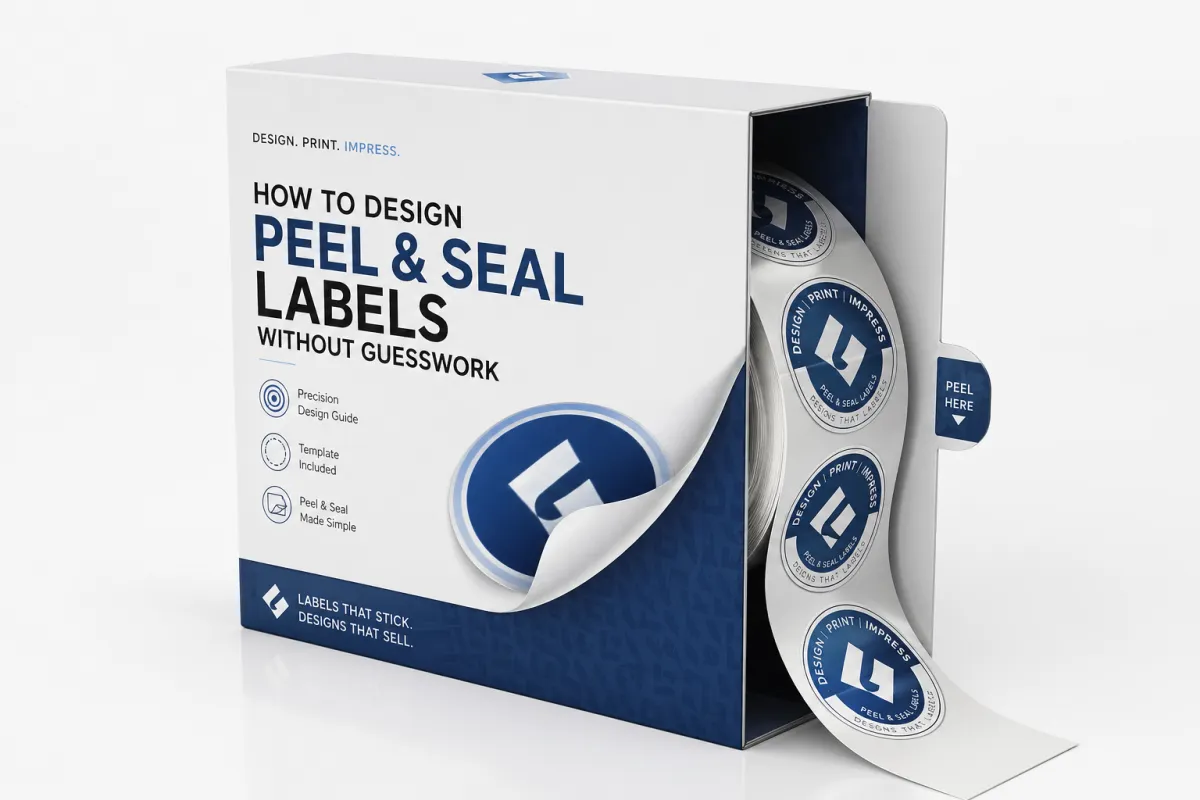
Start with the container, the environment, and the application method before you touch the artwork. If you want how to design peel and seal labels to feel predictable instead of experimental, define the substrate, the temperature range, the surface texture, and whether the labels will be applied by hand or with a label applicator. A clean die line, the right pressure-sensitive adhesive, and a liner that releases at a steady rate are the difference between a tidy run and a line full of small, expensive annoyances. That is the shortest honest answer I can give, and it saves a lot of back-and-forth later.
Once those basics are set, build the layout around bleed, safe margins, and readability at actual size. That is the part of how to design peel and seal labels that prevents the elegant file from turning into a messy print job. A label can look excellent on a monitor and still fail on a curved bottle, a chilled jar, or a corrugated mailer if the artwork is too close to the trim or the adhesive is wrong for the surface. The best files are the ones that already respect production, not the ones that expect production to rescue them.
How Peel and Seal Labels Work
At the most basic level, how to design peel and seal labels starts with understanding the sandwich. You have a face stock on top, which is the printed layer customers actually see; a layer of adhesive underneath, often a permanent acrylic or freezer-grade rubber-based formula; and a liner on the back, usually 40-50 gsm glassine or clay-coated paper, that keeps the label flat until it is ready to use. When the liner peels away cleanly, the label can be placed on the container by hand or by machine, then pressed down so the adhesive wets out on the surface. Cleaner release usually means steadier application, and steadier application means fewer people muttering at the end of the line.
I usually explain how to design peel and seal labels to first-time buyers by comparing it to a prep line in a bottling plant. If the operator has to fight the liner, the rhythm breaks. If the adhesive is too aggressive, the label skews before it lands. If the stock is too stiff for a round bottle, the edge lifts overnight and everyone suddenly develops very strong opinions about "the label art." On one private-label sauce job in Jiangmen, we used a 60 lb gloss paper with a permanent acrylic adhesive on glass. It worked because the fill line stayed dry and the bottles were straight-sided. On a cold-brew project in Foshan, the same style failed the second condensation hit the pack. Different product. Different answer. That is the whole lesson, and I wish more people wrote it down before approving anything.
There is also a real difference between how to design peel and seal labels for manual application and designing for an applicator. Hand-applied labels can tolerate a little more forgiveness in the margin and placement, while machine-applied labels usually need tighter dimensional control, more consistent roll winding, and predictable liner release. A label that feels fine in a sample pack can become a headache once a line operator is moving 40-60 units a minute on a semi-automatic table. The line does not care that the mockup looked beautiful. It only cares whether the roll feeds, the edge holds, and the adhesive behaves like it said it would.
These labels work well on jars, bottles, sleeves, mailers, corrugated cartons, and short-run branded packaging where speed matters without giving up finish quality. I have seen how to design peel and seal labels used on subscription boxes, Hot Sauce Bottles, candle jars, and shipping mailers with the same basic structure, yet each category asks for a different adhesive behavior. A candle jar sitting at room temperature does not need the same bond as a refrigerated yogurt cup, a 12 oz soda bottle, or a shipping carton that picks up humidity in transit on a route through Guangzhou and Shenzhen. If you ignore that difference, the label will remind you later, usually in the least charming way possible.
"The proof looked perfect on the PDF. Then the applicator met the liner, and the truth showed up fast." That was a line a plant manager in Dongguan gave me after we fixed a misfeed issue on a 3,000-unit run, and it still sums up how to design peel and seal labels better than most marketing copy ever will.
Key Factors That Shape Peel and Seal Labels
If you want how to design peel and seal labels to hold up in the real world, start with the material. Paper is usually the least expensive choice and works well for dry products, short promotions, and indoor use. A 350gsm C1S artboard can be a smart choice for carton seals or premium paperboard wraps, while 2 mil white BOPP, 3 mil clear BOPP, and 4 mil vinyl each solve different packaging problems. Specialty stocks, including metallics and textured papers, create a premium finish, but they can push the quote up fast. I have seen a foil-laminated label look stunning on a shelf in Shenzhen and feel completely wrong on a greasy deli container in a wet market outside Guangzhou. Pretty is not enough, even if the shelf photo gets a lot of compliments.
Adhesive choice matters just as much as the face stock when you are planning how to design peel and seal labels. Permanent acrylic adhesive is a common default because it holds well on glass and many plastics, but surface texture, moisture, and temperature change everything. A lightly textured kraft carton needs a different approach from a cold glass bottle with condensation on it, and low-surface-energy plastics like HDPE often need a more aggressive adhesive than PET. If the package is going into refrigeration, freezer storage, or damp handling, the stock and adhesive combination should be built for that condition, not guessed at from a sample image. I have seen a lot of expensive guessing, and it rarely ages gracefully past the first warehouse shift.
Then there is the artwork itself. How to design peel and seal labels means planning for bleed, safe margins, corner radius, and barcode legibility before you send the file. I like to see at least 0.125 inch bleed, a safe zone of 0.08-0.125 inch for critical copy, and enough breathing room so the die cut does not bite into a logo or legal text. For a rounded bottle, the corner radius needs to respect the container curve, especially if the label wraps around a 28 mm neck or stops short of a shoulder seam. If the label wraps too far or ends too abruptly, it can trap air and start peeling at the edge. It sounds small until the top corner starts flapping after a day in the cooler, and then suddenly it sounds very large.
Finish options are not just decoration. Matte softens reflections and can make premium skincare or candle labels feel expensive, while gloss helps color pop under retail lighting in a supermarket aisle with 4,000 lux overhead fixtures. Soft-touch lamination creates a nice hand feel, but it also adds cost and can shift turnaround by a day or two if the converter is backed up in Foshan or Zhongshan. If you are comparing options, how to design peel and seal labels should include a decision on what the finish is supposed to do: protect the print, support the brand, or both. I have seen teams spend $1,200 on an upgraded finish for a run where the product lasted six weeks. That is a quick way to spend like the label is part of a museum exhibit.
Compliance is another piece people skip until the last minute. If the label needs ingredient statements, warning copy, barcodes, or legal text, the layout has to support that information without turning the pack into a wall of tiny type. Brands that need an FSC-certified paper should ask for it early, not after the proof is approved, and they should confirm whether the mill can provide chain-of-custody documents before the 2:00 p.m. cutoff. For industry basics, packaging.org is a solid place to check packaging standards before you lock the spec.
I once worked with a beverage brand that wanted a natural paper look for a chilled bottle. Beautiful idea. Wrong execution. Condensation started at 38 degrees Fahrenheit, and the paper stock absorbed the moisture like a sponge. We switched the job to a white BOPP with a matte topcoat, kept the same artwork, and the edge lift problem disappeared. That is why how to design peel and seal labels needs to be driven by surface and environment, not just mood boards and good intentions.
If you are shopping for a wider mix of formats beyond this label style, our Custom Labels & Tags page is a better starting point than guessing from a single sample. The wrong format can cost you more than the label price; it can slow the whole packing table down, and nobody likes explaining that to operations at 5:40 p.m. on a Friday when the last pallet is still on the dock.
Peel and Seal Labels Cost: What Drives Pricing
Pricing for how to design peel and seal labels is usually driven by six things: material, adhesive, size, finish, quantity, and whether the shape needs a Custom Die Cut. A simple 2.5 x 4 inch paper label on matte stock with a standard permanent adhesive might land around $0.15 per unit for 5,000 pieces from a Shenzhen converter. Move the same label to white BOPP and the price may climb to $0.23-$0.28 per unit at the same quantity. Add soft-touch lamination or metallic effects, and you can easily see $0.39-$0.62 per unit depending on the printer and the order size. Those numbers are not fantasy. I have written them on actual quotes, then argued about them across a steel table in a factory office in Dongguan with fluorescent lights buzzing overhead, which is somehow the exact setting where all bad pricing surprises are born.
Setup costs are where small runs get expensive. When you are figuring out how to design peel and seal labels, remember that prepress, plate or digital setup, knife setup, and proofing are often spread over fewer pieces on a low-volume order. A 1,000-piece run might carry a unit cost of $0.34 when a 5,000-piece run drops closer to $0.15-$0.18, because the press time and prep work do not shrink in the same way. Once you cross into larger quantities, the unit price usually drops fast. That is why I always ask for quotes at 1,000, 5,000, and 10,000 pieces. One price point tells you very little. Three price points show you where the real break is, and they also reveal which vendor is being honest versus which one is throwing glitter at the spreadsheet.
I sat in one supplier meeting in Dongguan where a paper mill tried to tack on a $0.02-per-label liner increase because their release coating supplier had raised prices. On a 20,000-piece order, that was an extra $400 before freight, and the client never would have noticed until the invoice landed. We tested a different liner with a release force closer to 18-22 grams per inch, and the applicator ran better anyway. That is the kind of detail that changes how to design peel and seal labels from a quote exercise into a production decision. The difference between "looks fine" and "runs well" is usually hiding in a number nobody put on the first estimate.
| Option | Best For | Example Price at 5,000 Pieces | Notes |
|---|---|---|---|
| Matte paper | Dry goods, short promotions, mailers | $0.15-$0.20/unit | Lowest cost, but not ideal for moisture |
| White BOPP | Bottles, jars, refrigerated products | $0.23-$0.29/unit | Better moisture resistance and cleaner shelf appearance |
| Clear BOPP | No-label look, premium packaging | $0.25-$0.34/unit | Great for transparent containers, but print opacity matters |
| Vinyl or specialty stock | Textured surfaces, durable packs | $0.30-$0.45/unit | More forgiving on curved or rough surfaces |
| Soft-touch or foil finish | Luxury products, gift sets | $0.42-$0.80/unit | Higher setup and finishing cost, best when the pack justifies it |
That table is the short version of how to design peel and seal labels without getting ambushed by pricing. You save money by matching the label spec to the product life, not by stripping quality from a package that has to hold up for six months. I have seen brands overspend because they wanted a high-end tactile finish on a trial run that sold out in nine days. Nice label. Weak use of money. I say that with affection, but still.
If you are comparing quotes, ask for the same size, same finish, same adhesive, and same quantity across every vendor. Otherwise you are not comparing prices. You are comparing bait. Also check for hidden costs like art revisions, rush fees, split shipments, and sample charges. Those line items can add $75, $150, or more before a single label is printed. I have watched a "cheap" quote get expensive faster than a warehouse coffee pot empties on a Monday morning.
How to Design Peel and Seal Labels Step by Step
The clearest way to approach how to design peel and seal labels is to start with the brief, not the artwork. Before I open Illustrator, I want five details in writing: product type, container shape, order quantity, application environment, and the brand goal. A 250 mL glass bottle for shelf display is a different job from a 16 oz jar that gets refrigerated and handled by shoppers with damp hands. If the brief is vague, the label will be vague, and vague labels are expensive. They also tend to create vague conversations with accounting, which nobody enjoys at 9:10 a.m. on a Monday.
Next, request the dieline before finalizing the layout. That is not optional if you care about how to design peel and seal labels that actually fit. The dieline tells you the exact cut path, corner radius, bleed area, and trim limits, usually down to 0.5 mm on a well-run file. Designing without it is how people end up with a barcode too close to the edge or a headline chopped off by a rounded corner. I have watched a designer lose an entire afternoon because the template came in late and the logo sat 2.5 mm inside the safe zone instead of 4 mm. That kind of fix is avoidable, and if you have ever watched a team try to shrink a brand mark by 7 percent after approval, you know the mood in the room changes fast.
Once you have the shape, build the hierarchy. Brand name first, product name second, required information third, and decorative details only after the functional copy is clear. This matters more than people think when they are figuring out how to design peel and seal labels for retail shelves. A crowded front panel may look energetic on a monitor, but on a 3-foot shelf view, it reads like noise. Keep the main message legible from 4-6 feet away, especially if you are selling in a store where shoppers move fast and make decisions in about the time it takes to blink twice.
For file prep, I prefer vector artwork, outlined fonts, and images at 300 dpi at final size. Save the print file as a press-ready PDF if your printer allows it, or AI/EPS with linked assets packaged correctly. Keep line weights above 0.25 pt so they do not disappear in print, and avoid tiny reversed text under 5.5 pt unless you enjoy complaints. The file stage is where how to design peel and seal labels either turns professional or turns messy. There is no dramatic middle ground there, just a lot of prepress staring at a screen and trying not to sigh too loudly.
Proofing is where the real calendar lives. I like to map it as digital proof, color check, sample print, approval, production, trimming, and shipping. That sounds boring, and it is. Boring is what you want before a launch. A simple run with no revisions might move from proof approval to production in 12-15 business days. Specialty stocks, foil, lamination, or a new die cut can add several more days. If a supplier says they can do everything in two days and does not ask for a dieline, they are selling confidence, not accuracy. I have learned that one the hard way, and I would rather not revisit it.
How to design peel and seal labels also means thinking about the actual line conditions. Will the pack be labeled by hand at a table, or on a semi-automatic applicator? Is the surface dry, dusty, chilled, or slightly curved? Is the label going onto glass, PET, HDPE, or coated board? The same artwork can work across all four substrates, but the material and adhesive will not. That is why I push for a sample on the real container whenever possible. A mock bottle is useful. The real bottle is honest. It has no interest in being nice to your assumptions.
"We approved the proof on a laptop, and it looked fine. On the shelf, it looked like the product had a postage stamp stuck on it." I heard that from a buyer in a client meeting in Foshan, and it is exactly why how to design peel and seal labels needs a physical check before launch.
One more thing: if your label has regulatory copy, ingredients, or a barcode, test readability at print size. A UPC needs a clear quiet zone of at least 0.125 inch on each side, and a QR code needs enough contrast to scan under average retail lighting around 300-500 lux. If the code is going on curved packaging, keep it away from the seam. I once saw a supplement label fail because the QR code sat 3 mm over the transition point and the scan app could not lock. The art looked polished. The function was broken. That is a bad trade, and it is the kind of mistake that turns a tidy launch into a very untidy phone call.
For shipping-sensitive jobs, I also like to sanity-check the pack against ISTA testing ideas. You do not need a full lab report for every label, but if a bottle is going into transit and the label has to stay clean, intact, and readable after vibration or compression, a little test discipline saves a lot of embarrassment. A label that peels after a carton drop test is not ready for market, no matter how good it looks on the screen or how loudly someone insists the finish is "premium."
Common Mistakes With Peel and Seal Labels
The biggest mistake in how to design peel and seal labels is cramming too much into one panel. I keep seeing brands squeeze a paragraph of legal copy, three icons, a barcode, a QR code, a flavor story, and a logo into a label that only has room for two strong focal points. If the label size is 2 x 3 inches, the design has to respect that constraint. More text does not equal better branding. It usually equals squinting, and then somebody in the office says, "Can we make it all just a little smaller?" which is never a sentence that leads anywhere good.
Wrong adhesive selection is another classic error. A label that works on a dry carton may fail on a chilled bottle, a waxy jar, or a textured mailer. This is where how to design peel and seal labels becomes more about material science than graphic design. If the surface has low energy, the bond can be weak. If there is moisture or oil, the label may float just enough to fail later. I have seen a cosmetic brand lose edge hold because the cap line had a light silicone residue from the molding process in a factory near Zhongshan. The fix was not a prettier label. It was a different adhesive and a cleaner pack spec. Not glamorous, but effective, which is honestly the kind of fix I trust most.
Technical mistakes are just as common. People forget bleed, put critical art too close to the cut line, use 6 pt gray text on a textured stock, or design for a backlit monitor instead of print. If you are serious about how to design peel and seal labels, check the proof at actual size, not zoomed to 300 percent. I keep a 1:1 printout on my desk for exactly that reason. The eye lies less when the paper is real. Screens are useful, sure, but they also encourage a dangerous kind of optimism.
Workflow mistakes cost money too. Skipping the physical sample is a favorite shortcut right up until the adhesive behaves differently in the warehouse. Approving color too fast can lead to dull reds, muddy blacks, or a silver that turns green under store lighting. And assuming every printer interprets files the same way is a fast route to rework. One supplier may want all fonts outlined. Another may want linked fonts flattened in PDF/X-1a. If the production team has to guess, they will guess in the least convenient direction for you, which feels almost like a law of nature.
Here is the practical version of how to design peel and seal labels mistakes to avoid:
- Do not place small type within 1/8 inch of the edge.
- Do not choose a paper stock for a refrigerated or humid product unless you have tested it at 38 degrees Fahrenheit or lower.
- Do not use a barcode that has not been scanned on the real container.
- Do not approve color from a phone screen and call it a proof.
- Do not assume a round bottle needs the same layout as a flat carton.
The worst reprint I ever saw came from a brand that wanted a clean white label on a clear jar. The artwork was beautiful, and the opacity was wrong. The dark product inside showed through the thin stock, and the whole front panel looked dirty once filled. We fixed it with a higher-opacity white BOPP, adjusted the white underprint, and ran a 500-piece test before signing off on the full 8,000-unit order. That is the kind of problem you only catch when you understand how to design peel and seal labels for the package, not just for the file. The file can be gorgeous and still fail in the most basic possible way, which is its own special kind of frustration.
Expert Tips and What to Do Next
If you want better results from how to design peel and seal labels, ask for swatches before you place the full order. A good sample book will show you paper, BOPP, clear stock, matte finish, gloss finish, and maybe even a soft-touch option side by side, plus a comparison sheet that lists finish weight, liner type, and adhesive family. That costs far less than reprinting 5,000 labels because the finish looked different in the warehouse than it did in the mockup. I have paid for that lesson. Once. Enough. My memory of that invoice is still annoyingly vivid.
Then run a real-world test on the actual container. Put the label on, let it sit for 24 hours, and check adhesion at the corners and along the seam. If the product is refrigerated, check it after cold storage too. If the package will be handled a lot, press and rub the surface with a dry hand and a slightly damp hand. You are trying to see what a customer will do without thinking about it. That is a better test than any sales deck. For shipping checks or transit abuse, align your test with known standards and methods from ISTA so you are not just hoping the carton behaves.
I also recommend keeping a one-page spec sheet for every label SKU. Put the size, material, adhesive, finish, quantity, container type, and target environment in one place. If you reorder six months later, that sheet saves hours. It also keeps how to design peel and seal labels consistent when your team changes. I have seen more reprint mistakes come from lost memory than from bad design software. People leave, files get renamed, and suddenly somebody is digging through old emails trying to figure out whether the last run used 50 lb or 60 lb paper or whether the liner was a standard glassine or a heavier clay-coated release sheet. That is not a system. That is a scavenger hunt.
If you are still deciding between material options, think in terms of product life and customer touchpoints. A soap label may need to survive splashes in a bathroom for months. A mailer label may only need to look sharp for a week. A premium candle can justify soft-touch or foil if the shelf price supports it. A short promo flyer label probably cannot. That is the part people hate hearing, because the honest answer is often, "It depends on the container and the cost target." That answer is still the right one, even if it sounds unhelpfully adult.
For brands that are ready to move, my advice is plain: compare the material options, approve the proof at actual size, and lock the timeline before production starts. If you do those three things, how to design peel and seal labels stops being a gamble and becomes a repeatable process. And if you need a broader starting point for formats, finishes, or branded tag options, our Custom Labels & Tags catalog is the natural next step. I have seen too many teams rush the label and pay for it twice. Do the boring work now, and the label will do its job later without drama.
How to design peel and seal labels is really about respect: respect for the surface, respect for the adhesive, respect for the application method, and respect for the person who has to apply 800 labels without cursing your name. If you test the stock, size the dieline correctly, and approve the proof with the actual container in hand, you will avoid the sloppy reprints that burn time and cash. That is the part of how to design peel and seal labels that never shows up in a mockup, but always shows up in the warehouse. The takeaway is simple: pick the right stock, verify it on the real container, and do not sign off until the label survives a full day of handling, chill, and ordinary production abuse. The warehouse never forgets, and neither should the spec sheet.
How do I choose the best material for peel and seal labels?
Match the material to the container and environment first, then the look. For dry shelf products, matte paper can be fine. For chilled bottles, handled jars, or anything exposed to moisture, white BOPP or another moisture-resistant stock is usually a better pick. If you want a premium carton seal, 350gsm C1S artboard can work well on dry folding cartons. Ask for samples on the actual container, because a label that looks perfect on a flat sheet can behave differently on glass, PET, HDPE, or textured board.
What file format should I use when designing peel and seal labels?
Vector artwork is the safest starting point because it stays sharp at print size. Use outlined fonts, keep raster images at 300 dpi, and request the printer's dieline before you lock the layout. I also recommend a press-ready PDF or a packaged AI file so nothing goes missing when the file is handed off to production. If the printer works in PDF/X-1a, match that format exactly so prepress in Dongguan or Shenzhen does not have to rebuild the file.
Are peel and seal labels more expensive than standard stickers?
They can be, depending on the size, stock, adhesive, and finish. A plain paper label at 5,000 pieces may cost around $0.15-$0.20 each, while a BOPP version can land closer to $0.23-$0.29, and specialty finishes can run higher. The savings often come from faster application and better consistency, not just the label price itself. On a 10,000-piece order, even a $0.02 difference per unit can change the budget by $200.
How long does it take to produce peel and seal labels?
If the artwork is ready and the specs are locked, simple jobs can move quickly, often around 12-15 business days after proof approval. Specialty materials, Custom Die Cuts, or multiple revisions can add several days. If the label has to perform on a specific container, build time for a physical sample into the schedule and leave at least one extra business day for color review if you are working with foil, soft-touch, or a new adhesive.
Can peel and seal labels work on curved or cold surfaces?
Yes, but the stock and adhesive must be chosen for that exact use case. Curved containers need careful sizing so the label does not wrinkle or lift at the edge, and cold storage can change bond performance fast. I always recommend a real-world test on the container before you commit to a full production run, especially if the bottle will sit at 38 degrees Fahrenheit or below in a refrigerated display.