Buyer Fit Snapshot
| Best fit | Implement Mushroom Fiber Boxes for Packaging projects where brand print, material claims, artwork control, MOQ, and repeat-order consistency need to be specified before quoting. |
|---|---|
| Quote inputs | Share finished size, material target, print colors, finish, packing count, annual reorder estimate, ship-to region, and any compliance wording. |
| Proofing check | Approve dieline scale, logo placement, barcode or warning zones, color tolerance, closure strength, and carton packing before bulk production. |
| Main risk | Vague material claims, crowded artwork, missing packing details, or unclear freight terms can make a low unit price expensive after revisions. |
Fast answer: Implement Mushroom Fiber Boxes for Packaging: Board, Finish, Dieline, and Unit Cost should be specified like a repeatable production item. The safest quote records material, print method, finish, artwork proof, packing count, and reorder notes in one written spec.
Production checks before approval
Compare the actual filled-product size with the drawing, then confirm tolerance on folds, seals, hang holes, label areas, and retail display edges. Reserve space for logos, QR codes, warning copy, and material claims before decorative graphics fill the panel.
Quote comparison points
Review material grade, print process, finish, sampling route, tooling charges, carton quantity, and freight assumptions side by side. A quote is only useful when the supplier can repeat the same color, closure quality, and packing count on the next order.
Custom Packaging Notes
How to Implement Mushroom Fiber Boxes for Packaging
Learn how to implement mushroom fiber boxes, from materials and pricing to timelines, pilot testing, and the mistakes that derail launches in real packaging programs.
If a glass serum bottle gets to a customer intact because a custom insert absorbed the drop instead of letting the carton rattle it to death, you already understand why how to implement mushroom fiber boxes matters. The material gets the attention. The real win comes from fit, testing, and whether the package survives the trip from packing bench to doorstep.
I have watched more than one team fall in love with the idea of a greener package and then skip the ugly part: proving that it actually protects the product. That is the trap. How to implement mushroom fiber boxes is not just a sourcing question. It is a packaging system question. The outer carton, internal geometry, shipping lane, humidity, pack-out speed, and storage conditions all change the result. If you treat it like a material swap, you are kinda asking for trouble.
How Do You Implement Mushroom Fiber Boxes?
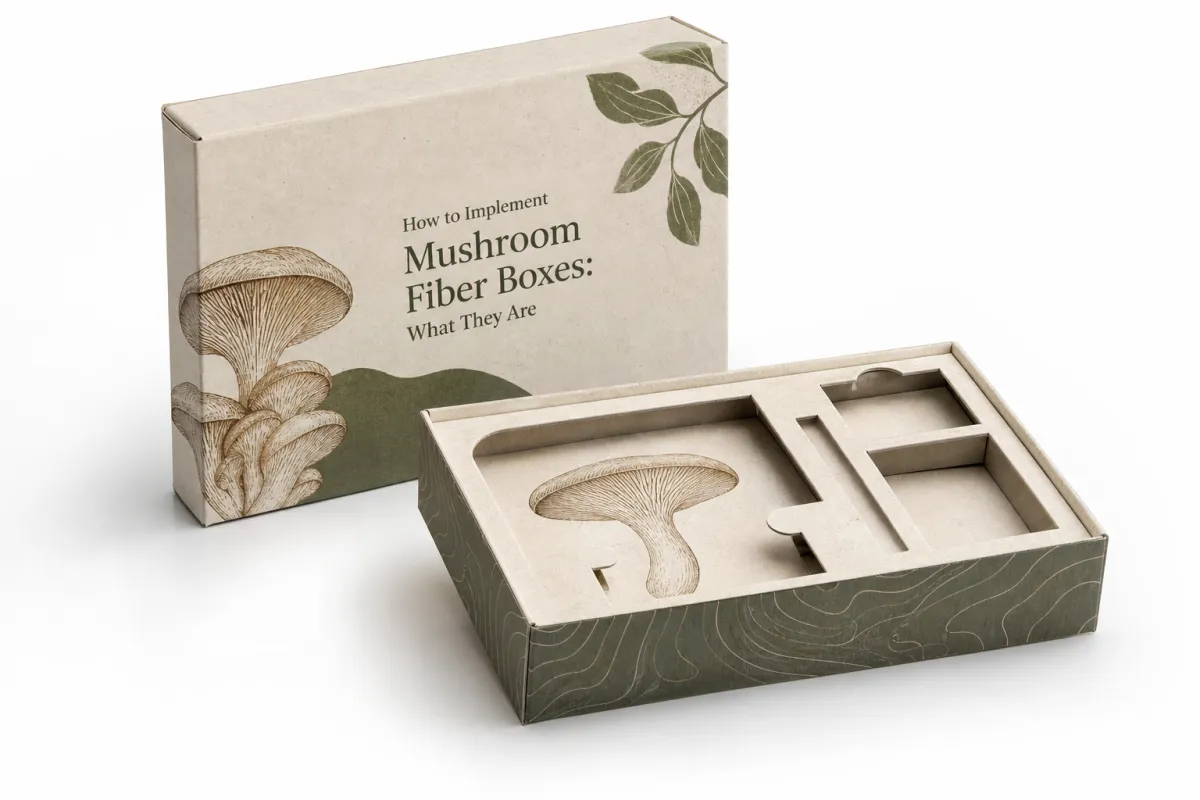
The short version: define the material, map the shipping risk, build a spec around the product, then test the insert in the same cartons and lanes you plan to use in production. If you want how to implement mushroom fiber boxes to work, start with one SKU, validate fit and pack-out speed, and run drop, vibration, and compression tests before you scale. That takes longer than guessing. It also costs less than replacing damaged products.
A clean pilot usually exposes the tradeoffs fast. You will see whether the mushroom fiber insert needs a geometry tweak, whether the outer carton needs reinforcement, and whether moisture or handling is likely to create headaches. That is the practical answer to how to implement mushroom fiber boxes: design for the route, not the mood board. Cute mockups do not survive a conveyor belt.
How to Implement Mushroom Fiber Boxes: What They Are
To understand how to implement mushroom fiber boxes, start with the name, because suppliers do not always mean the same thing. Some products are true mycelium-grown packaging, where fungal roots bind agricultural byproducts into a rigid shape. Others are molded fiber parts with mushroom-based binders or additives. A third group sits in the middle: hybrid protective inserts that borrow mycelium-inspired language but behave more like engineered pulp. If you do not define the material early, you can end up comparing very different structures as if they were interchangeable. They are not.
The appeal is obvious. Mushroom fiber packaging can be formed around corners, bottle necks, shoulders, or electronic housings so the load is spread instead of concentrated. That matters for fragile goods. A good insert reduces shock, controls movement, and gives the unboxing a cleaner, more premium feel than loose-fill filler or oversized corrugate stuffed with plastic. For brands trying to cut foam, lower plastic use, and tell a credible sustainability story, how to implement mushroom fiber boxes often becomes a practical answer rather than a marketing slogan.
Where does it fit best? Ecommerce shipments, cosmetics, small electronics, home goods, premium beverages, and retail packs that need a protective structure without EPS foam. The format also works well when the product has awkward geometry, because a custom cavity can hold the item more reliably than a generic carton divider. From a packaging buyer's point of view, that is the real value: fewer dunnage layers, fewer returns, and a package that looks intentional instead of improvised. That is why how to implement mushroom fiber boxes works best when the package is already being redesigned, not when a team simply swaps materials and hopes for the best.
- Best fit: fragile items with defined shapes and moderate parcel risk.
- Less ideal: very heavy products, high-moisture shipments, or loads that need deep stacking strength.
- Common benefit: cleaner brand presentation without plastic foam.
- Common tradeoff: more sensitivity to moisture and tighter design discipline.
Set expectations early. How to implement mushroom fiber boxes is less about changing one material line item and more about aligning product fragility, shipping abuse, warehouse handling, and end-of-life claims. That is a more demanding process, but it is also why the format can outperform a quick sustainability upgrade. If the design is right, the package protects. If the design is vague, the material does not save it.
How Mushroom Fiber Boxes Work in Real Packaging
At the material level, how to implement mushroom fiber boxes depends on how the structure is made and not just what it is made from. In a mycelium-based system, agricultural residue is cleaned, sized, and combined with a living fungal network that grows through the substrate and binds it together. The part is then cured or heat-treated so the growth stops and the final shape is stabilized. In molded fiber systems, the process looks different but the logic is similar: moisture, pressure, heat, and shaping tools turn loose fibers into a rigid protective form.
The production sequence is where quality is won or lost. Feedstock preparation affects density. Mold design affects wall thickness and corner integrity. Curing or drying affects dimensional stability. Trimming affects fit and finish. If the insert is over-dried, it can become brittle. If it is under-processed, it may warp or lose strength in humid conditions. That is why how to implement mushroom fiber boxes should be treated as a manufacturing conversation as much as a design conversation. Small changes in geometry can alter compression resistance more than the material label suggests.
Performance comes down to a few practical metrics. Compression resistance matters if cartons are stacked in a warehouse or during parcel consolidation. Cushioning matters if the product sees drops, vibration, and repeated handling touches. Thermal insulation can be a quiet benefit for temperature-sensitive products, although it should not be oversold. The tradeoff is moisture sensitivity: unlike some foams, these structures may absorb humidity or soften at the surface if storage conditions are poor. That means how to implement mushroom fiber boxes often includes a storage review, not just a purchase order.
A nicer-looking insert that fails in vibration testing is still a failure. Protective packaging earns its keep in the truck, not on the mood board.
Compare the format with molded pulp and EPS foam, and the practical differences get clearer. Molded pulp usually wins on price and familiar production methods. EPS foam can still deliver strong cushioning at a low unit cost, but it carries obvious sustainability baggage and can be hard to defend in a brand presentation. Mushroom fiber packaging sits in the middle: visually distinctive, structurally interesting, and often stronger as a brand statement than either pulp or foam. Still, how to implement mushroom fiber boxes successfully depends on matching the geometry to the product, because a beautiful insert with loose corners will not pass a drop test just because it looks advanced.
Geometry is the hidden variable. Corners, ribs, voids, and wall thickness often matter more than the raw material name. A shallow cavity may protect a bottle shoulder but fail at the base. A tight corner may perform well in compression but chip under repeated pack-out. A well-placed rib can increase stiffness without adding much mass. These are the details that separate a sample that photographs well from a system that ships well. That is also why how to implement mushroom fiber boxes should include prototyping with actual product weights, not just dimensional drawings.
Key Factors Before You Choose Mushroom Fiber Boxes
Before you decide on how to implement mushroom fiber boxes, start with the product itself. Weight, fragility, center of gravity, and surface finish all shape the design. A 4-ounce serum bottle with a fragile pump has very different requirements from a ceramic candle vessel or a small electronic device with corners that can crack under point load. If the package has a high center of gravity, the insert needs to resist tipping and side load, not just vertical compression. A good spec begins with the product, not the sustainability target.
Then map the shipping environment. One lane may be a local parcel route with mild handling, while another may involve multi-touch distribution, long-haul trucking, warehouse stacking, and seasonal temperature swings. A packaging concept that survives a short metro route may fail after two transfer points and three days in a hot trailer. From a buyer's point of view, how to implement mushroom fiber boxes is really about choosing the right risk level for the lane, because not every shipment needs the same amount of protection.
The business goal matters too. Some brands want to reduce plastic. Others want to cut breakage and returns. Some are trying to improve shelf presence or unboxing. Those goals overlap, but they are not identical. If your primary objective is return-rate reduction, you will judge samples very differently than if your main target is a better sustainability narrative. That is why how to implement mushroom fiber boxes should be written into a brief before samples are ordered. A vague brief usually leads to vague samples.
Supplier readiness is another practical filter. Ask about minimum order quantities, mold development, lead times, sample iterations, and dimensional tolerance control. A supplier may have a beautiful concept but no path to scale, or they may quote a low price without the tooling discipline to hold fit over a long run. The questions are not glamorous, but they matter: Can they revise the cavity by 2 mm? Can they maintain consistent thickness? Can they document quality checks? In other words, how to implement mushroom fiber boxes is partly a vendor qualification exercise.
Legal and marketing claims deserve attention too. Compostable, recyclable, biodegradable, and plastic-free are not interchangeable. If your end-of-life language cannot be substantiated, the sustainability story can backfire. Many teams use outside references to stay disciplined; for chain-of-custody and responsible fiber sourcing, fsc.org is a useful reference point. If you need to frame the environmental claim carefully, how to implement mushroom fiber boxes should always include a plain-language disposal statement that matches the material and the market you sell into.
For teams building the broader pack system, it can help to review Custom Packaging Products before locking the insert shape. That gives you a baseline for outer cartons, protective components, and print choices before the mushroom structure gets over-specified. The wrong outer box can erase the benefit of a smart insert, and that is where projects quietly lose money. So yes, how to implement mushroom fiber boxes is a material decision, but it is also a system-level decision.
How to Implement Mushroom Fiber Boxes: Process and Timeline
A disciplined rollout starts with a packaging audit. If you want how to implement mushroom fiber boxes to Work in Practice, document current damage rates, replacement costs, carton weights, pack-out time, and the specific SKUs that cause the most trouble. Look at where breakage happens: outbound line, carrier transit, customer opening, or warehouse returns. A lot of teams skip this step and then have nothing to compare the new design against. Without a baseline, a pilot becomes a hunch.
Once the audit is done, translate it into a spec sheet. That sheet should include product dimensions, target cavity clearance, wall thickness, acceptable tolerances, load limits, print requirements, and any finish or color expectations. If the product needs room for a charger, a booklet, or a secondary component, add that now. This is one of the clearest places where how to implement mushroom fiber boxes turns from concept into engineering. The more exact the brief, the fewer sample revisions you usually need.
- Audit the current pack-out and identify where damage, excess weight, or wasted void fill is happening.
- Write a spec sheet with dimensions, load targets, tolerance bands, and any branding requirements.
- Request samples from at least two suppliers so you can compare fit and finish side by side.
- Test under realistic conditions using actual product weight, real cartons, and the same packing sequence your team will use later.
- Pilot one SKU or one lane before you roll the design across the full catalog.
Sample comparison should be done under the same conditions, not by eye on a conference table. Set the same carton, the same product, the same drop sequence, and the same vibration exposure. If the insert shifts, chips, or softens, that matters more than surface appearance. This is where many teams ask how to implement mushroom fiber boxes and then accidentally test packaging as if it were a sculpture. It is not a sculpture. It is a transit system for your product.
Build the timeline with room for iteration. A simple pilot can move quickly, but custom tooling, fit refinements, and transit testing usually stretch the schedule. For a straightforward project, teams often need several weeks from sample approval to launch readiness, and complex forms can take longer if revisions are required. If the structure also changes the outer carton or the internal pack-out, add time for line validation. The box may look final on paper long before it is ready on the floor. That is normal. What is not normal is rushing a launch and hoping the material will forgive bad geometry.
Before the first production run, validate line fit. Watch how operators orient the insert, how much force is needed to place the product, whether the cavity self-locates, and whether the part chips during handling. A design that adds 8 seconds to every pack can create labor costs that dwarf the material savings. That is why how to implement mushroom fiber boxes should include time studies, not just protection tests. If you are also refining the broader packaging mix, the team at Custom Packaging Products can help you compare outer cartons and secondary components alongside the insert itself.
For the testing language, many teams reference ISTA methods such as 1A or 3A, and some use ASTM D4169 depending on the shipment profile. You do not need to turn every launch into a lab project, but you do need enough rigor to know whether the package can handle the route. The International Safe Transit Association publishes useful context at ista.org. In practical terms, how to implement mushroom fiber boxes means proving that the package survives the lane you actually sell into.
Cost, Pricing, and ROI for Mushroom Fiber Boxes
Pricing is where how to implement mushroom fiber boxes gets real. The main cost drivers are feedstock mix, mold complexity, order volume, tooling, freight, and whether the design requires a simple block or a sculpted custom insert. A plain protective shape will usually cost less than a tightly contoured cavity with multiple ribs and a branded surface. Volume matters too. Low quantities can carry a noticeably higher unit price, while larger runs help spread tooling and setup costs.
For a rough comparison, here is how pricing often looks at around 5,000 units, though actual numbers vary by region, finish, and geometry. The table is meant to help buyers compare on a landed basis, not to promise a universal quote. That distinction matters because a low unit price can be misleading if the material fails in transit or slows the line. A smart approach to how to implement mushroom fiber boxes is to compare cost against the full packaging outcome, not just the piece price.
| Packaging option | Typical unit cost at 5,000 units | Best use | Main tradeoff |
|---|---|---|---|
| Mushroom fiber insert or box component | $0.35-$1.10 | Premium fragile goods, brand-forward unboxing, custom-shaped protection | Higher tooling discipline and moisture sensitivity |
| Molded pulp | $0.18-$0.55 | General protective packaging, moderate fragility, cost-sensitive programs | Less sculpted feel and sometimes lower premium perception |
| EPS foam | $0.12-$0.40 | High cushioning needs at low cost | Poor sustainability optics and disposal concerns |
| Corrugated die-cut insert | $0.10-$0.32 | Light to moderate protection, simple shapes, easy sourcing | Less shock absorption for fragile items |
Hidden costs often matter more than the sample quote. Breakage drives replacement shipments, refund labor, customer service tickets, and negative reviews. Dimensional weight charges can increase when oversized void fill or bulky foam expands the carton footprint. Warehouse inefficiency also creeps in when packers need multiple dunnage materials or extra handling steps. This is why how to implement mushroom fiber boxes should always be evaluated with landed cost in mind, not just component cost.
A basic ROI model helps. Suppose a product line ships 20,000 units a year, with breakage falling from 3% to 0.8% after the new insert is adopted. That is 440 fewer failures. If each failure costs $18 in replacement product, freight, and service labor, the annual savings are about $7,920. If the packaging upgrade adds $0.28 per unit, the added annual packaging cost is $5,600. On paper, the project is ahead before you even count better customer perception. That does not mean every launch pencils out. It means how to implement mushroom fiber boxes should be judged on total system savings.
Be careful with cheap samples. A sample that is easier to make than to repeat can become an expensive headache if the supplier cannot hold tolerances at scale. Ask for expected variation, QC checkpoints, and lead-time commitments. A quote that looks attractive on a spreadsheet may not survive a real production schedule. The buyer's job is not to find the lowest piece price. It is to find the most dependable packaging outcome. That is the deeper logic behind how to implement mushroom fiber boxes.
Common Mistakes When You Implement Mushroom Fiber Boxes
The first mistake is treating the change like a branding exercise. Yes, mushroom fiber packaging can improve unboxing and sustainability messaging, but how to implement mushroom fiber boxes is still a structural decision. If the insert does not restrain the product, absorb impact, and survive handling, the marketing upside disappears the moment a damaged parcel arrives. A package that looks thoughtful in a mockup can still fail in a truck.
The second mistake is skipping real-world testing. A Design That Feels solid in the office can fail under vibration, humidity, or repeated compression. This is especially true if the lane includes long-haul shipping, warehouse stacking, or seasonal climate shifts. Run the actual product, not a dummy load that is lighter or tougher than the real thing. If you are serious about how to implement mushroom fiber boxes, the test plan should include drops, compression, and one or two handling scenarios that mimic your worst lane, not your best one.
Moisture is another frequent blind spot. Teams often assume a sustainable fiber structure will behave like a dry carton on a stable shelf. Then summer freight or a damp warehouse reveals softened edges, slight warping, or lost fit. That does not always mean the material is wrong; sometimes it means the storage and distribution rules were not written clearly enough. Still, the risk is real. When planning how to implement mushroom fiber boxes, include storage humidity, pallet wrap, and transit exposure in the spec, especially if the product has tight tolerances.
Over-customization can also derail a project. A complex mold, elaborate surface texture, and multiple custom cutouts may look impressive, but each extra detail increases tooling cost and may slow revisions. If the design changes too many variables at once, it becomes hard to tell which adjustment improved performance. The smartest teams move in steps: fit first, then protection, then brand cues. That sequence keeps how to implement mushroom fiber boxes grounded in measurable performance instead of aesthetics alone.
Finally, do not ignore pack-out speed. Sustainable material is not automatically operationally friendly. If the insert is awkward to orient, fragile to handle, or hard to align with the product, fulfillment labor can rise enough to erase the gain. A pack line that loses 5 to 10 seconds per unit may suffer more from labor inflation than it saves in dunnage reduction. In that sense, how to implement mushroom fiber boxes is partly a productivity question, and the best design is often the one that protects well and packs quickly.
Expert Tips and Next Steps for Mushroom Fiber Boxes
The safest way to roll out how to implement mushroom fiber boxes is to pilot one SKU or one shipping lane first. That gives you a clean comparison: breakage rate, pack-out time, material cost, and customer feedback before and after the change. If the first SKU is a moderate-risk item, you can learn quickly without gambling on the highest-value product. A small, focused pilot often tells you more than a broad, rushed rollout.
Use a scorecard. Keep it simple: breakage rate, return rate, packing speed, material cost, and perceived quality from customer comments or support tickets. If the numbers improve but the labor time explodes, the design is only half successful. If the insert ships beautifully but costs too much, the economics may still be wrong. A measured scorecard is one of the best answers to how to implement mushroom fiber boxes because it makes the tradeoffs visible instead of vague.
Ask suppliers for revision support. The first sample is rarely the final answer, and small geometry changes can produce big gains. A 2 mm adjustment to a shoulder cavity, a thicker rib at a corner, or a shorter wall can change fit and impact behavior more than a wholesale redesign. In a project like this, iteration is not failure. It is normal engineering. That is why how to implement mushroom fiber boxes should include at least one revision round before approval.
Do not leave disposal instructions as an afterthought. If the packaging is compostable in a specific context, say so clearly. If it is recyclable where facilities exist, explain that locally. If the end-of-life path is limited, be honest. Clear instructions protect trust, and trust matters just as much as the sustainability story. Brands that are precise tend to sound more credible than brands that make broad claims and hope nobody checks. The most durable version of how to implement mushroom fiber boxes is the one that tells the truth about disposal and performance.
There is also a broader strategic point. Mushroom fiber packaging rarely exists in isolation. It works best when the outer carton, print system, fill ratio, and branded presentation are designed together. If you are still sorting through those layers, review Custom Packaging Products as a reference point for the rest of the pack architecture. That gives you a practical baseline before you finalize the insert geometry. And if you remember only one thing, make it this: how to implement mushroom fiber boxes is a sequence, not a single purchase. Audit, sample, test, and pilot, then scale only after the data says the package is doing its job.
My honest take? The teams that get this right do not start with a purchase order. They start with a lane, a product, and a real test plan. That is the whole play. If the insert protects the product, keeps pack-out speed reasonable, and does not rely on fuzzy sustainability language, you have a design worth shipping. If it misses those marks, the packaging looks nice and the returns still come in. Nobody needs that kind of surprise.
Frequently Asked Questions
How do I start implementing mushroom fiber boxes without changing my whole line?
Begin with one SKU or one shipping lane so you can test fit, protection, and packing speed before a wider rollout. Keep the first design close to your current dimensions to minimize line changes, storage disruption, and operator retraining. If the geometry is too different from what your team already packs, the learning curve can hide the real result. That is why how to implement mushroom fiber boxes usually works best as a controlled pilot instead of a full conversion on day one.
How long does it take to implement mushroom fiber boxes from sample to launch?
A simple pilot can move quickly, but custom tooling, testing, and revisions usually add several weeks to the schedule. Sampling and fit checks should happen before transit testing so you do not waste time validating the wrong geometry. Build time for approvals, procurement, and fulfillment training into the plan, because those steps often slow the launch more than manufacturing. In practical terms, how to implement mushroom fiber boxes is easier to manage when the timeline includes at least one revision round.
Are mushroom fiber boxes more expensive than foam or molded pulp?
Unit price can be higher than commodity foam, but total cost may improve if damage rates and returns fall. Custom tooling, volume, and geometry drive pricing, so simple designs are usually easier to justify than highly sculpted forms. Compare quotes using landed cost and protection performance, not price per piece alone. That is the cleanest way to judge how to implement mushroom fiber boxes without overreacting to a sample quote that does not reflect real shipping outcomes.
Do mushroom fiber boxes work for fragile ecommerce products?
Yes, especially for products that need corner protection, inserts, or snug internal support during parcel transit. They are strongest when the packaging geometry matches the product closely and testing is done under realistic drop and vibration conditions. Moisture exposure and heavy stacking loads should be checked before full deployment. For fragile ecommerce goods, how to implement mushroom fiber boxes usually succeeds when the insert is built around the product, not around a generic carton size.
What should I test before I approve mushroom fiber boxes?
Run drop, compression, and vibration tests using the actual product, not a dummy load that hides weak points. Check pack-out speed, fit consistency, and whether the insert survives normal warehouse handling without chipping or warping. Review customer-facing details too, including unboxing feel and any composting or disposal instructions. If you want how to implement mushroom fiber boxes to hold up after launch, the test plan needs to reflect real shipping abuse, not ideal lab conditions.


