Buyer Fit Snapshot
| Best fit | Buy Recycled Cellulose Window Film projects where brand print, material claims, artwork control, MOQ, and repeat-order consistency need to be specified before quoting. |
|---|---|
| Quote inputs | Share finished size, material target, print colors, finish, packing count, annual reorder estimate, ship-to region, and any compliance wording. |
| Proofing check | Approve dieline scale, logo placement, barcode or warning zones, color tolerance, closure strength, and carton packing before bulk production. |
| Main risk | Vague material claims, crowded artwork, missing packing details, or unclear freight terms can make a low unit price expensive after revisions. |
Fast answer: Buy Recycled Cellulose Window Film: Specs, Pricing, MOQ should be specified like a repeatable production item. The safest quote records material, print method, finish, artwork proof, packing count, and reorder notes in one written spec.
Production checks before approval
Compare the actual filled-product size with the drawing, then confirm tolerance on folds, seals, hang holes, label areas, and retail display edges. Reserve space for logos, QR codes, warning copy, and material claims before decorative graphics fill the panel.
Quote comparison points
Review material grade, print process, finish, sampling route, tooling charges, carton quantity, and freight assumptions side by side. A quote is only useful when the supplier can repeat the same color, closure quality, and packing count on the next order.
buy recycled cellulose window film is usually the phrase packaging teams type after they have already been burned by a mixed-material carton story. The request sounds simple, but the work behind it rarely is. My first real window-film project was in Dongguan, Guangdong, where the brief asked for premium clarity, recycled content, and a line-friendly format that could run on a 240 mm x 320 mm carton with a 65 mm x 110 mm opening. That sounds tidy on paper and kinda stubborn in production. In practice, recycled cellulose window film is a cellulose-based transparent window patch, often specified with recycled content, used in folding cartons, display boxes, sample kits, and gift packaging. It is not magic. It is a material choice that helps a carton show the product without wrecking the sustainability story. When the spec is right, the window holds a crisp die-cut edge, keeps visibility high, and avoids the cloudy, fragile look that gives sustainable packaging a bad reputation. That bad reputation is often unfair, by the way; poor sourcing is usually the culprit, not the material family itself.
The business reason to buy recycled cellulose window film often appears before the design rationale does. A brand manager wants a cleaner claim sheet. Procurement wants fewer revision loops. Sustainability wants lower fossil-based input. And the sales team, usually the most practical voice in the room, wants a carton that looks intentional rather than apologetic. I saw that play out on a cosmetics project in Suzhou, Jiangsu, where a 40-micron PVC patch made a premium box feel slightly off, almost like a suit jacket with cheap buttons. Replacing it with a 35-micron cellulose option and tightening the cut tolerance to within 0.5 mm changed the pack from "good enough" to "we can stand behind this." The package did not get louder. It got more precise, and precision is what shoppers read as quality when they are moving fast. Sometimes that is all the difference a conversion line can give you.
Packaging gets judged quickly. A shopper spends maybe 2 to 3 seconds looking at a carton. A procurement manager scans a line item even faster. A compliance reviewer, bless them, moves through a checklist one small box at a time. buy recycled cellulose window film sits in the middle of those pressures. If the patch is clear, seals cleanly, and arrives with the right paperwork, it can help a brand protect its premium feel while making the claim easier to defend. If haze is too high, moisture behavior is off, or the patch distorts after conversion, the carton takes the blame. I have seen launches look polished on a sample table and ordinary on shelf in both Shanghai and Chicago. That is irritating in a very specific way because the problem usually traces back to one overlooked spec detail. A transparent window patch should make the product easier to trust, not harder to explain.
Before anyone asks about price, the useful questions are still basic: what carton structure is in play, how large is the opening, how much visibility does the product need, and what claims have to be documented? buy recycled cellulose window film is not one fixed item. It is a decision tree shaped by shelf life, packing line speed, climate exposure, and how much risk a team wants to carry on cost, timing, and compliance. A carton made from 350gsm C1S artboard behaves differently from a lighter 300gsm board. A window patch that works in a dry warehouse in Ningbo, Zhejiang may behave differently in a humid fulfillment center in Ho Chi Minh City. I tend to tell buyers to treat it as a packaging decision first and a sustainability decision second, because the order matters more than people admit.
Buy Recycled Cellulose Window Film: Why Buyers Switch
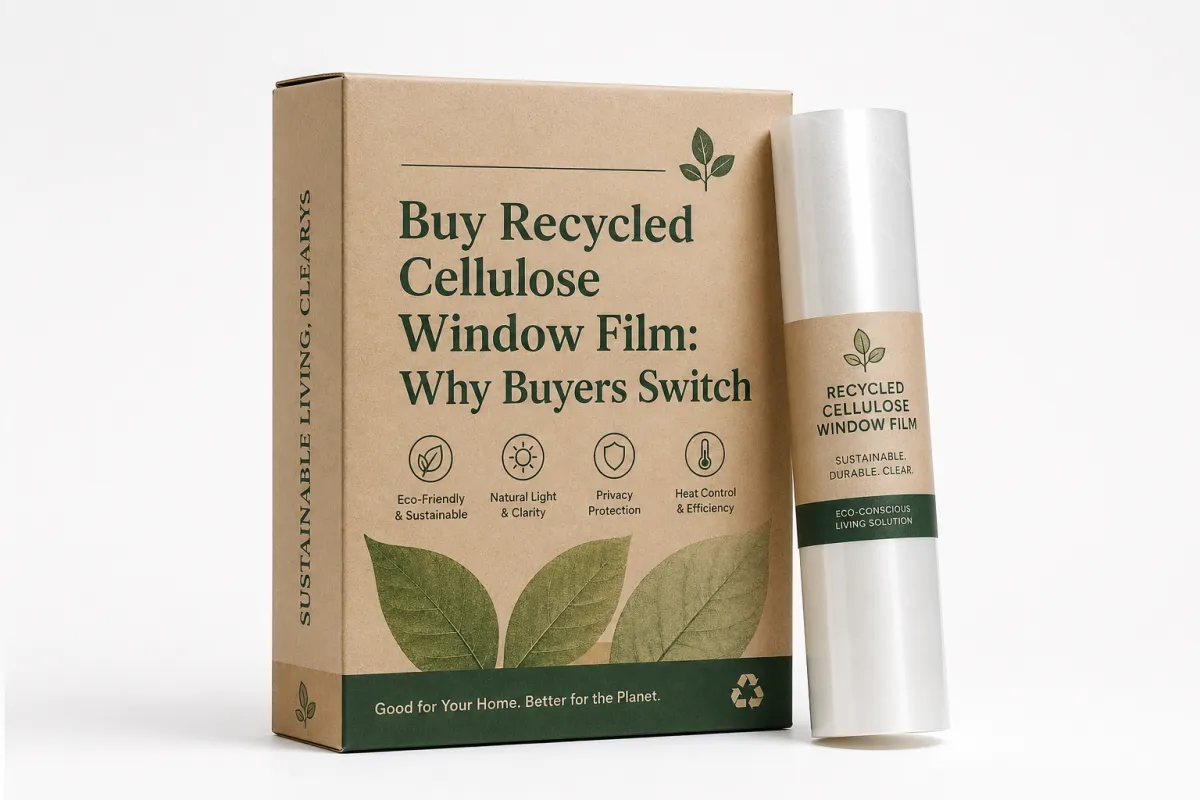
Buyers usually move toward buy recycled cellulose window film after they run into a contradiction. The carton has FSC board, water-based glue, soy inks, and a careful design system, then the window patch quietly tells a different material story. I once sat with a tea packaging team in Guangzhou that had already invested in a cleaner supply chain, yet the PVC window made the carton feel inconsistent. One 45-micron patch was enough to weaken the whole message. Replacing it changed the discussion from "Can we justify this?" to "Can we defend the full pack?" That shift matters because internal meetings go smoother when the sample on the table matches the claims on the slide. People relax when the story holds together.
The commercial case is stronger than many teams expect. A window is not just a cutout. It is a trust signal. When the shopper can see the product, color, texture, quantity, or finish becomes visible before the package is opened. That matters in cosmetics, tea, confectionery, apparel accessories, sample kits, and gift packaging. buy recycled cellulose window film helps preserve that visibility while reducing dependence on conventional plastic. In day-to-day terms, that can support shelf acceptance, cleaner claims language, and a more credible unboxing experience. I have watched buyers relax a little once they realize the pack does not have to look "eco" in the stereotypical sense to still be defensible, especially if the carton uses a 0.04 mm cellulose patch and a 2 mm glue margin.
"The pack did not need to look recycled. It needed to look right, and the material had to let us stand behind the claim." A client said that in a review meeting in Shenzhen after rejecting a 50-micron PVC patch, and I wrote it down because it cuts through a lot of fluff.
Internal alignment matters just as much as shelf appeal. Purchasing may care about unit cost, design may care about clarity, and sustainability may care about recycled-content proof. buy recycled cellulose window film can satisfy all three if the spec is disciplined. Start with a vague brief like "make it greener," and the result is usually a long sampling loop with no clean decision. Start with the carton size, target haze level, and cut format, and the work becomes much easier to manage. Clear inputs beat brave vibes every time, especially when the supplier is quoting from Dongguan while the brand team is reviewing from London.
The best-fit applications usually share one trait: the product does part of the selling. Folding cartons, display boxes, subscription kits, sample sleeves, and premium gift packs all fit that pattern. One wellness client had a 12-unit sampler box with a 65 mm x 120 mm window on 350gsm C1S artboard. The original pack used a standard plastic patch, yet the visual felt disconnected from the rest of the design. After testing buy recycled cellulose window film, the product stayed visible, the board stayed flat, and the packaging team could explain the choice in a single sentence instead of a paragraph. That alone saved everyone from a very boring meeting, which is its own kind of victory.
What Recycled Cellulose Window Film Is Made For
Think of buy recycled cellulose window film as a swap-in replacement for conventional plastic windows when the carton itself is doing most of the structural work. The film is usually cellulose-based, often with recycled content, and cut to fit a die-cut opening in paperboard. That makes it useful for brands that want product visibility without turning the carton into a mixed-material puzzle. The board carries the structure. The window gives the shopper a view. Simple idea, slightly annoying execution, which is most packaging work if we are being honest.
Compared with PET or PVC windows, cellulose options often win on the sustainability story and can deliver excellent clarity when the spec is tight. PET is familiar to many converters because it behaves predictably on some lines. PVC still appears in low-cost programs and legacy packaging. A growing number of buyers now ask to buy recycled cellulose window film because they want to move away from fossil-based plastics where the application allows it. The tradeoff is real: cellulose can be more sensitive to moisture, heat, and storage conditions, so the spec has to fit the use case rather than the marketing copy. I have had to say that more than once to teams in Ningbo and Kuala Lumpur that wanted a prettier answer than reality would allow.
Dry goods, retail-facing cartons, sample packs, and short- to medium-shelf-life products are usually the safest targets. One cosmetics client brought me a sample kit that had to stay clear after three weeks in a warehouse at 55% to 60% relative humidity and 26 degrees Celsius. We tested two formats and rejected one because the edges curled by about 1.2 mm after 72 hours. That is the sort of small measurement that decides whether buy recycled cellulose window film becomes a clean win or an expensive retry. I still remember staring at those curled edges like they had personally offended me. The material was fine in a dry office and less charming in real storage, which is exactly why test conditions matter.
Cosmetics, food, wellness, apparel, stationery, and premium consumer goods all use the same logic in different ways. Visibility helps the sale. A tea box wants the leaf quality seen. A skincare kit wants the bottle silhouette visible. An apparel accessories pack wants color obvious before the carton opens. buy recycled cellulose window film works best when the product itself strengthens the carton. If the contents are not visually useful, the window may not earn its place once cost and assembly time are counted. That is not me being cynical; that is me trying to keep people from paying for decoration that does nothing, especially on programs with a target landed cost below $0.50 per carton.
There are also limits that should be named early. Heat sealing can be tricky if the line runs at 165 to 180 degrees Celsius. Moisture resistance is not unlimited. Adhesive choice matters because some glues create visible distortion beneath the window. High-speed automated lines add another layer of risk because the film has to behave the same way during folding, patching, and compression. Before approving buy recycled cellulose window film, I ask for four checks: clarity under bright light, edge behavior after folding, how the patch sits in the opening, and whether the material stays flat after packing. That sounds unromantic, but packaging is not a poetry contest.
Buy Recycled Cellulose Window Film: Specifications to Check
If you want a serious quote for buy recycled cellulose window film, start with the spec, not with price. The details that matter most are thickness, sheet size, roll width, cut format, sealing method, and allowable tolerance. I have watched projects lose a week because one side assumed 0.05 mm film and the other side expected closer to 0.03 mm. That difference is not minor when clarity, rigidity, and machine behavior all matter at once. It is the kind of gap that makes everyone sound confident right up until the sample arrives and tells the truth. A cellulose-based window patch only works as well as the numbers behind it.
Procurement teams usually compare a second set of performance details: haze, gloss, stiffness, and resistance to handling during packing and shipment. Those numbers do not always appear on a basic quote, which is why buyers should ask directly. A film can look excellent on a bench sample and still read as dull once it is mounted in a carton under retail lighting at 800 lux. That is the point where buy recycled cellulose window film either helps the package or quietly undermines it. The sheet has to look good in the hand, in the box, and after transport. I have learned not to trust a sample that only looks great under one office lamp in a 22-degree meeting room.
Compatibility is often underpriced. Will the film accept glue cleanly? Can it be die-cut without fraying? Does the converter need a pre-applied adhesive strip? Will it work with automated patching, or does the line need manual placement? One supplier negotiation I remember turned on a 3 mm change in roll width because the existing line in Suzhou could not tolerate the original format without jams. That single decision changed the economics of buy recycled cellulose window film more than a small unit-price reduction would have. A 3 mm tweak sounds tiny until it starts stopping a machine. Then it becomes very expensive, very quickly.
Certification and compliance can slow a project if nobody brings them up early. Food-contact requirements may apply. Recycled-content documentation may be needed. Some brands need FSC board to support the carton story, while others require transport testing under ISTA 3A or similar methods. For packaging performance, I usually tell teams to check testing language and distribution expectations through sources like ISTA, and to review fiber sourcing and claim guidance through FSC. Those references do not replace internal approval, but they help keep the conversation grounded when buy recycled cellulose window film is part of a larger packaging claim. I find that grounding useful because "we think it is fine" is not a compliance strategy.
A compact checklist keeps the back-and-forth under control. I ask clients to include carton dimensions, window opening size, target thickness, surface finish expectation, sealing method, and any compliance requirement in one note. That kind of discipline saves sampling time. If the supplier knows the exact opening size and how the patch is applied, buy recycled cellulose window film moves from concept to sample much faster. A clear brief can cut two revision cycles and save 6 to 8 calendar days, which is a meaningful number when a launch is already pinned to a Monday ship date.
- Thickness: specify a target range, such as 0.03 mm to 0.05 mm, instead of "standard."
- Format: sheet, roll, die-cut patch, or pre-applied adhesive.
- Tolerance: define cut accuracy in millimeters, especially on small windows.
- Surface: clear, matte, or gloss, depending on shelf lighting.
- Compliance: food-contact, recycled-content proof, or testing needs.
Buy Recycled Cellulose Window Film: Pricing, MOQ, and Savings
Price can trap teams if they compare only unit cost. For buy recycled cellulose window film, the real drivers are custom size, thickness, recycled-content percentage, order volume, testing requirements, and whether the job needs special finishing. A patch that fits a common sheet size with a standard cut pattern will usually cost less than one that needs custom tooling and extra inspection. That sounds obvious once it is written down. It still gets missed in practice, usually right before someone asks why the quote changed in the final round.
I prefer to split cost into four lines: sample cost, prototype cost, production unit cost, and freight. If you only compare production price, you miss the trial cost that often decides whether a project survives. One apparel client in Melbourne came in with a target of $0.021 per patch, then found that the first two sample rounds added nearly $260 in setup and courier expense. Once the format was standardized, the program stabilized. That is why buy recycled cellulose window film should be judged on total landed cost, not a single line item. I am a little obsessed with this because I have seen too many teams get seduced by a tiny per-unit number and then stumble over everything around it.
These numbers are best treated as field examples, not a universal market average. Suppliers vary by region, tooling, and the type of recycled-content documentation they are willing to provide.
| Option | Typical MOQ | Sample Cost | Indicative Unit Cost | Best Use |
|---|---|---|---|---|
| Standard sheet cut | 5,000 pieces | $95 | $0.015 per unit for 5,000 pieces | Routine carton programs with stable dimensions |
| Custom die-cut patch | 10,000 pieces | $145 | $0.022 per unit for 10,000 pieces | Brand-specific windows and tighter fit requirements |
| Low-MOQ prototype run | 1,000 pieces | $220 | $0.065 per unit for 1,000 pieces | Launch testing, retailer approval, or internal demos |
| Premium clarified spec | 20,000 pieces | $160 | $0.034 per unit for 20,000 pieces | High-visibility retail packs where shelf clarity matters most |
MOQ is practical, not mysterious. It climbs when the film is fully custom, when the cut pattern is irregular, or when the supplier has to run a special batch to meet documentation requirements. It drops when the buyer accepts a common sheet size or a standard punch. In one negotiation in Ningbo, we cut the minimum by nearly 40% simply by choosing a slightly larger sheet and trimming the carton opening to suit the film instead of the other way around. That kind of compromise can make buy recycled cellulose window film workable for a smaller brand. I love that kind of fix because it saves money without pretending physics changed.
Savings also show up in places teams do not always measure. A clearer spec can reduce waste if the line operator no longer needs to stop and adjust patch position. Better fit can lower complaint risk if the window does not wrinkle during shipping. Stronger claims documentation can save a team from reworking artwork or replacing cartons after legal review. If the sustainability story is weak, the cost of fixing the story can exceed the cost of the material itself. That is why buy recycled cellulose window film should be measured against rework risk, not just the invoice, especially on a launch that spends $12,000 to $18,000 on printed cartons alone.
If you want an accurate quote, send five things: carton dimensions, window opening size, target quantity, application method, and compliance requirements. I would add one more if the launch date is fixed: include the delivery deadline in business days. A quote with no timing pressure often looks cheaper than one that has to land on schedule. Once the deadline is on paper, buy recycled cellulose window film becomes a procurement decision rather than a guessing game. A quote that says "12-15 business days from proof approval" is more useful than a vague "about two weeks," because one is schedulable and the other is a shrug.
From Spec Sheet to Shipment: Process and Timeline
The process stays fairly direct if the brief is complete. For buy recycled cellulose window film, I map the work as inquiry, requirements review, material recommendation, sampling, approval, production, quality control, and shipment. The first step can take one day. The second can take three if the team still has to confirm carton dimensions or compliance language. Sampling often consumes the most energy because design, procurement, and operations start arguing over details that looked minor in email. I have sat through more of those arguments than I care to remember, usually with a carton mockup, a ruler, and at least one person saying the opening is "probably fine."
Timing matters more than people admit. A simple sample round may take 5 to 7 business days once the supplier has the dimensions. Prototype approval may take another 3 to 5 business days if the team reviews fit, gloss, and handling in one pass. Production typically needs 12 to 15 business days from proof approval for custom work, though that changes with volume and finishing. If buyers plan for buy recycled cellulose window film as if it were an off-the-shelf item, at least one approval gate usually gets missed. The calendar is less forgiving than the pitch deck, especially when a freight booking from Guangdong to Rotterdam is already locked.
The most common delays are unglamorous, which is exactly why they keep happening. Incomplete carton specs. Late artwork decisions. Unclear sustainability claims. Sample feedback that says "looks off" without naming the issue. I saw one project stall for nine days because the team never agreed on whether "high clarity" meant lower haze or higher gloss. In another case, the packaging manager and the brand owner approved different versions of the same dieline. buy recycled cellulose window film moves faster when one person owns the technical answer and one person owns the final sign-off. Otherwise everybody is busy and nothing is finished, which is my least favorite kind of meeting.
A disciplined approval path saves time and money. I recommend one technical contact, one procurement approver, and one final sign-off person. If the product needs sustainability verification, bring in the documentation reviewer early, not after sampling. The cleaner the approval path, the less likely the project is to spin through unnecessary revisions. That matters even more when buy recycled cellulose window film sits inside a larger launch with printed cartons, inserts, and shipping packs that all have to land together. A 48-hour delay at the sample stage can turn into a 10-day delay once press time, carton finishing, and freight are all connected.
Here is the working checklist I give teams before they release an order: confirm the finished carton dimensions, confirm the window opening size, approve the cut format, agree on the material thickness, name the person who signs the sample, and set the shipping deadline in business days. If those six items are settled, buy recycled cellulose window film behaves like a normal sourcing job. If they are not, the purchase order turns into a design workshop with a freight bill attached. That is not a theory. I have watched it happen on a 15,000-piece launch with a factory in Shenzhen and a retail date in Seattle.
Why Custom Logo Things for Recycled Cellulose Window Film
Custom Logo Things matters here because the job is more than material sourcing. It is packaging coordination. When a client asks to buy recycled cellulose window film, they are really asking for a partner who understands the carton, the opening, the branding, and the production limits at the same time. Too many suppliers quote a patch without asking how the carton folds, where the glue lands, or whether the window sits under a folded flap. That is how avoidable problems get sold as surprises, and surprises are expensive when the carton is already printed.
What I would expect from a serious partner is straightforward documentation. Clear specs. Honest lead times. Transparent price breaks. Support for the claims language printed on the carton, because recycled-content statements need precision. If the film contains recycled input, the team should be able to explain what that means and what it does not mean. That level of clarity helps when buyers need to buy recycled cellulose window film and still satisfy brand, legal, and retail review. I am a fan of plain language here; confusion costs more than people think, especially when a retailer in Frankfurt asks for an explanation in writing.
Quality control is where consistency is either won or lost. Clarity can vary by batch. Cut size can drift if the tooling is not monitored. Adhesion can shift if humidity rises during packing. I once watched a run where a 2 mm placement shift made the window look off-center on a premium gift box, even though the carton dimensions were technically correct. That is a small failure on paper and a loud one on shelf. A partner who knows buy recycled cellulose window film should catch that before production, not after complaints arrive. Shelf mistakes do not whisper.
The practical advantage of working with a packaging specialist is that design, converting, and sourcing are handled together. That trims revisions and cuts waste. If the window can be resized by 4 mm and save a custom tool change, the right partner will say so. If a standard format can shorten sample time from 10 days to 6, that should be part of the discussion. In my experience, buy recycled cellulose window film goes better when the vendor is willing to explain what can be customized without inflating cost or complexity. I trust that more than glossy promises, especially from teams with production ties in Dongguan, Suzhou, or Wenzhou.
Honest constraints matter too. Not every project needs the thinnest material or the brightest finish. Some need a lower MOQ. Some need a safer approval path. Some need a shorter lead time more than they need a perfect spec. That is where Custom Logo Things can be useful: the conversation stays tied to the realities of the carton, not to a brochure promise. If you want to buy recycled cellulose window film with fewer revisions, treat the supplier like a technical collaborator, not a catalog, and ask for a sample that matches the final 350gsm board and the final glue line.
How Do You Buy Recycled Cellulose Window Film?
Start with the carton dimensions, the window opening size, and the application method. That sounds basic because it is basic, and it keeps the quote grounded in reality. A 68 mm x 92 mm opening behaves differently from a 70 mm x 95 mm opening once glue overlap, machine tolerance, and board thickness are all counted. If the project team wants to buy recycled cellulose window film, the first task is to strip uncertainty out of the dimensions. I have seen teams argue for half an hour over a film quote that was technically fine but physically impossible for the carton. That is the kind of avoidable drama I could happily live without.
Next, confirm the sustainability claim you actually need to support. Do you need recycled-content documentation? Do you need an FSC board story for the full carton? Are you replacing only the window, or reshaping the entire pack narrative? I have sat in meetings where the packaging team wanted a vague "eco" message, the legal team wanted exact wording, and the retailer wanted proof. Those are different jobs. The stronger the claim, the more important it is to match the material to the documentation before you buy recycled cellulose window film. A fuzzy claim and a precise procurement spec do not magically become one another.
Request a sample or test run, then compare it with the current packaging on three points: clarity, fit, and sealing performance. Do not rely on one sample under office lights. Place it near the actual product, under the actual shelf conditions if possible, and let the line operator handle it once. I have seen a sample that looked excellent on a desk fail the simple fold test because the window sat 1.5 mm too close to the crease. That kind of issue is easy to catch early and expensive to discover after 20,000 cartons are printed. Nobody enjoys explaining why the reprint is going to cost another $3,800.
When quotes come back, compare three columns side by side: unit cost, MOQ, and Lead time. That is the fastest way to separate an apparently cheap offer from a genuinely useful one. A low unit price with a huge MOQ is not a bargain for a brand testing a new line. A fast lead time with weak documentation is not a win if the claims team rejects it. If you want to buy recycled cellulose window film with confidence, decide on total value, not price alone, and compare the final landed cost with the cost of printing the carton in 350gsm C1S artboard.
My final recommendation stays simple: send one concise approval note with dimensions, quantity, target launch date, and compliance questions. Keep it to one page if possible. Buyers who do that usually get better quotes, fewer revisions, and cleaner sample feedback. If you are ready to buy recycled cellulose window film, the next move is practical: send the specs, request samples, and ask for a production quote that spells out MOQ and lead time in business days. I like decisions that can survive a second look, and I like them even more when the supplier can ship from Ningbo or Dongguan without adding a week of mystery.
Frequently Asked Questions
How do I buy recycled cellulose window film if I need a custom carton size?
Send the finished carton dimensions, the window opening size, and whether the film should be cut flat, rolled, or die-cut. If the patch has to sit under a folded flap, say that in the first email so the supplier can check clearance. I always tell teams to ask for a sample or prototype first, because a 2 mm mismatch can change both appearance and packing speed. If repeat orders matter, confirm that the supplier can hold the same tolerance on the next run before you buy recycled cellulose window film. That extra question saves a lot of grumbling later, especially when the carton uses a 350gsm board and the patch margin is tight.
Can I buy recycled cellulose window film for food packaging?
Yes, but only if the film and the full carton structure meet the required food-contact and compliance standards for your market. Ask for documentation before approval, including recycled-content details and any relevant testing or declaration paperwork. If the product is sensitive to moisture or has a shorter shelf-life window, that can affect the material choice. For food use, the claim has to match the package reality. That is where buy recycled cellulose window film needs a careful compliance review, not just a visual approval. I would never let that ride on a pretty sample alone, particularly for tea, confectionery, or ready-to-eat items shipped through humid ports like Shenzhen or Busan.
What is the usual MOQ when I buy recycled cellulose window film?
MOQ depends on the size, format, and whether the job is standard or fully custom. Smaller orders are easier when you use a common sheet size or accept a standard cut pattern. If you need a low MOQ, ask whether sample-to-production conversion is possible so the trial order can scale without a full retool. In practice, the minimum can move a lot based on tooling and inspection requirements, which is why buy recycled cellulose window film should always be quoted against the exact spec, not a generic catalog size. The generic answer is usually the least useful one, especially if the supplier is building the order around a 0.04 mm stock line in Suzhou.
How does recycled cellulose window film compare with PET window film on clarity and cost?
Clarity can be comparable, but you should compare haze, gloss, and how the film looks once it is mounted in the carton. Cost should be evaluated alongside total landed cost, not just unit price, because revision risk and sustainability claims matter too. I would request side-by-side samples and review them under retail lighting if possible. If PET looks slightly better in hand but cellulose fits the brand story and claim structure better, the cheaper option is not always the better one. That is the real test when you buy recycled cellulose window film. A small visual win can still be a business loss, especially if the PET version creates a claim conflict on a carton printed in 350gsm C1S artboard.
What should I send to get an accurate quote for recycled cellulose window film?
Provide carton dimensions, window opening size, annual or initial quantity, and your preferred cut format. Include any compliance needs, sustainability claim requirements, and whether the film must work with automated packing equipment. If you have a target launch date, mention it early so lead time and sampling can be planned correctly. The faster the supplier understands the production environment, the faster the quote becomes useful. That is the difference between a rough estimate and a quote you can actually use to buy recycled cellulose window film. The practical move is to send the exact carton size, the actual opening, and the deadline in business days; that gets you to a usable answer faster than any polished brief ever will.
Related packaging resources
Use these related guides to compare specs, costs, quality checks, and buyer decisions before making the final call.