Buyer Fit Snapshot
| Best fit | Seal Corrugated Boxes for Ocean Freight Safely projects where brand print, material claims, artwork control, MOQ, and repeat-order consistency need to be specified before quoting. |
|---|---|
| Quote inputs | Share finished size, material target, print colors, finish, packing count, annual reorder estimate, ship-to region, and any compliance wording. |
| Proofing check | Approve dieline scale, logo placement, barcode or warning zones, color tolerance, closure strength, and carton packing before bulk production. |
| Main risk | Vague material claims, crowded artwork, missing packing details, or unclear freight terms can make a low unit price expensive after revisions. |
Fast answer: Seal Corrugated Boxes for Ocean Freight Safely: Board, Finish, Dieline, and Unit Cost should be specified like a repeatable production item. The safest quote records material, print method, finish, artwork proof, packing count, and reorder notes in one written spec.
Production checks before approval
Compare the actual filled-product size with the drawing, then confirm tolerance on folds, seals, hang holes, label areas, and retail display edges. Reserve space for logos, QR codes, warning copy, and material claims before decorative graphics fill the panel.
Quote comparison points
Review material grade, print process, finish, sampling route, tooling charges, carton quantity, and freight assumptions side by side. A quote is only useful when the supplier can repeat the same color, closure quality, and packing count on the next order.
How to Seal Corrugated Boxes for Ocean Freight Safely
The moment an export carton leaves an inland dock, its fate is decided less by paperwork and more by the way it was closed. I have watched boxes that looked fine on a packing table fail three days later because the seam was only barely holding, the liner picked up moisture, and a few hard transfers added enough vibration to peel the tape. That is why figuring out how to seal corrugated boxes for ocean freight is never just a last-step packaging task. It is a systems problem.
A neat-looking seam can be deceiving. A carton may sit perfectly under warehouse lights, then soften in humidity, lose adhesion in a cold hold area, and start opening after repeated handling from truck to container to destination yard. In export work, how to seal corrugated boxes for ocean freight means building a closure that survives peel force, stack pressure, moisture, and the rhythm of real handling without turning the carton into a weak point.
Why Sealing Matters for Ocean Freight
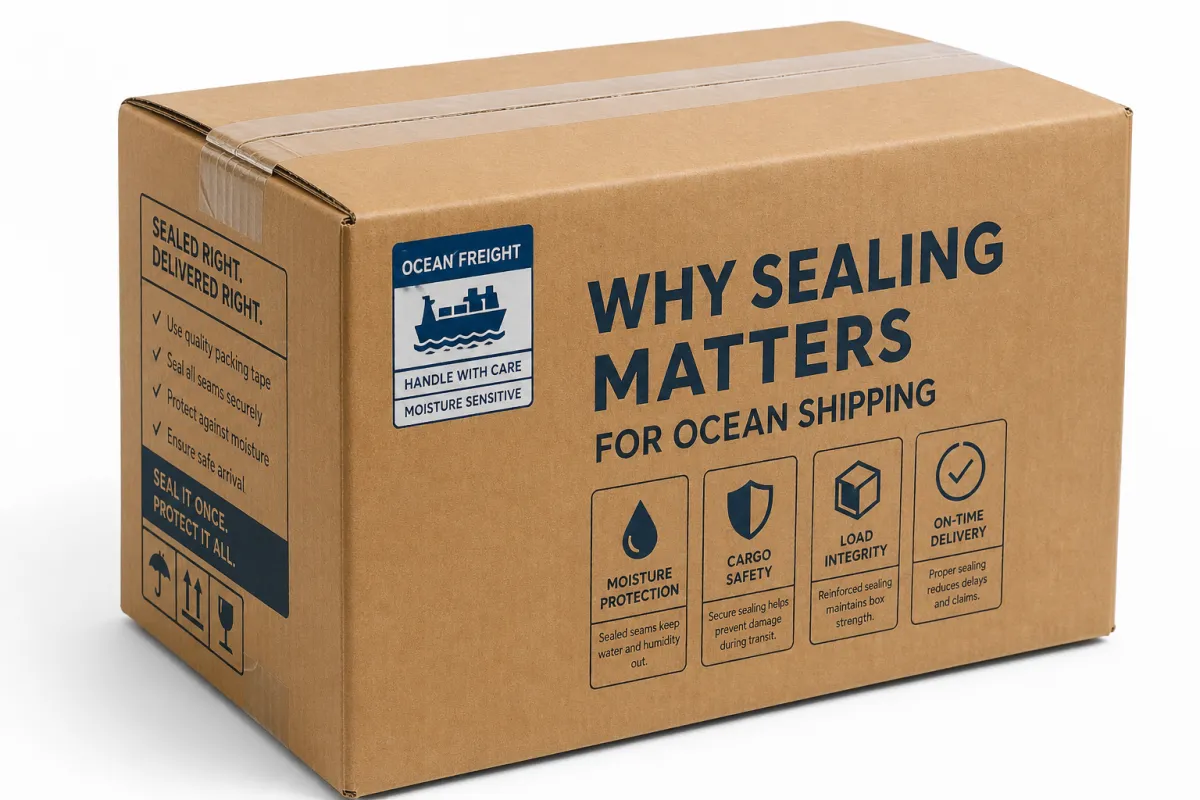
Ocean logistics is a punishment test for corrugated materials. The route exposes a carton to road vibration, crane jolts, compression from stacking, and humidity swings that can soften board fibers. When teams ask how to seal corrugated boxes for ocean freight, the instinct is often to fixate on tape width or one pattern, but the real issue is whether the closure still performs after many handling cycles and long dwell times.
A domestic line haul might be over in 48 hours. Ocean transit can stretch across days of movement, storage, and temperature change. That extra time turns small weak points into real failure risk. A closure that holds on day one can start to peel by day five if the initial bond is marginal, and one opened carton can trigger a chain reaction across a pallet face or a full lane. That is not a theory problem; it is a claims problem.
Many exporters make the mistake of separating the carton from the closure. Box grade, product weight, fill strategy, and closing method get treated like independent dials, when they really interact. Weak board, overfilled contents, or a rough die-cut edge can undo premium tape in a hurry. A practical view of how to seal corrugated boxes for ocean freight is to match board structure, closure choice, fill, and pallet orientation as one package. Kinda obvious once you have seen enough failures, but it gets missed all the time.
A reliable export closure does more than keep flaps shut; it helps the carton hold its shape when it is lifted, wrapped, stacked, and moved again.
A box that is closed is not automatically secure. Narrow tape may look acceptable in a warm warehouse, then loosen when exposed to damp air or edge stress from neighboring freight. Teams learning how to seal corrugated boxes for ocean freight should start with a route map: where moisture enters, where friction happens, and where pressure concentrates.
Many export programs use external testing and material standards to reduce guesswork. Transport test methods from ISTA transport testing resources help quantify vibration, drop, and compression behavior, while traceable paper sourcing through FSC certification can support consistency in board procurement. Those tools help, but they still need to be matched to the actual cargo and lane. A standard is not the shipment.
How to Seal Corrugated Boxes for Ocean Freight
No single closure wins every case. The right answer for how to seal corrugated boxes for ocean freight changes with freight density, moisture exposure, liner quality, and handling intensity. Most teams work through pressure-sensitive tape, reinforced tape, water-activated tape, and glue- or strap-assisted methods for heavier loads.
Pressure-sensitive tape remains the default because it is fast and familiar. It works well with moderate payloads, clean board, and well-formed seams, and 2-inch or 3-inch widths are common for lighter cartons. What matters in export conditions is not just the first bond, but whether the adhesive holds through flexing, vibration, and repeated flap movement.
Reinforced tape helps when cartons are repeatedly gripped, pinched under stretch wrap, or dragged across rough surfaces. Water-activated tape, especially fiberglass-reinforced versions, usually creates a stronger fiber-to-fiber bond and better closure reliability when tamper resistance matters. Glue-and-staple or strap combinations are less common on routine profiles, but they are useful on dense, abuse-prone packs where flap distortion is likely.
Three mechanical realities decide whether the closure works: coverage across the seam, contact on both sides of the joint, and resistance to peel at the edge folds. If a strip only touches the high ridge in the center, full contact never develops. Corner exposure is where failures begin. Covering the center and both edges often reduces weak points more effectively than adding one extra strip only on the centerline.
Common closure patterns include:
- Center-seal only for lightweight boxes, though this is the riskiest pattern on longer routes.
- Top H-tape for broad export use, with a center seam strip plus two edge-crossing strips.
- Full H-tape on top and bottom when cartons are rehandled often or repacked in transit nodes.
- Strap plus tape for heavy cartons where loading force can push flaps out of tolerance.
Most export teams eventually move toward an H-pattern because it reinforces the center and corners where stress concentrates. Openings often start at the corner on failed cartons, where one edge catch is enough to start peeling the rest of the seam. If your team is documenting how to seal corrugated boxes for ocean containers, corner integrity usually prevents repeat incidents more reliably than simply widening the center strip.
Export performance also improves when carton format supports the closure. Better-sized boxes create better flap overlap and give tape cleaner contact on flatter surfaces. If you are sourcing dimensions with load geometry in mind, our Custom Shipping Boxes can reduce weak overlaps. Matching them with the right tape or tape-plus-strap spec from Custom Packaging Products helps reduce variability in how to seal corrugated boxes for ocean transit.
The difference between top-seal, bottom-seal, and full-seal logic is practical, not theoretical. Bottom-seal is usually set during carton erection, and it can improve speed and consistency before product insertion. Top-seal is often the final closing step before palletizing. Full-seal with both top and bottom reinforcement becomes useful when containers face multiple transfers or delayed loading in damp conditions. A closure strategy should match the real handling path, not a tidy diagram copied into a manual and forgotten.
How do you seal corrugated boxes for ocean freight?
Use a clean H-pattern across the center seam and both edge folds, then match the closure to board strength, product weight, and humidity exposure. For most export cartons, that means reinforced tape or water-activated tape on a dry, squared box with enough flap overlap to keep the seam flat. In heavier or higher-risk lanes, add strap support or full H-tape coverage before palletizing, because how to seal corrugated boxes for ocean freight depends on both adhesion and carton geometry.
The shortest answer is also the one That Holds Up in practice: keep the board dry, keep the seam clean, and keep the closure pattern consistent. A box that looks neat but has poor corner coverage is still vulnerable. A carton with good overlap, proper application pressure, and a stable pallet build usually performs better than a more expensive tape applied badly.
Key Factors That Affect Seal Strength in Export Cartons
Seal strength is the end point of three interacting systems: board, closure material, and environment. A 32 ECT single-wall B-flute carton can be enough for light goods, while high-density or humid routes often push teams toward 44 ECT or double-wall construction. The logic is simple. If the board collapses even slightly, the closure has to work harder and will fail sooner.
Flute design shifts the stress profile. B flute stays efficient in lower thickness and offers decent crush resistance, while C flute usually supports more compression and cushioning for heavier cargo. BC double-wall gives another layer of stiffness for dense exports where pallet loads are tall. Once flaps curl, they pull at the seam under vibration, and the bond becomes less reliable.
Environmental conditions can weaken adhesion before freight reaches the port. Cold conditions can reduce tack in some pressure-sensitive systems, and high humidity can make liners spongier and reduce edge hold. Dust, fiber debris, and die-cut remnants further reduce real contact area. Dirty or damp packout zones therefore turn how to seal corrugated boxes for ocean freight into a process-control issue, not just a material choice.
Internal product movement matters too. Shifted loads create repeated flexing at seam and corner zones, especially during container movement. Internal dividers, foam barriers, or denser fill strategies reduce that motion and protect the closure indirectly. In plain terms, how to seal corrugated boxes for ocean cargo succeeds when the load is stable, not when the closure is asked to fight a product that is bouncing around inside the case.
Palletization changes the stress geometry again. A sealed carton on the floor and the same sealed carton inside a wrapped pallet can perform very differently. Orientation can amplify corner loads; a carton designed to stand upright but shipped on its side experiences flap strain it was never meant to absorb. Stretch wrap reduces unit movement at the pallet level, but it does not remove flap-edge forces from compression or friction. Tape and strap integrity still protect at the case level.
A quick planning list helps teams move from guesswork to consistency:
- Carton grade and flute type.
- Gross weight per box and load density.
- Number of handling touches expected from origin to destination.
- Humidity and temperature exposure profile.
- Palletization method, wrapping, and strap placement.
That checklist mirrors the most common export failure patterns. If goods are heavy, the route is humid, and handling points are high, stronger closure is usually the rational choice. Lighter cargo on sturdy board can move with simpler closure and still meet reliability targets.
Application pressure often decides the outcome. Recycled liners with more surface variation need firm compression and full seam contact. A quick swipe may satisfy a visual check yet still create micro-voids that become peel points later. Teams that use a roller or controlled pressure protocol often get better consistency in how to seal corrugated boxes for ocean results than teams that only change tape type.
How to Seal Corrugated Boxes for Ocean Transit: Process and Timeline
The highest-performing export programs treat closure decisions as an engineered sequence, not a final station after production is already running. A practical workflow for how to seal corrugated boxes for ocean transit starts with carton selection, continues with a matched closure method, then sample assembly, then validation under realistic stress conditions before full-volume release.
A workable sequence looks like this:
- Choose the carton using weight, stack design, and humidity exposure.
- Set the closure by tape width, reinforcement profile, and optional mechanical support.
- Build sample packs with real product and real insert geometry.
- Inspect seam quality for continuous bond, corner coverage, and flap alignment.
- Build a test pallet and apply wrap and stack forces similar to the real load plan.
- Capture the standard with exact application pressure, spacing, and quality checkpoint definitions.
Water-activated systems often change the timeline because tape application and cure behavior differ from pressure-sensitive methods. Adhesive labels, inked cartons, and sensitive inserts can also create a short settling period before final pallet release. Scheduling that interval for how to seal corrugated boxes for ocean shipping can reduce last-minute rework and missed vessel cutoffs.
Many teams use a two-step cadence: one to two days for materials and specification confirmation, one shift to configure the line, and part of a day for sample builds and checks. If cartons will sit in humid buffer storage before loading, adding controlled dwell time allows seam movement to show up before the shipment is locked. The rule is straightforward: closure decisions should be stable before the export timeline gets tight.
Controlled sourcing strengthens this routine. Locking box dimensions early, especially for special overlap or print constraints, gives a steadier seal profile across batches. Tape batch consistency and dispenser maintenance also matter; one lot of liner variation or pressure drift can change closure outcomes. Standard inputs turn variation into data instead of surprises in how to seal corrugated boxes for ocean shipments.
Clear ownership is part of process quality. A packing lead, quality analyst, and operations manager often form the fastest signoff path, as long as each checks the same items: pattern, box condition, orientation, and wrap method. A one-page signoff sheet can settle later disputes when someone asks why how to seal corrugated boxes for ocean freight was modified mid-run.
High-volume export teams treat closure spec as part of the operating system. Tape width, strip overlap, carton grade, and inspection checkpoints should be documented with the same rigor as pallet weights and labels. That discipline makes how to seal corrugated boxes for ocean loads easier to duplicate across shifts and easier to defend when returns or claims questions arrive.
Cost and Pricing Tradeoffs for Better Box Sealing
Closure upgrades often look expensive at first glance, yet the real cost of poor sealing is usually measured in claims, freight disruptions, and line stoppage. The right how to seal corrugated boxes for ocean freight decision compares total landed risk, not only material spend per carton.
Common options compare like this in practical terms:
| Closure Method | Typical Use | Approximate Material Cost per Carton | Strength and Handling Notes |
|---|---|---|---|
| Standard pressure-sensitive tape | Light to moderate cartons with clean board surfaces | $0.03-$0.08 | Fast and simple, but more sensitive to dust, peel force, and humidity swings |
| Reinforced tape | Export cartons that need better tear resistance | $0.05-$0.12 | Higher hold under lifting and wrap pressure; common step up for how to seal corrugated boxes for ocean freight |
| Water-activated tape | Higher-risk cartons, tamper-sensitive shipments, heavier loads | $0.08-$0.18 | Strong bond to corrugated, excellent seam security, but needs dispenser setup and consistent application |
| Staple plus tape or strap plus tape | Heavy industrial packs and cartons that can distort under load | $0.06-$0.20 | Extra mechanical hold, but requires careful setup so the box is not cut or crushed at the closure |
Cost components shift by production size, board design, labor rate, and print coverage, so the numbers are directional, not universal. A reliable pattern usually adds a few cents, while a single compromised carton can generate expensive claims, rework labor, and route delay costs that are far larger than the premium.
Labor intensity belongs in every decision meeting. More tape layers or pressure checks increase cycle time, while water-activated systems may require training and hardware before benefits appear. High-volume operations often recover the initial investment through reduced rework and fewer exceptions near cutoff windows.
Scrap and rework hide silent cost. A failed carton frequently means unpacking, replacing materials, reprinting labels, and relabeling paperwork. One opened case can become half a day of delay across a dense container load if it triggers a claims loop. Stronger closure planning usually pays back quickly when it prevents repeated failures on the same shipping route.
Carton sizing influences cost too. Slightly oversized boxes reduce flap overlap and push teams toward extra tape use, while oversized dimensions can increase compression and transport stress. A correctly sized custom carton reduces both material use and labor while making how to seal corrugated boxes for ocean freight more predictable over time.
Common Mistakes That Cause Ocean Freight Failures
Most failures follow recognizable patterns. A frequent one is a single tape strip on a high-mass carton, then an assumption that visual neatness equals durability. That setup often gives way at the corner under repeated pull and peel forces.
Another common trap is sealing over contamination. Dust films, loose board fibers, and damp liners all interrupt adhesive contact. Corrugated does not hide defects; it amplifies them once the cargo starts to move. If cartons enter packing with moisture or residue, the safest move for how to seal corrugated boxes for ocean shipment is pre-seal inspection and correction.
Many teams assume stretch wrap can compensate for a weak closure. Wrap can stabilize pallet units, but it cannot create bond strength in an already compromised seam. A carton that opens beneath wrap becomes a weak link for the entire stack.
Mismatch between material and board is harder to spot because it often looks fine at first. A high-adhesion tape can cut into weak recycled fiber, while a low-adhesion tape can slide on a rough surface. Small overlap errors and uneven flap alignment trigger similar problems by reducing effective contact area exactly where peel force concentrates.
Internal fit also determines closure outcome. Overpacked cartons expand seam stress from within, while underpacked cartons allow vibration to flex flaps. Both conditions punish the seam. The practical fix is usually to tune product fit and internal restraint before dialing up tape complexity.
Orientation and stacking discipline create avoidable failures too. Wrong orientation, unstable stacking density, or loose wrap can crush side seams and rotate stress vectors the carton was never designed for. Rush operations that skip final pallet checks see these failures far more often than planned lines.
To spot weak lots before departure, teams use short pre-load checks:
- Boxes showing moisture, softness, or edge delamination.
- Flaps with insufficient overlap or curled corners.
- Tape applied on dirt, powder, or loose fibers.
- Bulging cartons from overfill or collapsed cartons from underfill.
- Pallet stacks that violate approved orientation and height rules.
That kind of checklist is not paperwork theater; it is a direct control on what actually opens during ocean movement. How to seal corrugated boxes for ocean freight depends on the weakest link in the packout chain, whether that weak link is board, overlap, or pallet build.
Expert Tips and Next Steps for Safer Shipments
Teams that move beyond trial and error usually build a small matrix with real variables: actual dimensions, real fill level, and real ambient conditions. Compare two or three closure options, then stress-test them under conditions that match the shipping lane. That gives a practical answer for how to seal corrugated boxes for ocean freight instead of dependence on a broad catalog description.
Documentation is where consistency begins. Capture tape width, pattern, minimum overlap, and the precise inspection point before palletizing. If roller pressure is required, lock the method in writing. If closure timing must stay within a specific post-fill window, record that too. That creates a stable training reference and reduces operator drift between shifts.
Risk level, not product value alone, should guide closure escalation. A light carton with a stable internal fit may perform well on a simple H pattern. A heavier carton moving through multiple ports may justify reinforced or water-activated tape even if the unit price rises. The point is not to overbuild every box; it is to match closure strength to expected stress and route profile.
Carton geometry deserves the same scrutiny as tape. A wrong footprint can make perfect tape feel weak because edges no longer lock correctly. If you are moving into new packaging, a custom carton from Custom Shipping Boxes often removes recurring seam issues before they reach the line, then pair it with the right tape, inserts, and handling materials from Custom Packaging Products for a complete system.
A practical routine at packout can change outcomes with almost no extra spend: keep the area dry, keep boards flat and clean, and verify the first carton at the end of each shift against the same check sheet. That habit catches issues while they are still on the line, and it keeps the approach to how to seal corrugated boxes for ocean freight tied to measurable behavior instead of hope.
How to Seal Corrugated Boxes for Ocean Freight Safely comes down to disciplined matching of board strength, closure type, pallet strategy, and environmental control. Once those four move in sync, how to seal corrugated boxes for ocean shipping stops being a guessing exercise and becomes repeatable export performance. The most useful next step is simple: test one lane, one carton style, and one closure spec under the same conditions your freight will actually face, then lock that standard before the next booking.
Frequently Asked Questions
What tape is best when learning how to seal corrugated boxes for ocean shipping?
Start by matching the tape to board quality, product mass, and ambient conditions at the packing station. Reinforced tape or water-activated tape often outperforms standard pressure-sensitive tape on export loads that see repeated handling, while lighter and cleaner profiles may only need a simpler solution. Every candidate should be tested in the same temperature and humidity range where packing occurs.
How do I seal corrugated boxes for ocean freight in humid climates?
Keep cartons and tape out of damp air as long as possible, and never close cartons that are still wet or softened. Humid lanes usually favor stronger corner coverage and more forgiving closure patterns because board stiffness changes with moisture. For how to seal corrugated boxes for ocean freight, environmental control matters as much as tape choice.
Is H-tape necessary for ocean shipping cartons?
Many export teams rely on H-tape because it reinforces the two stress hotspots: the center seam and the flap edges. The method helps when cartons are stacked, slid, or rehandled through port operations. In many real routes, how to seal corrugated boxes for ocean loads stay intact longer with H-pattern coverage than with a center strip alone.
How far in advance should I close boxes before ocean transit?
Closing should happen late enough that board exposure to damp handling conditions is minimized, yet early enough to allow inspection and pallet build. Closure methods that need setup time require buffer in the schedule; otherwise teams lose control and rush near cutoff. For how to seal corrugated boxes for ocean shipping, late closure plus verified quality checks tends to reduce rework.
What should I do if my sealed cartons keep opening during export?
Start with fundamentals: board grade, flap overlap, seam pressure, and contamination level. A simple pull test, visual contamination scan, and review of corner coverage usually points to the weak link fast. If failures continue, raise the closure spec and lock the updated packing conditions into the same batch documentation before loading the next shipment.