Buyer Fit Snapshot
| Best fit | Source Custom Packaging Wholesale Without Guesswork projects where brand print, material claims, artwork control, MOQ, and repeat-order consistency need to be specified before quoting. |
|---|---|
| Quote inputs | Share finished size, material target, print colors, finish, packing count, annual reorder estimate, ship-to region, and any compliance wording. |
| Proofing check | Approve dieline scale, logo placement, barcode or warning zones, color tolerance, closure strength, and carton packing before bulk production. |
| Main risk | Vague material claims, crowded artwork, missing packing details, or unclear freight terms can make a low unit price expensive after revisions. |
Fast answer: Source Custom Packaging Wholesale Without Guesswork: Material, Print, Proofing, and Reorder Risk should be specified like a repeatable production item. The safest quote records material, print method, finish, artwork proof, packing count, and reorder notes in one written spec.
Production checks before approval
Compare the actual filled-product size with the drawing, then confirm tolerance on folds, seals, hang holes, label areas, and retail display edges. Reserve space for logos, QR codes, warning copy, and material claims before decorative graphics fill the panel.
Quote comparison points
Review material grade, print process, finish, sampling route, tooling charges, carton quantity, and freight assumptions side by side. A quote is only useful when the supplier can repeat the same color, closure quality, and packing count on the next order.
How to Source Custom Packaging wholesale sounds simple until the quote grows a few extra teeth: setup charges, revisions, freight, insert changes, and one wrong dimension can turn a decent-looking deal into a steady money leak. I have seen buyers find that out after the PO is signed, which is a miserable time to learn the box was guessed instead of measured. If the goal is margin, timing, and packaging that fits the product instead of fighting it, the real work starts before anyone prints a single sheet.
This piece is about the buying side. Not mood boards. Not vague brand talk. Real sourcing choices: dimensions, substrate, MOQ, print method, lead time, and the supplier checks that separate a usable quote from a polished guess. If you want custom printed boxes, mailers, rigid cartons, or branded packaging that reorders cleanly, the details below will save money and a few headaches.
Why wholesale packaging deals go sideways
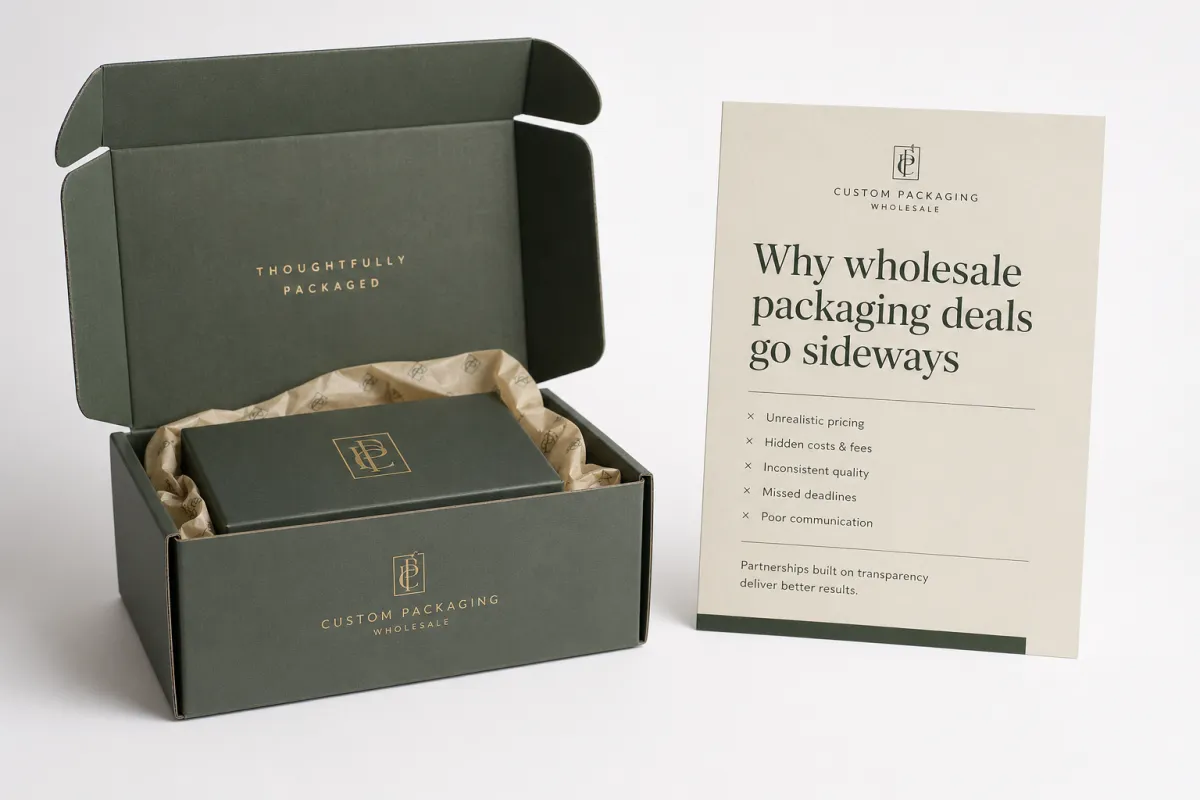
How to source custom packaging wholesale gets messy fast because most mistakes happen before production starts. The quote looks fine. Then the sample does not fit. Then freight lands higher than expected. Then the buyer realizes the "simple" structure needed a die change, and the budget is now doing cartwheels. Cheap quotes are often incomplete quotes with good manners.
Take a common case: a brand moves from plain mailers to Custom Rigid Boxes because the product finally deserves better presentation. Fair enough. Then someone estimates the box size from a product photo instead of measuring the item, the insert, and the clearance for tissue or protective wrap. The result is a box that looks nice on screen and burns a week in sampling.
How to source custom packaging wholesale the right way means asking for quotes with real numbers. Not "about this size." Not "roughly 6 inches." Exact dimensions matter because board usage, sheet layout, cutting dies, and freight weight all depend on them. Suppliers price to the spec, not to a mood board. That is not being fussy. That is how factories work.
Quantity causes just as many headaches. Buyers ask for a quote without a final order size, then compare a 300-piece estimate to a 3,000-piece estimate and act shocked when the numbers do not match. Of course they do not. Wholesale pricing only makes sense when the quantity is real, or at least close enough to real to matter. If demand is still soft, say that. A decent supplier can price a test run and a scale-up path.
How to source custom packaging wholesale gets much easier once you treat it like a purchasing process, not a design exercise. The job is to define the product, the shipping path, the brand experience, and the budget in one brief. Leave those pieces out and the supplier is guessing. Guessing is where overspending starts.
- Unclear size leads to wrong tooling and wasted material.
- Missing artwork specs leads to reproofs and delays.
- No real quantity leads to quotes that are not comparable.
- No freight plan leads to a landed cost shock later.
That is why how to source custom packaging wholesale should begin with one question: what does the package need to do? Protect the product? Win shelf presence? Support package branding? Reduce shipping damage? Once that answer is clear, the rest stops feeling random.
How to source custom packaging wholesale for your product
How to source custom packaging wholesale for your product starts with fit. Not graphics. Fit. What is going inside the box? How fragile is it? Does it ship Direct to Consumer, sit on a retail shelf, or move through a distributor warehouse before anyone touches it? Those answers decide the structure, board strength, and the kind of branded packaging that makes sense.
For fragile items, protection usually matters more than fancy print coverage. For retail packaging, shelf visibility and stackability matter more. For subscription and e-commerce brands, the box has to survive carrier handling and still look sharp when opened. A packaging buyer should decide the use case first and the finish second. A gold foil lid on a weak carton is still a weak carton.
How to source custom packaging wholesale gets clearer when you split options into practical buckets:
- Mailer boxes for shipping-friendly, DTC-friendly product packaging.
- Folding cartons for lightweight retail packaging and high-volume runs.
- Rigid boxes for premium presentation and stronger perceived value.
- Sleeves for cost-conscious branding over standard or stock packaging.
- Inserts for stabilization, especially with glass, electronics, or cosmetics.
- Tissue, labels, and bags for lower-cost branded packaging touches.
The best buyers do not custom-make everything. They choose what should be custom and what should stay standard. That is how you keep package branding strong without turning every SKU into a one-off engineering project. A stock mailer with a custom sleeve can beat a full Custom Rigid Box if the budget is tight and the product does not need heavy crush protection.
How to source custom packaging wholesale also depends on repeat orders. If the packaging will reorder every month or quarter, consistency matters more than a one-time wow factor. If it is a launch box for a short campaign, the buyer may accept a different finish or a lower-cost substrate to stay inside budget. Use case drives the format. Style comes after.
If a supplier cannot explain the box structure, the print method, and the freight impact in plain language, the quote is not finished yet.
That is the standard I use. Keep the process boring. Boring sourcing is good sourcing. How to Source Custom Packaging Wholesale Without headaches usually means choosing the simplest structure that still does the job and supports the brand story.
Packaging specifications that control quality and cost
How to source custom Packaging Wholesale Without getting tripped up by specifications starts with the basics: exact dimensions, material, board thickness, print method, finish, color count, and any special coating. Leave out one of those and the quote gets fuzzy. Fuzzy pricing is how buyers end up arguing over what was included.
Dielines matter more than mockup screenshots. Suppliers engineer and price to the dieline because it shows the structure, folds, glue points, and material usage. A pretty render helps with approval, sure. A render does not tell a factory how much board to buy or where the tuck closure lands. How to source custom packaging wholesale becomes more precise the moment the dieline is locked.
Then there is tolerance. This is where people get casual and regret it later. If the insert is supposed to hold a bottle, candle, jar, or device, the fit window has to allow for the real production variation of the product. A 1 mm or 2 mm change can be the difference between snug and sloppy. For heavier items, ask about insert strength and weight limits, not just visual fit.
Artwork specs are not optional. Buyers need to confirm bleed, CMYK versus spot color, PMS matching, and whether the outside gets printed or the inside too. If the box uses metallic ink, embossing, soft-touch lamination, or UV varnish, that should be clear before quote approval. How to Source Custom Packaging Wholesale Without surprise costs means listing every finish upfront, even the ones that are still under consideration.
Materials and compliance belong in the brief too. Recycled content, FSC paper, food-safe requirements, child-resistant structures, or market-specific labeling rules all change the quote and sometimes the production method. For transit performance, shipping tests based on ISTA standards are a practical reference point. For responsible fiber sourcing, FSC certification gives buyers a cleaner path for paper claims. No mystery here. Just fewer bad assumptions.
How to source custom packaging wholesale also means deciding where not to overspec. A buyer can spend real money on a finish that adds little commercial value. Sometimes that choice is right. Sometimes it is just expensive glitter with a logo. If the box lives inside a shipper, a soft-touch exterior may not justify the premium. If it sits on a shelf and sells by looks, the story changes.
- Structure: mailer, carton, rigid, sleeve, or bag.
- Substrate: SBS, C1S, CCNB, kraft, or rigid board.
- Thickness: often 14pt to 28pt for cartons; thicker for rigid builds.
- Finish: matte, gloss, soft-touch, foil, emboss, deboss, spot UV.
- Compliance: food-safe, recyclable, FSC, or market labeling.
That list is not decoration. It is the difference between a quote you can trust and a quote you have to rebuild.
Pricing, MOQ, and what wholesale quotes really include
How to source custom packaging wholesale gets expensive when buyers compare the wrong numbers. The quote sheet may look clean, but the real cost lives in the line items. Material, printing, finishing, tooling, setup, sampling, packing, and freight all matter. Ignore one of them and the landed cost changes. Usually upward. Funny how that keeps happening.
MOQ is not a moral issue. It is a production reality. Simple digital runs can start in the low hundreds. More complex offset jobs or rigid builds often make more sense at 500 to 1,000 units and up. Once a design is stable and the buyer can store inventory, unit pricing often improves at 2,500 to 5,000 units and beyond. That is the point where wholesale packaging starts acting like wholesale packaging.
How to source custom packaging wholesale means understanding where hidden costs sneak in. Custom dies. Plates. Proofing rounds. Inserts. Rush charges. Reproofing after artwork changes. Freight from factory to warehouse. Sometimes even repacking fees if the order ships in a way that is not warehouse-friendly. A quote that skips those items is not cheaper. It is just incomplete.
It also helps to ask how the shipment is being priced. EXW means you handle pickup from the factory. FOB means the supplier delivers to the port or export point. DDP sounds nice because the goods arrive with duties handled, but it often hides margin in the transport line. None of these terms is bad on its own. They just shift responsibility. If you do not know the term, you do not know the real cost. That is a pretty decent way to get burned.
Below is a simple comparison buyers can use before requesting samples or placing a PO. The numbers are broad, because structure, coverage, and finish change everything. But they are real enough to keep a budget from wandering into fantasy.
| Packaging option | Typical MOQ | Common unit range | Best use | Main tradeoff |
|---|---|---|---|---|
| Mailer box | 300-1,000 | $0.85-$2.10 | DTC shipping, subscription boxes, branded packaging | Good balance, but heavy print coverage raises cost fast |
| Folding carton | 500-2,500 | $0.18-$0.60 | Retail packaging, cosmetics, light products | Lower structural strength than rigid options |
| Rigid box | 500-1,000 | $2.50-$8.00 | Premium presentation, luxury product packaging | Higher freight and higher setup cost |
| Sleeve or wrap | 1,000-5,000 | $0.08-$0.35 | Cost-conscious package branding over stock packaging | Less protection; relies on the base pack |
How to source custom packaging wholesale wisely means comparing suppliers on landed cost, not unit price alone. A box that saves $0.10 per unit but adds another pallet of freight is not a win. It is a very normal way people trick themselves into thinking they saved money.
Ask for a quote breakdown in these terms:
- Unit price for the quoted quantity.
- Tooling and setup for the structure and print method.
- Sampling for prototype or pre-production approval.
- Freight to your warehouse or 3PL.
- Taxes and duties if they apply to your shipment path.
If you want an easy rule, here it is: how to source custom packaging wholesale correctly means treating the quote like a contract summary, not a sales teaser. Ask what happens if the quantity changes by 10%, if the artwork needs one more revision, or if the product size moves 2 mm. The answers tell you more than the glossy line item ever will.
Process and timeline: from brief to delivery
How to source custom packaging wholesale without delaying a launch comes down to process discipline. A clean sourcing flow should look like this: brief, spec review, quote, artwork check, sample, approval, production, quality control, and shipping. Skip one step and you usually pay for it later with rework or a missed ship date.
Sampling takes longer than impatient buyers expect because structure has to be tested, not admired. A simple sample can move in 3 to 10 business days. Production often runs 10 to 30 business days after sample approval, depending on complexity, print coverage, and finishing. Freight adds its own clock. Air is faster and pricier. Ocean is slower and kinder to margin. Nothing fancy there.
How to source custom packaging wholesale without schedule pain also means knowing the usual delay points. Late artwork is a big one. Missing dimensions is another. Approval stalls are brutal, because factories often hold a slot while waiting for sign-off. Then there is the classic move: the buyer changes quantity after quoting and expects the schedule to stay the same. It does not.
Use the right shipping mode for the launch date. Air freight can rescue a release if inventory is already late, but it can distort landed cost badly. Ocean freight is better for repeatable wholesale orders and larger volumes. If the packaging will repeat, plan the first run early enough to avoid panic shipping. Panic shipping is how a well-priced box becomes a regrettable one.
- Brief the supplier with dimensions, artwork, quantity, finish, and destination.
- Approve the structure before worrying about minor visual details.
- Review the sample for fit, print accuracy, and closure performance.
- Lock the spec sheet so production matches the approved version.
- Build buffer time of at least one to two weeks if the launch matters.
How to source custom packaging wholesale without a scramble is mostly about discipline. Buyers who lock specs early, provide complete artwork, and confirm the order quantity before quoting tend to get better results. That is not luck. That is process.
If the package is supposed to protect the product in transit, ask for a test plan that matches the risk. Drop, vibration, compression, and edge crush all matter in different ways. The structure should fit the shipping reality, not just the brand deck.
Why choose us for wholesale custom packaging
Custom Logo Things is built for buyers who want the packaging conversation to be clear, not theatrical. How to source custom packaging wholesale gets easier when the supplier can explain dimensions, print choices, and tradeoffs without dressing every answer up like a marketing brochure. Straight talk saves time.
Good wholesale packaging support should make the hard parts boring. That means clear communication, accurate quoting, solid dieline help, artwork checks, and realistic guidance on what each spec change does to cost. If a buyer wants better shelf impact, we can talk through branded packaging options. If the priority is lower freight or a cleaner reorder path, we can talk through that too.
Our Custom Packaging Products page is where buyers can review practical formats without sorting through a pile of fluff. If the goal is repeat order planning or volume-based pricing, the Wholesale Programs page gives a cleaner view of how order size affects the structure and the economics. That matters because how to source custom packaging wholesale is not just about the first shipment. It is about the second, third, and fourth one too.
Transparency should not be a premium feature. Buyers should know the MOQ, the lead time, and the fees before they commit. They should also know where a specification adds value and where it just adds cost. A supplier who pushes every upgrade is not helping. They are padding the invoice and calling it enthusiasm.
I also think good support means saying no when a request is a bad fit. If a finish will scuff in transit, if a box will blow the freight budget, or if a structure is overkill for the product, that should be said plainly. Nobody needs polite nonsense. They need a package that works.
Here is what a dependable wholesale partner should handle well:
- Dielines and fit guidance for real products, not idealized mockups.
- Artwork checks that catch obvious print issues before production.
- Repeatability so reorders match the approved spec.
- Cost clarity so the buyer can compare options fairly.
- Material advice so the package matches the shipping path and budget.
How to source custom packaging wholesale should feel controlled, not mysterious. The best supplier relationship reduces decision fatigue. That is the real value. Not hype. Not gimmicks. Just packaging that shows up on spec and on time.
How do you source custom packaging wholesale without delays?
How to source custom packaging wholesale without delays starts with one complete brief. Include the product dimensions, packaging style, artwork count, finish, quantity, destination, and target ship date. Leave out a piece and the supplier fills the gap with assumptions. Assumptions are where schedules go to die.
Send reference photos and a physical sample if you can. Screenshots are weak evidence. A real sample tells the supplier how much clearance the product needs, how the insert should hold it, and whether the package must resist scuffing, crushing, or shipping vibration. How to source custom packaging wholesale gets much cleaner once the supplier can see the product in context.
Ask for quotes that separate the moving parts. Unit price. Tooling. Samples. Freight. Taxes. Maybe even a reproof fee if the artwork is still changing. That separation makes comparison easy and helps prevent the classic buyer mistake: picking the lowest number without understanding what the number includes.
A smart buyer will often request two quotes:
- Cost-efficient version with standard materials and limited finishing.
- Premium version with the higher-end finish or structure.
That gives real tradeoffs instead of guesswork. You can see exactly where the money goes. More foil? More board thickness? Better insert? Higher freight because the box is bulky? Good. Now the decision has data behind it. That is how to source custom packaging wholesale like a professional instead of a hopeful shopper.
How to source custom packaging wholesale also means approving the spec sheet before production starts. Not after the sample passes around the office three times. Not after someone on the team decides they want a different interior print. Lock the document. Then hold the line. Reorders become much easier when the first run is documented properly.
One last point: compare total landed cost, confirm the timeline, and only approve once the dimensions, finish, and shipping plan are final. That sounds basic because it is basic. And basic discipline is usually the difference between a clean launch and a costly mess. If you remember one thing about how to source custom packaging wholesale, make it this: lock the spec, verify the timing, and buy on the full landed number, not the shiny headline price.
FAQ
How do I source custom packaging wholesale with a low MOQ?
Use simpler structures and standard sizes so the supplier does not need expensive tooling or unusual setup. Digital printing and limited finishes can keep the first run smaller and more affordable. Ask for a test quantity plus a scale-up price so you can see where the savings begin if demand grows.
What details do I need to source custom packaging wholesale quotes?
Give exact product dimensions, target quantity, packaging style, print coverage, finish, and shipping destination. Include artwork files or at least reference images so the supplier can check feasibility before quoting. If the timeline is tight, say so early; rush schedules often change cost and production method.
How long does custom packaging wholesale usually take?
Sampling often takes about 3 to 10 business days, depending on structure and complexity. Production commonly runs 10 to 30 business days after sample approval, and complex jobs can take longer. Freight time varies by air or sea, so ask for a full timeline instead of only the factory window.
How do I compare suppliers when sourcing custom packaging wholesale?
Compare total landed cost, not just the unit price on the quote sheet. Check what is included: samples, tooling, inserts, shipping, taxes, and any reproofing fee. Also verify lead times, minimum order quantities, and whether the supplier can repeat the same spec on reorders.
What is the easiest way to lower cost when sourcing custom packaging wholesale?
Reduce special finishes, extra print coverage, and structural complexity first. Use standard dimensions when possible so the supplier can work with efficient sheet layouts or existing tooling. If cash flow and storage allow it, increase order quantity because larger runs usually lower the unit price.