If you are comparing jacquard Beanies Logo Patches price, the quote only matters if the finished hat fits the job. Buyers usually weigh three things: how clearly the brand reads, whether the cost holds at scale, and how well the beanie keeps its shape after wear. Jacquard knitting gives the cap structure and texture, while a patch gives the logo a clean, durable face without forcing every detail into yarn.
That split matters because it lets the body and the logo be optimized separately. The knit can stay practical and cost-aware, while the patch carries the visual detail. For retail, team programs, and winter promos, that usually produces a better result than trying to do everything in the knit alone.
Why Jacquard Beanies With Logo Patches Outsell Plain Knit Caps
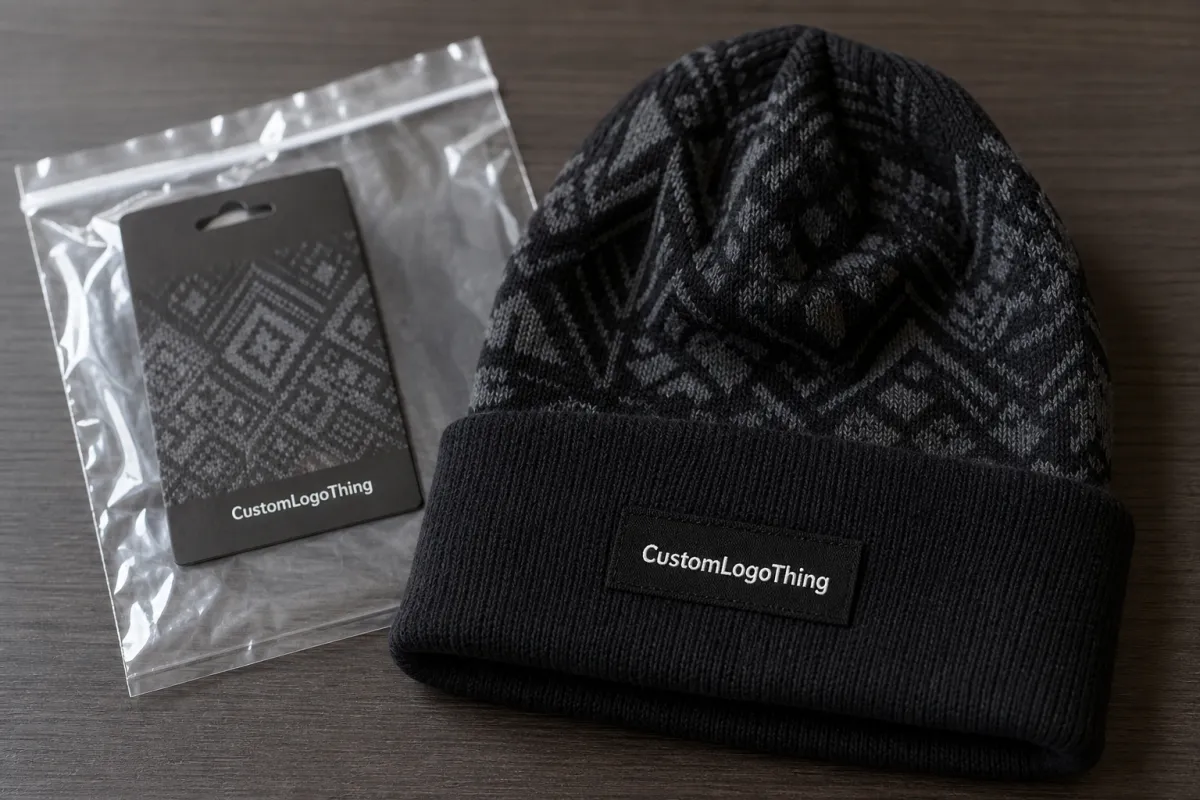
Plain knit caps are easy to make, but they often look generic and can flatten the logo. A patch creates a defined focal point on the cuff or front panel, which makes the brand easier to read from a distance. The jacquard body adds texture so the piece feels designed, not improvised.
Construction details shape the final look. Gauge, rib depth, cuff height, and body length all affect how the patch sits. Tighter knits usually give cleaner edges and better shape retention. Looser knits feel softer, but they can blur small details and make alignment issues more visible.
Buyers who want a stronger retail read usually choose a more structured body and a patch sized for normal viewing distance, not just close-up photos. That balance gives a better shelf presence without pushing the hat into a heavy or overbuilt feel.
Patch Styles, Knit Structures, and Finish Choices That Change the Look
The patch style is the main visual decision. Woven patches work best for fine text and sharp edges. Embroidered patches add texture and a classic feel. Leather patches are understated and premium. PVC patches are dimensional and more technical. Heat-applied options can reduce assembly time, but they are not the right choice for every yarn, surface, or wash requirement.
On the knit side, the main variables are gauge, rib depth, cuff height, and body length. A 7-gauge or 9-gauge knit usually feels heavier than a looser cap. Deep ribbing improves stretch and recovery. A taller cuff gives more room for branding and helps the patch frame the front. A shorter cuff looks cleaner, but it leaves less space and can crowd the logo.
| Patch Type | Look and Feel | Best Use | Typical Cost Impact |
|---|---|---|---|
| Woven | Clean, detailed, flat finish | Small text, sharp logos, retail | Usually lowest to moderate |
| Embroidered | Textured, classic, visible depth | Bold marks, heritage brands | Moderate |
| Leather | Premium, rugged, understated | Outdoor, lifestyle, premium merch | Moderate to higher |
| PVC | Dimensional, modern, weather-resistant | Outdoor promotion, sportswear | Higher |
| Heat-applied | Flat, efficient application | Simple logos, faster assembly | Usually lower on labor |
Placement changes both appearance and pricing. A centered cuff patch is the most common because it reads quickly and uses familiar tooling. A side patch is quieter. A front-panel patch can feel more retail if the knit body is clean and the patch is large enough to stand on its own.
If the logo is built into the jacquard pattern instead of added afterward, the result can look more integrated. The tradeoff is tighter color planning and less flexibility on contrast. Color count also affects cost: two yarn colors are straightforward, while five or six colors add setup, error risk, and approval time. Patch construction works the same way; a simple woven patch is usually cheaper than a molded PVC patch with layered detail or a special edge finish.
The lowest sample quote can become the most expensive order if patch size, knit gauge, and placement are still changing.
Specs to Lock Before You Request a Sample
A useful quote starts with a clear spec sheet. Send the artwork file, preferred patch size, target beanie size, cuff height, color references, and shipping destination. If you already know the decoration method, include that too. The more complete the build, the less likely the sample is to drift from the final order.
Vector artwork is the safest starting point. AI, EPS, and editable PDF files preserve small text and fine outlines better than raster images. If the logo depends on a thin line or a tight wordmark, ask for a proof at actual size. A mockup is useful, but actual size is what shows whether the patch will read correctly on the cuff.
Lock these practical details before sampling:
- Yarn fiber: Acrylic is common, wool blends feel warmer, and recycled yarns can change both hand feel and price.
- Gauge and stitch density: These affect warmth, clarity, and how well the beanie holds its shape.
- Patch backing: Sew-on, heat-applied, or stitched borders each change durability and labor.
- Patch size: Too small and fine text disappears; too large and the cuff looks crowded.
- Color reference: Pantone helps, but a physical sample is still safer for final approval.
- Wash expectation: Heavy-use programs need patch construction chosen with that in mind.
Ask for the sample to reflect final placement, not a rough logo position. A patch that sits a few millimeters too high or too low can change the balance of the whole piece. Most problems on these orders are not dramatic; they are small enough to notice immediately once the hat is on a head.
Jacquard Beanies Logo Patches Price, MOQ, and Unit Cost
For wholesale buyers, jacquard beanies logo patches price usually comes down to four levers: quantity, knit complexity, patch material, and packaging. Volume lowers Unit Cost Faster than almost anything else. More knit colors increase production time. Specialty patches raise material and application cost. Packaging can add more than expected, especially if the order needs hangtags, branded cards, or retail-ready folding.
MOQ tends to move with complexity. A single-color body with one woven patch can support a lower entry point. Dense jacquard patterns, embossed leather, or a more involved patch application usually push the minimum higher. Buyers should separate sample cost from bulk cost every time. A prototype may be charged as a standalone item, sometimes refundable against production, sometimes not.
| Order Volume | Typical Unit Price | Common MOQ Range | Best Fit |
|---|---|---|---|
| 100-300 pcs | $6.50-$9.50 | 100-200 pcs | Samples, small team runs, trial merch |
| 500-1,000 pcs | $4.20-$6.50 | 200-500 pcs | Promotions, club programs, seasonal resale |
| 2,000-5,000 pcs | $2.35-$4.10 | 500-1,000 pcs | Retail, regional campaigns, reorders |
Those ranges assume a standard acrylic or acrylic-blend jacquard body with one custom patch. Wool blends, recycled yarns, oversized patches, or specialty finishes can move the quote higher. Setup often adds $30-$150 depending on the patch method and how many revisions the proof needs. Freight, customs duties, and local taxes are separate, so landed cost should always be broken out from the unit number.
There are also pricing traps that show up late. A logo with tiny text can require a larger patch than expected. A complex knit pattern can increase machine time enough to erase savings from a cheaper patch. Retail packaging can cost more than the decoration itself on small runs. The cheapest line item is not always the cheapest order.
Example pricing framework: a 500-piece order with a woven patch may land around $4.20-$5.80 per unit, while a leather patch version of the same beanie may move closer to $5.10-$6.50. At 3,000 pieces, the same styles can drop into the low-$3 range if the knit pattern is straightforward and the artwork is approved quickly. Material choice, labor efficiency, and shipping lane all matter.
Production Steps and Turnaround From Artwork to Delivery
The production path is usually straightforward: quote confirmation, artwork proof, sample approval, knit production, patch application, QC, packing, and shipment. It gets messy when the buyer changes logo colors, patch material, or placement after proofing has started. Each change adds time, and sometimes just a little time is enough to push the shipment.
For a standard order, sampling often takes 5-10 business days. Bulk production is commonly 12-20 business days after sample approval, depending on quantity and the number of colors in the knit. Custom-dyed yarn, embossed patches, and retail packaging can add more time.
Fast approvals matter more than most buyers expect. A factory can knit quickly, but a stalled proof can burn a week without any production mistake. The same goes for labels, hangtags, and carton art. If those pieces are not signed off early, the order drifts. Buyers who need transit protection or retail cartons should ask whether the supplier follows packaging and testing practices aligned with ISTA guidance. If the brand policy calls for paperboard inserts or hangtags, FSC-certified board is worth specifying up front.
One practical habit helps a lot: treat the sample as the production standard, not as a rough draft. Once that expectation is fixed, mass production is easier to control and reorders stop feeling like a fresh negotiation.
Quality Checks That Keep Color, Shape, and Patch Placement Consistent
Quality control on these orders is not complicated, but it has to be specific. The team should inspect stitch uniformity, patch alignment, trim cleanup, color matching, and fold consistency. A hat can pass a quick visual check and still miss the buyer’s standard if the patch sits slightly crooked or the knit tension changes across the run.
Tolerance windows need to be clear before production starts. Most buyers will accept small variation in stretch and patch position. They will not accept a logo that feels off-center or a run where every third hat looks different. A solid QC plan defines what gets passed, what gets reworked, and what triggers a remake.
Packaging checks belong in the same process. Folded beanies can pick up compression marks, wrinkle lines, or label distortion before they leave the factory. If the order is split across multiple destinations, photo approval and pre-shipment checks reduce disputes later. A short image set of the cartons, the packed units, and one close-up per colorway usually catches the kind of issue that is easy to miss on a production line.
The strongest sign of control is not a promise of perfection. It is a supplier that can show exactly where the issue would be caught and who owns the fix.
Why Buyers Reorder From a Beanie Supplier That Handles Custom Patch Work
Reorders are easier when one supplier handles the knit, the patch, the proof, and the shipment. Fewer handoffs usually mean fewer mismatches between artwork and production. A broker can quote quickly and still leave the buyer chasing separate teams for yarn approval, patch revisions, and shipping updates.
The real value is repeatability. When patch placement, color control, and trim finish are documented well, the next order becomes faster and less risky. Buyers are not just paying for a hat; they are paying for a result that can be repeated across stores, seasons, and staff programs without turning into a new project every time.
Reliable suppliers also give cleaner answers on spec changes. If a buyer wants a wider cuff, a different patch edge, or a new colorway, the quote should show exactly how that affects price and lead time. That transparency prevents hidden revision costs and keeps the order on schedule.
If you are comparing vendors, ask who owns production control, who signs off on the proof, and who handles the final QC photos. Those answers tell you more than a polished sales pitch ever will.
For buyers reviewing jacquard beanies logo patches price, the cleanest approach is to compare landed cost, not just the headline unit number. Lock the knit spec, patch style, and placement first. Then request a written quote that separates unit price, setup, sample, and freight. That is how buyers keep the order tidy, protect the brand, and avoid paying twice for changes that should have been settled before production started.
What affects jacquard beanies logo patch price the most?
Quantity is the biggest lever, because higher volume usually lowers the unit cost fastest. Patch material, knit color count, and stitch density can push the price up or down quickly. Packaging, sampling, and freight should be reviewed separately so the quote stays clear.
What is the MOQ for jacquard beanie logo patch orders?
MOQ depends on knit complexity and the decoration method selected for the patch. Simple one-patch builds usually allow lower minimums than dense multi-color jacquard designs. Ask whether the MOQ is based on units, colors, or total style combinations before signing off.
How long does production take for custom jacquard beanies with patches?
Turnaround includes proofing, sample approval, production, inspection, and shipping time. Fast approvals can shorten the schedule more than any factory-side adjustment. Specialty patches or complex color matching usually add time at the sampling stage.
Can you match brand colors on jacquard beanies with logo patches?
Yes, but the best match starts with Pantone references or a physical color sample. The knit yarn and the patch material may match differently, so both should be approved together. Ask for a proof that shows the full color layout before production begins.
What should I prepare before requesting a quote for jacquard beanies logo patches?
Have your logo file, quantity target, patch style, and delivery date ready. Include sizing, color references, and any packaging or labeling requirements. A complete spec sheet helps the supplier quote more accurately and cuts down on revision cycles.