Jewelry Logo Patch Beanies Unit Cost Review: What You're Really Buying
A beanie can pick up more daily street exposure than the jewelry box it came in. That only helps if the beanie feels like it belongs with the brand. If it looks like bargain merch, the exposure works against you.
A real jewelry Logo Patch Beanies unit cost review needs to show what is built into the price, what pushes it up, and which details are worth protecting. Jewelry brands use logo patch beanies for client gifts, launch kits, staff uniforms, pop-up merch, influencer mailers, VIP thank-you packages, and holiday bundles. Each use case calls for a different mix of softness, structure, decoration quality, packaging, and cost control.
Unit cost is not just a blank beanie plus a patch. Real pricing includes yarn type, knit density, cuff construction, patch material, border style, stitch method, logo colors, setup charges, sampling, packaging, freight, and revision time. Artwork changes after proofing can add cost or delay, especially once the patch has moved into setup or sample production.
The easiest mistake is chasing the lowest unit price before the spec is clear. That usually creates the same problems: thin cuffs, weak stretch recovery, curled patch corners, muddy logo detail, or packaging that feels careless next to fine jewelry. Jewelry buyers notice small details for a living. Their customers do too.
Not every order needs wool blend, custom labels, and a rigid gift box. Not every order should be built around the cheapest acrylic blank either. A staff beanie for outdoor markets needs warmth and durability. A VIP gift may need better hand feel, cleaner patch detail, and neater presentation. A retail add-on needs consistent sizing and repeatable specs. The job should drive the product.
Buyer reality: a $6 beanie that nobody wears is more expensive than a $10 beanie that becomes part of someone's winter rotation.
Best Beanie and Patch Options for Jewelry Brands
Beanie style sets the tone before the logo does any work. A cuffed acrylic beanie is the steady choice: affordable, consistent, easy to source in standard colors, and friendly to bulk pricing. It fits staff uniforms, event giveaways, and mid-size customer gifts in the 250 to 2,000 unit range.
Rib-knit beanies feel more structured and retail-ready. Fisherman beanies sit higher and closer to the head, which suits minimalist jewelry brands with clean typography and restrained packaging. Slouch styles feel casual and fashion-forward, but they are less universal for gifting. Chunky knits bring warmth and texture, though they can look bulky in gift boxes and may overpower a small jewelry mark.
Recycled yarn options work well when the brand already uses recycled paperboard, FSC-certified packaging, or lower-plastic fulfillment materials. They do not fit every program. Color selection, minimums, and yarn hand feel can be tighter than standard acrylic or acrylic blends.
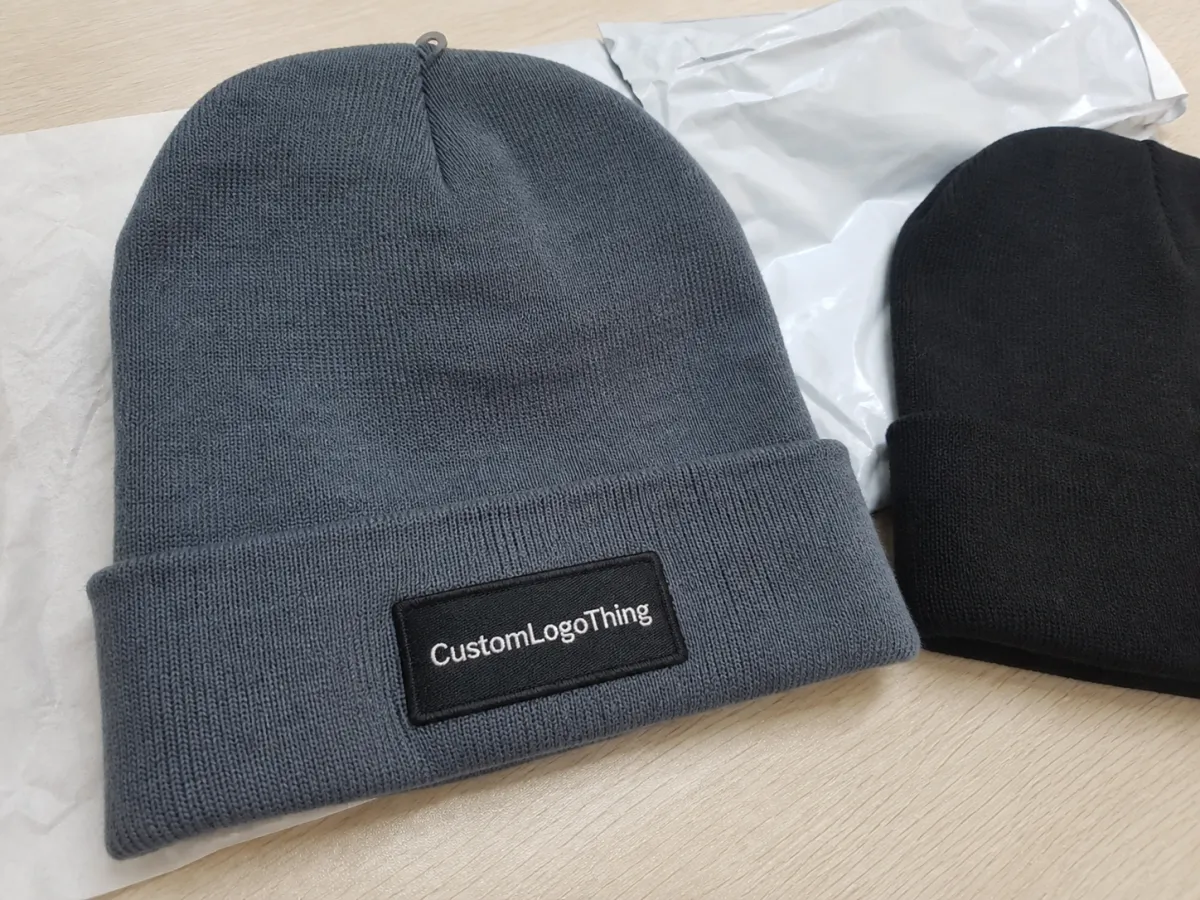
Patch choice has a bigger effect on perceived value than many buyers expect. Woven patches are usually the safest option for fine line marks, small serif type, tiny gemstone icons, and delicate crests because the threads hold sharper detail than standard embroidery. Embroidered patches add texture and a familiar retail feel, but small letters can close up fast. Leatherette patches work well for clean wordmarks and boutique branding, especially in tan, black, cognac, ivory, or charcoal. PVC patches suit modern brands with bold marks, outdoor positioning, and simple color blocks. Chenille is best for large, bold fashion graphics; it is dimensional, warm, and not subtle.
Centered cuff placement is the clean retail default. Side cuff placement feels quieter and can look more premium on minimalist brands. A small offset patch works well when the rest of the packaging already uses restraint. Patch width often falls between 1.5 and 2.5 inches for discreet branding, or 2.75 to 3.5 inches when the logo needs to read clearly from a few feet away.
Logo artwork needs an early production review. Thin serif type, hairline icons, detailed crowns, fine gemstone illustrations, and delicate script may need to be simplified depending on the patch material. That is not a design failure; it is translation from screen to textile. A logo that looks perfect on a jewelry card can turn cramped or fuzzy on a small patch if the lines are too fine.
| Patch Type | Best For | Watchouts | Typical Feel |
|---|---|---|---|
| Woven patch | Fine text, line art, delicate logos | Less raised texture than embroidery | Clean and precise |
| Embroidered patch | Bold marks, simple icons, textured branding | Tiny details can fill in | Classic and tactile |
| Leatherette patch | Boutique branding, clean wordmarks | Not ideal for very detailed art | Premium and minimal |
| PVC patch | Modern logos, outdoor edge, bold color blocks | Can feel too sporty for fine jewelry | Sharp and durable |
| Chenille patch | Large bold designs, fashion merch | Bulky and poor for tiny text | Loud and dimensional |
Specifications That Change Feel, Fit, and Perceived Value
Specs decide whether the beanie feels giftable or disposable. Start with weight and knit density. A light acrylic beanie may weigh around 55 to 75 grams, while heavier rib or chunky styles can run 90 to 140 grams or more. Higher weight can feel more substantial, but thicker is not automatically better. Heavy knits can be too hot, too bulky for gift boxes, and too expensive for wide distribution.
Cuff height affects both fit and branding space. A 2.5 to 3 inch cuff usually works for small patches. A 3.25 to 4 inch cuff gives more room for centered retail-style branding. The cuff also needs enough structure to hold the patch without sagging, twisting, or flaring away from the head.
Stretch recovery matters. If the beanie bags out after two wears, the low unit cost did not save much. Acrylic gives budget-friendly consistency and broad color availability. Wool blends add warmth and retail value, though they can raise cost and care concerns. Cotton blends feel softer against the skin but may not hold structure as well as acrylic rib. Recycled fibers can support documented sustainability claims, but the available colors and MOQs may be tighter.
Fit is not one-size-fits-all magic. Adult one-size is the safest gift option for most jewelry brands. Youth sizing works for family-oriented promotions or children's jewelry lines. Slouch fits feel casual and relaxed. Fisherman fits look current and close to the head, but they do not suit every wearer. Unisex sizing keeps a gifting program simple, especially when the beanie is bundled with a purchase or sent to customers without size data.
Decoration specs need to be locked before quote approval: patch material, backing, border style, stitch color, thread count or weave detail, attachment method, and placement tolerance. A normal placement tolerance may be around 1/8 inch to 1/4 inch, depending on construction and sewing process. Small variation is normal. Random angles, puckered fabric, and drifting placement are not.
Packaging changes the way the beanie is perceived before anyone wears it. Jewelry brands may need individual polybags, paper belly bands, hang tags, custom tissue, gift boxes, barcode labels, or carton labeling for fulfillment. If the beanie ships inside a jewelry bundle, confirm the folded size early. A chunky knit that looks great on a model can wreck a rigid gift box plan very quickly.
Sustainability language should stay specific. FSC-certified paper components support responsible packaging communication, and buyers notice that kind of detail when the rest of the brand story already points in that direction. Recycled yarn is useful when the supply chain can back it up. If the beanie or patch cannot support a claim clearly, leave the claim out.
Unit Cost, Pricing, and MOQ Ranges to Expect
Beanie pricing moves fast once the spec changes. A plain acrylic cuffed beanie at a mid-range MOQ is usually the cheapest starting point. Add a custom patch, and the unit cost moves up with the patch type, size, and attachment method. Woven and leatherette patches usually stay friendlier to budget than complex embroidery or specialty finishes. PVC and chenille can run higher because of tooling, labor, and the extra handling they need.
For planning purposes, many jewelry brands see blank beanies land in the low single digits at higher quantities, then move into the mid-to-high single digits once decoration, setup, and packaging are added. Small runs almost always cost more per piece because the setup is spread across fewer units. That is normal. The real question is whether the final piece feels worth giving or selling.
MOQ also changes the math. A supplier may offer a lower unit price at 500 or 1,000 pieces, but the total spend may still be too heavy for a seasonal test. Smaller programs often work better with 100 to 250 pieces if the brand needs a fast drop, a staff order, or a mailer tied to one promotion. Higher runs make sense when the same spec will be reused across stores, events, or repeated campaigns.
Setup charges deserve attention because they are easy to miss. Some suppliers include one patch proof in the quote. Others charge separately for artwork cleanup, digitizing, sample production, patch tooling, and packaging changes. Ask what is included before comparing prices. A cheap quote with a long list of add-ons is not cheap.
Freight matters too. Flat shipping can distort the real unit cost on smaller runs, especially when cartons are bulky and the destination is far from the factory. If the beanies need to arrive by a launch date, rush freight can cost more than the decoration itself. Plan the calendar before the quote is approved.
A simple way to judge the quote is to ask one question: does the total landed cost still make sense if 10 percent of the order is held back for samples, replacements, or launch delays? If the answer is no, the spec is too thin or the timeline is too tight.
Process, Lead Time, and Production Steps
The process usually starts with artwork and a spec sheet. The supplier needs the logo file, patch type, beanie style, color callouts, placement notes, packaging needs, and target quantity. A clean brief cuts out back-and-forth later. If the logo has fine lines, ask for a production review right away instead of waiting for a sample to reveal the problem.
After the quote, the supplier sends a mockup or digital proof. That proof is where patch size, placement, and color balance get checked. If the first proof feels off, say so then. Changes are cheap before sampling and expensive after production starts.
Sample production is the next checkpoint. A physical sample shows actual texture, stretch, patch finish, and stitching quality. For jewelry brands, this step is worth the wait because small errors read loudly on a premium item. If the sample is close but not right, ask for a revision before approving bulk.
Once the sample is approved, production moves into the main run. Lead times vary by material, season, quantity, and decoration method. Simple programs can move quickly, while custom yarn, specialty patches, or complex packaging take longer. Peak Q4 orders need extra buffer because every supplier is dealing with the same holiday surge.
After production, the order goes through inspection, packing, and freight booking. If the beanies are part of a retail launch or a client gifting campaign, ask for carton labeling and count confirmation so fulfillment does not get messy at the end. Missing units are cheaper to catch at the factory than after they land.
In practice, the schedule looks like this: quote and proof first, sample next, then bulk production, then final check, then shipping. The cleanest projects are the ones where each step is approved without guessing.
Quality Checks Before You Approve Bulk Production
Check the patch size against the cuff. A patch that looks balanced on a flat mockup can feel too small or too large once it sits on knit fabric. Placement should be centered, level, and consistent from piece to piece. Small drift is normal. Sloppy alignment is not.
Look at the logo at reading distance, not just in the close-up photo. Fine details matter, but the patch still needs to read as a brand mark first. If the lettering blurs or the icon loses shape when viewed from a few feet away, revise the spec.
Test the fabric for stretch and rebound. Pull the cuff, let it settle, and see whether it returns cleanly. A beanie that stays stretched out looks tired before it leaves the box. Check seam quality, loose threads, patch edges, and any puckering around the attachment points.
Compare the actual color to the approved reference. Knit and patch materials do not always match a screen exactly, so the real test is whether the colors look intentional together. This matters a lot for jewelry brands that rely on neutrals, muted metals, or a very controlled palette.
Review the folded size and packaging fit before the order ships. If the beanie is part of a gift set, the fold should fit the box without forcing the knit out of shape. A nice beanie tossed into the wrong box looks like an afterthought.
One final check is wearability. If the beanie feels scratchy, too tight, or too loose in a way that would annoy the end user, the cost conversation is already wrong. People keep the items they actually wear.
Information Needed for an Accurate Beanie Quote
Start with the logo file and the beanie style. The supplier needs to know whether the patch is woven, embroidered, leatherette, PVC, or chenille, and whether the beanie is cuffed, ribbed, slouch, fisherman, or chunky knit. Those two choices shape most of the price.
Share the quantity, target delivery date, and shipping destination. Those three details affect MOQ, production speed, and freight. If the order is tied to a launch, say so early. A hard deadline changes what is realistic.
Include the color choice, placement preference, patch size, and packaging requirements. If the beanie has to sit inside a jewelry box or mailer, the folded dimensions matter. If the brand wants a premium unboxing moment, say that up front instead of adding it after the quote.
Send any notes on sustainability, sizing, and use case. A staff uniform order is not the same as a VIP gift or a retail add-on. The supplier can only match the right spec if the use is clear.
If you already have a budget ceiling, share it. That saves time. A good supplier can usually point out where the money is working hard and where it is being wasted.
FAQ
What patch type works best for fine jewelry branding?
Woven patches usually handle small text and delicate marks best. If the logo is bold and simple, leatherette or embroidered patches can still look sharp.
Is acrylic too cheap for a premium jewelry brand?
Not if the knit, patch, and packaging are handled well. Acrylic is often the smartest base because it keeps cost under control and holds consistent color.
What MOQ makes sense for a first run?
Small test runs often start around 100 to 250 units. If the style will be reused across events or stores, higher quantities usually bring better pricing.
How long does production usually take?
It depends on the spec, but the sample-to-ship timeline is often measured in weeks, not days. Add extra time during the holiday season.
Can the beanie be packaged like a gift?
Yes. That is often the difference between a casual giveaway and something that feels worth keeping. Just confirm the folded size before production starts.