Buyer Fit Snapshot
| Best fit | Kraft Bags Supplier projects where brand print, material claims, artwork control, MOQ, and repeat-order consistency need to be specified before quoting. |
|---|---|
| Quote inputs | Share finished size, material target, print colors, finish, packing count, annual reorder estimate, ship-to region, and any compliance wording. |
| Proofing check | Approve dieline scale, logo placement, barcode or warning zones, color tolerance, closure strength, and carton packing before bulk production. |
| Main risk | Vague material claims, crowded artwork, missing packing details, or unclear freight terms can make a low unit price expensive after revisions. |
Fast answer: Kraft Bags Supplier: Film, Print, MOQ, and Carton Packing should be specified like a repeatable production item. The safest quote records material, print method, finish, artwork proof, packing count, and reorder notes in one written spec.
Production checks before approval
Compare the actual filled-product size with the drawing, then confirm tolerance on folds, seals, hang holes, label areas, and retail display edges. Reserve space for logos, QR codes, warning copy, and material claims before decorative graphics fill the panel.
Quote comparison points
Review material grade, print process, finish, sampling route, tooling charges, carton quantity, and freight assumptions side by side. A quote is only useful when the supplier can repeat the same color, closure quality, and packing count on the next order.
A kraft bags supplier is not just a source of paper bags. The right partner helps you balance strength, print quality, handle style, and cost so the bag does its actual job instead of sagging, splitting, or making the brand look underfed in a customer’s hand.
That sounds straightforward. It usually is not. Buyers still approach kraft bags as if every sheet of paper behaves the same once ink and glue are added. It does not. A bag may be the first physical thing a customer touches, and weak handles or muddy print can drag down a premium product faster than a bargain sticker on a luxury shelf.
What follows is a practical look at how a kraft bags supplier works, what shapes pricing, how long production tends to take, and which details deserve scrutiny before you approve a run. Retail, food service, events, subscription boxes, cosmetics, promotional packaging, and gift use all create different demands, and those differences show up in the final bag long before the carton is opened.
What a Kraft Bags Supplier Actually Does
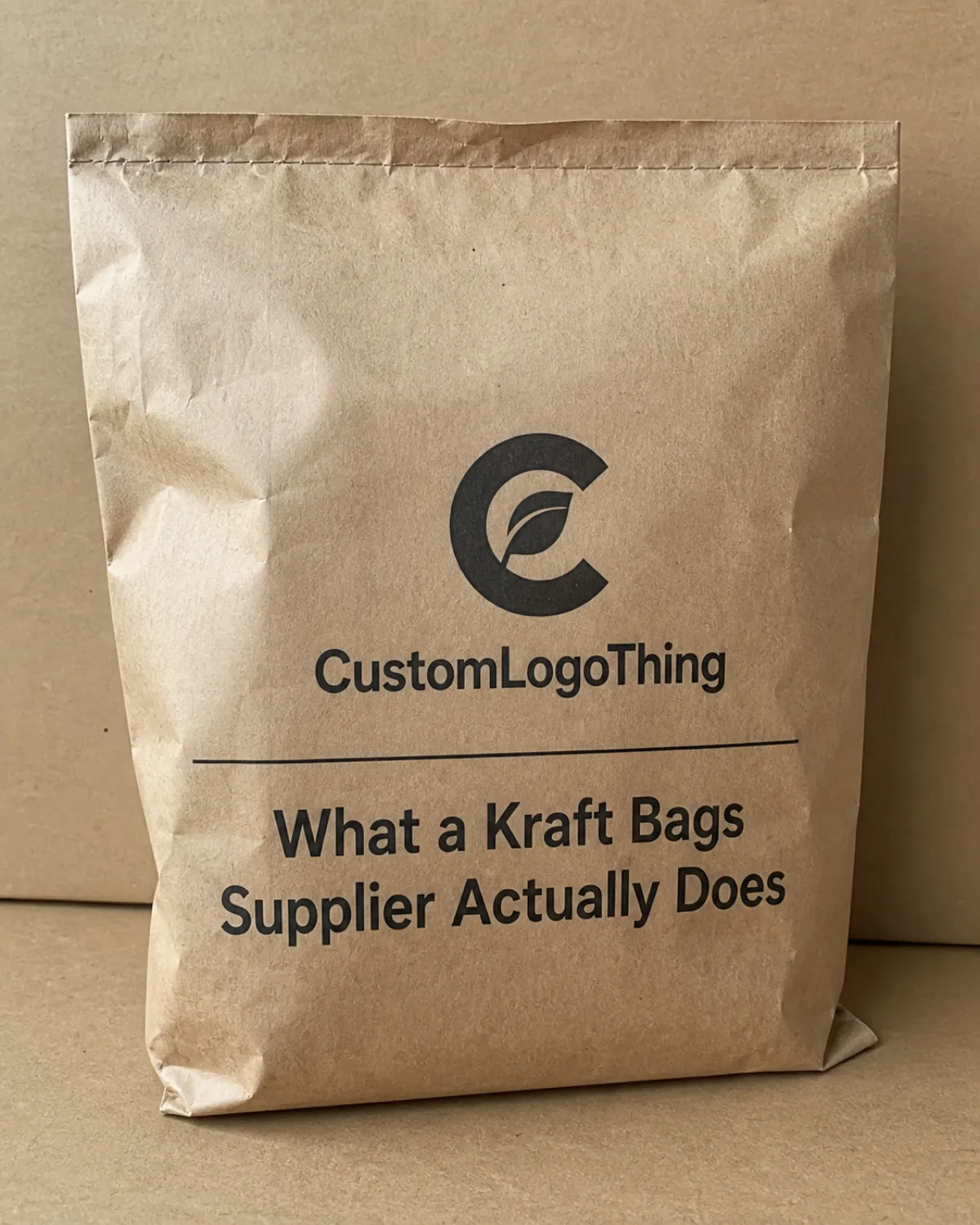
A real kraft bags supplier does more than print a logo and ship cartons. The work begins with spec matching. Paper grade, bag size, handle style, reinforcement, print method, and packing format all need to fit the weight of the product and the way the bag will be used. A supplier worth trusting will ask about product weight, store environment, order volume, and whether the bag needs to survive a full retail day or only make one clean handoff at an event.
That part sounds technical because it is. The details most buyers leave for later are usually the details that decide whether the order feels polished or flimsy. Paper weight matters. So do the gusset, the bottom fold, and whether the handles are twisted paper, flat paper, rope, or die-cut. A 120gsm kraft paper bag carrying light cosmetics lives in a very different category from a reinforced 200gsm retail bag holding boxed candles. Product weight, brand image, and distribution method are not interchangeable variables.
Buyers tend to fall into a few familiar groups:
- Retail boutiques that need a neat branded carry bag with real load strength.
- Food service brands that may need grease resistance, food-safe inks, or careful carton packing.
- Events and trade shows that need fast production, simple artwork, and predictable volume.
- Subscription box brands that watch unboxing quality, print consistency, and repeat orders closely.
- Cosmetics and beauty brands that want a premium feel without paying for overbuilt specs.
- Promotional packaging buyers who need short runs, seasonal graphics, or a quick reorder path.
The difference between a manufacturer, a trading company, and a local reseller matters more than many buying teams expect. A manufacturer controls the line and usually gives better pricing on custom work, but minimums and lead times can be stricter. A trading company can widen sourcing options and smooth communication, although it may add margin and another layer between you and the factory. A local reseller is often the simplest route for small or urgent orders, though the tradeoff is higher unit cost and less room for tiny custom adjustments.
Here is the blunt version: a good kraft bag is not built around one flashy feature. It depends on the right mix of paper, glue, handle, print, and packout. If one piece is off, the whole order reads cheap. The supplier’s job is to keep those pieces aligned without turning the spec into an overcomplicated engineering exercise.
“A weak handle turns a decent order into a refund problem.” That mistake only needs to happen once, because customers remember bags that fail in public.
Kraft Bags Production Process and Timeline
The production path looks simple on paper and far less tidy in real life. A proper kraft bags supplier usually moves through a sequence like this: request specs, prepare artwork, confirm dielines, source paper, print, die-cut, fold and glue, attach handles, inspect quality, pack, and ship. Each step can stay on schedule or become the reason the launch slips, especially when the brief is vague or the artwork keeps changing.
For a standard custom run, the timeline usually lands in a familiar range:
- Sample development: often 3-7 business days for a simple sample, longer if the bag has special print or structure.
- Artwork and dieline approval: 1-3 business days if the file is clean; longer if revisions are needed.
- Production: commonly 2-4 weeks for standard custom bags.
- Special finishes or complex builds: closer to 4-6 weeks, sometimes more during busy seasons.
- Freight and delivery: a few days for local delivery, 1-5 weeks for ocean freight, depending on route and customs.
Those numbers are working estimates, not promises carved into paper stock. They are still useful because they keep planning anchored in reality rather than hope. A supplier who claims every custom order is finished in a week is either speaking loosely or ignoring the steps that usually cause trouble.
Late artwork changes create a lot of delays. Missing dimensions and absent weight requirements cause just as much damage. Print files made for a screen, not a die line, often need cleanup before production can begin. Color matching can slow things too, especially if you want a specific Pantone result on uncoated kraft paper, where the ink often dries a little duller than it looks on coated stock. Handle changes and paper shortages can also push schedules back. Holiday congestion makes all of it worse.
That is why suppliers ask for exact dimensions, product weight, print area, and packing expectations before quoting. They are not being difficult for entertainment. They are trying to avoid the expensive version of “close enough.” A vague brief creates bad timing and bad bags. Then everyone acts surprised, which is always a creative way to waste money.
If the launch date is fixed, build buffer time into the schedule. Leave room for proof review, shipping, and reorders. Do not build a product release around the fantasy that a factory or freight lane will move faster just because your calendar is feeling dramatic.
For buyers who want a broader view of packaging standards and sustainability, the paper side is worth checking against recognized references. FSC-certified fiber sources are one route to verify responsible forestry practices, and transit-testing logic from groups like ISTA can help when the bags travel inside larger cartons or kits. For fiber sourcing and chain-of-custody basics, FSC remains a common reference point for packaging teams.
Kraft Bags Supplier Pricing, MOQ, and Quote Basics
Pricing for Custom Kraft Bags follows a fairly predictable pattern, and the details really do move the number. The main cost drivers are paper thickness, bag size, print colors, coating or lamination, handle style, reinforcement, and any extras such as inserts, windows, embossing, foil, or custom die-cuts. Small, simple bags printed one color on one side tend to sit near the low end. Larger bags with heavier printing and a premium finish climb quickly.
MOQ means minimum order quantity. It is the point where factory setup costs stop making the job uneconomical. For many Custom Kraft Bags, MOQs can range from a few hundred pieces to several thousand, depending on the factory, print complexity, and construction. A straightforward retail bag may start around 1,000 to 3,000 units. More customized work often wants 5,000 or more. Short runs can be done, but the unit cost usually climbs with them.
One simple way to think about unit cost: a basic custom kraft bag might land around $0.18-$0.35 per unit at higher quantities. A mid-range retail bag with stronger paper, better handles, and clean branding can sit around $0.30-$0.65 per unit. Premium bags with thick stock, full-color print, special finishes, or reinforced construction can move into $0.65-$1.40+ per unit. Those figures are not universal, yet they are realistic enough to keep a buyer from being shocked when a quote arrives.
Quotes usually contain more than unit price. A proper quote may include:
- Unit price based on quantity and spec.
- Plate or setup fees for printing preparation.
- Sample fees if you want a pre-production sample or mockup.
- Freight for shipping, domestic or international.
- Duties and taxes if the bags cross borders.
- Storage or split-shipment charges if you do not take the full order at once.
Low price is not the same thing as low cost. A cheap bag that tears, prints poorly, or fails inspection is not cheap. It is a refund with a logo on it. Smart buyers compare quotes only after matching the spec line by line. Same size. Same paper weight. Same print count. Same handle style. Same finish. Same shipping terms. Without that, the “cheapest” supplier is just the one that left out the most expensive pieces.
| Bag Spec | Typical MOQ | Typical Unit Price | What Drives Cost | Best For |
|---|---|---|---|---|
| Basic kraft bag, one-color print, twisted handles | 1,000-3,000 pcs | $0.18-$0.35 | Paper weight, print area, handle attachment | Retail basics, events, simple promotions |
| Mid-range retail bag, reinforced base, 2-4 color print | 3,000-5,000 pcs | $0.30-$0.65 | Color count, reinforcement, sizing accuracy | Boutiques, gift shops, recurring retail use |
| Premium bag, special finish, upgraded handle, custom insert | 5,000+ pcs | $0.65-$1.40+ | Finish type, heavier stock, decorative effects | Cosmetics, luxury packaging, higher-margin products |
Land the cost, not just the factory price. Freight can swing the final number more than people expect, especially on bulky items like bags. A quote that looks slightly higher at the factory level may still be cheaper once shipping, duties, and local delivery are included. That is not a trick. It is just math arriving late to the meeting.
Key Factors to Compare Before You Sign Off
Do not stop at “kraft paper” and assume the rest will sort itself out. Paper quality matters, recycled content matters, and the exact paper weight matters even more once the bag starts carrying real product. Stiffness, surface feel, and load performance all change the experience. A lighter bag can work well for apparel or paper goods. It is a poor fit for glass jars, heavy gift boxes, or several items stacked together. If the supplier cannot explain how the bag behaves under load, treat that as a warning.
Handle style is another place where buyers get distracted by appearance and forget physics. Twisted paper handles are common, inexpensive, and usually fine for retail use. Flat handles are simple and economical, but they feel less premium. Die-cut handles can look clean and modern, yet they are not always the best choice for heavier loads unless the bag is reinforced properly. Rope handles add cost, though they often earn their place in premium presentation. The question is not which handle looks good in a mockup. The question is which one survives the way customers actually use the bag.
Print quality is where repeat orders either build trust or erode it. Ask the supplier how they control color tolerance. Ask whether artwork is checked against a proof before production starts. Ask if the same job can be repeated later without major drift in shade or layout. If your brand depends on a consistent look across stores or launches, this is not a side note. It is the whole point.
Finishing options should come after structure, not before it. Matte lamination, gloss varnish, hot stamping, embossing, and spot effects can make a bag feel more premium. They can also raise cost and create extra production risk. A fancy finish does not rescue weak construction. A glossy bag that splits at the bottom is still a bad bag.
Compliance deserves a real conversation too. Food service buyers should ask about food contact suitability, ink safety, and grease resistance if the bags will touch unpackaged food. Gift packaging and promotional use may have simpler requirements, but any regulated market needs extra care. Not every supplier is set up for every use case, and pretending otherwise usually ends in corrections, delays, or worse.
Before you sign off, compare these areas in order:
- Load requirement — what the bag must carry.
- Paper spec — what stock and thickness are being used.
- Handle style — what customers will actually hold.
- Print method — what the final artwork needs.
- Finish — what is decorative versus necessary.
- Packaging format — how the bags will arrive and be stored.
One more useful habit: if a supplier can show similar samples from a past run, inspect the edges, fold lines, glue points, and handle attachment. Those places reveal whether the supplier knows how to build bags, not just sell them.
Step-by-Step: How to Order from a Kraft Bags Supplier
The cleanest path to a solid order is making every supplier quote the same job. That begins with a short spec sheet that is specific enough to be useful. Include bag dimensions, quantity, product weight, print count, handle type, finish, target budget, and delivery location. If you already have a reference sample, send that too. Clear specs save money because they stop assumptions from growing into revisions.
A practical ordering process usually looks like this:
- Define the bag purpose. Is it for retail checkout, product gifting, shipping inserts, or event handouts?
- Set the load target. If the bag needs to carry 1 lb, 3 lb, or 8 lb, say so.
- Choose the structure. Decide on size, gusset depth, handle type, and any reinforcement.
- Prepare artwork. Use the supplier’s dieline and keep text inside safe areas.
- Request comparable samples. Ask for photos or physical samples of similar work.
- Approve the proof. Check spelling, placement, colors, and size.
- Confirm shipment terms. Make sure you know who handles freight and customs.
- Approve production. Only after the spec and proof are settled.
Samples are not a luxury. They are insurance. Photos can help, but a real sample tells you more about stiffness, handle comfort, print clarity, and the way the bag feels in hand. If the supplier will not send a sample or a close equivalent, that tells you something. Not something reassuring.
Ask how proofing works. The process should include artwork review, dieline confirmation, and one final sign-off before mass production begins. If each revision triggers another loop of confusion, expect delays. Good suppliers keep the approval path simple because they know where mistakes tend to happen. Bad ones rely on everyone remembering everything perfectly. That plan fails often.
Payment terms matter as well. A standard deposit and balance structure is common, though the exact split can change. Ask about shipping method, carton count, label requirements, and inspection method before you place the order. A bag shipment should be dull when it arrives. Correct labels, consistent packing, and proper counts turn receiving into a ten-minute task instead of a warehouse mystery.
If the order supports a retail launch or seasonal promotion, set reorder triggers early. Running out of stock and then scrambling for a second run while the supplier is already booked is how one packaging decision becomes a supply problem.
Common Mistakes When Choosing a Kraft Bags Supplier
The first mistake is easy to spot: buying on price alone. Cheap quotes look decisive, which is why they are so tempting. Then the paper turns out thinner than expected, print alignment drifts, or the supplier quietly adds charges after proof approval. A low number on page one is not a win if page two contains the invoice-shaped surprise.
The second mistake is ignoring load requirements. A bag that holds folded socks is not the same bag that carries a ceramic mug or a box of skincare. Handles fail when the structure is wrong, and they usually fail in the least convenient place possible: in front of a customer, at a store counter, or during transit. That is not just a packaging defect. It becomes a brand moment, and not the flattering kind.
Skipping samples is another classic error. Some buyers think samples slow the process, but the opposite is usually true. A single sample can expose problems with print density, paper feel, dimensions, or handle strength before thousands of units are committed. That is efficient. Ordering blind is not efficient. It is expensive optimism.
Unclear artwork creates its own mess. If the supplier has to guess font sizes, safe zones, or logo placement, the proof cycle stretches. If measurements are missing, the bag may be too tight for the product or too loose to look intentional. Vague briefs create production confusion, and production confusion creates blame. Nobody needs that chain reaction.
Another mistake is forgetting the reorder plan. First orders receive all the attention. Reorders get ignored until the shelf is empty. If the bag performs well, the second order matters just as much as the first. A supplier that disappears, changes materials without warning, or cannot repeat the same print quality has failed the business even if the opening order looked fine.
Here is a quick reality check on the most common failures:
- Thin stock that looks fine but buckles under product weight.
- Poor glue lines that open during use or packing.
- Handle attachment issues that show up after the bag is already in circulation.
- Artwork drift between initial approval and actual production.
- Bad packing format that causes crushed bags, warped corners, or messy storage.
If any of those show up in a sample, stop and fix them before production starts. The goal is not to admire a prototype. The goal is a shipment that behaves the same way every time a customer picks it up.
Expert Tips and Next Steps for a Better Order
Treat the first order like a test run, even when the quantity is large. Validate size, color, handle strength, and packing before committing to a bigger program. A first run tells you whether the supplier can actually repeat the bag the way you need it. That matters more than a polished sales deck or a friendly quote.
Build a simple supplier scorecard. Keep it practical. Score each kraft bags supplier on five things: price, communication speed, sample quality, lead time, and consistency. You do not need a ten-tab spreadsheet with a motivational quote in cell A1. You need evidence. A supplier that answers clearly, ships samples on time, and repeats the same quality is usually worth more than one that is slightly cheaper but unreliable.
Ask for a landed-cost estimate, not just a factory quote. Freight, duties, local delivery, and packing fees can move the final number enough to change your decision. If you are comparing two suppliers and one is faster but slightly more expensive, that may still be the better buy if shipping is cleaner and inventory risk is lower. Real cost is what lands at your door, not what appears in a screenshot.
Set reorder alerts before stock gets tight. That sounds basic because it is basic, and basic things are often the ones people skip. If the bags support a retail launch, a subscription cadence, or seasonal packaging, the reorder date should be on the calendar before the first pallet leaves the factory. Otherwise you will be negotiating under pressure, which is a miserable way to buy anything.
If you are comparing options for Custom Logo Things, keep the decision anchored in use, not ego. The better kraft bag is the one that fits the product, prints cleanly, arrives on time, and holds up in the real world. That is the whole job. Gather the specs, request two or three comparable quotes, order samples, and choose the kraft bags supplier that balances cost, timing, and quality without drama. That approach saves money and cuts down on the usual packaging nonsense.
How do I choose the right kraft bags supplier for retail packaging?
Look for a supplier that can show matching samples for your bag size, print style, and load requirement. Compare communication speed, proofing clarity, and repeat-order consistency, not just the lowest unit price. If the supplier cannot explain construction details in plain language, that is usually a warning sign.
What is the usual MOQ from a kraft bags supplier?
MOQs often range from a few hundred to several thousand units depending on customization, print colors, and factory setup. Heavily customized jobs usually need a higher MOQ because setup and waste costs have to be spread across more bags.
How long does a kraft bags supplier usually need to produce an order?
Simple custom runs can move in a few weeks, while samples, revisions, and special finishes can extend the schedule. Add extra time for shipping, peak season, and approval delays so the order does not collide with your launch date.
What affects kraft bag pricing the most?
Paper weight, bag size, print complexity, handle style, and finish have the biggest impact on unit cost. Freight, duties, sample fees, and low-MOQ orders also move the total price more than most buyers expect.
Can a kraft bags supplier make custom sizes and printing?
Yes, most custom suppliers can adjust dimensions, handle types, print areas, and finishes as long as the order specs are clear. The more unusual the size or decoration, the more important it is to confirm dielines, samples, and production limits early.

