Buyer Fit Snapshot
| Best fit | custom kraft bags with logo branding for retail for packaging buyers comparing material specs, print proof, MOQ, unit cost, freight, and repeat-order risk where brand print, material, artwork control, and repeat-order consistency matter. |
|---|---|
| Quote inputs | Share finished size, material target, print colors, finish, packing count, annual reorder estimate, and delivery region. |
| Proofing check | Approve dieline scale, logo placement, barcode or warning zones, color tolerance, and any recyclable or compostable wording before bulk production. |
| Main risk | Vague material claims, crowded artwork, or missing packing details can create delays even when the unit price looks attractive. |
Fast answer: Custom Kraft Bags with Logo Branding for Retail: Film, Closure, Print, and Fulfillment should be specified like a repeatable production item. The safest quote includes material, print method, finish, artwork proof, carton packing, and reorder notes in one written spec.
What to confirm before approving the packaging proof
Check the product dimensions against the actual filled item, not only the sales mockup. Ask for tolerance on folds, seals, hang holes, label areas, and retail display edges. If the package carries a logo, QR code, warning copy, or legal claim, reserve that space before decorative graphics fill the panel.
How to compare quotes without losing quality
Compare board or film grade, print process, finish, sampling route, tooling charges, carton quantity, and freight assumptions side by side. A lower quote is only useful if the supplier can repeat the same color, closure quality, and packing count on the next order.
Custom Kraft Bags with logo do more than carry a purchase out the door. They get picked up at the counter, swung by a hand on the sidewalk, dropped into a car seat, and sometimes set on a kitchen table or office desk long after the sale is finished. That kind of repeated visibility is hard to beat for a paper bag, especially when the size, print quality, and structure are chosen with care. A bag does not need to be flashy to work hard. It needs to look thought through.
For a packaging buyer, custom kraft bags with logo sit in a practical sweet spot. They cost less and move faster than rigid boxes, yet they still give the brand a clear presence in the moment of purchase. A plain brown bag says there was a bag. A clean, well-made custom kraft bags with logo order says the business paid attention. Customers notice that difference quickly, often before they can put words to it, which is why branded packaging can change the feel of an entire transaction.
In my experience, the best bag programs are the ones that seem almost boring on paper and then feel quietly solid in hand. That is usually the goal. Not flashy, not precious, just well resolved.
Custom kraft bags with logo: what they are and why they punch above their weight
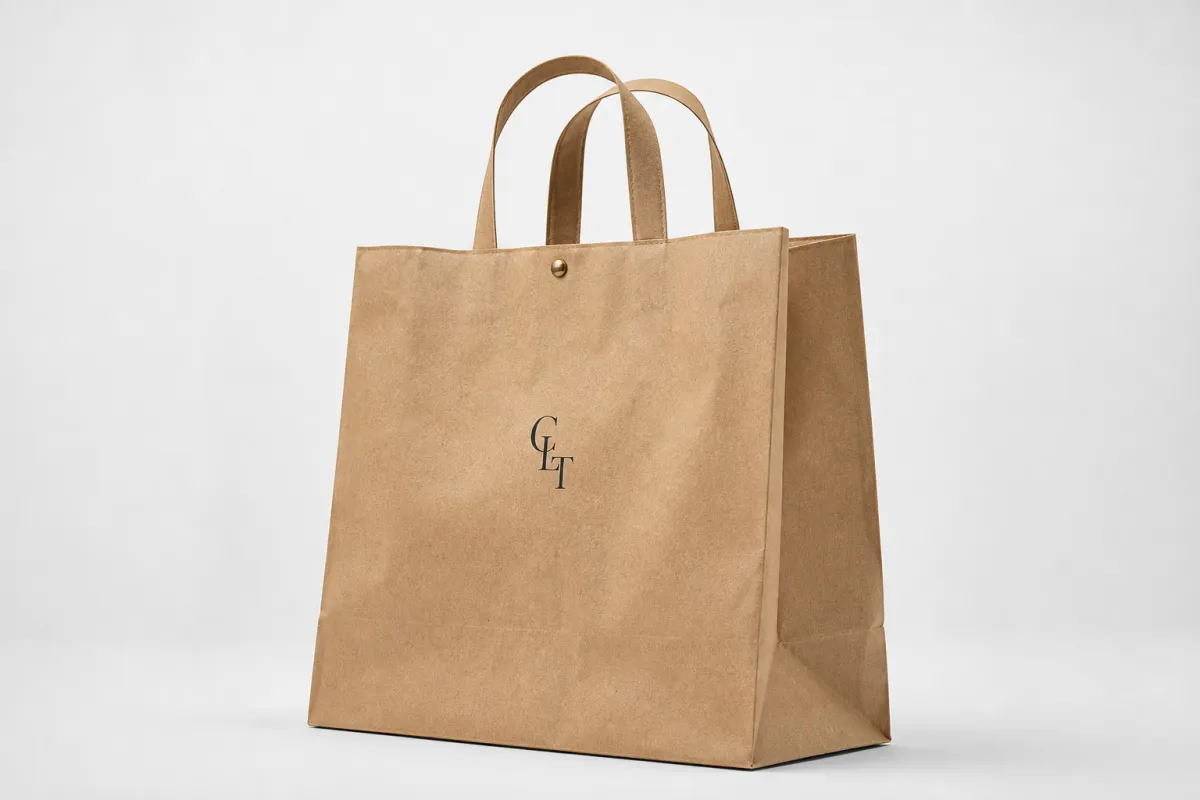
Custom kraft bags with logo are paper shopping bags made from kraft stock, then printed, stamped, or foil marked with a brand identity. They appear in retail stores, gift shops, bakeries, cafes, trade events, and any place where a purchase needs a carrier that looks more deliberate than a plain sack. The material is usually brown kraft or white kraft, and the formats range from flat-bottom carry bags to heavier gusseted Bags with Twisted paper handles, flat handles, or rope handles.
The strength of custom kraft bags with logo comes from exposure. A bag gets handled in the store, carried outside, moved into a vehicle, and often left in sight once the customer gets home. That creates multiple impressions from one item. A candle priced at $12, a skincare set at $28, or a small apparel purchase can feel more complete when the carrier matches the product’s value. The bag does not replace the product. It frames it.
That added structure changes perception in a real way. A plain kraft bag with a crisp logo can make a candle, soap bar, or bottle set feel more considered than a flimsy unbranded carrier ever will. The surface is not just moving merchandise. It is carrying package branding, and every design decision shapes that message. Color, handle style, print placement, and the breathing room around the mark all affect how polished the final result feels.
“A bag does not need to be fancy. It needs to look like the brand made a choice.” That is the part most buyers miss.
Flexibility is another reason custom kraft bags with logo keep coming back into retail programs. One bag style can work for apparel, specialty foods, candles, and gifts when the dimensions are planned correctly. If the print is handled well, the bag supports the product instead of competing with it. That is the difference between packaging design that disappears and packaging design that earns its place.
Custom kraft bags with logo are not rigid boxes, and pretending they should behave like one is a quick way to waste money. With the right paper weight, a clean logo lockup, and the right handle type, they can still feel premium. That is their real lane. They should look tidy, strong, and branded, not overdressed or trying too hard.
There is also a trust side to this. A bag that holds up without tearing at the fold or curling at the top says the brand made sensible choices behind the scenes. Customers may not know the paper weight or glue pattern, but they can feel the difference. And yeah, they usually remember the cheap-feeling one.
Custom kraft bags with logo: process and timeline
The production flow for custom kraft bags with logo is usually straightforward, which is welcome news for anyone who has dealt with packaging delays before. It begins with choosing the bag style, then confirming dimensions, paper weight, handle type, and print method. From there the work moves into artwork review, proof approval, production, packing, and shipping. Simple orders on stock sizes can move quickly. Fully custom dimensions or special finishes add more time because the tooling, setup, and inspection steps grow with the complexity.
The longest delays tend to come from familiar problems. Artwork files that are too small, colors that were never defined clearly, or last-minute changes to the bag size after proofing are common culprits. A logo that looks fine on a laptop can print poorly if the file is low resolution or built in the wrong color space. With custom kraft bags with logo, small mistakes show up fast because kraft paper is less forgiving than glossy coated stock. Thin lines can vanish. Dark colors can dull. Fine text can lose clarity on textured paper.
Lead times depend on the order type. Stock bag printing is often the quickest route, and a simple run can take about 7 to 12 business days after proof approval, not counting transit. Fully custom sizes or heavier paper often move into the 15 to 25 business day range. Add specialty handles, foil stamping, embossing, or other finishing work, and another 3 to 7 business days is common. Shipping can add a few days or several weeks depending on the origin of the bags and whether the order is domestic or imported. None of that is unusual. It is normal production timing.
That is why buffer time matters before a launch, a holiday rush, or a trade show. Custom kraft bags with logo almost always cost more when the schedule is tight, and rushed work narrows your options. If the proof needs another round or the paper weight needs to change, you want room to adjust. Packaging should support the launch calendar, not pressure it.
If the bag is part of a larger packaging system, compare it with the rest of your materials early. Strong retail programs keep the shopping bag, insert card, and label language aligned. A business that already uses Custom Printed Boxes for online orders or shipping cartons should avoid a bag that feels like it came from a different company. That kind of mismatch weakens the overall package branding and makes the program look pieced together.
I have seen projects lose a week because the team approved the artwork first and only then realized the bag size had to change. That is the kind of delay nobody plans for, but it happens a lot more than people think.
Pricing, MOQ, and quote drivers
Pricing for custom kraft bags with logo depends on more variables than many buyers expect. Bag size is a major factor. So are paper thickness, handle style, print coverage, number of ink colors, and whether the bag is a stock size or a fully custom build. Quantity matters too, because setup costs get spread over more units as the run grows. A 1,000-piece order and a 10,000-piece order are not comparable just because the logo is the same.
As a practical reference point, simple one-color custom kraft bags with logo on stock sizes often land around $0.18 to $0.35 per unit at higher quantities, usually near 5,000 pieces, though size and paper weight can push that higher. At 1,000 pieces, the same basic bag may sit more in the $0.45 to $1.10 range per unit. Once the stock gets heavier, the bag gets larger, or the print becomes more complex, the price can move into the $0.35 to $0.80 range or beyond. That is not inflated pricing. Material, setup, and handling rise together, and the quote reflects that.
| Option | Typical MOQ | Approx. unit cost at 5,000 | Best for | Tradeoff |
|---|---|---|---|---|
| Stock kraft, one-color print | 500-1,000 | $0.18-$0.35 | Retail basics, events, seasonal promos | Limited size and finish choices |
| Stock kraft, two-color print | 1,000-2,000 | $0.24-$0.48 | Clean branding with more contrast | Higher setup and print cost |
| Custom size, one-color print | 2,000-5,000 | $0.32-$0.62 | Stores with specific product dimensions | More lead time and sample review |
| Premium handle, specialty finish | 3,000-5,000 | $0.55-$1.20 | Gift packaging, upscale retail, launches | Cost rises fast with extras |
MOQ is where a lot of people lose the thread. A lower minimum order quantity sounds convenient, and sometimes it is, but the per-unit cost usually climbs because setup is spread over fewer bags. A larger run lowers the unit price, yet it also ties up cash and storage space. That is the tradeoff. For custom kraft bags with logo, the right MOQ is not the smallest number available. It is the number that fits sales velocity, storage reality, and the pace at which the bags will actually move.
Watch for hidden costs too. Shipping on bulky cartons can be meaningful, especially when the bags arrive flat in large outer cartons. Plate charges, screen setup, sampling fees, and rush fees can all appear on the quote. Some suppliers quote low on the bag and recover the margin elsewhere. Others quote honestly but leave freight out of the total. A fair comparison only works when every supplier is quoting the same spec sheet for custom kraft bags with logo. Same size. Same paper weight. Same handle. Same print area. Anything less is just noise with a price tag.
If sustainability matters to your buyers, ask whether the supplier offers FSC-certified paper options and ask for the exact wording they can support. The certification itself is not decoration. It tells you the sourcing chain is being tracked. For a clear reference point, the FSC site explains the basics well: FSC certification guidance. For transit durability, especially if the bags carry heavier contents, test language from ISTA is more useful than vague promises that the bags should be fine. Packaging is full of wishful thinking. Testing cuts through it.
One thing worth saying plainly: a lower quote is not automatically the better buy. If the supplier has shaved down the paper weight or excluded freight, the “deal” can turn into a reprint faster than you would expect. That kind of false economy is annoyingly common.
Design choices that change the result
Design is where custom kraft bags with logo either look intentional or look slightly off. Size comes first. If the bag swallows the product, the brand looks small. If the bag is too tight, the customer wrestles with it and the bag starts to feel cheap. The right proportion settles the whole package. Narrower formats work well for apparel, light gifts, and smaller retail items. Wider formats with deeper gussets work better for boxed candles, glass jars, and bundled orders that need the contents to sit flat without strain on the handles.
Paper weight matters more than many buyers expect. Lighter kraft stock can work for small, low-weight items, but once the contents carry real mass, stronger paper and reinforcement at the bottom and handle area become important. A lightweight retail bag may use around 120gsm to 140gsm paper. Medium-duty bags often move into the 150gsm to 200gsm range. Heavier products or a more premium presentation may justify even more structure. The right spec comes from the fill weight, not from a guess.
Logo placement shapes the mood. Centered front branding is still the safest choice, and for many stores it is enough. Custom kraft bags with logo can also look more refined with a smaller logo placed higher on the front panel, a side print, or a repeating mark pattern when the brand identity supports it. Restraint helps. Kraft paper already has texture and personality, so the bag does not need to be covered edge to edge to feel visible.
Finish choices alter the feel too. Brown kraft suggests natural, sturdy, and grounded. White kraft gives more contrast and a cleaner appearance for color logos. Coated paper supports sharper artwork, though it moves away from the raw, honest look that many brands want from kraft packaging. There is no universal winner. A skincare line may choose white kraft for a crisp, clinical appearance. A bakery or gift shop may prefer brown kraft because it feels warmer and less precious. That is packaging design doing its real job: matching the brand to the customer moment.
Handle style is not a minor detail. Twisted paper handles are the workhorse choice for everyday retail. Flat handles are usually cheaper, which matters on price-sensitive orders, but they can look more utilitarian. Rope handles, especially in cotton or polypropylene, tend to move the bag toward a more upscale feel. They also add cost and sometimes require a sturdier top board or extra reinforcement. If the audience expects a more polished carry moment, the handle choice may be the difference between average and memorable.
A good rule: put the budget into the parts people can feel. Size, paper strength, and handle quality affect the experience directly. A second ink color can be nice. A specialty finish can be nice. If the bag collapses, tears, or feels awkward in hand, the rest loses value quickly. Custom kraft bags with logo should feel easy to carry and hard to miss. That is the standard worth holding.
If you are choosing between a prettier bag and a stronger bag, choose the stronger bag first. A nicer-looking failure is still a failure, and customers usually do not give extra credit for it.
Step-by-step guide to ordering custom kraft bags with logo
Start with the product, not the artwork. Measure the item the way it will actually be packed, including any tissue, box, insert, or protective wrap. Then choose the bag dimensions from that real package size. That avoids the common mistake of ordering custom kraft Bags with Logo That look fine on a spec sheet but fail the moment the actual product goes inside. Bottles, candles, jars, and boxed goods all need enough width and gusset depth to sit naturally without forcing the bag out of shape.
- Define the finished product package size and target fill weight.
- Choose the bag structure, paper weight, and handle type.
- Set the print area, logo placement, and number of colors.
- Prepare artwork in vector format when possible.
- Request a proof and review it line by line.
- Approve a sample if the order is large or the bag will be customer-facing in a high-stakes launch.
A simple spec sheet keeps everyone aligned. Include size, paper weight, handle style, print colors, logo placement, finish, quantity, and deadline. If you have Pantone references, include them. If the logo has thin strokes, say so. If the bag must fit a box or retail insert, say that too. The more specific the brief, the fewer surprises. Custom kraft bags with logo are easy to quote badly and much harder to repair once production starts.
Artwork preparation is where a lot of projects get sloppy. Use vector files whenever possible. Define brand colors clearly. Keep small text away from folds, handle anchors, and bottom seams. Kraft paper is not the place for hairline typography. If a supplier asks for a stronger line weight or a simpler logo version, take that seriously. They are trying to protect you from a print result that looks soft at arm’s length.
Ask for a digital proof before anything is approved, and for larger orders, ask whether a physical sample is available. A proof is not only about spelling. It is also about placement, proportion, and how the logo sits against the paper tone. On custom kraft bags with logo, brown paper warms and darkens artwork a little. White kraft reflects more light and can make colors feel sharper. That difference is easy to miss on a screen and obvious in hand.
If you are comparing packaging across categories, keep the whole system in view. The bag should match the look of the label, insert card, and shipping carton, especially if you also buy from a broader Custom Packaging Products catalog. Cohesion makes a brand feel organized. Randomness makes the customer wonder whether each piece came from a different decision.
Lock down the practical details in writing: unit cost, turn time, freight method, revision policy, and what happens if the proof changes after approval. That paperwork is not there for drama. It is the line between a clean production run and an expensive argument. Custom kraft bags with logo are a manageable purchase when the details are settled before the press starts running.
The part that saves the most headaches is the sample step. It feels slower in the moment, but it usually prevents the sort of mistake that costs time twice: once in production and once again when you have to explain the problem to your team.
Common mistakes with custom kraft bags with logo
The first mistake is ordering by guesswork. A buyer looks at a product, estimates the bag size, and places the order without testing the item in a packed state. That is how the bag fails at the very moment it is supposed to help. Measure the finished product package, not only the item itself. A bottle in a carton is a different shape than a bottle alone. A folded sweater is different from a hanger garment. Custom kraft bags with logo should be sized for the real use case, not for the sketch in somebody’s head.
- Choosing the lightest paper just to shave a few cents. If the handles tear or the bottom bows, the savings disappear fast.
- Stuffing the design with too much artwork. Kraft bags often look better with one clear logo and enough open space to breathe.
- Ignoring color contrast. Dark brown kraft plus a dark logo can flatten into mud, and thin lines can vanish on textured paper.
- Skipping sample approval. That is how brands discover print drift, awkward placement, or a bag size problem after the whole run is printed.
- Forgetting storage and transit. Flat-packed bags still take space, and bulky cartons can drive freight cost higher than expected.
Another common miss is treating custom kraft bags with logo as a cheap afterthought because the material is paper. Paper can still look poor, and it can still fail under load. A slightly heavier bag with stronger handles usually beats a cheaper bag that saves pennies but creates customer complaints. That complaint may never appear as a formal return, yet it still shows up in brand perception. Packaging has a quiet way of keeping score.
People also overestimate how much ornament the bag needs. First-time buyers often want more color, more graphics, more text, more everything. In practice, the cleaner version usually wins. The eye reads a clear logo faster than a crowded layout. On custom kraft bags with logo, restraint usually feels more confident than clutter. Good proportion, strong contrast, and tidy placement already do most of the work.
One more mistake is treating every product line the same. A boutique apparel bag does not need the same structure as a food service bag, and a gift bag does not need the same finish as a shipping insert. Retail packaging should match the purchase moment. That is why custom kraft bags with logo need context. A bag for a candle launch can be elegant and restrained. A bag for a trade show giveaway may need stronger handles and more obvious branding because it will be handled aggressively all day.
It also helps to remember that kraft is not a forgiving canvas for tiny, overly detailed artwork. If a logo depends on thin hairlines or delicate gradients, simplify it for the bag. That is not a compromise so much as a practical adjustment to the material.
Expert tips for custom kraft bags with logo and next steps
Use one strong message and one strong logo lockup. That is usually enough. Custom kraft bags with logo get seen quickly, so the print needs to read at a glance. If the brand name is long, choose the version that is most legible from arm’s length. If the logo has a complicated mark and a wordmark, test both. Many packaging teams find that the simpler lockup carries better on kraft than the fully detailed one.
If the budget is tight, spend it first on the pieces that affect performance: the correct size, the paper strength, and a clean print. Extra colors, specialty inks, and premium finishes can wait until the bag has proved itself. That is not anti-design. It is the difference between paying for decoration and paying for a bag that works. Custom kraft bags with logo should carry real value before they try to look expensive.
A small test run is worth considering when the bag will be used in a new store format, a seasonal launch, or a product line that has not been packaged this way before. Real handling tells you things a proof will never show. Does the bottom hold? Do the handles bite into the hand? Does the logo fade in dim lighting? Those details decide whether the bag feels right in retail packaging.
Match the bag to the customer moment. A boutique jewelry purchase can handle more restraint. A gift purchase may need a little more polish and a sturdier feel. A grab-and-go retail bag should be easy to carry and branded without shouting. That is where custom kraft bags with logo outlast a lot of trendier options: they adapt to the moment without turning into expensive noise.
For material claims, ask for specifics instead of vague eco language. If the supplier says the paper is recyclable, check whether that claim applies in the intended market. If sustainability is part of the brief, FSC-certified stock is worth asking for, and the certificate language should be exact rather than assumed. Packaging buyers hear a lot of feel-good language. Paper specs and certification details are more useful than slogans.
For programs that travel a lot, think beyond the shelf. Bags may arrive flat, but they still need to survive packing, stacking, and delivery without crushed corners or handle damage. That is where ISTA-style thinking helps. It is not glamorous, but it prevents reorder costs. If the bags will sit inside a shipping carton or be bundled with other inserts, test them the way they will actually ship. Real packaging plans care about the journey, not just the photo.
Most of all, do the practical work first: gather dimensions, artwork files, quantity targets, and a real deadline. Then request two or three comparable quotes. If you compare custom kraft bags with logo on the same spec sheet, the differences show up fast. If you compare vague guesses, you mostly compare sales talk. Nobody needs more of that.
If you are getting ready to place an order, the best next step is not picking the prettiest mockup. It is building a clean spec sheet with product dimensions, paper weight, handle type, print colors, quantity, and timeline. Once those pieces are fixed, custom kraft bags with logo become much easier to price, compare, and produce without surprises.
What size should I order?
For most custom kraft bags with logo, the right size is the one that fits the finished product package with a little breathing room. Measure the box, tissue, or insert as it will actually be packed, then leave enough width and depth so the bag closes cleanly without crushing the contents. One filled sample tells you more than a stack of guesses.
How long do orders usually take?
Simple stock bag runs are usually faster than fully custom sizes. Once artwork is approved, a straightforward order may move in roughly 7 to 12 business days, while more complex custom kraft bags with logo can take closer to 15 to 25 business days before transit. Sampling, proof changes, and freight can add more time, so build in buffer before holidays, events, or launches.
What is the minimum order quantity?
MOQ depends on the bag size, print method, and whether the bag is stock or custom made. Lower quantities usually cost more per bag because setup is spread over fewer units. If you are comparing custom kraft bags with logo from multiple suppliers, ask for MOQ by exact spec instead of a generic minimum. That keeps the comparison honest.
Are they much more expensive than plain bags?
Yes, but that is the point. Plain bags are cheaper and usually forgettable. Custom kraft bags with logo add branding value, and one-color prints on standard sizes are the most budget-friendly starting point. The cost jumps usually come from specialty handles, heavier paper, multi-color artwork, and custom dimensions.
How do I keep the logo sharp?
Use vector artwork whenever possible, keep thin lines and tiny text to a minimum, and make sure the logo has enough contrast against the paper color. If the artwork is too delicate, custom kraft bags with logo can look blurry or flat even when the press work is technically fine. Simplicity usually prints better than ambition.
Done right, custom kraft bags with logo do exactly what they should: they carry the product, reinforce the brand, and leave the customer with one more clean impression instead of a throwaway bag that disappears into the background. The practical move is simple: measure the packed product, choose the bag structure around that reality, and compare quotes on the same spec sheet before you approve anything.

