Kraft custom printed Retail Hang Tags with string do three jobs at once. They identify the product, carry the retail information shoppers need, and shape the first physical impression of the brand. That combination matters because a hang tag is not just a label. It is a small piece of packaging that can make a product feel considered, priced with intention, and ready for a shelf or peg hook instead of assembled as an afterthought.
Kraft stock gives that signal quickly. The paper texture reads natural and grounded, which suits apparel, candles, accessories, stationery, gift items, and other goods where a plain coated white tag would feel too polished or too generic. The look can be minimal or graphic, but the base material already does some of the branding work. For buyers balancing presentation, cost, and turnaround time, that is a useful advantage.
There is also a practical reason these tags stay popular. A well-specified hang tag can hold pricing, size, SKU, a barcode, care notes, or a short brand statement without moving into the cost and complexity of custom printed boxes or larger retail packaging systems. For many product lines, that is enough structure to support package branding while keeping the operation lean.
Why Kraft Custom Printed Retail Hang Tags with String Win on the Shelf
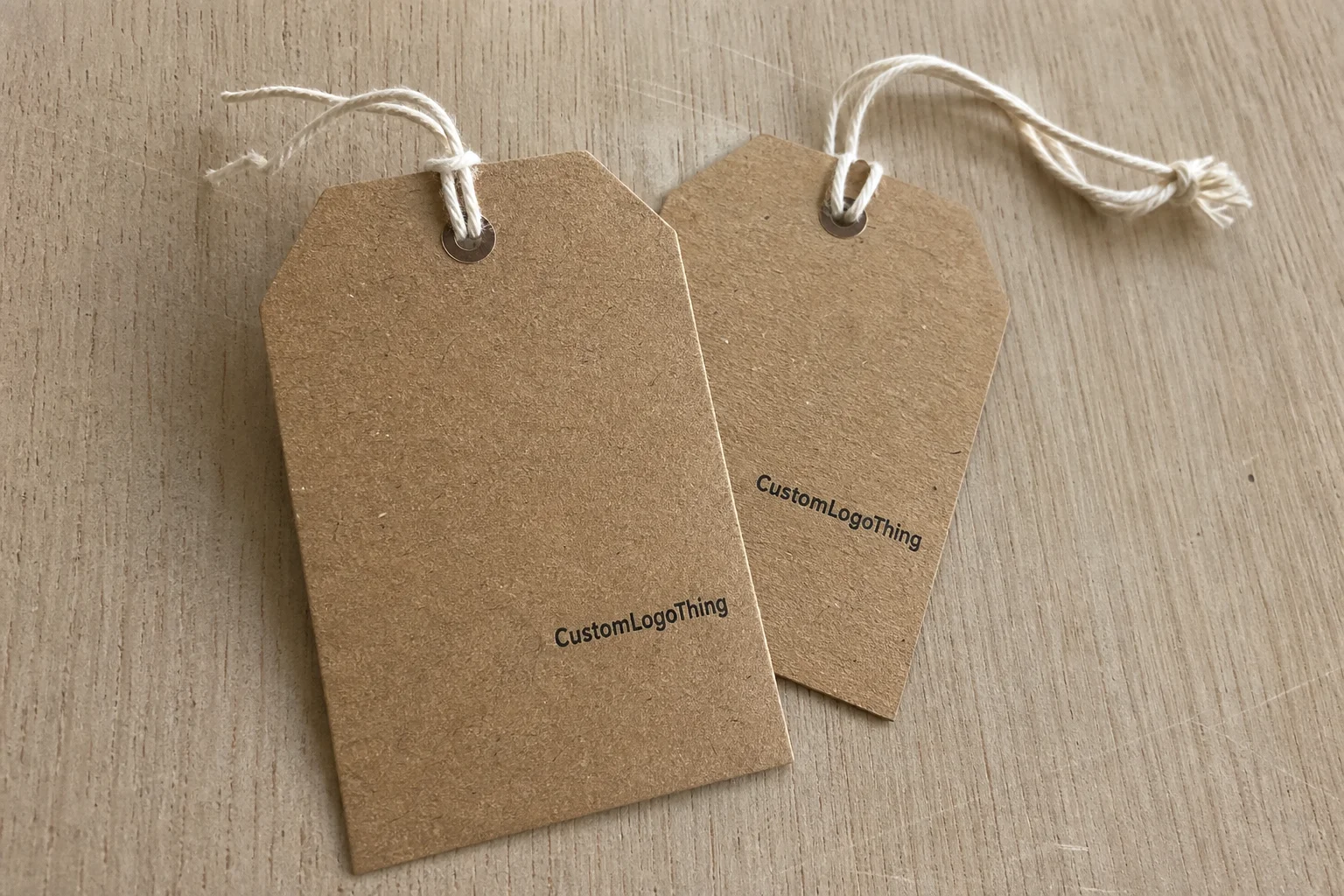
Retail buyers often notice a tag before they notice the construction of the product itself. That sounds minor until you watch how shoppers behave. They pick up the item, rotate it, compare it with the item beside it, then decide whether the brand looks trustworthy. A tag that feels deliberate helps that decision. Kraft works well in that moment because it carries texture, and texture tends to feel more specific than a flat coated surface.
That is one reason kraft tags show up so often on products with a handmade, natural, recycled, or small-batch story. The material does not need much explanation. It already implies restraint, practicality, and a slightly less promotional tone. For a brand that wants to look premium without looking slick, that balance is hard to beat.
The format also stays flexible across price points. A simple one-color tag can support a low-margin item, while a heavier board with front-and-back print can sit comfortably on a more expensive product. The same basic structure works for a soap bar, a sweater, a tote bag, or a seasonal gift set. That is useful because many brands do not want to redesign their entire labeling system every time the assortment changes.
A hang tag should read like a working retail label, not a miniature flyer. If the shopper needs to stop and decode it, the tag has already failed its most basic job.
That practical mindset is why these tags often sit alongside Custom Labels & Tags and other Custom Packaging Products. Buyers are usually trying to build a family of related pieces, not a random collection of printed surfaces. Kraft makes that easier because it pairs well with restrained typography, bold illustration, and packaging systems that lean into texture instead of gloss.
For teams that care about sourcing claims, the FSC site is a sensible reference point when verifying certified paper options. It does not replace a spec sheet, but it helps separate general claims from actual chain-of-custody documentation.
How the Material, Print, and String Work Together
The build looks simple on paper. In production, the details matter. The tag stock, print method, punch placement, and string choice all affect how the finished piece hangs, how long it lasts, and whether it feels intentional when a customer handles it.
Paper weight is the first decision that changes the outcome. A lighter kraft stock can work for apparel accessories and soft goods, especially when the tag only needs to carry a logo and a few lines of text. Heavier board gives more presence and resists curling, which matters on premium products or items that get handled repeatedly. The middle range is often the safest starting point. Too thin looks flimsy. Too heavy can complicate punching, folding, or assembly.
The print design should respect the color of the paper. Kraft is not a neutral white base. It is warm, textured, and visually busy compared with coated stock. That means contrast has to be planned instead of assumed. Dark inks usually perform well. Light inks can work, but only when the type is large enough and the layout has enough breathing room. Very fine reversed type on kraft is where many tag designs start to break down.
The string is not a minor accessory. It changes the way the tag behaves. Cotton string gives a softer, more natural appearance and is a common fit for brands leaning into organic or handcrafted cues. Twine looks a little rougher and can suit rustic or artisanal product lines. Elastic loops are often faster to attach in quantity and can be practical for retail teams that need a clean assembly process. Thin cord can look neat, but if the product is heavy or the display gets a lot of handling, it can fray, slip, or feel undersized.
- Cotton string: good for a natural look and moderate handling.
- Twine: useful when the brand wants a handmade or rustic feel.
- Elastic loop: efficient for faster attachment and repeat assembly.
- Reinforced cord setup: better for heavier items or more aggressive retail handling.
Hole size and placement deserve the same attention as the artwork. A punch that sits too close to the edge increases tear risk. A hole that is too small for the chosen string slows assembly and can create an uneven hang. In practice, a small design adjustment often solves a problem that would otherwise show up as damaged tags in the warehouse or on the sales floor.
For many buyers, the most useful question is not which paper looks best in a mockup. It is how the finished tag behaves after printing, punching, stringing, packing, shipping, and retail handling. That is the standard that matters.
Cost, MOQ, and Quote Factors That Change Unit Price
Pricing is usually easier to understand than buyers expect, provided the specification is complete. The biggest drivers are size, paper weight, print coverage, color count, hole reinforcement, string type, and the amount of manual assembly required. Once those pieces are clear, the quote becomes much more predictable.
Small tags with one-color print and standard string are generally the lowest-cost option. Add size, print on both sides, heavier board, or custom assembly and the unit price rises. That is not arbitrary. It reflects material usage, press setup, punching, kitting, and labor. On short-run work, labor often matters as much as paper.
For a typical retail run of 5,000 pieces, a simple kraft tag may land around $0.12 to $0.20 per unit if the build is basic and the string is standard. A mid-range tag with heavier board, front-and-back printing, and a more finished attachment may sit closer to $0.18 to $0.32 per unit. A more involved piece with extra finishing, reinforcement, or more manual assembly can move into the $0.28 to $0.48 range, sometimes higher if the order is unusually labor-heavy. Those numbers are not exact quotes; they are the kind of range a buyer can use to budget realistically.
MOQ changes the economics quickly. Higher quantities spread setup and finishing costs across more pieces, which lowers the unit price. Smaller quantities are still worth doing for seasonal launches, testing, or limited editions, but the buyer should expect a higher per-piece cost. That is standard across custom printed boxes, labels, and most other retail packaging components. The factory is still doing the setup work, whether the run is 500 or 5,000.
| Option | Typical Build | Best Use | Typical Price Impact at 5,000 Units |
|---|---|---|---|
| Basic kraft tag | 2 x 3.5 inch, one-color print, standard hole, cotton string | Apparel basics, accessories, simple pricing tags | Lower range, often around $0.12-$0.20 |
| Mid-range retail tag | 2.5 x 4.5 inch, two-sided print, heavier kraft board, twine | Boutique goods, candles, gift items | Mid range, often around $0.18-$0.32 |
| Premium assembly tag | 3 x 5 inch, heavier coverage, reinforced hole, custom cord or loop | Higher-ticket items, seasonal collections, detailed brand story | Upper range, often around $0.28-$0.48 |
When asking for a quote, include the finished size, paper preference, print sides, color count, string type, hole location, and packing method. Packing is the detail that gets forgotten most often. If tags need to be bundled in a certain count, packed for kitting, or separated for multiple product lines, that handling time belongs in the estimate. A quote that ignores it is not really complete.
For teams trying to balance material use with waste concerns, the EPA’s packaging and waste resources at epa.gov are a practical reference point. They will not tell you how to lay out a tag, but they do help frame the conversation around material efficiency and disposal.
Production Steps From Artwork to Finished Bundles
The production sequence is straightforward, but only if the artwork is prepared correctly. It starts with file review: bleed, safe area, image resolution, font size, and color build. Kraft stock changes the way ink reads, so contrast has to be checked carefully. A layout that looks fine on a bright monitor can lose clarity on a textured brown surface, especially if the type is too small or the design relies on subtle color differences.
After prepress approval, the job moves into printing, then cutting, then punching. If the string is attached by machine or by hand, that comes after the tag blanks are ready. Some buyers prefer pre-attached strings because the tags arrive ready to use. Others want loose tags and separate string for internal kitting. The right answer depends on who is doing the final assembly and where the labor is cheapest.
That distinction matters more than it first appears. A wholesale program may want fully assembled tags so the product can go straight to retail. A DTC operation might prefer loose components if the warehouse already has a labeling workflow. There is no universal best practice. There is only the method that fits the downstream process.
Quality control should focus on the issues that actually show up in the field: hole alignment, string security, trim accuracy, and print contrast. For large orders, count accuracy is just as important. A short count is easy to miss on the production floor and annoying to fix after shipment. On a limited release, it can cause real delays.
If the product will ship through distribution or face rough handling, some buyers ask for packaging checks modeled on basic transit testing principles. The hang tag itself is simple, but the bundle still needs to survive transport, storage, and retail setup without arriving creased, torn, or tangled.
The key point is that this is a workflow, not a decoration order. The tag has to arrive in a usable state. If the warehouse has to rework it, the spec was not finished properly.
Timeline, Lead Time, and Approval Checks
A clean project usually moves through quote, artwork submission, proof, approval, production, finishing, packing, and shipment. Most delays happen at the proof stage or in the handoff between design and prepress. Once the file is approved, the schedule becomes far easier to manage.
For straightforward orders, production often falls in the range of 8 to 15 business days after proof approval. Quantity, assembly complexity, and sourcing status all affect that window. If the job needs special stringing, tighter color matching, or custom pack-out, the timeline extends. If materials need to be sourced to spec, it extends again. That is normal, and it is better to account for it early than to compress a launch schedule later.
Proofing is the point where most avoidable mistakes can still be caught. On kraft stock, that matters even more because the background is visually active. Small type, thin strokes, and low-contrast colors can disappear faster than they would on coated white paper. A proof gives the buyer a chance to check real readability, not just design intent.
Good planning means building in buffer. If the launch date is fixed, order earlier. If the project is tied to a trade show, seasonal reset, or gift period, leave room for one revision cycle and some freight cushion. That is not caution for its own sake. It is how packaging projects avoid becoming rushed production problems.
- Repeat order with unchanged artwork: usually the fastest route.
- New artwork with standard string: moderate schedule, usually predictable.
- Heavier assembly or specialty finishing: allow extra time.
- Seasonal launch with freight sensitivity: build a wider buffer.
Common Mistakes That Hurt Readability and Durability
The most common mistake is crowding the surface. A tag has limited space. If the logo, price, SKU, care notes, barcode, and brand story all compete at the same size, the result becomes hard to read. That problem is amplified on kraft because texture already reduces apparent sharpness compared with a smooth white stock. Hierarchy matters more than decoration.
Weak contrast is the second major problem. Dark inks usually work well, but light tones can disappear depending on the shade of the board and the printing method. Fine reversed type is especially risky. Buyers should check the artwork at actual size and at arm’s length, not just on a screen at 200 percent zoom. The screen can hide a lot.
Attachment failures are more expensive than they look. A string that frays in handling, a loop that sits too short, or a hole punched too close to the edge can make the whole product feel cheap. Those are not cosmetic defects. They affect how the customer perceives quality. In retail, that perception forms quickly.
Another mistake is treating the tag like a small brochure. Most shoppers do not need a paragraph. They need the product identity, the price, and maybe one line that clarifies material, care, or origin. If there is a story, keep it compact. If there is legal or compliance copy, place it clearly and do not let it crowd the front of the tag.
Consistency across packaging also matters. If the hang tag is kraft, restrained, and tactile, the rest of the package system should not suddenly switch to a high-gloss style that feels disconnected. A coherent system makes the product line look better than any one component does on its own. That includes labels, inserts, mailers, and any retail packaging pieces used with the item.
Next Steps for Specifying Tags That Ship Cleanly
The most efficient way to order kraft custom printed Retail Hang Tags with string is to define the spec before the quote goes out. Confirm the finished size, paper choice, print method, string type, hole position, quantity, and the exact content that has to appear. If the tag needs a barcode, SKU, pricing field, or care copy, decide where each element belongs before layout starts.
Keep the front focused on the strongest brand message and the product identity. Use the back for the details that help the customer make a decision or use the item correctly. That might be size, price, origin, care notes, or a short brand statement. The point is not to fill the surface. The point is to make the tag usable at retail distance and still clean up close.
Ask for a proof and inspect it for hole placement, string length, text contrast, and any areas where the kraft background weakens readability. If the order is going to ship in volume, add a cushion for packing loss, samples, and store replacement needs. A small overage usually costs less than a second rush order.
For teams managing a full packaging line, the hang tag should feel like part of the same system as the product packaging and any other branded components already in use. That is where kraft tags earn their place. They help the product look ready, they carry the operational details that keep retail moving, and they ship cleanly when the spec is done with care.
FAQ
What paper weight works best for kraft retail hang tags with string?
Choose a stock heavy enough to stay flat and resist bending, but not so thick that punching and stringing become difficult. Lightweight apparel and accessory tags can often use a medium kraft board, while heavier products usually need a sturdier stock for better durability. In practice, the middle range is often the safest starting point.
How do I keep the string from fraying or breaking?
Match the attachment to the product weight and the amount of handling the item will get in store. Thin cords can look neat, but they are a poor fit for heavier items or high-touch retail displays. It also helps to check how the string is secured at the hole, because knot style and loop finish matter as much as the material itself.
Are kraft custom printed retail hang tags with string suitable for small runs?
Yes. They work well for limited collections, seasonal launches, and boutique product lines. The main tradeoff is economics: smaller runs usually cost more per unit because setup and finishing are spread over fewer pieces. That does not make them a bad choice. It just means the buyer should budget with the run size in mind.
What should go on the front and back of the tag?
Put the strongest brand message and the product identity on the front. Use the back for price, size, care instructions, origin, story copy, or compliance details. Keep the layout simple enough that the most important information is readable at a glance, because clutter is one of the fastest ways to weaken a retail tag.
How far in advance should I order before launch?
Work backward from the in-store or ship date and leave time for proofing, corrections, production, finishing, and freight. Straightforward repeat orders move faster than new builds, but even simple jobs can slip if approvals are delayed. If the launch date is fixed, the safest move is to build in buffer rather than count on the shortest possible schedule.