Buyer Fit Snapshot
| Best fit | Poly Mailers With Logo Cost projects where brand print, material claims, artwork control, MOQ, and repeat-order consistency need to be specified before quoting. |
|---|---|
| Quote inputs | Share finished size, material target, print colors, finish, packing count, annual reorder estimate, ship-to region, and any compliance wording. |
| Proofing check | Approve dieline scale, logo placement, barcode or warning zones, color tolerance, closure strength, and carton packing before bulk production. |
| Main risk | Vague material claims, crowded artwork, missing packing details, or unclear freight terms can make a low unit price expensive after revisions. |
Fast answer: Poly Mailers With Logo Cost: Pricing, MOQ, and Value should be specified like a repeatable production item. The safest quote records material, print method, finish, artwork proof, packing count, and reorder notes in one written spec.
Production checks before approval
Compare the actual filled-product size with the drawing, then confirm tolerance on folds, seals, hang holes, label areas, and retail display edges. Reserve space for logos, QR codes, warning copy, and material claims before decorative graphics fill the panel.
Quote comparison points
Review material grade, print process, finish, sampling route, tooling charges, carton quantity, and freight assumptions side by side. A quote is only useful when the supplier can repeat the same color, closure quality, and packing count on the next order.
Poly Mailers With Logo Cost: Pricing, MOQ, and Value
Trying to figure out poly Mailers with Logo cost usually starts with the wrong assumption. People look at the bag and think that is the whole bill. It is not. The film matters, sure. But the real swings come from print setup, order quantity, freight, and how complicated the artwork is. Two jobs that look almost identical can still land in very different price bands.
From a packaging buyer's point of view, the real question is not just what poly mailers with logo cost. It is what that printed mailer replaces. A brand shipping hundreds of orders a week may cut packing labor by skipping separate labels, extra inserts, or extra taping. That is not fluff. That is time and money coming off the table.
A clean estimate needs three things: unit cost, MOQ, and shipping method. Those three usually explain most of the gap between a quote that looks cheap and the invoice that shows up later. Simple artwork and standard sizing tend to keep the price sane. Custom dimensions, heavy coverage, and multiple colors usually push it the other way.
Poly Mailers With Logo Cost: What Actually Drives the Price
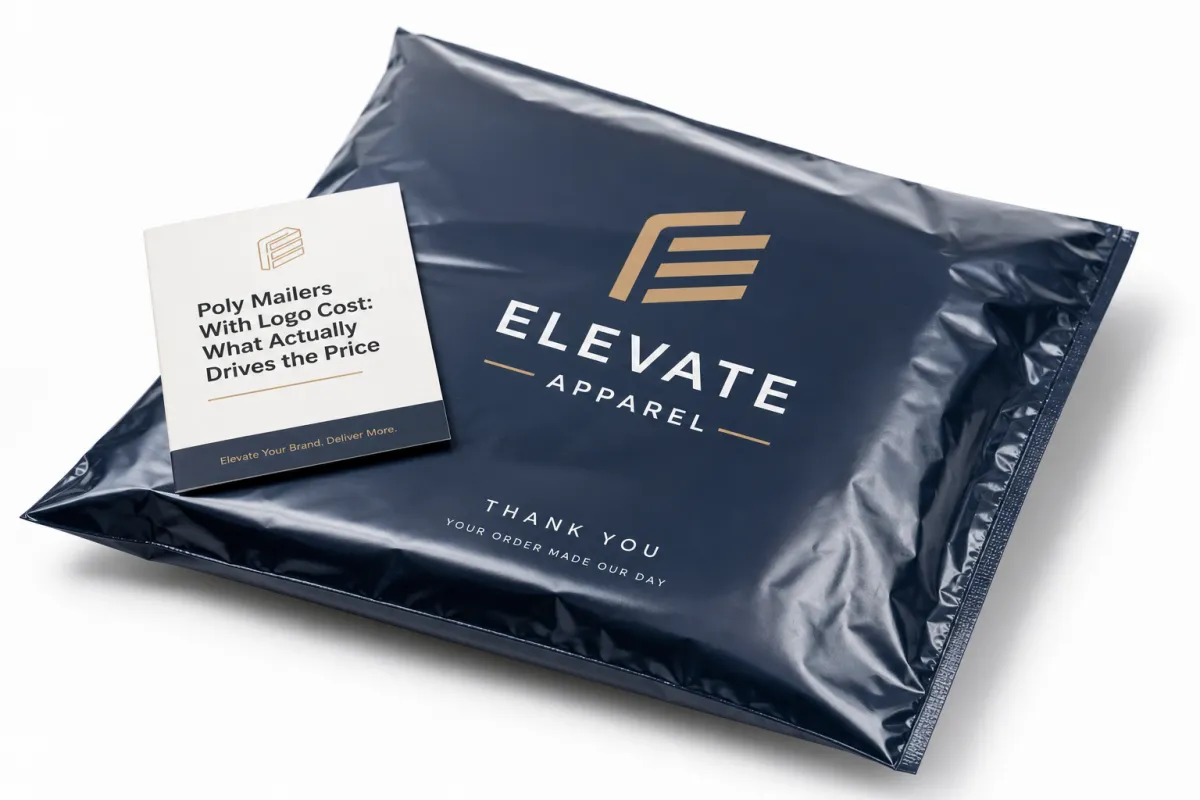
The fastest way to understand poly mailers with logo cost is to stop treating it like a single number. It is a stack of costs. The base film has a price. Printing adds setup charges. Higher quantity lowers the unit cost. Freight can move the total more than buyers expect, especially on smaller orders that still need to travel a long way.
Volume is usually the biggest lever. A 1,000-piece run will almost always show a higher unit cost than a 10,000-piece run, because the same prep gets spread across fewer bags. That prep includes plate creation, color matching, press setup, and the usual production handling. A quote that looks suspiciously low on a tiny order usually means one of two things: it is a stock item, or some cost is waiting to show up later.
Complexity changes the math too. One-color print on a standard poly mailer is usually the easiest route. Add multiple colors, metallic ink, custom sizing, or full-bleed coverage, and the quote climbs. That is not drama. That is extra press time, more waste, and more room for error.
A branded mailer also changes the packing workflow. That matters more than people admit. Shipping 500 orders a week with one printed mailer can remove the need for a plain mailer plus a separate label plus a promo insert. When that happens, the small bump in unit price may be worth it. Compare poly mailers with logo cost against the full packing system, not against a plain bag sitting alone on a spreadsheet.
The value is not only visual. A printed mailer shortens pack-out time and gives the customer a cleaner unboxing moment. It also cuts down on the risk that a sticker falls off or an insert gets skipped. On a busy day, fewer loose pieces mean fewer mistakes. Boring? Yes. Expensive to ignore? Also yes.
I have seen teams shave minutes off a pack line just by moving from plain bags plus labels to a single printed mailer. That sounds small until you multiply it by the week. Then it gets real fast.
Pricing levers that matter most:
- Order size - bigger runs lower unit cost and usually improve bulk pricing.
- Print coverage - one small logo costs less than full-bleed artwork.
- Mailer size - standard dimensions are cheaper than custom dimensions.
- Film thickness - thicker film raises the quote but can reduce shipping damage.
- Shipping method - ocean, air, and domestic freight do not land at the same number.
Best rule of thumb: the cheapest custom packaging usually comes from simple artwork, standard sizing, and a high enough quantity to spread setup costs around. That holds for poly mailers with logo cost, and it keeps holding even when suppliers wrap the quote in polished language.
What You Get With Custom Poly Mailers
Custom mailers are simple on the surface and picky underneath. A standard poly mailer is usually made from low-density polyethylene or a coextruded polyethylene film with a self-seal adhesive strip. After that, you choose thickness, size, color, print style, and finish. Every choice affects both performance and poly mailers with logo cost.
The product fits lightweight, non-fragile goods best. Apparel is the obvious one. Beauty items, accessories, soft home goods, and subscription products also fit well when they already have some internal protection. If the item can survive a normal shipping ride without a hard shell, a printed mailer can handle it efficiently.
Not every brand should use one. Fragile glass, sharp corners, and anything that needs crush resistance belong somewhere else. A box or padded mailer will cost more upfront, but it can save you from replacements and customer complaints. Cheap packaging turns expensive fast when it fails in transit.
The branding upside is easy to see. The mailer becomes part of the unboxing experience instead of a plain transit shell. That first view matters. The customer sees the logo before the product. For a smaller e-commerce brand, that gives the package a more deliberate feel without piling on inserts or decorations that nobody asked for.
There is a labor angle too. A branded mailer can remove one packing step. Fewer separate items mean fewer grabs from the bench and fewer chances to mispack an order. That is why I always tell buyers to compare poly mailers with logo cost against labels, taping, and labor. The cheapest supply item is not always the cheapest system.
Here is a simple comparison that helps buyers sort the options:
| Option | Typical Use | Approx. Unit Cost | Pros | Tradeoff |
|---|---|---|---|---|
| Plain stock poly mailer | Low-appearance shipments, internal use | $0.08-$0.18 | Lowest upfront price, easy to source | No branding, less brand value |
| One-color logo mailer | Apparel, accessories, everyday e-commerce | $0.12-$0.28 | Good balance of brand impact and price | Setup charges still matter on small runs |
| Full custom artwork mailer | High-volume branding, seasonal launches | $0.18-$0.45 | Strong shelf and shipping presence | Higher tooling fees, more proofing time |
| Heavy-duty or premium film mailer | Long-haul shipping, heavier soft goods | $0.16-$0.38 | Better seal and tear resistance | More material cost |
Those ranges are not universal, because no quote is universal. Still, they are close enough to expose nonsense. If someone offers poly mailers with logo cost that looks absurdly low on a tiny quantity, ask what is included, what is excluded, and whether the number covers freight, plates, and proofing.
For buyers comparing packaging options across a broader line, it helps to look at other formats too. Our Custom Packaging Products page is a practical starting point if you are deciding whether a mailer is the right structure or whether a different package makes more sense. If your ship-out items are mostly apparel or other soft goods, our Custom Poly Mailers category will get you closer to the right fit than a generic packaging search.
Poly Mailer Specs That Change Your Quote
Specs are where quotes stop being vague and start becoming useful. A real answer on poly mailers with logo cost needs size, thickness, color, finish, adhesive strength, and print coverage before pricing begins. Leave those out and you get a rough number that shifts later. Usually upward. Funny pattern, that.
Size is the first spec that moves price. Standard sizes cost less because they run on common tooling and familiar production patterns. Custom dimensions cost more because they need more material planning and usually create more cut waste. Oversized mailers also burn freight space. Empty volume still gets billed.
Thickness is the next lever. Common films might sit in the 2.5 mil to 4 mil range for lighter fashion goods, while thicker builds are used when the package needs more abuse resistance. More film means more material cost. It also means better tear resistance and a lower chance of the bag splitting in transit. That tradeoff is worth it when the product is heavy or the carrier network is rough.
Print style matters more than casual buyers expect. A small logo in one spot costs less than full-front print. Two-color art costs more than one-color art. Large flood coverage needs more ink, more setup, and more inspection. If your logo works cleanly in one or two colors, your poly mailers with logo cost usually stays in a friendlier range.
Finish is another quiet variable. Matte and soft-touch effects are less common in mailers than in paperboard packaging, but certain surface treatments and film colors still change the price. White, black, and clear usually sit in the basic lanes. Custom tinted films or specialty finishes can add cost without adding much shipping value. A lot of buyers chase visual drama and forget the parcel spends most of its life in a truck.
Adhesive strength is worth checking. A weak seal creates returns and repacks. A strong seal protects the contents and lowers complaints. That is not glamorous. Packaging is full of unglamorous decisions. If the seal strip fails, the mailer loses the whole point of existing.
For shipping abuse and package testing discipline, many teams reference ISTA-style transit testing. You can review the testing framework at ISTA. That does not mean every mailer needs a full lab program. It does mean the packaging should match the route the parcel actually takes.
The best buying rule is simple: choose the smallest size that fits the product safely, then match thickness to the product weight and the level of shipping abuse. That keeps poly mailers with logo cost under control without turning the package into a flimsy compromise. Nobody gets a prize for buying the cheapest film that tears on the first real shipment.
Typical spec questions to answer before quoting:
- What is the finished size in inches or millimeters?
- What film thickness do you want?
- Do you need one color, two colors, or full artwork coverage?
- Is the bag white, black, clear, or a custom color?
- Do you need a strong self-seal or tamper-evident strip?
Answer those clearly and your poly mailers with logo cost quote gets tighter. Leave them vague and you will spend time adjusting a quote that should have been right the first time.
Poly Mailers With Logo Cost: MOQ, Pricing Tiers, and Samples
This is the part where most buyers finally see why poly mailers with logo cost changes so much from order to order. MOQ, or minimum order quantity, is not some supplier mood swing. It exists because setup, tooling fees, plates, and production prep all need to be paid for. Spread those costs over 500 pieces and the unit price looks one way. Spread them over 10,000 pieces and the math gets a lot friendlier.
For a small run, the quoted cost per piece can feel annoyingly high. That is normal. On lower-volume orders, setup often matters more than the film itself. A buyer ordering a few hundred bags for a new launch may pay a premium for speed and flexibility. A buyer ordering in bulk every month can usually get better bulk pricing.
Here is a practical way to think about tiers:
| Quantity Tier | Typical Use Case | Common Price Behavior | Best For |
|---|---|---|---|
| 300-999 pieces | Launches, testing new artwork, seasonal promotions | Highest unit cost, setup charges are heavy | Proof of concept, low-risk trials |
| 1,000-4,999 pieces | Growing e-commerce brands, repeat campaigns | More balanced pricing, still sensitive to print complexity | Most first-time custom runs |
| 5,000-19,999 pieces | Established sellers with stable order volume | Better unit cost and stronger bulk pricing | Brands trying to lower total packaging spend |
| 20,000+ pieces | High-volume operations and national rollouts | Lowest unit cost, but larger cash outlay | Companies with predictable demand |
Those tiers explain why poly mailers with logo cost is rarely about chasing the lowest quote. It is about the best quote for your volume. A lower MOQ may be worth paying for when you are testing a new brand, changing a size, or printing seasonal artwork. If the mailer stays the same all year, waiting for a larger run usually saves real money.
Samples matter too. Simple artwork and standard sizing may not need a physical sample before production. Color-sensitive branding or a bag size that sits close to the product dimensions is a different story. Sample approval is cheap insurance. Catching a bad fit early costs less than fixing it after production.
Hidden costs deserve attention. Freight can be a meaningful slice of the total, especially on smaller orders. Artwork setup may sit outside the production price. Plate fees and tooling fees may appear as separate line items. Rush production is another common add-on. None of those are unusual. They just need to be visible before you sign off.
The cleanest buying process is to ask for at least two or three quantity tiers at the same spec. That lets you compare poly mailers with logo cost across real order sizes instead of guessing. If the 5,000-piece tier barely moves from the 1,000-piece tier, the larger order usually wins. Tight cash flow and limited storage can still make the smaller order the smarter pick.
Here is the blunt version: cheap unit pricing is nice, but dead inventory is not. If you buy more mailers than you can move in a sensible window, the savings disappear into storage, cash tied up on a shelf, and occasional obsolescence when artwork changes. That is not smart pricing. That is regret with a barcode.
How the Order Process Works and How Long It Takes
A good quote only matters if the order process is clean. The usual flow for poly mailers with logo cost looks like this: request quote, send specs, review artwork, approve proof, produce, and ship. Simple on paper. Messier in real life, mostly because delays love proof approval and freight booking.
Step one is information gathering. Send the logo file, the quantity, finished dimensions, thickness target, color preference, and delivery ZIP or destination country. If you already know the packaging use case, mention it. Apparel, beauty, and accessories do not always need the same construction. A supplier cannot guess your risk level from a logo file.
Step two is artwork review. Vector files are the best starting point. A clean AI, EPS, or high-resolution PDF saves time and lowers proof errors. Brand colors should come with a Pantone reference or a clear digital spec. A fuzzy file or one built wrong can push both time and poly mailers with logo cost upward.
Step three is proofing. Buyers should slow down here and read every detail. Check spelling, placement, bleed, orientation, and seal-side direction. A proof is not decoration. It is the production map. If the proof is wrong and gets approved anyway, the factory usually prints exactly what was approved. Fair? Yes. Annoying? Also yes.
Production timing depends on quantity and complexity. Simple orders often take about 12-15 business days after proof approval. Larger runs, custom dimensions, or multi-color artwork can stretch that longer. Rush jobs are possible in some cases, but rush production usually adds cost. Shipping time is separate. A fast production schedule does not help much if freight is stuck behind a carrier backlog.
For brands that care about repeatability, this process matters as much as the print itself. Stable artwork files, consistent size specs, and clean proof approvals make reorder pricing easier to manage. They also help keep poly mailers with logo cost from bouncing around every time someone edits a detail at the last minute.
What usually slows a job down:
- Missing logo files or low-resolution artwork.
- Unclear size requirements.
- Color changes after proof approval.
- Late responses during the proof stage.
- Freight decisions that get delayed until production is already done.
If you want to keep the timeline tight, prepare the basic specs before asking for pricing. Include the product dimensions, target ship date, quantity, and delivery location. The less guesswork involved, the less likely poly mailers with logo cost will shift after you thought the quote was finished.
Why Buy Poly Mailers With Logo From Us
Buyers do not need packaging poetry. They need predictable output and honest pricing. Our approach to poly mailers with logo cost centers on straightforward spec matching, clear proofing, and packaging that holds up in transit. Clean quote, clean production. That is the deal.
Print consistency matters in this category. A logo that looks good on screen but turns muddy on film is not a win. A good supplier should talk about artwork setup, color limits, and print coverage before the job starts. That keeps the first sample and the final run closer together. Nobody enjoys paying twice for the same mistake.
Response time matters too. Packaging buyers often work against launch dates, inventory arrivals, or retail season changes. If a supplier takes days to answer a simple spec question, that delay usually shows up later in the schedule. We keep the process direct because the buyer's time is part of the cost equation too, even if it never appears as a line item for poly mailers with logo cost.
Reorders deserve attention. A lot of packaging issues show up on the second run, not the first. Color drift, size drift, and artwork drift are common when the production file is sloppy. Repeat orders should feel boring in the best way. Same spec, same result, same pricing structure unless the quantity changes.
If you are comparing us to generic suppliers, look at the questions they answer before the order starts. Do they explain MOQ clearly? Do they separate setup charges from production pricing? Do they spell out freight? Do they give realistic ranges instead of pretending every job is identical? Those answers tell you more than any polished headline ever will.
"The best packaging quote is the one that still makes sense after proof approval, freight, and the second reorder."
That is the standard that matters here. Not hype. Not vague promises. Just a clean chain from specification to production, with poly mailers with logo cost explained in plain language. If you want a broader look at packaging formats before locking in a bag, our Custom Packaging Products page gives you a practical starting point. If your brand is already set on mailers, focus on the exact size, print method, and volume that fit your shipping reality.
For sustainability-minded buyers, the package system around the mailer matters too, not just the mailer itself. If you use paper inserts or supporting materials, FSC-certified paper can be part of that discussion. You can review certification standards at FSC. The point is not to turn a poly mailer into a manifesto. The point is to Choose the Right materials for the job and stop paying extra for the wrong ones.
Next Steps to Get an Exact Quote
If you want a real answer on poly mailers with logo cost, come prepared. Pick the size. Pick the quantity. Pick the thickness. Decide whether you want one-color print or full artwork. Then send the delivery location and target ship date. That is enough to move out of guesswork and into actual pricing.
The cleanest comparison is always apples to apples. Compare quotes on the same size, same film, same print coverage, and same freight terms. Otherwise you are comparing different products and calling it a price check. That is how buyers end up thinking a quote is cheaper when it is really just incomplete.
If the artwork is complex or brand color accuracy matters, request a sample or proof first. It costs a little time, but it protects the rest of the order. For routine jobs, a digital proof may be enough. For new launches, custom dimensions, or anything with a strict brand standard, a physical sample can be worth the extra step.
From there, the path is simple: send specs, get a quote, review proof, confirm production, and lock the ship date. That process keeps poly mailers with logo cost under control and makes the final order easier to repeat. If you have a packaging budget to protect, this is where discipline pays off.
Bottom line: poly mailers with logo cost depends less on the bag itself than on the choices around it. Keep the artwork simple, use a standard size, and order enough quantity to spread setup costs properly. Do that, and you will usually get better value without wasting money on packaging theater. If you want the quote to be accurate the first time, send the finished size, film thickness, print area, quantity, and freight ZIP in one shot. No mystery. No back-and-forth circus.
How much do poly mailers with logo cost for a small order?
Small orders usually carry a higher unit price because setup charges and print prep get spread across fewer pieces. For many buyers, a short run lands in the $0.18-$0.45 per piece range depending on size, print coverage, and freight. If you need custom dimensions or fast turnaround, expect poly mailers with logo cost to rise further. That part is kinda annoying, but it is real.
What affects poly mailers with logo cost the most?
Quantity is usually the biggest driver because higher volume lowers the cost per piece. Print complexity, thickness, and freight also matter, and tooling fees can move the total on smaller runs. If the artwork needs multiple colors or full coverage, poly mailers with logo cost goes up for a very boring reason: more production work.
Are printed poly mailers cheaper than using labels?
For many growing brands, yes, because printed mailers can remove label labor and reduce extra materials. They also create a cleaner look. On low-volume orders, labels may still be cheaper upfront, but once order volume grows, branded mailers often win on total packing cost. That is the part people miss when comparing only the sticker price.
What is the minimum order for custom poly mailers?
MOQ depends on size, print method, and film choice. Lower MOQs are possible, but unit cost is usually higher because setup charges are spread across fewer bags. If budget matters, ask for pricing at two or three quantity tiers so you can see how poly mailers with logo cost changes before you commit.
How long does it take to produce poly mailers with a logo?
Production time depends on proof approval, artwork complexity, and current factory load. Simple orders often move in about 12-15 business days after approval, while larger or more complex jobs can take longer. Shipping time is separate, so always confirm both production and freight before placing the order. That keeps poly mailers with logo cost from surprising you in the wrong direction.


