Buyer Fit Snapshot
| Best fit | Kraft Shipping Boxes Wholesale Pricing projects where brand print, material claims, artwork control, MOQ, and repeat-order consistency need to be specified before quoting. |
|---|---|
| Quote inputs | Share finished size, material target, print colors, finish, packing count, annual reorder estimate, ship-to region, and any compliance wording. |
| Proofing check | Approve dieline scale, logo placement, barcode or warning zones, color tolerance, closure strength, and carton packing before bulk production. |
| Main risk | Vague material claims, crowded artwork, missing packing details, or unclear freight terms can make a low unit price expensive after revisions. |
Fast answer: Kraft Shipping Boxes Wholesale Pricing: Board, Finish, Dieline, and Unit Cost should be specified like a repeatable production item. The safest quote records material, print method, finish, artwork proof, packing count, and reorder notes in one written spec.
Production checks before approval
Compare the actual filled-product size with the drawing, then confirm tolerance on folds, seals, hang holes, label areas, and retail display edges. Reserve space for logos, QR codes, warning copy, and material claims before decorative graphics fill the panel.
Quote comparison points
Review material grade, print process, finish, sampling route, tooling charges, carton quantity, and freight assumptions side by side. A quote is only useful when the supplier can repeat the same color, closure quality, and packing count on the next order.
Kraft Shipping Boxes wholesale pricing: what to expect is not about chasing the lowest carton and pretending the rest of the math will sort itself out. It never does. Kraft Shipping Boxes Wholesale pricing rewards buyers who pay attention to fit, board strength, freight, and reorder discipline. The cheap box can get expensive fast once damage, dimensional weight, and rush replenishment enter the picture.
I've sat through enough packaging reviews to know the pattern. Someone looks at a quote, spots the unit price, and thinks the job is done. It usually isn't. From a packaging buyer's point of view, the work is bigger than buying a stack of boxes. It is about buying package protection that keeps fulfillment moving without creating waste, claims, or repacking labor. That is why Kraft Shipping Boxes wholesale pricing should be judged on landed cost, not the little number sitting on a quote line.
The patterns are familiar. A small size tweak cuts corrugate waste. A stronger flute lowers crush risk. A cleaner spec sheet kills the endless back-and-forth. Those shifts sound minor. They still move kraft shipping boxes wholesale pricing enough to matter across a quarter of ecommerce shipping volume, and sometimes a lot more than people expect.
Companies that ship on a schedule usually do better with stable specs than with improvised one-offs. Standard dimensions, repeatable art files, and predictable forecast volumes give suppliers room to quote better kraft shipping boxes wholesale pricing without padding for uncertainty. That is the practical advantage wholesale buyers should chase. Not drama. Not mystery. Just fewer surprises.
Kraft shipping boxes wholesale pricing: what really drives cost
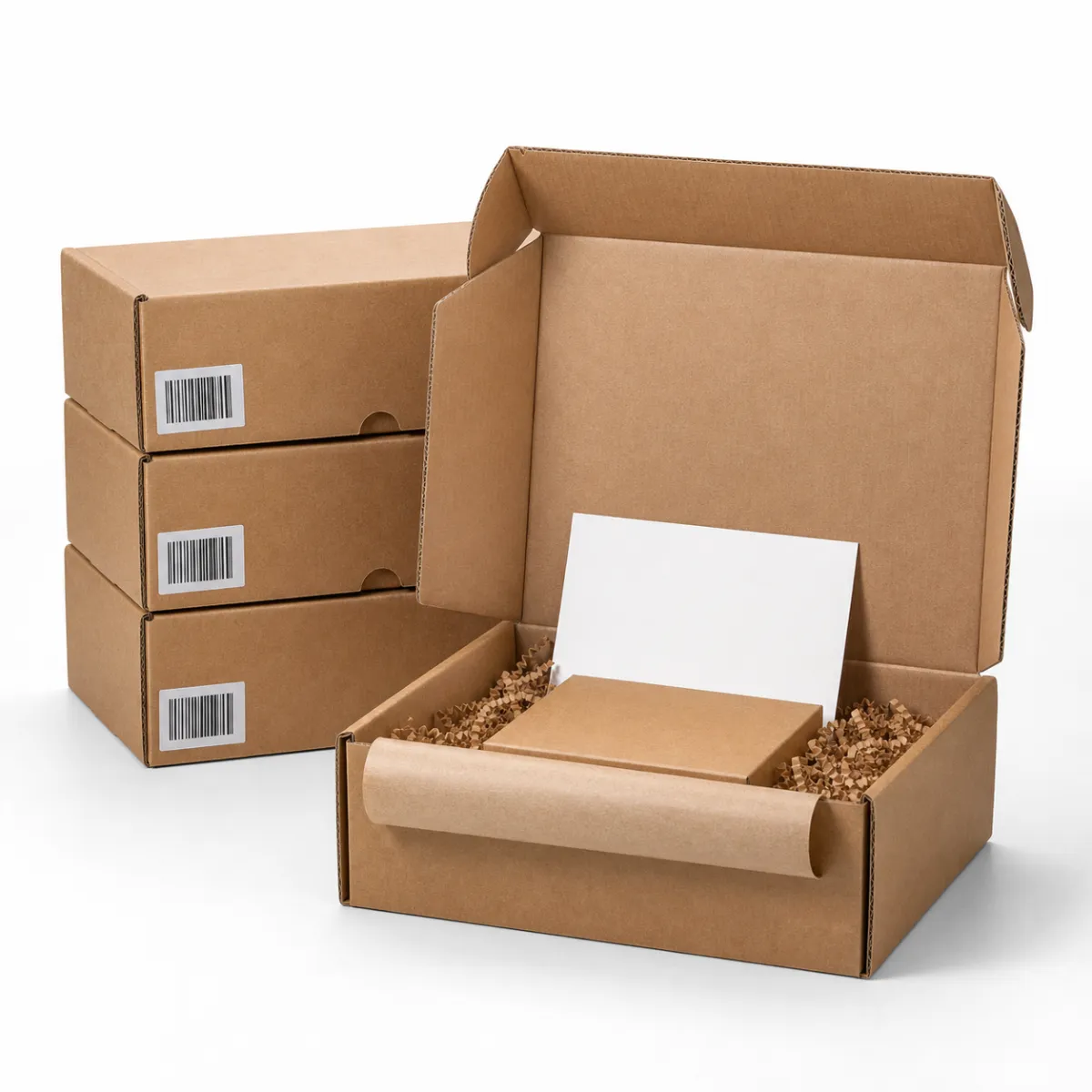
The first mistake buyers make is comparing only the carton price. Kraft shipping boxes wholesale pricing depends on a stack of linked variables, and each one pushes the number in a different direction. Size is the obvious one. Bigger boxes eat more corrugate, weigh more, and often raise outbound freight charges. A box that is oversized for the product can also trigger dimensional weight pricing, which means the carrier charges for air the package never needed to carry. That part is annoyingly simple, and annoyingly common.
Board grade is the second major lever. A lightweight mailer for apparel does not need the same build as a heavy-duty shipper for metal parts or bottled goods. A 32 ECT single-wall carton sits in one price band. A 44 ECT board or a double-wall structure lands somewhere else entirely. That difference shows up quickly in kraft shipping boxes wholesale pricing, especially after the order moves from samples to full production.
Quantity tiers matter too. Suppliers spread setup, production planning, and material yield across more units as the order grows. That is why kraft shipping boxes wholesale pricing often falls in steps instead of sliding down a smooth slope. A buyer moving from 1,000 units to 5,000 units may see a real drop. A move from 5,000 to 6,000 might save only a little more because the press and die cost already got absorbed.
Print coverage changes the equation as well. Plain kraft is usually the most efficient route. One-color branding is still manageable. Full-coverage graphics, multiple ink stations, and special coatings push setup and run time higher. If the goal is to keep kraft shipping boxes wholesale pricing under control, simple branding usually gives the best cost-to-impact ratio. Fancy is fine if it earns its keep. If not, it is just expensive beige.
The cheapest carton on paper is not always the least expensive carton in practice. Damage claims, repacks, and emergency reorders can wipe out the savings before the month is done.
Packaging buyers also need to think about freight method. Palletized truckload, LTL, and parcel delivery all change landed cost. If cartons ship in a way that wastes cube or causes stacking damage, kraft shipping boxes wholesale pricing gets distorted by transportation costs. That is why fit matters as much as strength. A tighter spec usually means less wasted corrugate and less wasted space.
Standardization is the quiet pricing advantage. When a brand uses the same insert geometry, the same ship-ready carton, and the same reorder cadence, suppliers can quote with less uncertainty. In practice, that steadiness often improves kraft shipping boxes wholesale pricing more than asking for a last-minute discount ever will. I have watched a clean spec save more money than a three-page negotiation. Kinda boring, but very real.
For buyers comparing product families, the same logic applies across Custom Shipping Boxes and broader Custom Packaging Products. The more consistent the specs, the easier it is to keep pricing predictable from one order cycle to the next.
One point gets skipped too often. Kraft shipping boxes wholesale pricing is not just a material question; it is a packaging system question. The carton has to protect the product, support warehouse handling, and survive the carrier network. If any one of those breaks, the savings vanish. That is the part many first-time buyers miss, and it is usually where the hidden costs start to pile up.
Product details: styles, board grades, and common uses
Kraft shipping boxes come in several formats, and each one serves a different job. The right choice depends on product shape, weight, presentation, and the demands of transit packaging. For ecommerce shipping, the most common styles are mailers, regular slotted cartons, tuck-top boxes, and heavy-duty shippers. Each structure changes both package protection and kraft shipping boxes wholesale pricing.
Mailers are popular for apparel, subscription kits, and smaller retail items. They usually arrive flat, assemble quickly, and work well when visual presentation matters. Regular slotted cartons are the workhorse. They are efficient, familiar to fulfillment teams, and easy to stack. Tuck-top styles support retail-ready presentation. Heavy-duty shippers are built for more punishing use, such as industrial parts, kitchen equipment, or dense goods that need stronger edges and better crush resistance.
Board grade matters just as much as box style. Kraft liner gives a natural brown appearance and often performs well for brands that want a plain, recycled look. The flute profile changes how the box behaves under pressure. E-flute creates a thinner profile with decent printability. B-flute offers a balanced middle ground. C-flute and double-wall builds deliver stronger stacking performance for heavier loads. That is why a buyer should never treat kraft shipping boxes wholesale pricing as a one-variable problem.
For ecommerce shipping, lighter items often benefit from a smaller carton with a moderate flute. That trims dimensional weight and keeps shipping materials usage in line with the product itself. For industrial shipments, the math changes. If the item is dense, sharp-edged, or heavy, the box needs more margin. The extra board cost can save more in claims than it adds to the quote. That tradeoff is the whole game, honestly.
Optional features affect both function and price. Inserts hold product in place. Tear strips speed opening. Handles can help with carrying. Printed logos make the package feel deliberate instead of generic. None of those features is free. They can still be worth it if they reduce damage, improve unboxing, or support a stronger retail position. Kraft shipping boxes wholesale pricing should reflect those choices honestly, not bury them in a vague line item.
If a brand also ships soft goods or light accessories, it may compare cartons with Custom Poly Mailers to split shipment types by SKU. That kind of mix can lower packaging cost overall, but only if the product mix actually fits the format. A mailer should not be forced to do a box's job, and a box should not get used where a lighter packout would do fine.
From an operations standpoint, the best box is the one that supports the full chain: receiving, packing, palletizing, and final delivery. The product inside is only half the story. Warehouse efficiency and damage reduction often matter more than a small unit-price gap, especially in repeat order fulfillment.
For a practical product mix, many buyers combine cartons with branded packing accessories and Wholesale Programs that support repeat replenishment. That helps keep specs stable across seasons, which is where kraft shipping boxes wholesale pricing becomes easier to forecast.
Kraft shipping boxes wholesale pricing: how quotes are built
Wholesale quotes usually break into five pieces: unit cost, setup or tooling, print charges, freight, and sample or proof fees if those apply. Buyers often stare at the unit number because it is the easiest thing to compare. Kraft shipping boxes wholesale pricing makes more sense when every component is on the table. A quote that looks cheap can turn ugly once freight gets added, especially if the order is shipping cross-country or on multiple pallets.
Setup cost is where custom work starts to matter. Standard stock sizes may avoid tooling entirely. A custom size or custom structure can require a dieline, cutting tool, or production adjustments. That means the first run carries more overhead than a reorder. This is one reason kraft shipping boxes wholesale pricing improves on repeat business: the supplier is not rebuilding the entire setup from scratch.
Volume breaks are another big piece. They are rarely linear. A quote may show a noticeably better rate at 2,500 units, another step at 5,000, and a softer gain after that. That is normal. Materials are purchased in bulk, production time is planned in batches, and waste rates become more predictable as the run gets larger. A buyer who understands that structure can read kraft shipping boxes wholesale pricing more accurately and stop expecting a perfect downward slope.
There is also a real difference between stock and custom dimensions. Stock cartons usually ship faster and often cost less upfront because the supplier already has the spec in circulation. Custom sizes can reduce wasted empty space and protect the product better, but they can also add lead time. When the wrong box size inflates dimensional weight, the supposedly cheaper carton may cost more over the life of the program than a slightly more tailored spec would have.
To compare quotes properly, buyers should ask suppliers to list the same details on every line. That includes inside dimensions, board grade, flute type, quantity, print coverage, freight terms, and any additional services. Without that structure, kraft shipping boxes wholesale pricing is almost impossible to compare cleanly.
| Option | Typical volume | Illustrative unit price | Setup impact | Best fit |
|---|---|---|---|---|
| Plain stock kraft mailer | 500-5,000 | $0.38-$0.82 | Low or none | Apparel, sample packs, light ecommerce shipping |
| Custom unprinted RSC carton | 1,000-10,000 | $0.44-$0.96 | Moderate | General order fulfillment and repeat replenishment |
| Printed branded shipper | 2,500-20,000 | $0.62-$1.45 | Higher | Retail presentation, subscription kits, customer-facing unboxing |
| Heavy-duty double-wall carton | 500-5,000 | $0.88-$2.10 | Moderate to higher | Dense parts, fragile products, long transit packaging lanes |
Those figures are directional, not universal. Box size, board source, ink usage, pallet count, and delivery zone can swing the result. That is normal. The useful move is not to chase the lowest starting number. It is to compare quotes on identical specs and then see which supplier gives the best landed cost, best reliability, and best reorder logic.
If a supplier is vague about shipping, treat that as a risk. Freight can distort kraft shipping boxes wholesale pricing more than many buyers expect, especially when the order ships by LTL and the pallet count is small. A lower base price loses its shine if the pallet rate is high or if the boxes arrive with corner crush that creates rework at the packing line.
For buyers who want a broader purchasing relationship, suppliers often group cartons, inserts, and related shipping materials into a more complete buying plan. That is where Wholesale Programs can improve forecasting. The benefit is not just price. It is fewer surprises across the next reorder cycle.
One technical detail worth asking about is the test standard behind the build. Corrugated shipments are often discussed in terms of burst strength, edge crush resistance, and transit testing. Industry methods from organizations such as ISTA help buyers think beyond paper thickness alone. A carton that passes a basic crush test may still fail in rough transit if the interior packout is weak.
That is exactly why kraft shipping boxes wholesale pricing should be read alongside performance criteria. A quote is not strong if the box cannot survive the route.
Specifications that affect strength, stackability, and freight
Good box buying starts with the spec sheet. Inside dimensions tell you whether the product fits tightly enough to stay stable without extra void fill. Board grade tells you how much pressure the box can tolerate. Flute type tells you how the corrugate behaves under stacking and impact. Edge crush resistance and burst strength tell you how well the structure handles loading. Together, those variables decide whether a carton is merely cheap or actually suitable.
Stackability matters more than many buyers think. A box that collapses under pallet pressure creates waste twice: once in damaged shipping materials, and again in labor used to repack or replace product. For businesses with heavy order fulfillment loads, that cost can be larger than the difference between two box quotes. Kraft shipping boxes wholesale pricing must therefore be evaluated against the box's performance in storage, on pallets, and in the carrier network.
Freight efficiency is tied to box design as well. A better fit means more units per pallet and less dead space in the trailer. That can lower inbound freight, reduce warehouse handling time, and improve storage density. It also helps outbound shipping because a box that matches the product better is less likely to trigger dimensional weight penalties. In plain terms, fit is not decoration. It is a cost control tool.
Moisture resistance is another factor buyers should not ignore. Warehouses do not always stay dry. Transit lanes do not always stay gentle. If a shipment is exposed to humidity or variable weather, the board choice and coating, if any, need to account for that. Recycled content can still perform well, but the application must match the route and the product. Kraft shipping boxes wholesale pricing should reflect those conditions rather than pretending every lane is clean and dry.
For brands focused on sustainability, FSC sourcing can be part of the conversation. The FSC framework gives buyers a recognized way to discuss responsible fiber sourcing. That does not automatically make a box better for every use, but it does help procurement teams align packaging decisions with broader sourcing policies. The right carton can support both performance and procurement goals without forcing the buyer to choose one at the expense of the other.
Print durability belongs on the checklist too. A logo that smears during handling or rubs off during pallet movement creates a bad impression. A restrained one-color mark can hold up well and still communicate brand identity. That balance is often where kraft shipping boxes wholesale pricing stays sensible while the package still looks intentional.
Buyers should match box specs to the product weight and fragility, not to a budget target alone. A lighter build may save a little on paper, but if the product is dense or delicate, the savings can disappear in damage claims. That is especially true in transit packaging where vibration, compression, and drop risk all hit at once. A smart spec is rarely the absolute cheapest one.
Pricing tiers, MOQ, and when wholesale becomes worthwhile
Minimum order quantities exist for a reason. Setup time, material purchasing, press scheduling, and waste control all get easier when the run is large enough to justify the production cycle. That is why MOQ is one of the first questions buyers should ask when reviewing kraft shipping boxes wholesale pricing. The minimum is not just a sales rule; it is usually tied to the economics of the line.
Small orders often carry a higher per-box cost because the fixed effort is spread across fewer units. Medium orders usually deliver the first real efficiency jump. Large orders can bring the best unit price, but only if the business can store the boxes, use them steadily, and avoid tying up cash in inventory that sits too long. The lowest quote is not automatically the best buying decision. Cheap and smart are not the same thing. Wish they were.
Wholesale becomes worthwhile when the box is tied to a stable SKU, a repeat shipment pattern, or a predictable launch schedule. If the packout changes every week, it is harder to justify a larger run. If the same carton serves multiple products, the case for wholesale gets stronger. Kraft shipping boxes wholesale pricing tends to improve most clearly when the spec is standardized and the reorder pattern is reliable.
That said, larger quantities are not always the right answer. Warehouse space has a cost. Cash flow has a cost. Obsolescence has a cost, especially if branding changes or product dimensions shift. A buyer should compare reorder frequency, storage capacity, and service level before moving to a higher tier. Sometimes a slightly higher unit cost is the smarter financial choice if it keeps inventory lean.
A useful way to think about the tradeoff is landed cost over time. For example, a run of 2,500 cartons may carry a higher unit price than 10,000 cartons, but if the smaller order avoids extra storage, limits aging inventory, and lets the team react faster to demand changes, the economics may still favor the smaller tier. Kraft shipping boxes wholesale pricing only looks simple until those hidden costs show up.
Here is the practical decision frame:
- Choose a lower MOQ if product dimensions change often or storage is tight.
- Choose a mid-tier wholesale run if the SKU is steady and monthly usage is visible.
- Choose a larger tier if the box supports a long-selling product with predictable order fulfillment.
- Keep a close eye on freight and warehouse labor, because they can wipe out some of the unit-price advantage.
Many buyers also work across more than one packaging format. If a carton is only one part of the program, it can help to align it with branded secondary packaging or light-duty alternatives. The point is to build a packaging mix that supports the business instead of forcing every item into one box logic. That is where suppliers with broader Custom Packaging Products and procurement support can be more useful than a one-line quote.
There is also a procurement psychology problem here. A buyer can chase the largest discount and still lose money if the boxes arrive too early, occupy too much space, or require more handling than the warehouse can comfortably support. Wholesale is worth it when the buyer can use the savings without adding friction elsewhere. That is the real test behind kraft shipping boxes wholesale pricing.
Ordering process and production timeline for wholesale buyers
The cleanest ordering process starts with good data. A supplier needs product dimensions, estimated weight, shipping method, target quantity, print requirements, and any special handling details. If those inputs are fuzzy, the quote will be fuzzy too. More than one project gets delayed because the inside dimensions were given loosely, or because the product changed after the first proof was reviewed.
Typical workflow looks like this: request for quote, spec review, proof or dieline confirmation, sample or prototype if needed, approval, production, and freight booking. Each step can move quickly when the buyer is prepared. Each step can also slow down when artwork changes late or when sample sign-off drifts across the calendar. Those delays do not just affect schedule; they can change kraft shipping boxes wholesale pricing if the supplier has to reslot the job or hold inventory longer than planned.
Standard stock orders are usually faster than custom ones. No surprise there. A stock run may move through procurement and shipment with little friction. A custom run typically takes longer because the supplier must confirm dimensions, tooling, print placement, and production sequence. If the order has multiple colors, special coatings, or insert components, add more time. Buyers should plan for that instead of assuming every box can be turned around on the same schedule.
As a practical benchmark, simple stock cartons can often move faster than custom production, while custom orders commonly need more time for review and scheduling. The exact window depends on quantity, complexity, and freight lane. A local or regional shipment may arrive sooner than a cross-country one even after production is complete. That is why timeline planning should include both make time and transit time. Kraft shipping boxes wholesale pricing is only part of the buying decision; delivery reliability matters too.
Reorders are where process discipline pays off. If the original spec file, dieline, ink references, and approval record are already on file, a repeat order can move much faster. That saves time and often preserves pricing too, because the supplier does not have to rebuild the job from zero. For brands with stable ecommerce shipping volume, that is a serious advantage.
Good communication also reduces mistakes. A buyer who sends clean information gets better answers back. A supplier who gets exact dimensions, target board grade, and expected use case can suggest a smarter spec rather than defaulting to something generic. That kind of exchange is what keeps kraft shipping boxes wholesale pricing aligned with the actual business need.
If a program includes branded shippers plus other transit packaging, it helps to plan the mix as one system rather than several disconnected purchases. That is also the point at which buyers often review Custom Shipping Boxes alongside other options and decide what should be standardized versus what should stay flexible. Buyers with that level of control usually see fewer surprises and better long-run cost stability.
For teams managing multiple SKUs, it is smart to lock the spec early and keep a change log. One small dimension change can affect fold style, pallet count, freight class, and even how the team packs the item. Those changes ripple through the operation. A clean workflow keeps kraft shipping boxes wholesale pricing from drifting because of avoidable revisions.
Next steps for your kraft shipping boxes order
If you are preparing a quote request, start with the basics: product dimensions, target weight, shipping method, monthly volume, and whether the box needs print. That information gives a supplier enough context to build a quote that reflects the real use case, not a guess. Kraft shipping boxes wholesale pricing becomes much more actionable when the spec sheet is complete.
It is smart to ask for two or three size options. A tighter box may lower dimensional weight. A slightly larger one may protect the product better or improve packing speed. The best option is not always obvious from the first draft. Comparing a few sizes side by side often reveals a better balance between fit, freight, and package protection.
Samples matter too. A short pilot run can expose problems that a quote cannot show. Does the box assemble quickly? Does the product shift inside? Do the flaps close cleanly? Does the board hold up under normal stacking? Those answers are worth the time. A small test can save a full wholesale order from underperforming.
Before you commit, verify four things: spec accuracy, MOQ, lead time, and freight terms. Those four items shape the actual cost more than most buyers expect. If a supplier can answer them clearly, the odds are better that the final program will run smoothly. If not, the quote may be missing something important.
For brands that want a broader packaging relationship, it can help to evaluate carton programs next to mailer programs and any other recurring shipping materials. That is where a package mix can be tuned for both durability and cost. Some operations use cartons for fragile SKUs and Custom Poly Mailers for light apparel or flexible goods, which can improve total packaging economics without forcing one format to carry every use case.
Here is the shortest path to a better buying decision:
- Gather dimensions, weight, and shipping method for each SKU.
- Ask for stock and custom options so you can compare price against fit.
- Request a sample or pilot before placing the full wholesale run.
- Confirm lead time, freight method, and reorder expectations in writing.
- Choose the spec that balances cost, protection, and warehouse efficiency.
Kraft shipping boxes wholesale pricing is most attractive when the carton actually supports the business behind it. The right wholesale order lowers waste, protects the product, and keeps order fulfillment steady. The wrong one creates extra handling, freight penalties, and replacement costs that quietly erase the initial savings. Buyers who look at kraft shipping boxes wholesale pricing through that wider lens usually end up with a better outcome.
That is the practical goal: not the cheapest number, but the smartest one. When kraft shipping boxes wholesale pricing is matched to the right dimensions, board grade, and shipping lane, the result is stronger transit packaging, cleaner operations, and a lower total cost of ownership. Simple enough. Not always easy, but simple.
Frequently Asked Questions
How does kraft shipping boxes wholesale pricing change with order volume?
Per-box cost usually drops at volume breaks because setup, material waste, and production planning are spread across more units. The biggest savings often show up when moving from small custom runs to repeat wholesale quantities. Freight and storage still need to be counted, because a lower unit price can get cancelled out by higher logistics costs, especially if the boxes ship across a long lane or sit in inventory too long.
What is the typical MOQ for kraft shipping boxes wholesale orders?
MOQ depends on whether the box is stock size, custom size, printed, or finished with special features. Custom sizes and printed cartons usually require higher minimums than plain stock cartons. A supplier should confirm MOQ together with artwork, board grade, and lead time so the quote reflects the real production plan. That is the cleanest way to avoid surprises later.
Which box specifications matter most for shipping durability?
Inside dimensions, board grade, flute profile, and edge crush resistance are the main durability factors. Weight, stacking pressure, and transit conditions should guide the spec choice, not just the base price. If the product is fragile or heavy, ask for a test sample before placing a full wholesale order. A sample can expose packout problems that a spec sheet will not show.
How long do kraft shipping boxes wholesale orders usually take?
Standard stock orders are usually faster than custom runs because no new tooling or proofs are needed. Custom projects typically take longer because they require quoting, dieline review, sample approval, and production scheduling. Lead time also depends on freight booking and whether the order is shipping domestically or cross-country. Buyers planning a launch should build in a cushion rather than betting on the shortest case.
Can I get branded boxes without raising kraft shipping boxes wholesale pricing too much?
Yes, but the cost depends on print coverage, number of colors, and whether the artwork needs special setup. Simple one-color branding is usually more cost-efficient than full-coverage printing. If budget is tight, ask for a plain kraft box with a limited-print logo instead of a fully printed design. That keeps the package recognizable without pushing the quote into a higher bracket.


