Buyer Fit Snapshot
| Best fit | laminated folding cartons supplier for stronger branding for packaging buyers comparing material specs, print proof, MOQ, unit cost, freight, and repeat-order risk where brand print, material, artwork control, and repeat-order consistency matter. |
|---|---|
| Quote inputs | Share finished size, material target, print colors, finish, packing count, annual reorder estimate, and delivery region. |
| Proofing check | Approve dieline scale, logo placement, barcode or warning zones, color tolerance, and any recyclable or compostable wording before bulk production. |
| Main risk | Vague material claims, crowded artwork, or missing packing details can create delays even when the unit price looks attractive. |
Fast answer: Laminated Folding Cartons Supplier for Stronger Branding should be specified like a repeatable production item. The safest quote includes material, print method, finish, artwork proof, carton packing, and reorder notes in one written spec.
What to confirm before approving the packaging proof
Check the product dimensions against the actual filled item, not only the sales mockup. Ask for tolerance on folds, seals, hang holes, label areas, and retail display edges. If the package carries a logo, QR code, warning copy, or legal claim, reserve that space before decorative graphics fill the panel.
How to compare quotes without losing quality
Compare board or film grade, print process, finish, sampling route, tooling charges, carton quantity, and freight assumptions side by side. A lower quote is only useful if the supplier can repeat the same color, closure quality, and packing count on the next order.
A laminated Folding Cartons Supplier can shape how a product is judged before a shopper ever touches it. Packaging gets a very short window to communicate quality, control, and confidence, and that first read happens fast. A well-built carton does more than hold the product in place; it helps decide whether the brand looks careful, premium, or just plain ordinary.
From the buyer side, the difference between a standard folding carton and a laminated one becomes obvious once you compare them in person. Lamination can deepen color, improve scuff resistance, and give paperboard a more finished feel in the hand. That one surface choice can affect how premium the item appears on shelf, how well it holds up through handling, and how comfortably the marketing team can present the line. I have seen plenty of launches where the structure was fine, but the finish made the whole pack feel either elevated or a little flat.
The right Laminated Folding Cartons supplier is not just printing and converting a box. It is a production partner that affects structure, finish, color management, unit economics, and the final retail impression. Brands that treat packaging as a working part of the product story usually ask better questions, review samples more carefully, and look past the first quote that arrives in the inbox.
Why a laminated folding cartons supplier can change shelf impact
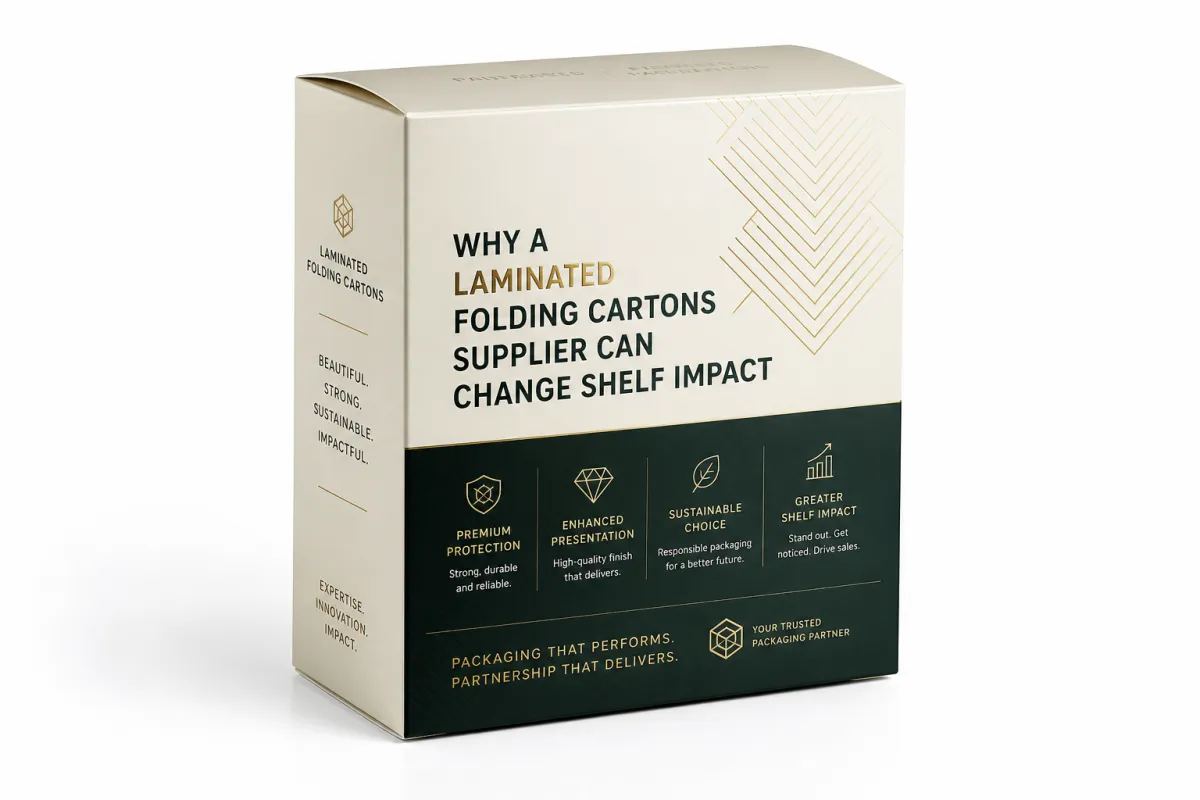
Most shoppers do not stand there and study packaging for very long. They scan, compare, and decide. A laminated folding cartons supplier understands that the carton has to communicate value almost immediately, because the surface itself becomes part of the message. Gloss, matte, and soft-touch finishes all send different signals, and those signals are read before the back-panel copy gets a chance.
Standard folding cartons rely on the board and print alone. Laminated folding cartons add another layer that can act like a visual amplifier. Dark blacks look denser, photography looks crisper, and saturated brand colors hold together better under retail lighting. That matters in categories where competitor cartons are already loud, reflective, or crowded with claims.
There is a tactile side to the story that buyers sometimes underestimate. A carton with a controlled laminated surface can feel cleaner and more engineered, which works well for skincare, confectionery, supplements, electronics accessories, and premium gift packaging. If the brand wants to suggest discipline, purity, or a higher formulation value, the finish can support that message without redesigning the structure.
Two cartons can share the same dieline, the same paperboard, and the same copy, yet tell very different stories. One may look flat and commercial. The other may look refined and worth a higher shelf price. That gap often comes from the laminated surface, not from a dramatic structural change.
A good laminated folding cartons supplier also thinks about competition, not just protection. If a rival brand uses high-gloss imagery and bold contrast, a matte laminated carton may look quieter but more credible. If competitors are all soft and muted, a gloss laminate or selective finish can create sharper shelf interruption. The right answer depends on the category, the shelf set, and the brand's position in the price ladder.
In practice, the carton is doing three jobs at once:
- It protects the product during packing, shipping, and retail handling.
- It supports branding with color, texture, and finish.
- It helps consumers read quality before they touch the product itself.
That is why the supplier choice matters. A laminated folding cartons supplier is not just producing a box. The supplier is helping determine whether the carton feels premium, looks consistent, and survives the trip from press sheet to shelf. For brands that want a better cost-to-impact ratio, that distinction carries real weight.
What a laminated folding cartons supplier does and how the process works
The work starts long before cartons are folded and glued. A laminated folding cartons supplier usually reviews dielines, board selection, artwork files, finish requirements, and shipping expectations before production even begins. That early review matters because lamination affects more than appearance; it can influence ink behavior, crease performance, and adhesive bonding during conversion.
The workflow usually has more layers than many buyers expect. First comes file checking and spec alignment. Then the team confirms the carton style, board grade, and finish choice. After that, proofs or mockups are generated so the buyer can verify color, legibility, and structure. Printing follows, then lamination, then die-cutting, scoring, folding, gluing, and final packing.
That sequence sounds simple, but the finish changes the mechanics. A laminated surface may resist scuffing better, yet it can also affect how deeply a score folds or how reliably glue grabs on the seam. A supplier that understands laminated cartons will account for those variables instead of treating the finish as an afterthought. That is one of the clearest ways to separate an experienced laminated folding cartons supplier from a generic print shop.
The best communication usually happens early. Good suppliers flag artwork issues before print plates are made. They may recommend small type adjustments, white underlay strategies, or changes in contrast if the design is likely to disappear under a matte or soft-touch finish. They should also warn you when metallic-looking art, fine lines, or dark rich backgrounds may need special handling to stay sharp after lamination.
Sampling is where the theory gets tested. Buyers should ask for a press proof, a flat sample, or a finished prototype if the launch matters. A laminated carton can look great on a monitor and still disappoint in hand if the sheen is too strong, the touch is too slick, or the fold lines crack under stress. A careful laminated folding cartons supplier uses sampling to reduce surprises, not to decorate the sales process.
A carton should not only look better after lamination; it should still fold cleanly, glue correctly, and survive real handling without losing the visual gain.
If you want a neutral reference point for transport and distribution testing, the ISTA site is a useful starting point for understanding how packaging is evaluated under shipment conditions. For brands that care about responsible fiber sourcing, the FSC system is another important benchmark. A thoughtful laminated folding cartons supplier should be able to talk about both structure and compliance with equal clarity.
One practical note: not every finish behaves the same way in production, and not every supplier names finishes the same way. Gloss and matte are usually straightforward, while soft-touch can vary by chemistry and press line. That means a sample you approve from one run is helpful, but it is not magic. It still needs to be matched back to board stock, adhesive choice, and the actual converting plan.
Cost, pricing, MOQ, and what drives the quote
Price is rarely driven by a single variable. A laminated folding cartons supplier will usually quote based on carton size, paperboard grade, print coverage, finish type, folding style, quantity, and converting complexity. If any one of those changes, the quote can move more than buyers expect, especially on shorter runs where setup costs are spread across fewer units.
MOQ is where the economics become visible. Smaller quantities almost always cost more per unit because the supplier still has to cover prepress work, plates, setup, die cutting, and finishing preparation. Larger runs usually reduce unit price, but they also increase inventory exposure. That is the trade-off: lower unit cost versus more cash tied up in cartons that may sit in storage.
Buyers often focus on the headline carton price and miss the add-ons. Soft-touch lamination, specialty matte finishes, spot UV, foil accents, windows, inserts, and custom structural features can all change the true landed cost. A careful laminated folding cartons supplier should spell out what is included and what is extra, rather than hiding those costs inside a vague estimate.
For realistic planning, many brands want to know the size of the cost step, not just the direction. As a rough commercial guide, standard gloss or matte lamination may add a modest amount per carton at volume, while soft-touch or more complex finish packages can raise the unit price more noticeably. The exact range depends on order size and print coverage, but the pattern is consistent: finish complexity adds cost faster than simple structure changes. That part can feel a little annoying, sure, but it is usually predictable once the spec is locked in.
| Finish option | Typical shelf effect | Relative durability | Estimated add-on at mid-volume |
|---|---|---|---|
| Gloss lamination | Bright, high contrast, strong color pop | Good scuff resistance | $0.02-$0.05 per carton |
| Matte lamination | Cleaner, softer, less glare under retail lighting | Good to very good | $0.02-$0.06 per carton |
| Soft-touch lamination | Premium, tactile, often used for luxury positioning | Very good against fingerprints | $0.05-$0.12 per carton |
| Aqueous coating | Lower-cost protective finish with a lighter feel | Moderate | $0.01-$0.03 per carton |
That table is not a quote sheet; it is a planning tool. The real value comes from comparing apples to apples. If one laminated folding cartons supplier is quoting 18pt SBS with gloss lamination and another is pricing 16pt CCNB with matte lamination, the unit price alone tells you almost nothing. Board thickness, print coverage, finish, and tooling all need to be aligned before you can judge which offer is actually better.
It also helps to think in unit economics rather than sticker price. A slightly more expensive carton can be the better buy if it reduces shelf damage, supports a higher selling price, or makes the product easier to pack on the line. In some categories, a premium-looking box returns more than its cost through stronger retail acceptance. That is exactly where a skilled laminated folding cartons supplier earns its keep.
For honest budgeting, I usually recommend that teams reserve a small contingency for revision rounds or finish tweaks. It is not pessimism; it is just the reality of converting. If the project is tightly priced from the start, even a minor change in board stock or foil area can shift the math enough to matter.
Production timeline, lead time, and handoff from proof to delivery
A realistic schedule usually moves through several stages: brief, quote, artwork prep, proofing, sampling, production, finishing, inspection, packing, and delivery. A laminated folding cartons supplier should be able to separate those stages clearly so buyers know what can be accelerated and what cannot. That distinction matters, because one delayed approval can push the whole launch window back.
Lead time is driven by complexity more than by wishful thinking. A simple straight-tuck carton with standard lamination may move relatively quickly. A custom carton with specialty coatings, heavy print coverage, multiple SKU variations, or several proof rounds will usually need more time. If the supplier also has to coordinate FSC-certified board, transit testing, or a complex shipping destination, the schedule becomes tighter still.
Where do delays usually happen? Artwork revisions are a major one. A late structural change after proof approval can slow things down too. Another common issue is sample approval taking longer than planned because the brand team did not specify what it wanted to check: color, fold, tactile feel, seam quality, or shelf appearance. A careful laminated folding cartons supplier will ask those questions early rather than waiting for a second round of surprises.
There is also a hidden source of delay that many launch plans ignore: shipping time. Production may finish on schedule, but freight, customs, or warehouse receiving can still move the cartons out of the critical path later than expected. If the packaging is tied to a product release or a seasonal window, the team should build buffer time for proof approval, production tolerance, and transit risk.
For buyers, the best question is not simply "How fast can you make it?" It is "How does each stage affect the delivery date?" A supplier who can break out prepress, print, lamination, converting, packing, and transit is usually easier to work with because the schedule becomes visible. That is a good sign that the laminated folding cartons supplier understands real production, not just sales talk.
It also helps to ask how the supplier handles changes after the first sample. Can the carton be reproofed quickly if the tint needs adjustment? Is a structural tweak possible without restarting the whole process? Those details can save a launch when timing is tight. Brands that ask for the timeline in writing, stage by stage, usually avoid the worst misunderstandings.
Common mistakes when choosing a laminated folding cartons supplier
The first mistake is obvious, but still common: choosing on price alone. A low quote may hide weak color control, poor lamination quality, limited prepress support, or a schedule that looks good only because it assumes perfect artwork. A good laminated folding cartons supplier should be judged on consistency, responsiveness, and proof quality, not only on the first number that lands in the inbox.
The second mistake is approving samples without testing them the way the carton will actually be used. A box can look excellent under ideal lighting and still show fingerprints, fold cracking, or corner wear after a few handling cycles. Buyers should inspect samples in hand, under warehouse-style lighting, and, if possible, under the type of distribution stress the product will face. If shipping is rough, the sample should be evaluated like a shipping object, not like a showroom prop.
Third, many brands ignore finish-language mismatch. High gloss feels different from matte. Soft-touch feels different from both. If the brand is meant to communicate natural, clinical, technical, or artisanal values, the finish has to support that story. A laminated folding cartons supplier can help translate the brand position into a surface choice, but only if the buyer shares the positioning clearly.
Fourth, reorder planning gets skipped. The first run may have been priced attractively because of a special setup, a one-time artwork adjustment, or a material combination that is not easy to repeat. Buyers should ask how the reorder will work, whether tooling stays on file, and whether the next run can be made from the same board and finish spec without a new approval cycle. That is a practical question, not a procurement formality.
Fifth, technical details are often under-shared. Missing dielines, vague target quantities, unclear shipping destinations, and half-finished artwork files force the supplier to guess. Guessing creates friction. Friction creates delays. A reliable laminated folding cartons supplier would rather receive a complete brief than have to fill in blanks after the quote has already been sent.
There is a simple way to reduce risk: compare the supplier's questions, not just the supplier's answers. The better partner usually asks about carton fit, shelf presentation, production tolerance, fold style, proof expectations, and reorder path. Those questions show attention to detail, and they often reveal more than a sample gallery ever will.
One more trap that shows up a lot is over-specifying the pack because the team wants to impress everyone at once. More effects are not always better. A carton can get busy quickly, and then the finish starts fighting the graphics instead of supporting them. Keeping the design disciplined is often the smarter move.
Expert tips for stronger branding, finishes, and print consistency
Treat the finish as part of the brand architecture. A laminated folding cartons supplier can help make the surface work as a visual cue: matte for restraint, gloss for energy, soft-touch for premium tactility, or a more controlled finish for technical credibility. The point is not to make the carton shinier or softer for its own sake. The point is to reinforce the positioning the brand is already trying to claim.
Color control matters more once lamination enters the picture. Deep blues, rich blacks, complex skin tones, and fine typography can all shift slightly depending on board, ink density, and finish selection. A buyer who cares about repeatable shelf performance should ask the laminated folding cartons supplier how color is managed across runs and whether any finish choice is likely to mute or intensify the palette.
For multi-SKU lines, consistency across the range is often where brands win or lose the shelf. If one carton uses soft-touch, another uses gloss, and a third uses matte without any design logic, the line can feel fragmented. A stronger system keeps typography, layout, and finish decisions aligned so the collection reads as one family. That does not mean every carton must be identical; it means the differences should look intentional.
Three finish rules usually hold up well:
- Use gloss when color impact and visual contrast need to do heavy lifting.
- Use matte when glare reduction and a cleaner premium look matter more.
- Use soft-touch when the hand feel should reinforce a luxury or sensory message.
Another detail that gets overlooked is crease behavior. Laminated surfaces can look pristine and still crack if the board, score, or fold geometry is off. That is why a seasoned laminated folding cartons supplier will talk about score depth, glue windows, and finishing tolerances instead of just discussing visual appeal. If the structure is weak, the finish cannot rescue it.
Think ahead to storage and retail conditions as well. Humid backrooms, repeated handling, and long shelf dwell times all change what good packaging means. A supplier who has worked with retail cartons should be able to recommend a finish that survives those conditions without becoming dull, brittle, or marked up too quickly. The best carton is the one that still looks composed after the journey, not only on the sample table.
In my experience, the best results come from pushing the supplier to explain why a certain finish works, not just what it is called. That conversation usually exposes whether the recommendation is grounded in real production experience or just copied from a spec sheet. If the answers stay practical, you are probably talking to the right people.
If the finish fights the brand story, the box works against you. If the finish supports the story and the structure still runs well, the packaging starts earning its cost.
That is the real test for any laminated folding cartons supplier: can they balance visual lift, line performance, and repeatability without turning the carton into an expensive science project?
Actionable next steps before you request samples and place an order
Start with a brief that leaves very little room for guesswork. A strong laminated folding cartons supplier needs product dimensions, carton style, target quantity, finish preference, shipment destination, and any compliance or display constraints. If the packaging has to fit on a specific shelf, inside a mailer, or into a retail shipper, say so up front. Those details shape the quote and shorten the back-and-forth.
Request samples that reflect the real use case. A pretty presentation sample is useful, but it is not enough if the carton has to survive warehouse handling or line packing. Ask for the board spec, finish type, and print style that match the actual launch. If the product is premium, test the premium finish. If the line is value-focused, test the lower-cost spec. A good laminated folding cartons supplier will not mind that request; it is normal due diligence.
Comparing three suppliers on the same spec sheet is one of the simplest ways to find real differences. Once size, board, finish, quantity, and delivery window are aligned, the comparison becomes much clearer. Then you can judge communication, sample quality, reorder planning, and price in a fair way. That is far more useful than collecting three quotes that are built on three different assumptions.
It also helps to ask for a quote that separates the stages. Prepress, production, lamination, finishing, packing, and freight should each be understandable. If a supplier cannot break those pieces apart, the cost structure is probably less transparent than it should be. A transparent laminated folding cartons supplier is easier to trust because the buyer can see where the money goes.
Before signing off, use a short checklist:
- Does the supplier understand the branding goal?
- Do the samples match the promised finish and print quality?
- Is the quote built on the same spec as the other bids?
- Is the lead time realistic, including proofing and freight?
- Is the reorder path clear enough to support future runs?
That last question matters more than many teams admit. A packaging program is not successful because it works once. It is successful because the laminated folding cartons supplier can repeat the result without drama, color drift, or a new round of surprises. If a supplier can do that, the relationship becomes much more valuable than the first carton price suggests.
The most practical next move is simple: lock the spec before you compare quotes, then ask each supplier to prove the same finish, the same board, and the same run conditions in sample form. That gives you a clean read on cost, quality, and repeatability, which is where the real decision lives.
How do I compare laminated folding cartons suppliers fairly?
Use the same specs for every quote: size, board, finish, quantity, print coverage, and delivery location. Then compare the sample quality, communication speed, proofing support, and lead time. A laminated folding cartons supplier that asks better questions usually gives you a better long-term result, even if the quote is not the cheapest.
What should I send a laminated folding cartons supplier for an accurate quote?
Send exact dimensions or a dieline, target quantity, carton style, artwork status, finish requirements, and the shipping destination. If the carton has to hit a specific launch date, include that too. A clear brief helps the laminated folding cartons supplier price the project correctly the first time.
How long does a laminated folding cartons supplier usually need to produce cartons?
Timing depends on proofing, sampling, finish complexity, and order size. Simple cartons with standard lamination usually move faster than custom structures with specialty effects or multiple revisions. A good laminated folding cartons supplier should break out design, production, and transit time so you know where the schedule can move and where it cannot.
Is lamination worth it for premium branding on folding cartons?
Usually yes, if the goal is stronger shelf presence, better scuff resistance, and a more polished look. Lamination can deepen color and make the carton feel more deliberate without changing the whole structure. The key is to match the finish to the brand story, which is exactly where a skilled laminated folding cartons supplier adds value.
What MOQ questions should I ask a laminated folding cartons supplier?
Ask for the minimum order quantity, the unit price at higher quantities, and whether tooling or setup can be reused on future runs. Also ask how reorder Pricing and Lead Times change after the first order. That gives you a clearer picture of whether the laminated folding cartons supplier can support growth, not just a one-time purchase.
The best results usually come from matching brand goals, production reality, and budget with a supplier who can repeat the same finish and structure without compromise. If you choose a laminated folding cartons supplier who understands shelf impact, cost drivers, lead times, and reorders, the packaging starts working like a business asset instead of a line item.