Buyer Fit Snapshot
| Best fit | Low Cost Custom Packaging for Popups Without Losing Profit projects where brand print, material claims, artwork control, MOQ, and repeat-order consistency need to be specified before quoting. |
|---|---|
| Quote inputs | Share finished size, material target, print colors, finish, packing count, annual reorder estimate, ship-to region, and any compliance wording. |
| Proofing check | Approve dieline scale, logo placement, barcode or warning zones, color tolerance, closure strength, and carton packing before bulk production. |
| Main risk | Vague material claims, crowded artwork, missing packing details, or unclear freight terms can make a low unit price expensive after revisions. |
Fast answer: Low Cost Custom Packaging for Popups Without Losing Profit should be specified like a repeatable production item. The safest quote records material, print method, finish, artwork proof, packing count, and reorder notes in one written spec.
Production checks before approval
Compare the actual filled-product size with the drawing, then confirm tolerance on folds, seals, hang holes, label areas, and retail display edges. Reserve space for logos, QR codes, warning copy, and material claims before decorative graphics fill the panel.
Quote comparison points
Review material grade, print process, finish, sampling route, tooling charges, carton quantity, and freight assumptions side by side. A quote is only useful when the supplier can repeat the same color, closure quality, and packing count on the next order.
Low Cost Custom Packaging for Popups Without Losing Profit usually starts with a mistake nobody wants to admit out loud. A popup team grabs the cheapest print quote, guesses the carton size, and then discovers on launch day that the package does not match the real product mix. The cartons are late, the table is crowded, and somebody is repacking units while customers wait. That is not savings. That is a budget leak with a nice logo on it.
Low cost Custom Packaging for Popups only works when the decisions are disciplined. Pick the right structure. Keep the spec honest. Size the run for the actual event window instead of some fantasy future where demand is infinite and storage is free. Do that, and packaging supports margin instead of eating it.
From a packaging buyer's point of view, the job is straightforward: protect the product, make the brand look deliberate, and avoid a second production round. Good branded packaging does that without forcing you into unnecessary foil, oversized cartons, or a miserable MOQ. Bad packaging looks cheap on the quote and expensive everywhere else. I've seen brands save three cents a unit and lose it ten times over in freight and rework. Cute, right?
That is the frame here. By the end, you should be able to choose a format, judge a safe MOQ, and spot the hidden costs that show up after approval. The four filters are simple: value, product fit, technical fit, and execution risk. Use those, and low cost custom packaging for popups becomes a planning tool instead of a panic buy.
If you need a place to start, compare Custom Packaging Products by structure first, then trim finishes second. People love decorating a bad package. It still ships badly.
Low cost custom packaging for popups: the hidden cost math nobody likes
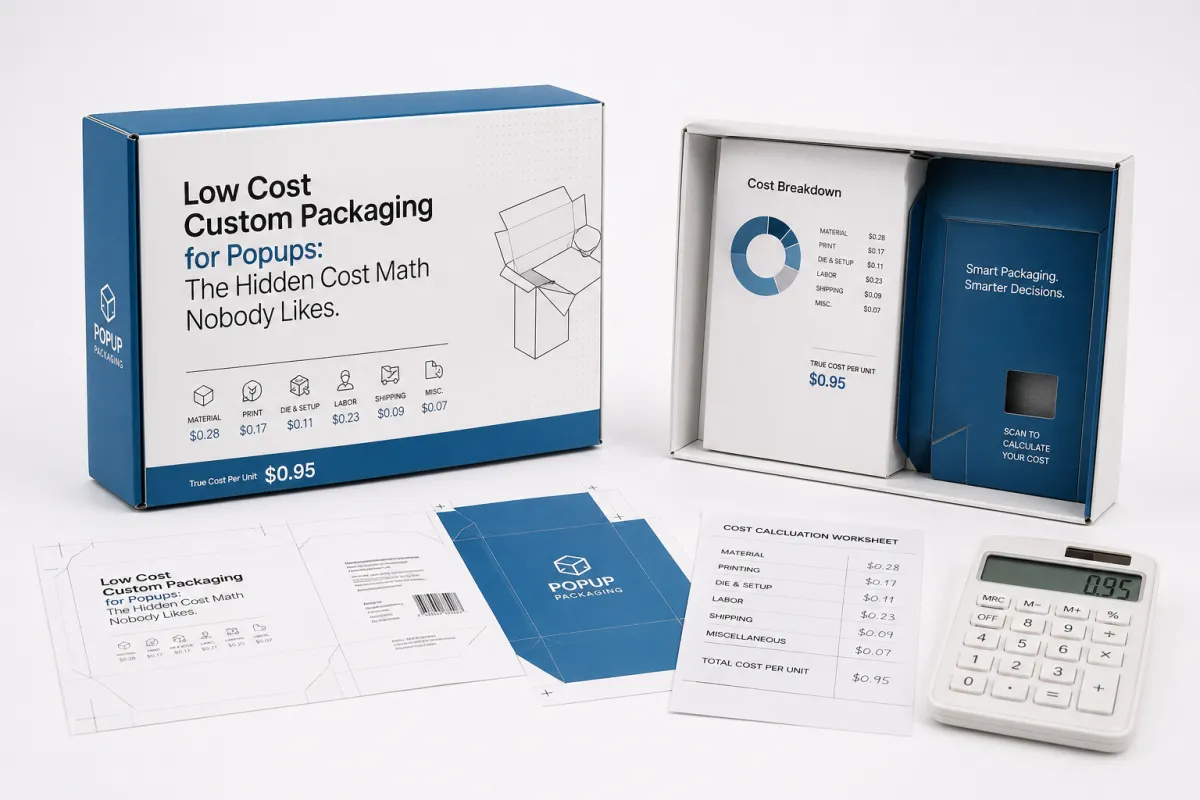
The tricky part is this: low cost custom packaging for popups is rarely about the lowest unit price. It is about the lowest total cost to sell through a weekend, a launch window, or a short product run. If the box is a little too large, the insert is off by 3 mm, or the finish adds one more day and one more fee, the "cheap" option stops being cheap very quickly.
Here is the usual story. A brand trims the print spec and saves a few cents per unit. Then the package is oversized by 8 percent, freight goes up, and the team orders about 35 percent more inventory than needed because nobody checked the carton against the actual counter display. By the time the popup opens, the brand has spent less on ink and more on waste, freight, and dead stock. Very clever. About as clever as a flat tire.
Low cost custom packaging for popups should mean disciplined packaging design, not stripped-down quality. A buyer is not paying for decoration. The buyer is paying for:
- Fit - product dimensions that reduce movement, dents, and filler waste.
- Print efficiency - artwork that stays within a realistic color count and coverage range.
- Inventory control - a run size that matches launch demand without leaving dead stock behind.
- Execution speed - a structure and finish that can be approved, produced, and shipped without drama.
That is the real math behind low cost custom packaging for popups. It is not just about shaving unit cost. It is about avoiding three separate bills for the same bad decision. One sizing error can trigger a reprint, a freight upgrade, and another round of staff repacking on event day. Nobody needs to learn packaging math at a folding table.
Every packaging choice has a visible cost and an invisible one. The visible cost is the quote. The invisible cost is lost time, wasted product, damaged brand image, and rework. In popup retail packaging, the invisible cost usually wins unless somebody is paying attention.
Timing matters too. Popup brands move fast, which means the packaging has to support short replenishment cycles. If a design forces a full reapproval every time you change a scent, colorway, or bundle, stock turns slower and margin gets eaten by admin. Low cost custom packaging for popups works best when the structure can support several SKU variations with small artwork changes.
A cheap box that needs one extra repack at the event is not cheap. It is just disappointment paid in advance.
Before you approve any quote, check the package against four filters. Does it match product size and weight? Does it fit the sale format, whether that is samples, gift sets, or impulse bundles? Can the artwork be produced cleanly at the target run size? Does the timeline leave room for proof correction and shipping? If any answer is shaky, low cost custom packaging for popups is not actually low cost.
That is why experienced buyers treat the quote as the start of the discussion, not the finish. A good quote gives you the starting unit cost. A good plan tells you whether that cost survives the real world.
Value proposition: why low cost custom packaging for popups can raise conversion
Popup shoppers decide fast. Very fast. Packaging is often the first physical proof that the product belongs in the space and deserves the price on the tag. Low cost custom packaging for popups can improve conversion because it removes hesitation. The shopper sees a package that looks intentional, staff can handle it quickly, and the product feels ready to buy instead of assembled in a hurry.
That matters because popup buying is emotional, but it is also immediate. There is no endless comparison shopping. There is a table, a crowd, a line, and a few seconds to say yes. Product packaging does more than hold the item. It signals quality, ease, and trust. If the package feels flimsy, the sale feels risky. If it feels well made, the price feels easier to accept.
Low cost custom packaging for popups can raise conversion in a few very practical ways:
- Faster handling - easy-open structures reduce friction at checkout and on the floor.
- Cleaner presentation - branded packaging improves shelf impact without expensive finishing.
- Lower damage rates - better fit means fewer crushed corners and fewer product swaps.
- More repeatable setup - staff can restock faster when the package format is simple and consistent.
That last one gets ignored too often. A popup may only run for a few days, but setup and replenishment still matter. If the packaging is awkward to stack, hard to identify, or slow to open, staff burn time with every restock. A small gain in unit cost means nothing if it creates a bottleneck every hour.
There is a tradeoff, of course. Premium-looking finishes on tiny counts can fool people. A soft-touch coating, foil accent, or heavy emboss may look attractive in a mockup, but the cost jumps fast once setup, finishing, and freight are added. For many popup brands, one well-chosen feature is enough. A matte stock with strong graphics often reads better than a pile of effects that do not help sell the product.
Most buyers do not need luxury theater. They need a package that signals value, protects the contents, and keeps fulfillment simple. That is why low cost custom packaging for popups often performs best when the visual hierarchy is clean: logo first, product name second, benefit message third. If the shopper can understand the package in a glance, the package is doing its job.
Different popup formats also favor different commercial outcomes. Sample kits, launch bundles, gift-ready add-ons, and demo packs all benefit from Custom Printed Boxes or sleeves that look like part of the brand system, not random storage. A retail package that is easy to open and easy to scan can shorten the line and reduce human error. Those two things help conversion more than a lot of expensive finishes do.
There is a trust element too. A clean package tells the buyer you thought through the details. That does not mean spending more. It means making the package feel deliberate. In branded packaging, that is often enough to move a shopper from interested to committed.
For Brands That Sell multiple SKUs, the smartest route is often a core structure with variable graphics. One box size, one insert system, and artwork tweaks for scent, flavor, shade, or set type. That gives low cost custom packaging for popups a better chance of scaling without creating a different production headache for every version.
If you are comparing retail packaging options, start with buying behavior, not a design mood board. Ask whether the package is being used for display, protection, gifting, or transport. The answer changes the budget split. A display-led package can spend more on graphics. A transport-led package should spend more on structure. That is not glamorous, but it is how margins stay alive.
Product details: popup-ready formats and when to use each
Low cost custom packaging for popups works best when the format matches the product and the selling environment. There is no universal winner. A slim sleeve, a folding carton, a mailer-style box, or a flexible pouch can all be the right answer depending on weight, handling, and shelf exposure. The wrong answer is the one that looks nice in a render and falls apart during actual use.
Custom boxes for structured presentation
Custom boxes are the obvious choice when the product needs a hard outer frame, a clean unboxing moment, or a more premium retail package feel. Folding cartons usually work well for lightweight cosmetics, candles, supplements, accessories, and small gift sets. They keep unit cost under control when the dimensions are standard and the artwork is not overloaded.
For low cost custom packaging for popups, folding cartons often beat rigid structures on price because they ship flat and assemble quickly. A good default is 300gsm to 400gsm C1S or C2S artboard for light retail goods, with a matte or aqueous coating if scuff resistance matters. If the box will be handled all day, reinforce the corners in the design instead of trying to rescue the project with decorative finish choices.
Mailers for transport and bundles
Mailers are practical for popup kits that also need to survive distribution. If the same packaging has to work for shipping, carryout, and display, a mailer-style structure can do a lot of work. It is one of the better formats for low cost custom packaging for popups because the outer shape carries brand presence while the interior can be tuned with inserts, tissue, or product dividers.
That said, mailers can get bulky if the product is tiny. Do not let the structure grow just because the template allows it. Oversized mailers waste board, raise freight weight, and make the package feel less efficient. That extra empty space is not a design choice. It is air you are paying to move.
Sleeves, wraps, and bands for fast-moving items
Sleeves and wraps are the budget-friendly workhorses. They are common for soap bars, boxed treats, small accessories, and bundled items that already have a primary container. Low cost custom packaging for popups often benefits from sleeves because they can add branded packaging without forcing a full custom box build. They also let a brand refresh graphics more easily between event cycles.
If the SKU is price-sensitive, sleeves are a strong option. The base container does the protection, and the outer print does the selling. That split keeps unit cost sane while still giving a polished retail packaging look. For seasonal popups, this is one of the easiest ways to keep artwork fresh without rebuilding the structure every time.
Pouches for light, flexible products
Pouches suit dry goods, samples, small consumables, and lightweight items that do not need a rigid shell. They can be efficient for low cost custom packaging for popups because they use less board and often pack flat. The product still has to tolerate the flexible format. A pouch that crushes the item or hides the contents too much can hurt perceived value.
Use pouches when the handling needs are simple and the brand story is clear. If the package has to stand upright on a counter, check the base and fill weight carefully. If the package needs a premium shelf profile, test the print finish and zipper or seal before committing.
Rigid displays and inserts for higher-ticket sets
Rigid boxes and display structures are not the default low-cost route, but they can be justified for high-value bundles or gift kits where presentation affects price acceptance. The trick is to keep them targeted. A rigid shell used on every unit will eat margin. A rigid shell used on the hero SKU may actually lift average order value enough to justify the spend.
In practice, inserts matter just as much as the outer shell. Foam, molded pulp, folded paperboard, and die-cut partitions all shape the unboxing experience. For low cost custom packaging for popups, paperboard inserts are usually the best balance of cost and protection unless the item is unusually fragile. If you need more technical guidance on options, the custom printed boxes range is often where buyers compare these formats first.
| Format | Best for | Typical cost pressure | Popup advantage |
|---|---|---|---|
| Folding carton | Light retail goods, cosmetics, samples | Low to moderate | Ships flat, strong brand surface, easy to scale |
| Mailer box | Kits, bundles, transport-heavy items | Moderate | Good protection and display value in one structure |
| Sleeve or wrap | Existing containers, bars, small bundles | Low | Fast branding with small material spend |
| Pouch | Light consumables, flexible goods | Low to moderate | Compact, easy to stock, useful for quick replenishment |
| Rigid display | Gift sets, premium kits | High | Strong shelf presence, but only worth it on select SKUs |
There is one more packaging design point that gets skipped too often: the opening direction. A package can be beautifully printed and still be annoying if the tear line, flap, or tuck closure fights the staff member. For popup retail packaging, speed matters. A format that opens cleanly and re-closes cleanly saves time every single day it is used.
If you are making a first pass, keep the dieline-safe margins generous, avoid micro-type, and do not chase thin decorative lines on short-run stock. Small text and delicate line art are common failure points in low cost custom packaging for popups. They look fine on a screen and slightly tragic in production.
Specifications and prepress checks that stop delays before they happen
Good low cost custom packaging for popups lives or dies on prepress. The quote can look perfect and still fail if the spec sheet is sloppy. Most delays are not caused by the press. They are caused by missing dimensions, bad artwork files, or someone assuming the template "should be fine." That phrase has ruined more schedules than bad weather.
Start with the physical details. You need exact finished dimensions, product weight, closure type, stack height, and any insert or divider thickness. If the item has a fragile edge, note the clearance required. If the product needs to be displayed standing up, say so. Low cost custom packaging for popups only stays low cost if the package is built once, not guessed three times.
Artwork should be production-ready. That means vector logos, CMYK files, proper bleed, embedded or outlined fonts, and image resolution That Holds Up at print size. A raster-only logo on a branded box is a self-inflicted problem. So is a color swatch picked on a phone screen and then treated like a print standard.
Three checks matter a lot for popup speed:
- Barcode and QR readability - test scan quality at the actual counter distance.
- Text size - make sure unit info is readable from about 1.5 m away.
- Language consistency - match the box copy to the label copy, not a stale draft.
That third point sounds boring. It is. It is also where a surprising amount of friction starts. If the box says one thing and the sticker says another, staff spend time explaining, correcting, or repacking. That is not a design flourish. That is a correction loop.
For buyers who want broader sourcing references, packaging standards and material stewardship matter here. The Packaging Industry Association is a useful place to review packaging topics, and FSC certification guidance at fsc.org is relevant if paper sourcing matters to your brand story. If a supplier cannot speak clearly about substrate choice, print method, and certification, keep asking questions.
Common production blockers are predictable: low-resolution images, wrong substrate choice, wrong fold allowance, unplanned spot UV on a textured stock, and a dieline that was edited without telling the printer. Those are not exotic problems. They are the usual suspects. Low cost custom packaging for popups is easiest to keep on track when the buyer avoids "small" changes after final approval.
Here is a clean proof workflow that works well for popup launches:
- Confirm size and closure with a physical sample or measured product.
- Review color against a print-friendly reference, not a random display.
- Check die-cut alignment and fold sequence.
- Simulate opening, closing, and staff restocking.
- Verify ship orientation so cartons arrive usable, not just boxed.
One proof round is often enough if the files are prepared properly. A second round is where money starts leaking, so treat it as an exception, not a habit. If scope changes after final approval, expect extra charges. That is normal. Rework is labor, and labor is not free just because the design team forgot the deadline.
For brands that sell across multiple popup dates, the smartest move is to create a locked packaging system with a reusable spec sheet. That makes it easier to quote repeat runs and keep unit cost predictable. It also reduces the odds that a new team member introduces a bad revision at the worst possible moment.
Pricing and MOQ for low cost custom packaging for popups
Pricing for low cost custom packaging for popups comes from a few moving parts, and pretending otherwise is how people end up irritated with their supplier. The big pieces are setup fee, die or pattern cost, per-unit print cost, coating or lamination, freight, and any inserts. If the order uses special finishes, price those separately. If the packaging has multiple components, price each one with the same discipline.
The smallest order is not always the smartest order. That sounds backward until you factor in setup costs. Low order quantities raise unit cost because the fixed charges are spread over fewer pieces. That does not mean you should always buy big. It means the right MOQ is the one that matches sell-through and event frequency without burying cash in the warehouse.
For practical planning, buyers usually see ranges like these for low cost custom packaging for popups:
- Short-run digital - often best for low volumes, launch tests, and quick changes; unit cost is higher but setup is lighter.
- Economy offset - better for repeatable runs where quantities justify the setup; unit cost improves as volume climbs.
- Standard folded cartons - strong middle ground for custom packaging with decent shelf impact.
- Special finishes - foil, emboss, or soft-touch raise the look, but they also raise total spend faster than many buyers expect.
Here is the useful part: a low MOQ can still make financial sense if it avoids a full return cycle. A brand that orders too much, then changes the SKU or package size, often spends more on disposal, storage, and markdowns than it saved on unit cost. That is the part people like to ignore because the quote looked tidy.
| Choice | Typical cost behavior | Best use case | Risk level |
|---|---|---|---|
| Small digital run | Higher unit cost, low setup burden | Test launch, limited popup, fast artwork changes | Low if files are clean |
| Mid-volume offset run | Lower unit cost, higher setup burden | Repeat popup cycle, stable design | Moderate if demand is uncertain |
| Large economy run | Best unit cost, highest cash tied up | Proven SKU with predictable sell-through | Higher inventory risk |
Break-even math should be simple. Add the total packaging cost, freight, and waste handling. Divide by the number of units you expect to sell. Compare that number to your margin per sale. If the package eats too much of the margin, the upgrade is not helping. It is just prettier overhead.
Then add one more test: what happens if sell-through is 20 percent slower than expected? If the answer turns ugly, the MOQ is probably too aggressive. Low cost custom packaging for popups should protect the launch, not force a huge bet on the first run.
There are also add-ons that move unit economics in obvious ways. Extra color adds print complexity. Foil adds finish cost and can slow the schedule. Embossing raises tactile appeal but usually belongs on a smaller hero line, not every budget SKU. Custom die shapes look distinctive, but the pattern cost needs enough volume to pay for it. Window film and heavy stock can be useful, but only if the product benefits from the visibility or extra stiffness.
For many popup brands, the sensible move is to keep the first order narrow and learn from the market. Place a controlled run, watch sell-through, then scale the best-performing size or format on the next cycle. That is how low cost custom packaging for popups stays low cost. Not by guessing bigger. By learning faster. Kinda boring. Also very effective.
If you want more than one format in the mix, ask for a split quote. One version can use the lowest safe spec for testing, while another can use a more polished structure for the hero set. A good packaging partner will price both options clearly instead of forcing you into a single "take it or leave it" answer.
For product packaging decisions, MOQ is not just a purchasing term. It is a planning lever. Use it to match launch scale, not ego.
How do you keep low cost custom packaging for popups profitable?
You keep low cost custom packaging for popups profitable by treating it like a system, not a decoration decision. The system has three moving parts: the structure has to fit the product, the print spec has to stay realistic, and the order size has to match actual sell-through. Miss one of those and the quote starts lying to you.
Start with the package structure. If the carton is oversized, the insert is decorative instead of protective, or the opening style slows staff down, the package is already costing more than it should. A good structure reduces damage, cuts filler, and keeps popup retail packaging easy to stock. That is boring. It is also where the savings live.
Then keep the artwork simple enough for short-run digital printing or efficient offset. Use the cleanest possible logo lockup, a limited color palette, and a finish that earns its keep. A matte stock or aqueous coating often does more for branded packaging than three expensive effects that only look impressive in a mockup. If the finish does not help the sale, it is just a cost with confidence issues.
Finally, control the MOQ. Order enough to cover the event window and a bit of safety stock, but not enough to trap cash in a warehouse after the popup closes. If you are unsure, ask for a smaller test run plus a repeat-run quote. That gives you real numbers instead of hopeful guesses.
For a quick decision check, use this list:
- Does the package fit the product without filler waste?
- Can the team open, restock, and hand it off quickly?
- Is the artwork clean enough to avoid reproofs?
- Does the MOQ match the actual event forecast?
- Will the package still make sense if sell-through is slower than planned?
If the answer to any of those is no, the packaging is not low cost custom packaging for popups. It is a cheaper-looking way to spend more later.
Process and timeline: production path for low cost custom packaging for popups
The cleanest timeline for low cost custom packaging for popups starts early and stays boring. That is a compliment. Boring is good in packaging. Boring means files are correct, proofing is quick, and nobody is calling for a rescue at 9 p.m. the night before setup.
A realistic event-driven schedule often looks like this:
- Quote and art review - 1 day if the dimensions and format are already known.
- Proof and corrections - 1 to 3 days depending on file readiness.
- Production - 2 to 7 business days for many standard runs.
- Finishing and quality check - about 1 day for inspection and packing.
- Shipping buffer - at least 2 days before event setup whenever possible.
That schedule is not a fantasy. It is the safer lane. If the event is fixed, aim to have files in 7 to 14 days before launch. That gives enough room for one proof round, a correction window, and shipping without turning the whole project into a fire drill. Low cost custom packaging for popups gets expensive when the request becomes urgent and the artwork is still rough.
Digital short runs are usually the best path for speed and flexibility. Offset becomes more attractive once the quantity rises and the artwork is locked. The tradeoff is straightforward: digital can handle change with less setup, while offset tends to improve unit cost on larger pulls. Neither is magic. Both still need correct files and a sane timeline.
Use three checkpoints to keep the work organized:
- T0 - style lock: choose structure, dimensions, and finish direction.
- T1 - supplier confirmation: agree on MOQ, lead time, and artwork requirements.
- T2 - proof approval: sign off only after size, color, and fit are checked.
- T3 - final release: no more changes unless you want to pay for them.
One owner should control the file folder. One person should control approvals. One deadline should be the deadline. That may sound strict, but loose communication is how low cost custom packaging for popups turns into repeated revisions, inconsistent art versions, and "which file did you mean?" messages. Teams lose time that way. Suppliers do too.
There is also a quality angle. If the shipment needs protection in transit, ask about distribution testing. The International Safe Transit Association has useful guidance on packaging test methods and transport protection at ista.org. You do not need a lab coat to understand the point: if the package cannot survive the trip, the weekend starts with damage control.
For popup brands, practical timing matters more than theoretical speed. A same-week order can work if the design is simple, the stock is available, and the proof is clean. But that is a narrow lane. If there is a launch date, a staffed setup, and any chance of artwork changes, planning early is the less painful option. Low cost custom packaging for popups is supposed to reduce pressure, not create a new calendar puzzle.
One final detail: build your shipping buffer backward from event setup, not from the order date. That single habit saves more launches than any flashy finish ever will.
Conclusion: final action plan for low cost custom packaging for popups
Low cost custom packaging for popups is not a race to the cheapest quote. It is a sequence of practical decisions that keep the package useful, the brand credible, and the margin intact. If you get the structure right, the print spec realistic, and the MOQ aligned with sell-through, the packaging helps sell the product instead of draining the event budget.
Use this action plan:
- Finalize the package type and exact dimensions from the real product, not from a rough guess.
- Request a short spec sheet with paper stock, print method, MOQ, lead-time window, and unit-cost breakdown.
- Keep one premium-safe design path and one cost-safe fallback so you can switch without rebuilding the project.
- Run a pre-production check on opening mechanics, barcode scan area, and staff handoff speed.
- Place a controlled first order sized to the minimum viable popup launch, then track sell-through within 24 hours of go-live.
If the package plan raises return handling, slows setup, or forces a late shipping gamble, revisit the structure before production starts. That is the smart move. Nobody needs a cheaper box that creates a more expensive event.
For most brands, the winning formula is modest: one efficient structure, one clean print system, one believable MOQ, and one clear timeline. That is how low cost custom packaging for popups stays useful, keeps branded packaging sharp, and protects unit cost without pretending the budget is infinite. If the package fits the product and the event, you are already ahead of most of the market. Low cost custom packaging for popups can look good, sell well, and still leave room for profit if you stop asking it to do ten jobs at once. Pick the structure that fits the product, keep the run size honest, and lock the files early. That is the whole trick.
Frequently Asked Questions
What is the minimum order size for low-cost custom packaging for popups?
Typical popup-ready print runs start smaller than large wholesale packaging orders, but the real MOQ depends on format, stock, and finish. For low cost custom packaging for popups, a practical approach is to start with the smallest stock-safe size that covers launch demand, then scale the next run based on actual sell-through. Ask for two quotes if you can: one for a test run and one for a repeat run. That shows where the unit cost actually lands.
Can I still get premium-looking low-cost custom packaging for popups on a tight budget?
Yes. Choose one signature feature and keep everything else clean. A matte stock, a strong logo lockup, and one accent finish can look far better than a box crowded with effects. Premium feel usually comes from structure and visual hierarchy, not a pile of embellishments. For low cost custom packaging for popups, the smart move is to spend on clarity first and decoration second.
How does low cost custom packaging for popups affect profit margins on small batches?
Margins improve when you avoid repeat edits, avoid over-ordering, and avoid rush fees at the end. The real cost is not just the print quote. It includes freight, waste handling, and time lost to rework. Use a simple formula: total packaging spend plus freight plus waste handling, divided by units sold. That gives you the real packaging cost per sale and shows whether low cost custom packaging for popups is actually helping.
What technical specs are required to avoid extra charges for low cost custom packaging for popups?
You need finished dimensions, a dieline with safe bleed, CMYK vector files, and fonts outlined or embedded correctly. Image files should be sharp enough for print, and color conversion should be resolved before proofing. Ask for a preflight pass and a proof review. When the proof is clean, the risk of late revisions and expensive rework drops fast. That is how low cost custom packaging for popups stays low cost.
How quickly can low cost custom packaging for popups be delivered for a pop-up event?
Standard digital runs often fit inside a 7 to 10 business day window if the files are ready and the structure is simple. Faster lanes may be possible, but they depend on material availability and proof complexity. For same-week events, keep changes under one revision round and keep a fallback stock option ready. Build at least two shipping days before setup. Otherwise the timeline stops being a plan and becomes a gamble.

