Buyer Fit Snapshot
| Best fit | Matte Poly Mailers With Logo projects where brand print, material claims, artwork control, MOQ, and repeat-order consistency need to be specified before quoting. |
|---|---|
| Quote inputs | Share finished size, material target, print colors, finish, packing count, annual reorder estimate, ship-to region, and any compliance wording. |
| Proofing check | Approve dieline scale, logo placement, barcode or warning zones, color tolerance, closure strength, and carton packing before bulk production. |
| Main risk | Vague material claims, crowded artwork, missing packing details, or unclear freight terms can make a low unit price expensive after revisions. |
Fast answer: Matte Poly Mailers With Logo: Design, Cost, and Fit should be specified like a repeatable production item. The safest quote records material, print method, finish, artwork proof, packing count, and reorder notes in one written spec.
Production checks before approval
Compare the actual filled-product size with the drawing, then confirm tolerance on folds, seals, hang holes, label areas, and retail display edges. Reserve space for logos, QR codes, warning copy, and material claims before decorative graphics fill the panel.
Quote comparison points
Review material grade, print process, finish, sampling route, tooling charges, carton quantity, and freight assumptions side by side. A quote is only useful when the supplier can repeat the same color, closure quality, and packing count on the next order.
Plain shipping disappears into the background. Matte Poly Mailers with logo do the opposite, because the package starts carrying the brand before the customer ever opens it. Apparel, accessories, beauty samples, and subscription orders all benefit from that kind of first impression, and matte poly Mailers with Logo remain one of the most cost-conscious ways to make a shipment feel intentional instead of generic.
The matte finish does more than change the look. Glossy mailers catch light, show fingerprints, and make small type harder to read when a package gets photographed or filmed on a phone. Matte Poly Mailers with logo usually read cleaner on camera and feel more deliberate in hand, which gives the package a premium edge without adding much complexity to packing. That matters more than people think, especially for brands that live on social content.
From a packaging buyer’s standpoint, the job never changes: protect the order, keep packing fast, and make the brand look organized. That is the lane matte poly mailers with logo fit into so well. They are not built for fragile items without support, but they work beautifully for soft goods, folded garments, and other low-bulk products that do not need a carton. I have watched a plain mailer and a branded matte mailer land side by side, and the difference in perceived value is not subtle.
“If the outer mailer looks good in a warehouse photo, a porch photo, and a social post, it already earned its keep.”
Matte Poly Mailers With Logo: What They Are
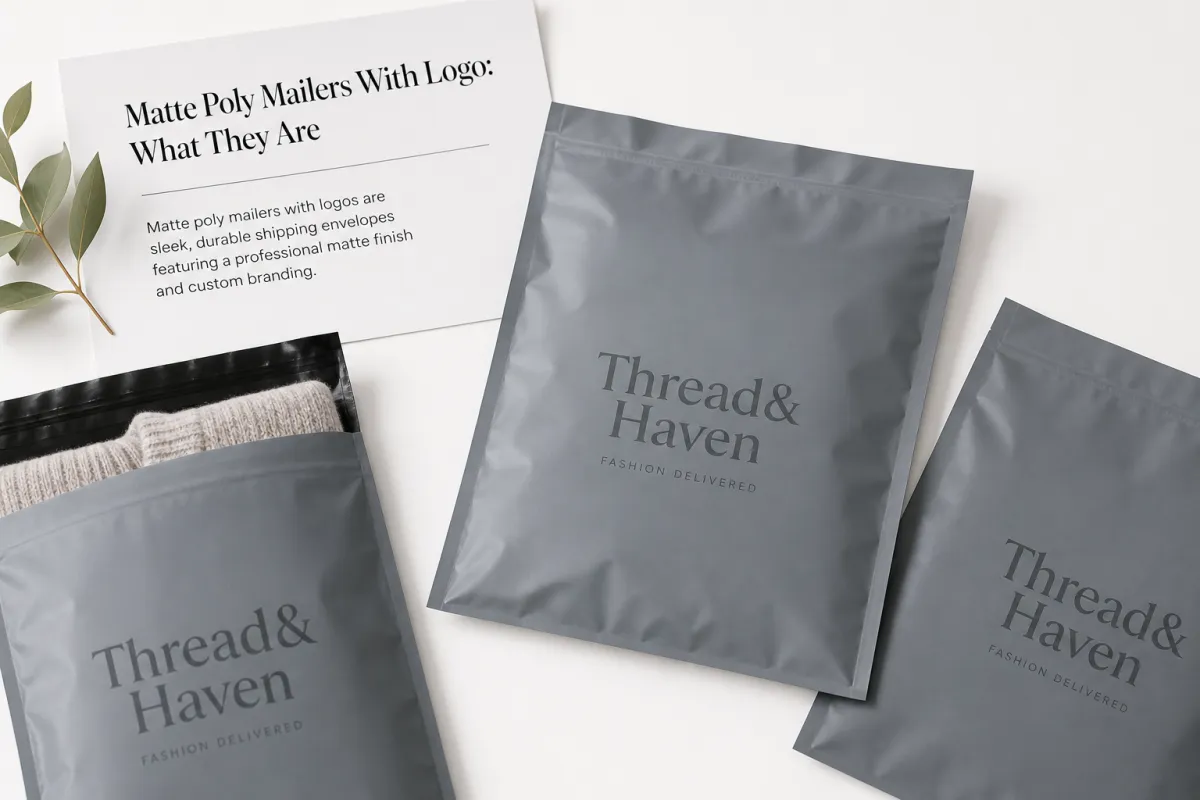
Matte poly mailers with logo are lightweight plastic shipping mailers with a low-glare finish and printed branding on the outside. Most are made from polyethylene film, usually with a self-seal adhesive strip and a tear-resistant body. They show up often in apparel, socks, small accessories, books, and subscription kits where the product can travel safely without a box.
The appeal is practical. You get a branded outer package without paying for corrugated board, void fill, or extra packing labor. Many brands choose matte poly mailers with logo because they reduce packaging cost while still looking polished at the doorstep. That combination makes a lot of sense for direct-to-consumer shipping, especially when speed matters.
The matte surface is not just a style preference. It cuts glare, hides handling marks better than glossy film, and keeps logos easier to read in product photos or unboxing clips. A lot of brands find that matte poly mailers with logo look more upscale than shiny alternatives because the finish feels calmer and more controlled. The change is subtle, yet the branding effect is real.
One point needs to stay clear: these mailers are branding tools, not armor. If the product can bend, crush, or scratch, the packing plan has to account for that. A tissue wrap, an insert card, or an inner sleeve may be the right move before the item goes into matte poly mailers with logo. Fragile goods usually need the mailer as an outer layer, not the only layer.
For brands comparing formats, it helps to look at broader packaging options too. You can browse Custom Packaging Products for a wider view of what can be branded, or compare construction and sizing against Custom Poly Mailers if you want a more focused starting point.
There is a presentation angle that gets missed often. A plain pouch says shipment. A branded matte pouch says brand. That shift is small on paper, but it changes how the customer reads the order the moment it arrives. It also explains why matte poly mailers with logo show up so often in fashion, fitness, and beauty shipping.
How Matte Poly Mailers With Logo Are Made
Most production starts with the film. Matte poly mailers with logo generally use a printed outer film and a protective inner layer, with the matte effect created by the film surface or a finish treatment during manufacturing. After the film is formed and cut to size, the adhesive closure gets added. The idea is straightforward, but the process still needs care at every step.
Print method depends on volume and artwork complexity. Flexographic printing is common for medium and large runs because it handles repeat production efficiently. Gravure can deliver very consistent output on high-volume jobs. Digital methods work well for shorter runs or for brands that want more flexibility in layout and color changes. For matte poly mailers with logo, the printing method usually comes down to cost, color count, and how much setup a supplier wants to absorb.
The artwork workflow matters just as much as the machine. Logos need to be separated into print layers, spot colors need to be matched, bleed has to be checked, and proofs need a careful review before production starts. Good suppliers do not stop at “Does it look okay?” They check whether the logo still reads at arm’s length, whether the type is large enough, and whether the matte surface keeps enough contrast. That is the difference between decent matte poly mailers with logo and mailers that look flat or muddy in person.
Quality lives in the details. Edges should stay crisp. Color should hold steady across the run. The finish should feel matte rather than chalky. The mailer should still feel sturdy, not flimsy or limp. A sample that only looks good under perfect lighting is not much help. Real matte poly mailers with logo need to survive stacking, rubbing, machine packing, and a delivery route that may be less than gentle.
For basic industry context, it helps to look at packaging design and shipping performance standards instead of guessing. Packaging.org has useful educational material on packaging structures, while ISTA is the name many buyers see when shipping test methods come up. Those references matter if you want matte poly mailers with logo that do more than look good on a mockup.
One more detail deserves attention: the adhesive strip and seal area need to stay clean during manufacturing. A polished print job does not matter much if the closure peels open because the seal was poorly applied or contaminated during production. I have seen buyers focus on print color and ignore the seal. Bad trade. The logo is not the only part of matte poly mailers with logo that needs to hold up.
Key Factors That Affect Matte Poly Mailers With Logo
Size comes first, and it is often where the first mistake shows up. Too large, and the package looks sloppy and wastes material. Too small, and seams get stressed or the product bulges badly. The right size for matte poly mailers with logo should fit the product, plus any insert, sleeve, or tissue, without making the front panel look swollen.
Thickness follows close behind. Most branded mailers sit somewhere around 2.0 to 3.0 mil total thickness, though real specs vary by supplier and construction. Thicker film usually feels more substantial and resists tearing better, but it can add cost and sometimes a little weight. For apparel and soft goods, many buyers land in the middle of that range for matte poly mailers with logo because it gives a good balance between cost and handling confidence.
Print complexity changes the equation too. One-color logos are usually the cleanest and least expensive. Two-color jobs add setup. Full-bleed art, gradients, metallic inks, and dense background coverage push pricing up quickly. If the goal is simple brand recognition, matte poly mailers with logo do not need a lot of effects. A strong logo, clear contrast, and a sensible layout usually beat a crowded design every time.
Finish and base color matter as well. Matte black looks sharp, but it can swallow low-contrast art. Matte white gives a cleaner canvas and tends to photograph well. Kraft-style looks more natural, though it is usually a printed effect rather than actual kraft paper. Custom colors can look striking, but they may also make handling marks more visible. The right choice for matte poly mailers with logo depends on the brand personality and the product inside.
Here is the tradeoff buyers usually face:
- Simple one-color design: lower cost, faster approval, cleaner branding.
- Two or three colors: more visual interest, more setup, slightly higher risk of color variation.
- Full coverage print: stronger shelf and social impact, but more expensive and less forgiving if the artwork is weak.
- Heavier film: better durability, a more premium feel, and slightly higher unit cost.
One practical note from the buyer side: think about what the package looks like after it has been handled a few times. Scratches, smudges, and tape marks show differently on different finishes. A matte surface usually hides that abuse better than gloss, which is one reason matte poly mailers with logo stay popular in direct-to-consumer shipping. The customer should see the brand, not every tiny scuff from the logistics chain.
| Mailer Option | Best For | Typical Unit Cost at 5,000 pcs | Tradeoff |
|---|---|---|---|
| One-color matte print | Simple apparel orders and lean branding | $0.18-$0.30 | Lowest cost, but limited visual impact |
| Two-color matte print | Retail-ready shipments and stronger logo contrast | $0.22-$0.36 | Slightly higher setup and proofing time |
| Full-coverage custom design | Brand launches and social-friendly unboxing | $0.28-$0.55 | More expensive and less forgiving on artwork |
| Heavier-gauge matte mailer | Products that need better tear resistance | $0.24-$0.40 | Better durability, slightly higher freight and material cost |
If you want the design to do its job, keep the logo readable at arm’s length. That sounds basic because it is basic. Still, plenty of matte poly mailers with logo are weakened by tiny type, weak contrast, or decorative clutter that disappears once the package is shrunk to actual shipping size.
Matte Poly Mailers With Logo: Ordering Process and Timeline
The ordering process is usually simple, but the details decide whether the project stays calm or turns into a pile of revisions. Start by selecting size, quantity, material thickness, and print style. Then send artwork. Then review the proof. Then approve a sample if the supplier offers one. That is the normal sequence for matte poly mailers with logo, and skipping steps rarely saves time.
Timing usually breaks into artwork review, proofing, production, and freight. If the artwork is clean and the supplier already knows the spec, the front end can move quickly. If the design needs color correction or resizing, the schedule stretches. Most delays happen before production starts, not during the machine run. That is why matte poly mailers with logo should be planned before the launch countdown gets too tight.
A realistic timeline for many custom runs looks like this: artwork review in a couple of business days, proof approval in another day or two if the buyer responds quickly, production often around 10 to 15 business days for standard jobs, then shipping time on top of that. Rush work is possible, but rush work is also where mistakes cost more. If your matte poly mailers with logo support a seasonal drop, do not wait until the week before launch to start the conversation.
What usually slows a project down?
- Low-resolution artwork or missing vector files.
- Color changes after the first proof.
- Late size changes because the product spec changed.
- Full-bleed artwork that needs extra layout cleanup.
- Approval delays from too many internal reviewers.
That last one shows up all the time. The designer wants one thing. Operations wants another. Marketing wants more logo. Someone else wants the website URL larger. Pretty soon the proof turns into a committee meeting. Keep it focused. The best matte poly mailers with logo usually make one clear promise and do it cleanly, instead of trying to win every argument on the front panel.
Build in sample time if the order matters. A physical sample can reveal things a screen never will: print density, surface feel, how the matte finish reads under indoor light, and whether the colors still feel balanced after manufacturing. For brands that depend on presentation, a pilot run is cheap insurance. The goal is to avoid opening a carton of matte poly mailers with logo and realizing the art looks noticeably worse than the proof.
If the product line is still evolving, short runs make sense. If the design is locked and fulfillment volume is stable, larger runs usually improve unit cost. That is the real tradeoff. Short runs protect flexibility. Larger runs protect margin. Good matte poly mailers with logo ordering uses both ideas instead of pretending one answer fits every brand.
Matte Poly Mailers With Logo Pricing: What Changes the Cost
Pricing for matte poly mailers with logo is not random. It usually breaks into five buckets: material choice, size, print colors, quantity, and whether the mailer spec is standard or fully custom. If any one of those changes, the quote can move more than a buyer expects. A small design tweak can cost more than the design itself, which is packaging’s favorite little joke.
Quantity has the biggest impact. Larger runs spread setup costs across more pieces, so the per-unit price drops. Smaller runs cost more per mailer because the supplier still has to do the same proofing, plate work, machine setup, and production handling. That is why matte poly mailers with logo can look affordable at 20,000 pieces and surprisingly expensive at 1,000 pieces. The work does not shrink just because the order is smaller.
Design complexity matters just as much. Metallic ink, full-bleed coverage, more print stations, custom sizing, and special finishes all raise the cost. Freight can also change landed price more than people expect, especially if the mailers are large or if the schedule pushes you into expedited shipping. A quote for matte poly mailers with logo is only useful if it includes the full landed cost, not just the unit price someone highlighted in bold.
Here is a practical way to think about it:
- Low-budget route: standard size, one-color print, higher quantity, minimal artwork revisions.
- Middle-ground route: standard size, two-color logo, moderate quantity, a little customization.
- Premium route: custom size, full-coverage design, heavier film, and tighter proof control.
From a buyer’s perspective, the cheapest quote is not automatically the best deal. If a supplier saves a few cents but the print looks washed out, the closure fails, or the delivery slips past the launch date, the real cost is much higher. I would rather see a slightly higher quote for matte poly mailers with logo that arrives on time and prints cleanly than a bargain number that turns into rework and apologies.
That also means you should ask for apples-to-apples comparisons. Same size. Same thickness. Same print count. Same closure style. Same freight assumptions. Otherwise one supplier looks cheap because they quietly quoted a thinner film or a different run length. If you are comparing matte poly mailers with logo, compare the actual spec, not the sales language around it.
| Cost Driver | What Happens to Price | Buyer Takeaway |
|---|---|---|
| Higher quantity | Per-unit cost usually drops | Best choice for steady demand |
| More print colors | Setup and production cost rise | Use only if the design truly needs it |
| Heavier film | Cost rises, durability improves | Worth it for thicker or higher-value products |
| Rush freight | Total landed cost can jump fast | Build time into the schedule if you want margin |
A useful sustainability note belongs here too. If the shipment includes printed inserts or thank-you cards, consider FSC-certified paper for those pieces. The mailer itself is still plastic, but the full package can be planned more responsibly. That is the kind of detail that makes matte poly mailers with logo feel like a considered packaging system instead of a random pile of supplies. For broader recycling guidance, the EPA’s recycling resources at epa.gov/recycle are worth a look when you are deciding what can realistically be recovered after use.
Common Mistakes With Matte Poly Mailers With Logo
The first mistake is choosing the wrong size. Oversized mailers waste material and can make the order look underfilled. Undersized mailers stretch seams and make the product look jammed in. With matte poly mailers with logo, the front panel should look composed, not stuffed like someone lost a wrestling match with a sweater.
Artwork is the second trap. Thin fonts, tiny logos, weak contrast, and low-resolution images all break down faster on a matte surface than people expect. The finish is elegant, but it is not magic. If the logo is too delicate, matte poly mailers with logo can lose legibility the moment the print scale gets reduced for actual production.
Finish mismatch is another quiet problem. Some brands want premium and soft, then choose a dark matte base that swallows the artwork. Others want a natural look but choose colors that make scuffs obvious. That is why sample review matters so much. In hand, matte poly mailers with logo can look very different from how they appear on a monitor.
Then there is proofing. Skipping proof review is a great way to get the wrong color, off-center placement, or a logo that sits too close to the seam. Screen mockups are useful, but they are not a substitute for a proper proof. I have seen enough packaging jobs to say this plainly: if you do not review the proof on matte poly mailers with logo, you are betting the launch on luck.
Here are the mistakes that show up again and again:
- Too much copy: front panels should not read like a press release.
- Bad contrast: pretty color pairs are useless if the logo disappears.
- Wrong seal direction: it sounds small until fulfillment starts tripping over it.
- No sample run: the fastest way to discover a problem after you have already paid for it.
One more reality check: not every product needs maximal branding. Sometimes a simpler design is smarter because it looks better, prints cleaner, and ships faster. That is especially true for matte poly mailers with logo used on recurring orders where the customer already knows the brand. Good packaging is not about shouting. It is about being clear.
Expert Tips For Better Matte Poly Mailers With Logo
Start with the goal, not the decoration. Ask what the mailer has to do: look premium, cut cost, improve durability, support social content, or all four. Once the goal is clear, the rest gets easier. The best matte poly mailers with logo are usually the ones that solve one problem very well instead of trying to impress every stakeholder at once.
Keep the front design simple. Use one strong logo placement, one readable message if needed, and enough empty space for the eye to rest. That does not mean boring. It means disciplined. A clean layout on matte poly mailers with logo usually reads better than a crowded one, especially once the package is seen in motion, on a shelf, or in a delivery photo.
Pay close attention to contrast. Dark on dark can disappear. Light on light can wash out. If the logo has thin strokes, thicken it a bit before production. If the brand mark is complex, test a simpler version for the mailer. This is one of those packaging choices where less clutter usually gives better results. Strong matte poly mailers with logo do not need to explain themselves.
A pilot run is worth the money when the product line is new or the branding is still evolving. A sample can reveal whether the finish feels right, whether the seal closes cleanly, and whether the color still works in normal light. If you are unsure, order a short run before you commit to a larger production batch of matte poly mailers with logo. That small step can save a lot of waste.
For buyers comparing product families, the cleanest move is usually simple: shortlist sizes, request quotes from a few suppliers, compare proof quality, and check lead times side by side. If you need a broader packaging mix, start with Custom Packaging Products; if you already know a mailer is the right format, compare direct options through Custom Poly Mailers. That helps narrow the spec before the quote starts drifting.
Ask about shipping test expectations as well. If the supplier knows ISTA-style testing, ask what level they used or what internal checks they run before production release. No one needs to overcomplicate a mailer order, but you do want a supplier who understands that matte poly mailers with logo still have to survive real handling, not just a desk-side approval.
Bottom line: choose the size that fits, use artwork that reads fast, keep the finish matte for the right visual impact, and confirm the sample before you buy in volume. That is the path that keeps matte poly mailers with logo from becoming an expensive lesson. Done right, they are practical, attractive, and easy to live with in fulfillment.
FAQ
Are matte poly mailers with logo better than glossy ones?
Usually, yes, if your goal is a cleaner premium look. Matte poly mailers with logo reduce glare, hide fingerprints better, and tend to photograph more consistently. Glossy can still work, but it usually shows scuffs more easily and can make small type harder to read.
What is the minimum order for matte poly mailers with logo?
Minimums vary by supplier and print method. Small custom runs are common, but the per-unit cost rises when the quantity drops because setup costs are spread across fewer mailers. If you are testing a new design, start with a sample or pilot run before placing a larger order of matte poly mailers with logo.
How long does it take to produce matte poly mailers with logo?
Simple orders move faster, but proofing and print setup still take time. A realistic schedule often includes artwork review, proof approval, production, and freight. If the project is tied to a launch, build extra time into the plan so matte poly mailers with logo do not become the thing that delays everything else.
What affects the price of matte poly mailers with logo most?
Quantity, size, print colors, and film thickness usually drive the biggest price changes. Full-coverage art, custom sizing, and rush production add cost quickly. Always compare total landed cost, not just the quote for the mailers themselves, because matte poly mailers with logo can look cheaper than they are once freight is added.
How do I make sure my logo looks good on matte poly mailers with logo?
Use a vector file, keep the logo simple enough to read at a glance, and choose strong contrast against the mailer color. Review a digital proof and, when possible, a physical sample before approval. That is the safest way to make matte poly mailers with logo look sharp instead of washed out.
For most brands, matte poly mailers with logo sit in a very useful spot between cost, speed, and presentation. They are not fancy for the sake of being fancy. They are practical. They protect soft goods, they pack quickly, and they give the customer a branded first impression without dragging the budget into the weeds. Choose the size carefully, keep the artwork disciplined, and approve a real sample, and matte poly mailers with logo can do exactly what packaging should do: make the shipment feel like part of the brand, not just the shipping.


