Buyer Fit Snapshot
| Best fit | MOQ Packaging Design That Cut Costs and Waste projects where brand print, material claims, artwork control, MOQ, and repeat-order consistency need to be specified before quoting. |
|---|---|
| Quote inputs | Share finished size, material target, print colors, finish, packing count, annual reorder estimate, ship-to region, and any compliance wording. |
| Proofing check | Approve dieline scale, logo placement, barcode or warning zones, color tolerance, closure strength, and carton packing before bulk production. |
| Main risk | Vague material claims, crowded artwork, missing packing details, or unclear freight terms can make a low unit price expensive after revisions. |
Fast answer: MOQ Packaging Design That Cut Costs and Waste: Material, Print, Proofing, and Reorder Risk should be specified like a repeatable production item. The safest quote records material, print method, finish, artwork proof, packing count, and reorder notes in one written spec.
Production checks before approval
Compare the actual filled-product size with the drawing, then confirm tolerance on folds, seals, hang holes, label areas, and retail display edges. Reserve space for logos, QR codes, warning copy, and material claims before decorative graphics fill the panel.
Quote comparison points
Review material grade, print process, finish, sampling route, tooling charges, carton quantity, and freight assumptions side by side. A quote is only useful when the supplier can repeat the same color, closure quality, and packing count on the next order.
One 3 mm change in a carton wall can save more than a decorative finish ever will. I watched that happen on a shop floor in Dongguan, Guangdong, where a buyer wanted 2,000 units of a premium carton and the quote jumped as soon as the structure needed a deeper lock flap and a heavier board. That is why moq packaging design tips matter so much: at low volume, every extra board grade, ink pass, and die line shows up directly in the unit price. Packaging has a way of tattling on your decisions, usually in dollars.
MOQ Packaging Design Tips: Why Small Changes Save Big
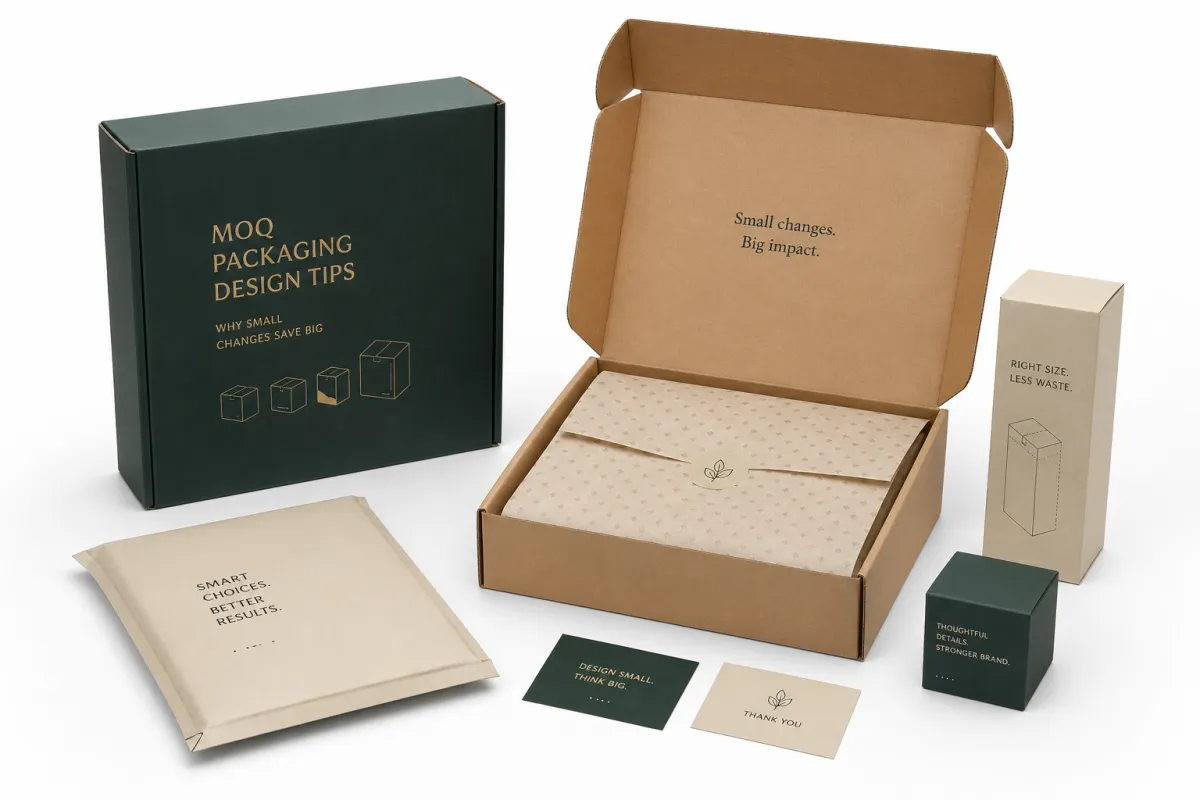
moq Packaging Design Tips start with a hard fact: minimum order quantities magnify bad decisions, and they magnify smart ones just as quickly. A run of 500 or 1,000 pieces leaves little room for waste to hide inside scale. A carton that is 4 mm too wide, a 24 pt board used where 18 pt would hold, or a full-black flood that covers every panel can push the quote upward in ways that look tiny on a spreadsheet and irritating on an invoice. On a 1,000-piece order, that extra 24 pt stock alone can add $0.08 to $0.14 per unit depending on the supplier in Shenzhen or Ningbo.
I have watched that play out in a buyer meeting where the team was split between a foil stamp and a cleaner two-color system. We removed the foil, tightened the logo knockout, and the quoted price fell by $0.11 per unit on a 3,000-piece order from a plant in Guangzhou. The carton still felt premium because the typography carried the weight. The budget did not have to pay for shine that a shelf buyer in Chicago would barely register in a 3-second glance.
moq packaging design tips also keep teams from making the oldest mistake in short runs: treating packaging as branding alone. Packaging design is production design first. If the dieline is awkward, the board is inconsistent, or the closure needs extra handwork, the quote rises before the artwork even matters. I have seen buyers spend two weeks refining a render, then lose two more days because the insert depth was 2 mm too shallow for the product neck on a sample built in Dongguan. It is the sort of thing that makes a person stare at a proof and mutter a few words the printer does not print in the report.
Feasibility deserves more attention than mood-board aesthetics. A package can look elegant and still be a poor manufacturing choice. Strong moq packaging design tips reduce waste, protect lead time, and make supplier minimums easier to reach without piling up unused inventory. In practice, that means fewer components, tighter dimensions, and a structure that nests well on a press sheet instead of fighting it. A 350gsm C1S artboard carton that locks cleanly often costs less than a Custom Rigid Box that needs hand assembly in two steps.
I think most people overrate expensive decoration at MOQ and underrate the value of a clean structure. A 350gsm C1S folding carton with a disciplined ink layout often looks sharper than a complicated box with three finishes and a confused interior. The best moq packaging design tips are the least glamorous ones: tighter specs, fewer revisions, less material waste. Those three moves make quotes easier to approve and production easier to run. They also keep everyone from pretending a box can be “fixed later” when the press schedule in Dongguan is already booked for the week.
“The cheapest box is the one that does not waste board, time, or hands.” A procurement manager said that to me after we reworked a cosmetic carton from a five-panel design to a standard folding carton, and the line item dropped by almost 14% on a 4,000-piece production run.
Set the expectation here: this is not abstract branding advice. It is a practical look at what changes quotes, lead times, and manufacturing risk. If you want to compare the packaging formats that usually drive those decisions, our Custom Packaging Products page shows the options buyers usually evaluate first, including folding cartons, mailers, sleeves, and rigid boxes.
What are the best moq packaging design tips for small runs?
The best moq packaging design tips for small runs are simple: standardize the structure, limit the finish count, and make the spec sheet exact before you ask for a quote. A low minimum order quantity leaves almost no room for hidden costs, so the smartest move is usually to remove complexity where the customer will not notice it. That might mean a standard tuck-end carton instead of a custom lock style, a matte varnish instead of foil plus embossing, or a printed sleeve over an existing bottle instead of a fully custom rigid box. In short runs, the quote rewards discipline more than decoration.
That answer sounds plain, but the numbers are not. A small order can carry setup costs that feel outsized because there are fewer units to absorb them. The same is true for printing: a one-color change can seem minor until it turns into another plate, another proof, and another round of color checks. The practical moq packaging design tips are the ones that reduce those add-ons while preserving brand impact. Clean typography, a controlled palette, and a structure that fits the product usually do more for perception than a stack of finishes ever will.
In my experience, buyers sometimes try to make a small run look like a flagship launch. That is usually the wrong battle. A clean one- or two-color carton can look expensive if the type is well spaced, the paper stock is chosen carefully, and the fold lines land cleanly. A messy package with five embellishments just looks like the team was kinda in a hurry. The budget notices, too.
Product Details That Shape MOQ Packaging Design
moq packaging design tips begin with the format itself, because every package behaves differently at low quantity. Folding cartons often give buyers the cleanest starting point when the product is light and the dimensions are stable. Rigid boxes deliver a stronger unboxing moment, yet they add chipboard, wrap paper, and more labor. Mailers suit e-commerce, sleeves work well when the primary container already exists, and corrugated shippers handle heavier items with less risk in transit, especially on routes from Ningbo to Los Angeles or from Xiamen to Toronto.
The material choice changes more than appearance. Paperboard prints cleanly and folds flat, which helps with storage and freight. Corrugated adds structure and crush resistance, especially when the box has to survive route handling or subscription shipping. Rigid chipboard creates a premium feel for branded packaging, but the extra wrap steps and corner finishing add labor. Kraft stocks support a natural look and often fit sustainability messaging, while specialty papers can elevate a package but may require careful ink testing and tighter color control. A 300gsm kraft sleeve behaves very differently from a 1.5 mm chipboard rigid box wrapped in 157gsm art paper.
One client asked me why a plain matte carton came in nearly $0.20 per unit lower than a soft-touch version on a 1,500-piece order from a supplier in Shenzhen. The answer was not just the coating. The soft-touch finish required a longer drying window, a different handling sequence, and more rejects during sampling. Those are the kinds of details moq packaging design tips should surface before a PO gets signed, not after someone is already telling finance the “small change” was not small at all.
Finishes are where many buyers overspend. Foil can work beautifully on a logo, embossing can add depth, spot UV can separate the mark from the background, and window patching can help sell the product inside. At MOQ, each extra effect adds setup time and risk. A simple one- or two-color design with careful contrast often protects budget while still supporting package branding and shelf appeal. On a 2,500-piece run, dropping one foil pass can save roughly $0.06 to $0.18 per unit depending on the factory in Guangzhou or Ho Chi Minh City.
Brand assets matter too. A logo with six thin strokes, a gradient that has to hold across different substrates, or a dense illustration with tiny reverses can complicate retail packaging far more than a bold symbol and a disciplined type system. In short runs, clean shapes print more reliably. A crisp logo, a controlled palette, and one strong focal point often produce better Custom Printed Boxes than an overworked layout that looks polished on screen and muddy on press. If your brand guide is built around Pantone 186 C or a metallic gradient, expect more proofing time and more color conversation.
Match the package to the channel. Shelf display asks for visual punch and quick legibility at arm's length. E-commerce asks for drop protection and efficient pack-out. Subscription packaging needs a strong opening sequence without too many loose parts. The best moq packaging design tips always connect the physical structure to the way the box will travel, open, and survive in the customer’s hands, whether that journey starts in Dongguan, passes through a consolidation warehouse in Shenzhen, and ends at a fulfillment center in Texas.
On a recent floor walk in a plant near Guangzhou, I saw a sleeve-and-tray concept that looked elegant in renderings but turned into a slow hand-assembly line. We replaced it with a single-piece mailer and a printed insert, and the change cut labor by 18% while preserving the same visual story. That is the hidden value of moq packaging design tips: they align product packaging with how the factory actually works, not how a mood board hopes it works.
Specifications That Protect MOQ Packaging Budgets
moq packaging design tips get serious when the specification sheet appears. Exact dimensions, tolerances, bleed, safe zones, closure style, and insert measurements are not housekeeping details; they are quote drivers. A 1 mm change in width can alter nesting, and a 2 mm change in depth can affect the lock tab, glue flap, or tray fit. If the supplier is guessing, the quote already contains padding. On a carton measured at 120 x 80 x 40 mm, even a 2 mm shift can affect how many pieces fit on a 1,100 x 780 mm press sheet.
Dielines matter more at MOQ because there is less room for correction. A clean dieline cuts prepress revisions and lowers the odds of a fit issue after sampling. When the structural file is clear, the supplier can tell whether the product needs a straight tuck, reverse tuck, auto-lock bottom, shoulder-neck rigid structure, or a simple sleeve. I have watched a 4-day delay disappear because the client supplied a verified dieline instead of a rough sketch from a marketing deck. It is amazing how much time disappears once people stop describing geometry in vibes.
File prep is where many budget problems begin. Vector logos keep edges clean. Linked images should be high resolution, ideally 300 dpi at final size. Color mode should be CMYK unless the supplier asks for something else. Proof notes need to call out varnish areas, spot UV shapes, barcodes, and text that must stay inside the safe zone. These are practical moq packaging design tips, not theory dressed up as advice. A barcode that is 2 mm too close to the fold can turn into a reprint in both Dongguan and Guadalajara.
Production realities matter just as much. Board thickness changes fold accuracy. Glue flap space affects machine speed. Sealing method changes labor. Pallet configuration matters too, because a compact shipper can save freight and damage claims. If the supplier knows your target freight lane, whether that is domestic LTL in the United States or export carton packing bound for Rotterdam, the quote becomes more realistic. That is the difference between a usable estimate and a number that falls apart later.
For regulated or fragile products, ask early about test standards and documentation. If the pack needs transport verification, the supplier may reference ISTA procedures, often with drop and vibration tests that run 24 to 72 hours depending on the protocol. If the paper should be chain-of-custody certified, FSC status matters. For recycled content and disposal guidance, the EPA’s recycling resources are useful background, especially for buyers balancing retail packaging with sustainability claims in California, the EU, or Japan. Those references do not replace engineering, but they keep the conversation anchored in real criteria.
moq packaging design tips should also cover compliance items that often get buried in the draft. Food contact copy, barcode placement, country-of-origin statements, warning icons, and lot code locations can all affect the usable layout. When I visited a supplier floor during a beverage project in Ningbo, a tiny barcode shift saved us from a reprint because the scanner zone finally cleared the fold line. That kind of fix is far cheaper before press than after it, and far less annoying than hearing, “We can probably make it work,” which usually means, “Please do not ask too many questions.”
“Give me the final dimensions, the final artwork, and the final closure style before you ask for a price.” That was the line from a veteran plant manager in Guangzhou, and he was right. A quote without those three details is a placeholder, not a plan.
If you need a broader order history, use the company FAQ as a starting point, then match the package file to the exact build. The cleanest moq packaging design tips are still the ones that keep the spec sheet honest, especially when the order moves between a 500-piece pilot and a 5,000-piece commercial run.
MOQ Packaging Design Tips for Pricing and MOQ
moq packaging design tips make the most sense once a quote is broken into its real drivers. Material choice, print method, finishing, number of components, setup time, and freight all shape the final number. A buyer who understands that can compare quotes with a critical eye instead of staring at the total and hoping the supplier did the math correctly. I have seen too many people compare a full build against a half-built quote and call it “vendor strategy.” No. That is just missing line items, often worth $150 to $400 on a small run.
The MOQ effect on unit economics is simple. Fixed costs such as plate setup, die cutting, proofing, and sampling are spread across fewer units, so every design choice becomes visible. Remove one print pass or standardize the insert and the savings can be meaningful. On a 5,000-piece run, a $280 setup burden may feel manageable; on a 500-piece run, it can dominate the per-piece price. That is why moq packaging design tips focus on simplifying the build before chasing decoration.
| Packaging option | Typical MOQ-friendly use | Example low-run price | What drives the cost |
|---|---|---|---|
| Folding carton, 18pt SBS, 4-color print | Light product packaging, retail displays, sample launches | $0.18-$0.32 per unit at 5,000 pieces | Dies, ink coverage, finishing, and board thickness |
| Corrugated mailer, E-flute, 1-2 color print | E-commerce shipping, subscription packaging, protected transit | $0.55-$0.95 per unit at 1,000 pieces | Board grade, print area, and tuck style |
| Rigid box with wrap paper | Premium branded packaging, gifting, launch kits | $1.80-$4.50 per unit at 500 pieces | Chipboard, hand assembly, wrap material, and inserts |
| Printed sleeve over existing container | Fast package branding updates, seasonal refreshes | $0.09-$0.21 per unit at 3,000 pieces | Length, width, color count, and paper stock |
Those numbers are reference points, not promises. A 2-color sleeve in 300gsm art paper behaves very differently from a soft-touch rigid box with foil and a magnet closure. Even so, the table shows why moq packaging design tips usually begin with the question, “What can we simplify without losing the customer experience?”
When suppliers quote differently, compare the structure of the estimate, not just the final figure. Some vendors bundle tooling, proofing, and assembly. Others itemize every step. If one quote says $1,250 and another says $980, the lower line may exclude sampling, freight, or a second revision. I have seen that distortion more than once during supplier negotiations in Shenzhen and Ho Chi Minh City, and it can bend the decision badly if you do not ask what is included.
Here is the comparison I push buyers to use: standard size versus custom size, one-piece construction versus multi-part assembly, matte varnish versus specialty coating, and digital short run versus traditional print setup. These moq packaging design tips usually protect the visible part of the box while trimming the hidden cost. The package does not have to look bland. It does have to look efficient.
The best pricing checklist stays short. Ask for base price, sample cost, revision fees, packaging components, and freight assumptions. Ask whether insert tooling is included. Ask how much the quote changes if the order moves from 500 pieces to 1,000 or from 1,000 to 3,000. A supplier who can answer directly is usually a better partner than one who sends a single number and hopes no one reads the notes. In many factories around Dongguan, a sample fee lands at $35 to $120, while extra artwork revisions can add another $20 to $60 each.
moq packaging design tips also mean knowing when a premium finish earns its keep. If your product sells on a small shelf display and the box will be photographed often, spot UV on the logo may be a better investment than a metallic flood. If the box ships inside another carton, the finish can be less dramatic because the retail moment is shorter. Think in terms of the customer journey, not the finishing catalog.
“We stopped paying for the parts the buyer never touches.” That was a line from a cosmetics brand manager after we removed a hidden inner print and kept the outer panel strong. The box looked cleaner, and the margin improved by 6% on a 7,500-unit launch in California.
Used properly, moq packaging design tips make pricing faster to approve because the quote is easier to explain. If the budget needs a cleaner landing, start with the structure, then the finish, then the print count. That order usually saves the most money without making the product feel stripped down.
Process & Timeline for MOQ Packaging Projects
moq packaging design tips work best when the schedule is realistic. The usual workflow is discovery, specification review, dieline development, proofing, sampling, approval, production, and shipment. Skip two of those steps and the project does not move faster; it usually circles back with more corrections. I learned that lesson watching a launch slip because the first proof used the wrong insert cavity by 5 mm on a 1,200-piece skincare order. Nobody enjoys explaining that kind of miss to a marketing team that already booked the photoshoot in Singapore.
- Discovery: define the product, target quantity, and shipping destination.
- Specification review: confirm size, board, finish, and closure style.
- Dieline development: build the structural file and test fit.
- Proofing: check colors, text, barcode placement, and legal copy.
- Sampling: review a physical sample for fit, fold, and print behavior.
- Approval: sign off on the final version and lock the job.
- Production and shipment: manufacture, pack, and move the order to transit.
Where do delays happen? Missing artwork is the usual suspect. Unclear dimensions come next. Late approvals and sample revisions can add days or even weeks. On a project for a skincare client in Hong Kong, one missing ingredient panel held the job for four business days because the team had to reconcile regional compliance text for the EU and the UK. Strong moq packaging design tips always assume someone in the chain will need one more round of review.
Timeline expectations should be specific by format. A standard printed folding carton can sometimes move in 12-15 business days from proof approval if artwork is final and the stock is available. A rigid box with foil, embossing, and a two-piece insert may need 18-25 business days, sometimes longer if the sample requires a correction round. Custom inserts, especially die-cut paper or molded components, can add another 3-5 days before the final build starts. Those numbers vary by load, season, and freight lane, but they are more useful than “soon.”
Buffer time is not a luxury. It is the difference between a launch that ships and a launch that slips. I tell clients to leave room for proof correction, one round of sample adjustment, and transit to the final destination. If the order is time-sensitive, build in an extra 20% on the calendar. That recommendation comes from watching too many teams assume the printing window is the whole project. It is not. Corrections count too, and ocean freight from Shenzhen to Los Angeles can add 14 to 20 days all by itself.
Communication cadence matters more than most buyers expect. Weekly check-ins, milestone approvals, and a single decision-maker reduce bottlenecks. If three people are editing the same artwork file, version control gets messy fast. The cleanest moq packaging design tips are often project-management tips wearing a design hat. Pick one owner, freeze one file, and keep the approvals moving.
“We can move quickly, but only if the buyer moves in the same direction.” A supplier told me that after a sample sat untouched for a week because two departments wanted different line copy. The project ended up taking 9 extra days.
When the team is aligned, moq packaging design tips make the entire process feel lighter. Less back-and-forth. Fewer surprises. Better control over what actually reaches production. That is what most buyers want, not speed for its own sake, but a schedule they can trust.
Why Choose Us for MOQ Packaging Design
moq packaging design tips only matter if the supplier can execute them, which is where Custom Logo Things earns attention. Buyers need more than print output. They need quoting support, file checks, and production guidance in one place. When I evaluate a packaging partner, I want to know whether they can tell me what is feasible before the order becomes expensive. Otherwise the relationship is just a nicer way to say “we’ll find out later,” and later is where budgets go to sulk.
At MOQ, the useful capabilities are the ones that reduce waste and confusion: low-waste nesting, reliable short-run printing, steady color management, and Finish Options That fit smaller volumes. In our experience, short-run buyers care less about buzzwords and more about whether the first sample actually reflects the final product. That is a fair expectation. A box that looks good only after three revisions is not a strong short-run solution, especially when the target is 500 units for a retail test in California or 2,000 units for a regional launch in Ontario.
Custom Logo Things is built around practical support for Custom Packaging Products, which means buyers can compare folding cartons, mailers, sleeves, and inserts without starting from zero each time. That matters when the goal is efficient branded packaging or fast-moving retail packaging. I have seen this approach cut the buying cycle by several days because the structural options are already clear and the specs are easier to approve. A standard 18pt carton with a tuck top is often quoted faster than a fully custom rigid build with magnets and a two-part tray.
The real value is in catching expensive mistakes early. A sizing issue, a structural weakness, or a print-risk detail is far cheaper to solve before production starts. In one supplier review in Guangzhou, a prepress check caught a logo too close to a score line, and the fix avoided a full reprint. That is exactly the kind of safeguard moq packaging design tips should support, and it is the kind of support a good packaging partner should provide.
Clear estimates matter too. Buyers move faster when they can compare one quote against another with the same assumptions for setup, materials, and freight. Faster answers mean fewer internal delays, and fewer delays mean better launch timing. That is especially useful when the order is small, the marketing deadline is fixed, and the team cannot afford a week of interpretation on every line item. If one supplier quotes EXW Dongguan and another quotes DDP Los Angeles, the comparison should be made on a like-for-like basis.
We also pay attention to the details around the sample. A sample is not just a yes-or-no object. It is a learning tool. If the board creases too sharply, if the closure feels loose, or if the print reads dark on one side of the panel, we treat that as useful production data. Buyers who want clear, honest feedback usually appreciate that more than a polished sales pitch. A sample that arrives in 5 business days and tells the truth is worth more than a prettier mock-up that hides the problem.
If you want a broader support path for recurring ordering questions, the FAQ covers the most common setup, sampling, and shipping issues. Paired with moq packaging design tips, that gives buyers a faster way to move from idea to quote without guessing what the supplier needs next.
Next Steps: Turn MOQ Packaging Design Tips Into a Quote
moq packaging design tips only pay off when they become a clear quote request. Start with the product size, target quantity, packaging style, finish preferences, and launch date. If you can tell a supplier whether you need 500 units for a pilot or 5,000 units for a broader roll-out, the estimate will be far more usable. Vague asks usually return vague prices, which is a polite way of saying everyone just wasted an afternoon. A quote built from a 60 x 60 x 150 mm bottle and a 120 x 80 x 170 mm carton is much more accurate than one built from “medium size.”
Build a simple quote packet. Include product photos, rough dimensions, brand assets, shipping destination, and any compliance requirements from the first message. If the item needs food contact language, barcode placement, or transit durability, say so early. A complete packet means the supplier can answer with a real production view instead of an educated guess. That is one of the most useful moq packaging design tips for buyers who want fewer revision loops and fewer sample rounds.
Use a decision framework that compares cost, durability, visual impact, and lead time together. The lowest price is not always the best choice if the package crushes in transit or looks inconsistent on shelf. A slightly higher quote can be the better commercial option if it saves a week of sampling or removes a late-stage revision. I have watched buyers save money by choosing a standard structure that shipped faster and needed no extra tooling. The irony is pretty simple: less drama, lower cost.
After the first estimate lands, review the sample, confirm the final dieline, approve artwork, and lock the production schedule. If the supplier includes one revision round, use it to confirm fold behavior, print density, and insert fit. If the sample feels off by even 1 or 2 mm, fix it before the run starts. The quietest production jobs are usually the ones that were most carefully prepared, and the best ones often move from proof approval to shipment in 12 to 15 business days for standard folding cartons.
The practical takeaway is straightforward: simplify the structure, freeze the dimensions early, and ask for a quote only after the product, artwork, and closure style are all locked. That one habit keeps moq packaging design tips from staying theoretical and turns them into a cleaner price, fewer revisions, and a package the factory can actually build without drama.
FAQ
What is the best packaging style for MOQ packaging design tips if I need a low minimum order?
Start with a standard folding carton or mailer if the goal is to keep the order efficient at a low quantity. Those formats usually need less tooling than a fully custom rigid build, and they are easier to sample in 1 or 2 rounds. If the product already has a primary container, a sleeve can also work well because it adds branding without rebuilding the whole package. For a 500-piece launch in Dongguan or Ningbo, a sleeve over an existing bottle is usually faster and cheaper than a new rigid box.
How can I lower costs with moq packaging design tips without making the box look cheap?
Simplify the structure first, then protect the visible brand elements. A strong logo, disciplined typography, and a clean matte surface often look more polished than a box loaded with multiple effects. Ask the supplier which details drive setup costs the most, because removing one print pass or one custom insert can save more than changing the finish. On a 3,000-piece run, swapping soft-touch coating for water-based matte varnish can save roughly $0.05 to $0.12 per unit.
What files do you need for accurate MOQ packaging pricing?
Send the final product dimensions, artwork files, and any dieline references so the quote reflects the real build. Include the number of colors, finish requirements, insert details, and your shipping destination. If the launch timing is fixed, share that too, because freight and lead time can change the total price and the schedule. A PDF proof, editable AI or EPS artwork, and a simple dimension sketch usually reduce back-and-forth by at least one revision cycle.
How long does a custom MOQ packaging project usually take?
Simple printed packaging can move quickly if the artwork is ready and the structure is standard. Projects with custom inserts, specialty finishes, or multiple sample revisions take longer because each change adds review time. A realistic schedule should include proof approval, sample review, production, and transit, not just the printing window. For a standard folding carton, 12-15 business days from proof approval is common; for a rigid box with foil and insert work, 18-25 business days is more realistic.
What costs are usually included in MOQ packaging quotes?
Most quotes should account for setup, materials, printing, finishing, assembly, and shipment assumptions. Ask whether sampling, revisions, tooling, and packaging inserts are included so you can compare suppliers fairly. If a quote looks unusually low, confirm whether freight, proofing, or special finishes are excluded before you decide. A $980 quote that leaves out a $120 sample fee and $85 freight charge is not cheaper than a $1,150 quote that includes both.
