Buyer Fit Snapshot
| Best fit | Offset Printing for Retail Boxes projects where brand print, material claims, artwork control, MOQ, and repeat-order consistency need to be specified before quoting. |
|---|---|
| Quote inputs | Share finished size, material target, print colors, finish, packing count, annual reorder estimate, ship-to region, and any compliance wording. |
| Proofing check | Approve dieline scale, logo placement, barcode or warning zones, color tolerance, closure strength, and carton packing before bulk production. |
| Main risk | Vague material claims, crowded artwork, missing packing details, or unclear freight terms can make a low unit price expensive after revisions. |
Fast answer: Offset Printing for Retail Boxes: Board, Finish, Dieline, and Unit Cost should be specified like a repeatable production item. The safest quote records material, print method, finish, artwork proof, packing count, and reorder notes in one written spec.
Production checks before approval
Compare the actual filled-product size with the drawing, then confirm tolerance on folds, seals, hang holes, label areas, and retail display edges. Reserve space for logos, QR codes, warning copy, and material claims before decorative graphics fill the panel.
Quote comparison points
Review material grade, print process, finish, sampling route, tooling charges, carton quantity, and freight assumptions side by side. A quote is only useful when the supplier can repeat the same color, closure quality, and packing count on the next order.
Offset Printing for Retail Boxes: A Practical Guide
The odd thing about offset printing for retail boxes is that the pricing can look a little scary right up front, then start making sense once the quantity climbs. Setup costs get spread across more cartons, color stays steadier from the first sheet to the last, and the box starts doing more than just protecting the product. It can influence a buying decision before anyone even touches the item.
I have seen that shift happen on real jobs, not in theory. A carton that looked merely decent at proof stage suddenly became the strongest thing on the shelf because the black stayed deep, the type held its edges, and the finish did not wander. That is the kind of detail people notice in a store, even if they do not say it out loud. A shopper usually gives packaging only a few seconds, so the box has to speak fast and clearly.
A retail box is not just packaging. It is a folded sales surface with cut lines, glue flaps, and tight production limits. If the type softens, the blacks drift, or the image loses detail, the package can make a strong product feel ordinary. Offset printing for retail boxes usually handles that problem with more control than many brands expect, especially when the goal is crisp branding, color discipline, and a premium shelf read.
Digital printing has a real place in the mix. Short runs, test markets, seasonal launches, and variable data often belong there. Flexographic printing has its own strengths too, especially on corrugated structures and some very high-volume work. For folding cartons, though, offset printing for retail boxes keeps showing up as the practical middle ground once order size rises, color standards tighten, and finishes need to look deliberate rather than improvised.
The question is not whether offset works. It does. The better question is whether the setup cost makes sense for the quantity, artwork, board, and launch schedule in front of you. Another question sits beside it: how do you avoid paying for complexity that never improves the box on shelf? That is where production details, pricing thresholds, and finish decisions start to matter.
Offset Printing for Retail Boxes: Why It Still Wins on Shelf
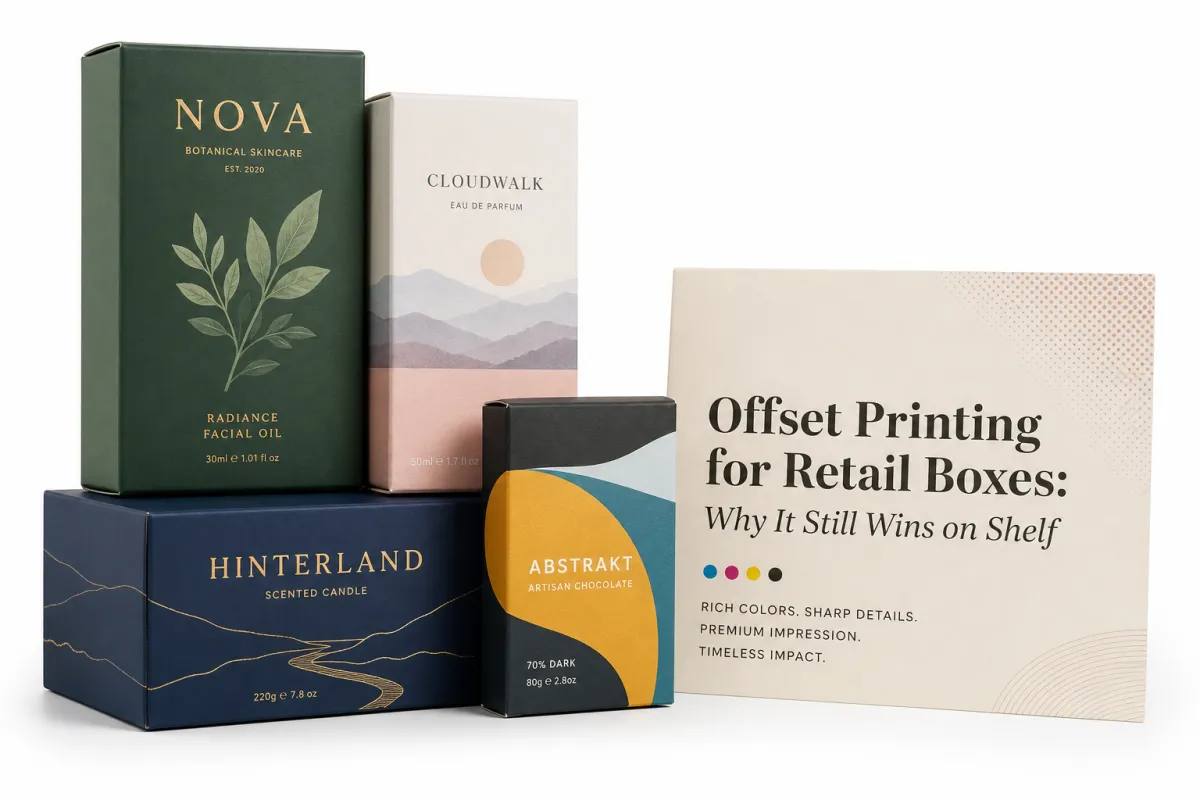
Shelf time is short. A shopper may give a package only a few seconds before moving on. That means the box has to communicate quality almost instantly. Offset printing for retail boxes helps because it produces sharp type, smooth gradients, and steady image reproduction over long runs. Consistency matters more than many buyers admit, especially when a line includes multiple SKUs and every carton needs to look like part of the same family.
The box also performs a quiet pricing role. A clean magenta, a deep black, and an image with no visible banding can make a product feel more trustworthy and more expensive. The opposite happens quickly. Muddy midtones or weak registration can make a strong formula look ordinary. In practice, offset printing for retail boxes is often chosen not because it is flashy, but because it protects the brand story at the exact moment a buyer decides whether to pick the item up.
Repeatability keeps offset relevant. Once the plates are made and the press is tuned, a long carton run can hold tight color behavior. That is valuable for a brand with strict Pantone expectations or a signature shade that must remain believable across product launches. Digital printing can be excellent, yet offset printing for retail boxes usually gives larger runs a steadier visual baseline, especially when the artwork includes fine text, photography, or broad flood coats.
Day to day, the comparison is usually straightforward. Digital printing is flexible and fast for smaller quantities. Offset printing is stronger when the order needs better cost absorption, tighter color control, and more refined finishing. Flexographic printing can be efficient on specific structures, but it does not always suit crisp retail branding. For folding cartons, offset printing for retail boxes remains a common choice because it sits between commercial print precision and packaging practicality.
That said, offset is not the automatic answer for every job. Small batches can become costly because plates and press setup must be paid for before the first sale. As volume rises, the curve changes quickly. At a certain point, offset printing for retail boxes can push unit cost below digital while still delivering the shelf presence that helps a product look premium instead of merely adequate. If the run is 500 units, the setup can feel heavy; if it is 10,000 units, the math starts acting a lot friendlier.
"A box that prints beautifully but misses the fold is still a bad box. Shelf presence starts with registration, not glamour."
What Makes Offset Printing for Retail Boxes Worth the Setup Cost?
Most buyers reach the same crossing point: the job is too polished to feel like a throwaway, but too large to keep paying short-run pricing. That is where offset printing for retail boxes often earns its place. The setup cost is real, yet it buys steadier color, stronger image detail, and better economics as the run grows. In plain terms, the first invoice can look high while the total project cost looks smarter.
There is also a second layer to the decision. Retail boxes do not just hold products; they hold attention. A carton that carries a consistent brand color across 10,000 units behaves differently from one that drifts from batch to batch. Add fine typography, photography, or a high-contrast logo, and the case for offset printing for retail boxes becomes less about print method and more about protecting the brand's visual credibility.
Think of the break-even point in numbers rather than in vibes. If plates and make-ready add $750 to a job, that overhead is $1.50 per box at 500 units, $0.15 at 5,000 units, and $0.075 at 10,000 units before paper, finishing, and freight are even counted. That is why offset printing for retail boxes often becomes more attractive as the order grows. The same setup can feel expensive on a tiny run and surprisingly efficient on a larger one.
For brands building a broader packaging system, the rest of the operation matters too. A carton is only one piece of the larger manufacturing picture, and the same artwork decisions need to work across trays, mailers, inserts, and shipping formats. Many buyers review Manufacturing Capabilities before locking the print method, then compare the box design against the rest of their Custom Packaging Products so the visual system does not drift from one format to the next. Offset printing for retail boxes is strongest when it sits inside a coherent package strategy, not as a one-off decision.
How Offset Printing for Retail Boxes Works
Offset printing relies on a transfer chain. Ink moves from plate to rubber blanket, then from blanket to the sheet or board. That extra step looks minor on paper, but it is part of the reason offset can produce such clean detail on paperboard. The blanket helps even out image transfer and gives offset printing for retail boxes the sharp, repeatable results designers tend to want when the artwork includes small type, thin rules, or detailed photography.
On folding cartons, the process is usually sheetfed offset rather than web offset. That matters because sheetfed presses handle thicker board more comfortably and give converters more control over registration and finishing. The production sequence usually begins with artwork preparation. The dieline gets checked, bleed gets confirmed, fonts are outlined or embedded, and images are set at the right resolution, usually 300 dpi or better for carton work. Plate creation comes next. Most packaging programs require separate plates for each color in CMYK, and any spot color that is not built from process ink needs its own plate as well. When a brand depends on a signature color, a spot color often protects consistency better than a screen-based approximation. That is one reason offset printing for retail boxes can be the safer choice for identity-driven packaging.
Press setup and color calibration follow. Operators dial in ink density, balance water and ink on press, and test how the board accepts impression. Coated SBS, C1S, C2S, kraft, and recycled board all behave differently. Bright white SBS reflects color differently than natural kraft, and that changes how the artwork has to be tuned. The difference may only be a few points of ink density, yet on shelf it can separate a polished carton from one that feels slightly off. Offset printing for retail boxes is reliable, but it is not magic; the substrate still shapes the result.
Once the sheets are printed, they need drying or curing depending on the ink system, then they move into print finishing and converting. That can include die cutting, folding, gluing, coating, foil stamping, embossing, debossing, spot UV, or lamination. The box only becomes a box once those steps are done. In that sense, offset printing for retail boxes is part of a longer manufacturing chain, not a single press event.
One useful comparison: offset tends to excel when the brand wants smooth gradients, photo reproduction, and predictable bulk output. Digital printing has advantages in speed and personalization. Flexographic printing can be efficient for some packaging formats and simpler graphics. For detailed folding cartons that need a polished look, offset printing for retail boxes still stands out because image fidelity and surface consistency are hard to beat at scale.
Key Factors That Shape Offset Printing Quality
The biggest mistake in packaging is assuming the press is the only thing that matters. It is not. Quality in offset printing for retail boxes starts long before ink hits the sheet, and it continues after the press stops. If the files are off, the proofing is rushed, or the finishing tolerance is sloppy, even a strong press cannot rescue the job.
Artwork quality is the first filter. High-resolution images help, but practical file setup matters just as much: correct bleed, clean dielines, proper overprint settings, and safe zones that keep text away from folds and cuts. A carton panel can look generous on screen and still become cramped once the structure is imposed. Smaller boxes feel this hardest. A 2 mm shift can make a logo look centered on a monitor and visibly off on the finished carton. That is why offset printing for retail boxes rewards disciplined prepress work.
Color management comes next. CMYK is the workhorse, but it does not always reproduce a brand color exactly. A spot color can be a better answer for a logo, a signature stripe, or a premium label panel. Strong packaging teams check proofs under controlled light, not only on a backlit screen. Screen brightness, paper tint, coating choice, and ink density all influence perception. That gap between monitor and board is where many print misunderstandings begin. offset printing for retail boxes does not erase that gap; it gives you more control over it.
Finishing can help or hurt. Matte coating can calm an image and make it feel more upscale. Gloss coating can lift saturation and make color pop. Soft-touch lamination changes the tactile read right away, while foil, embossing, or spot UV can turn a plain carton into a stronger retail signal. Every finish adds cost, time, or both. A carton with three special effects may look powerful in a mockup and become expensive on press. With offset printing for retail boxes, the right finish should support the product story, not just decorate it.
Structure matters as much as appearance. Seam placement, panel size, and fold lines all affect how safely the artwork can be laid out. Large solid color areas may crack on folds if the board choice and score quality are not planned well. Heavy black coverage near a crease can show scuffing faster than a lighter design. Quality in offset printing for retail boxes is therefore a mix of design judgment, press discipline, and converting tolerance.
For recycled or certified boards, documentation matters too. If the brand wants a verifiable paper sourcing claim, ask for the correct certification trail rather than assuming the board is automatically compliant. The FSC system is one of the clearest references for responsible forest management and chain-of-custody records, which becomes useful when sustainability statements appear on the pack or in sales materials. That does not change how offset printing for retail boxes looks on press, but it can shape the substrate decision before the job begins.
There is also a simple reality that gets missed: the most beautiful carton proof in the world can still fail if the fold memory is wrong or the score is too sharp. I once watched a run where the front panel looked perfect, but the gloss coating made a tiny scuff line visible after the first case pack. Nobody saw it on the PDF. Everybody saw it on the pallet. That is why press checks and finishing checks are not ceremonial; they are part of the process.
- Check the dieline first: one bad panel measurement can waste a full run.
- Match the finish to the board: soft-touch on one board may feel elegant, while the same finish on another can feel muted or too heavy.
- Approve under the right light: daylight-standard viewing helps catch tone shifts that screen previews hide.
- Ask for a press proof when color is critical: that extra step can prevent expensive surprises.
Offset Printing for Retail Boxes: Cost, Pricing, and Value
Cost is where the conversation gets real. With offset printing for retail boxes, the quote is usually shaped by quantity, number of colors, plate count, substrate, coating, finishing, and freight. A simple carton printed in four-color CMYK on standard SBS board is one thing. The same box with a Pantone spot color, matte lamination, foil stamping, and a custom insert is a different project entirely. The price can move more than newer buyers expect.
There is also a curve that matters more than the base quote: the unit cost falls as quantity rises. That is the core reason offset stays competitive. Setup is expensive relative to the first few hundred boxes, but once the run reaches a few thousand pieces, the per-box cost often becomes much more attractive. For many brands, offset printing for retail boxes starts to look sensible somewhere in the mid-range volumes, especially when the packaging supports a premium retail launch and shelf value matters as much as direct manufacturing cost.
Think about it in practical terms. If a box costs a little more in offset but raises the perceived value of the product even slightly, the total return can still beat a cheaper package that fails to stand out. Retail packaging is not judged only in the print quote. It is judged next to competing products, next to wholesale margin, and next to the selling price. That is why offset printing for retail boxes should be evaluated on value, not just unit cost.
| Printing Method | Best Fit | Setup Profile | Typical Unit Economics |
|---|---|---|---|
| Offset printing | Mid to large runs of folding cartons with sharp graphics, CMYK images, and brand-critical color | Higher upfront setup because plates and press preparation are required | Often around $0.18-$0.55 per unit at 5,000-10,000 pieces, depending on coverage, board, waste, and finishing |
| Digital printing | Short runs, fast turnarounds, prototypes, seasonal test SKUs, variable data | Low setup, quick file-to-print process | Often around $0.45-$1.20 per unit at 250-2,000 pieces, depending on artwork and board |
| Flexographic printing | High-volume packaging, especially some corrugated and simpler graphics | Moderate setup with plate costs; best when the design stays stable | Often around $0.12-$0.35 per unit at higher volumes, but less common for premium folding cartons |
The table is a guide, not a quote. A heavily covered carton with foil and embossing will cost more than a clean two-color pack, even when the quantity stays the same. Board thickness changes the math too. A 14pt stock is not priced the same way as a 24pt structure, and a box that needs extra rigidity for shipping may push the budget before decoration is added. In short, offset printing for retail boxes rewards careful specification more than last-minute embellishment.
Where do brands overspend? Usually in three places. First, they approve premium finishes on every SKU instead of reserving them for the lead product. Second, they choose a board that is heavier than needed, which raises material cost and can make folding harder. Third, they revise artwork multiple times after the quote is approved, which can trigger extra prepress work or schedule disruption. A good supplier will flag those issues early, because offset printing for retail boxes is more economical when the brief is tight and the decision path is clean.
A useful pricing habit is to ask for three quantities, not one. Request quotes at 2,500, 5,000, and 10,000 pieces. That shows the break-even point clearly and reveals how much the unit price changes as setup gets absorbed. It also makes it easier to decide whether a design should stay in offset or move to digital for the first launch phase. The best answer is not always the cheapest quote; it is the quote that fits the sales plan, the expected sell-through, and the reality of offset printing for retail boxes.
Step-by-Step Offset Printing Workflow and Timeline
The fastest way to lose money is to treat the print schedule as an afterthought. A solid offset printing for retail boxes project usually works backward from the launch date, not forward from the moment the quote is requested. That shift in planning sounds simple, but it changes everything: artwork deadlines, proof reviews, press time, finishing, packing, and freight all need buffer.
- Define the pack brief: box dimensions, product weight, quantity, finish targets, color standards, and retail deadline.
- Finalize the dieline: confirm panel sizes, glue flap positions, fold direction, and any insert or display needs.
- Approve artwork: resolve copy, images, legal text, barcodes, and brand colors before plates are made.
- Prepare proofs: check digital proofs for layout and, if needed, request a physical proof for color-critical work.
- Make plates and set the press: separate plates are created for CMYK and any spot color used in the design.
- Print the sheets: operators manage ink density, registration, and drying conditions to keep output consistent.
- Apply finishing and converting: coating, foil, die cutting, scoring, folding, and gluing happen after print.
- Inspect and ship: cartons are checked for registration, finish quality, and structural accuracy before delivery.
Typical timing depends on complexity, but a simple run can move from proof approval to finished cartons in roughly 12-15 business days when schedules are open and files are clean. More complex work takes longer. Foil stamping, embossing, or multi-step finishing adds time, and freight does too. If the boxes need to go through a co-packer or fulfillment center, add enough cushion for receiving and inspection. Offset printing for retail boxes does not reward last-minute rushes; it rewards a clean handoff.
Approval delays show up again and again. A color tweak that seems small on screen can trigger a fresh proof. A copy change can force a plate revision. A structural change can require the dieline to be rebuilt. None of those issues is unusual, but all of them can move a schedule. The buyer who protects the timeline treats approvals like a gate, not a casual email thread. That discipline matters more than people admit in offset printing for retail boxes.
Shipping tests deserve attention too. If the box will travel through parcel networks, a carton that looks beautiful on the bench may still fail in transit. Test references like ISTA protocols help check whether the packaging can survive vibration, drop, and compression stress before the launch window opens. That is not overkill. It is a low-cost way to avoid a painful replacement run after the first shipment is damaged. Good offset printing for retail boxes should be paired with a structure that can actually do the job.
Common Mistakes to Avoid in Retail Box Offset Printing
The most expensive packaging mistakes are often the quiet ones. They do not announce themselves during the quote stage. They show up later, when the carton is already in production. Offset printing for retail boxes can produce excellent output, but only if the team avoids a handful of predictable errors.
- Rushing file prep: blurry type, missing bleeds, and untested color builds can all create avoidable rework.
- Ignoring the structure: a gorgeous surface does not help if the box does not close cleanly or stack well.
- Choosing finishes too early: the coating should support the box design, not compete with it.
- Underestimating minimums: setup costs can make small runs less attractive than digital printing.
- Approving proofs too fast: one missed color shift can affect thousands of units.
File problems are especially common. A brand may send artwork that looks polished on a monitor but has no real bleed around the dieline, or type that sits too close to a fold. Those are not minor annoyances; they are production risks. The same is true for large ink floods that cross panels without enough consideration for scoring. In offset printing for retail boxes, the layout needs to respect how the board bends, not only how it looks flat.
Another common issue is treating the finish as a cure-all. A spot UV panel cannot fix weak hierarchy. Foil cannot rescue a cluttered front face. Soft-touch lamination cannot hide a box that is hard to assemble. Print finishing should sharpen the design, not distract from structural flaws. Buyers who spend too much on embellishment before they solve the box logic often end up with a package that feels expensive but performs poorly. That is a bad trade in any form of offset printing for retail boxes.
There is also a sneaky budgeting problem: comparing offset to digital without matching the actual run size. A 1,000-unit order and a 10,000-unit order are not the same conversation. Digital may be the better answer for the first, while offset printing for retail boxes may be far better for the second. The mistake is not choosing one method or the other. The mistake is assuming the first quote proves anything.
Inconsistent branding across a product family can also weaken the shelf story. If one SKU uses a saturated spot color, another uses a close-but-not-identical CMYK build, and a third uses a different gloss level, the line stops looking intentional. The boxes may each be printed well, but the collection feels fragmented. A strong packaging system uses consistent rules for color, typography, and finish, especially when offset printing for retail boxes is part of a larger launch sequence.
Finally, do not treat proof approval as a formality. A proof is not a box, but it is the last easy moment to catch mistakes. After plates are made and press time is booked, changes cost more. That is why seasoned buyers slow down at the proof stage even when the schedule feels tight. In practice, that pause protects the budget better than any last-minute rush ever will in offset printing for retail boxes.
Expert Tips and Next Steps for Your Next Box Run
If a brand wants better results without overspending, the answer usually starts with a better brief. A smart packaging checklist should include box dimensions, target quantity, substrate preference, color standards, finish goals, and launch date. Those six items solve more problems than a vague request for premium packaging. For offset printing for retail boxes, specificity is an economic tool.
Here is the practical sequence I would recommend.
- Lock the structure first: make sure the carton size and board strength fit the product and shipping method.
- Confirm color priorities: decide which elements must match exactly and which can be built in CMYK.
- Ask for a physical proof when needed: use it for photography, rich black backgrounds, metallic effects, or tactile finishes.
- Compare two print methods: check offset against digital or flexographic printing on the same quantity so the real break point is visible.
- Review the finish in context: a matte box may feel more premium for one brand, while gloss may suit another product better.
That is also a good moment to talk with the supplier about board options. A 350gsm C1S artboard may be enough for one carton, while a heavier or coated stock may be needed for another. If the box is carrying a premium claim, ask how the coating, board tint, and print method will interact. Offset printing for retail boxes often wins because it gives more room to tune those variables without making the pack feel generic.
The best suppliers do not just quote. They explain where the budget goes. They can show how a spot color affects the plate count, why a foil panel adds time, or how a change in board grade shifts the unit cost. That is the kind of conversation worth having before artwork is finalized. It usually saves more money than trying to trim a few cents later, especially on a program built around offset printing for retail boxes.
And if the project sits inside a broader packaging rollout, use the wider catalog as a reference point. The style, construction, and finish choices on one SKU should feel related to the rest of the line, not isolated from it. The Custom Packaging Products page is a useful way to compare formats, while Manufacturing Capabilities helps confirm whether the production team can support the exact combination of structure and print method the launch needs. A coordinated system usually performs better than a disconnected one, which is especially true for offset printing for retail boxes.
FAQ
Is offset printing for retail boxes better than digital printing?
Offset usually wins for larger runs, tighter color control, and more refined finishing options. Digital can be better for short runs, rapid turnaround, and projects that need variable data or frequent artwork changes. The better choice depends on quantity, design complexity, and how much shelf impact the product needs.
What quantity makes offset printing for retail boxes cost-effective?
The break-even point depends on the artwork, board, and finishing. In many programs, offset becomes more attractive as quantities rise because setup costs spread across more units. Ask for pricing at several run sizes so you can see where the unit cost drops sharply, then compare that against the launch plan and sell-through forecast.
How long does offset printing for retail boxes usually take?
Timing depends on proofing, plate creation, press availability, finishing, and shipping. A clean approval process shortens the schedule, while late artwork changes are often the biggest source of delay. If the packaging is tied to a product launch or seasonal retail window, build in buffer time from the start.
Can offset printing handle specialty finishes on retail boxes?
Yes. Offset pairs well with coatings, foil, embossing, debossing, spot UV, and lamination. Some finishes add strong visual impact, but they also add production time and cost, so they should be selected with the budget and deadline in mind. A proof is smart whenever color accuracy or tactile feel is critical.
What files do I need before requesting an offset box quote?
Have the dieline, final artwork, print dimensions, quantity estimate, substrate preference, and finish goals ready. Provide brand color references if matching is important, especially for logos or signature packaging colors. The more complete the brief, the faster a supplier can price the job accurately and reduce the chance of revisions.
Before you request quotes, pin down three things: the real run size, the colors that cannot drift, and whether the launch date can absorb plate-making and finishing time. That simple brief usually gets you a cleaner estimate and a better press plan than asking for a "premium carton" and hoping the rest sorts itself out. For most retail brands, that is the practical way to use offset printing for retail boxes.