Buyer Fit Snapshot
| Best fit | Opaque Mailers for Subscription Boxes projects where brand print, material claims, artwork control, MOQ, and repeat-order consistency need to be specified before quoting. |
|---|---|
| Quote inputs | Share finished size, material target, print colors, finish, packing count, annual reorder estimate, ship-to region, and any compliance wording. |
| Proofing check | Approve dieline scale, logo placement, barcode or warning zones, color tolerance, closure strength, and carton packing before bulk production. |
| Main risk | Vague material claims, crowded artwork, missing packing details, or unclear freight terms can make a low unit price expensive after revisions. |
Fast answer: Opaque Mailers for Subscription Boxes: Film, Print, MOQ, and Carton Packing should be specified like a repeatable production item. The safest quote records material, print method, finish, artwork proof, packing count, and reorder notes in one written spec.
Production checks before approval
Compare the actual filled-product size with the drawing, then confirm tolerance on folds, seals, hang holes, label areas, and retail display edges. Reserve space for logos, QR codes, warning copy, and material claims before decorative graphics fill the panel.
Quote comparison points
Review material grade, print process, finish, sampling route, tooling charges, carton quantity, and freight assumptions side by side. A quote is only useful when the supplier can repeat the same color, closure quality, and packing count on the next order.
Opaque Mailers for Subscription boxes sound boring until a customer opens the shipment and sees a clean outer shell instead of a bag that advertises the whole month's lineup to the hallway. That outer layer does real work. Opaque mailers for subscription boxes protect privacy, keep the presentation under control, and stop the shipping process from turning your product into a moving billboard for everyone in the building.
From a packaging buyer's angle, the outer mailer is not an afterthought. It sits inside the fulfillment system and has to earn its place. Recurring orders need something that packs quickly, stays consistent, and does not blow up postage or labor. That is where opaque mailers for subscription boxes pull their weight. They hide silhouettes, make casual tampering less tempting, and give you a predictable outer layer whether the contents are apparel, beauty products, accessories, or a stack of small add-ons.
I have watched teams spend hours perfecting the inner box and then shrug at the outer shipper like it barely matters. It does matter. A premium inner reveal wrapped in a flimsy, semi-transparent mailer feels off. Customers may not say, "the outer packaging looked cheap," but they feel it. The right mailer tightens the whole experience. Not fancy for the sake of it. Just controlled. And control usually reads as quality.
What Opaque Mailers for Subscription Boxes Actually Do
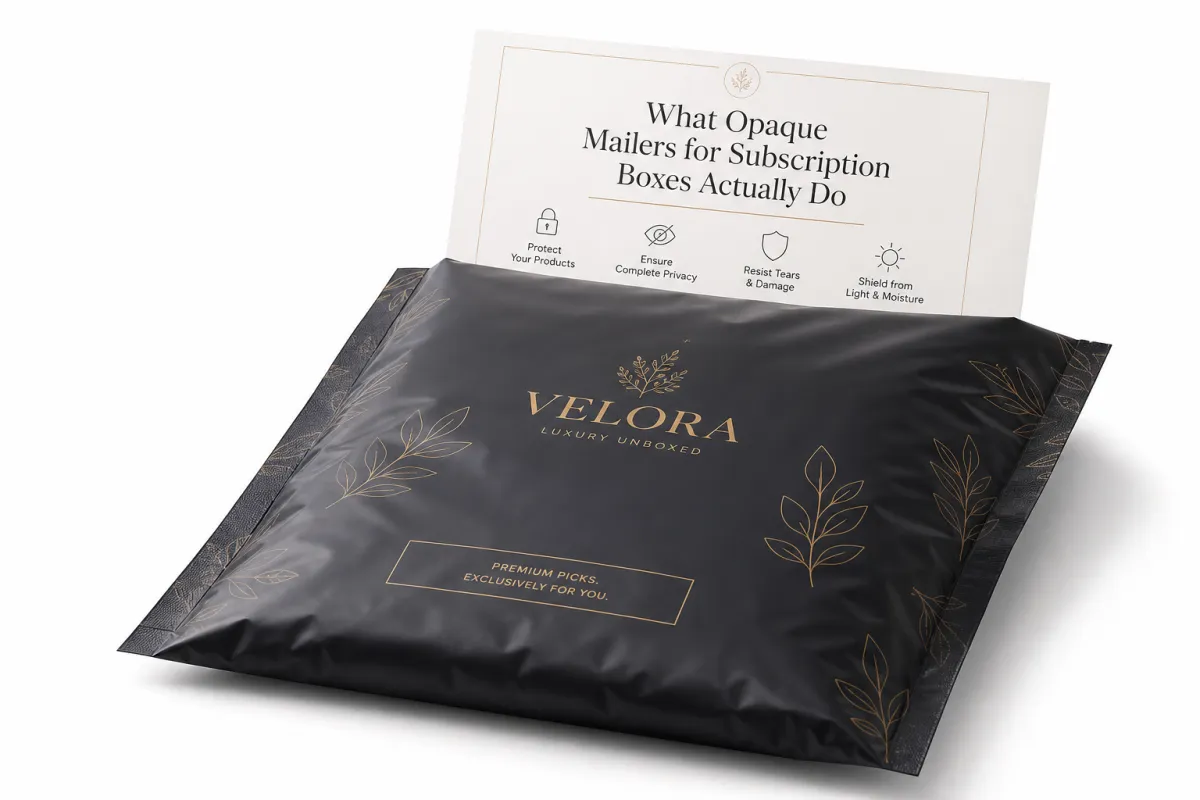
Opaque mailers for subscription boxes are light-blocking poly mailers built to keep contents from showing through the outer layer. That sounds basic because it is basic, but the effect matters. The mailer hides product shapes, lowers visibility in sorting hubs, and gives the shipment a cleaner first impression before anyone touches the inner box. Recurring shipping runs on repeatability, not one-off flair.
These mailers are usually made from LDPE or a similar flexible film, then colored or layered so the contents do not telegraph under normal light. A truly opaque film should not reveal the outline of a small carton, a bottle, or a folded garment under a bright warehouse lamp. Cheap dark film can be sneaky in the worst way: it looks private from a few feet away and then reveals everything once it is held up to the light. That is not privacy. That is costume work.
For subscriptions, the outer mailer needs to support a process that repeats every week or month without slowing the pack line. Opaque mailers for subscription boxes help because they are light, flexible, and fast to seal. You are not building the outer layer from scratch every time. You are loading, sealing, and moving on. Whether the program ships 300 orders a week or 30,000, that difference shows up in the labor bill. And yes, it shows up fast.
There are three common levels of concealment:
- Opaque - the film blocks visibility under normal handling and bright warehouse light.
- Semi-opaque - the material cuts visibility but may still show dark silhouettes or edges.
- Fully printed - the outer mailer carries a complete graphic layer, so the brand owns the surface instead of just hiding the contents.
The right choice depends on the job. Sometimes the answer is pure concealment. Sometimes the outer bag is the first brand touchpoint. Sometimes it has to do both, which is why opaque mailers for subscription boxes are not one-size-fits-all. A muted charcoal film can feel cleaner than a loud printed bag if the brand leans minimal. A full-coverage print can turn the mailer into part of the reveal if the subscription is built around surprise and energy. I have seen both work. I have also seen both fail when somebody picked the "nice looking" option without testing the actual pack.
Good packaging does not need to shout. It needs to survive the trip, fit the pack, and tell the customer that somebody paid attention to the details.
That is the real value. No drama. No packaging poetry. Just a better outer layer that keeps the subscription experience under control.
How Opaque Mailers for Subscription Boxes Work in Transit
Transit is where packaging gets judged. Opaque mailers for subscription boxes work by combining three things: a film that blocks visibility, a closure that holds under handling, and a flexible body that conforms to the shipment instead of wasting space around it. The result is a package that moves through a carrier network with fewer headaches. Less rigid bulk. Less wasted air. Fewer chances for the package to snag or split.
The film handles the visual side. The seal handles security. The shape of the mailer handles efficiency. A good peel-and-seal strip is usually faster than taping a carton shut, especially when the team handles the same SKUs all day. If the inner pack already sits in a box, the outer mailer acts like a protective sleeve instead of a second retail box. That matters because every extra layer adds handling time and sometimes postage weight.
Opaque mailers for subscription boxes also help with the messier parts of shipping. They reduce exposure to dust, light scuffing, and small moisture splashes from conveyor systems or porch conditions. They are not waterproof armor. Nobody serious should pretend they are. They do, though, make a smart outer skin for shipments that do not need rigid carton-level protection. They also make the package less interesting to tamper with because the contents are not obvious at a glance.
When a subscription includes a rigid inner box, the outer mailer should be sized with enough clearance for the sealed carton plus the flap or seam area. When the pack includes mixed add-ons, the filled height can change month to month. That is where brands get burned. A mailer that works for the standard kit may fight back when a promo insert or bottle gets added. With opaque mailers for subscription boxes, the bag body can absorb some of that variation, but only to a point. Overstuff it and the seal starts doing too much work.
The customer-side effect is easy to underestimate. Some outer mailers disappear into shipping and do little more than protect privacy. Others become part of the brand reveal because they use a strong color, a matte finish, or a printed panel that frames the experience before the inner box gets opened. Neither is automatically better. Consistency matters. If the outer bag looks cheap while the inside looks premium, people notice. They may not say it out loud, but they notice.
For carriers and fulfillment teams, the best outer mailer is usually the one that keeps the shipment compact without creating new failure points. That is why many teams test opaque mailers for subscription boxes with actual packed cartons, not just empty sample bags. A 14 x 19 inch film bag can look perfect on paper and still waste movement at the packing table if the seal lands badly or the inner pack drifts around inside.
There is no magic trick here. Just physics and process. If you want better protection, use thicker film. If you want faster packing, keep the format simple. If you want a more premium front-end feel, use print or color on purpose. The best programs balance those three without pretending they can get all of it for free.
Key Factors That Decide the Right Mailer
Choosing opaque mailers for subscription boxes starts with material thickness. Film is usually measured in mils or microns, and the numbers matter more than the sales sheet wants to admit. A lighter 1.5-2 mil bag may work for soft apparel or lower-risk contents. A 2.5-3 mil spec makes more sense when the box has edges, heavier inserts, or a higher chance of rough handling. If the contents are sharp, awkward, or dense, thicker film is usually the smarter move. Thin film does not become brave because the brochure was cheerful.
Opacity quality is the next issue. Dark color is not the same thing as true light blockage. A cheap black film can still show the outline of a square carton under warehouse lights. That defeats the privacy goal and makes the shipment look less polished. If the contents need to stay hidden, ask for a sample under bright light, not just on a desk. Opaque mailers for subscription boxes should pass the ugly test, not only the pretty one.
Size is where many teams burn money. Too small and the seams bulge, the seal strains, and the mailer looks stuffed. Too large and you pay for empty air, more film, and sometimes higher postage. For subscription boxes, the right size is based on the finished packed dimensions, not the bare carton. Leave room for the closure area, any inserts, and month-to-month variation. If the box changes thickness because of samples or seasonal extras, size for the worst realistic case.
Closure type matters too. Peel-and-seal is common because it is fast and predictable. Recloseable or tamper-evident features can make sense for some programs, but every added function should earn its place in labor savings or customer value. If the seal is weak, the whole point of opaque mailers for subscription boxes gets undercut. A bag that opens in transit is not saving money. It is creating a reship problem with a nicer label.
Branding is another tradeoff. Some companies want the outer mailer to be part of the brand voice. Others want it to disappear behind a plain, private exterior. Both are valid. The trick is knowing which problem you are actually solving. A fully printed mailer can raise perceived value, but it also raises setup cost and complicates art approval. A plain opaque bag can be cheaper and faster while still doing the job. If you want to compare options, it helps to browse Custom Packaging Products and see how the outer layer fits into the rest of the stack.
Sustainability deserves an honest answer instead of a vague green sticker. Recycled content, downgauged film, and lighter constructions can reduce material use, but only if the mailer still survives transit. Otherwise you save a few grams and spend more on replacements. If your brand makes eco claims, back them with actual material specs, supplier documentation, and, where it applies, standards such as FSC for fiber-based components or carrier-test protocols that reflect real shipping conditions. For broader packaging context, packaging industry resources like packaging.org are useful when you want more than marketing fluff.
Here is the short version: opaque mailers for subscription boxes should be chosen by contents, fit, handling speed, and brand role. Not by whatever looks cheapest on a quote sheet.
Opaque Mailers for Subscription Boxes: Cost and Pricing
Pricing depends on more variables than people like to admit. The main drivers for opaque mailers for subscription boxes are film thickness, bag size, print coverage, color count, closure style, and quantity. Stock inventory usually gives you the lowest unit price. Custom printing usually gives you the strongest brand control. You do not get both at full strength unless you buy enough volume to make the math stop complaining.
At a practical buying level, stock opaque mailers often land in the range of about $0.12-$0.28 per unit at 5,000 pieces, depending on size and film weight. Custom printed bags commonly sit closer to $0.22-$0.55 per unit, with heavier constructions or broader print coverage pushing higher. Smaller runs can cost much more. Larger runs can pull the unit price down, but only if you have storage space and a forecast you trust. That last part is usually where optimism gets expensive.
| Option | Typical Use | Approx. Unit Cost at 5,000 Pieces | Advantages | Tradeoffs |
|---|---|---|---|---|
| Stock opaque poly mailer | Light to medium subscription boxes, fast restocks | $0.12-$0.22 | Low MOQ, quick availability, simple buying | Limited branding, fewer size/color choices |
| Custom printed opaque mailer | Brand-led subscription programs with steady volume | $0.22-$0.55 | Stronger brand presence, better visual control | Setup cost, longer lead time, art approval required |
| Heavy-duty opaque mailer | Heavier kits, sharp corners, mixed inserts | $0.25-$0.60 | Better puncture resistance, fewer damages | More material cost, sometimes higher postage |
The hidden costs are where the real bill lives. Oversized mailers can increase postage. Thin film can cause tears, which leads to reships. Weak seals can trigger customer service complaints and replacements. A bad fit can slow the packing line by a few seconds per order, and that becomes a brutal tax when you ship at scale. Opaque mailers for subscription boxes should be priced against those failure points, not against the lowest visible quote.
Here is the simple buying logic I would use. If your subscription volume is still moving around, start with stock and prove the dimensions first. If the program is stable and the outer package is part of the retention story, move toward custom print. If your contents are bulkier than average or have edges that like to punch through cheap film, spend on material before you spend on graphics. If you are comparing format options, the right Custom Poly Mailers can fit better than forcing a carton-sized solution into a bag-shaped workflow.
One more practical note: do not let the price conversation ignore labor. A bag that packs in 8 seconds and seals cleanly can beat a cheaper option that needs 15 seconds and hand-fixing. That is why opaque mailers for subscription boxes often look a little more expensive on paper than they really are in the warehouse.
The best budget framing is simple: cheap mailers save pennies, but the real cost shows up in labor, damage rates, and how customers feel when the package lands. That is the part that keeps eating margin after the quote gets approved.
Process and Timeline for Ordering the Right Mailer
Ordering opaque mailers for subscription boxes should follow a simple sequence: define the pack, sample the options, test the fit, approve the art or stock spec, and then place the production order. The problem is not the sequence. The problem is skipping a step because the bag "looks close enough." That is how teams end up with a carton that fits in the sample room and fails on the real table.
Start with the finished packed dimensions of the actual subscription. Not the carton vendor's spec. Not the estimate. The real thing, filled the way it ships. Measure length, width, and height after inserts are in place. Then check whether the mailer needs extra room for the seal strip and a clean top edge. Opaque mailers for subscription boxes are more forgiving than rigid packaging, but they still need a sensible size window.
After that, request samples. Three to five sample options is usually enough to show the differences that matter: film thickness, opacity, seal strength, and handling feel. Put them on the packing table, not just in a conference room. Load a real box into each one. See how fast it seals. See whether it wrinkles awkwardly. See whether the film feels flimsy when the pack is lifted. If the bag looks good but slows hand packing, the problem is already paid for.
Typical timeline stages look like this:
- Sample review - often 2-7 days for stock options, longer for custom.
- Fit testing and revisions - 2-5 days, depending on how many pack variants you have.
- Art approval or spec confirmation - 1-3 days if your approvals move quickly.
- Production scheduling - about 10-20 business days for many custom jobs.
- Freight and receiving - plan another 3-7 days, sometimes more.
Those ranges are planning numbers, not promises. Stock can move faster. Custom can move slower. If you are ordering opaque mailers for subscription boxes around a seasonal campaign, build extra time for revisions and freight. The last thing you want is a packaging shortage because somebody assumed production would behave like a calendar reminder.
One of the better habits is to set a reorder trigger based on monthly burn rate plus lead time. If you use 8,000 mailers a month and the true lead time is 3 weeks, do not wait until you have 4,000 left. That is a panic order. Better to reorder when you still have enough inventory to absorb a delay, a quality issue, or a spike in subscriptions. Recurring fulfillment runs on buffer, not hope.
If your program uses other packaging components too, it helps to view the mailer as part of the full stack rather than a standalone purchase. A quick review of Custom Packaging Products can clarify whether the mailer, outer carton, insert, or label system needs to change together. That is usually cheaper than fixing each piece one by one after the fact.
Common Mistakes With Subscription Box Mailers
The first mistake is buying by price alone. Opaque mailers for subscription boxes that look cheap can turn expensive fast if they tear, split at the seam, or need a second protective outer shipper. A few cents saved upfront means nothing if the cost shows up in reships, complaints, or labor rework. This is packaging, not a coupon hunt.
Wrong sizing is probably the most common operational error. Too tight, and the bag bulges, wrinkles, or strains the seal. Too loose, and the shipment looks sloppy while you pay for extra film and sometimes extra postage. If your subscription changes month to month, test the fullest legitimate pack, not the average one. Average is how you miss the problem. Opaque mailers for subscription boxes should be sized to the worst realistic case inside your program, not the idealized one.
Branding mistakes are subtler. Overcomplicated artwork can make the outer bag look noisy or cheap. A finish that fights the rest of the packaging can make the subscription feel disconnected. A print that is too small to read under normal handling might as well not exist. If the mailer is supposed to support the brand, keep the visual system clean enough that it still looks good when it is folded, scuffed, and stacked in a warehouse.
Skipping transit tests is another classic error. A bag that holds a soft apparel kit may fail when the subscription includes a glass bottle, a metal tin, or a hard insert with sharp corners. Basic testing habits are not complicated. Drop the packed mailer from waist height. Squeeze the corners. Check the seal after compression. If the package ships through a parcel network, look at transit testing norms like ISTA methods to understand how rough handling gets simulated in a more controlled way. You do not need a lab for every decision, but you do need some respect for gravity.
Compliance and operations issues can create pain too. The closure should be reliable enough for the team to seal fast without babysitting each bag. Barcode visibility matters if the pack uses a shipping label on the outside. A slippery or oversized mailer can slow the line enough to waste labor. In a real fulfillment setting, opaque mailers for subscription boxes work when they match the speed of the team using them. If they fight the process, they are the wrong product.
Finally, do not ignore customer perception. A bag that arrives scuffed, thin, or oddly transparent can make a subscription feel less premium before the box is even opened. That problem is hard to fix with better inserts or a nicer thank-you card. The outer shipper sets expectations. If it feels careless, people assume the rest was careless too.
Expert Tips and Next Steps
Start by matching opaque mailers for subscription boxes to the heaviest, sharpest, or bulkiest subscription variant you ship. Not the average one. The average pack hides the failure mode. If your largest monthly kit fits properly, the lighter versions usually follow without drama. If you size to the lightest pack, you are basically inviting a support ticket.
Order three to five sample options and compare them under bright light, on the packing table, and after a simple squeeze-and-drop test. That sounds basic because it is basic. Teams still skip it and then act surprised when thin film shows the outline of the box. The sample process is also the right time to test whether the mailer matches the hand feel you want. A matte opaque bag feels different from a glossy one. The difference is not subtle when customers touch it.
A simple decision rule works well here:
- If branding is secondary and speed matters most, choose stock opaque mailers for subscription boxes.
- If customer perception drives retention, consider a custom printed version.
- If the content is sharp, dense, or fragile, prioritize film strength before print.
Document the final spec once you settle on it. Size, film thickness, seal style, print coverage, color, and reorder point should all live in one place. If the next buyer has to rediscover those choices from scratch, you will waste time and probably repeat the same mistakes. That is avoidable, and frankly, it is the kind of avoidable that gets expensive faster than people expect.
Use the same discipline for planning the reorder cycle. If lead time is 3 weeks and your monthly usage is 10,000 units, set the reorder trigger early enough to survive an unexpected lift or a delayed shipment. That kind of buffer is boring. It is also what keeps subscription programs from tripping over their own packaging. If you want a broader view of product options before locking the spec, the Custom Poly Mailers page is a useful place to compare formats and see what fits your workflow.
One last practical thought: if your customer journey is built around surprise, privacy, and consistency, opaque mailers for subscription boxes are doing more work than their price suggests. They are not the star. They are the reliable stagehand. And in packaging, the stagehand who shows up on time usually saves the show.
For subscription Brands That Ship every week, every month, or in seasonal waves, the smart move is to audit your current dimensions, confirm actual pack weights, sample the strongest contenders, and test them in real shipping conditions. That will tell you more than any product page will. Once you have that data, opaque mailers for subscription boxes stop being a guess and start being a controlled part of the operation.
My practical takeaway is simple: choose the smallest opaque mailer that still passes real-world packing, seal, and transit tests, then lock that spec before you scale volume. That order of operations saves money, cuts rework, and keeps the subscription experience looking intentional instead of kinda improvised.
Are opaque mailers for subscription boxes better than clear poly bags?
Usually yes, if privacy and presentation matter. Opaque mailers for subscription boxes hide the contents, look cleaner in transit, and reduce the chance that a customer or carrier sees product silhouettes. Clear poly bags can work for retail display or scan-heavy workflows, but for direct-to-consumer shipping they usually feel less polished.
What thickness should opaque mailers for subscription boxes be?
It depends on the contents. Light apparel subscriptions may be fine at 1.5-2 mil if the seal is strong and the pack is soft. Heavier kits, sharp corners, or dense add-ons usually benefit from 2.5-3 mil or more. The honest answer is to test opaque mailers for subscription boxes against the real packed order, because overstuffing changes the result fast.
How do I choose the right size for a subscription box mailer?
Measure the finished packed box, not the empty carton. Leave room for the seal area, any inserts, and seasonal extras that change the finished height. If you are between two sizes, sample both. The cheaper option is not cheaper if it slows packing or causes damage. That lesson has a habit of showing up in invoices.
Do custom opaque mailers cost much more than stock options?
Usually yes. Custom print adds setup, art approval, and minimum order pressure, so the unit price rises. For stable, higher-volume programs, the branding value can justify it. For smaller or shifting subscriptions, stock opaque mailers for subscription boxes are often the smarter place to start.
How long does it take to order opaque mailers for subscription boxes?
Stock mailers are faster because you are choosing from existing inventory. Custom jobs usually take longer because of sampling, approval, and production scheduling. In practical terms, stock can sometimes land in about 1-2 weeks, while custom often needs 3-5 weeks or more depending on the spec. Build in extra time for fit testing, especially if opaque mailers for subscription boxes are part of a recurring fulfillment cycle.