Custom Paper Bags for gift set packaging do more than move a bundle from point A to point B. They set the first expectation. Before a ribbon is touched or a lid is lifted, the bag tells the customer whether the set feels considered, rushed, premium, seasonal, or forgettable. That signal matters because gift programs are judged in seconds, not in spec sheets.
Used well, the bag can replace extra wrap, reduce packing steps, and keep a product set looking deliberate instead of improvised. Used badly, it becomes the weak link: too small, too soft, too glossy, too plain, or simply wrong for the load. The gap between those outcomes is often a few details that buyers treat as minor until the production run is already underway.
That is why the bag should be treated as part of the packaging system, not a decorative add-on. A gift set with tissue, inserts, cartons, and an outer carrier works best when all of those parts are measured together. If the pieces are not coordinated, the result is usually visible before the customer even gets the product home.
Custom Paper Bags for Gift Set Packaging: What They Do
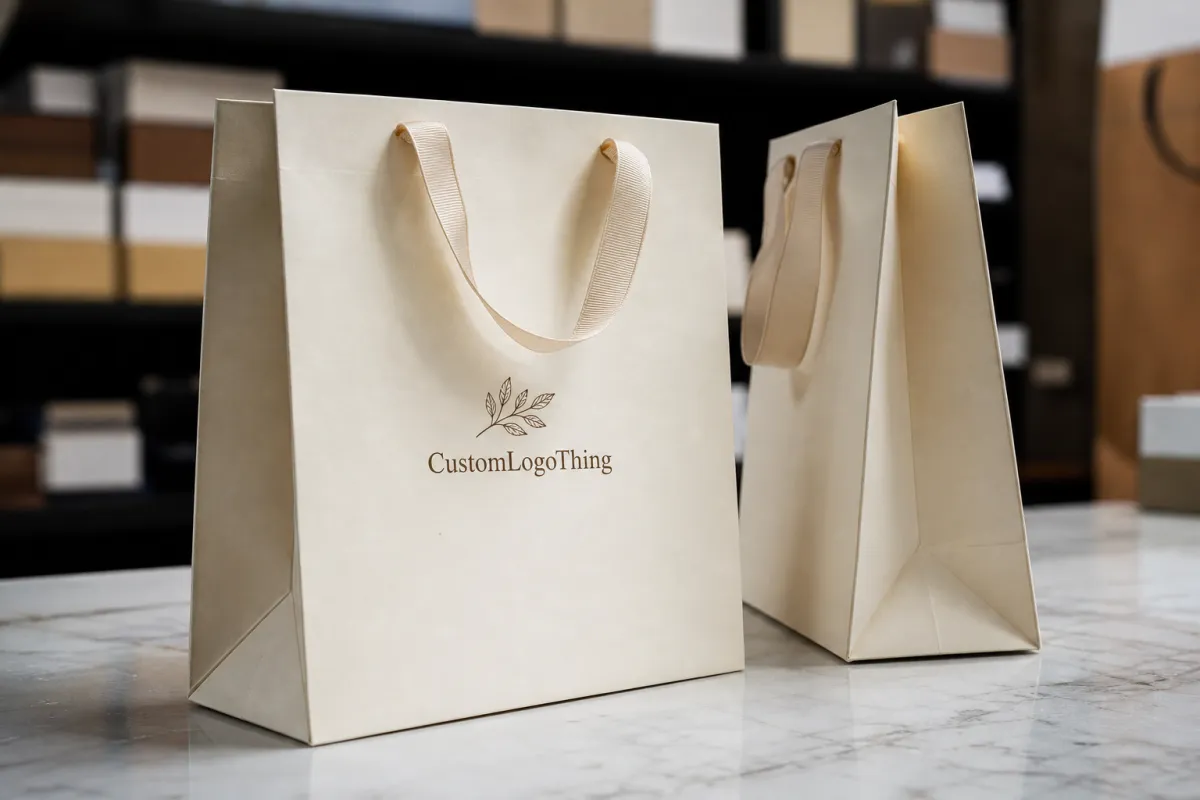
The cleanest definition is practical: Custom Paper Bags for gift set packaging are printed paper carriers designed to hold a bundled gift cleanly, support light protection, and present the contents with a stronger brand cue than a stock shopping sack. They are not shipping mailers. They are not generic retail bags. They sit somewhere between display and utility, which is why they need a better spec conversation than "paper bag, custom print".
Standard shopping bags are usually built for speed and volume. Mailers are built for transit. Gift set bags have a different job. They need to fit a known bundle, hold shape once packed, and remain visually straight after handling. That often means a square-bottom structure, a wider gusset, reinforced handles, or a heavier board than a buyer would choose for a basic boutique purchase.
The best way to think about them is as a shaped frame around the gift. A skincare trio needs a different cavity than a candle pair or a bottle-and-card combo. A corporate set with a notebook, mug, and note card may need extra headroom so the top edge does not buckle once the handles are lifted. The bag is sized to the final packed footprint, not to the empty products on a table.
The effect on labor is easy to underestimate. If one bag design saves 20 seconds per set across 3,000 units, that is about 16.7 labor hours recovered. If the assembly line is short-staffed, those hours are not abstract. They decide whether a launch finishes on time or slides into overtime.
For that reason, buyers should think in systems. A paper gift bag is not a separate cost line floating beside the product. It affects packing speed, shelf presence, shipping performance, and the way the whole program reads at retail. When the bag matches the contents and the print style, the gift set feels intentional. When it does not, the customer notices the mismatch before the product itself gets any credit.
A good gift bag does three jobs at once: it carries the set, protects the presentation, and keeps the pack-out process from becoming a bottleneck.
That combination is what makes the format useful for seasonal sets, welcome kits, event favors, and branded giveaways. A generic sack cannot do that work as cleanly.
How Gift Bag Packaging Supports the Unboxing Flow
A gift set rarely falls apart because of one dramatic mistake. More often, it feels off because five small choices point in the wrong direction. The bag is too shallow and the top wrinkles. The gusset is too narrow and the sides pinch. The handles cut into the hand and make a premium set feel oddly cheap. The artwork is correct, but the structure is not. With Custom Paper Bags for gift set packaging, the unboxing flow starts the moment the customer lifts the bag, not when the tissue comes off.
That flow usually has four layers. First is the outer carrier. Then comes the filler or tissue, if the program uses it. Then the insert, carton, or wrapped product. Finally, the reveal. Each layer either supports the next one or compensates for a weak decision upstream. If the bag collapses, the inner pieces have to work harder. If the bag is oversized, the set shifts and the presentation loses focus.
Square-bottom bags usually handle boxed sets better because they stand up, keep the front panel readable, and reduce sidewall distortion. Wider gussets help when the contents are irregular, but too much empty space can make the gift feel underfilled. Premium styles with reinforced board, rope handles, or lamination are better suited to heavier kits or reception-counter presentation. Flat bags can still work for slim favors, but they are not the right answer for most multi-item sets.
Finish changes the reading too. Matte gives the package a quieter, more controlled appearance. Gloss makes color brighter and can help a bright campaign stand out from a distance, but it also shows scuffs and fingerprints faster. Soft-touch coatings create a smoother, more tactile surface, though they add cost and are not always the best match for every print system. Interior color matters as well. A black-lined kraft bag communicates something very different from a plain uncoated interior, even when the outside artwork is the same.
The real test is simple. Does the bag hold shape in transit, carry comfortably, and still look crisp on a table, counter, or desk? If yes, the unboxing flow stays coherent. If not, the gift set starts losing value before the customer has seen what is inside.
Cost, MOQ, and Unit Pricing for Branded Bags
Pricing for Custom Paper Bags for gift set packaging makes more sense once you split it into variables instead of treating it as one number. Paper stock, dimensions, print coverage, finish, handle style, insert structure, packing method, and freight all move the quote. A change in any one of them can change the unit price in a way that is entirely normal from a production standpoint.
Small runs carry more setup pressure. A 500-piece order can absorb a meaningful portion of prepress, proofing, or plate charges, so the per-unit cost looks high even when the bag itself is simple. At 5,000 pieces, that same setup gets spread out. For a medium kraft bag with one-color print and twisted paper handles, a practical range might land around $0.18-$0.28 per unit at 5,000 pieces before freight, depending on size and paper weight. At 1,000 pieces, the same spec is often materially higher. Add foil, soft-touch lamination, or a heavier board and the price climbs quickly.
MOQ strategy depends on how the bag will be used. A launch collection can justify a smaller run because demand is still being tested. Seasonal programs usually need firmer forecasting because the stock has to arrive before the selling window opens. Corporate gift sets sit in the middle: the schedule is often fixed, but the quantities may be predictable enough to justify a more efficient production run.
Buyers comparing quotes should ask for a line-item breakdown. That means material, print, finish, assembly, and shipping shown separately. A total price hides too much. Two quotes can look similar and still represent very different bag constructions, and those differences matter when the set has to carry weight or survive repeated handling.
| Spec choice | Typical effect on price | Practical tradeoff |
|---|---|---|
| Uncoated kraft, one-color print | Lowest starting point | Natural look, fewer finish options, good for simple or eco-led programs |
| Coated paper, full-color print | Moderate increase | Better color density, stronger shelf presence, cleaner graphic reproduction |
| Lamination, foil, or specialty coating | Higher increase | More visual impact, more setup, often longer lead time |
| Rope handles, reinforcement, or inserts | Raises unit cost | Better carry comfort and load support for heavier gift kits |
If sustainability is part of the brand positioning, ask for the paper source, recycled content, and whether the stock can be FSC-certified. The FSC reference is useful for understanding what certification covers and what it does not. For transit resilience, some teams also check ISTA guidance so the finished bag is not crushed or distorted before it reaches retail.
One caveat: eco claims only help if the bag still performs. Recycled stock can be the right choice, but dark print, heavy inserts, and sharp-edged products can expose weak paper faster than a sample swatch suggests. A lower-impact material that fails in use is more expensive than a slightly better stock that holds up.
Production Process, Proofing, and Lead Time
The production path for gift bags is usually straightforward: brief, dieline, artwork, proof, sample, production, packing, and shipping. The process looks simple until one detail changes. A late artwork correction, a resized gusset, or a finish adjustment can force a proof cycle to restart. That is where schedules slip, not in the press room alone.
Proofing deserves real attention. Color on screen is not color on paper. Handle placement can look centered in a mockup and still feel slightly off in the hand. Small type, barcodes, care copy, and compliance marks need to be checked before production, not after. Once lamination or foil is applied, some corrections become expensive enough to matter.
Lead time depends on more than quantity. A simple one-color kraft run may move quickly, especially if the dieline is already approved. A laminated bag with rope handles, special coating, or foil details will take longer because those steps add both processing time and opportunities for revision. Factories also have workload swings. A quote that sounds fast on Monday can become unrealistic if approval drags into the next week.
For simpler programs, a reasonable planning window might look like this: 3-5 business days for artwork and proofing, 10-15 business days for production, then freight on top of that. Premium finishes, special handles, or custom inserts can stretch the schedule closer to 20-30 business days before shipping. None of that is unusual. What causes trouble is assuming that the factory timeline includes proof approval, packing, and transit when it does not.
Ask for milestones, not just an optimistic delivery date. A supplier should be able to say whether the schedule is best-case or committed, whether a physical sample is required, and whether the quoted window includes freight. If a vendor can show a similar production reference, that is a useful check. It helps verify print registration, board stiffness, and finish behavior without relying on a render.
Spec Choices That Change Appearance and Durability
Size is the first spec to get right, and it should be based on the fully packed gift set, not the empty product components. Measure the longest, widest, and tallest version after tissue, inserts, closures, and any protective material are already in place. A bag that fits loose products on a desk can become too tight once the set is assembled. That is one of the most common and most preventable mistakes.
Paper weight needs to match the load. Lightweight favors can be handled with thinner stock. A set with glass jars, multiple cartons, or heavier bundled items needs stronger board and more reliable construction. If the bag has to survive repeated lifting, rougher retail handling, or the kind of pressure that happens in a busy warehouse, the reinforcement matters as much as the artwork.
For clarity, the useful range is not just "paper" versus "premium paper". The spec should reflect the contents. A 170-230 gsm stock can be fine for lightweight gift sets. Heavier or more luxurious programs often move into stronger board or laminated paper with added reinforcement. The point is not to choose the thickest option available. The point is to choose the one that holds the load without looking overbuilt.
Finish changes how the bag feels in hand and how it photographs. Matte finishes read calmer and usually hide minor handling marks better. Gloss makes saturated colors stand out, but fingerprints and scuffs appear sooner. Soft-touch coating feels refined, although it can add cost and may not be ideal for every seasonal campaign. Uncoated stock has its own appeal because it feels direct and tactile, especially for natural, artisanal, or low-impact branding.
Handle style deserves the same level of scrutiny. Twisted paper handles are usually economical and serviceable for lighter sets. Rope handles feel more premium and typically carry weight more comfortably. Reinforced die-cut handles can look sleek, but they are not always the right answer for heavier contents. The carrier has to function first. If it fails in the hand, the visual design stops mattering.
Material and finish choices also affect the print itself. Dense solids on recycled kraft can read softer than the artwork file suggests. Foil on a heavily textured stock may lose crispness. A white-coated interior can brighten the reveal, while a natural interior keeps the package feeling earthier. Those are not cosmetic details. They shape how the product is perceived before it is opened.
One rule holds across categories: do not optimize for appearance alone. A beautiful bag that collapses, scuffs badly, or twists under load is not premium. It is fragile with a nice logo.
Step-by-Step Ordering Plan for a Clean Launch
Start with the contents. List every item in the gift set and measure the packed footprint with tissue, dividers, closures, and cards already included. Then define where the bag will be used: retail shelf, ecommerce packing, event handoff, office gifting, or boutique counter service. The use case determines the shape of the spec.
- Lock the packed dimensions, including the tallest and widest version of the set.
- Choose a paper weight and handle style that match the actual load.
- Request a quote with dimensions, artwork, quantity, finish, and delivery destination.
- Review the proof against a checklist, then test one finished sample with the real contents.
That checklist should cover logo placement, color accuracy, handle position, top fold height, barcode or care-copy legibility, and any packing requirement the warehouse needs. If the bag is part of a broader packaging system, review it alongside the insert, carton, and tissue. A good bag with a mismatched insert can make the whole program feel disjointed.
A pilot batch is worth considering for higher-value or higher-visibility runs. It catches weak adhesive, over-tight gussets, poor color match, and top edges that do not sit cleanly once the bag is filled. A small delay at sample stage is cheaper than a warehouse full of stock that looks good in the file and wrong in the hand.
Test one finished bag with a full kit, carry it the way a customer would, and judge the details specs do not show: handle comfort, panel stiffness, top opening, and how the set settles after a few minutes of movement.
If the sample feels balanced in a real hand, the spec is probably close. If it looks right in a mockup but awkward in use, trust the physical sample. Packaging buyers learn quickly that paper does not behave like a flat screen.
Mistakes to Avoid, Expert Tips, and Next Steps
The most expensive mistake is ordering a bag that is too small. The second is assuming decoration can rescue weak construction. A third is choosing a paper stock that looks elegant in a sample but fails once the full gift set is loaded. Those errors happen because buyers often look at the front panel first and the loaded weight second.
Storage and transit create another set of problems. Paper bags hate edge crush, damp pallets, and loose overpacking. A well-designed bag can still arrive scuffed or warped if the outer cartons are poor or the warehouse treats them like filler. For programs that move through multiple handling points, ask how the bags will be packed for transit and whether an overpack carton is needed.
Two practical checks usually reveal more than a polished render:
- Test the real kit: Put the actual gift set into one finished bag and carry it through a normal workday or packing flow. Watch the top edge, the handle strain, and whether the front panel stays flat enough for the logo to read clearly.
- Check proof and sample together: Review the printed proof beside a physical sample if the bag needs to match an existing packaging system. That makes it easier to judge color drift, board stiffness, and finish behavior before production starts.
For repeat orders, standardize the spec once it works. Lock the dimensions, paper weight, handle style, print rules, and packing instructions. That makes future runs easier to reorder and easier to compare across seasons. It also reduces the chance that a small change slips in and quietly changes the whole look of the gift set.
For brands that need Custom Paper Bags for gift set packaging on a recurring basis, the cleanest workflow is simple: measure the packed kit, confirm the line-item quote, approve the sample, and move into production only after the bag has passed a real handling test. That sequence is boring in the best possible way. It protects the budget, protects the schedule, and leaves the presentation looking deliberate instead of accidental.
FAQ
What size gift bag should I choose for a bundled set?
Measure the fully packed version of the set, not the loose products. Include tissue, dividers, inserts, and any closure material. The goal is a bag that clears the contents without bulging at the top or letting the contents shift around inside.
How much do custom paper bags for gift set packaging usually cost?
Pricing depends on size, paper weight, print colors, finish, handle style, quantity, and freight. Simple kraft bags with basic print can be relatively economical at volume, while smaller runs and special finishes push the unit price up quickly. Ask for a line-item quote so you can compare specs fairly.
What lead time should I plan for?
Simple runs may fit into a short production window, but proofing, revisions, special finishes, and shipping add time. A common planning range is 3-5 business days for proofing, 10-15 business days for production on simpler orders, and longer for premium builds. Holiday schedules need extra buffer.
Which finish works best for a premium look?
Matte and soft-touch finishes usually read more restrained and premium. Gloss can make color brighter, but it also shows fingerprints and scuffs faster. The right choice depends on the brand tone, print style, and how much handling the bag will get.
What should I include in a quote request?
Send the final dimensions, quantity, artwork files, finish, handle type, and delivery destination. If you need samples, proof approval, inserts, or retail-ready packing, say so early. The clearer the brief, the less likely the order is to drift during production.

