Buyer Fit Snapshot
| Best fit | Order Custom Printed Corrugated Boxes for Better Shipping projects where brand print, material claims, artwork control, MOQ, and repeat-order consistency need to be specified before quoting. |
|---|---|
| Quote inputs | Share finished size, material target, print colors, finish, packing count, annual reorder estimate, ship-to region, and any compliance wording. |
| Proofing check | Approve dieline scale, logo placement, barcode or warning zones, color tolerance, closure strength, and carton packing before bulk production. |
| Main risk | Vague material claims, crowded artwork, missing packing details, or unclear freight terms can make a low unit price expensive after revisions. |
Fast answer: Order Custom Printed Corrugated Boxes for Better Shipping should be specified like a repeatable production item. The safest quote records material, print method, finish, artwork proof, packing count, and reorder notes in one written spec.
Production checks before approval
Compare the actual filled-product size with the drawing, then confirm tolerance on folds, seals, hang holes, label areas, and retail display edges. Reserve space for logos, QR codes, warning copy, and material claims before decorative graphics fill the panel.
Quote comparison points
Review material grade, print process, finish, sampling route, tooling charges, carton quantity, and freight assumptions side by side. A quote is only useful when the supplier can repeat the same color, closure quality, and packing count on the next order.
Why do brands order custom printed corrugated boxes?
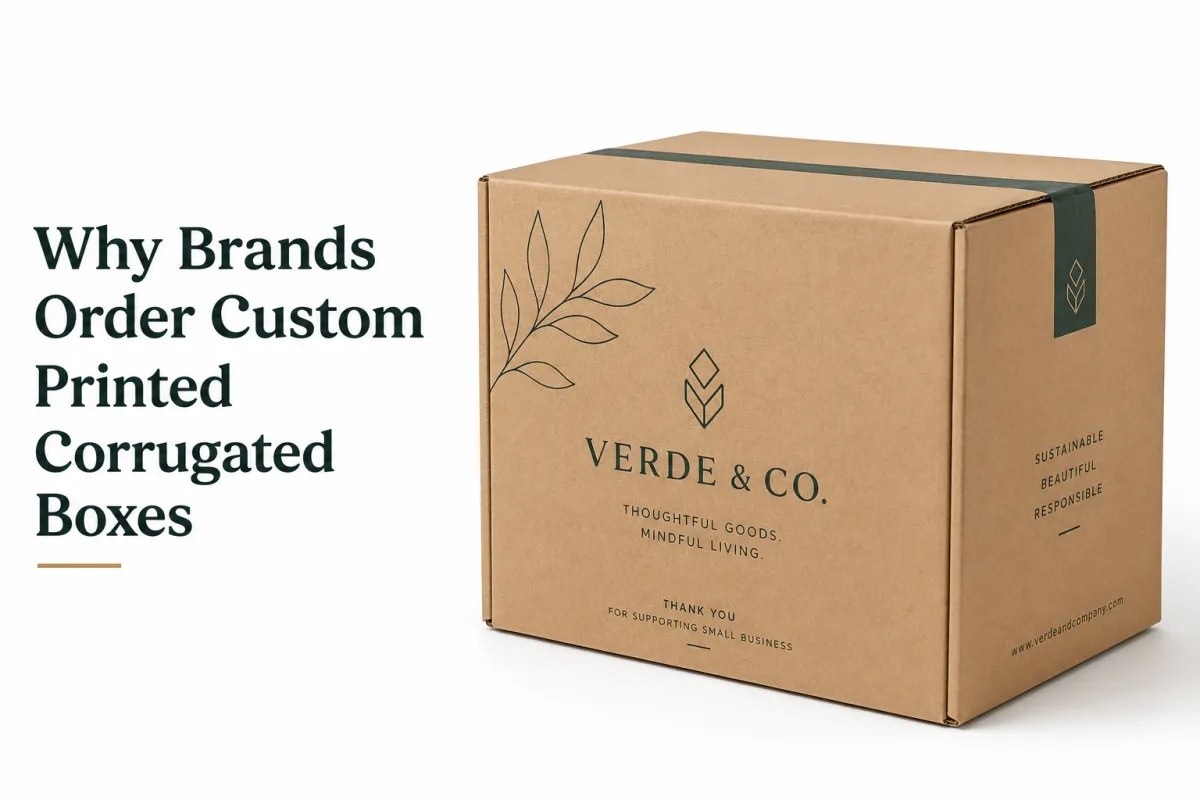
I have seen more shipping problems start with the carton than with the artwork, which is why so many brands Order Custom Printed corrugated boxes instead of treating the shipper like a throwaway. On a humid July morning in Dongguan, I watched a beauty brand lose a 2,000-unit run because the 32 ECT single-wall board buckled at the corners after a 900-mile truck move, even though the 2-color logo looked flawless. The contrast was almost funny in a grim way: perfect print, failed structure. If you order custom printed corrugated boxes, you are buying protection and presentation together, not just a logo on brown paper with better manners. The box has to survive the route first; the branding only matters if it arrives in one piece.
A well-built shipper has to do several jobs at once. It has to protect a 1.8 kg product through parcel handling, signal brand identity the moment the carton leaves the warehouse, and keep the packing line moving because there is no extra label, sleeve, or outer carton to manage. That combination is why brands order custom printed corrugated Boxes for Subscription kits, replenishment orders, launch campaigns, and wholesale shipments from Shenzhen to Chicago. The strongest programs connect packaging design, board grade, and print layout before a die is ever cut. If those three are not talking to each other, the box usually ends up doing a mediocre impression of all of them. And mediocre cartons, unlike mediocre headlines, get dragged by forklifts.
The economics are practical, not abstract. If damage claims fall from 4.8% to 1.2%, a brand moving 20,000 cartons a quarter can avoid roughly 740 reships, and a cleaner presentation can cut customer service emails from buyers asking why a $48 skincare set arrived in a plain carton with a taped-on sticker. Freight teams notice the difference too. A carton that stacks cleanly on a 48 x 40 inch pallet without bowing saves cube, pressure, and labor, especially in regional distribution centers in Dallas, Atlanta, and Newark. I have seen clients order custom printed corrugated boxes for retail packaging, then discover the same format trims pack time by 12 to 18 seconds per order because the box arrives pre-branded and ready to fill. That sounds tiny until you multiply it by 6,000 orders and suddenly everyone is pretending they always cared about seconds.
The smartest packaging programs treat the carton as part of the system. Flute profile, board strength, print coverage, and product dimensions all have to agree before production begins, and that agreement usually starts with a sample run in Dongguan or Foshan rather than a guess in a spreadsheet. Miss one of those pieces and the result is predictable: a good-looking box that fails in transit or a strong box that does nothing for brand recall. That is why I tell buyers to order custom printed corrugated boxes only after the shipping method, product weight, and fulfillment flow are already clear. Otherwise, you are designing confidence on top of uncertainty, and uncertainty loves a hidden cost.
"We stopped treating the shipper like a disposable container and started treating it like part of the product," a shipping manager in Suzhou told me after their damage rate dropped from 4.1% to 0.9% once they moved to custom printed boxes with the right ECT and print placement.
For teams comparing Custom Packaging Products against stock cartons, the difference is not subtle. Off-the-shelf boxes may fit the SKU, but they rarely fit the way a team packs, stacks, and ships every day across facilities in Phoenix, Rotterdam, or Guangzhou. If you order custom printed corrugated boxes with the right spec sheet, you get a carton that supports order accuracy, cleaner unboxing, and more consistent retail packaging across channels. That matters whether you ship DTC, wholesale, or both, and it matters even more when a warehouse manager tracks damage by lane and by shift.
Custom Printed Corrugated Boxes: Product Details That Matter
When buyers order custom printed corrugated boxes, the first question should never be "How many colors can I print?" It should be "What structure will survive the trip?" Single-wall board works well for lighter goods and standard parcel shipping, while double-wall makes sense for heavier, denser items or anything that stacks tall in a warehouse. I usually start with 32 ECT for lighter e-commerce items, 44 ECT for tougher shipments, and double-wall when the pallet has to carry serious weight without panel crush, especially on long-haul routes through Texas, Ohio, or Bavaria. That is not glamorous, but shipping rarely rewards glamour. It rewards boxes that behave.
Flute choice matters just as much. B-flute is a workhorse for strength and printability, while E-flute gives you a smoother surface for tighter graphics and cleaner folds. Kraft liner has a rugged, natural look that many brands prefer for branded packaging, but white liner gives print more contrast and usually works better when the carton needs a premium look on camera or in retail packaging. I have seen brands order custom printed corrugated boxes in white-on-white print for cosmetics, then switch to kraft after a supplier review because the warehouse wanted less scuff visibility and a stronger sustainability story. A 350gsm C1S artboard insert can also improve the unboxing moment for kits, but it should be matched to the carton, not thrown in as decoration. Nothing says "premium" like a box that arrives looking like it lost a fight with a conveyor belt.
Box style changes the experience too. Regular slotted cartons are efficient for high-volume fulfillment, especially at plants in Dongguan and Ningbo that run tens of thousands of units a day. Die-cut mailers bring a more polished opening moment and can reduce tape use by one strip per order, which adds up fast on a 4,000-order weekly run. Tray-and-lid formats work well for gift sets or kits with multiple components, while specialty shippers are the better answer for fragile items, expensive electronics, or odd shapes that would otherwise need too much void fill. If you order custom printed corrugated boxes for a fast pack station, the structure should help the operator instead of slowing them down. I have watched packers quietly curse a bad closure design like it personally offended them, which, to be fair, it did.
Print method affects the result more than many buyers expect. Flexographic printing is efficient for long runs and straightforward artwork, especially one- to two-color branding on a shipping carton. Litho-lamination is the premium route for richer graphics, photo quality, and sharper shelf presence, and it is often chosen for retail launches in Los Angeles, Paris, or Tokyo. The mistake many people make is assuming more art automatically means a better box. I have watched a one-color logo on a strong kraft shipper outperform a busy full-panel design because the brand looked confident, the print stayed readable across seams, and the carton cost stayed under control. If you order custom printed corrugated boxes for regular shipping, disciplined usually beats cluttered. A box can try too hard. It is a packaging object, not a contestant on a makeover show.
In a fulfillment center, the best carton is the one that runs without drama. It should open square, stack flat, and stay true when a picker grabs it from the line, whether the line sits in Nashville, Prague, or Penang. That is why I always ask where the box will live: pallet, cart, conveyor, or hand-pack bench. The answer changes the spec. A box that looks great in a studio can fail in a distribution center if the board grade is too soft or the closure fights the workflow. That is also why many procurement teams order custom printed corrugated boxes only after a pack-out test instead of relying on a catalog assumption. A test takes an afternoon. A production mistake can linger for months, which is a very expensive way to learn humility.
For a deeper look at box structures and packaging terminology, the Packaging School and the Fibre Box Association provide useful technical references, and both can help a buyer speak the same language as a corrugated supplier in Chicago, Xiamen, or Vancouver. You can also review industry guidance from packaging.org and shipping test standards from ista.org if your team wants a better sense of what real transit performance looks like. That kind of homework makes it easier to order custom printed corrugated boxes with fewer surprises and fewer phone calls that start with, "So, weird thing..."
Specs to Lock In Before You Order Custom Printed Corrugated Boxes
The fastest way to make a quote useful is to give the supplier the right dimensions. I always tell buyers to use inside dimensions first, because that is what determines fit. Outside dimensions matter for freight and pallet planning, but inside dimensions control whether a product slides in cleanly, whether inserts fit, and whether a kitting line can run at speed. If you order custom printed corrugated boxes for subscription shipments or a bundle with inserts, a half-inch mistake can become a daily headache. I have seen a whole team in a St. Louis warehouse lose an afternoon because a "close enough" measurement turned into a box that was, in practice, not close enough at all.
Before you order custom printed corrugated boxes, lock in these technical details: inside dimensions, board grade, flute profile, style, print coverage, color count, ink limits, finish, closure type, and any special handling notes. I also like to ask for product weight, not just dimensions, because a 2.4 lb glass jar behaves differently than a 2.4 lb apparel kit. Humidity exposure matters too. A carton that performs beautifully in 35 percent relative humidity can soften quickly in a Gulf Coast warehouse where the air sits near 65 percent RH for half the summer. I know that sounds fussy. Then the rainy season arrives, and the fussy person is the only one not surprised.
Compression and handling are where a lot of programs become real. ECT ratings, burst strength, stacking height, and carrier handling conditions all need to match the route. If a box will sit six high on a pallet, go through parcel networks, and ride in a trailer for 1,200 miles, I want to see the spec before I approve the artwork. That is not fear talking. It is the result of watching cartons from a weak run buckle at the corners while the print stayed perfect. If you order custom printed corrugated boxes for industrial or wholesale use, ask for an ASTM D642 compression target or a clear internal load requirement so you are not guessing later. It is much easier to debate a number on paper than to explain a crushed shipment to finance.
Artwork specs are where the proof stage gets won or lost. You want bleed, safe zones, dielines, and registration marks set before the file hits the press. Keep logos away from folds, seams, and flap edges unless the design was built for that placement. A clean panel on a 10 x 8 x 4 mailer can carry a logo beautifully, but if the seam runs straight through the wordmark, the carton looks cheap even when the board grade is excellent. I have had clients order custom printed corrugated boxes, then ask for a late logo move by three-quarters of an inch because the first proof showed the mark sitting too close to the score line. That kind of change is easy before plate-making and expensive after. It is also the sort of thing that makes a designer stare into the middle distance for ten full seconds.
A good buyer asks for the proof, then checks three things: panel orientation, print density, and carton fit. If the product has a retail-facing side, the artwork should support that orientation every time. If the box will be handled by multiple teams, a small location code or pack-out note can help, especially when one plant in Mexico and another in Vietnam are both filling the same SKU family. For teams managing multiple SKUs, this is where Custom Shipping Boxes become a more intelligent system than stock cartons ever could. And if your internal team wants a quick answer path, our FAQ page is a helpful place to start before you order custom printed corrugated boxes. It is not glamorous, but neither is filing a damage claim at 4:52 p.m. on a Friday.
Standards matter here. If sustainability is part of the brief, FSC-certified board can help support sourcing goals, and packaging recycling guidance from epa.gov/recycle is useful for teams that want to align packaging decisions with store-level recycling claims. I have seen more than one buyer order custom printed corrugated boxes with a sustainability story in mind, only to discover that the liner choice and print coverage made the carton harder to position honestly. Better to solve that on paper than in a customer complaint. Customers can smell corporate improvisation from a mile away, especially if the box says "recyclable" in 18-point type but the insert is a mixed-material maze.
Pricing, MOQ, and Cost Drivers for Custom Printed Corrugated Boxes
Pricing becomes much easier to understand once you know what actually drives it. The main variables are board grade, size, print colors, order quantity, finishing complexity, tooling, and freight. If you order custom printed corrugated boxes in a 1-color flexo format on a standard structure, your cost can stay very manageable. In southern China, a simple 32 ECT RSC at 5,000 pieces can sometimes land near $0.15 per unit before freight if the artwork is minimal and the die is already on file. If you move to a premium litho-laminated finish with multiple spot colors and a new die, the budget changes fast because each step adds setup time and waste. I know that sounds obvious, but I have watched smart teams miss it anyway because the quote came wrapped in enough jargon to qualify as a minor novel.
MOQ is tied to production efficiency. Setup time, plates, die cutting, and line clearance all have to be spread across enough units to make the job sensible. That is why small runs cost more per box. In the market I work in, a 3,000-unit order may be the practical floor for many Custom Printed Boxes, though some programs can run lower if the art is simple and the style is standard. If you order custom printed corrugated boxes at 500 units, expect a higher unit cost because you are paying for the same setup work over fewer pieces. It is not punishment; it is just math wearing work boots, usually in a factory in Foshan or Dongguan with a 6:00 a.m. shift change.
There is a straightforward way to save money without hurting performance: simplify where you can. Standardize sizes across a family of SKUs, reduce the print to one or two colors, choose a common flute, and plan purchases in production batches instead of placing one emergency run after another. A buyer who orders custom printed corrugated boxes in forecasted waves can often lower the unit price by 12 percent to 18 percent simply because the plant can run more efficiently. I have seen one supplement brand in Austin cut annual packaging spend by nearly $14,000 after moving from five box sizes to three and consolidating artwork across those sizes. Nobody threw a parade, but the controller did stop frowning in meetings.
Procurement teams should compare quotes by total landed value, not just the sticker price on the carton. A box priced at $0.62 at the plant can end up cheaper than a $0.54 box if the stronger board reduces damage, the pallet count improves freight density, or the pack line gains 8 seconds per order. That is why I keep saying you do not just order custom printed corrugated boxes; you buy freight protection, labor efficiency, and brand consistency in one decision. The cheapest box on the quote sheet is often the most expensive box on the warehouse floor, especially once a 600-mile freight bill and two damaged cases enter the chat.
| Box Option | Typical Use | Print Style | Typical Unit Cost at 5,000 pcs | Notes |
|---|---|---|---|---|
| Single-wall RSC, 32 ECT | Light DTC goods, apparel, kits | 1-color flexo | $0.15 - $0.22 | Common in Dongguan and Ningbo for standard shipping |
| Die-cut mailer, E-flute | Premium unboxing, cosmetics, small electronics | 1-2 color flexo or digital | $0.32 - $0.48 | Works well with 350gsm C1S artboard inserts |
| Double-wall shipper, 44 ECT+ | Heavy products, bulk shipping, warehouse stacking | Simple branding | $0.58 - $0.89 | Better compression and better pallet stability for long-haul freight |
| Litho-laminated custom shipper | Premium retail packaging and branded packaging | Full graphic wrap | $0.95 - $1.65 | Best visual impact, more artwork control needed, often produced near Guangzhou or Xiamen |
If a supplier cannot explain why a quote changes from one quantity band to the next, keep asking. I once sat across from a purchasing manager in New Jersey who had three quotes within nine cents of one another, but one supplier had hidden tooling in freight and the other had bundled plate charges into the unit price. He thought he was buying the same carton everywhere. He was not. That is why people who order custom printed corrugated boxes need line-item clarity, not just a low number on the last page. A cheap answer that hides its assumptions is usually expensive later.
Production Process and Timeline for Custom Printed Corrugated Boxes
The process usually starts with a spec review, and that stage matters more than buyers expect. A clean inquiry should include dimensions, product weight, quantity, ship method, and artwork files. From there, the supplier can review the structure, recommend board, and confirm whether a new die or plate set is needed. If you order custom printed corrugated boxes with incomplete specs, the timeline slips before production ever begins because the team has to stop and clarify the basics. I have seen more schedules blown up by missing dimensions than by actual factory problems, which is a little embarrassing for everyone involved, especially when the plant is already booked for a 14-day run in Foshan.
After the spec review comes sampling and proofing. A structural sample shows fit and closure; a digital or prepress proof shows artwork placement and color treatment. For a simple repeat order, the cycle can be short. I have seen repeat jobs move from approval to production in 10 to 12 business days, while a new structure with die cutting and print changes can take 15 to 20 business days or more. The longest delay is usually not the press. It is waiting for final sign-off from a marketing team that wants one more logo tweak and one more typo check. I say that with affection, but also with a little fatigue, because a 2-millimeter logo move can consume 48 hours of calendar time.
There is a good reason to be precise at proof stage: once the line is on press, rework is expensive. If the dieline is off by even 1/8 inch, fold lines can shift the logo onto the seam. If the copy is still changing, plate work has to stop. That is why I ask clients to send final text, final barcodes, and final artwork before they order custom printed corrugated boxes. A clear proof saves money, reduces waste, and keeps everyone honest about what the carton will actually look like on the floor. Honest proofing is not exciting, but it does prevent the kind of late-night panic that makes people snack directly from the conference room candy bowl.
Manufacturing and fulfillment deserve attention too. Moisture control keeps sheets stable, bundle counts keep inventory accurate, and palletization affects how the cartons arrive at the warehouse. I once visited a line in Suzhou where the cartons printed beautifully, but the pallets were wrapped too loosely and the top rows picked up humidity during a rainy transfer. The print was fine; the board lost shape in transit. That kind of problem is avoidable if you order custom printed corrugated boxes with freight and storage conditions in mind from the beginning. Board hates surprises. Warehouses, unfortunately, produce them by the truckload.
For brands planning testing or compliance checks, ISTA transit tests and internal compression targets are worth discussing early, especially if the box carries fragile goods or expensive returns. Some programs also need FSC documentation for sustainability reporting, or a carton that aligns with retail packaging claims across multiple channels in California, Ontario, and the UK. That is the kind of planning that turns a simple purchase into a repeatable packaging program. It is also why the best teams order custom printed corrugated boxes with both the plant and the warehouse in the same conversation. If those two groups are not in the room together, someone will eventually use the phrase "that was not what I thought we meant."
Here is a simple rule I use: if the shipper will be touched by people three or more times before the customer sees it, the production plan needs to reflect that reality. A box that is easy to bundle, easy to stack, and easy to label saves real labor. A box that only looks good on a render does not. That distinction sounds small until you are running 8,000 cartons a day in a facility outside Atlanta and every 20 seconds matters. Suddenly, small details are the whole argument.
Why Choose Custom Logo Things for Corrugated Packaging
Custom Logo Things understands corrugated from both sides of the aisle - the print side and the shipping side. That matters because buyers do not just order custom printed corrugated boxes for visual appeal; they need cartons that work on a real line, in a real warehouse, under real transit conditions. In my experience, the best packaging partners ask about stack height, carrier type, product fragility, and the way the carton will be handled by the first warehouse worker and the last delivery driver. If they skip those questions, they are really just selling rectangles with optimism attached.
What I appreciate most is process discipline. A good packaging partner checks the spec, validates print alignment, and recommends the right board before the job gets locked. That keeps buyers from overbuying a heavy carton they do not need or underbuilding a carton that will fail after 800 miles of rough handling. If you order custom printed corrugated boxes through a team that understands production reality, you usually get cleaner approvals, fewer surprises, and a better repeat order experience the second time around. I care about the second order because that is where the truth usually shows up, usually around reorder number three or four.
Communication matters just as much. I have sat through supplier negotiations where everyone agreed on "good quality" but nobody agreed on ECT, liner color, or carton style, and the result was two weeks of avoidable back-and-forth. A straightforward quoting process that explains sizes, setup charges, and timelines in plain language is worth a lot. That is also why brands looking for Wholesale Programs often prefer a partner that can support planned replenishment instead of one-off panic buying. If your team regularly order custom printed corrugated boxes, predictability becomes a cost advantage. It is boring in exactly the right way, like a plant that ships on Tuesday instead of "sometime next week."
Brand consistency is not a soft benefit. It helps customers recognize your product packaging from one order to the next, and it helps operations maintain the same carton spec across seasonal runs, product launches, and reorder cycles. I have seen retail packaging programs break down because one supplier used a different board shade or a slightly different print layout on the next batch. A managed corrugated program avoids that drift. It is the reason repeat buyers order custom printed corrugated boxes from a partner that can keep specs, artwork, and reorders aligned over time. A tiny mismatch in liner shade can look harmless on a spreadsheet and wildly obvious under warehouse LEDs at 5:30 a.m.
There is a practical buying advantage too. If the team can recommend a standard structure from the start, the client avoids reinventing the wheel for every SKU. That is one reason I point people toward Custom Shipping Boxes rather than treating each need as a one-off transaction. The right platform can support mailers, shippers, and branded packaging with less complexity, which means more time spent on growth and less time chasing carton details. For brands that need to order custom printed corrugated boxes regularly, that difference shows up in the budget and in everyone's blood pressure, especially during Q4.
Custom Logo Things also fits the way real buyers work. Some need a fast proof, some need a structural sample, and some need a packaging review before they place a larger order. A partner that can move at the pace of procurement, marketing, and operations is easier to live with than a vendor who only knows how to quote and wait. In other words, if you are ready to order custom printed corrugated boxes, you want a team that can keep up with the factory floor and the calendar at the same time. That combination is rarer than it should be, particularly when the first shipment has to land before a launch date in 12 business days.
How do you order custom printed corrugated boxes the right way?
The best way to order custom printed corrugated boxes is to arrive with clean information. Start with inside dimensions, product weight, ship method, artwork files, target quantity, and any performance requirement you already know. If the product is fragile, say so. If the carton must fit a specific shelf, say that too. The more precise the brief, the faster the quote and proof can move. Vague instructions create vague cartons, and vague cartons tend to become someone else's emergency, usually in a warehouse that closes at 6:00 p.m.
I always recommend sending a sample product or an existing carton if you have one. Even a rough sketch can help the packaging team confirm fit, board grade, and print placement before production begins. If the job is new, ask for a structural sample or digital proof. That step is especially valuable if the box will run on a high-speed pack line, because small changes in flap size or score depth can affect line speed. It is one of the simplest ways to order custom printed corrugated boxes without paying for avoidable revisions later. A single sample can save a week of back-and-forth and a lot of sighing, especially if the sample comes from a plant in Dongguan before noon.
Be ready to discuss trade-offs. If you want a premium graphic look, a white liner may be the right call. If you want lower cost and a natural finish, kraft can work beautifully. If your team is shipping over long distances, a stronger ECT may be worth a few extra cents per carton. I have seen brands order custom printed corrugated boxes at 5,000 units and save more money by choosing a simpler print and a stronger standard board than by chasing the lowest quote from a weak spec. Sometimes the smarter decision is the one that looks less exciting in a spreadsheet, but it protects a 30-pound carton from crush in transit.
Here is the order path I trust: request a quote, confirm the structure, review the proof, approve the sample if needed, then lock the timeline and freight plan. That sequence keeps everybody accountable. It also gives you a cleaner paper trail for replenishment, which matters if the product launches in stages or ships through multiple warehouses in New Jersey, Texas, and Alberta. If you need a starting point, explore Custom Packaging Products and compare options before you order custom printed corrugated boxes for the full program. That is a much better use of your afternoon than guessing and hoping the box "feels right."
One more practical point. Ask for the break points in quantity pricing. Knowing the jump from 3,000 to 5,000 units, or from 5,000 to 10,000, helps you plan inventory with fewer emergency orders. I have had clients order custom printed corrugated boxes for a quarter's worth of demand and then miss out on a better price tier because they were 400 pieces short of the next level. That is a painful mistake that never shows up in a glossy proposal. Numbers have a way of being very polite until the invoice arrives, and then they become very specific.
If your team wants a faster answer, send the specs together instead of piecemeal. A quote with dimensions, weight, artwork, and quantity gives the manufacturer enough information to price honestly. A quote request with only a logo and a hope does not. The right goal is simple: order custom printed corrugated boxes with enough clarity that the first proof is close, the production run stays on schedule, and the cartons land square in your warehouse, not 300 miles away from the route you planned.
When the pieces line up, the result is straightforward. You get better shipping performance, cleaner branding, and a cost structure your team can forecast. If that is the outcome you want, send the brief, request the sample, and order custom printed corrugated boxes once the spec, proof, and timeline are all aligned. Packaging does not need to be magical. It just needs to work, every time, without becoming a story people tell in the break room.
How do I size custom printed corrugated boxes for shipping?
Measure the product at its widest points and start with inside dimensions, because the inside fit controls how the item moves in transit. Add room for inserts, void fill, or automation tolerances if the carton will run on a fulfillment line, and check carrier limits plus stacking needs before you approve the dieline. If you order custom printed corrugated boxes for a kit or bundle, a quarter-inch of extra room can matter a lot more than the outside spec suggests. The difference between "fits" and "fits every day without drama" is often absurdly small, especially on a line moving 1,200 cartons per shift.
What board grade should I choose when I order custom printed corrugated boxes?
Use lighter single-wall board for lower-weight goods and standard parcel shipping, then move to stronger ECT ratings or double-wall construction when cartons will stack, travel farther, or carry heavier items. I usually start buyers at 32 ECT for lighter DTC shipments, 44 ECT for tougher jobs, and double-wall for bulk or industrial loads. The right answer depends on humidity, compression, and drop risk, so it helps to order custom printed corrugated boxes with the actual shipping conditions in mind. A box is not just a size; it is a little structural argument about the trip ahead, and that argument changes between Miami and Minneapolis.
Can I order custom printed corrugated boxes in small quantities?
Yes, but smaller runs usually cost more per box because setup, plates, and die cutting are spread over fewer units. The best small-order strategy is to simplify the artwork and choose a standard structure whenever possible. Ask for pricing at several quantities so you can see the break points clearly, because a 1,000-piece run and a 5,000-piece run can look very different once the setup is included. If you plan to order custom printed corrugated boxes again soon, a planned reprint often gives you a better total cost. Short runs are useful; they are just not famous for being cheap, especially if the die has to be made from scratch in Guangzhou.
How long does it take to produce custom printed corrugated boxes?
Timelines depend on artwork approval, sample needs, print method, and whether a new die or plate set is required. Simple repeat jobs can move faster than new structural designs that need testing and revision. In my experience, 10 to 12 business days is realistic for a clean repeat order after proof approval, while more complex new work can take 15 to 20 business days or longer. The fastest way to order custom printed corrugated boxes is to submit final artwork, exact specs, and target quantity together. Every missing detail is another small delay waiting to happen, and those delays usually pile up right before a launch date.
What artwork files do I need for custom printed corrugated boxes?
Provide editable vector artwork when possible, along with the dieline, logo files, and color references. Make sure bleed, safe zones, and fold areas are already considered in the layout, because a good file saves a lot of proofing time. If the design is new, request a proof so panel alignment and seam placement can be checked before production starts. That extra step helps you order custom printed corrugated boxes with fewer surprises on press and fewer adjustments after the cartons arrive. It also spares everyone from the joyless ritual of discovering a typo after the plates are already made, which can cost both time and a reprint fee.

