Buyer Fit Snapshot
| Best fit | Order Custom Size Shipping Boxes Online projects where brand print, material claims, artwork control, MOQ, and repeat-order consistency need to be specified before quoting. |
|---|---|
| Quote inputs | Share finished size, material target, print colors, finish, packing count, annual reorder estimate, ship-to region, and any compliance wording. |
| Proofing check | Approve dieline scale, logo placement, barcode or warning zones, color tolerance, closure strength, and carton packing before bulk production. |
| Main risk | Vague material claims, crowded artwork, missing packing details, or unclear freight terms can make a low unit price expensive after revisions. |
Fast answer: Order Custom Size Shipping Boxes Online: Structure, Print Proof, Packing, and Reorder Risk should be specified like a repeatable production item. The safest quote records material, print method, finish, artwork proof, packing count, and reorder notes in one written spec.
Production checks before approval
Compare the actual filled-product size with the drawing, then confirm tolerance on folds, seals, hang holes, label areas, and retail display edges. Reserve space for logos, QR codes, warning copy, and material claims before decorative graphics fill the panel.
Quote comparison points
Review material grade, print process, finish, sampling route, tooling charges, carton quantity, and freight assumptions side by side. A quote is only useful when the supplier can repeat the same color, closure quality, and packing count on the next order.
Order custom size Shipping Boxes Online, and you are not just buying corrugated board; you are buying fewer crushed corners, cleaner pallet builds, and a packing line that stops arguing with the carton every five minutes. I still remember a run at a Midwest fulfillment center in Indianapolis, Indiana, where one box was only 3/4 inch too tall, yet it forced extra void fill, pushed the parcel into a higher dimensional-weight bracket, and still let the product shift enough to scuff a corner on the way out. That kind of mess is exactly why I tell buyers to order custom size shipping boxes online with the fit and the board grade already decided, not guessed in a hurry over coffee.
The business case usually becomes obvious the moment the boxes start moving through a real warehouse. A carton that fits correctly often means less corrugated waste, tighter pallet patterns, lower freight exposure, and fewer returns caused by movement inside the shipper. If you are building ecommerce shipping kits, subscription boxes, industrial replacement parts, retail-ready shipments, or a line of branded packaging that has to look clean the moment the customer opens it, order custom size shipping boxes online can be the difference between a tidy pack-out and a constant workaround with pads, inserts, and extra tape. A 2-cent swing per unit becomes a $500 problem at 25,000 cartons, and that is before the returns team starts counting damaged corners. Small numbers are sneaky like that.
Most buyers begin with a stock carton that is close enough on paper and expensive in practice. The next few months usually go the same way: more paper, more air pillows, more corner blocks, and still no real fix. I prefer to talk through the box style, the flute, the print, the MOQ, and the lead time before anyone commits. If you want a practical path instead of a sales pitch, the sections below walk through how to order custom size shipping boxes online with confidence, what specs matter, what pricing drivers to watch, and how Custom Logo Things can help you move from sample to production without wasting a week on avoidable revisions. That kind of planning is especially helpful if your cartons are being produced in Dongguan, Guangdong, or Greensboro, North Carolina, where freight and press scheduling can change by several days.
Order Custom Size Shipping Boxes Online: Why Exact Fit Pays Off
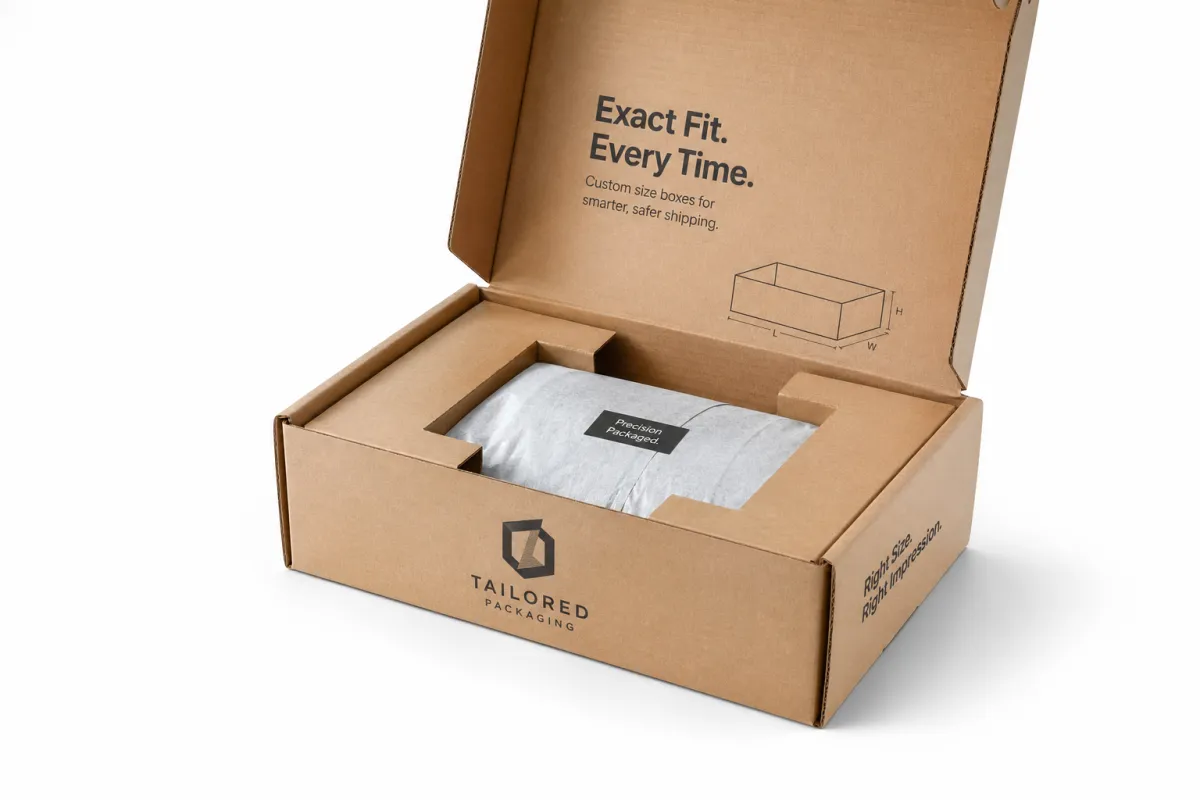
On a plant floor, the difference between a good carton and a bad one can be measured in fractions of an inch. I once watched a packaging line in eastern Pennsylvania pack a small metal assembly into a box that was just loose enough to let the part migrate 1.5 inches during transit; the carton was still intact, but the corner dent on the part triggered a return and a credit. That is the hidden cost people miss when they order custom size shipping boxes online by guessing from the product alone instead of the packed product.
Exact sizing pays off in three places right away. First, you use less corrugated material because the blank does not need to be oversized just to cover a broad range of items. Second, your pallet pattern gets tighter, which matters a lot if you ship 48 x 40 pallets and you are trying to fit 60 or 72 cartons per load. Third, dimensional-weight exposure drops because the outer dimensions stop inflating the parcel rate. For ecommerce and order fulfillment teams, those small changes can save real money on every thousand units once the box is in repeat production. A 2-cent difference looks tiny until it is multiplied by 25,000 cartons, and then the number starts to matter. That is the part people always think they can ignore right up until finance sends the email.
Damage is the other half of the equation, and it tends to stay invisible until claims start landing on someone’s desk. A carton that is too large allows the product to bounce, flex, or settle against one seam, and that is where scuffing, corner crush, and puncture risk show up. A carton that is too tight can slow the line by 10 to 15 seconds per unit, which feels minor until a busy shift turns that delay into a backlog. The useful answer sits between those extremes, which is why I encourage customers to order custom size shipping boxes online only after they have confirmed the packed dimensions and the handling environment. In a test I reviewed for a cosmetics shipper in Columbus, Ohio, a 1/2 inch reduction in empty space cut corner damage by 18 percent over a six-week sample.
Here is the version of the story I share most often with buyers in client meetings: a subscription brand wanted to ship glass jars in a standard 12 x 12 x 8 carton because it was available from inventory. The product looked fine on the bench, but once we added molded pulp and a 1/8 inch clearance target, the cube changed enough to justify a custom size. That one change cut void fill by about 40 percent and made the packing station easier to train. When people order custom size shipping boxes online with that level of fit, the improvement usually shows up in labor, freight, and damage claims at the same time.
For common use cases, exact-fit cartons matter most in ecommerce shipping, replacement parts, cosmetics, auto components, industrial hardware, and retail packaging that needs a clean shelf presence. A nearly right box can work for a while, but it rarely works beautifully. I have seen packaging teams spend more on fillers and tape than they would have spent on a properly specified carton. That is why a lot of experienced buyers now order custom size shipping boxes online as part of a larger packaging design review instead of treating the box as a last-minute purchase. On a 10,000-unit program, a 32 ECT carton that saves just $0.04 per shipment adds up to $400, and that ignores labor savings from fewer re-packs.
"The carton is part of the product experience, not an afterthought. If the box is wrong by half an inch, the warehouse feels it, the freight bill feels it, and the customer feels it." - a packaging manager I worked with during a corrugated line audit in Ohio
Custom Size Shipping Box Styles and Material Options
When you order custom size shipping boxes online, the box style should match the way the item moves through your operation. Regular slotted containers, or RSCs, are the workhorse choice for most shipping boxes because they are easy to run, easy to stack, and easy to print. Die-cut mailers are better when the presentation matters and you want a cleaner closure, while telescoping boxes help with longer or irregular products that need variable depth. For fragile items, insert-ready designs and partitioned cartons can reduce movement without forcing you to overfill the space with loose dunnage. In a plant in Louisville, Kentucky, I saw a die-cut mailer shave 8 seconds off each pack-out compared with a hand-taped RSC, which is not glamorous but is very real at 3,000 units a day.
Material choice matters just as much as style. Single-wall corrugated is usually enough for lighter loads, but once the product gets heavier, more brittle, or more expensive to replace, double-wall construction starts to make sense. In factory terms, I look at flute profile, edge crush test, burst strength, and how the box will behave under stacking pressure. A 32 ECT carton may be fine for a 15-pound ecommerce kit, but I would not use it for a 40-pound metal part if the box is going through multiple transfers and pallet stacks. If you plan to order custom size shipping boxes online for industrial shipments, that decision should happen before the quote is approved, not after the first damage report. For lighter branded mailers, a 350gsm C1S insert card or sleeve can be a smart add-on when print clarity matters more than crush resistance.
Exterior liners also change the equation. Kraft gives you a sturdy, familiar look that holds up well in warehouse handling, while white liners support cleaner branding and sharper print contrast. For long-distance transit, a moisture-resistant treatment or a tougher liner can be worth the small price bump, especially if the cartons will sit in a trailer overnight or move through humid docks. I have seen boxes lose a noticeable amount of stiffness after one wet dock transfer, so if your lane includes rain, cold storage, or high humidity, do not treat liner choice as cosmetic. That is a common mistake when teams order custom size shipping boxes online from a picture and not from the shipping reality. A manufacturer in Savannah, Georgia, will often quote a different liner spec than one in Monterrey, Nuevo Leon, because humidity and freight dwell times are not the same.
Structural features are where box engineering really starts to pay. Custom score lines can turn one carton into a multi-depth option. Dust flaps can keep small parts from shifting. Product locks can reduce tape usage on the line. Interior partitions are useful for glass, electronics, or mixed SKU kits, and a snug insert can make the difference between a box that just ships and a box that protects. If you are building branded packaging for a retail launch, the structure should serve the brand and the transit lane together, not one at the expense of the other. A good box behaves like part of the packaging system, not an isolated object. In practical terms, that can mean a 1/4 inch score adjustment, a 2-tab lock change, or a 48 ECT upgrade before the first 5,000-piece run leaves the plant.
For buyers who want a deeper industry reference point, I often point them to ISTA for transit testing principles and to FSC when sourcing goals include responsible fiber. Those two references are not a substitute for a good box spec, but they do help you keep packaging design grounded in real performance and sourcing standards. If you also need a broader view of packaging formats beyond shipping cartons, browse Custom Packaging Products or review Custom Shipping Boxes to see how styles differ before you order custom size shipping boxes online. A designer in Atlanta may call the same box a mailer, while a plant in Qingdao may call it a folding carton, and the spec sheet is where that language gets translated into something measurable.
| Box Style | Best Fit Use | Typical Board Choice | Practical Notes |
|---|---|---|---|
| RSC shipping carton | Ecommerce, parts, general order fulfillment | 32 ECT single-wall | Lowest setup complexity, easy to stack, good all-around choice |
| Die-cut mailer | Branding, subscription kits, retail packaging | 32 ECT to 44 ECT | Clean closure, strong presentation, tighter fit for smaller items |
| Double-wall carton | Heavy parts, fragile goods, long-haul shipping | 48 ECT or stronger | Higher crush resistance, better for stacking and rough handling |
| Telescoping box | Long products, adjustable depth | Varies by load | Useful when one fixed depth will not work across product sizes |
Specifications to Gather Before You Order Custom Size Shipping Boxes Online
The most accurate quote starts with inside dimensions, not a rough guess. Measure length, width, and depth of the packed item, then add the space needed for bubble wrap, molded pulp, foam corners, or paper void fill. If you are packing a 10.25 x 7.5 x 3.75 inch product with a 1/2 inch insert on each side, the carton spec changes fast, and that is exactly where many buyers go wrong when they order custom size shipping boxes online. I tell teams to measure the finished pack-out, not just the naked product, because the carton has to fit the shipping method, not the inventory shelf. The warehouse does not care what the original sketch said; the carton has to survive the real thing. A tape measure and a caliper will tell you more than a polished mockup ever will.
Weight matters too, and not just the gross shipping weight. A 6-pound item that stacks on top of 40 other cartons has different engineering needs than a 6-pound item that ships one at a time. Tell the supplier the product weight, the stacking load, and whether the carton will ride on a pallet, in a parcel stream, or inside a mailer system. If the box needs to fit an automation lane, a tote, or a specific shelf opening, include that information before you order custom size shipping boxes online, because a half-inch adjustment can be the difference between a smooth pack-out and a line stoppage. I have seen a whole shift slowed down because someone thought "close enough" was a dimension strategy. It is not. A 38-pound industrial part in a carton rated for 20 pounds is a mistake that announces itself loudly at dock 7.
Operational details are the other half of the picture. The warehouse environment, temperature swings, ship method, and handling frequency all influence the spec. A carton that leaves a climate-controlled building and spends two days in a hot trailer behaves differently from one that moves locally on a short route. If the box must survive a rough parcel network, you may need a stronger board, better closure, or an insert that locks the item in place. This is where honest packaging design pays off, because the fastest way to overpay is to spec a box for the warehouse and ignore the truck. A carton shipping from Seattle, Washington, to Miami, Florida, faces a very different humidity profile than a local same-day route in Denver, Colorado.
Tolerances also deserve attention. A good corrugated supplier will tell you whether the box should be built snug, with perhaps 1/8 inch of working room, or whether you need a bit more clearance for fast, repeatable packing. I remember a negotiation with a converting plant where the customer wanted a very tight die-cut mailer but the pack line was using a hand-fold method. Once we allowed a slightly looser score, line speed improved by roughly 12 percent and the staff stopped tearing tabs. Those are the details worth settling before you order custom size shipping boxes online, because once tooling is made, every small change becomes more expensive. And yes, people do try to change the size after approval. They act surprised, as if cardboard is a philosophy seminar. A 0.1 inch change can mean a new die, a new proof, and a new freight quote.
To make the quote process smoother, gather the following before you send the request:
- Inside dimensions for length, width, and depth, measured after inserts are included.
- Product weight and any stacking load that will sit on top during warehouse storage.
- Box style preference, such as RSC, die-cut mailer, or double-wall carton.
- Print needs including logo location, color count, and any branded packaging elements.
- Ship method such as parcel, freight, subscription kit, or retail packaging.
Pricing, MOQ, and What Drives the Cost
Pricing becomes much easier to compare once you know what is actually driving the quote. Board grade, box size, print coverage, the number of colors, the number of cuts and scores, custom inserts, and freight from the converting plant all affect the final number. If you order custom size shipping boxes online and only compare unit price, you can miss the real cost of storing too many oversized cartons or paying for damage that better fit would have prevented. I have seen buyers save 6 cents a unit on paper and lose 40 cents a unit in filler, labor, and freight later. That is not a savings; that is just a more complicated bill. A plant in Dalton, Georgia, may quote one freight figure while a plant in Riverside, California, quotes another, and the landed cost can swing 8% to 18% before a single carton is packed.
Minimum order quantities exist for a reason. Corrugated manufacturing needs setup time on the die cutter, material staging, make-ready adjustments, and waste from the first few sheets while the line gets dialed in. That is why a custom run of 500 units usually costs more per piece than 5,000 units. In one supplier meeting in North Carolina, a plant manager showed me the setup sheet for a die-cut carton and the changeover alone took 45 minutes before the first clean blank came off the press. That is real labor, and it is why people should order custom size shipping boxes online with a quantity strategy, not just a size request. If your run crosses from 1,000 pieces to 10,000, the unit cost can drop by 15% to 30% depending on the board and print complexity.
Here is a simple pricing snapshot I use when buyers ask for a benchmark. A plain 10 x 8 x 6 inch RSC in 32 ECT kraft might land around $0.52 to $0.68 per unit at 5,000 pieces, depending on freight and region. A printed die-cut mailer with one-color branding and a custom insert could sit around $1.10 to $1.45 per unit at 3,000 pieces. A heavy-duty double-wall carton for industrial parts may run higher, especially if the board spec moves to 48 ECT or stronger. Those numbers are not universal, but they are realistic enough to help you compare a quote when you order custom size shipping boxes online. If a supplier in Michigan or Jiangsu quotes far outside those bands, the difference should be explained line by line.
To compare quotes well, look beyond the box price and check these factors:
| Comparison Point | What to Check | Why It Matters |
|---|---|---|
| Unit price | Price at each quantity tier | Shows how much setup cost is spread across volume |
| Freight | Plant-to-door shipping cost | Can change the landed cost by 8% to 18% |
| Damage reduction | Expected claim savings | Better fit often reduces returns and replacements |
| Storage impact | Pallet count and cube usage | Smaller cartons can free up warehouse space quickly |
| Labor savings | Seconds saved per pack-out | Even 10 seconds per unit adds up fast across a shift |
My advice is to start with a moderate run if the carton is new, then move into tiered pricing once the spec is proven. A 2,000-piece validation order is often enough to test fit, damage performance, and pack-line speed. If the carton performs well, the next order can move to 5,000 or 10,000 units and the per-unit price usually improves. That approach is especially smart for ecommerce shipping programs where product mix changes, because you do not want to overcommit to a carton size that looked perfect on paper but slows down packing in the real world. I have watched "perfect" specs fall apart as soon as a different SKU entered the line, and I have watched a 2-day proof cycle save a 20-day production headache.
How Do You Order Custom Size Shipping Boxes Online Without Delays?
The cleanest order flow is straightforward: request a quote, confirm dimensions and board grade, review the dieline or spec sheet, approve the proof, and release the job to production. That sounds simple, but most delays happen because one of those steps is incomplete. If you want to order custom size shipping boxes online without a two-week back-and-forth, send the dimensions, the packed weight, the print requirements, and the shipping destination in the first message. A supplier can work much faster when they are not chasing basic data in three different emails. I have seen projects stall because someone forgot to include the zip code. That kind of thing should not happen, yet somehow it does. It is also why a quote from Charlotte, North Carolina, may move faster than one assembled from half-finished notes and a screenshot.
Timeline expectations should be grounded in the amount of decision-making involved. Simple unprinted cartons can move quickly once the spec is approved, while printed boxes, special die cuts, and insert work need more review. Artwork approval is often the slowest part, not the manufacturing itself. I have seen a job sit idle for 4 business days because the customer wanted to move a logo 0.25 inch after proof sign-off. If the goal is to order custom size shipping boxes online and keep production moving, lock the artwork and the structural spec together before the release date. For a straightforward corrugated run, production is often 12-15 business days from proof approval; for more complex printed jobs with custom inserts, 18-22 business days is more realistic.
It helps to understand what is being approved at each stage. A sample shows size and basic function, a preproduction prototype proves the final structure and print placement, and a full production run is the actual commercial quantity. Those are not interchangeable. I learned that the hard way years ago during a plant visit where a buyer approved a sample with hand-cut edges, then expected the same exact fold quality on a 20,000-unit run without adjusting for die-cut tolerances. The result was confusion that cost everyone time. Better to order custom size shipping boxes online with a clear sample hierarchy than to assume every sample tells the whole story. A prototype from a plant in the Chicago area is useful, but it is not the same as a full run on the line.
The most common delay causes are easy to list because they repeat on nearly every project:
- Incomplete measurements, especially when the packed product includes inserts or protective wrap.
- Late artwork changes after the proof has already been reviewed.
- Unclear ship-to addresses that make freight planning impossible.
- Missing performance targets for heavy, fragile, or long-haul shipments.
- Quantity changes after pricing has already been based on a specific run size.
If you are coordinating packaging design across multiple SKUs, it can help to keep the conversation tied to the real use case. A box for a retail launch should not be engineered the same way as a box for replacement components or a subscription kit. The first may need a sharper printed exterior and tighter presentation, while the second may need faster assembly and fewer operations at the pack station. Buyers who order custom size shipping boxes online with those distinctions already spelled out usually avoid the worst delays and get a cleaner final result. A company shipping 500 boutique units from Portland, Oregon, has different priorities than a distributor sending 15,000 replacement kits from Dallas, Texas.
One more practical point: if the carton is part of a larger program, do not separate it from the rest of the packaging. I have seen teams specify a shipping box, then discover later that the label size, pallet pattern, and insert all had to change to fit the warehouse flow. That is why the best projects treat the carton as part of the full product packaging system, not a standalone item. If you are unsure about the order path, the FAQ can help, and the team can often align shipping cartons with broader Custom Shipping Boxes or Wholesale Programs once the first spec is stable. That kind of coordination matters whether the boxes are moving from a plant in Pennsylvania or a pressroom in southern China.
Why Choose Custom Logo Things for Shipping Boxes
Custom Logo Things is a practical manufacturing partner, not just a storefront, and that matters if you need a carton built for real shipping abuse instead of a pretty mockup. I respect suppliers who understand corrugated construction from the plant floor up, because box performance is shaped by things like flute recovery, score quality, print registration, and board consistency. If you want to order custom size shipping boxes online with fewer surprises, you want people who can talk about edge crush test values, closure behavior, and freight impact in plain English. You do not need poetry here; you need a box that survives the trip. A good spec is one you could hand to a plant in Greensboro, North Carolina, or Dongguan, Guangdong, and still get the same intended result.
Quality control is where a good run becomes a dependable program. Dimensional verification keeps the carton within spec, board checks help catch inconsistency before it reaches the packing line, and make-ready review gives the printer a chance to confirm that the artwork will land cleanly on the blank. I have stood beside a converting line where a 1/16 inch shift in score position caused a box to bow at the corners; it did not look dramatic on the table, but it mattered once pallets were stacked four high. That is why buyers who order custom size shipping boxes online through a serious supplier get more than price; they get review, correction, and accountability before the boxes ever leave the plant. In one audit, a 0.03 inch score correction reduced rework from 6 percent to under 1 percent.
Support matters too, especially if your team is trying to balance protection and cost. Some buyers need help choosing between 32 ECT and 44 ECT, while others need to know whether a die-cut mailer will pack faster than an RSC on the line. Custom Logo Things can help with that kind of decision because the conversation is rooted in production reality, not marketing fluff. If your application is retail packaging, ecommerce shipping, or a branded packaging rollout that has to land clean on the customer side, those choices affect both performance and presentation. A one-color logo on a 350gsm C1S insert card can be enough for a premium unboxing, while a 2-color corrugated print may be the better move for warehouse durability.
Another advantage is flexibility across order sizes. A lot of suppliers can handle one run, but fewer can support a test order, a redesign, and then a repeat program without forcing you to start over. That continuity matters when your line grows from a 2,500-piece pilot to a 15,000-piece replenishment order. It also matters when you need to tweak the structure by 1/4 inch after the first shipment reaches the field. Buyers who order custom size shipping boxes online with a partner that can scale usually spend less time rebuilding the spec and more time shipping product. That is especially true when the repeat order is split between a U.S. plant and an overseas facility, where lead times can differ by 5 to 7 business days.
From my side of the counter, I trust vendors who are honest about limits. If a print layout will drive cost up, say so. If the chosen board will be marginal for a 38-pound item, say that too. That kind of directness is rare, and it saves everyone from a mismatch between expectation and reality. If you want to order custom size shipping boxes online and still keep the spec grounded, that is exactly the sort of conversation Custom Logo Things is built to have. I would rather hear "this will be $0.08 more per unit" than discover six weeks later that the lighter board failed on a trailer run from Texas to New Jersey.
What to Do Before You Order Custom Size Shipping Boxes Online
Before you order custom size shipping boxes online, start with a simple prep list and keep it on one page. Measure the packed product, not just the naked item, then Choose the Box style that fits the workflow. Confirm the board strength, decide whether inserts are needed, and write down the quantities you actually want to test. That five-part checklist prevents the most common revision cycle, and it makes the first quote much more useful. A 30-minute prep session can save three days of back-and-forth later, which is a good trade by any warehouse standard.
Next, gather the operational details that influence the estimate. If the cartons are shipping parcel, say so. If they are going on pallets, include the pallet pattern and the maximum stack height. If the shipment is going to a humid warehouse or a long-haul lane, mention that as well. I have seen a buyer reduce order revisions by half simply because they sent the ship method, the storage conditions, and the target carton weight in the first email. That is the kind of preparation that helps you order custom size shipping boxes online without wasting two rounds of clarification. If your warehouse is in Phoenix, Arizona, the heat profile is different than a dock in Baltimore, Maryland, and the quote should reflect that.
Artwork and labeling should be ready at the same time, even if the first run is unprinted. If you plan to add a logo later, decide where it will sit now so the die line can account for it. If compliance labels, barcodes, or handling marks are part of the process, note those early. The same goes for destination details, because freight rates and transit time depend on where the boxes are shipping from and where they are going. When buyers order custom size shipping boxes online with artwork, measurements, and ship-to data aligned, production can move much faster. A clean proof package can turn an 18-day project into a 13-day one if the press schedule cooperates.
Use this final checklist before you send the request:
- Write down inside dimensions with 1/8 inch precision.
- Confirm packed weight and stacking needs.
- Choose the box style and board grade.
- Decide whether print, inserts, or partitions are required.
- Include shipping destination and any warehouse restrictions.
If you are still comparing options, send the use case first and the supplier can usually narrow the spec quickly. A replacement part in a 24-ounce carton, a subscription kit with tissue and molded pulp, and a retail-ready box for a boutique product all need different answers, even if the outer dimensions look close. That is why a serious packaging partner asks about the packed item, the route, and the end customer before telling you to order custom size shipping boxes online. It is not overkill; it is how you avoid a carton that fits the tape measure but fails the workflow. A spec written for a 12-piece boutique launch in Austin should not be recycled blindly for a 12,000-piece fulfillment program in Columbus.
When you are ready to move, send the dimensions, quantity, board preference, and use case to Custom Logo Things so the team can help you order custom size shipping boxes online with the right fit, the right cost structure, and the right production plan. If you are comparing a few programs at once, a short note with your product specs, freight lane, and branding goals is usually enough to turn the first quote into something you can actually approve. A complete request can often get a response in 1 business day, while a half-filled form tends to sit until someone asks the obvious follow-up questions.
How do I choose the right dimensions when I order custom size shipping boxes online?
Measure the packed product, not just the bare item, so you account for inserts, cushions, or any extra clearance needed for safe packing. Use inside dimensions for the quote, and confirm whether the supplier wants length, width, and depth in that order. If you are unsure, send photos of the item and the packing method so the supplier can recommend a snug but workable fit. That is the fastest way to order custom size shipping boxes online without ending up with a carton that is 1/2 inch too loose or too tight. In practice, I like to see the packed sample measured three times before the quote goes out.
What is the minimum order quantity for custom size shipping boxes?
MOQ depends on the box style, board grade, and whether the run requires custom tooling or print. Custom corrugated jobs usually have setup costs, so larger quantities improve unit pricing, but many buyers start with a smaller validation run. Ask for tiered pricing so you can compare the cost of testing a smaller order versus locking in a larger production run. That approach helps you order custom size shipping boxes online with less risk and more control over your first spend. A 500-piece run might be priced for testing, while 5,000 pieces often unlock a much better per-unit number.
How long does it take to produce custom size shipping boxes after approval?
Timeline usually depends on proof approval, material availability, and how complex the box design is. Simple unprinted runs move faster than printed boxes with special die cuts, inserts, or structural changes. The quickest way to avoid delays is to approve dimensions, artwork, and ship-to details before the job enters production. If you want to order custom size shipping boxes online and keep the schedule tight, send complete specs the first time. For many standard jobs, production is typically 12-15 business days from proof approval, while more detailed printed projects can run 18-22 business days.
Can I print on custom size shipping boxes and still keep them economical?
Yes, but print coverage, color count, and artwork complexity all affect cost. Simple one-color branding or limited logo placement is usually more economical than full coverage printing. A supplier can often recommend a layout that keeps branding visible without driving the box into a much higher price tier. That is a smart way to order custom size shipping boxes online when package branding matters but the budget still has to stay disciplined. A one-color flexo print on a 5,000-piece run is usually far easier to control than a full-bleed design with multiple screens and special coatings.
What information should I send for an accurate quote when I order custom size shipping boxes online?
Send inside dimensions, product weight, quantity, preferred box style, and whether the product will ship with inserts or void fill. Include any print needs, board strength preferences, and shipping destination so freight can be estimated correctly. If possible, share a photo or sketch of the product in its packed state so the quote matches the real-world use case. That gives the supplier enough detail to help you order custom size shipping boxes online with fewer revisions and fewer surprises. A good quote packet often includes a target cost per unit, a target lead time, and the plant location if you already know whether production is coming from the U.S. or overseas.
The shortest path is the disciplined one: measure the packed item, decide the box style, choose the board grade, and send one complete spec sheet instead of a trail of follow-up messages. If you do that before you order custom size shipping boxes online, you will get a cleaner quote, fewer delays, and a carton that actually fits the route it has to survive. That is the whole point.

