Order Custom Tattoo Stickers That Look Retail-Ready
A temporary tattoo can look perfect on a screen and still disappoint on skin. With custom tattoo stickers, the finished result depends on more than the artwork file. Film thickness, adhesive behavior, ink density, backing paper, transfer coating, and instruction copy all affect how the piece applies, wears, and removes.
That is the part many buyers miss. The logo may be clean in Illustrator. Great. But if the lines are too thin, the contrast is weak, or the sheet layout makes the tattoo awkward to cut and handle, the final piece starts to feel like a cheap party favor instead of a branded product.
The difference is usually not one dramatic failure. It is a stack of small decisions. Wrong file. Tiny type. No spacing. Vague proof. No removal instructions. Then everyone acts surprised when customer photos look rough. They should not be surprised.
What Custom Tattoo Stickers Are and Why Small Details Matter
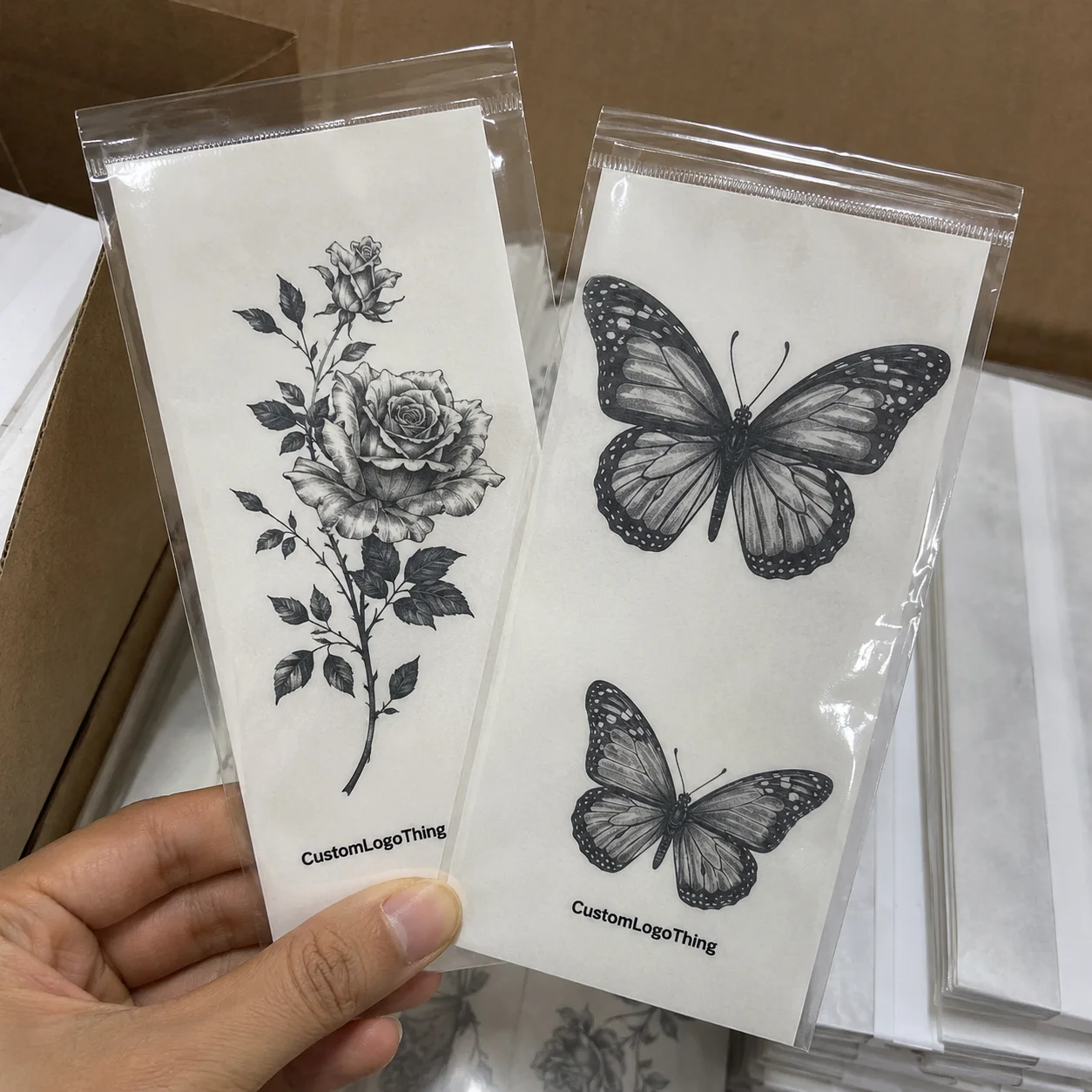
Custom tattoo stickers are temporary skin-applied designs printed on a transfer system. A typical construction includes a printed image layer, backing or release paper, a water-activated release coating, an adhesive layer intended for short-term skin contact, and a clear protective top sheet that keeps the image clean before use.
They are not standard vinyl stickers with a different name. A vinyl decal is made to grip packaging, glass, laptops, bottles, retail fixtures, or equipment for weeks or months. A temporary tattoo transfer is built for flexible wear on skin, water-assisted application, short-term decoration, and relatively clean removal.
Skin is a difficult surface. It bends. It sweats. It has oils. It stretches and rubs against sleeves, bags, towels, jewelry, and everything else humans drag through a day. A good tattoo transfer needs to be thin enough to move with the skin while still holding the printed image together during application.
Heavy films can feel like a label. Weak transfer systems can crack, wrinkle, smear, or leave pieces stuck to the backing sheet. Neither looks premium.
Common uses are practical: event giveaways, merch drops, kids’ promotions, festival branding, product launches, beauty packaging inserts, streetwear extras, and retail novelty packs. They also work as small inserts inside broader branded packaging programs, especially where a brand wants something fun inside a mailer, pouch, box, or gift set.
Format matters. A loose bulk sheet may be fine for a one-day handout. A retail pack often needs a backer card, barcode, hang hole, warning copy, protective sleeve, and carton pack plan. If the piece is going into a kit, it also needs to fit the kit without bending, curling, or floating around loose.
These are informational, promotional, or decorative products. They should be specified with materials and inks intended for temporary skin application in the market where they will be sold or distributed. If the audience includes children, ask more questions early. Age guidance, labeling, documentation, and warning copy may need extra attention.
Packaging-floor rule of thumb: if the product touches skin, do not treat it like an ordinary printed sticker. Treat it like a small printed consumer product with material, use, and removal requirements.
How Temporary Tattoo Transfers Work on Skin
Most temporary tattoo transfers use a water-transfer method. The user removes the clear protective film, places the printed side against clean, dry skin, wets the backing paper thoroughly, waits briefly, then slides or lifts the paper away. If the sheet shifts during that wet stage, the image can smear, split, or land crooked.
The layers each have a job. The release paper carries the printed image before use. The water-activated release coating lets the image separate from the paper. The adhesive helps the image bond to skin. The top protective film keeps the printed surface from scuffing, blocking, or picking up dust while the product is packed and handled.
Artwork is usually mirrored before printing. That way, once the design is placed face-down and transferred, the final image reads correctly on skin. Text, logos, arrows, mascots, and any directional graphic need careful proof review because orientation errors are easy to miss if the proof only shows the production view.
Ask for both views: mirrored production art and final applied view. It is a small request. It prevents a very stupid mistake.
Print behavior deserves respect too. Solid black, bold color blocks, and simple shapes tend to transfer more confidently than hairline strokes, tiny type, or pale gradients. A logo that looks clean at 4 inches wide may fail at 1 inch wide if it relies on thin outlines or small reversed-out lettering.
The finish should feel light. The goal is a thin, flexible image film that moves with the skin without feeling like a plastic label. It still has to hold together during transfer. That balance comes from the transfer coating, ink laydown, adhesive, drying, and finishing process.
Wear time varies. Skin type, placement, friction from clothing, sweating, swimming, bathing, and aftercare all change the result. Hands, wrists, and ankles usually see more rubbing than upper arms or shoulders. For promotional use, position these as short-term decorative wear, not long-term body art.
Removal is usually handled with baby oil, rubbing alcohol, adhesive-removal wipes suitable for skin, or gentle scrubbing with soap and water. Clear removal guidance belongs on the sheet, backer card, or retail instruction panel. Good instructions reduce complaints. Bad instructions create “your product didn’t work” messages that were avoidable.
Key Material, Ink, and Artwork Specs to Decide Early
Start with intended use. Children’s giveaways, fashion merch, beauty inserts, event promotions, and retail packs can need different quality checks, packaging choices, and documentation. A quick booth giveaway is not the same job as a novelty pack hanging beside cosmetics or accessories.
Material structure drives performance. Backing paper weight affects handling and curl. Protective film affects storage and scuff resistance. Adhesive and transfer coating affect release, feel, and removal. You do not need to know every chemistry detail, but you should ask whether the system is designed for temporary skin contact and water-transfer application.
Color planning is different from ordinary Custom Labels & Tags. Labels are usually viewed on white or predictable stock. Tattoo transfers are viewed on skin tones that range widely. Pale yellow, beige, light gray, and soft pastels can disappear on some wearers, so contrast matters more than it does on a white label proof.
White ink and opacity are worth discussing before proof approval. Some temporary tattoo systems print color in a way that depends on the skin tone underneath. Others may use a white base or different ink strategy for stronger color. Do not assume the proof on a bright monitor equals the final appearance on skin.
For artwork files, vector is preferred for logos and line art. High-resolution raster files can work for illustrations, but 300 dpi at final print size is a practical minimum. Tiny web images pulled from a site header almost never hold up well in print. They are convenient. They are also usually garbage for production.
Safe margins matter. If several tattoo designs sit on one sheet, leave enough space around each piece for the user to cut or separate it without nicking the artwork. For multi-design sheets, a gap of 0.125 to 0.25 inches between designs often makes handling easier, depending on the final format.
Avoid tiny text, ultra-thin line art, and small reversed-out details. Those are the first elements to break, blur, or become unreadable after transfer. As a rough production check, if legal copy or social handles need to be smaller than 6 to 7 points, move that information to the backer card instead of forcing it into the tattoo image.
Sheet size should match the job. Small singles work well for giveaways. Multi-design sheets suit retail packs, party favors, and branded merchandise bundles. Larger sheets can feel more valuable, but they increase material cost, packing size, and sometimes freight.
Packaging add-ons can include instruction cards, printed backing, branded header cards, cello bags, paper envelopes, hang holes, barcode labels, batch labels, or carton markings. For brands already building product packaging or package branding around a launch, the tattoo sheet should look like part of the same system. Not a last-minute insert someone found in a desk drawer.
Process, Timeline, and Production Steps from Art to Delivery
The usual path is simple on paper: artwork review, quote confirmation, proofing, prepress adjustments, material preparation, printing, transfer-layer finishing, cutting or sheet trimming, packing, and shipping. Each step can add time if details are missing.
Artwork review checks the basics: resolution, mirrored orientation, line thickness, color mode, safe margins, sheet layout, and whether instruction copy or packaging art is included. If the order includes retail packaging, the review may also cover barcode placement, backer card size, hang-hole location, warning copy, and carton pack count.
Proofing is not a rubber stamp. Review spelling, orientation, scale, color expectations, sheet size, and how each tattoo sits on the page. If the proof shows mirrored artwork, ask for a final applied-view reference. If the proof only shows the applied view, ask how mirroring is handled in prepress.
Sampling or pre-production checks are useful for larger retail runs, detailed artwork, or programs where skin feel and transfer performance are critical. Not every small promotional order needs a full sample round. If you are ordering thousands of retail units, though, a physical sample can be worth the added time and cost.
A sample is not just about color. Check whether the tattoo releases cleanly from the backing, whether thin areas tear, whether the surface feels too heavy, whether instructions are clear, and whether the packed unit curls or scuffs. For retail, also check scan position, hang-hole strength, and how the unit sits in the planned display.
Timeline depends on quantity, sheet complexity, packaging requirements, proof revision speed, material availability, and shipping distance. Many straightforward promotional orders fall around 7 to 15 business days after proof approval, with more time needed for custom cards, individual bagging, retail assembly, or sample approval. That is a planning range, not a universal promise.
Count lead time from approved proof, not from the first inquiry. Artwork changes, missing files, unclear orientation, and unanswered proof questions can easily burn two or three business days before production starts.
Give the supplier the in-hands date, event date, and delivery location at quote stage. If freight needs to cross a border, reach a convention center, or arrive before a launch kit assembly date, that affects the plan. Buyers who share the real deadline early usually get better routing options.
Cost, Pricing, MOQ, and What Changes the Unit Cost
Pricing is not based only on the number of tattoo sheets. The quote is built from setup, print method, sheet size, number of designs, material structure, finishing, packing, and freight. A single 2-inch giveaway tattoo and a retail-ready multi-design card may both be temporary tattoos. Production sees two different jobs.
MOQ exists because setup, proofing, material handling, machine time, and packing labor exist whether the order is small or large. Unit cost usually drops as quantity rises because fixed setup costs spread across more pieces. Packaging labor can keep the price from falling as sharply as buyers expect, especially with individual sleeves, backer cards, or barcode labeling.
Common cost drivers include larger sheet sizes, heavy color coverage, complex multi-design layouts, individual bagging, custom backer cards, retail hang holes, rush production, split shipments, and carton labeling. Freight can also surprise people, particularly if the pieces are carded, bagged, and packed with display-ready count requirements.
| Format | Typical Use | Common Cost Drivers | Practical Price Behavior |
|---|---|---|---|
| Simple single tattoo sheet | Event handouts, booth giveaways, street team promos | Setup, sheet size, print coverage, bulk packing | Lowest unit cost at volume; often best for quick promotional programs |
| Multi-design sheet | Party favors, merch bundles, kids’ promotions | Layout time, safe spacing, larger sheet area, trimming | Higher than singles, but stronger perceived value per sheet |
| Carded retail pack | Retail packaging, novelty sales, beauty inserts | Backer card, barcode, hang hole, sleeve, assembly labor | Higher landed cost; better for shelf presentation and resale |
| Individually wrapped giveaway unit | Festivals, product launches, controlled handouts | Bagging, instruction insert, count verification, carton packing | Labor adds cost, but distribution is cleaner and more controlled |
As a broad planning range, simple promotional pieces can sometimes price below a dollar each at higher quantities. Small runs, larger sheets, or retail-ready packs can rise quickly because setup and hand assembly dominate the cost. A 5,000-piece bulk sheet program will price very differently from 500 individually sleeved carded units.
The honest quote needs artwork, size, quantity, packing style, and destination. Anything else is guesswork dressed up as confidence.
Ask for price breaks at two or three quantities: a test run, expected launch quantity, and likely reorder quantity. That gives you a real view of the economics instead of one isolated number. Also ask the supplier to separate tattoo cost from optional packing costs if the budget is tight.
For broader launch planning, compare tattoo inserts with other Custom Packaging Products, such as cards, sleeves, custom printed boxes, and promotional labels. Sometimes the tattoo itself is inexpensive while the presentation format carries the larger share of the budget.
Step-by-Step Guide to Preparing a Print-Ready Order
-
Decide the job purpose. Is this an event giveaway, merchandise insert, retail sale, party favor, or promotional launch? That choice shapes sheet size, packaging, quality checks, and instruction copy.
-
Choose the format. Options include a single tattoo, a sheet-style layout with several designs, a branded carded pack, or an individually wrapped giveaway unit. For retail, think about how the piece will hang, scan, ship, and sit in a display carton.
-
Set final dimensions. Confirm both the tattoo image size and the full sheet size. Keep enough space around each design for easy handling. If users need scissors, leave room for cutting without damaging the printed image.
-
Prepare strong artwork. Use vector files where possible, especially for logos. Keep edges clean, contrast high, and text large enough to survive transfer. Print the proof at actual size on office paper and view it from arm’s length. That simple check catches more than people expect.
-
Confirm mirroring responsibility. Some manufacturers want normal artwork and handle mirroring during prepress. Others request mirrored files. Either can work, but the proof should make orientation unmistakable, especially for logos, words, arrows, and faces.
-
Add instructions and safety notes. Include application steps, removal guidance, age recommendations if applicable, and retail information such as SKU, barcode, batch code, or warning copy. If the product is for children, ask about documentation early.
-
Review the proof slowly. Check spelling, logo proportions, color expectations, sheet layout, final scale, and packaging copy before approval. Proof approval is the last inexpensive point to catch mistakes.
Compliance can vary by destination and audience. For paper packaging, chain-of-custody or sourcing may matter; the Forest Stewardship Council is a useful reference if you are specifying FSC paper for backer cards or sleeves. For transit performance on larger shipments or retail cartons,