Folded Woven Labels Bulk low MOQ is a useful sourcing lane for brands that need presentation quality without overbuying. It sits in a practical middle ground: enough volume to bring unit cost down, not so much that you are forced to warehouse years of trim for one season’s style.
That balance matters more than it sounds. A label is small, but it touches brand perception on every garment. If the weave is coarse, the edge scratches, or the print detail collapses after stitching, the product feels unfinished even when the fabric and sewing are solid. Customers usually cannot explain why a garment feels better or worse. They just feel it.
For capsule collections, test drops, and modest reorder programs, the buying question is not whether woven labels are premium. The real question is whether the spec is right for the garment and whether the MOQ aligns with cash flow. For broader trim sourcing, our Custom Labels & Tags page covers the core label formats, while the FAQ page answers the order details buyers usually check first.
Why folded woven labels bulk low MOQ works for small brands
Small brands do not have the luxury of treating every trim order as if it were a long-run commodity purchase. A woven label run may look inexpensive on paper, but the real cost is tied to inventory risk, design stability, and how often the line changes. Low MOQ protects against buying too much of a label that only fits one collection.
That protection is valuable during launches. It is also useful when a brand is changing fit blocks, testing a new garment category, or splitting a line into multiple colorways. A label spec that can be ordered in bulk without a huge entry quantity gives the team room to test the market before committing to a larger production cycle.
There is a second advantage that gets missed in price-only comparisons. Factories often build quotes around setup, loom programming, yarn selection, cutting, folding, and finishing. When the order is too small, those fixed tasks are spread across fewer pieces, which raises the unit price. That does not make the order bad. It just means the buyer should judge the quote against the business purpose of the run.
Woven labels also tend to hold up better than printed labels in repeat wash cycles. Print can be fine for simple care content or emergency budget work, but woven construction generally keeps text and borders more stable over time. That matters for retail apparel, children’s clothing, activewear, and basics that are expected to survive a lot of wear.
A label should do three jobs at once: identify the brand, stay comfortable against skin or lining, and keep its shape long enough to survive the garment’s life cycle. If one of those fails, the garment feels less complete.
In buyer terms, folded Woven Labels Bulk low MOQ works because it connects product quality to production discipline. The brand gets a premium-looking component, the factory gets a spec that can be repeated, and the finance team avoids tying up cash in oversized trim inventory.
Select the fold, edge, and placement that fit the garment
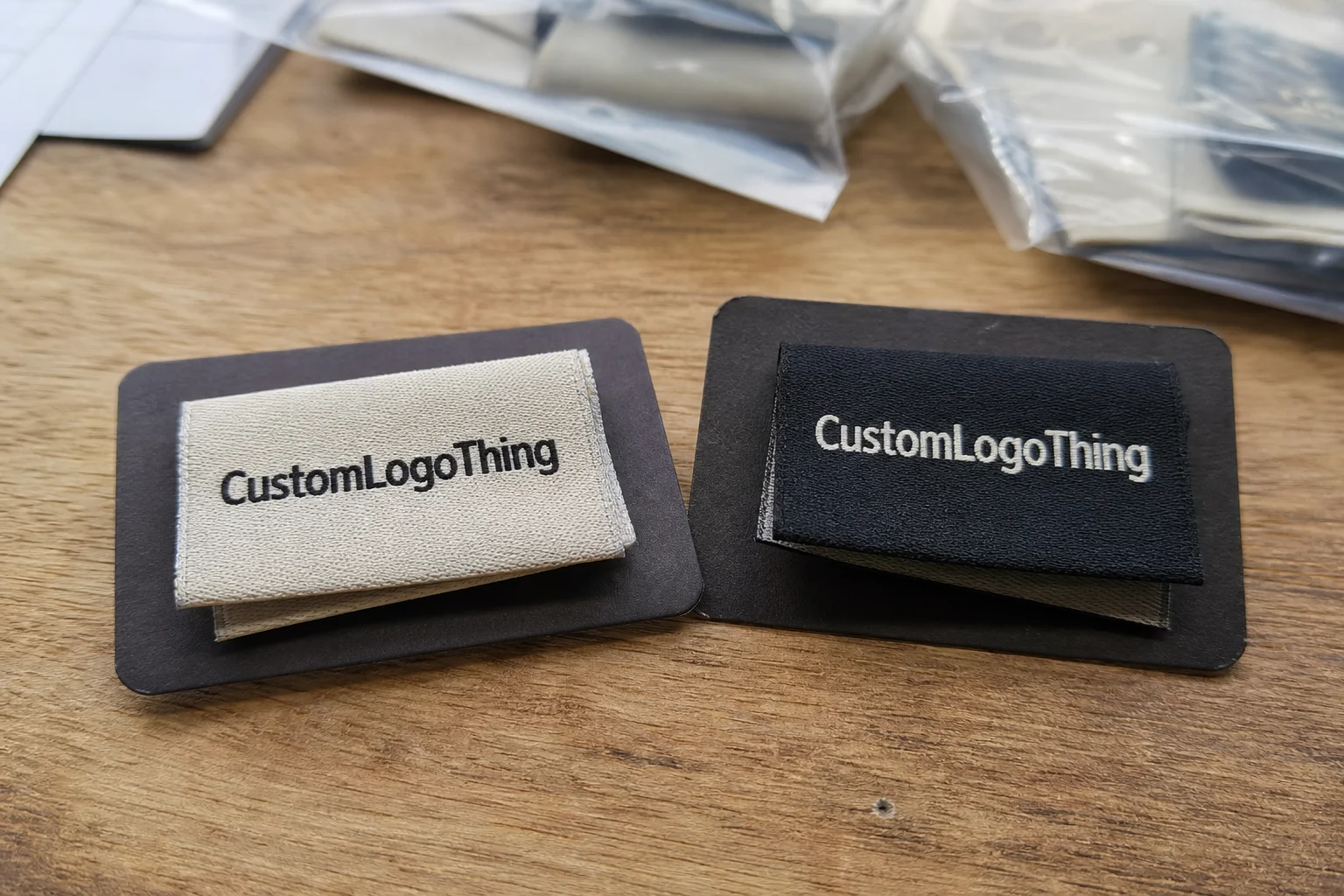
Fold choice should start with sewing reality, not with artwork preference. A center fold is common for neck labels because it tucks neatly into the seam and gives the garment two visible faces. An end fold is often better for side seams and exterior branding because the label disappears more cleanly into the stitch line. Mitre folds help when the label needs to lie flatter. Flat labels still have a place when the construction needs maximum flexibility.
The garment decides the fold almost as much as the design does. A jersey tee, a heavyweight hoodie, a woven shirt, and a lined jacket do not ask for the same label behavior. Neck labels need softness and low bulk. Side-seam labels can tolerate a little more structure because they sit away from the skin. Waistbands and outerwear lining usually need a label that will not twist, curl, or build up a hard ridge inside the garment.
Placement also changes how the label reads. If the visible area is too small, text crowds the border and the label starts looking cramped after stitching. If the fold allowance is too tight, the edge can sit awkwardly or feel sharp. That is why the artwork should be designed around the actual sewing space, not around the full uncut rectangle.
- Center fold - best for neck labels with a clean interior finish and two readable panels.
- End fold - useful for side seams and exterior branding where the edge needs to tuck under stitching.
- Mitre fold - helpful when the label needs to lie flatter with less bulk at the corners.
- Flat label - suitable when sewing flexibility matters more than a folded presentation.
Comfort is not an abstract design goal. It shows up in returns, complaints, and how often a customer cuts the label out. Children’s wear and activewear are especially sensitive here because the label moves more and touches skin more often. If the edge treatment is poor, even a good fabric can feel irritating.
For buyers ordering multiple trims together, keeping the label spec aligned with other branding pieces can save time across the supply chain. That is one reason some teams route trim purchases through Wholesale Programs rather than ordering each component in isolation.
Specifications that control quality, softness, and clarity
The quality of a folded woven label is mostly determined before production starts. Once the artwork and construction are approved, the factory can only work within those limits. The most important specs are finished size, fold type, weave density, thread colors, background color, edge finish, and the exact text layout.
Weave density matters more than many first-time buyers expect. A damask-style weave is usually the better choice when the label needs small type, fine lines, or compact logos. It supports better visual resolution in a tight space. A heavier weave can work for bold marks and simple graphics, but it will not protect tiny care symbols or thin serif lettering very well. If the artwork depends on delicate detail, ask how it will look at the final sewn size, not just on a screen proof.
Softness is partly a yarn choice and partly a finishing choice. A label can be technically accurate and still feel abrasive if the seam allowance is too narrow or the cut edge is left too stiff. A neck label that passes a visual check may still fail in wear if it feels scratchy after a few hours. Buyers should ask for a sample or, at minimum, a proof that makes the finish and border width obvious.
Durability should be discussed in practical terms. For everyday apparel, the label should stay legible after repeated laundering and tumble drying. For activewear, it must handle more friction and moisture. For kids’ clothing, the edge finish matters more because the garment is washed often and worn close to skin. A useful supplier answer is not “high quality.” It is how the label behaves after 20, 30, or more wash cycles in the intended use case.
Artwork quality can shorten or wreck the production timeline. Vector files are easier to work with because they preserve clean edges and proportions. Low-resolution raster files often force revisions, and revisions add both time and cost. Buyers who are trying to keep cost per piece down usually do better when the artwork is already final before they request the quote.
Digital proofs are standard. Physical samples are worth the extra step when the label has very small text, multiple colors, a tight border, or a fold that affects readability. That is especially true if the buyer is trying to get Folded Woven Labels Bulk low MOQ pricing without losing the premium feel that the garment needs at retail.
Packaging and transit quality are part of the spec, too. Labels are small, but bulk packs can still arrive bent, count-mismatched, or exposed to moisture if the packing method is careless. Standards and guidance from ISTA are useful if you want to think about distribution stress in a more disciplined way. For labels that sit alongside cards, hangtags, or cartons made from paper-based materials, FSC sourcing can matter for the broader trim package as well.
Cost, pricing, and MOQ thresholds to compare before you order
The headline unit price is only one part of the cost. Quantity, number of colors, fold complexity, yarn matching, proof requirements, and whether tooling or setup is included all move the quote. A simple two-color center-fold label is not comparable to a dense label with multiple colors and a custom edge treatment.
Low MOQ reduces inventory risk, but it usually raises the unit price relative to a large repeat order. That is normal. The mistake is treating a test run as if it should match the pricing of a mature core SKU. Different buying jobs deserve different price structures.
| Order Type | Typical MOQ | Approx. Unit Cost | Best For | Common Tradeoff |
|---|---|---|---|---|
| Test run | 300-500 pieces | $0.10-$0.24 | New styles, launch testing, sample programs | Higher unit price and stronger setup sensitivity |
| Small bulk order | 1,000-3,000 pieces | $0.05-$0.12 | Capsule collections, limited reorders, seasonal lines | Still enough room to refine the spec if needed |
| True bulk run | 5,000+ pieces | $0.02-$0.06 | Core styles, recurring production, stable SKUs | More cash tied up in inventory |
Those ranges shift with the design. More colors usually mean more cost. Smaller type may force a tighter weave and a more careful proofing process. Special folds and extra finishing add labor. Buyers should ask whether sampling, artwork corrections, shipping, and any tooling fees or setup charges are included in the quote, because an apparently cheap line item can become expensive once the missing pieces are added back in.
The most useful comparison is landed cost, not unit price. That means the label price, shipping, rework risk, replacement allowance, and the time cost of delays all matter. If the first order is being used to test a product, a slightly higher unit price may still be the better financial move because it avoids overbuying trim that never gets used.
Brands that manage several SKUs often standardize the label spec so future orders are easier to quote. That also makes it easier to see whether a factory is pricing consistently or padding the cost without explanation. Stable specs help purchasing teams compare one order to the next, which is where the actual savings show up.
Production steps, timeline, and approval checkpoints
The production sequence is straightforward when the buyer gives clear input. It usually goes: artwork submission, proofing, loom setup, weaving, folding or cutting, inspection, and packing. The schedule depends heavily on how clean the file is and how quickly the buyer can approve the proof. A complicated label with multiple revisions can lose days before production even starts.
A simple order often moves through production in about 10-15 business days after proof approval. More detailed artwork, multiple colors, special folds, or complicated finishing can extend that window. Shipping time should be counted separately. Missing that distinction is how launch dates slip even when the factory did its part on time.
The proof is the critical checkpoint. It should show the final dimensions, fold style, color references, stitch position, and exact text layout. If the label includes care content or compliance copy, check the line breaks carefully. Tiny text can become unreadable if the spacing is too tight or the weave is too coarse.
Quality control should be concrete. Good checks include edge consistency, color accuracy, stitch alignment, count verification, and pack labeling before shipment. If the labels are going into a larger apparel program, carton labeling and bundle counts should be locked in as well. A neat woven label is useful; a neat woven label packed incorrectly is still a problem.
Production speed is mostly a function of clarity. Clean vector art, final dimensions, and a decisive approval path make it easier for the factory to move quickly without making avoidable mistakes. A buyer who keeps changing the spec creates waste. A buyer who finalizes the spec early usually gets better timing and better consistency.
For teams that want to organize reorder structure or compare minimums across several trim lines, the most efficient starting points are our Wholesale Programs page and the FAQ. That keeps the brief aligned before production begins and reduces the back-and-forth that slows smaller orders.
Why repeat buyers standardize on one woven-label spec
After a few production cycles, most repeat buyers settle on one label format. That is usually a sign that the spec is doing its job. A stable width, fold, weave density, and artwork placement reduce rework across styles and seasons. They also make quality control faster because the team already knows what “right” looks like when the boxes arrive.
Standardization is not about dullness. It is about reducing avoidable variables. The label should support the garment, not compete with it. If every style in the line uses the same woven label format, the visual identity stays consistent and the operations team has fewer one-off decisions to manage. For a small team, that reduction in decision load is real value.
It also helps purchasing. Once the approved spec is fixed, future quotes can be compared against the same baseline. That makes it easier to catch unexplained price jumps, altered materials, or a change in fold execution. A recurring label spec becomes a reference point, not just a trim order.
There is a quieter benefit: reorders become less risky. The buyer already knows how the label behaves on the garment, how it feels in wear, and how it holds up after laundering. That means fewer surprises, fewer samples, and fewer approval loops. Even if the MOQ stays modest, the administrative burden drops.
For Brands That Sell through direct-to-consumer and wholesale channels at the same time, a stable label spec helps keep presentation consistent while the product mix changes underneath it. That is where folded woven labels bulk low MOQ becomes more than a procurement choice. It becomes part of the operating model.
Next steps: what to send for an accurate quote
An accurate quote starts with the right input. Send the finished label size, preferred fold, quantity break, garment type, and sewing location. Those details determine the price, but they also determine whether the label will work in production. A quote for a neck label is not the same as a quote for a waistband insert or an exterior seam tab.
Include vector artwork when possible, plus brand color references, care-copy text, and any required compliance wording. If the label is still being finalized, say so. A supplier can quote a test run differently from a production order, but only if the brief reflects the real plan. A vague request usually returns a vague price.
It also helps to share the target ship date and whether the order is a launch, a reorder, or a sample stage. Those are different schedules with different pressure points. If the date is fixed, the factory needs to know early so the lead time can be judged honestly rather than optimistically.
From a production buyer’s point of view, the right decision path is simple: define the garment need, compare landed cost, and approve the spec only when it matches the line. If the label is soft, legible, and consistent, it earns its place. If it is not, it becomes a small defect that keeps showing up in returns, complaints, or avoidable production delays.
Send the spec, compare the quote against your garment margin, and move ahead only when the folded woven labels bulk low MOQ order supports the collection instead of complicating it.
What is a realistic MOQ for folded woven labels in a small run?
MOQ depends on the factory, fold style, and design complexity, but low-MOQ programs are often set up for launches, sample tests, and seasonal drops. Ask whether the minimum applies per design, per colorway, or per size, because those details change the real entry point. A lower MOQ usually raises cost per piece, so the better comparison is landed cost rather than the headline unit price.
Which fold is best for neck labels versus side-seam labels?
Center fold is common for neck labels because it gives a clean sewn-in finish and two visible panels. End fold usually works better for side seams and exterior branding because the edge can sit inside the stitch line. The best choice depends on comfort, visibility, and how much seam allowance the garment actually has.
Do folded woven labels bulk low MOQ orders cost less than printed labels?
Not always on the unit quote, but woven labels usually deliver stronger wash durability and a more premium tactile feel. Bulk pricing improves as quantity rises, while low MOQ mainly reduces inventory risk and protects cash. A useful comparison includes replacement rate, appearance after washing, and how the label affects retail presentation.
How long does production usually take after proof approval?
Simple orders often move through production in about 10-15 business days after proof approval, though detail level and quantity can extend that window. Shipping time is separate and should be added to the factory lead time before launch commitments are made. Clean files and fast approvals are the fastest way to keep the schedule predictable.
What files do I need to get an accurate quote for folded woven labels?
Send vector artwork when possible, along with the desired label dimensions, fold style, quantity, and garment placement. Include care instructions or compliance copy if they must appear on the label, because that affects spacing and readability. Clear specs reduce back-and-forth and make the quote more dependable before production starts.