Custom Frosted Zipper Bags for soap brands solve a problem that sounds simple and rarely is: how to make a bar of soap feel finished, retail-ready, and worth its price without forcing it into a box that does too much. The frosted surface softens fingerprints and minor scuffs. The zipper adds reuse value. The pouch format keeps the product visible, but not exposed in a way that makes it look unfinished.
Soap is a strange category in packaging terms. It can be artisanal and low volume, yet still need the same discipline as a mass-market item: clear labeling, stable presentation, shelf impact, and a reliable pack-out process. A frosted pouch sits in that middle ground better than many rigid formats. It does not feel as formal as a carton, and it does not feel as disposable as a basic clear sleeve.
That middle ground matters because buyers react quickly to packaging. A bar that smells excellent can still be passed over if the presentation looks thin or improvised. A frosted zipper bag gives a soap brand one useful advantage: it turns a practical item into something that looks considered without overbuilding the package.
Why custom frosted zipper bags for soap brands stand out on shelf
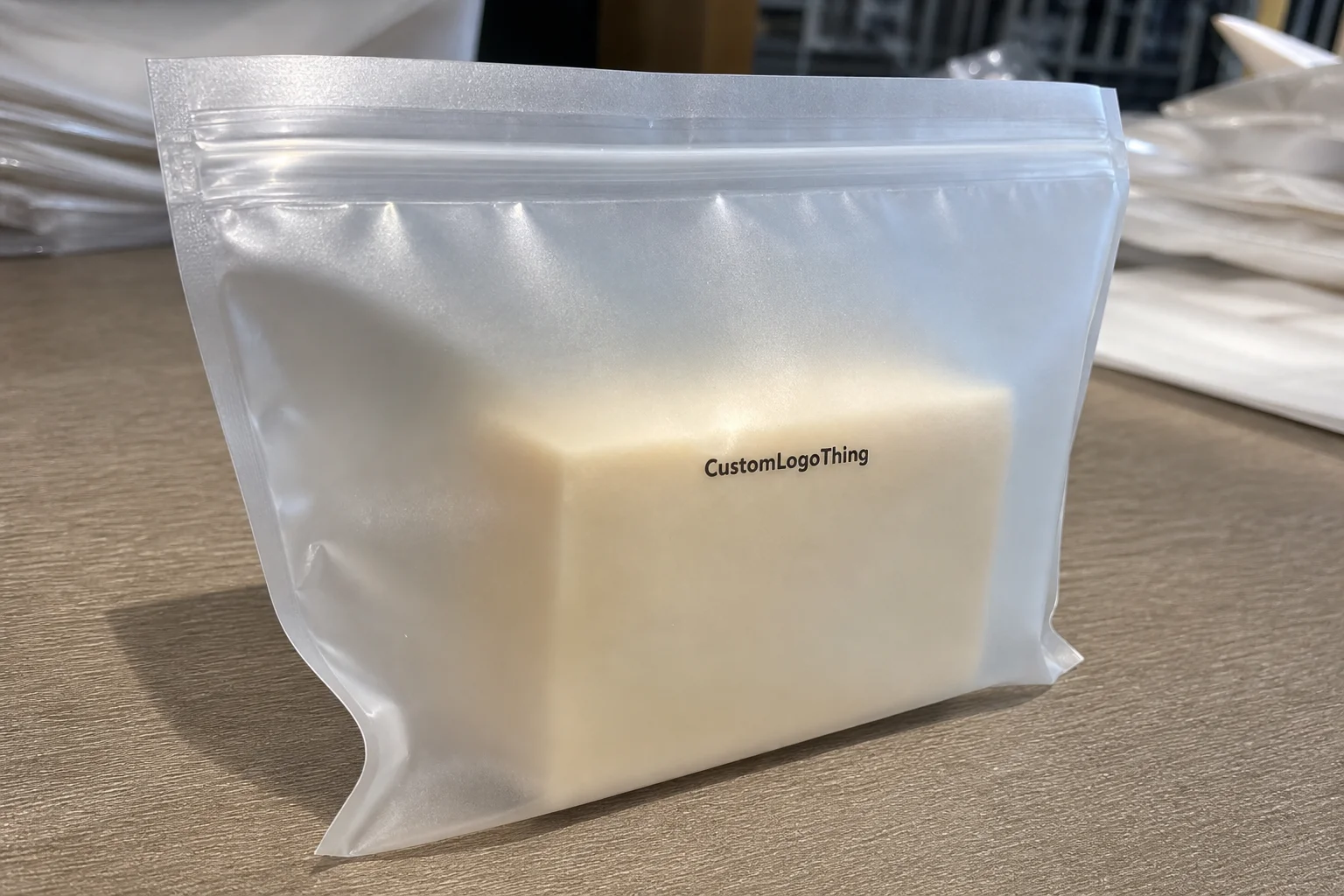
The first thing people register is finish, not copy. Frosted film has a muted, matte-like quality that reads calmer than glossy plastic. That visual quiet is useful for soap because the product itself often carries enough color, texture, or branding to do part of the work. The packaging does not need to compete with it.
Clear pouches can be too blunt. They show every edge, every blemish, and every uneven corner in the bar. Fully printed opaque packaging solves that, but it can swing too far in the other direction and hide the product completely. Custom Frosted Zipper Bags for soap brands keep the bar visible while smoothing the presentation. The bag feels deliberate rather than exposed.
The zipper changes the perception again. It signals that the package can be opened and resealed, which is useful for sample sets, gift bundles, travel bars, and products that are handled more than once. Customers may not say “resealable closure” out loud, but they register the utility immediately. That tiny functional cue often supports the premium feel more than a decorative flourish does.
These bags tend to perform well for:
- Single bar soap with a handmade or premium position
- Sample kits and discovery sets
- Holiday bundles and scent collections
- Retail packaging that will be touched before purchase
For brands building a broader packaging system, the frosted pouch usually works best as one piece of a larger set rather than a one-off decision. The packaging line should be coherent across soaps, labels, inserts, and any outer cartons. More on broader format choices sits under Custom Packaging Products, while Case Studies show how format choice affects presentation across categories.
If the bag feels cheap, the soap inherits that feeling. Packaging sets the price expectation before the bar is ever touched.
That is why this format shows up so often in higher-margin handmade lines. It makes a product look giftable without making it look fragile. It also scales across channels. The same pouch can work in retail, at a market table, or inside an order fulfillment workflow if the dimensions and closure are right.
How the bag structure protects soap without boxing it in
Most frosted zipper soap pouches use a layered structure: an outer frosted film for appearance, a seal layer for containment, and a zipper for access. That sounds ordinary until you start comparing poor versions against good ones. Too light, and the bag wrinkles, bends, or feels flimsy in hand. Too heavy, and a modest soap bar starts looking overpacked. The right construction should feel intentional, not inflated.
Soap itself is not as straightforward as many packaging buyers expect. A hard, fully cured bar is stable. A freshly packed bar may still release a little moisture or fragrance, and certain formulas leave more residue or oil on the surface. If the soap is heavily scented, not fully cured, or intended for warmer storage conditions, the bag may need stronger barrier performance or a tighter spec around the seal.
That is why one generic pouch spec rarely fits every line. A retail bar that sits on shelf for months is a different package from a seasonal sample kit shipped quickly in small quantities. Freight conditions matter too. Heat, compression, and repeated handling can all show up in the final result. A bag that looks fine during sample approval can still fail the practical test if the seal line is weak or the zipper drifts out of alignment.
Good buyers think about use, not just appearance. Can the customer open the zipper with dry hands and close it again without fighting the track? Does the front panel keep its shape after pack-out? Does the soap move around too much inside the pouch? If the answer to any of those is yes, the packaging is not doing its job.
For brands selling across more than one channel, the structure also helps consistency. One pouch can work for ecommerce, wholesale, holiday kits, and counterside display if the dimensions are designed correctly. That flexibility is one reason Frosted Zipper Bags keep showing up in soap packaging conversations. They solve more than one problem at once, which is rare enough to matter.
Film thickness, print setup, and closure details that change the result
If there is one practical lesson here, it is that spec choices matter more than artwork. A good logo on the wrong bag still looks wrong. The major variables are film thickness, zipper style, bag size, seal width, and whether the pouch is meant to read as lightly translucent or nearly opaque. Those choices affect both the look and the invoice.
Thicker film usually gives a bag more body and better resistance to scuffing. That matters for rough-edged soaps, larger bars, or orders that will move through multiple touchpoints before the customer sees them. Thicker material also adds cost and bulk. For a small bar, excess bulk can make the pouch look clumsy. For a dense handmade bar, it can be the difference between a package that holds up and one that slumps.
Print setup is where many brands overcomplicate things. On frosted material, simple logos and disciplined typography usually outperform crowded artwork. The surface already adds texture. If the design also tries to do too much, the front panel becomes busy fast. Clean type, strong spacing, and a limited color palette usually hold up better than a front filled with tiny claims and decorative elements.
Legibility is not optional. Soap packaging often needs scent name, ingredients, usage guidance, net weight, and sometimes a barcode. On frosted film, pale ink and fine detail can disappear faster than expected. Darker ink on a lighter frosted surface is usually safer. If the goal is fast reading at arm’s length, keep the critical text larger than you think you need and avoid placing text over dense visual elements.
The closure deserves the same attention. A zipper that lines up cleanly communicates quality immediately. One that catches, bows, or closes unevenly can make the entire package feel off, even if the print is perfect. Customers notice friction. They may not know why the pouch feels cheap, but they will feel it.
| Option | Best for | Typical unit cost at 5,000 pcs | Tradeoff |
|---|---|---|---|
| Standard frosted zipper bag | Single bars, sample sets, retail display | $0.18-$0.28 | Balanced presentation and cost, lighter structure |
| Heavier-gauge frosted bag | Large bars, shipping, premium retail packaging | $0.24-$0.38 | Better structure, higher material cost, bulkier profile |
| Premium print with upgraded zipper | Gift sets, signature lines, higher-margin SKUs | $0.32-$0.55 | Stronger shelf presence, slower quoting, higher setup impact |
If the soap will ship through a more demanding distribution path, transit testing is worth discussing early. Standards such as ISTA transit testing can help verify whether the pouch and carton system survive compression and vibration. That is not required for every brand, but it becomes more relevant once the order moves beyond small retail batches. If the pack includes inserts or outer cartons, FSC-certified paper stock is also worth considering for the rest of the system.
Cost, pricing, MOQ, and unit cost for custom soap bags
Pricing for custom Frosted Zipper Bags for soap brands usually comes down to five variables: bag size, film thickness, print colors, zipper style, and order quantity. Everything else is secondary. Buyers often ask for a unit price first, but the unit price is really the result of those decisions, not the starting point. Change the spec, and the quote changes with it.
Small runs cost more per unit because setup gets spread across fewer bags. A 1,000-piece order may look close to a 5,000-piece order on paper, but the unit price can move enough to change margin planning. That is why many soap brands test with a narrow assortment first, then expand once the bar size, scent lineup, and packaging direction are confirmed.
MOQ is a real tradeoff, not a formality. Lower minimums help with seasonal lines, new scents, or trial runs, but they usually raise the per-unit price. Larger quantities improve cost and often make print setup easier to justify. If a brand is launching multiple variants, ask for pricing at two or three quantities. That gives a clearer view of the cost curve and prevents guesswork.
A practical quoting request should include at least three versions if the budget is tight:
- A standard bag for baseline pricing
- A heavier film version for durability comparison
- A premium print version for retail comparison
Those three points expose the tradeoffs quickly. A cheaper bag is not automatically the better purchase if it makes a premium bar look underbuilt. For a soap line retailing in the $8 to $14 range, packaging has to support the price, not sit beside it as an afterthought.
For some brands, there is a crossover point where a pouch is no longer the right answer. If the soap needs more structure, more protection, or a stronger unboxing moment, custom printed boxes may make more sense. If the main priorities are lower freight weight, flexibility, and a resealable closure, custom frosted zipper bags for soap brands usually stay ahead.
Process and timeline: from dieline approval to delivery
The production sequence is straightforward, but the delay points are predictable. First confirm dimensions. Then review the dieline. Then approve the artwork. Then sign off on the proof. If samples are required, that adds a step before mass production. The factory cannot guess the bar size, and it should not be expected to.
The most common delay is artwork, not manufacturing. Files arrive at the wrong size, barcode placement is missing, copy changes late in the process, or the brand revises the color direction after proof approval. Those changes are normal once. They become expensive when they happen repeatedly. Every late revision can push the production schedule, especially if the job uses multiple print colors or special finishes.
For simple custom frosted zipper bags for soap brands, a realistic timeline is often 12 to 15 business days from proof approval to production completion, with freight added on top. Custom dimensions, heavier film, and more complicated print setups can add time. Sampling may take another week or two depending on how quickly decisions move on the brand side. Speed is possible. Speed plus indecision is where schedules fall apart.
Before shipment, ask how the supplier checks quality. The main items are zipper alignment, seal strength, print registration, and clarity of the frosted film. A pouch can look fine from a distance and still fail in use if the closure catches or the seal is uneven. Good factories catch that before packing, but the inspection process should be visible, not implied.
Carton packing matters too. If the pouches are compressed too tightly in the master carton, the finished bags can arrive bent or scuffed in a way that changes how they look on shelf. Packaging is a chain. The bag is only one link.
Common mistakes soap brands make with frosted zipper bags
The most common sizing mistake is ordering a pouch that fits the bar too tightly. On paper, that sounds efficient. In practice, it slows pack-out, can wrinkle the front panel, and makes the soap look cramped. A small amount of breathing room improves presentation and usually makes the zipper easier to use.
Overdesign is another recurring problem. Too many colors, too much copy, and too many claims can make frosted material look busier than intended. The bag already has visual texture. Add too much artwork and the front panel starts to feel noisy rather than premium. The cleanest soap packs usually choose one focal point and leave the rest quiet.
Handling gets underestimated. If the zipper is stiff, misaligned, or difficult to close, the packaging stops feeling premium and starts feeling annoying. That is not a small issue. Customers interact with the closure every time they open the pouch. If the mechanism is awkward, the damage is repeated use, not a one-time impression.
Spec mismatch is just as damaging. Thin film around a heavy bar feels weak. A glossy surface can clash with a handmade or low-waste brand story. A frosted zipper bag works best when the finish, structure, and brand position are aligned. That sounds obvious, but it still gets missed because packaging is often treated as the last decision instead of part of the product design.
There is one more mistake worth avoiding: judging the packaging from a mockup alone. Mockups are useful, but they can hide weak points in closure alignment, opacity, and print contrast. Ask for a sample or a clear production proof before approving a full run. A supplier that explains the tradeoffs is usually more trustworthy than one that says every option will look the same.
What to send before you request a quote
If the goal is a useful quote, start with the basics: product dimensions, bar weight, quantity per bag, print colors, and preferred finish. Those five details are enough to quote the correct structure instead of guessing. Guessing is how brands end up with a second round of pricing and a size that is almost right but not actually usable.
Then add the commercial details that affect the final number: target MOQ, ship-to location, whether samples are needed, and whether the pouches are for retail display, bulk storage, or fulfillment. A bag built for shelf merchandising should not be quoted exactly the same way as one meant for warehouse staging. Same format. Different job.
Ask for at least two options side by side. A standard bag and a heavier bag is often enough to reveal the cost step. If the line is positioned as premium, ask for a third version with upgraded print or closure details. That usually makes the quality tradeoff visible in a way a single quote never can.
For brands building out a full packaging system, the pouch should match the rest of the line in tone and information hierarchy. The label language, product claims, and any outer carton should read like they belong together. That consistency matters more than people expect, especially once the same soap line is sold through retail and ecommerce at the same time.
Custom frosted zipper bags for soap brands work best when the packaging is designed around the product first and the artwork second. Get the dimensions right. Choose the Right film. Keep the print disciplined. Ask for pricing that shows the tradeoffs instead of hiding them. That is the route to packaging that looks good, functions properly, and still makes sense on the invoice.
Are custom frosted zipper bags better for bar soap or liquid soap?
They are usually the better fit for bar soap, sample sets, and multipacks. Liquid soap needs different leak-proof packaging and closure specs. For bars, the zipper and frosted finish improve presentation without adding much weight.
What film thickness should soap brands choose for frosted zipper bags?
Choose thicker film if the soap is heavy, rough-edged, or shipped in bulk. Use a lighter spec for sample sizes or low-risk retail displays. The right thickness depends on how much protection you need versus how premium you want the bag to feel.
How much do custom frosted zipper bags for soap brands cost?
Pricing depends on size, film gauge, print complexity, zipper style, and order volume. Small runs cost more per unit because setup gets spread over fewer bags. Ask for quotes at multiple quantities so you can see where unit cost starts to improve.
What is the usual turnaround for custom frosted zipper bags?
Turnaround starts after artwork and dimensions are approved. Simple specs move faster than custom sizes, special finishes, or multi-color print jobs. Sampling, proofing, and freight timing all affect the final delivery window.
Do frosted zipper bags need vent holes for soap?
Sometimes, especially if the soap is freshly cured or still releasing moisture. Venting depends on the formulation, fragrance level, and storage conditions. A packaging supplier should confirm whether venting, barrier changes, or a tighter seal is the safer choice.


