Buyer Fit Snapshot
| Best fit | Order FSC Certified Carton Boxes for Sustainable Packaging projects where brand print, material claims, artwork control, MOQ, and repeat-order consistency need to be specified before quoting. |
|---|---|
| Quote inputs | Share finished size, material target, print colors, finish, packing count, annual reorder estimate, ship-to region, and any compliance wording. |
| Proofing check | Approve dieline scale, logo placement, barcode or warning zones, color tolerance, closure strength, and carton packing before bulk production. |
| Main risk | Vague material claims, crowded artwork, missing packing details, or unclear freight terms can make a low unit price expensive after revisions. |
Fast answer: Order FSC Certified Carton Boxes for Sustainable Packaging should be specified like a repeatable production item. The safest quote records material, print method, finish, artwork proof, packing count, and reorder notes in one written spec.
Production checks before approval
Compare the actual filled-product size with the drawing, then confirm tolerance on folds, seals, hang holes, label areas, and retail display edges. Reserve space for logos, QR codes, warning copy, and material claims before decorative graphics fill the panel.
Quote comparison points
Review material grade, print process, finish, sampling route, tooling charges, carton quantity, and freight assumptions side by side. A quote is only useful when the supplier can repeat the same color, closure quality, and packing count on the next order.
Order FSC certified carton boxes if you want packaging that clears procurement, supports the brand story, and still protects the product in transit. A carton can look responsible and still fail its real job. Nice printing does not stop dents, crushed corners, or awkward questions from a buyer who wants proof instead of slogans.
Order FSC certified carton boxes for the practical reasons first. The box needs to hold the product, the paperwork needs to satisfy the buyer, and the order should not turn into a week of email ping-pong. That matters for retailers, ecommerce brands, and any company that has to explain its sourcing to a procurement team that reads everything twice.
I have watched good launches get slowed down by a packaging spec that looked fine on a screen and fell apart in the warehouse. The fix was rarely dramatic. Usually it was a better board grade, a cleaner dieline, or a certification claim that matched the paperwork instead of the marketing copy. Boring? Sure. Effective? Absolutely.
If the carton is the first thing your customer touches, it has to do three things well: protect the product, look credible, and pass sourcing checks without a long back-and-forth.
For FSC basics, the source matters more than the slogan. The Forest Stewardship Council explains claim types and chain-of-custody standards clearly at fsc.org, and that documentation is what separates a genuine certified carton from a vague sustainability claim. If your packaging travels through parcel networks, testing matters too; ista.org covers shipping test methods that help reduce crushed corners, burst seams, and returns nobody wants to pay for.
One quick reality check: FSC certification covers the fiber claim and chain of custody, not every possible component in a mixed-material pack. Foils, plastics, magnets, and some specialty coatings may sit outside the certification claim. That does not make the box bad. It just means the paperwork has to match the build. Clean claims beat fuzzy ones every time.
Why Order FSC Certified Carton Boxes Instead of Cutting Corners
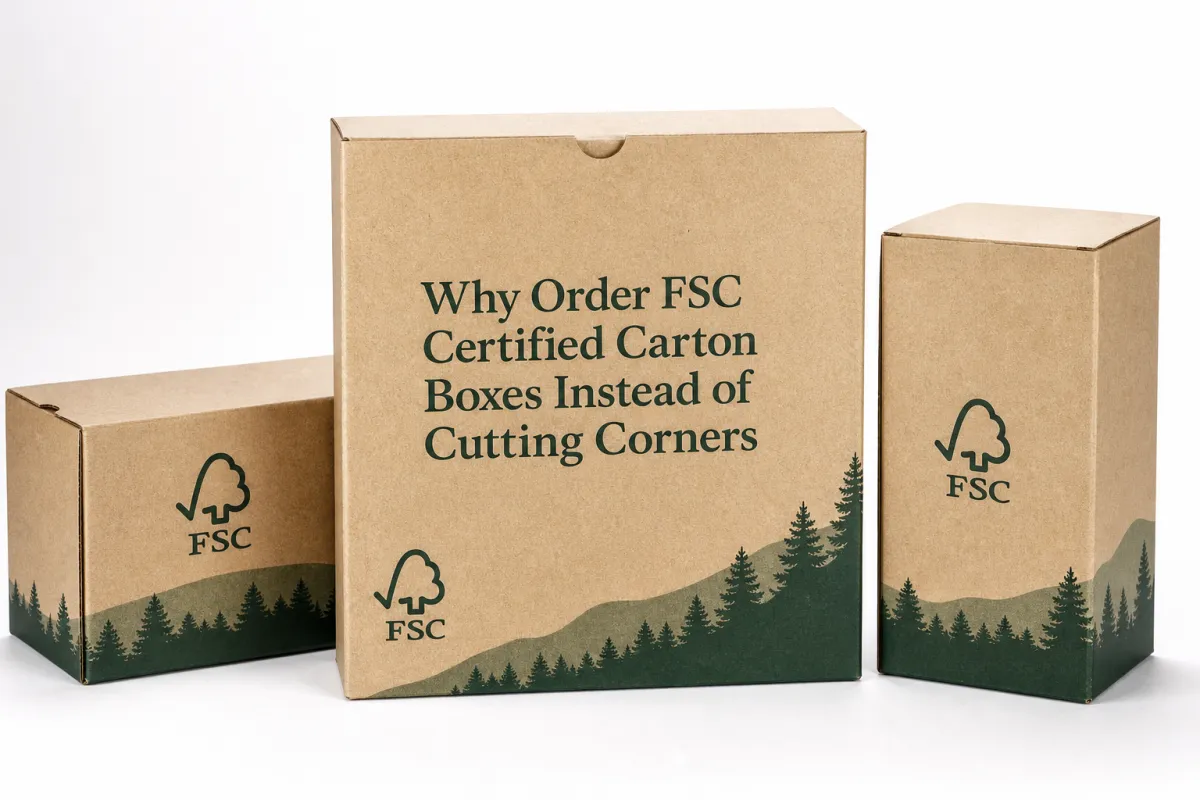
Order FSC certified carton boxes because the label only means something if the fiber claim can be verified. A brown carton does not automatically mean responsible sourcing. "Eco-friendly" printed in small type does not satisfy a retailer audit or a procurement review. Buyers want proof. That is the whole point.
From a packaging buyer's point of view, the carton is not decoration. It is part of the product experience. It has to fit the item, survive handling, resist compression, and still present the brand cleanly when the customer opens the shipping case or sets it on a shelf. When you order FSC certified carton boxes, you are buying a container that can carry both the product and the sourcing story without sending everyone back to square one.
There are also hard business reasons to order FSC certified carton boxes instead of leaving sourcing claims vague. Retailers often ask for documentation before they approve a vendor. Marketplaces and regulated channels can be even pickier. A certified supply chain can reduce document chasing, shorten approval cycles, and stop that annoying game where one department says "green packaging" and another department asks, "green according to whom?"
The FSC claim itself matters. FSC 100%, FSC Mix, and FSC Recycled are not interchangeable. If your sustainability policy requires a specific claim, say so early. A box made from recycled materials or post-consumer waste can support the message, but it still needs the correct certification structure behind it. That distinction saves time, and time is usually the expensive part.
The mistake most teams make is trying to save a tiny amount on the box and then losing more money on delays, rejected proofs, or last-minute material changes. A packaging change one week before launch is not a strategy. It is a fire drill wearing a spreadsheet. If you order FSC certified carton boxes with the right spec from the start, you lower the risk of rework, re-approval, and emergency freight.
Practical upside: certified cartons can support your brand story, help procurement sign off faster, and give sales teams something solid to say beyond "it looks sustainable." That is especially useful if your packaging is reviewed by buyers who care about chain-of-custody, product protection, and supplier reliability in equal measure.
Another angle: honest certification language is also a trust signal. Buyers remember the supplier who said, "this structure is FSC-certified, but the insert material is separate," instead of the one who tried to make everything sound greener than it was. That kind of honesty goes a long way, kinda more than fancy adjectives ever do.
Carton Box Materials and Styles That Fit the Product
Order FSC certified carton boxes with the product in mind, not the logo mockup. The best-looking carton is useless if the dimensions are off by 5 mm and the insert rattles around like it was packed by someone guessing in the dark. Style matters because different products create different demands on structure, crush strength, and print surface.
Folding cartons work well for retail shelf presentation, cosmetics, supplements, small electronics, and other lighter items. They usually use board in the 250gsm-400gsm range, depending on size and rigidity needs. They are efficient, printable, and easy to stack. If you want a cleaner shelf face and a tighter print finish, folding cartons are often the most economical place to order FSC certified carton boxes.
Mailer-style cartons are a better fit for ecommerce. They give you a self-locking structure, decent presentation, and enough durability for parcel handling. For brands shipping direct to consumer, mailers often hit the sweet spot between branding and cost. If the box needs to survive a little abuse and still open neatly, this style usually earns its keep.
Corrugated cartons are the workhorses. If the product is heavier, fragile, or stacked in warehouse storage, corrugated cardboard is the safer choice. E-flute gives a smoother print surface for lighter shipper boxes, while B-flute or double-wall construction brings more compression resistance. That tradeoff matters. Stronger board generally weighs more and costs more, but a crushed shipment costs even more than that.
Kraft paper, whiteboard, and recycled content boards all have different visual and functional effects. Kraft signals a natural look and hides scuffs better. Whiteboard prints cleaner and supports sharper branding. Recycled materials can strengthen the sustainability message, especially when you need to show post-consumer waste content. Just do not confuse biodegradable packaging with recyclable carton board; those are different claims, and sloppy language gets people in trouble with compliance teams.
For an ecommerce brand, the best style is not the fanciest one. It is the one that fits the product dimensions, shipping method, and unboxing goal without forcing oversized packaging or extra void fill. In practice, smaller, tighter cartons usually cost less to freight and are easier to store. Large empty boxes burn money fast, and nobody thanks you for that.
Useful rule: if the product has multiple SKUs, choose one carton system that can cover the common sizes with minimal inserts. That can simplify reorders and keep the packaging line from turning into a puzzle every time you launch a new variant.
Specifications That Matter Before You Place the Order
Order FSC certified carton boxes only after the spec sheet is complete. That sounds obvious. Still, plenty of orders go wrong because somebody sent a logo file before sending the actual product dimensions. The artwork is not the starting point. The product is.
The first thing to lock down is exact internal size. Not approximate. Not "close enough." Exact. A carton that holds a bottle, tray, jar, or retail insert needs enough clearance for product insertion but not so much slack that the item shifts during transit. Even a few millimeters can change fit, folding behavior, and shipping performance.
Next, define the board structure. For folding cartons, confirm caliper or gsm. For corrugated cartons, confirm flute type, board grade, and whether single-wall or double-wall is needed. If there is an insert, say what it is made from and how it sits in the carton. A paperboard insert behaves very differently from molded pulp or foam, and yes, that affects both cost and protection.
Print specs matter more than many buyers expect. Confirm whether the job is CMYK or spot color, how much ink coverage is on the board, whether there is bleed, and where the barcode will sit. A barcode printed too close to a fold line is a classic avoidable mistake. So is placing a logo where glue flaps will hide it. People keep doing this, then act surprised when the prepress team flags it.
Here is the checklist I would want before I order FSC certified carton boxes for production:
- Internal dimensions and target fit tolerance
- Board type, gsm or caliper, and flute specification if corrugated
- Print colors, finish, and coverage level
- Closure style, insert type, and any tamper-evident features
- Barcode placement, retailer requirements, and legal copy
- Quantity, target ship date, and delivery address
Tolerance sounds boring until the sample arrives and the product either rattles or wedges so tightly that assembly slows to a crawl. For first-time orders, I usually recommend a physical sample or a pre-production sample if the product is fragile, premium-priced, or hard to repack. Digital proofing is useful, but it does not tell you how the carton folds under real pressure.
Think about finish as well. Matte looks calmer and can hide fingerprints. Gloss brings higher contrast and a brighter retail feel. Soft-touch adds a premium hand-feel, but it also adds cost and can complicate recyclability claims if the project depends on very strict end-of-life messaging. Aqueous coating is often a good middle ground for protection and appearance. The right choice depends on what the box needs to do, not what looks best in a mood board.
For teams trying to order FSC certified carton boxes across multiple product lines, consistency is the real win. Standardize dimensions where possible. Use shared board grades. Keep dielines organized. That makes future reorders faster and reduces errors when the packaging coordinator is juggling ten things before lunch.
One more thing from experience: do not bury legal copy or certification text under an art director's mood board and hope the printer sorts it out. The printer is not your compliance team. If the carton needs a specific claim line, put it in the spec before prepress starts. Saves everybody a headache.
Pricing to Order FSC Certified Carton Boxes Without Overbuying
Order FSC certified carton boxes with a clear view of the cost drivers. Certification itself is rarely the main price swing. Size, board type, print complexity, finish, quantity, and freight usually move the number more than the FSC claim does. If a quote looks cheap for a custom carton, the missing cost is usually hiding in another line item or in lower material specs.
The most common pricing trap is comparing two suppliers that quoted the same size but not the same product. One may be using heavier board. One may include a better proofing process. One may allow tighter tolerances or more careful die-cutting. On paper, those quotes look similar. In production, they are not. That is why the lowest price is often the most expensive one after the third revision.
Typical pricing for FSC certified carton boxes can vary a lot, but these rough ranges help buyers sanity-check quotes before they approve them:
| Box Style | Typical MOQ | Typical Unit Price Range | Best Fit |
|---|---|---|---|
| Folding carton | 1,000-3,000 units | $0.18-$0.45 | Retail products, light items, shelf presentation |
| Mailer-style carton | 500-2,000 units | $0.28-$0.65 | Ecommerce shipments, branded unboxing |
| Corrugated shipping carton | 300-1,000 units | $0.55-$1.40 | Heavier products, parcel transit, warehouse handling |
| Specialty premium carton | 1,000+ units | $0.90-$2.50+ | High-end presentation, inserts, specialty coatings |
Those numbers are broad on purpose. If you order FSC certified carton boxes with heavy ink coverage, foil, embossing, or complex inserts, the price rises fast. If the carton is a simple one-color job on standard board, the unit cost drops. Quantity matters too. A 5,000-piece run will usually price better than 1,000 pieces, but only if you can actually store and use the extra boxes without tying up cash and warehouse space.
MOQ is where buyers get practical. Digital runs can start lower, which is useful for testing a launch or handling seasonal drops. Offset or specialty finishing usually pushes minimums higher, because the setup time and waste are spread across fewer or more pieces depending on the method. If your team is unsure, ask for pricing at two or three quantities. That shows the break point where the unit cost finally becomes worth the larger buy.
Hidden costs deserve attention. Ask whether the quote includes die-line setup, plates, sample charges, inserts, overage allowance, and freight to your warehouse. Some suppliers quote ex-works and leave shipping for later, which can make the order look cheaper than it is. I prefer a quote that tells the whole story up front, even if the number is a little less flattering. At least then you can make a decision without doing detective work.
Buyers who need to order FSC certified carton boxes at scale should also think about storage and reorder cadence. A lower unit cost is useful only if the cartons move through inventory in a sensible time. Sitting on six months of packaging to save a few cents per unit is a funny way to create a cash flow problem.
And yes, I have seen teams order a larger run because the per-unit math looked sexy, then spend months stacking cartons in every spare corner of the warehouse. That is not cost control. That is cardboard furniture.
Process, Proofing, and Timeline for FSC Carton Orders
Order FSC certified carton boxes through a process that is clean enough to avoid surprises. The sequence matters: quote request, specification review, dieline confirmation, artwork proof, sample approval, production, quality check, and shipment. Skip steps and you usually pay for it later in time, freight, or rework.
For straightforward jobs, the quote can come back in 1-2 business days if the specs are complete. Artwork proofing often takes another 1-3 days, assuming the file is clean and the revisions are minor. Physical samples or pre-production samples may add 5-10 days, depending on the structure and finishing. Production itself often falls in the 10-18 business day range after approval, but that range shifts if the order involves special coatings, complicated inserts, or multiple revisions.
That timeline is not a promise. It is a realistic working range. If someone tells you every custom carton ships in "a few days," they are either selling you something very simple or skipping over the details. FSC certified carton boxes can move quickly, but speed depends on how fast the buyer approves the dieline and whether the artwork arrives ready for press instead of as a file full of surprises.
Where do delays actually happen? Three places. First, missing dimensions. Second, late artwork edits after proof approval. Third, unclear certification requirements. If the supplier does not know whether you need FSC 100%, FSC Mix, or FSC Recycled, the order can stall while everyone pretends that "eco packaging" counts as a technical spec. It does not.
Proofing is not a formality. A digital proof catches layout, copy, and barcode placement. A physical sample catches fit, fold direction, glue flap issues, and the little structural problems that only show up when someone holds the carton in their hands. For a first-time buyer, the sample is cheap insurance. For a repeat order, the sample may be less necessary if the same die and spec have already been approved.
Quality checks should include print registration, board color consistency, glue integrity, and cut accuracy. If your packaging needs to pass parcel testing or distribution testing, align the spec with recognized test methods. That is where standards matter more than marketing language. If your product is sensitive, use the carton as part of the protection system, not as a last-minute sleeve around a risky packout.
Freight often becomes the final bottleneck. Production can finish on time and still miss the launch if the delivery window is not booked correctly. Domestic transit might be a few business days, while international shipment can stretch further depending on destination, customs, and carrier capacity. Plan backward from the in-stock date, not from the day production ends. That small habit saves a lot of bad phone calls.
If you want to order FSC certified carton boxes without dragging the process out, give the supplier a single clean approval path. One contact. One file set. One final sign-off. That is enough to keep the order moving and reduce the "I thought someone else checked that" problem that wrecks otherwise solid packaging jobs.
One honest disclaimer: if your carton depends on layered approvals from sustainability, procurement, operations, and legal, the timeline will stretch. That is normal. The fastest order is usually the one where every decision-maker sees the same spec on day one instead of three slightly different versions on day four.
Why Choose Us for FSC Certified Carton Boxes
Order FSC certified carton boxes from a supplier that treats paperwork, prepress, and structure as part of the job, not as annoying extras. Buyers do not need another vendor who sends vague answers and hopes nobody asks follow-up questions. They need someone who can read the spec, confirm the claim, and keep the order moving without making the customer chase five different people for one usable answer.
That is where packaging experience pays for itself. A supplier that understands carton structure can spot fit risks before production starts, flag print problems before the plates are made, and recommend a board grade that fits the product instead of just the sales pitch. In other words, the supplier should know the difference between "looks nice" and "survives shipping." Those are not the same thing, and pretending otherwise gets expensive.
For brands growing into repeat runs, predictability matters. You want reorders that match the first order closely, not a new interpretation every time a purchase order lands. If you work with Custom Packaging Products, you should expect packaging choices that are practical, consistent, and easy to reorder. If you want to understand the company behind the process, the About Custom Logo Things page gives the background without the usual chest-thumping. For larger buyers and resellers, the Wholesale Programs page helps map out higher-volume ordering in a way that does not waste everyone's time.
Fast quoting helps, but only if the quote is actually useful. Transparent MOQ guidance matters because it tells you whether the box is a digital-run candidate or a better fit for a larger offset order. Straightforward sample approval matters because it keeps the buyer from signing off on a box that fits poorly or prints off target. A flashy promise with no operational backup is just a polished delay.
Order FSC certified carton boxes through a team that can answer the practical questions: What is the unit cost at 1,000 versus 5,000? Which board grade fits the product weight? How much coverage can the carton handle before print quality suffers? Can we use recycled materials without changing the structure? That kind of response saves time because it solves the actual problem instead of decorating it.
Bottom line: if you need cartons that can be certified, printed, sampled, and reordered without chaos, the right supplier is the one who behaves like a production partner. Not a guesser. Not a brochure. A partner.
What to Send Before You Request a Quote
Order FSC certified carton boxes faster by sending the right information the first time. A clean quote starts with product dimensions, quantity, carton style, print count, finish preferences, and the delivery address. That sounds basic because it is basic. Yet a surprising number of requests arrive with only a logo and the phrase "need pricing." Pricing for what, exactly?
Supporting files matter too. Send the dieline if you have one. Include logo artwork in vector format, barcode specs, brand colors, and any retailer or marketplace packaging rules. If the carton needs to meet shelf dimensions, shipper standards, or display requirements, include those details before the quote starts. It is much easier to approve a usable spec than to rescue a vague one later.
If you need FSC labels, chain-of-custody references, or a specific certification claim, say that in the first message. Do not bury it in paragraph nine and then act surprised when the quote does not match your policy. If your order must be aligned with compliance, spell it out. If you want the supplier to help you choose between FSC 100%, FSC Mix, and FSC Recycled, ask that question directly. Clear input gets better output. Magic not required.
Here is the simplest route to order FSC certified carton boxes without dragging the process out:
- Send dimensions, quantity, style, print needs, and delivery location.
- Review the quote and confirm the FSC claim type.
- Approve the dieline and artwork proof.
- Request a sample if the box is new, fragile, or unusually tight in fit.
- Release production only after the final spec is locked.
If the project is a repeat, reuse the approved spec instead of reinventing it. If the project is new, slow down long enough to confirm the fold lines and barcode placement. That extra half hour prevents the kind of production issue that costs a whole week. A carton is a simple object, but simple does not mean careless.
For teams that want to order FSC certified carton boxes across several products, keep a living spec sheet and a reorder note on every SKU. That makes future quotes faster and keeps the art team, procurement team, and warehouse team from arguing over old files like they are state secrets.
Need a quicker path? Start with the packaging need, not the decoration. Once the size, print, certification claim, and timeline are confirmed, the order moves cleanly and the buyer gets fewer revisions. If you want more general ordering help, the FAQ page is a good backup, but the better move is still to send a complete quote request the first time.
Final thought: if you are ready to order FSC certified carton boxes, send the exact dimensions, the claim type, and the production deadline in one clean request. That is how you get packaging that fits the product, passes sourcing checks, and ships without the usual mess.
Frequently Asked Questions
How do I order FSC certified carton boxes correctly the first time?
Send exact product dimensions, quantity, print requirements, and delivery address in one request. Ask the supplier to confirm the FSC claim, certificate type, and whether chain-of-custody documentation is available. Approve the dieline and proof before production so the carton fits and prints correctly. If you want to order FSC certified carton boxes without delays, the cleanest move is to get the spec right before anyone touches artwork.
What makes FSC certified carton boxes different from regular carton boxes?
The fiber source is verified under FSC standards instead of being assumed or claimed loosely. A certified supplier can usually provide documentation tied to the order, which helps with audits and retailer checks. The box can still be custom printed, sized, and finished like a standard carton, but the sourcing trail is much clearer when you order FSC certified carton boxes.
Can I get custom printing when I order FSC certified carton boxes?
Yes, custom CMYK, spot color, and basic finishing options are common on certified carton stock. Print coverage, coatings, and special effects can change cost and turnaround time. Ask for an artwork proof so you can check barcode placement, fold lines, and brand color accuracy Before You Order FSC certified carton boxes in production quantity.
What is the usual MOQ for FSC certified carton boxes?
MOQ depends on box style, board type, print method, and finishing, not just certification. Lower-volume digital runs are often possible, while offset or specialty finishes usually need higher quantities. Request pricing at multiple quantities so you can compare unit cost against storage and cash flow Before You Order FSC certified carton boxes in a larger run.
How long does it take to receive FSC certified carton boxes?
Simple jobs move faster, while custom structures, coatings, and proof revisions add time. The cleanest schedule is quote, dieline approval, proof approval, production, and shipping with no artwork changes in between. Freight time can be the final bottleneck, so confirm the delivery window before you order FSC certified carton boxes and build your launch calendar around it.
Do FSC certified carton boxes automatically mean the whole package is certified?
No. The certification applies to the claimed fiber content and the chain of custody behind it. If the pack includes inserts, magnets, plastic windows, or specialty finishes, those pieces may need separate review. That is why a clear spec matters before you order FSC certified carton boxes; the paperwork has to match the build, not the vibe.

