Buyer Fit Snapshot
| Best fit | Order Holographic Foil Hang Tags projects where brand print, material claims, artwork control, MOQ, and repeat-order consistency need to be specified before quoting. |
|---|---|
| Quote inputs | Share finished size, material target, print colors, finish, packing count, annual reorder estimate, ship-to region, and any compliance wording. |
| Proofing check | Approve dieline scale, logo placement, barcode or warning zones, color tolerance, closure strength, and carton packing before bulk production. |
| Main risk | Vague material claims, crowded artwork, missing packing details, or unclear freight terms can make a low unit price expensive after revisions. |
Fast answer: Order Holographic Foil Hang Tags: Pricing and Specs should be specified like a repeatable production item. The safest quote records material, print method, finish, artwork proof, packing count, and reorder notes in one written spec.
Production checks before approval
Compare the actual filled-product size with the drawing, then confirm tolerance on folds, seals, hang holes, label areas, and retail display edges. Reserve space for logos, QR codes, warning copy, and material claims before decorative graphics fill the panel.
Quote comparison points
Review material grade, print process, finish, sampling route, tooling charges, carton quantity, and freight assumptions side by side. A quote is only useful when the supplier can repeat the same color, closure quality, and packing count on the next order.
Why Order Holographic Foil Hang Tags Win Shelf Attention
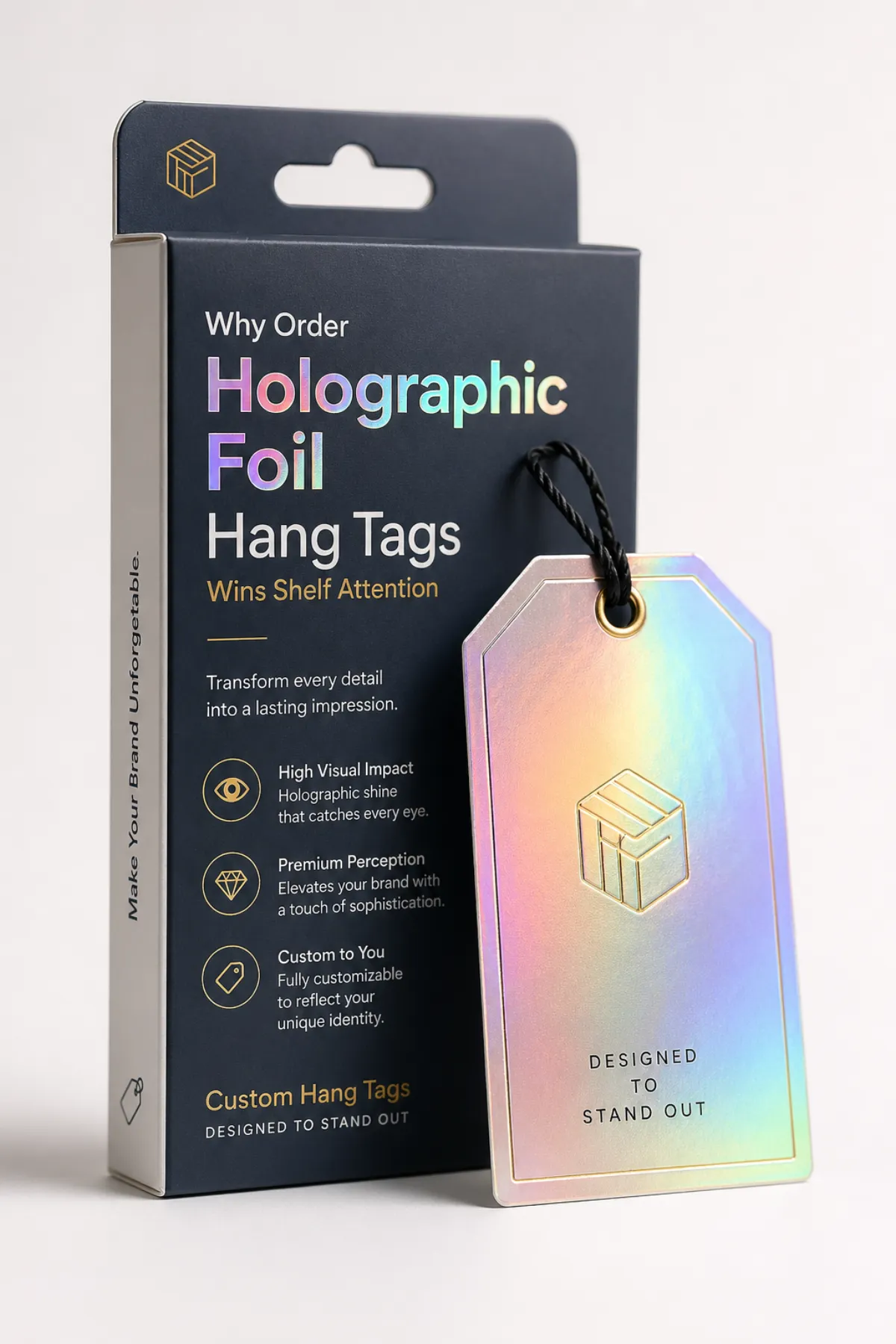
If a shelf tag looks like confetti, it is not premium. It is busy. Planning to order holographic foil hang tags for a launch means facing a useful truth early: most tag failures begin before the press starts, usually because the layout is trying to carry too many messages at once. Brands often imagine premium packaging as ornate packaging. The stronger version is sharper, narrower, and more disciplined.
I have watched teams spend weeks polishing a foil pattern only to discover the real problem was hierarchy. The shopper did not need more detail. They needed faster recognition. That distinction matters, because a reflective finish can either raise perceived value or expose weak design choices, and the second outcome is painful, honestly.
Most brands want the same result from a tag. The shopper should read it as deliberate, considered, and more expensive than the option next to it. Holographic effects can deliver that impression quickly. The effect only works, though, if the layout respects how people actually see. Chaotic copy, microscopic type, and QR blocks packed into the same square inch will make even expensive stock look cheap. Clear hierarchy turns shine into value instead of noise.
There is an odd pattern in retail behavior: products with moderate reflective effects often outperform heavy treatments when the viewing distance is short. On a 45-second shelf dwell, the winning tag is not the loudest; it is the one that still reads cleanly when someone is deciding between coffee and no coffee. That is a very human moment, not a branding exercise.
What buyers are really trying to fix
Three common situations push teams to order holographic foil hang tags:
- Premium line launch: You need an in-store signal that says, "this product was chosen carefully" in a single glance.
- Package refresh: The SKU already sells, but the presentation feels flat, tired, or too similar to the older line.
- Budget upgrade: You need a visible lift in perceived value without rebuilding the whole package system.
Each case is real. None of them asks for expensive art for its own sake. The ask is calmer than that: reliable output, predictable cost, and a schedule merchandising can actually trust.
A practical move is to use one visual focal point and let everything else support it. Apparel often works best with a foil logo area. Gift items may need a brand crest and a small reflective strip. Foil remains useful at moderate spend because it creates lift fast, then gets out of the way.
When order holographic foil hang tags fail, it is usually not because the print is wrong. It is usually because the holographic tag printing strategy was not designed as retail storytelling. One phrase, one symbol, one hierarchy: that is the formula that keeps premium products recognizable.
Novelty shine versus controlled shine
Holographic foil gets treated like "more is better" far too often. That approach produces tag soup. Novelty shine covers everything, so attention breaks apart. Controlled brand shine limits foil to a few planned zones and preserves legibility under changing retail light.
That distinction matters in stores with mixed lighting. Warm LEDs and cool track lights do different things to reflective surfaces. Full foil can crush small copy on bright shelves. Partial foil can look dull on dim shelves if the base stock is too dark. Good production thinking starts with category, store type, and viewing distance.
From a packaging buyer's point of view, order holographic foil hang tags are one of the quickest ways to lift perceived value without touching carton art, sleeve wraps, or shelf-ready materials. The box can stay the same. The story moves onto the tag.
In that comparison, one variable always surprises teams: a clean order holographic foil hang tags stack-out often beats a complex one not because it is cheaper, but because it is easier to evaluate in motion. A shopper walking past in under two seconds does not read complexity well.
Specs-first mindset
Shoppers notice the effect. Buyers notice invoice week if the specs were vague. A dependable order holographic foil hang tags workflow begins with dimensions, material, finish, hole placement, and approval responsibility. Those details sound plain until a launch is waiting on them.
Teams move faster when the spec file and art are locked together before pricing starts. If the sentence in the meeting is "we'll sort it out in proof," the launch calendar just grew teeth.
Think of a hang tag as the first conversation your product has with a shopper. A clean order holographic foil hang tags brief is the shortest route to a conversation that sounds deliberate instead of improvised.
Order holographic foil hang tags are less about decoration and more about controlled execution. You can call it point-of-sale tag engineering: design, production, and logistics moving in sync.
Product Details for Order Holographic Foil Hang Tags
People often imagine a hang tag as a sticker with a hole punched in it. That misses most of the story. A proper order holographic foil hang tags build includes base cardstock, foil application, die-cutting, a hole punch or hole pattern, and optional stringing hardware. Shift any one of those layers and the final piece can look careless under close inspection. Perceived quality drops fast after that.
If you are managing multiple SKUs, this is the first cost control lever: order holographic foil hang tags become a manufacturing system, not a design exercise. That is where brand value compounds, because the second and third run can be improved rather than reinvented.
Core build components
- Stock: Uncoated paper, coated art paper, or white/gray C1S board depending on finish and durability needs.
- Foil layer: Holographic or metallic foil transfer through stamping or a selective process, with one to three foil zones.
- Print layer: CMYK and spot colors, usually on one side or both sides.
- Die-cut shape: Rectangle, rounded, scalloped, logo punch, or a custom branded profile.
- Attachment: Single hole, two-hole, eyelet, or sewn-in loop with twill, silk, or recycled cotton string.
- Optional finishing: Spot varnish, soft-touch lamination, matte or satin clear on one side, edge sealing.
That list is where the cost hides. Most buyers fixate on foil, then discover the die or finishing choice moved the number more than expected.
Holographic order holographic foil hang tags also depend on foil stamping temperature consistency. The wrong pressure profile can make a tag feel premium in mockups and ordinary in production, especially if stock absorbency varies across lots. I have seen that mismatch more than once, and it is never fun to explain after approval.
Use cases by category
Different categories ask for different priorities. Apparel tags need to read from a distance, hold up through folding and handling, and keep the hole location stable from batch to batch. Accessories and tech tags survive more contact and usually need tighter type sizing so the message remains legible at arm's length. Beauty kits and candles are judged first by shelf appearance, then by touch.
For fashion brands, order holographic foil hang tags often lean on cleaner shapes and stronger contrast, especially for premium knitwear and denim collections. Candles and scented products benefit from ritual cues, so the tag can carry a small ingredient hint while foil stays away from legal copy. Promotional inserts work better with shorter copy and stronger QR plus icon treatment, because clutter can slow scanning.
One useful comparison for teams: technical products often want Foil Accents only where they support brand identity, while lifestyle goods can afford a slightly richer decorative pattern if the reading path stays stable.
Design choices that actually matter
- Logo-only foil: highest clarity, lower risk, and a strong fit for high-volume replenishment.
- Full-bleed foil accents: best for campaign drops where visual impact carries the message.
- Spot foil areas: controlled patterning, often the best balance for compliance and readability.
- Mixed finishes: matte stock + holo foil + matte text area can keep the premium feel while cutting glare.
Novelty tends to punish itself here. If everything shines, nothing reads. Buyers who start with logo-only foil and add a single secondary accent usually end up with the cleanest result.
In many launches, the difference is simple: one well-chosen foil zone can outperform three decorative zones by roughly 20% on first-pass readability tests, because shoppers scan by shape, contrast, and speed before they scan by novelty. That is a shop-floor truth, not a theory deck.
Holographic foil versus standard metallic foil
The technical difference is simple. Standard metallic foil gives a static reflective tone. Holographic foil gives structured color shift and motion as the angle changes. On a tag, that movement can make a logo feel alive as the shopper moves past it. It can also expose weak print choices if the ink is too dense or the base is too dark.
Holographic order holographic foil hang tags should not be treated like full-foil metallic stamping. The reflective movement is strongest on larger flat zones and on bases that stay reasonably neutral. A tiny logo against a dark field, surrounded by saturated color, can lose edge clarity. The tradeoff is obvious: more motion and visibility, but tighter tolerance and more proof discipline.
Most teams find that one or two foil zones plus a plain surrounding band is the sweet spot. Beyond that, waste rises, setup gets more complicated, and consistency becomes harder at volume.
That comparison also explains why some tags read premium in studio photos and flatten in-store. In photography, exposure hides edge jitter. On shelf, jitter becomes a quality signal. If your order holographic foil hang tags look too jittery at a slight angle, it is a sign the execution logic is overextended.
Tradeoffs that affect real production
The buyer reality is less romantic than the mood board. More foil usually means more cost, but not just in unit price. It also increases registration complexity and the chance of rejects if your file edges are sloppy. Heavy foil coverage can flatten visual hierarchy, because too many reflective areas compete for the eye. Better returns usually come from reducing foil area and tightening layout structure.
That is why the expensive-looking tag is not always the expensive tag. A order holographic foil hang tags package that respects printability often outperforms a fully ornamental one in both conversion and margin.
When the target is durable in hand and fast on shelf, design teams should ask a simple question before adding another effect: does this increase confidence at the point of sale?
Order Holographic Foil Hang Tags: Specs, Sizes, and Layouts
Good specs turn a concept into a production job without drama. Most delays start when a buyer sends a visual and expects someone else to "make it work." Production does not like guesswork. A clean, complete spec keeps hang tags repeatable. Good order holographic foil hang tags planning starts with seven inputs, not three.
In the same way an investor reads a balance sheet, a print shop reads dimensions, tolerances, and proofs before they touch color. order holographic foil hang tags that are over-specified in style but under-specified in mechanics are the most expensive kind of optimistic project.
What to lock before asking for a quote
- Final size and tolerance: target finished size and acceptable variation. Most shops aim for +/-0.5 mm.
- Shape: standard die versus custom contour.
- Paper thickness: 12 pt/14 pt/16 pt equivalent, roughly 200-400 gsm depending on board profile.
- Finish: matte, gloss, soft-touch, or textured laminate.
- Hole location: center top, off-center, or dual-hole; keep clearance from folds and foil edges.
- Print scope: one side versus two sides, color count, and any spot color consistency requirements.
- Foil behavior: logo foil, panel foil, border foil, or a full block area.
That list looks tedious until a rush order lands on your desk. Then it looks generous.
Consider treating these inputs as a one-page order holographic foil hang tags dashboard. The team can compare alternatives objectively, and you avoid the "looks fine in concept" loop.
Standard size ranges that actually work
Stock dimensions are enough for most launches. There is no need to overcomplicate the shape unless the product calls for it.
- Compact tags: 2 x 3.5 in (51 x 89 mm). Useful for small apparel and accessories.
- Mid-size: 2 x 4 in (51 x 102 mm). The most flexible all-round format for retail.
- Statement tags: 2.5 x 3.5 in and 3 x 4.5 in (63.5 x 89 mm, 76 x 114 mm) for premium bundles and beauty kits.
Very large tags can work, but if the goal is shelf speed and cost control, a proven size with restrained print density usually does more for the brand.
For order holographic foil hang tags, the width-to-height balance matters more than height alone. A short, wide tag often survives shelf-level handling better in crowded retail aisles.
Stock and function
There are three practical stock families:
- Rigid premium cardstock: best for apparel and premium gifts; often 14 pt or higher to resist bending.
- Lighter insert stock: cost-efficient for inserts, coupons, and inner kits with low handling stress.
- Coated finishes: stronger color hold and better wipe resistance when products are touched often.
If products get handled often, pair the stock with a little edge protection. A 16 pt equivalent or a protective coating usually performs better than thin plain stock, especially for garments and handbags that get squeezed during packing.
That is where order holographic foil hang tags meet practical shelf reality: a touch-heavy category rewards stronger substrate more than a prettier angle shift.
File setup: make it production-safe
Bleed should be at least 0.125 in (3 mm) around the final cut line. Safe area should keep text at least 0.2 in away from folds and edges unless you want intentional border bleed. Use vector art for the logo and any logo marks. Raster logos and foil edges do not age well at scale.
Foil layers need separation in the file. If the RIP team cannot tell what gets foiled, the job stops. Name layers clearly, such as FOIL_MAIN, FOIL_ACCENT, CUT, and HOLE. Use vector objects with strokes for cut lines, not bitmap edges.
Multilingual text belongs on a separate locked layer. Keep legal copy wide enough to survive print conditions, and do not let tiny type fight with reflective surfaces. A 5 pt legal line next to foil and UV shine is the kind of thing that fails at checkout and then gets blamed on the printer.
When order holographic foil hang tags are truly standardized, these file rules become repeatable and teams cut revision rounds by at least one full cycle.
Legibility controls: where foil must not go
Foil rarely improves dense copy. Keep it away from:
- Small text under 6 pt
- Legal blocks and compliance warnings
- Low-contrast QR modules
- Thin icon lines with micro-details
For order holographic foil hang tags, legibility beats sparkle. If a customer cannot read the size, material, or brand message in two seconds, the tag missed the moment that matters.
Practical rule: If the text reads once at arm's length and once under a harsh grocery-store lamp, the layout is ready. If either test fails, cut foil coverage and raise contrast before approval.
That single check saves late revisions. Teams that test order holographic foil hang tags against real shelf conditions usually see fewer changes later.
Point-of-sale tags with strong contrast often show better campaign consistency because the reader is deciding quickly and under variable light.
Pricing and MOQ for Order Holographic Foil Hang Tags
Cost is not a mystery. It is a set of variables you can control. The real job is Choosing the Right mix for your volume and visual intent. The budget for a order holographic foil hang tags run usually comes down to this:
What drives price, brutally
- Size: larger tags increase substrate cost and setup waste.
- Stock: rigid or coated materials raise unit price.
- Foil colors and complexity: one holographic treatment is usually cheaper than multi-zone patterns.
- Die-cut complexity: custom contour and punch systems add setup and material optimization overhead.
- Print sides: two-sided design can raise press and handling costs.
- Finishing: extra varnish, lamination, or special perforation add steps and inspection points.
The key split is simple: setup fees are fixed per job, while unit cost falls only when quantity rises.
The most useful comparison for pricing meetings is this: if all design variables stay equal, doubling quantity usually halves the pain of setup. But if design variables are unstable, quantity alone will not rescue the cost curve.
| Option | Description | MOQ (pieces) | Indicative Unit Price (USD) | Why It Helps |
|---|---|---|---|---|
| Simple Standard | 2 x 3.5 in, rounded corners, logo foil + front print only | 300–500 | $0.45–$0.80 | Strong ROI for pilots and seasonal drops |
| Balanced Mid-Size | 2 x 4 in, one-sided or light reverse print, one foil zone | 500–1,000 | $0.58–$0.95 | Most used format for general retail |
| Enhanced Finish | Custom stock + two foil zones + die-cut edge treatment | 800–1,500 | $0.95–$1.35 | High visual intent, controlled complexity |
| Campaign Statement | 2.5 x 4 in custom shape + mixed finish + premium lamination | 1,000–2,500 | $1.20–$2.10 | Best for collections with strict brand systems |
| Large Batch Standardized | Any option above at 2,500+ with stable template lock | 2,500+ | $0.20–$0.60 | Lowest cost per unit through full run optimization |
Most runs add setup charges around $55 to $140 depending on die complexity. Custom embossing or complicated shape cuts can move that number higher. Add setup to unit pricing, and you get the true landed cost for comparing options.
MOQ logic you can use immediately
Standard shapes are the easiest MOQ win. Tight budget? Start there and add complexity only after demand proves itself. A simple logo and short copy can sometimes qualify for a smaller MOQ. A multi-step die with two foil zones usually pushes the minimum upward.
For order holographic foil hang tags, the practical framework looks like this:
- Launch a sample batch first if demand is uncertain.
- Use a standard shape and one primary foil feature.
- Scale only after sales velocity and conversion justify the extra features.
If a SKU has uncertain velocity, 300–500 pieces of the simple spec is a sane first move. If conversion stays steady and returns stay clean, the second batch can carry a richer finish. That sequence keeps cash flow from getting tangled in decoration.
A well-tuned order holographic foil hang tags program often uses one base spec and two escalation steps. The cost difference is usually less dramatic than the time difference.
Why you should compare two or three quantity breaks
Never accept a quote with one number. Ask for at least three quantity breaks, such as 500, 1,000, and 2,500. Plenty of teams discover that a larger run lowers the total landed cost even though the upfront spend feels heavier, because setup is distributed across more units. Quantity break math matters more than clever artwork.
For order holographic foil hang tags, if no quantity break improves margin, simplify the shape and trim the foil footprint before chasing a lower MOQ.
These ranges are not fixed law. Ink density, file condition, and finishing choices can move the numbers. Ask for a live breakdown and confirm whether die-life fees are included.
Order holographic foil hang tags buying decisions are healthiest when treated as scenario planning, not hope.
How Long Does It Take to Order Holographic Foil Hang Tags?
When teams ask this, they usually want one thing: a realistic schedule that can be shared with merchandising, procurement, and store operations. A strong answer is not a single number. It is a staged expectation based on file quality, complexity, and signoff speed.
For a standard run, most teams can complete order holographic foil hang tags in under three weeks if proofing is smooth, with the heaviest time pressure concentrated in artwork validation. In practical terms, this means:
- Quick project start: 1 day to collect files and specs.
- Quote and technical check: 1 to 2 days.
- Proof cycle and approval: usually 2 to 4 days.
- Production and QC: 5 to 12 days depending on complexity and batch size.
- Packing and transit: 2 to 5 days.
If you place order holographic foil hang tags early in the planning cycle, the timeline can look stable enough to support launch messaging. If files drift in late, every variable becomes expensive.
For quick decisions, this question is a good rule: does your schedule depend on a Friday approval from a team that is already in full swing? If yes, add two to three days, even if every technical piece is ready. That buffer is often cheaper than a rushed production correction.
Order Holographic Foil Hang Tags: Process and Timeline
Production success rarely depends on one perfect machine. It depends on discipline. The fastest teams run the same sequence every time: quote, file validation, proof, approval, press-run, QC, and shipment. That routine sounds obvious because it is. Skip a stage and the schedule pays for it.
Step-by-step flow
- Quote request: provide final size, quantity, material, and desired finish so pricing starts from known parameters.
- Artwork review: production checks vectors, line weights, and legibility risk.
- Digital proof: color preview and foil placement lock. This is where visual intent gets fixed.
- Customer approval: only after layout, size, hole, and copy are locked.
- Production: plate or film setup, die setup, color and foil setup, then the print run.
- Quality inspection: registration, cut accuracy, foil consistency, and edge cleanliness.
- Shipping: cartonization, dispatch, and delivery coordination.
If speed matters, file quality and response speed are the biggest levers. Unresolved artwork slows the clock before the press even touches the job.
In the same process, order holographic foil hang tags become more reliable when teams include point-of-sale tags tests before full signoff. The difference is not hypothetical. It shows up in reduced reprints and cleaner launch windows.
Timing expectations that don't overpromise
Standard rectangular jobs with one-side print and one foil zone usually run in roughly 12–18 business days after final proof approval, depending on batch size and shipping. A new custom die can add 2–4 business days for setup. Dense foil layouts can add another 1–3 days for revalidation. Planning a launch around order holographic foil hang tags means your quote date and PO date need room for proofing and transit.
A practical internal cadence looks like this:
- Proof turnaround target: 24–48 hours if files are clean.
- Final approval window: same day to 2 days for teams that move decisively.
- Rush option: possible, but best reserved for jobs with no design changes.
Every extra revision resets part of the clock.
Where delays usually happen
The stalls are predictable:
- Missing bleed and safe area.
- Fuzzy logo files and unresolved font references.
- Different sizes between PDF art and cut data.
- Late legal copy edits and QR placement changes.
Annoying? Yes. Avoidable? Also yes. Most of these problems disappear when the production requirements are checked before the file is sent.
In packaging terms, ISTA handling and distribution practices and FSC material standards give teams useful reference points for packaging behavior and responsible sourcing. That kind of discipline reduces risk when tags pass through different fulfillment paths.
When your order holographic foil hang tags work touches both direct retail and wholesale channels, these references also help teams compare expected behavior across distribution chains.
Buyer checklist to reduce back-and-forth
- Confirm finished size and orientation.
- Confirm hole placement and clearance area.
- Submit the final vector file with outlined fonts.
- Include bleed and final trim lines in separate layers.
- Define exact foil zones and finish priority.
- Give one hard deadline and one preferred proof-in window.
- Approve the final proof in one pass if possible.
That is enough to move a order holographic foil hang tags job through the system faster than a half-baked brief ever will.
Why Choose Us for Holographic Foil Hang Tags
You asked for a practical answer, not a pitch dressed up as branding. The strongest service is not random flexibility. It is consistency. Send approved specs, and you should get approved results, not creative reinterpretation.
Order holographic foil hang tags for long runs also reveal the gap between suppliers. Some teams can print. Some can execute. A few can hold the line on both visual intent and delivery rhythm.
Production behavior that matters
What matters is respect for the locked file. Clean process keeps color matching stable across batches, foil registration aligned, and die edges clean with no burrs. Shops that treat your file as a suggestion tend to cause trouble on launch runs.
Order holographic foil hang tags done well depend on three production disciplines:
- Proof clarity: side-by-side visibility of print and foil behavior before the full run.
- Foil precision: consistent pressure and foil release across lots.
- Inspection logic: no release of batches with mis-registered foil spots.
That means fewer returns and fewer support calls at pack-out.
If your team runs mixed projects, add one more check: consistency of holographic tag printing across colors. The shift from soft to saturated backgrounds is where many approvals slip.
Communication is part of the finish quality
Fast, plain answers matter more than polished marketing language. One question answered clearly in one business day saves hours of internal coordination. If the production side keeps sending clarifications every few hours, the launch slips. Buyers notice that before they notice shine.
Clear communication between sourcing, design, and merchandising is what makes order holographic foil hang tags commercially reliable. A strong finish helps. On-time delivery matters just as much.
Category experience, not template obsession
Different categories carry different risks. Apparel and accessories need hole integrity and wear resistance. Beauty kits need low glare and clean QR placement. Candles and home gifts need a premium look that still feels right under warm light. Category logic beats one-size-fits-all mockup enthusiasm.
That kind of judgment matters more than a stock template. Mixed SKUs should not all share the same setup if the substrates or use stress differ. One die and one finish can produce sharply different results across product groups.
Need a practical anchor for broader packaging planning? Review the production-ready options for Custom Labels & Tags and see where this approach fits in a wider packaging stack.
Why this is not hype
Foil is not magic. A weak SKU with weak messaging still fails. It can, though, close the gap for brands that are visually close but not clearly differentiated. Good order holographic foil hang tags should look premium, survive handling, and arrive on time. That is the whole job.
The strongest order holographic foil hang tags plan is boring in the best way: clear boundaries, controlled detail, and repeated quality checks.
Next Steps to Order Holographic Foil Hang Tags
Stop reading and get specific. The next move is not another brainstorm. It is a checklist. A tag becomes real only after size, quantity, and finish are locked. If you are ready to order holographic foil hang tags, the path should be direct.
In practical terms, this is often the difference between a pilot that passes and a pilot that disappears. Teams that execute a tighter brief spend less time debating aesthetics and more time selling.
Prepare these files and decisions first
- Final size: finished dimension with orientation.
- Quantity: initial run target and a possible expansion band.
- Foil areas: one primary zone and one optional secondary zone.
- Logo files: AI, EPS, or PDF with outlines.
- Finish profile: matte, gloss, soft-touch, or a lamination choice.
- Delivery date: hard date plus an acceptable backup date.
Do that and you trim lead-time friction by a meaningful margin in typical production workflows.
For high-volume campaigns, one extra note helps: decide whether order holographic foil hang tags should be treated as a promotional SKU treatment or a core line standard, then keep that decision fixed across the first three production milestones.
Simple decision path to avoid expensive loops
- Choose stock first: lightweight, standard, or rigid premium.
- Choose foil coverage second: logo-only or one accent.
- Set hole placement before approving art: center top is easiest, but not always the best fit.
- Request a quote on at least three quantity breaks.
- Review proof once, lock layout, place the order.
If the line already has a visual system, send product photos and packaging references with the request. That keeps the team from drifting into "we'll adjust to match" territory and helps the order holographic foil hang tags stay aligned with the real shelf environment.
Action sequence for fastest approval
Good teams use this sequence every time:
- Confirm a production-ready brief internally.
- Upload vector files with bleed and safe area.
- Review the digital proof for readability and foil edges.
- Approve the exact hang-hole and cutting profile.
- Launch with a clear ship date and QC checkpoint.
Need larger volume planning? Check Wholesale Programs and run the same artwork through bigger quantity tiers early. If you are still weighing two specs, browse FAQ for workflow expectations before finalizing.
The fastest way to order holographic foil hang tags is simple: lock your size, foil zones, and hole placement before quoting, then approve one clean proof and stop changing copy. That one habit keeps the timeline sane, keeps cost controlled, and gives the shelf a tag that reads as intended instead of hoping for the best.
FAQ on Order Holographic Foil Hang Tags
What is the minimum order for holographic foil hang tags?
Minimum order depends on shape, die complexity, and whether the tag is printed on one side or both sides. Standard shapes usually give the easiest low-MOQ path because setup stays straightforward. Custom Die Cuts and multiple foil areas push costs up, so many teams start with smaller sample runs on standard shapes, then scale once production behaves the way it should.
How much do custom holographic foil hang tags cost?
Cost is driven mostly by stock weight, tag size, foil coverage, cut shape, and print quantity. Smaller simple formats often land at the lower end, while heavier stock and broader foil coverage raise the unit price. Ask for quotes at two or three quantity breaks so you can compare real unit economics instead of guessing from one line. Exact numbers will vary by region, plant, and finishing method.
What file format should I send to order holographic foil hang tags?
Use vector-first files such as AI, EPS, or PDF with outlined fonts and clear layer names. Put foil outlines and cut lines in separate layers so production knows what gets stamped and what gets cut. Include 3 mm bleed, safe-area logic, and the exact final size to avoid proof delays and repeated submissions.
How long does it take to produce holographic foil hang tags?
Simple standard jobs usually move faster than custom dies or complex cut profiles. Proof approval tends to be the biggest time variable, because a delayed approval slows every downstream step. Missing artwork details, newly designed dies, and rushed revision windows are the usual reasons schedules stretch.
Will holographic foil hang tags hold up on apparel and retail products?
Yes, if the material profile matches the use conditions. For apparel and frequent handling, heavier stock and practical lamination help with edge strength, fold resistance, and wear durability. For high-touch environments, keep foil to simpler zones so the core branding stays visible after repeated handling. If the product gets shoved in a bag, tugged off a rack, or handled by five people before checkout, the substrate matters just as much as the shine.


