Matte Zipper Bags for florists order guide searches usually start with a presentation problem, not a packaging one. Gloss can throw reflections across a bouquet, flatten color, and make a carefully arranged stem bunch look more like retail inventory than a finished gift. Matte does the opposite. It quiets the surface, gives the flowers visual priority, and makes branding feel deliberate instead of loud.
That matters because floral packaging is judged in seconds. At the counter, in a delivery photo, or in the hands of a customer walking out the door, the bag is part of the product story. A well-chosen matte zipper bag can raise perceived value without changing the flowers inside. A poorly chosen one can do the reverse, even if the print is expensive and the bouquet is strong. The decision is less about style preference than about fit, handling, and consistency across repeated orders.
For florists buying custom packaging, the practical question is simple: does the bag improve the selling experience enough to justify the spec, lead time, and minimum quantity? In most cases, the answer depends on the finish, the zipper quality, and whether the bag shape matches the bouquet profile the shop actually sells.
How Matte Packaging Changes the Way Bouquets Sell
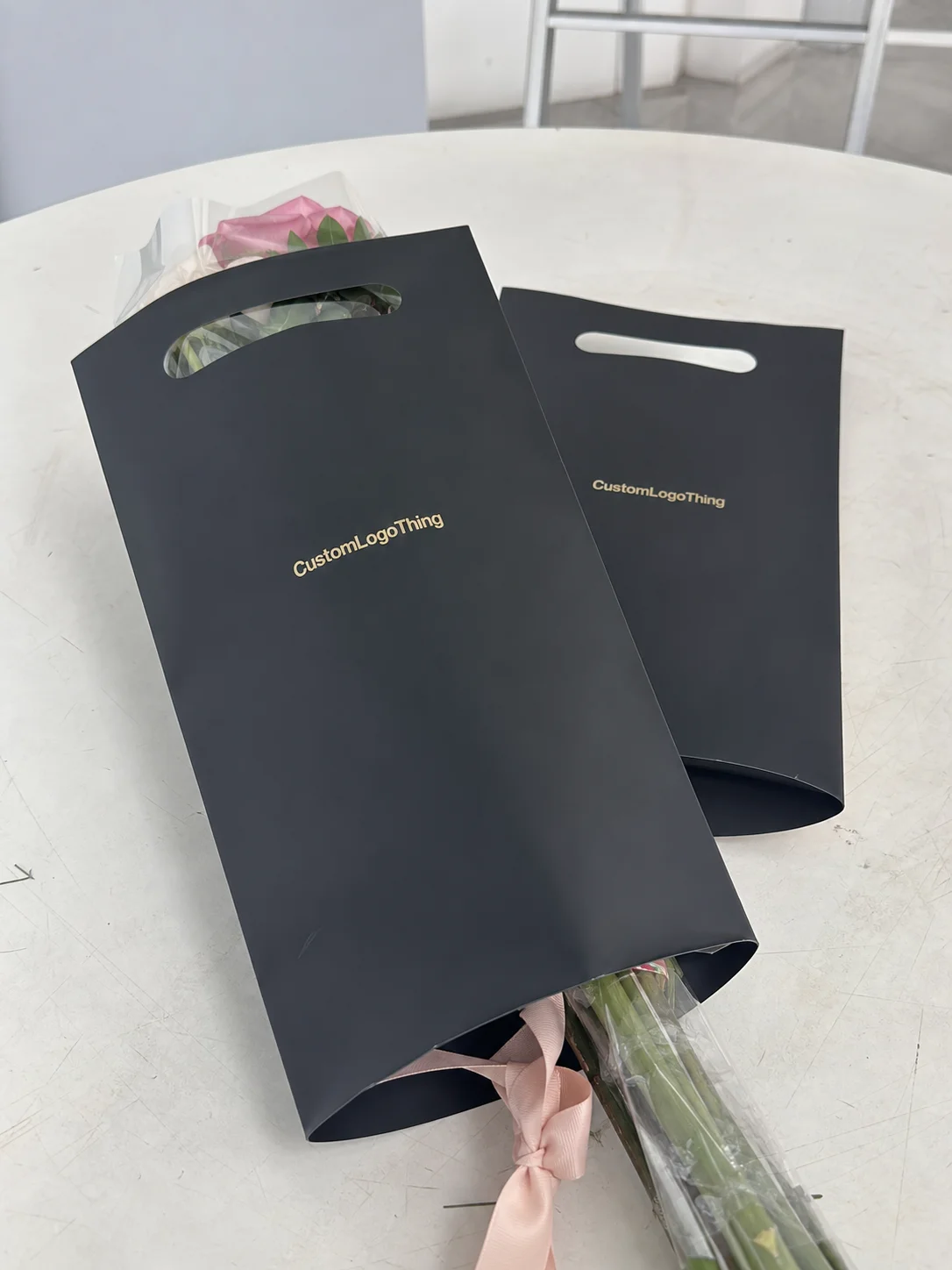
Matte packaging changes the hierarchy of what people notice first. Glossy bags reflect counter lights, windows, and camera flashes. Matte surfaces absorb more of that visual noise, so the arrangement reads more cleanly. That sounds like a cosmetic distinction, but packaging lives or dies on cosmetics. A bouquet surrounded by glare looks busier than it is. A bouquet in a matte bag looks composed.
There is also a measurable retail effect. Products that photograph well tend to circulate more often on social platforms, and floral orders are unusually dependent on visual proof. A customer receiving a bouquet often shares the moment within minutes. If the bag catches hard reflections or looks flimsy under phone lighting, the brand exposure is weaker. If the surface is soft and even, the flowers carry the image.
For shops with premium pricing, matte also reduces the odds of a mismatch between price and presentation. A bouquet sold at a higher ticket level should not arrive in packaging that feels like a convenience-store sleeve. Matte suggests restraint, and restraint usually reads as quality. That is especially useful for wedding work and sympathy arrangements, where the packaging should support the flowers rather than compete with them.
Practical handling matters too. Matte finishes often hide light scuffs better than high-gloss film. Small marks from transport, stacking, or being passed across a counter are less visible. That does not make the bag indestructible. It just gives the packaging a little more forgiveness during a busy day.
Florists usually see the benefit in three settings:
- Retail pickup, where the bag has to look polished under mixed lighting.
- Event and wedding delivery, where the package may be seen before it reaches the recipient.
- Gift orders, where the bag supports the perceived value of the arrangement.
There is a reason matte keeps showing up in premium packaging categories. The finish does not demand attention. It frames the product. For flowers, that restraint is often the better commercial choice.
Matte Zipper Bags for Florists Order Guide: Film, Zipper, and Print Choices
The film is the first spec worth reading closely. Most floral zipper bags use a layered structure with a matte exterior and a seal system built for closure strength, flexibility, and print stability. Buyers often focus on finish first, but the real differences usually come from opacity, thickness, and how the film behaves once the bag is filled.
Opaque matte bags hide mechanics, sleeves, and water tubes more effectively. Semi-transparent versions show more of the bouquet and work better if the stems or wrap are part of the visual design. Frosted options sit between those two. The right choice depends on whether the bag should conceal the mechanics of the arrangement or reveal them as part of the presentation.
Thickness deserves attention because it affects both hand feel and in-use durability. A light film may be fine for short counter transfers, but a heavier structure tends to stand better, resist creasing, and feel more controlled in the hand. That is not only a durability issue. It changes the way the customer interprets the bag. Thin film can make a premium bouquet feel underpackaged.
Zipper behavior is the other point that separates good samples from frustrating ones. A zipper should close with low resistance and stay aligned after repeated handling. If it snags, opens unevenly, or requires awkward pressure, staff feel it immediately. In a florist workflow, friction adds up. Ten extra seconds per order is nothing on paper. Across a holiday rush, it becomes a real bottleneck.
Print choices should follow use case, not ambition. A single-color logo is often enough for everyday retail, especially if the bag color already supports the brand palette. Full-surface artwork makes more sense for high-visibility programs, seasonal campaigns, or event packaging. More coverage is not automatically better. It can increase risk if the print crosses folds, handles, or gusset edges where distortion is likely.
Useful spec questions include:
- What is the film thickness, and how tightly is it controlled from run to run?
- Is the zipper heat-sealed or mechanically attached?
- Does the logo sit on a flat panel or cross a fold line?
- How much variation is allowed in width, height, and gusset depth?
- How does the material behave around moisture, condensation, or damp wrap paper?
Distribution performance matters too, even for a local florist brand. If bags will be stored, loaded, stacked, or shipped in mixed temperatures, ask how the structure handles pressure and transit. Standards such as ISTA test protocols are useful reference points for thinking about packaging under stress. If sustainability claims matter to your brand, a third-party reference like FSC can help clarify whether a paper component or insert is genuinely traceable.
A matte finish is not a virtue by itself. It matters because it improves readability, reduces glare, and keeps the bouquet looking intentional from prep table to pickup.
One caution: sample photos rarely tell the full story. A bag can look elegant on a screen and still feel too rigid, too slick, or too opaque in hand. Physical approval is not a formality. It is the point where the packaging reveals whether the finish, zipper, and structure work together.
Sizes, Gussets, and Capacity Rules for Floral Arrangements
Size selection should start with the bouquet, not with the catalog. Measure the widest part of the arrangement, then add room for tissue, wrap paper, ribbons, and any water tube or protective insert. A bag that matches stem length but ignores bloom width often looks fine on paper and fails in use. Flowers do not compress neatly the way flat products do.
Gusset depth is just as important as height. A narrow gusset can make a bag unstable even if the vertical measurement looks generous. Once the bouquet opens at the top or flares near the base, the shape changes quickly. If the bag cannot support that geometry, it will bow, slump, or pinch the arrangement in awkward places. That is the kind of problem that shows up only after the first packed sample.
For most florist orders, the rule is practical rather than mathematical: measure the fullest point of the bouquet, allow clearance for the wrap, and confirm that the zipper will close above the petals, not against them. If the bag needs to stand upright for pickup or transport, the sample should be tested loaded and moved, not just held still for a photo.
Capacity is not just volume. It is also balance. Two bags with the same dimensions can behave very differently if one has a stronger bottom seal, more stable gussets, or a different film stiffness. A bag that stands well in the shop can collapse in a vehicle if the base structure is weak. That is one reason buyers should ask for a sample that reflects actual handling, not just a flat proof.
For a first order, request these production details:
- Tolerance ranges for width, height, and gusset depth.
- Bottom reinforcement details.
- Whether the bag can stand upright without slumping.
- Handle style, if applicable.
- Any venting or moisture-control feature built into the design.
Moisture deserves special mention. Fresh flowers can create condensation, and packaging that traps that moisture too aggressively may feel unreliable during transport. That does not mean every bag needs ventilation. It means the bag must be matched to the packing method. Wet wraps, sleeves, and water tubes all change the internal environment. A florist who ships across town and a florist who handles wedding staging need different answers.
As a rough comparison, a bouquet that looks compact in a bucket may spread 20 to 30 percent wider once it is wrapped and tied. That kind of expansion is enough to turn a nominal fit into a cramped one. The shape matters as much as the measurements.
Cost, MOQ, and Quote Variables That Move Unit Price
Price is usually driven by a limited set of variables: size, film thickness, zipper style, print coverage, color count, and order volume. The wording in the brief matters less than the physical choices. Two bags can look similar in a mockup and still price very differently because one uses heavier film or a more complex printing process.
MOQ should follow actual reorder behavior, not a theoretical ideal. A florist with stable weekend volume, wedding work, and recurring corporate orders can justify a larger minimum if the packaging is part of the core brand. A shop testing a new line should stay smaller until the response is clear. Storage costs money too, even if the packaging itself is inexpensive.
| Option | Typical MOQ | Indicative Unit Price | Best For | Tradeoff |
|---|---|---|---|---|
| Basic matte bag, one-color logo | 3,000-5,000 pieces | $0.18-$0.28 | Routine retail and standard bouquet handoff | Limited visual depth compared with richer print setups |
| Opaque matte bag, custom print, heavier film | 5,000-10,000 pieces | $0.24-$0.42 | Premium retail, weddings, branded gifting | Higher cost and stricter proof discipline |
| Frosted matte bag, more complex artwork | 8,000+ pieces | $0.30-$0.55 | High-visibility brand programs | Best economics only when the bag is used frequently |
Those figures are not universal. Freight, seasonality, print setup, and raw material prices move the number around. But they help separate a serious quote from a vague one. A supplier should be able to explain why one line item is higher than another without hiding behind generic language.
Watch for charges that are easy to miss at first glance: tooling or plate fees, sample fees, packaging configuration, and freight method. Sometimes a low base price hides a more expensive landed cost. If a quote appears unusually cheap, ask what is excluded. A bag that arrives with weak seals, print drift, or poor stacking performance is not a bargain.
For brands comparing repeat programs, the right benchmark is landed cost against failure rate, not unit price alone. A slightly more expensive bag that survives handling and stays visually consistent usually costs less in the long run than a cheaper one that creates complaints or needs frequent replacement.
Internal reorder rhythm matters as well. If the bag is part of a broader procurement program, compare the quote with your own volume assumptions and with related Wholesale Programs so the packaging category is priced in context, not as a one-off purchase.
Production Process, Timeline, and Approval Steps
A clean order begins with complete specifications. The supplier needs dimensions, artwork, quantity, color references, and the delivery target before production starts. If those details are missing, the risk does not vanish. It moves downstream into proofing delays, incorrect samples, or a batch that needs rework.
The usual sequence is straightforward: quote approval, artwork proofing, sample sign-off, manufacturing, inspection, packing, and transit. The step that causes the most damage is proofing, because buyers sometimes approve a design without checking zipper clearance, fold lines, or logo placement against gusset depth. Those details are easy to overlook on screen and expensive to fix after the run starts.
A useful production window for standard custom work is often 12 to 15 business days after proof approval, followed by transit time. More complicated artwork, heavier film, or a crowded factory schedule can add days. Rush orders can happen if the spec is already frozen and the right material is in stock, but rush should be treated as an exception, not the base plan.
The biggest approval mistakes are usually visual, not technical. A logo can be centered on a flat dieline and still look wrong once the bag is folded. A bag can measure correctly and still compress flowers near the closure. A sample solves those questions. The flat proof cannot.
Use a short checklist before sign-off:
- Confirm the bouquet dimensions the bag must hold.
- Review the proof with folds, zipper line, and print boundaries visible.
- Approve a physical sample for closure feel and visual balance.
- Lock freight method and delivery address before production starts.
- Keep one person responsible for final sign-off.
That last point sounds administrative, but it saves time. In multi-person teams, packaging approvals often stall because nobody owns the final yes. The supplier cannot guess your internal process. Clear ownership keeps the order moving.
If your team handles multiple packaging formats, a shared reference such as a FAQ page can reduce basic back-and-forth before quoting starts. The fewer assumptions buried in the request, the fewer surprises later.
How to Vet a Supplier Before You Reorder
The best supplier question is not “Can you make this?” It is “Can you make it consistently?” That is the difference between a one-time sample and a repeatable packaging program. Consistency matters because floral packaging is handled by people in real time, often under pressure, with no room for random variation in closure feel or print placement.
Ask for material specs, sample photos from previous runs, and any available test documentation. If the supplier cannot explain normal tolerance ranges, the order is not ready for a large reorder. A serious vendor should be able to describe film behavior, zipper attachment, print registration, and the expected variation across production lots.
Good suppliers also ask useful questions back. They want to know bouquet height, wet wrap use, delivery distance, temperature exposure, and whether staff are packing at a prep table or in a loading area. Those details affect the ideal film and closure strength. A vendor that thinks through those conditions is usually looking at the full use case, not just the SKU.
Operational signals matter. Fast responses are useful, but clear responses matter more. So do freight terms, confirmation of tolerances, and a direct answer about what happens if a batch misses spec. Vague language around defects or corrections is a warning sign.
Industry references can help frame the conversation. The Packaging School and related industry resources are useful for broader packaging literacy, while ISTA remains a practical reference for distribution performance. Not every florist order needs formal lab testing. A good supplier should still understand why shipping and handling matter.
Before reordering, ask one blunt question: will this packaging still look like my brand after several months of use, storage, and mixed handling? If the answer depends on perfect conditions, the supplier has not solved the problem yet.
Next Steps for a Clean Florist Order
Before requesting a final quote, lock three variables: bouquet size range, preferred finish, and expected monthly volume. Those three inputs determine most of the design and pricing path. After that, ask for a sample or pre-production proof and inspect it for zipper action, print placement, and whether the matte surface matches the tone of the shop.
Gather the artwork file, shipping destination, and target delivery window together. A supplier can work fast with clean inputs. Vague inputs create avoidable delay. If a first run is being used to test demand, keep the order smaller and treat the sample as a specification check, not a decorative preview.
The practical formula is uncomplicated: define the bouquet, verify the finish, test the closure, and confirm the quote line by line before production. That is how a florist avoids costly surprises and keeps the presentation consistent across orders. In packaging, consistency is not a nice extra. It is the brand.
For a florist comparing options now, the strongest Matte Zipper Bags for florists order guide approach is to buy on evidence: sample fit, measured tolerances, realistic cost, and clear production timing. Matte works best when it solves more than glare.
FAQ
What size matte zipper bags work best for florist bouquets?
Match the bag to the widest point of the bouquet, not just the stem length. Leave room for tissue, water tubes, and the zipper closure so petals are not compressed.
How do I estimate MOQ for matte florist zipper bags?
Use peak monthly volume and reorder frequency, not a guess. A slightly higher MOQ can lower unit price if the bag is a core packaging format that you will use regularly.
Can matte zipper bags for florists be custom printed?
Yes. Most suppliers can add one-color or multi-color logo printing. Confirm print area, artwork format, and whether the design crosses folds or gussets.
How long does production usually take after approval?
Standard custom runs often take about 12 to 15 business days after proof approval, plus transit. Complex artwork, material constraints, or peak season can extend that timeline.
Are matte zipper bags suitable for wet floral arrangements?
They can be, but only if the bag size, seal strength, and internal packaging are designed for moisture exposure. Confirm whether the flowers will travel in a water tube, sleeve, or other protective insert.