Order Personalized Pillow Boxes That Fit the Product, the Budget, and the Shelf
Personalized pillow boxes work best when the structure, print, and finish are matched to a lightweight product and a clear retail use case. The format is simple, but the result depends on details such as board weight, sizing, coating, and artwork placement. Those choices affect not only appearance, but also cost and production time.
The main advantage is efficiency. Pillow boxes ship flat, use relatively little material, and create a distinctive silhouette without the bulk of a rigid carton. The tradeoff is that they are best suited to light items and presentation-focused packaging. They are not a good fit for heavy products, sharp edges, or shipment without secondary protection.
If you are comparing formats, our Custom Packaging Products page is a useful place to weigh pillow boxes against other retail options. The right package depends on how the product is handled, displayed, and delivered.
Why pillow boxes win when shelf space is tight
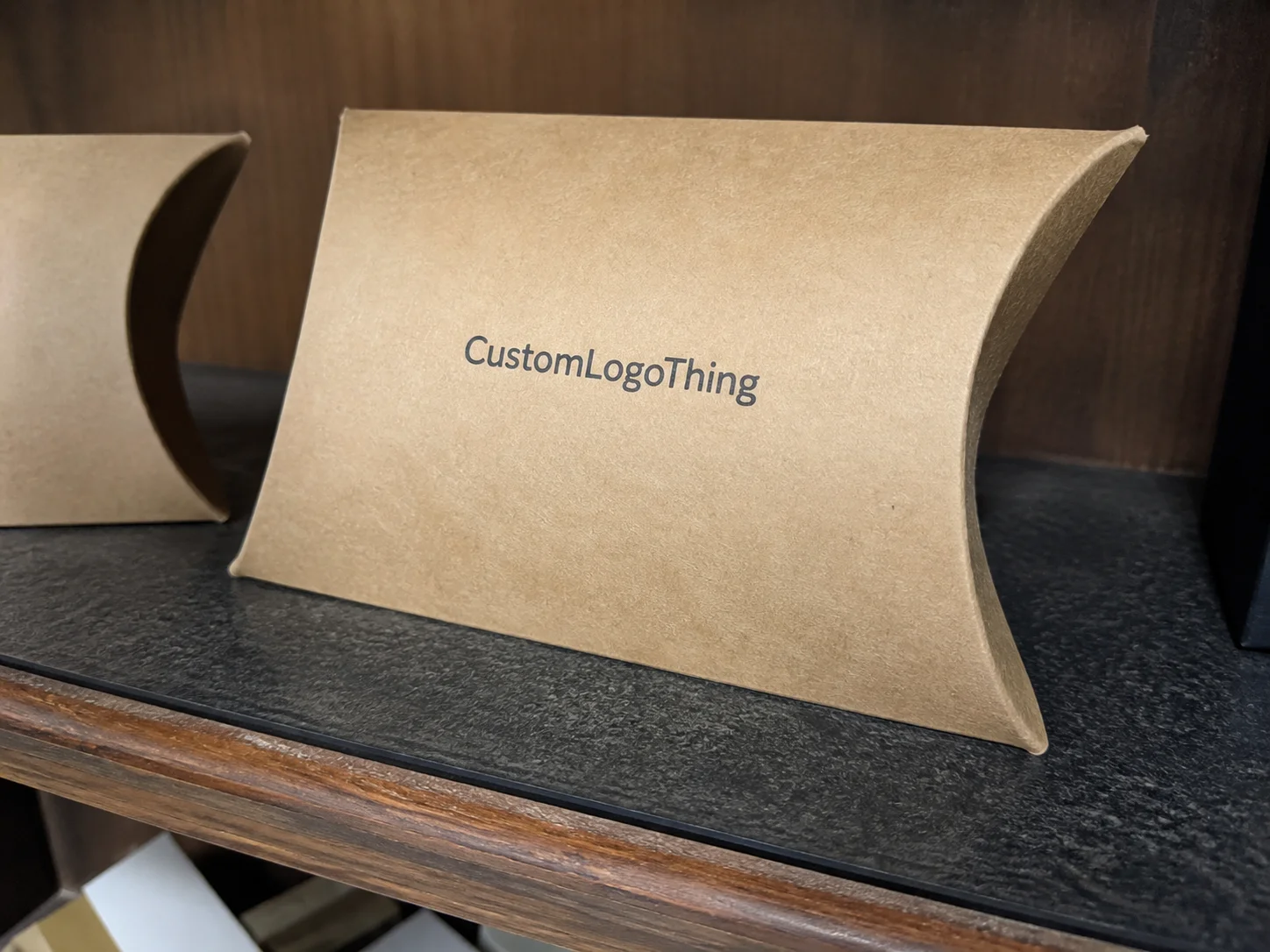
Pillow boxes stand out because their curved profile breaks the standard rectangular look buyers see in most cartons and sleeves. That shape can make a small product feel more deliberate and giftable, especially when the packaging is compact and the artwork is restrained.
They are commonly used for:
- Cosmetics and personal care samples
- Jewelry and accessory sets
- Gift cards and promo inserts
- Travel-size retail items
- Event favors and seasonal gifts
The format also helps control material usage. That matters for cost, but it also matters visually. Oversized packaging makes a product look padded or uncertain. A properly sized pillow box feels intentional because the fit supports the product instead of hiding it.
For lightweight retail goods, the format does what it should: it frames the item, supports branding, and avoids unnecessary bulk. For products that need compression resistance or rough transit protection, a pillow box is the wrong structure. It may look attractive, but it will not solve the functional problem.
The strongest use case is presentation. The box should make the product look finished the moment it is picked up. That is why this format shows up so often in gift sets, sample programs, and compact retail displays.
How the structure, folds, and print setup work
A pillow box starts as a flat die-cut sheet, usually scored and cut from paperboard so it can fold into shape after printing and finishing. Most versions tuck or lock at both ends. The structure is straightforward, but the score placement, seam position, and artwork layout need care.
Artwork placement is one of the first things buyers underestimate. Logos too close to a fold line may bend out of shape, small text near the curve can disappear into the crease, and a barcode across a seam can create a production issue. Dielines matter more than a flat mockup because they show where the package actually bends, locks, and closes.
Common setup choices include board thickness, size, coating, finish, and whether the design needs a window cutout. Windows work well when the product itself should remain visible, but they add tooling and reduce print area. If the graphics already carry the design, a window can weaken the front panel more than it helps the presentation.
For the best result, the box should close flat, open cleanly, and hold its shape after packing. The print should stay consistent across the curved face, and the edges should not crack at the fold. Those checks are what separate a package that photographs well from one that still looks controlled after handling.
Ask for a dieline before final artwork is locked. That gives the design team room to keep critical copy away from folds, tuck edges, and seam zones. If the supplier can show a previous build in a similar size, use it to judge how much distortion to expect around the curve. Pillow boxes do not punish good design, but they expose careless placement quickly.
What affects strength, finish, and retail appeal
Board weight is the first strength decision. For lightweight retail packaging, a common range is around 300gsm to 400gsm, but the right choice depends on product weight and how much stiffness the box needs to keep its shape. Lighter stock is often enough for gift cards, sachets, and small accessories. Heavier stock adds body, but it should not be specified automatically.
Finish changes how the box reads on shelf. Matte gives a quiet, controlled look. Gloss pushes color and contrast harder, which can help the artwork stand out under retail lighting. Soft-touch gives the surface a premium feel, but it can increase cost and show wear sooner if the boxes are handled often. Foil, embossing, and spot UV all add emphasis, but they work best as selective accents.
| Finish | Best use | Cost impact | Watch out for |
|---|---|---|---|
| Matte lamination | Clean retail branding and a subdued premium look | Low to moderate | Can mute very bright colors |
| Gloss coating | Color-heavy graphics and shelf pop | Low to moderate | More glare, more fingerprint visibility |
| Soft-touch | Gift, beauty, and higher-end presentation | Moderate to high | Higher scuff sensitivity and more cost |
| Foil, embossing, spot UV | Logo emphasis and selective detail | Moderate to high | Easy to overdo, expensive if used everywhere |
Sizing affects both strength and appearance. If the box is too large, the product shifts and the package loses its fit. If it is too tight, the ends wrinkle, split, or open under stress. The best result is a snug cavity with just enough room for insertion, tissue, or a small insert card.
Material sourcing matters too. If your brand requires FSC-certified stock, ask for documentation at the quotation stage, not after artwork approval. For transit performance, ask whether the packaging has been checked against practical shipping conditions rather than judged by appearance alone. The ISTA test framework is a better reference point than a polished sample photo because it speaks to handling, vibration, and compression.
A clean pillow box sells the product before anyone touches it. If the structure fights the fit, the finish is only covering up a mistake.
Personalized pillow boxes: pricing, MOQ, and quote basics
Pricing is shaped by size, quantity, board grade, print coverage, finishing steps, and any added tooling such as a window cutout. Buyers often ask for a price too early, before the dimensions or finish are fixed, and then wonder why the number shifts. That usually means the brief is incomplete.
In smaller quantities, setup cost is spread across fewer pieces, so the unit price stays high. That is normal. A short run can still be right for a launch, seasonal promotion, or test market, but it will not behave like a mass-production order. Personalized pillow boxes become economical when volume rises.
| Order size | Typical build | Indicative unit price | Best fit |
|---|---|---|---|
| 500 to 1,000 pieces | Simple print, standard board, minimal finishing | $0.45 to $0.90 | Samples, testing, small launches |
| 2,000 to 5,000 pieces | Full-color print, matte or gloss finish | $0.22 to $0.55 | Most retail programs |
| 10,000+ pieces | Higher-volume production with stronger price breaks | $0.15 to $0.40 | Established product lines |
Those figures move with print method and finish. A plain one-color box at scale will usually land toward the low end. Add soft-touch, foil, or a window, and the cost climbs quickly. A quote that looks unusually low often leaves something out, most often freight, proofing, or one of the finishing steps.
Ask for price breaks at several quantities, not just one. A quote at 1,000 pieces may look awkward, while 3,000 or 5,000 pieces may bring the unit cost down enough to make the larger run sensible. The reverse can also happen if storage space is tight or demand is uncertain.
MOQ also affects options. Lower minimums may require digital printing instead of offset, or they may limit specialty finishes. That is a reasonable tradeoff for a short program. It is not reasonable to expect premium finishing and very low quantities to price like a standard retail run.
Process, timeline, and production steps to expect
A clean order usually follows the same sequence: brief, sizing, dieline, artwork review, proofing, sample approval if needed, production, finishing, packing, and delivery. Skipping the early steps creates expensive corrections later. It is much cheaper to catch a bad text placement on a proof than in a warehouse full of finished stock.
For standard production, a realistic turnaround is often 12 to 15 business days from proof approval if the files are ready and the finish is straightforward. Complex artwork, custom windows, foil stamping, embossing, or multiple proof rounds will add time. If a physical sample is needed, add that lead time too.
Digital proofs are useful for checking layout, spelling, panel alignment, and copy placement. They are not enough for judging exact color, coating feel, or board stiffness. A physical sample takes longer, but it is usually worth it for higher-value products, delicate artwork, or any package that must match an existing range.
If the packaging program includes other formats, the Custom Packaging Products page can help compare how a pillow box stacks up against cartons, sleeves, and display boxes. That comparison is useful because it forces a more honest question: do you need presentation first, or protection first?
For products that will pass through parcel networks, ask about transit testing before approval. A box can be attractive and still fail the handling environment. If paper traceability matters, request FSC paperwork before final sign-off so the approval process does not stall late in the schedule.
Common mistakes that make the box look cheap
The fastest way to weaken a pillow box is to overload it. Too much copy, too many icons, and too many competing colors create visual noise on a surface that is already curved and compact. The format does not have room for the same amount of information as a larger folding carton.
Color handling deserves more attention than most buyers give it. Bright digital artwork can flatten if the stock or coating does not support it. Dark backgrounds make folds and seams more visible. Very light backgrounds can show scuffs sooner. A premium feel usually comes from restraint rather than more effects.
Ignoring the product dimensions is another common issue. A box that is slightly too shallow will wrinkle at the ends. A box that is too long lets the product rattle inside. Both mistakes make the package feel careless. Good packaging feels built around the object, not around a rough estimate of the object.
Finish overload is another trap. Foil, embossing, spot UV, and soft-touch can all work, but not all at once on a small format. One strong effect is often enough. Once the surface is crowded with finishes, the package stops feeling premium and starts feeling overworked.
Shipping conditions matter too. If personalized pillow boxes are meant only for retail display, a lighter structure may be fine. If they will be placed inside mailers or handled by fulfillment teams, the build needs more stiffness, tighter fit, and probably a secondary outer shipper. Presentation-only packaging does not hold up well under rough handling.
A box can be beautiful and still be wrong. If it cannot handle the actual use case, the finish is decoration rather than design.
Cheap-looking packaging is often the result of three small mistakes happening together: poor fit, noisy artwork, and the wrong finish. Fix any one of those and the box improves. Fix all three and the format starts to do the work it was meant to do.
Expert tips and next steps before you order
Before requesting a quote, gather the product dimensions, target quantity, finish preference, artwork format, delivery deadline, and budget range. If you already know how the product will be packed or inserted, include that too. Board choice changes more often than buyers expect once the packing method is clear.
Ask for the same quote at two or three quantities. That shows the real break points and prevents guesswork. A run of 1,000 pieces might look expensive, but the jump to 3,000 may be modest enough to justify the larger order. Sometimes the increase is steep, which is also useful information because it keeps you from overcommitting stock.
Review the dieline before the artwork is finalized. Keep important copy away from folds, seam zones, and tuck edges. If the supplier can provide a sample or a comparable previous build in the same size range, use that to judge fit and closure behavior. The curve and the end tuck are small features, but they control how the package behaves in hand.
Here is the practical order sequence:
- Confirm the product size and any insert needs.
- Choose the presentation level: plain, premium, or gift-ready.
- Ask for pricing at multiple quantities.
- Review the dieline and proof carefully.
- Approve only after the fit, price, and timeline all make sense.
That approach keeps the project grounded. Personalized pillow boxes work best when the structure fits the product, the finish fits the brand, and the production plan fits the budget. If those three parts line up, the box earns its place.
FAQ
What sizes work best for personalized pillow boxes?
Start with the product dimensions, then add enough clearance for insertion, closure, and any tissue or insert card. Small retail items usually need a tighter fit, while gift or sample packaging can allow a little extra room. A supplier should provide a dieline or sample size check before production starts.
Are custom pillow boxes strong enough for shipping?
They are best for lightweight products and retail presentation, not for heavy items or rough handling without protection. If shipping is part of the plan, choose stronger board, tighten the fit, and add a secondary mailer or shipper. Test one packed unit before placing a large order.
How much do personalized pillow boxes cost per unit?
Unit cost depends on size, quantity, material, print coverage, and finish complexity. Smaller runs usually cost more per box because setup work is spread over fewer units. Ask for pricing at several quantities so you can see where the real break points are.
What is the usual turnaround for custom pillow boxes?
Turnaround depends on artwork approval, sample needs, print method, and finishing choices. Simple jobs move faster when files are ready, while foil, embossing, and revisions add time. Freight is separate, so confirm both production and delivery windows.
What file format should I use for personalized pillow box artwork?
Vector files are the safest choice for logos and type because they scale cleanly. Use the supplier's dieline and keep important text away from folds, seams, and cut lines. Ask for a proof before production so layout errors are caught early.