Many pharmacy buyers assume mailers will be a simple line item. Then the order slips because artwork is not final, recycled film is not allocated, compliance changes copy, or a return strip gets added after quoting. The bag looks simple. The workflow behind it is not.
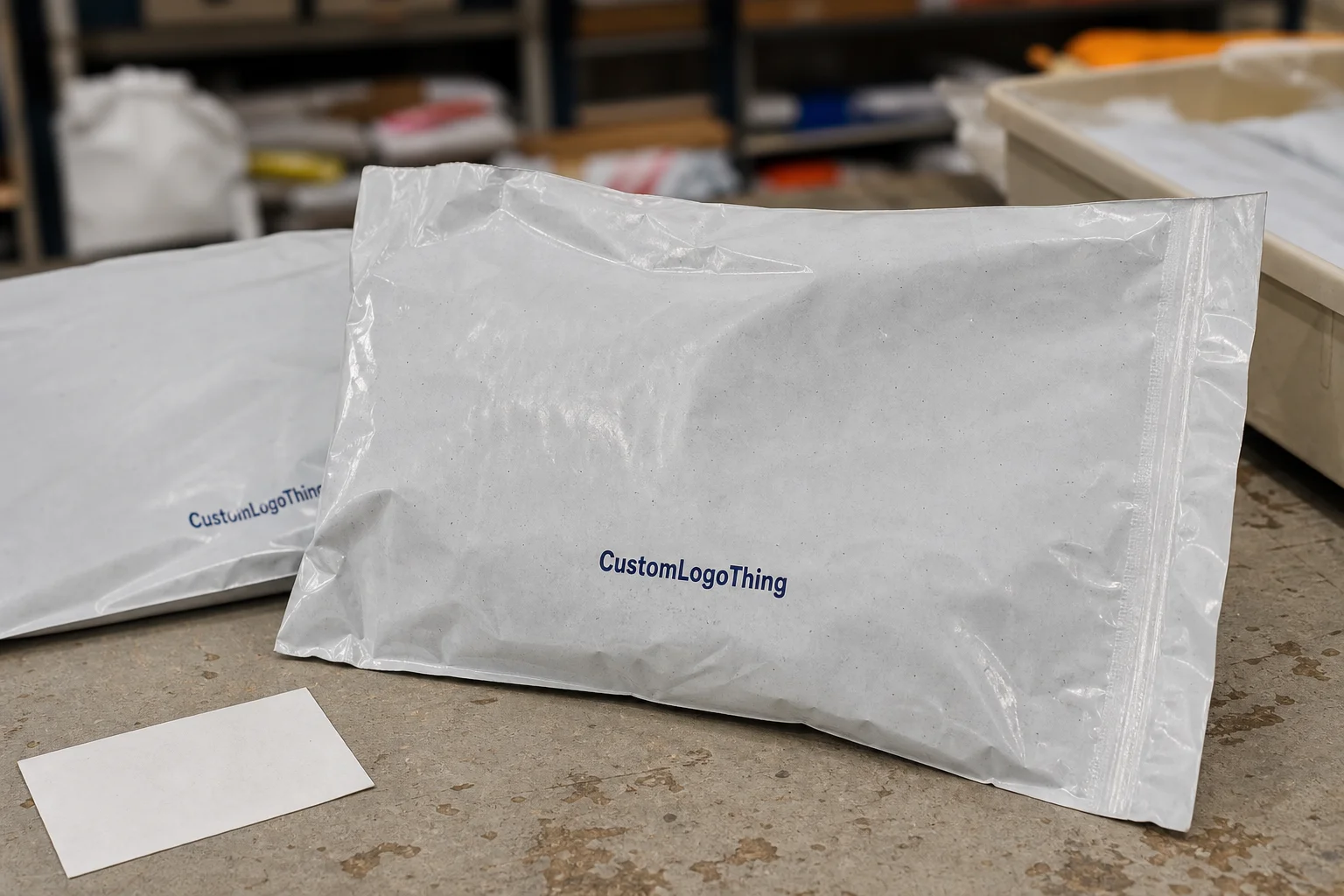
These mailers are used for prescription shipments, refill programs, wellness kits, and OTC e-commerce orders. They need to stay discreet, survive parcel handling, accept labels cleanly, and support sustainability goals without creating new fulfillment problems.
The key point: lead time is not just factory days. It includes quoting, spec lock, proofing, approvals, material allocation, printing, converting, packing, and freight. Many orders lose more time in review loops than on the production floor.
Why pharmacy recycled poly mailers lead time catches buyers off guard
Lightweight packaging creates false confidence. A poly mailer may weigh only a few grams and still take weeks to source properly because procurement, operations, marketing, and compliance are all reviewing different risks.
Buyers often treat mailers as commodity packaging. Converters see a chain of steps: film sourcing, print prep, plate or cylinder setup where needed, film allocation, slitting, folding, adhesive application, seal checks, case packing, and shipping. That difference in perspective is where timing assumptions break down.
Pharmacy use also raises the bar. The package needs to be discreet, opaque enough for privacy, resistant to light moisture, and compatible with shipping labels and barcode scanning. If recycled-content claims are involved, buyers may also need supporting documentation. Teams often reference the EPA for broader environmental guidance. For paper packaging, some look to FSC, though that does not answer verification questions for poly mailers.
The first delay is usually vague input. “White outside, black inside, high recycled content, standard size” is not enough to quote accurately. A 10 x 13 inch mailer at 2.5 mil is not interchangeable with a 12 x 15.5 inch bag at 2.0 mil once inserts, paperwork, or secondary pouches are involved.
Important: “Ships in 3 weeks” is not a usable schedule. Ask for proof date, production completion date, and freight departure date as separate milestones.
What counts as a recycled poly mailer for pharmacy fulfillment
A recycled poly mailer is typically a polyethylene shipping bag made with some percentage of recycled content, often post-consumer recycled (PCR), post-industrial content, or a blend. Many are co-extruded in multiple layers to balance durability, opacity, and print performance.
For parcel use, common gauges run about 2.0 mil to 3.15 mil, though the right spec depends on product weight, insert bulk, and parcel abuse. Skip that discussion and you usually end up with one of two problems: an overbuilt bag that costs too much or a thin bag that splits at the seams.
Specs that matter most include:
- Finished dimensions, standard or custom
- Film thickness or gauge
- Recycled-content percentage
- Single permanent closure or dual-seal return feature
- Tear strip design
- Exterior and interior color
- Opacity level for privacy
- Print coverage and label zone requirements
For pharmacy fulfillment, a good mailer needs reliable label adhesion, enough stiffness to pack efficiently, decent puncture resistance, and a surface that supports barcode readability. If the bags run on semi-automated or automated packing lines, opening consistency and film slip matter too.
Recycled content can complicate sourcing. Higher PCR levels may affect whiteness, gloss, feel, and print consistency. If you want a very bright white surface and a very high recycled percentage, the available supplier base narrows and timing often stretches before printing even starts.
Stock mailers are usually faster if inventory exists. Custom mailers add proofing, setup, and scheduling. If you need exact dimensions, pharmacy-specific copy, or branded print, custom may still be the right choice. Just do not expect stock timing on a made-to-order spec.
Teams comparing formats often start with Custom Poly Mailers and then review other Custom Packaging Products if the program also needs inserts, pouches, or secondary cartons.
The production process and timeline from quote to dock
A custom order usually moves through inquiry, quote, spec review, artwork submission, proofing, material allocation, printing, converting, packing, and freight. That full chain determines timing, not a single factory number.
Preproduction, production, and transit are different clocks
Preproduction covers dimensions, gauge, recycled-content target, print requirements, case pack, ship-to location, and artwork review. If files are complete and decision-makers are aligned, this may take 2 to 7 business days. If details keep changing, it can drag much longer.
Production starts after proof approval and material availability are confirmed. For a straightforward Custom Printed Mailer, a realistic range is often 12 to 20 business days from approved proof to production completion. Specialty features, unusual dimensions, or tight film supply can push that longer. Stock plain bags are much faster because most of these steps disappear.
Transit is its own variable. Domestic ground freight to one distribution center may add 2 to 6 business days. LTL appointments, split shipments, or longer routes add more. Overseas production changes the math again with ocean schedules, customs, inland transfer, and port risk.
Where orders usually get stuck
- Spec ambiguity. Missing dimensions, unclear gauge, or no recycled-content target.
- Artwork churn. Revisions to legal copy, return instructions, logo placement, or barcode clear zones.
- Freight changes late in the process. One destination turns into several, or a standard shipment becomes an urgent partial release.
Order size can also affect scheduling. Very small custom runs may wait longer for a press slot because setup time is harder to justify. Larger runs often schedule more easily because they absorb fixed setup better.
| Order Type | Typical Preproduction | Typical Production | Freight Range | Risk Level |
|---|---|---|---|---|
| Stock plain mailers | 1-2 business days | Inventory pick and pack | 2-6 business days domestic | Low if stock is available |
| Custom printed standard size | 3-7 business days | 12-20 business days | 2-8 business days domestic | Moderate |
| Custom size or specialty features | 5-10 business days | 15-30+ business days | Varies by route | Higher |
When a supplier gives a lead time, ask how much is approvals, how much is factory time, and how much is transportation.
Key factors that change turnaround for custom pharmacy mailers
Material availability is usually the first swing factor. Recycled resin supply is not always stable, and appearance targets narrow options quickly. A request for higher PCR, tight opacity, and a bright white exterior can limit what film is available in your time window.
Print complexity matters too. A one-color logo on the front panel is relatively simple. Full coverage print, heavy solids, reverse text, inside print, or multiple instruction panels add more scrutiny in prepress and proofing. The extra time is often in approvals rather than on press.
Construction choices affect schedules as well. Custom dimensions, perforations, easy-open features, dual adhesive strips for returns, gussets, or tamper-aware elements may require additional setup or slower converting steps. They may be worth it, but they are not timing-neutral.
Compliance review is another common source of delay. Pharmacy packaging often needs sign-off on privacy language, return instructions, disposal statements, or sustainability claims. Many jobs are manufacturing-ready while internal copy approval is still unresolved.
Freight strategy can save or sink a deadline. Domestic production may reduce transit risk, but not always total cost. Overseas production can lower unit pricing on larger runs, yet adds more schedule exposure. Partial shipments can protect launch dates, though landed cost usually rises.
For buyers shipping fragile or sensitive contents, parcel testing may also matter. Not every program needs formal validation, but if damage claims are increasing, transit performance should be reviewed. Guidance from ISTA can help frame that discussion.
Cost, pricing, and MOQ: what buyers should expect
Pricing is built from resin cost, recycled-content availability, print setup, converting labor, packing method, and freight. Buyers who compare quotes on unit price alone usually miss something important.
As a rough market range, Custom Printed Mailers in moderate volumes may land around $0.18 to $0.34 per unit for common sizes at roughly 5,000 to 25,000 pieces, depending on gauge, print coverage, recycled percentage, and ship lane. Smaller runs, specialty features, or more demanding print can push higher. Plain stock recycled mailers are usually lower because there is no custom print setup.
These numbers are directional. A thin 10 x 13 bag with light print is a different product from a thicker 12 x 15.5 mailer with dual adhesive strips and higher opacity.
MOQ exists because setup is real. Material staging, press prep, and converting setup cost time whether you order 3,000 bags or 30,000. If quantity sits below a supplier’s efficient run size, the unit price rises because fixed costs are spread over fewer pieces.
The speed-versus-cost tradeoff is usually direct:
- Rush production increases factory charges.
- Expedited freight can add 20% to 100% or more compared with standard shipping.
- Split shipments can protect service levels but raise handling and transportation costs.
Ask for apples-to-apples quotes: same dimensions, gauge, recycled-content target, print coverage, and freight assumptions. Otherwise one supplier appears cheaper because the film is thinner, the PCR content is lower, or freight is excluded.
| Scenario | MOQ Tendency | Unit Cost Tendency | Lead Time Tendency |
|---|---|---|---|
| Stock plain recycled mailer | Low | Lowest | Fastest if stocked |
| Custom print on standard size | Moderate | Moderate | Moderate |
| Custom size with specialty features | Moderate to high | Highest | Longest |
The right order size is not automatically the biggest one your budget can absorb. It is the one that balances unit economics against storage, demand swings, and obsolescence risk if artwork or compliance language changes.
A step-by-step buying plan to reduce delays before you place the PO
Most avoidable delays happen before the PO goes out.
Step 1: define the actual use case
Document what the mailer needs to hold, including product weight, dimensional range, paperwork, inserts, and any added components. A bag sized for a single bottle and leaflet is not automatically right for a refill kit.
Step 2: lock the core spec early
Confirm dimensions, gauge, recycled-content target, closure style, tear strip, print colors, opacity, and any equipment requirements. If the bag must run on automation, say so up front.
Step 3: send a production-ready artwork package
Include vector files when possible, barcode zones, clear-space requirements, legal copy, return instructions, and dieline notes. A complete file package can shorten proof cycles by days.
Step 4: ask for milestone dates, not a vague promise
Request a proof issue date, proof approval deadline, production completion date, estimated ship date, and transit assumption.
Step 5: build a fallback before you need one
Keep a backup stock size, a simpler approved custom version, or an unprinted option on file for urgent demand. Also review reorder points against real consumption, not outdated planning settings.
Common mistakes that quietly add days or weeks
The first mistake is reusing an old spec without checking current product fit. Teams assume last year’s size still works, then discover after proofing that the label zone, insert stack, or closure allowance is wrong.
The second is treating recycled content like a vague preference instead of a material requirement. “High recycled” is not a spec. If there is no minimum percentage, no documentation expectation, and no stated tolerance for cosmetic variation, quoting slows down immediately.
Third, artwork gets approved without enough operational review. A barcode too close to a seal, low-contrast print under a shipping label, or a return strip that interferes with packout can all create avoidable problems.
Fourth, freight gets discussed too late. Production can finish on time and still miss a program window because receiving appointments are backed up, the shipment must be routed to several fulfillment sites, or the buyer wants staged releases after production is complete.
Fifth, reorders happen after safety stock is already tight. Buyers trying to reduce carrying cost end up turning a normal schedule into a rush order.
Quiet truth: many lead-time emergencies start as forecasting problems, not manufacturing problems.
Expert next steps for shortening reorder risk and improving supply continuity
The most useful next step is usually a supplier scorecard. Track quote response time, proof revision count, on-time shipment rate, defect rate, and invoice accuracy across several orders. Patterns appear quickly.
A supplier with a slightly higher unit price but strong proof discipline and a 95% to 98% on-time ship record may cost less overall than a cheaper option that misses dates or burns a week in every artwork cycle.
Set reorder triggers based on actual usage and actual supplier milestones. If demand averages 20,000 bags per month and the combined proofing, production, and freight window runs about 25 business days, your reorder point should reflect that plus safety stock.
It also helps to maintain one approved backup structure, such as an unprinted stock mailer in a nearby size or a simplified custom version without specialty features. If the full spec is delayed, the backup can keep orders moving.
Standardize the packaging brief as well. One document should cover dimensions, gauge, recycled-content target, print files, compliance copy, barcode locations, test requirements, shipping destinations, and forecast volume.
Practical next moves:
- Audit current mailer specs against the products actually shipping now.
- Pull 6 to 12 months of usage data and seasonality patterns.
- Request timeline-based quotes from two or three suppliers.
- Compare landed cost, not just piece price.
- Approve one fallback option before demand spikes force the issue.
Handled this way, lead time becomes more predictable and easier to manage for patient shipments and refill programs.
FAQ
How long is pharmacy recycled poly mailers lead time for a custom order?
For a straightforward domestic custom job, many buyers see roughly 3 to 7 business days for preproduction, 12 to 20 business days for manufacturing, then a few more days for freight. Specialty features, custom sizes, complex approvals, or constrained recycled film supply can extend that. Ask for milestone dates instead of one broad estimate.
What usually increases turnaround for pharmacy recycled poly mailers?
The biggest drivers are unclear specs, artwork revisions, recycled-content sourcing constraints, custom sizes, specialty closures, and late freight changes. Internal legal or compliance review often adds more time than buyers expect.
Do higher MOQs reduce unit cost on pharmacy mailers?
Usually yes, because setup and production costs are spread across more units. But lower piece price is only part of the calculation. Buyers still need to weigh storage, carrying cost, and obsolescence risk if artwork or messaging may change.
Can production-ready artwork speed up quoting and proofing?
Yes. Final dimensions, vector files, barcode zones, legal copy, and clear dieline notes reduce back-and-forth and improve quote accuracy. Missing files or placeholder copy can add days fast.
What is the best way to avoid reorder delays?
Track actual usage, reorder before safety stock gets thin, and keep one approved backup option available. Review the last order for defects, proof delays, or freight issues before placing the next PO. Small corrections there usually save more time than arguing over a promised ship date later.