A boutique orders 800 garment bags because the product photos look clean, clear, and “premium.” Two weeks later, the zipper splits, the hanger hole stretches, and the PVC clouds in storage. That is not packaging. That is a return waiting to happen.
Buyers searching for an order PVC Zipper Garment bags low moq quote guide usually need more than a pretty picture and a suspiciously cheerful unit price. They need to know what actually drives cost, what specs protect the garment, and where low MOQ stops being helpful and starts being expensive theater.
PVC Zipper Garment Bags are often judged by price first. Fine. Budgets matter. But the bag that works is judged by film thickness, zipper strength, seam sealing, venting, print method, and carton packing. Boring details. Expensive when ignored.
These bags are used by apparel brands, dry cleaners, uniform suppliers, wedding dress shops, promotional kit teams, hotel wardrobe programs, resale sellers, and showroom teams that need visibility, dust protection, and repeated opening. Low MOQ helps when testing a new product line or buying for a smaller program, but only if the finished bag still protects the garment, carries the logo cleanly, and ships without wasting half the budget on bad specs.
Why Cheap Garment Bags Fail Before They Reach the Rack
Cheap garment bags fail in predictable places. The zipper tape pulls away from the PVC. The top hanger opening stretches until it looks chewed. The seams split near the shoulders because that area carries weight. The bag creases so badly in the carton that it looks tired before a garment ever goes inside.
None of this is mysterious. A suit jacket, coat, uniform, or gown is not weightless. Add a hanger, repeated handling, warehouse storage, and retail display, and the bag needs enough structure to survive. Very light PVC film can work for short-term dust covers. It is a poor choice for reusable branded packaging unless expectations are low. Basement low.
The first buying question should not be, “What is your cheapest price?” Better question: “What specs will survive my use case at the lowest practical cost per piece?” That is the difference between buying packaging and buying regret by the carton.
Useful quote details include PVC thickness, bag width and length, zipper type, seam width, hanger reinforcement, print coverage, packing style, carton weight, and inspection expectations. If a supplier cannot explain those details, the low quote may not be a bargain. It may be a warning label wearing lipstick.
Practical rule: low MOQ is useful only when the supplier can still control material, construction, print quality, and packing. A tiny run with every possible custom feature will not produce magical pricing. Packaging is not a wish-granting department.
Product Details Buyers Should Confirm Before Ordering
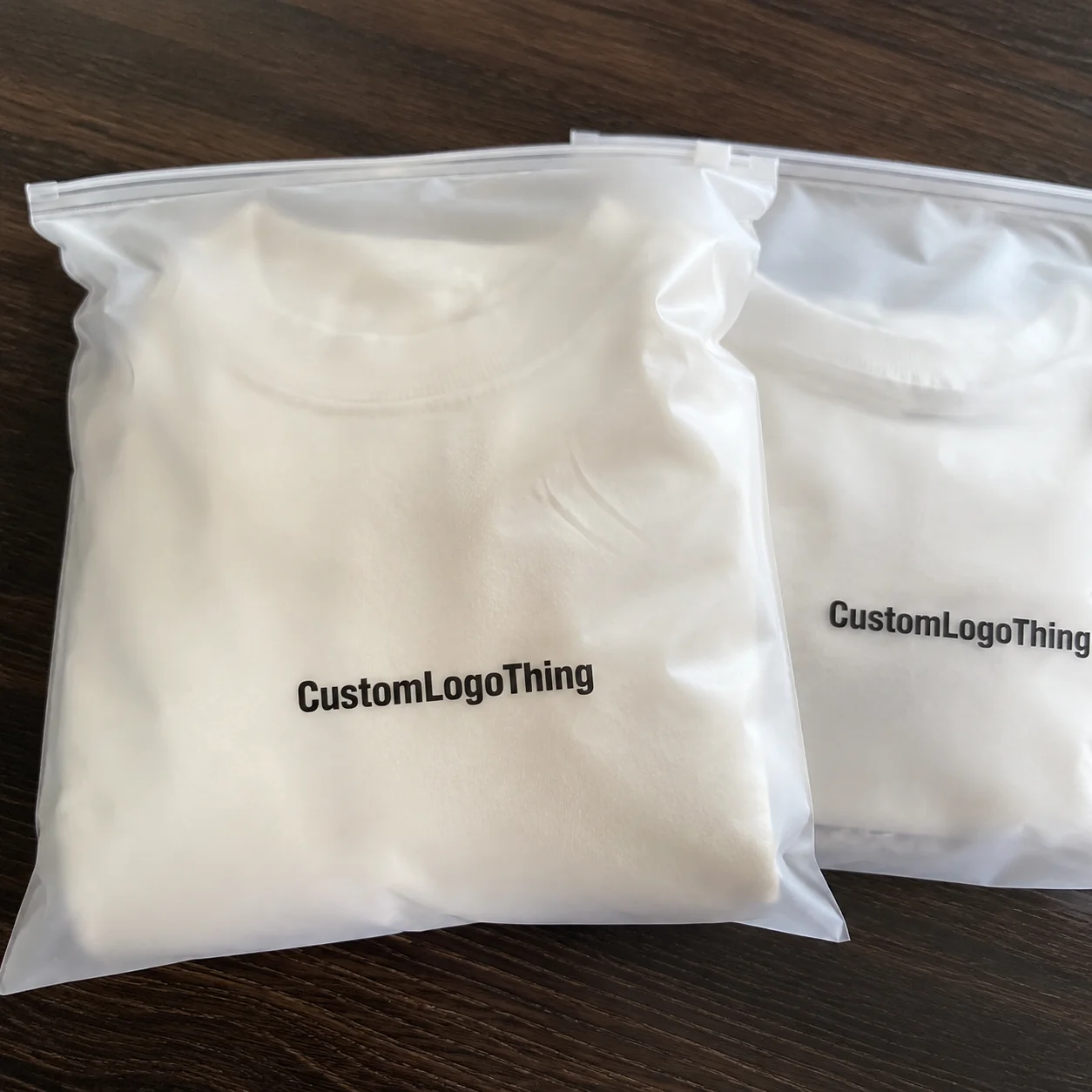
A standard PVC zipper garment bag is usually a transparent or frosted PVC cover with a zipper closure, hanger opening, sealed or sewn edges, and custom logo printing. Depending on the garment, it may also include side gussets, handles, card pockets, warning labels, ventilation holes, or reinforced hanger patches.
The shape matters more than many buyers expect. Flat garment bags are common for shirts, jackets, lightweight suits, and sample-room storage. Side-gusset bags add depth for thicker suits, coats, uniforms, and layered apparel. Shoulder-cover bags protect only the top of a garment during storage or retail display. Full suit bags run longer and protect jackets with trousers. Dress bags and gown bags need extra length, better drape room, and often a larger bottom gusset.
The wrong shape saves pennies and creates ugly garment bunching. Great plan, if the goal is complaints.
Zipper choices are not decoration. A standard nylon zipper works for many apparel and dry-cleaning uses. Heavier zipper tape is better for repeated opening, retail reuse, travel kits, or uniform programs. Plastic pullers are common and economical. Metal pullers can look more premium, but they may increase cost and carton weight. Double sliders are useful for long bags, gown bags, and larger openings where the user needs access from more than one direction.
PVC clarity changes the final presentation. High-clear PVC gives strong retail visibility and works well when the garment itself is the visual selling point. Frosted PVC gives a softer branded look and hides minor scuffs better. Tinted PVC can help a premium collection feel more intentional. Opaque panels are useful when privacy matters, such as uniforms, alterations, or resale handling.
Common add-ons include business card pockets, document sleeves, care instruction inserts, suffocation warning labels, hanger reinforcement patches, ventilation holes, bottom gussets, and carry handles. Each add-on should earn its place. If it does not improve fit, handling, retail presentation, compliance, or reuse, it is probably just another line on the invoice.
PVC is not always the right material. PEVA is softer and often chosen for garment covers with a different environmental profile. Non-woven fabric is better for breathable suit bags and premium reusable presentation. PE film is cheaper for basic short-term dust protection. PVC wins on clarity, structure, and shelf presentation, but it is not always the cheapest or softest option.
Size, Thickness, Printing, and Packaging Specifications
Do not guess size from a competitor's listing. Measure the actual garment plus hanger. A jacket that measures 24 inches across the shoulders may need a bag closer to 26 to 28 inches wide, depending on hanger width and garment bulk. A full-length gown may need 60 to 72 inches of bag length. Bridal gowns can need more if the train or layered skirt should not be compressed.
| Garment Type | Typical Bag Size Range | Common PVC Thickness | Best Use |
|---|---|---|---|
| Short jacket or shirt cover | 24 x 36 in to 26 x 40 in | 0.08 mm to 0.12 mm | Dust cover, showroom storage, light retail handling |
| Suit bag | 24 x 40 in to 28 x 44 in | 0.10 mm to 0.18 mm | Branded apparel packaging and dry-cleaning presentation |
| Coat or uniform bag | 26 x 48 in to 30 x 54 in | 0.15 mm to 0.25 mm | Repeated handling, heavier garments, uniform programs |
| Dress or gown bag | 28 x 60 in to 36 x 72 in | 0.15 mm to 0.30 mm | Formalwear, bridal shops, premium retail storage |
Film thickness affects price, durability, stiffness, and freight. Lighter PVC in the 0.08 mm to 0.12 mm range can work for short-term dust covers or low-cost retail packaging. Mid-weight PVC around 0.15 mm to 0.20 mm is more common for branded garment bags that need better handling strength. Thicker PVC, roughly 0.25 mm to 0.30 mm and above, feels more premium and holds shape better, but freight and stiffness increase. Physics still charges extra.
Construction specs deserve the same attention. Confirm zipper length, zipper direction, hanger hole size, seam width, top reinforcement, side gusset depth, and bottom fold or seal. A common hanger opening might be 2 to 3 inches wide, but heavy coats or specialty hangers may need more room. Reinforcement around the hanger opening is cheap compared with a torn top panel on a loaded rack.
Printing should match the artwork and order size. One-color screen print is often the cleanest and most cost-effective method for low MOQ logo bags. Multi-color screen print works for brand graphics but adds setup charges. Heat transfer can handle higher detail, gradients, or smaller elements, although it may not be the cheapest route. Printed inserts or adhesive labels make sense when artwork changes often across collections.
Artwork should be supplied as vector files, usually AI, EPS, SVG, or a clean PDF. Add Pantone references if color accuracy matters. Confirm imprint size, print location, and whether the artwork sits on the front panel, back panel, pocket, or opaque insert. Proof approval matters because PVC is transparent; a logo that looks strong on white paper may read weaker when printed over a dark suit.
Packing affects appearance and warehouse handling. Flat packing reduces creasing but can increase carton size. Folded packing saves space but may create fold lines, especially on thicker PVC. Individual polybags protect each unit but add labor and material. Master carton quantity, carton markings, barcode labels, and palletization should be decided before production. If the bags go into a retailer or 3PL warehouse, ask for carton requirements early, not after the goods are packed.
Order PVC Zipper Garment Bags Low MOQ Quote Guide
The real order PVC Zipper Garment Bags low moq quote guide starts with one honest point: MOQ depends on the spec. A standard size, clear PVC, stock zipper color, and one-color logo can often start around a few hundred to 1,000 pieces. A custom size with tinted PVC, heavy film, special zipper color, large multi-color print, and individual packing may push MOQ higher because material sourcing and setup are less flexible.
For simple custom runs, practical starting quantities may land around 500 to 1,000 pieces. Better bulk pricing usually appears at 2,000 to 5,000 pieces and above. That does not mean every buyer should order 5,000 pieces. It means the price curve often improves once setup, material handling, and production labor are spread over more units.
| Quantity Tier | Typical Fit | Cost Behavior | Buyer Advice |
|---|---|---|---|
| 300 to 500 pcs | Testing, boutique launches, urgent small programs | Higher unit cost due to setup and handling | Keep size standard and print simple |
| 1,000 pcs | Small apparel lines, local dry cleaners, uniform pilots | More reasonable cost per piece | Good tier for first branded order |
| 2,500 pcs | Retail programs, showroom packaging, recurring apparel use | Better spread of setup charges | Compare against 1,000 pcs before deciding |
| 5,000+ pcs | Ongoing wholesale, retail rollout, hotel or uniform programs | Strongest bulk pricing in many specs | Confirm storage space and reorder timing |
Quote drivers include film usage, zipper length, labor for sewing or heat sealing, number of print colors, print coverage, tooling fees for unusual components, packing style, inspection level, and shipping method. A long gown bag with a gusset uses far more material than a short jacket cover. A zipper running the full length of the bag costs more than a shorter side zipper. Shocking? No. Frequently ignored? Absolutely.
Setup fees and sample fees are normal in custom packaging. A sample fee pays for setup, material, labor, and print testing. It is not automatically a scam. The problem is pretending custom development is free, then hiding it in an inflated unit cost or delivering a sample that has nothing to do with the bulk run.
Ask for tiered pricing at 500, 1,000, 2,500, and 5,000 pieces. That gives you a clean view of price breaks. Sometimes ordering 1,000 instead of 800 reduces the effective unit cost enough to make sense. Sometimes it does not. Real numbers beat guessing.
Tradeoffs are practical. Thinner PVC lowers material cost but may crease, tear, or feel flimsy. Fewer print colors reduce setup charges and production risk. Stock zipper colors move faster than custom zipper colors. Larger cartons may reduce packing labor, but they can create awkward warehouse handling. For deeper buying questions, Custom Logo Things can also support recurring supply needs through Wholesale Programs.
Process, Timeline, and Production Steps From Artwork to Delivery
A clean order path starts with spec confirmation. Confirm size, PVC thickness, zipper type, print method, packing, quantity, delivery address, and deadline. Then the supplier reviews artwork, prepares pricing, confirms setup or sample costs, collects a deposit, provides a digital proof, creates a sample if needed, and moves into bulk production after approval.
Typical quote preparation takes 1 to 3 business days when specs are complete. Sampling often takes 5 to 10 business days, depending on material and print complexity. Bulk production commonly takes 12 to 25 business days after approval. Shipping time is added after that, and it can range from a few courier days for samples to several weeks for larger sea freight orders.
What slows orders down? Missing dimensions. Low-resolution logos. Unclear PVC thickness. Changing print colors after proofing. Custom zipper colors. Holiday schedules. Freight bottlenecks. The zipper will not magically source itself because the launch date is dramatic.
There are several sample options. A digital mockup checks layout only. A blank material sample checks PVC clarity, flexibility, and thickness. A printed sample checks logo placement, color, and construction. A production sample is best for high-value orders where the final bag must match exact retail or warehouse expectations.
Inspection checkpoints should include material clarity, thickness tolerance, zipper function, seam strength, print position, color accuracy, bag dimensions, carton labeling, and random pull testing. For transit performance, buyers with heavier cartons or warehouse distribution can review packaging test concepts from the International Safe Transit Association. For broader packaging education and industry context, PMMI is also a useful authority source.
Shipping choices depend on urgency and quantity. Courier works for samples and very small urgent runs. Air freight works for urgent commercial orders, but the freight bill can bite. Sea freight is usually better for larger runs where landed cost matters more than speed. Delivered-duty options may be useful if you want clearer landed cost and fewer surprises during import.
Common Ordering Mistakes That Inflate Cost or Cause Delays
The first mistake is ordering by photo only. Two garment bags can look identical online and behave completely differently because PVC thickness, zipper tape quality, seam sealing, and reinforcement are not visible in a polished product image. A photo can show the idea. It cannot prove durability.
The second mistake is vague dimensions. Specify width, length, gusset depth, hanger opening, zipper placement, and whether the measurement is internal usable size or flat measured size. A 28-inch-wide bag may not give 28 inches of usable room if the side seams, gusset folds, and garment bulk eat into the space.
Overprinting is another cost trap. Large multi-color prints on clear PVC may look premium in a mockup, but they add setup charges, slow proofing, and reduce garment visibility. Sometimes a smaller one-color logo looks cleaner and costs less. Annoying, but true.
Ultra-low MOQ can backfire if every detail is custom. A custom size, custom zipper, custom tint, custom print, and custom packing method at 300 pieces may be technically possible, but the unit cost will not be cute. If the budget is tight, pick the custom detail that matters most and standardize the rest.
Compliance and labeling should not be an afterthought. Apparel packaging may need suffocation warnings, recycling marks, country-of-origin labels, barcode labels, or retailer carton markings. If bags are headed into retail distribution, ask for retailer requirements before artwork approval. If they are headed into a warehouse, confirm carton size, carton weight, and label placement before production packing starts.
Fit-critical orders need better information. Send an existing bag sample, garment sample, or at least clear photos with measurements. Bridal gowns, uniforms, heavy coats, costumes, and luxury retail pieces can fail badly in a generic bag. A quote guide only works if the supplier has enough detail to price the right product, not just the cheapest product.
Next Steps to Get a Clean Custom Bag Order Started
A useful quote request does not need to be fancy. It needs to be complete. Send the target quantity, bag width and length, garment type, PVC thickness preference, zipper color, print colors, logo file, packing method, delivery address, and required in-hands date. If you do not know the best thickness, explain the use: retail display, dry-cleaning return, showroom storage, travel kit, bridal packaging, or recurring uniform issue.
Choose two or three quote tiers instead of one quantity. Ask for 500, 1,000, and 2,500 pieces, or 1,000, 2,500, and 5,000 pieces if the product will repeat. This helps you avoid under-ordering by 200 pieces and paying a silly unit price. It also shows whether the next tier improves cost per piece enough to justify the extra inventory.
Attach photos if you have them. A photo of the garment, current bag, rack display, packing carton, or retail presentation reduces back-and-forth. Visual context prevents expensive assumptions, especially with gussets, hanger openings, print placement, and folded packing.
Custom Logo Things should respond with confirmed specs, material recommendations, print method recommendations, MOQ options, unit pricing, setup charges or sample fees, estimated production time, shipping estimates, and the proofing process. If your order is ready to quote, send the details through Contact Us. If you are still comparing options, the general FAQ can help with common custom printing questions.
Use this order PVC Zipper Garment Bags low moq quote guide as the spec checklist before requesting pricing. The more precise your bag size, PVC thickness, zipper option, logo artwork, quantity tier, and delivery requirement, the faster you get a quote that is actually useful.
FAQ
What is the lowest MOQ to order custom PVC zipper garment bags?
Simple standard-size bags with one-color printing can often start around a few hundred to 1,000 pieces, depending on available PVC stock and zipper options. Fully custom sizes, special tint, heavy PVC, multi-color printing, or unique zipper colors usually push MOQ higher because setup and material sourcing are less flexible. Ask for tiered pricing at 500, 1,000, 2,500, and 5,000 pieces so you can see whether a slightly larger run makes financial sense.
How do I get an accurate low MOQ quote for PVC zipper garment bags?
Send bag dimensions, quantity, PVC thickness, zipper color, print colors, logo file, packing style, shipping address, and deadline. If you are unsure about thickness or size, share the garment type and a photo of the current packaging so the supplier can recommend practical specs. A vague request like “send best price” gets a vague quote. Shocking, I know.
What PVC thickness should I choose for zipper garment bags?
Lighter PVC works for short-term dust protection and lower-cost retail covers. Mid-weight PVC is usually better for branded apparel packaging, showroom storage, and repeated handling. Thicker PVC gives a more premium feel and better durability, but it increases material cost, carton weight, and freight charges.
How long does production take after I order PVC zipper garment bags?
Digital proofing may take 1 to 3 business days after complete artwork and specs are received. Sampling commonly takes 5 to 10 business days, depending on material and print complexity. Bulk production often takes 12 to 25 business days after approval, with shipping time added based on courier, air, or sea freight.
Can I print my logo on low MOQ PVC garment bags?
Yes. One-color logo printing is usually the most cost-effective choice for low MOQ orders. Multi-color printing, large coverage artwork, or specialty effects can be done, but setup cost and lead time increase. Vector artwork is strongly recommended because it keeps edges clean and prevents the logo from looking like it was rescued from a blurry email signature.