Buyer Fit Snapshot
| Best fit | Order Recycled Ocean Plastic Pouches for Sustainable Brands projects where brand print, material claims, artwork control, MOQ, and repeat-order consistency need to be specified before quoting. |
|---|---|
| Quote inputs | Share finished size, material target, print colors, finish, packing count, annual reorder estimate, ship-to region, and any compliance wording. |
| Proofing check | Approve dieline scale, logo placement, barcode or warning zones, color tolerance, closure strength, and carton packing before bulk production. |
| Main risk | Vague material claims, crowded artwork, missing packing details, or unclear freight terms can make a low unit price expensive after revisions. |
Fast answer: Order Recycled Ocean Plastic Pouches for Sustainable Brands should be specified like a repeatable production item. The safest quote records material, print method, finish, artwork proof, packing count, and reorder notes in one written spec.
Production checks before approval
Compare the actual filled-product size with the drawing, then confirm tolerance on folds, seals, hang holes, label areas, and retail display edges. Reserve space for logos, QR codes, warning copy, and material claims before decorative graphics fill the panel.
Quote comparison points
Review material grade, print process, finish, sampling route, tooling charges, carton quantity, and freight assumptions side by side. A quote is only useful when the supplier can repeat the same color, closure quality, and packing count on the next order.
Order Recycled Ocean Plastic Pouches for Sustainable Brands
If you need packaging that looks good on shelf, travels lighter than rigid containers, and still gives your brand a real sustainability story, order Recycled Ocean Plastic pouches with a spec, not a wish list. That sounds blunt because it is. Claims matter. Seal strength matters. Barrier performance matters. Print coverage matters. And the order only goes smoothly if the product, the line, and the budget are all speaking the same language.
From a buyer's point of view, flexible packaging makes sense when you want a sharp presentation without dragging freight and storage costs through the roof. Brands often order recycled ocean plastic pouches for dry goods, snacks, supplements, pet treats, and other non-pressurized products that do not need a rigid bottle or tub. If your team buys across several product lines, our Wholesale Programs can keep the process from turning into five separate quote threads and a pile of half-finished approvals.
I've sat through enough packaging reviews to know where projects go sideways. It usually starts with a vague brief and ends with someone asking why the pouch doesn't fit the fill line. Recycled content is part of the story, sure. But the structure underneath the story is what actually decides whether the pack works. If the barrier is wrong or the seals are weak, the pretty part of the conversation becomes noise. Packaging does not care about brand deck language. It only cares about physics.
Why Brands Order Recycled Ocean Plastic Pouches
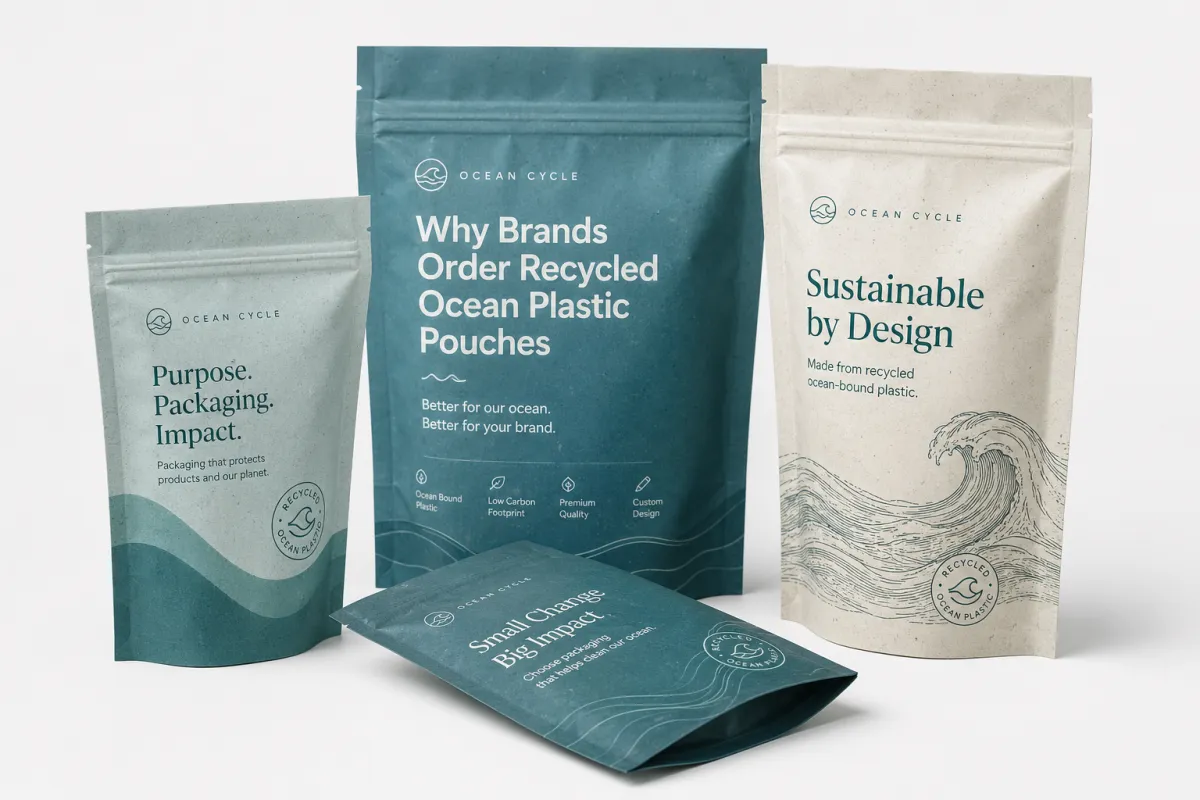
Brands usually order recycled ocean plastic pouches for three reasons: they want lower package weight, they want a cleaner sustainability message, or they want a format That Feels Premium without jumping to glass or rigid tubs. In real life, those reasons overlap. A pouch ships lighter than a jar. It takes less shelf depth than many cartons. And if the artwork is done well, it does not look like a compromise at all.
Freight is the obvious win. Flexible packaging can cut cube dramatically compared with rigid packaging, which matters for palletized shipping, case pack, and direct-to-consumer fulfillment. That does not mean every pouch is the cheapest package on paper. It means the landed cost often improves once you account for weight, storage, and outbound shipping. If the product is dry, stable, and not asking for a hard shell, a pouch can be a smart middle ground. Simple, really.
There is another reason buyers move in this direction: shelf presence. A stand-up pouch gives you a wide front panel and enough room for product claims, regulatory copy, and branding that does not feel crammed in. For smaller brands especially, that is a nice balance between visual impact and production practicality. You can order recycled ocean plastic pouches in a format that feels current without overcomplicating the package.
Here is the part some teams miss. Recycled content is not magic. It supports the story, but it does not solve performance on its own. Seal strength still matters. Barrier still matters. Drop resistance still matters. If the pouch leaks, wrinkles badly, or delaminates in transit, nobody is going to clap because the resin source sounded responsible. They will just notice the failure. That is why buyers who order recycled ocean plastic pouches should ask hard questions before artwork is approved, not after.
"A package that fails on the line is not sustainable. It is just a headache with a greener label."
There is also a practical production angle. Flexible packaging is usually easier to decorate and easier to store than rigid alternatives. It can make a launch feel more polished without forcing the operation into a complete overhaul. That is why many teams land here after pricing out bottles, jars, or tubs and realizing the math gets ugly fast. Not glamorous. Just smart.
If your company is trying to improve packaging without turning the whole operation upside down, order recycled ocean plastic pouches with a clear spec sheet and a realistic budget. That combination beats vague sustainability intentions every time. The package should support the product, not become the project.
How Do You Order Recycled Ocean Plastic Pouches?
The fastest way to order recycled ocean plastic pouches is to stop treating the quote request like a scavenger hunt. Send the supplier the product details, the fill weight, the pouch size you think you need, and the finish you actually want. A vague request gets a vague response. Packaging buying is not a mystery novel.
Start with the basics: product type, target quantity, pouch dimensions, closure preference, and whether the pouch needs extra barrier protection. If you already know the sales channel, include that too. Retail shelf, e-commerce, subscription, and sample pack use cases do not always need the same structure. A good supplier should be able to spot where the spec is too light, too heavy, or just plain wrong for the application.
Before you order recycled ocean plastic pouches, ask for a dieline, a technical sheet, and a quote that spells out what is included. That keeps the project from turning into a pile of assumptions. It also helps your designer place artwork correctly and keeps the operations team from finding out too late that the pouch does not match the filling equipment. That kind of surprise is expensive and annoying. Usually both.
Here is the clean version of the process:
- Share product specs, fill weight, and target quantity
- Choose the pouch format and closure type
- Review the quote, dieline, and technical sheet
- Approve artwork and proof files
- Confirm sample or pre-production sign-off
- Move into production and shipping
If you want the short answer, here it is: you order recycled ocean plastic pouches by sending precise specs, reviewing a technical quote, approving the dieline, and confirming artwork before production starts. The long answer just has more email. A lot more email.
Product Details: What You Actually Get
When you order recycled ocean plastic pouches, you are usually choosing from a few familiar formats, each with its own tradeoff. The most common are stand-up pouches, flat pouches, side gusset bags, zipper pouches, and tear-notch options. Those are not just style labels. They affect fill behavior, shelf display, and how the customer opens and re-closes the package.
Stand-up pouches are the most common Choice for Brands that want shelf visibility. Flat pouches are better when the product is small, sample-sized, or sold in a simpler format that does not need to stand upright. Side gusset bags work well for bulkier dry goods and products that benefit from a more traditional bag silhouette. If reclosability matters, a zipper is usually worth the extra cost. If first-open convenience matters, a tear notch makes a real difference.
The material story needs plain language, not marketing fog. Recycled ocean plastic usually refers to plastic recovered from marine or coastal collection streams and processed into usable resin for packaging or related applications. It does not mean the pouch is made entirely from ocean waste, and it does not mean the package is automatically compostable, biodegradable, or recyclable in every local program. Claims should be handled carefully. If a supplier cannot explain the resin source, layer structure, and any certification or chain-of-custody support, keep asking questions.
For practical buying, the important question is not whether the phrase sounds good. It is whether the pouch works for the product and whether the claim can be supported. Buyers who order recycled ocean plastic pouches for food or supplement use should ask for food-contact documentation where relevant, and they should verify whether the structure includes any layers that affect recyclability or barrier performance. That is basic diligence, not red tape.
Finish choices change presentation more than many teams expect. Matte finishes create a softer, more premium look. Gloss films often make colors pop and can look brighter on shelf. Spot effects add contrast, but they also raise production complexity. Clear windows let customers see the product, which can help build trust for snacks, pet treats, and dry goods. Every choice affects visual impact and, in some cases, the cost to order recycled ocean plastic pouches at scale.
Here is a straightforward breakdown of common options:
| Format | Best For | Typical Strength | Tradeoff |
|---|---|---|---|
| Stand-up pouch | Retail snacks, supplements, specialty dry goods | Strong shelf presence | Usually more tooling and print attention |
| Flat pouch | Samples, single-serve items, inserts | Low material use | Less shelf visibility |
| Side gusset bag | Coffee, bulk dry goods, pet products | Efficient fill volume | Less front-panel branding space |
| Zipper pouch | Products opened and closed repeatedly | Convenience for consumers | Raises unit cost |
| Tear-notch pouch | Products needing easy first open | Simple opening experience | Must be placed correctly in the structure |
The best-fit categories are usually snacks, dry goods, supplements, pet treats, and other non-pressurized consumer products. If you want to order recycled ocean plastic pouches for liquids, carbonated products, or anything with serious oxygen sensitivity, the review gets tighter and the structure usually needs to be more specialized. Some applications fit beautifully. Others do not. That is not a sales pitch. That is the reality of packaging.
One more practical point: artwork matters more than many buyers expect. Heavy print coverage can hide some surface variation and deliver a cleaner look, but it can also push costs higher. Lighter coverage may save money, yet it can make the recycled material story more visible in the texture or tone of the film. Some brands like that. Some do not. There is no universal answer. The right choice is the one that fits the brand and the shelf.
Specifications That Matter Before You Order Recycled Ocean Plastic Pouches
If you want to order recycled ocean plastic pouches without wasting time, start with the specs that actually control performance. The short list includes dimensions, film thickness, seal width, barrier level, closure type, and whether you need a tear notch. Leave those out and you are basically asking for a quote based on optimism. Optimism is not a specification.
Dimensions should match the product, not somebody's rough guess from a similar bag. Tell the supplier the fill weight, the product density, and whether the pouch needs room for headspace or a special closure. A snack pouch and a supplement pouch may look similar, but their internal volume and seal needs can differ enough to change the final size. If you already know the fit, approval gets easier and faster.
Film thickness is usually discussed in microns or mils, depending on the market and supplier. Thicker film can improve durability, but it is not always better. A heavier structure may cost more, seal differently, and feel less refined in hand. For many retail applications, the goal is to choose enough thickness to protect the product without turning the pouch into overbuilt baggage. That balance matters when you order recycled ocean plastic pouches for a real production line.
Barrier level is another issue that can make or break the project. If the product is moisture-sensitive, aroma-sensitive, or oxygen-sensitive, the pouch structure needs the right barrier properties. A dry pasta snack and an aromatic coffee blend do not need the same film build. More barrier usually means higher cost, and sometimes slower lead times because the structure requires more specialized materials. The tradeoff is simple: better protection costs more. Packaging is not sentimental.
Seal width deserves more attention than it gets. A wider seal can improve strength and reduce risk during filling and transport, but it also takes space away from the usable panel. If the pouch is small, that matters. Closure type matters too. Zippers add convenience. Press-to-close systems can improve reusability. Hang holes are useful for certain retail environments. Each feature pushes the pouch toward a specific use case, so pick the ones that earn their keep.
Print coverage affects more than the look of the package. Heavy ink coverage can influence flexibility, surface feel, and in some cases the way the pouch handles during sealing or folding. If your artwork includes full-bleed colors, metallic inks, or intricate registration, ask for a tech review before you order recycled ocean plastic pouches. A file can look perfect on a monitor and still create headaches on press. Design software does not care about line speed. The factory does.
Request a dieline and a technical sheet before approval. That is not optional if you want the pouch to fit your fill weight and machine setup without guesswork. A dieline tells your designer where safe zones and seals live. A technical sheet shows structure, thickness, closure details, and any compatibility notes. The earlier those documents are in play, the fewer revisions you will need later.
For brands that need a compliance-minded supplier, ask for documentation on material composition, food-contact suitability if relevant, and testing standards where applicable. Packaging teams often reference industry benchmarks such as ISTA for transit testing and EPA recycling guidance when evaluating end-of-life claims. Those references do not replace material review, but they do help buyers compare suppliers with less hand-waving.
The truth is simple. If you want to order recycled ocean plastic pouches confidently, ask for the technical basics first. A pretty render is not enough. A sample without specs is not enough. You need the dimensions, film build, seal configuration, and closure detail before you approve anything that will go into production.
Pricing & MOQ for Recycled Ocean Plastic Pouches
Pricing is where buyers either get clear answers or get buried in vague language. If you want to order recycled ocean plastic pouches at a sensible cost, the biggest drivers are usually size, film structure, print colors, finish, quantity, and shipping destination. Those are the levers. Everything else is secondary unless you add unusually complex features.
Size affects material consumption immediately. A larger pouch uses more film, more ink area, and more surface treatment. Film structure matters because barrier layers and specialty constructions usually cost more than basic formats. Print colors can push pricing up if the design requires multiple passes or fine registration. Finish choices like matte, gloss, soft-touch, spot effects, and clear windows can each add cost in different ways. Quantity then spreads fixed setup costs over more units, which is why small orders often look expensive on a per-unit basis.
MOQ guidance depends on whether you are choosing stock or custom. Stock formats can start at lower quantities because the tooling already exists. Custom sizes and custom print usually require a higher minimum, especially if the project needs new plates, new tooling, or a unique closure setup. If a supplier says the MOQ is low, ask what is already in inventory and what still needs to be manufactured. Low MOQ is nice. Transparent MOQ is better.
Here is a practical view of how pricing often behaves when brands order recycled ocean plastic pouches:
| Order Type | Typical MOQ Range | Price Behavior | Best Fit |
|---|---|---|---|
| Stock pouch with minimal customization | 500-2,000 units | Lower setup cost, higher flexibility | Launches, trials, fast restocks |
| Custom size with standard print | 3,000-10,000 units | Moderate setup cost, better fit | Growing brands with repeat demand |
| Fully custom pouch with premium finish | 10,000+ units | Lower unit cost at scale, higher upfront spend | Established retail programs |
Hidden costs are where buyers get annoyed. Sampling can cost money. Plates or cylinders can cost money. Freight can be a meaningful line item, especially if the order is heavy or the delivery point is far from the production site. Special accessories like zippers, tear notches, degassing valves, or spouts can all change the total. When you compare quotes, make sure sampling and shipping are included. Otherwise the cheapest quote may be the one with the most expensive surprise.
For a rough planning range, many brands look at something like $0.18-$0.28 per unit for 5,000 pieces on a straightforward pouch, with costs rising if the print coverage is heavy, the structure uses more barrier, or the finish gets more premium. Smaller quantities can land much higher. Larger runs can bring the price down. Those are not guarantees. They are the kinds of ranges that help procurement teams avoid fantasy math.
The best way to compare quotes is to compare the same package. Same size. Same film build. Same print method. Same finish. Same closure. Same shipping terms. If one supplier quotes a different structure, the comparison is useless. That is how bad buying decisions happen. The quote looks lower, the package performs worse, and everybody acts surprised later. Cute, but not useful.
If you need a broader buying framework for packaged products, our FAQ page is a useful starting point for common questions about artwork, samples, and ordering flow. It will not replace a real quote, but it will save you from asking the same basic questions three different ways.
When teams order recycled ocean plastic pouches with realistic specs and a clean scope, the pricing conversation gets a lot easier. You can decide where to spend, where to simplify, and where to hold the line. That is the difference between buying packaging and chasing quotes for a month.
Process & Timeline: From Quote to Delivery
The process to order recycled ocean plastic pouches should be pretty straightforward. If it is not, somebody is missing basic information. The clean sequence is simple: send specs, review a quote, approve a dieline, confirm artwork, and sign off on a proof or sample. After that, production can move with far fewer interruptions. That is the process. The hard part is keeping everyone from changing their minds halfway through.
Start with the right inputs. The quote request should include dimensions, fill weight, product type, quantity, closure choice, print colors, finish preferences, target ship date, and delivery location. If the order is for food, mention that too. If you already have a reference pouch, send a photo or sample reference. The more precise the brief, the fewer revisions you will need.
Artwork proofing can move quickly when the files are clean and the dieline is approved. A simple job may be proofed in a short window, while a more complex one may need extra time for print checks and layout corrections. Production timing depends on order size and complexity. Stock-based jobs are usually faster. Fully custom jobs take longer because the materials, print setup, and finishing all need to line up.
As a practical range, many projects can move from proof approval to production in roughly 12-15 business days for straightforward builds, while more complex custom pouch orders may take longer. Shipping then adds its own time depending on destination and transport mode. If timing matters, do not assume every step is automatic. Ask for a timeline with approval checkpoints spelled out. That is the only way to keep control of the schedule when you order recycled ocean plastic pouches.
Delays usually happen for three reasons. First, the spec is incomplete and the quote has to be revised. Second, the artwork changes after proofing, which means the design team has to circle back and fix files. Third, the sample or final proof sits waiting for approval while everyone is busy. None of that is mysterious. It is just what happens when packaging projects start before decisions are finished.
To keep the schedule moving, prepare these items before the quote is sent:
- Final or estimated pouch dimensions
- Product type and fill weight
- Closure preference such as zipper, tear notch, or both
- Print color count and artwork files
- Target quantity and reorder expectation
- Delivery address or shipping region
If you are comparing performance expectations, ask whether the pouch can be evaluated against transit testing standards such as those published by ISTA. That is especially useful for brands shipping Direct to Consumers or moving product through rough distribution channels. A pouch that looks fine in a studio photo may behave very differently after stacking, vibration, and temperature swings. Packaging lives a hard life. Test it like it.
When buyers order recycled ocean plastic pouches without a clear approval workflow, the project drifts. When they define the steps up front, production tends to stay on schedule. There is no mystery here. The fastest jobs are usually the ones with the cleanest paperwork.
Why Choose Us for Recycled Ocean Plastic Pouches
Custom Logo Things is a good fit for buyers who want straight answers instead of packaging theater. If you need to order recycled ocean plastic pouches, the value is not just in the material. It is in the guidance. Which structure makes sense. Where to spend money. Where to save. Which finish is worth the premium and which one is just a way to make the quote look more interesting than it needs to be.
We focus on manufacturing control and clear quoting. That means you should get a practical response on size, material build, print coverage, and finishing options rather than a cloudy promise that everything can be solved later. Later is where production mistakes are born. A decent supplier should be able to tell you, before you commit, whether the pouch is likely to fit your product and budget.
Our advice is intentionally direct. If you do not need a window, do not pay for one. If a premium finish will not improve shelf performance, skip it. If the product is moisture-sensitive, do not cheap out on barrier. If the order is a test run, do not overbuild the spec just to impress a meeting. The smartest way to order recycled ocean plastic pouches is to match the pouch to the actual use case, not to the loudest opinion in the room.
Quality control matters after the order is placed too. The key checks are print accuracy, seal consistency, pouch shape, and finished inspection before shipment. A good pouch should meet the approved artwork, run cleanly on fill equipment, and arrive without obvious defects. That sounds basic because it is. Basic things still fail when no one checks them.
Documentation support is another reason buyers come back. Some teams need material details for internal sustainability review. Others need help validating packaging claims or reviewing compliance paperwork. If your team needs a careful look at documentation, that is part of the process. Claims should be handled carefully, and nobody benefits from sloppy language around recycled content, recyclability, or food contact. For brand teams that want a path to repeat purchasing, our Wholesale Programs can simplify ongoing orders and reduce back-and-forth.
There is also a very practical advantage to working with a supplier that does not romanticize the process. We are not here to tell you every pouch is perfect for every product. Some packages need a better barrier. Some need a different closure. Some need a different format entirely. That honesty saves time and money. If your goal is to order recycled ocean plastic pouches that actually perform, you want a supplier who knows when to say yes and when to say not yet.
In packaging, clarity beats hype. Every time.
Next Steps to Order Recycled Ocean Plastic Pouches
If you are ready to order recycled ocean plastic pouches, keep the next move simple. Send the dimensions, product type, fill weight, quantity, closure preference, artwork, and target ship date. If you have a reference pouch or a competitor sample, include that too. Good input gets better quotes. Bad input gets a guessing game.
Ask for a quote, a dieline, and sample options at the same time if possible. That saves a full round of back-and-forth. It also helps you compare structure, finish, and closure options before the project gets too far down the road. The fewer revision cycles you burn early, the faster production can start.
Before you approve anything, confirm the final decision points: size, closure, finish, print coverage, and shipping location. Those are the items that move cost and timing the most. If you finalize them early, the order is easier to manage and easier to budget. If you leave them open, the quote will keep changing. That is not a mystery. It is packaging procurement.
For brands that want a flexible, practical, shelf-ready format, order recycled ocean plastic pouches with the right structure and the right expectations. The takeaway is simple: lock the spec before you lock the price. That is how you avoid wasted rounds, keep the lead time under control, and get a pouch that actually does its job in production and on shelf.
FAQ
Can I order recycled ocean plastic pouches in custom sizes?
Yes, custom sizes are usually available, but the MOQ can rise if new tooling or a new dieline is needed. Send the fill weight and product dimensions first so the pouch size is based on the product, not a guess. If you need a faster start, ask whether a stock format can be adapted before moving to full custom.
What affects the price when I order recycled ocean plastic pouches?
Size, film structure, and print coverage usually drive most of the cost. Closures, windows, special finishes, and small quantities can push pricing up fast. Freight and sampling should be included in the comparison so the quote is not misleading.
Are recycled ocean plastic pouches suitable for food products?
They can be, but the material structure and seal quality must match the product and shelf-life needs. Ask for food-contact documentation and confirm whether the barrier is appropriate for moisture or oxygen sensitivity. Dry goods are usually the easiest fit; more demanding products need tighter spec review.
How long does it take to receive recycled ocean plastic pouches?
Artwork proofing can move quickly if your files are ready and the specs are clear. Production and shipping vary by quantity, print complexity, and whether the pouch is custom or stock-based. If timing matters, confirm approval deadlines early so the schedule does not slip on the final sign-off.
What should I send to get a quote for recycled ocean plastic pouches?
Send dimensions, quantity, product type, closure choice, print colors, and your target delivery date. Include the shipping destination so freight is quoted correctly from the start. If possible, add a reference pouch or photo so the quote matches the format you want.

