Buyer Fit Snapshot
| Best fit | Order Seasonal Spring Shipping Cartons projects where brand print, material claims, artwork control, MOQ, and repeat-order consistency need to be specified before quoting. |
|---|---|
| Quote inputs | Share finished size, material target, print colors, finish, packing count, annual reorder estimate, ship-to region, and any compliance wording. |
| Proofing check | Approve dieline scale, logo placement, barcode or warning zones, color tolerance, closure strength, and carton packing before bulk production. |
| Main risk | Vague material claims, crowded artwork, missing packing details, or unclear freight terms can make a low unit price expensive after revisions. |
Fast answer: Order Seasonal Spring Shipping Cartons: Specs & Pricing should be specified like a repeatable production item. The safest quote records material, print method, finish, artwork proof, packing count, and reorder notes in one written spec.
Production checks before approval
Compare the actual filled-product size with the drawing, then confirm tolerance on folds, seals, hang holes, label areas, and retail display edges. Reserve space for logos, QR codes, warning copy, and material claims before decorative graphics fill the panel.
Quote comparison points
Review material grade, print process, finish, sampling route, tooling charges, carton quantity, and freight assumptions side by side. A quote is only useful when the supplier can repeat the same color, closure quality, and packing count on the next order.
If you need to order seasonal spring shipping cartons, start before the calendar starts eating your lead time. Spring has a way of making every team look busier than it planned to be. Approvals show up late. Freight gets tight. One missing sign-off can hold a carton order hostage for three days, then five, then long enough to blow the launch window. The box is rarely the true problem. The schedule is. If you wait to order seasonal spring shipping cartons until the campaign is already public, the packaging is usually the first piece of the plan to feel the squeeze.
Spring campaigns create packaging pressure from several directions at once. Garden kits, floral subscription boxes, Easter bundles, outdoor starter packs, retail replenishment, and mixed-SKU ecommerce shipments all need packaging that arrives on time, stacks cleanly, and keeps the product intact without burning money on unnecessary material. If the box misses the dock, the campaign misses the moment. A pretty print job does not rescue a late shipment. In that sense, corrugated shipping cartons are less like a simple supply item and more like insurance for the launch window.
Buyers who treat cartons as part of order fulfillment usually spend less and argue less. Early planning leaves more room for sampling, cleaner proofs, stronger pricing, and fewer surprises when production starts. Wait too long and the choices narrow fast. The unit cost climbs, the schedule shrinks, and the carton that looked ideal in January turns into the only carton still available in March. That is not a strategy. It is a rescue operation. It is also why many teams now order seasonal spring shipping cartons alongside artwork approval, not after it.
Why should you order seasonal spring shipping cartons before demand spikes?
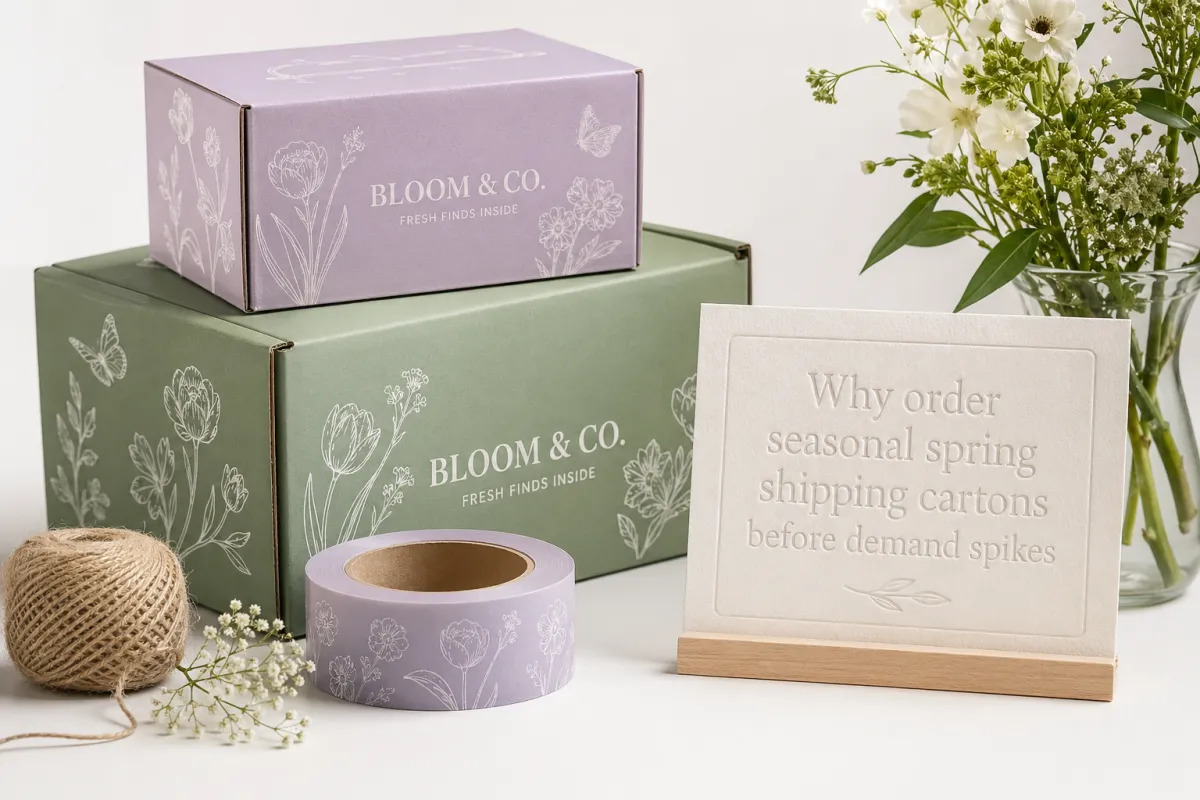
Most spring packaging problems are timing failures dressed up as procurement problems. The carton design can be fine. The spec can be sensible. Still, if you order seasonal spring shipping cartons after the promo calendar is already public, the project is behind before anyone opens a file. Spring launches move in bursts. Marketing changes artwork late. Sales adjusts pack counts after the meeting. Operations is left to make the timeline work with fewer days than the carton actually needs.
Garden kits, floral boxes, outdoor starter packs, and retail display replenishment all pull from the same spring window. That means the same board mills, the same converters, and the same freight lanes get crowded at once. In a season like that, timing changes cost money. A buyer who orders early can usually get the size, strength, and structure that fit the product instead of settling for whatever is left in the queue. One extra week of lead time can be the difference between a clean launch and a compromised one. If you plan to order seasonal spring shipping cartons in volume, that extra week can also keep freight from turning into a bottleneck.
Early ordering also leaves room for sample checks and proofing without blowing up the schedule. Small changes are easy when the carton has not entered production. Move the logo. Adjust the die line. Tighten the fit. Those are normal edits. They become expensive only when the shipment date is already staring back from the calendar. From a packaging buyer's point of view, that gap between "we can fix it" and "we have to live with it" is where most of the cost lives. The same applies to Packaging Lead Times: the earlier you order seasonal spring shipping cartons, the more control you keep over the final result.
Practical rule: if the delivery date matters, treat the carton order like production planning, not like restocking office supplies.
Waiting has its own price tag. Rush freight eats margin. Material choices get trimmed down to whatever can ship now. Approvals get compressed into a deadline nobody really owns. If the carton protects the product, the carton should not be the weak point. You are not buying corrugate alone. You are buying time, control, and fewer surprises at the dock. That is the main reason to order seasonal spring shipping cartons before the rush begins rather than during it.
I have sat through enough spring launch reviews to see the same pattern repeat: the team that orders early spends its energy improving the box, while the team that waits spends its energy surviving the box. Those are not the same job, even if the spreadsheets look similar. A little breathing room changes the economics of the whole run. If the program repeats every spring, that lead time becomes even more valuable because the structure can be refined instead of rebuilt from scratch. A second season should feel like an improvement, not a repeat of the same scramble.
Seasonal spring shipping carton options for retail and ecommerce
No single carton style solves every spring order, which is inconvenient if you were hoping for a universal answer. To order seasonal spring shipping cartons well, match the structure to the product and the route. Regular slotted cartons still do a lot of heavy lifting. They are straightforward, efficient, and usually the best value when the main goal is protection and pallet use. For ecommerce kits and small retail bundles, die-cut mailers often make more sense because they ship flat, open cleanly, and present better when the customer first sees the box. Those are the same reasons many teams choose Custom Mailer Boxes for spring promotions with lighter contents.
Heavier bundles and products that need tighter control may call for telescoping sets. They cost a little more, though they give better control over height and compression than a single-piece shipper. Reinforced shippers matter for spring items with glass, ceramic, metal, or moisture-sensitive components. If the carton has to survive a rough distribution route, board strength is not a nice-to-have. It is the reason the carton exists. For fragile spring kits, the right choice is often a reinforced corrugated shipper rather than a lighter box that only looks sturdy from the outside.
Print choices should follow the carton's job, not the other way around. No-print kraft still works for pure shipping shells. One-color branding fits a lot of recurring seasonal programs because it keeps the box recognizable without turning it into a premium print project. Full-color exterior print belongs on cartons that need shelf appeal, unboxing value, or brand recognition at a glance. When the packing line needs speed more than spectacle, label-ready cartons can keep the job efficient without making the design feel unfinished. If you order seasonal spring shipping cartons for recurring ecommerce campaigns, this is often where cost and presentation find a workable balance.
Insert choices matter too. Dividers, pads, chipboard wraps, and internal supports protect fragile spring items like planted goods, candles, glass vases, and decorative ceramics. The insert should fit the product, not merely fill empty space. Extra void fill can hide a bad fit for a while, but it adds weight and inconsistency. In packing, "close enough" tends to become "damaged in transit" faster than anyone wants. The same is true for spring shipping cartons that are undersized or overbuilt; both mistakes create friction somewhere else in the chain.
For buyers comparing wider packaging programs, the right carton choice often depends on where the box sits in the broader mix. Our Custom Packaging Products page is useful if you want to compare cartons against other formats, while Custom Shipping Boxes is the cleaner reference point when the goal is shipping efficiency rather than display packaging.
Order seasonal spring shipping cartons with the right specs
To order seasonal spring shipping cartons correctly, start with the specs that matter in transit. Internal dimensions come first. Outer dimensions are useful for freight math, but the product lives inside the box. If the product has too much room to move, the carton is wrong no matter how polished the print looks. Too tight is just as bad. A box that scrapes the product or crushes a flap during closure will create more trouble than it solves. That is especially true for seasonal products that arrive with inserts, finishes, or moisture-sensitive surfaces.
Board grade and flute profile are just as important. Single-wall board handles light to moderate kits, mail-order items, and lower-compression loads well enough in many programs. Double-wall board makes more sense when cartons are stacked higher, palletized, or exposed to rough handling. For heavier seasonal contents, ask what the carton needs to survive in the actual route rather than in a warehouse demo. Real freight behaves differently from a tidy test setup. If you order seasonal spring shipping cartons for multi-stop fulfillment, that difference shows up fast.
Practical transit packaging thinking matters here. If your cartons pass through multiple hubs, get handled aggressively on the line, or sit under other cases in a truck, ask about compression strength and stacking tolerance. If you want a benchmark for distribution testing, the methods used by ISTA are worth knowing. Testing does not make for dramatic marketing copy. It does keep returns and write-offs from multiplying. It also tells you whether the spring shipping cartons can do the actual job instead of the imagined one.
Other details deserve attention too: glue seam type, tuck style, venting if the product needs airflow, and moisture or scuff resistance for damp spring conditions and warehouse handling. If the job requires sustainable fiber content, ask about FSC-certified board. That is not decoration. It is a real procurement requirement when the brand, retailer, or internal policy expects a documented material source. In a season where many teams order seasonal spring shipping cartons at once, sourcing clarity can save a surprising amount of time.
Consistency is critical when you order seasonal spring shipping cartons for a repeat program. The dimensions should stay within normal production tolerance so the next reorder fits the same product without surprise gaps. One of the easiest ways to waste money is to approve a carton that only works because the sample was lucky. Samples are useful. Luck is not a spec. This is where repeatable corrugated cartons outperform improvised packaging every time.
Specs checklist that saves time
- Internal dimensions: exact product fit with room for inserts or protective materials if needed.
- Board grade: single-wall, double-wall, or reinforced based on weight and stacking.
- Print area: logo placement, warning copy, and brand panels before artwork starts.
- Packing method: individual shipper, case pack, or palletized unit.
- Performance need: scuff resistance, moisture exposure, or heavier transit handling.
If you order seasonal spring shipping cartons with those details ready, the quote is more accurate and the production file is cleaner. That saves time on both sides. It also lowers the odds of a carton that looks correct on screen but performs badly in the warehouse. That mistake usually costs twice: once in rework, once in damaged goods. A clear spec sheet also helps compare shipping cartons from one vendor to the next without mixing apples and oranges.
Pricing, MOQ, and what changes the carton cost
People often ask for a price before they provide the specs. Packaging does not work that way. To order seasonal spring shipping cartons at a sensible cost, the levers behind the number need to be clear. Size is the obvious one. Bigger cartons use more board and cost more to ship. Board grade comes next. Heavier or stronger stock raises the material cost, especially when a project moves from a standard single-wall structure to double-wall or a higher-test grade. Print coverage changes the price quickly too. One-color branding is a different job from full-color print across several panels.
Structural complexity matters as well. A regular slotted carton is usually cheaper than a die-cut mailer or a telescoping set because the tooling and converting steps are simpler. Inserts and fitments add cost, though they can also lower damage rates. That makes them cheaper in the larger sense once returns, replacements, and customer frustration are counted. Freight distance matters too. Cartons are bulky, and dimensional weight can punish a bad shipping plan if the finished product has a long trip ahead of it. Buyers who order seasonal spring shipping cartons for regional distribution often see a different cost profile than those shipping nationwide.
MOQ is not a single fixed number because carton style, print complexity, and board selection change the economics. Simple cartons can start lower. Custom print, special cuts, and stronger board usually push the order quantity higher before pricing starts to make sense. That does not mean a smaller run is a mistake. It means flexibility has a cost. If the goal is to test a spring campaign or launch a limited bundle, a smaller run can be the right move even when the unit cost is a little higher. The decision should follow the campaign, not the other way around.
| Carton Option | Typical Use | Common MOQ Range | Estimated Unit Price | Notes |
|---|---|---|---|---|
| Regular slotted carton | Case packs, warehouse replenishment, basic ecommerce shipping | 500-2,000 units | $0.42-$0.85 | Best value for simple shipping needs |
| Die-cut mailer | Subscription packs, small kits, branded unboxing | 1,000-3,000 units | $0.55-$1.10 | Better presentation, higher setup complexity |
| Reinforced shipper | Heavier bundles, fragile contents, stackable transit packaging | 1,000-5,000 units | $0.88-$1.85 | Higher board cost, better protection |
| Telescoping set | Variable-height kits, premium sets, controlled fit | 500-1,500 units | $1.20-$2.40 | More material, more control, usually pricier |
These ranges are directional, not universal. A compact carton with simple print and a clean die line will price very differently from a large, heavy-duty shipper with inserts and moisture-resistant requirements. The cleanest way to see the real curve is to quote the same project at a few quantity bands. Ask for 500, 1,000, and 3,000 pieces. That shows where the unit price drops enough to justify the volume and where it does not. Guessing is expensive. Numbers are cheaper. It also gives a more honest picture of how quickly you should order seasonal spring shipping cartons if the campaign has a real volume ceiling.
Hidden costs deserve attention too. Extra tooling, proof rounds, special coatings, split shipments, and last-minute freight upgrades can push the total up faster than the carton itself. That is why it helps to order seasonal spring shipping cartons with the full program in view, not just the headline unit price. The cheapest quote on paper is not always the cheapest program once the order lands in real life. In some projects, packaging lead times and freight timing change the final number as much as the board itself.
If the order is part of a larger recurring program, our Wholesale Programs page can be useful for buyers comparing repeat-run pricing against one-off seasonal purchases.
Process and timeline for seasonal spring carton orders
The process should be straightforward. If it is not, someone has added unnecessary friction. To order seasonal spring shipping cartons well, the work usually starts with a brief, moves to spec confirmation, then a dieline or sample approval, then production, quality check, and shipment booking. That sequence is dull in the best way. Dull means controlled. Controlled means fewer mistakes on the floor. It also means the team can spot gaps before they turn into an expensive recovery plan.
Lead times vary by structure. Straightforward repeat orders move faster because the carton already exists and only needs a rerun. New custom structures take longer because the artwork, dieline, and sample review all need attention. If the job needs changes after the first proof, add time. If the product measurements are missing or the pack-out method is unclear, add more. In packaging, uncertainty has a habit of turning into delay with almost comic speed. That is one more reason to order seasonal spring shipping cartons before the production queue gets crowded.
Artwork revisions are another common slowdown. A logo that is still under debate, a compliance note that changed, or a color spec nobody confirmed can hold the order. Spring campaigns rarely wait for packaging, which makes this part more stressful than it should be. If the shipment date is real, the proof needs to be real too. Otherwise, the team is only pretending to be ready. The same is true for spring shipping cartons that need regulatory text or retailer-specific copy: confirm it once, then move on.
Freight belongs in the schedule from the start. Cartons sitting in transit do not help fulfillment. They need to reach the warehouse, be received, and be ready before the packing line needs them. That sounds obvious. It also gets missed all the time when teams try to save a few days on the front end. A box that arrives after launch is not a packaging solution. It is inventory with a sad backstory. If you order seasonal spring shipping cartons for a launch date, the shipping calendar needs to be treated like part of production, not an afterthought.
Rush orders can happen, though the tradeoff is usually price, flexibility, or both. The structure may need to be simplified. Print coverage may need to be reduced. Freight may need to be upgraded. That is the reality of compressed production. If you must order seasonal spring shipping cartons fast, give exact specs and confirm where the project can bend before the quote is built. A rushed order can still work, but only if the tradeoffs are visible from the start.
For buyers who want fewer surprises on the paperwork side, our FAQ page is a useful companion resource before the order is locked in.
Why choose us for seasonal spring shipping cartons
When buyers come to Custom Logo Things, they usually are not shopping for theory. They need cartons that fit the product, arrive on time, and keep the campaign moving. That is the right focus. We pay attention to specification control, clear approvals, and direct recommendations so you can order seasonal spring shipping cartons without getting buried in unnecessary back-and-forth. If the carton should stay simple, we keep it simple. If the carton needs more strength or better print quality, we say that plainly. That directness matters most when the spring calendar is already tight.
Seasonal packaging has its own pressure points. Spring launches often overlap with other promotional windows, so order volume can rise while the timeline gets tighter. We approach the carton as part of a larger shipping and fulfillment system. It affects receiving, packing speed, pallet stability, damage rates, and the customer experience when the box lands on the doorstep. That is why board strength, fit, and print placement matter just as much as the design itself. A well-chosen carton can reduce labor at the line and help the whole program move more predictably.
Reorder consistency matters too. If the same spring program runs every year, the carton should not need to be reinvented every time. A good repeat order preserves the dimensions, keeps the print aligned, and makes the next run easier to approve. That saves more than money. It saves attention, and attention is usually the scarcest resource in seasonal packaging. It also makes it easier to order seasonal spring shipping cartons again next year without starting from zero.
Practical advice comes with the service. If the product is light, we will not push a heavy-duty shipper just because it sounds stronger. If the product is fragile, we will not pretend thin board is enough. If the carton is going to be stacked high, we will say so. If the carton only needs to survive short-run ecommerce shipping, we can keep the structure lean and the cost in check. There is no award for overbuilding a box. There is, however, plenty of regret for underbuilding one.
The same directness helps with timing. We give honest lead-time expectations, identify bottlenecks early, and make the tradeoffs visible before you commit. So if you need to order seasonal spring shipping cartons for a retail push, a subscription drop, or a case-pack refresh, you get a process that is actually usable. Nothing theatrical. Just packaging that does the job, on schedule, with fewer surprises.
Next steps to order seasonal spring shipping cartons
If you are ready to order seasonal spring shipping cartons, start with the facts. Send the internal box dimensions, product weight, print needs, quantity target, packing orientation, and the date the cartons need to land in your warehouse. Those details turn a vague request into a quote that can actually be used. They also make it easier to recommend the right carton style instead of guessing and calling it expertise. The more exact the brief, the less time you will spend revising it later.
If the carton is new, ask for a sample or proof. Then check fit, stackability, and print placement before approving anything. A carton can look fine in a PDF and still fail on the line if the product sits crooked or the flap closure feels awkward. That is why physical checks matter. Paper specs are useful. Real cartons are better. This step is especially valuable when you order seasonal spring shipping cartons with inserts, coatings, or retailer-specific print requirements.
It also helps to ask for pricing in a few cost tiers. Compare the same project at 500, 1,000, and 3,000 pieces. That shows where the unit price falls enough to justify the order and where the structure or print coverage starts pushing the budget. If the program repeats, compare the current run to last season so you can see whether board pricing, freight, or print complexity changed. That kind of side-by-side comparison often reveals where to save money without weakening the carton.
Do not leave freight to the last minute. Book the shipping plan at the same time as production, or you may end up with finished cartons sitting idle while everyone argues about pickup. That is a tedious way to lose time. Worse, it makes the carton order look like the problem when the real issue was the schedule all along. Freight planning is part of the job when you order seasonal spring shipping cartons, not a postscript.
One more thing: if you need to order seasonal spring shipping cartons, do it now while the supply window is still friendly. Gather the specs, confirm the budget, and lock the production slot before the rush starts. That is how you keep packaging from becoming the bottleneck. Nobody wants the box to be the reason the launch slips. The simplest path is usually the best one: order seasonal spring shipping cartons early, confirm the details, and keep the schedule intact.
How early should I order seasonal spring shipping cartons?
For custom cartons, leave enough time for spec review, proofing, production, and transit without stacking one delay on top of another. If the job needs samples or new artwork, add extra cushion. The safer move is to finish quoting before the seasonal launch calendar gets crowded. If your spring campaign has retailer deadlines or coordinated marketing, it is even smarter to order seasonal spring shipping cartons earlier than you think you need to.
What specs do I need to order seasonal spring shipping cartons correctly?
Give internal dimensions, product weight, required board strength, print coverage, and whether the carton ships individually or in cases. Add inserts, coatings, and stacking needs if they matter. A photo of the product packed in the current box helps more than a vague description. The more detail you provide, the easier it is to order seasonal spring shipping cartons that fit the real use case instead of a guessed one.
Can I add branding when I order seasonal spring shipping cartons?
Yes. Common options include one-color branding, full-color print, simple logo placement, or label-ready cartons for faster turnaround. Keep the print choice tied to the actual goal: shelf appeal, brand recognition, or pure shipping efficiency. More print coverage usually means more setup and more cost. If the carton is moving through ecommerce fulfillment, modest branding often gives the best balance between speed and presentation.
What is a typical MOQ for seasonal spring shipping cartons?
MOQ depends on carton style, print complexity, and material choice, so there is no single number that fits every project. Smaller quantities can work for testing, while larger runs usually make more sense for repeat spring programs. Ask for pricing at several volume bands to see where the unit cost drops enough to justify the order. That comparison is the quickest way to decide whether to order seasonal spring shipping cartons in a smaller pilot run or a larger seasonal batch.
How do I lower the cost without weakening seasonal spring shipping cartons?
Use the smallest carton that still protects the product, because oversized boxes waste material and raise freight cost. Reduce print coverage, skip unnecessary coatings, and avoid special structures unless the product truly needs them. Choose the lightest board grade that still passes the weight and stacking test. If you need to order seasonal spring shipping cartons on a budget, that is the cleanest way to keep package protection intact while controlling cost. Matching the carton to the route, not the wish list, usually delivers the best value.
What should I do first if I need to place a spring order this week?
Send the internal dimensions, product weight, quantity, artwork status, and in-warehouse date in one message. If you have a packed sample photo, include that too. Those five details are enough to start a serious quote and avoid a lot of backtracking. If the spec is clear, the timeline usually gets clearer right behind it. That is the point where a rushed order becomes manageable instead of kinda chaotic.

