Buyer Fit Snapshot
| Best fit | Packaging Branding Pricing projects where brand print, material claims, artwork control, MOQ, and repeat-order consistency need to be specified before quoting. |
|---|---|
| Quote inputs | Share finished size, material target, print colors, finish, packing count, annual reorder estimate, ship-to region, and any compliance wording. |
| Proofing check | Approve dieline scale, logo placement, barcode or warning zones, color tolerance, closure strength, and carton packing before bulk production. |
| Main risk | Vague material claims, crowded artwork, missing packing details, or unclear freight terms can make a low unit price expensive after revisions. |
Fast answer: Packaging Branding Pricing: Quote Scope should be specified like a repeatable production item. The safest quote records material, print method, finish, artwork proof, packing count, and reorder notes in one written spec.
Production checks before approval
Compare the actual filled-product size with the drawing, then confirm tolerance on folds, seals, hang holes, label areas, and retail display edges. Reserve space for logos, QR codes, warning copy, and material claims before decorative graphics fill the panel.
Quote comparison points
Review material grade, print process, finish, sampling route, tooling charges, carton quantity, and freight assumptions side by side. A quote is only useful when the supplier can repeat the same color, closure quality, and packing count on the next order.
Packaging Branding Pricing Guide: What It Really Costs
If you're using a packaging branding pricing guide to decode a quote that looks suspiciously cheap or strangely inflated, you're asking the right question. I once sat in a Shenzhen sample room while a snack brand founder argued that a $0.18 per-unit print change on a 20,000-piece run "couldn't possibly" create a five-figure swing. Then the supplier laid out plates, setup labor, export cartons, and rework, line by line. The total moved by $4,860 before lunch. That is the kind of gap this packaging branding pricing guide is meant to untangle.
A lot of people assume branded packaging means printing a logo on a mailer and moving on. That shortcut can cost more than a failed ad campaign. Real product packaging turns a plain carton into a selling surface that carries brand identity, survives shipping abuse, and still protects margin on a 5,000-unit order. The price comes from structure, board stock, print method, finishing, inserts, fulfillment, storage, and the line items that arrive after approval, usually in a separate email that starts with "one quick update."
I've seen teams obsess over a $0.03 ink change and ignore a $1,400 tooling fee because the tooling lives on a different page of the estimate. It is not background noise. A good packaging branding pricing guide helps founders, marketers, and operations teams compare real landed cost instead of chasing the lowest headline number and then discovering the freight invoice from Long Beach or Rotterdam two weeks later.
One honest caveat: these numbers are directional, not holy writ. Board availability, currency swings, seasonal labor pressure, and finishing yield can move a quote more than people expect. Anyone who pretends packaging pricing is fixed probably hasn't spent much time around a press room.
Packaging Branding Pricing Guide: Why Quotes Surprise People
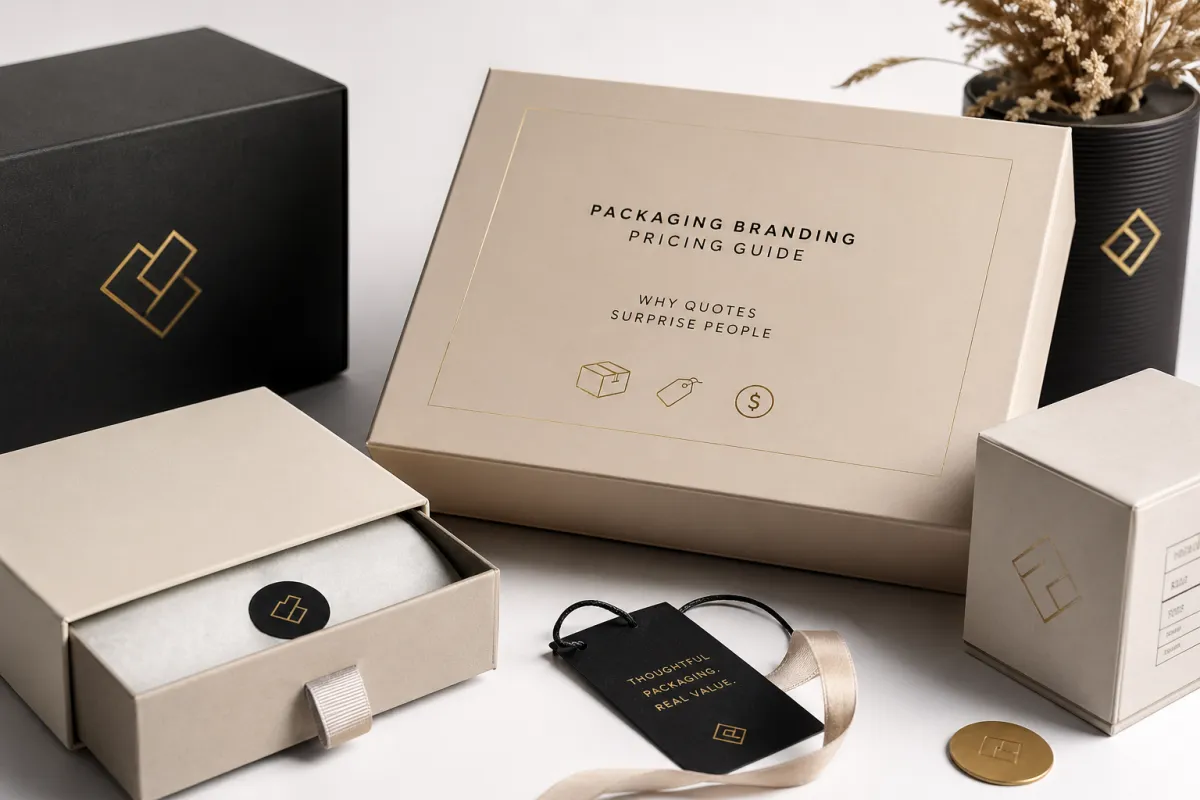
Quotes surprise people for one basic reason: they usually start with the wrong number. A supplier can quote a Custom Printed Box at $0.62 a unit, then leave out a $420 die charge, $180 in digital proofing, $260 for master cartons, and $480 for LCL freight from Yantian to Los Angeles. The actual spend lands closer to $0.95 before the warehouse even sees a pallet. I've had that conversation on a factory floor in Dongguan, with a tape measure on one wrist and a client staring at the spreadsheet like it had personally insulted their product.
Packaging design has a cost curve, and it shows up quickly. A one-color kraft mailer can stay lean. Add a second ink pass, a foil stamp, and a custom insert, and your packaging branding pricing guide changes shape in a hurry. The quote is not only paying for ink. It is paying for setup, machine time, operator attention, waste allowance, and the stop-start rhythm that comes from reconfiguring the line for a different job. A Heidelberg press does not care that the mockup looked elegant in Figma.
A branded box is rarely one product. It is a stack of decisions bundled together. Structure, substrate, artwork coverage, finishing, order size, and delivery terms all push the number in different directions. A retail packaging project with a thumb-notch closure, soft-touch lamination, and a molded pulp insert will never price like a plain mailer from a stock catalog. That is not the supplier being difficult. That is labor, material, and time doing exactly what they always do.
"The cheapest quote is usually the one missing freight, proofing, or the second plate charge." I said that to a founder after a Chicago sample review added $1,200 in revisions to a 3,000-unit cosmetic carton run. He laughed after the third invoice. Then he stopped laughing, which was the more useful reaction.
A practical packaging branding pricing guide trains you to ask three questions before you approve anything: what is fixed, what is variable, and what gets billed later? Once those are clear, quote comparisons get cleaner. You stop comparing one box and start comparing landed cost for the same spec, shipped to the same address, with the same delivery window. That sounds obvious now. It never feels obvious when you are looking at five supplier PDFs and one of them has a suspiciously cheerful total in bold type.
That matters because a lot of package branding is really a margin decision wearing better artwork. If a premium finish adds $0.22 per unit on a 10,000-piece run, that is $2,200. On a launch with a 38% gross margin, that is not pocket change. It is the difference between a first order that breathes and one that quietly bleeds out while everyone says the box "looks amazing."
What Drives Packaging Branding Pricing Guide Costs?
The biggest cost buckets in a packaging branding pricing guide are the substrate, print method, size, construction, finishing, inserts, and logistics. Every one of them can move the price by a few cents or a few dollars. A 350gsm C1S artboard carton behaves very differently from a 24pt SBS folding carton or a double-wall corrugated shipper. The material choice alone can create a 20% to 40% swing on a mid-volume order, and that kind of spread can wreck a forecast faster than a missed sales target in Q2.
Premium finishes are where budgets quietly disappear if nobody is watching the estimate. Foil stamping, embossing, debossing, spot UV, and soft-touch coating each add setup time or extra machine passes. A matte mailer might add $0.05 per unit. A soft-touch surface with foil accents can add $0.18 to $0.35 depending on size and quantity. I've watched teams spend more on the finish than on the structure because the mockup looked beautiful and nobody asked what the actual difference was. "Just one more finish" becomes a three-line-item problem very quickly.
Color count and artwork coverage matter more than most buyers expect. A one-color kraft box with a single logo plate is much easier to run than a full-bleed, four-color retail packaging design with tight registration and a white underbase. Even with digital printing, high-coverage art can slow production and raise waste. Your packaging branding pricing guide should treat artwork complexity as a real cost driver, not a creative afterthought that only gets attention after the invoice lands.
Fixed and variable costs need different treatment. A setup fee, die, plate charge, or proof run is usually fixed. Per-unit ink, board, lamination, assembly, and packing are variable. That distinction matters because a 500-piece order can look absurdly expensive until you realize the fixed costs are being spread across a tiny run. On a 5,000-piece order, those same fixed costs look much friendlier. The math is not glamorous, but it is the difference between buying wisely and getting politely mugged by your own spec.
After years of supplier negotiations in Shenzhen, Chicago, and Ho Chi Minh City, I keep coming back to the same three buckets. First, the hard cost of making the box. Second, the soft cost of getting the box approved, revised, and shipped. Third, the hidden cost of delays, reproofs, and missed launch windows. A packaging branding pricing guide that ignores the soft cost is not much of a guide. It is a sales sheet with a calculator taped to it.
If you need a starting point for formats, compare your options against Custom Packaging Products and choose the structure that actually fits your sell-through plan. A mailer, a folding carton, and a rigid box are not interchangeable just because the artwork is the same. I wish they were. My calendar would be calmer, and my inbox would have fewer photos of dented corners.
Cost Factors: Materials, Printing, and Minimums
Materials set the tone for the entire packaging branding pricing guide discussion. Corrugated mailers are usually the cheapest path for shipping-first brands, while rigid boxes sit at the top end because they use thicker board, more hand assembly, and more finishing time. Folding cartons sit in the middle and work well for shelf-ready retail packaging. Labels, sleeves, and inserts can cost far less than a full box if the brand only needs a cleaner surface and a stronger unboxing experience. I have seen startups spend rigid-box money on products that never left a warehouse in Newark or Seattle, which is a polished way to burn cash for no audience.
Print method changes the economics quickly. Digital printing is friendly for short runs because there is little or no plate cost, which is why it works well for 250 to 2,000 units. Offset usually wins once volume rises and color control matters, especially for Custom Printed Boxes with richer artwork. Flexo is common for corrugated and shipping cartons where speed and economy beat ultra-fine detail. Screen printing can fit specialty surfaces, but it is rarely the cheapest route for a standard product packaging job. There is no magical method that is always best, despite how some sales reps talk about their favorite press in Guangzhou.
| Print Option | Typical Setup Cost | Best Quantity Range | Typical Use Case | Watch-Out |
|---|---|---|---|---|
| Digital | $0 to $250 | 250 to 2,000 units | Launches, test runs, small custom printed boxes | Higher per-unit cost at scale |
| Offset | $300 to $1,200 | 2,000 to 20,000 units | Retail packaging, color-sensitive branding | Plate and setup costs hurt tiny runs |
| Flexo | $150 to $900 | 1,000 to 50,000 units | Corrugated shippers, mailers, wholesale cartons | Less detail than offset |
| Screen Print | $100 to $500 | 50 to 1,500 units | Specialty surfaces, bold logo hits | Slower and often labor-heavy |
Minimum order quantities are where the math gets stubborn. A supplier might quote $1.20 per unit for 300 boxes and $0.54 per unit for 5,000 boxes. That gap looks dramatic, but the printer still has to justify the same machine setup, the same board purchase, and the same quality checks. In a packaging branding pricing guide, small runs are expensive because the fixed cost has nowhere to hide. It sits on every unit like an invoice line that refuses to shrink.
Freight and warehousing can wipe out a cheap unit price faster than people expect. I have seen a buyer celebrate a $0.48 quote, then pay another $520 for pallet delivery, $300 for receiving, and $180 a month for storage because the boxes arrived six weeks early. Uline works fine for plain shipping materials. Packlane can handle short-run branded packaging. A local converter in Vernon, CA, or Taicang may beat both on freight if the pallet route is short and the carton size is standard.
That is why a packaging branding pricing guide should include freight as part of the landed cost, not as a footnote. If you are shipping by pallet, the board grade, pallet count, and delivery access can change the invoice. Dock-high delivery is one number. Residential delivery or liftgate service is another. The difference can be $75 to $250 before you even break the shrink wrap. Nobody enjoys learning that lesson from a carrier charge, least of all finance.
For teams that care about sustainability and compliance, I also point them to the Sustainable Packaging Coalition at packaging.org and shipping test references from the International Safe Transit Association at ista.org. If your supplier says a box "should be fine" without referencing ASTM D4169, ISTA 3A, or an FSC-certified board source, push harder. Guesswork is not a spec, and "should be fine" is not a test method.
Process and Timeline: From Brief to Delivery
A good packaging branding pricing guide is not only about money. It is about time, because time changes money. The usual workflow is brand brief, dieline selection, artwork setup, proofing, sampling, production, inspection, and delivery. If the brief is clean and the art is ready, a simple digital job can move in 7 to 12 business days. A custom run with special finishes can take 15 to 30 business days after proof approval, and that still leaves shipping out of the equation. The schedule is rarely as forgiving as everyone hopes it will be.
The biggest delays usually come from artwork, not the press. I watched a six-panel brand identity box sit idle for four days because a marketing manager wanted to "move the ingredients line" after the proof came back from a plant in Ningbo. That one line forced a new file check, a new proof, and another color review. A packaging branding pricing guide only helps if the team accepts that every revision has a cost in dollars and calendar days. The printer did not cause the delay. The people with the extra opinions did.
Sampling can slow everything down. A first sample can be ready in 2 to 5 business days for simple digital jobs, while a rigid box mockup or specialty insert may take longer. If you want a spot UV sample, a foil sample, and a structural sample, you are asking for three different approvals. That may be worth it for a retail launch, but it is not free, and the clock does not care how urgent the board meeting feels in a conference room on Tuesday.
Approval chains also create friction. If legal, sales, operations, and the founder all need to sign off on the same carton, your launch date is already under pressure. I once visited a plant in Dongguan where a printer had a stack of 14 approved jobs waiting because one U.S. team could not decide whether the back panel needed a QR code. The machine was ready. The client was not. The printer's expression said everything words could not.
Planning backward is the cleanest way to avoid rush fees. If your launch is on the 15th, reverse the calendar: shipping plus inspection plus production plus proofing plus design buffer. Add five extra business days if the team is new to the supplier. Your packaging branding pricing guide should assume at least one round of revision for a first-time run, because the first proof rarely survives unchanged. The box is never as "done" as the first deck says it is.
If you want real examples of what those timelines look like on live projects, our Case Studies page shows how different specs moved from concept to delivery. That is usually more useful than a generic promise of quick turnaround, which is easy to say and much harder to invoice.
How to Build a Budget That Actually Holds Up
A useful packaging branding pricing guide turns a messy quote stack into a budget the finance team can live with. Start with the goal. Is this box meant to protect a fragile item, lift shelf appeal, improve subscription retention, or create a premium gift moment? That answer decides the spec. A box built for damage reduction does not need the same finish stack as a box built for influencer content. Too many teams choose the spec before they choose the job the box is supposed to do.
Lock the variables before you request quotes. If one supplier is quoting a 6 x 4 x 2 mailer and another is quoting a 6.25 x 4.25 x 2.25 version, the numbers are not comparable. The same goes for board grade, finish, print coverage, insert style, and shipping terms. A real packaging branding pricing guide keeps those stable so the only thing changing is the supplier's efficiency and margin. Otherwise you are just comparing apples to slightly more expensive apples.
Here is the budgeting method I use with founders who need discipline, not drama:
- Set a target landed cost per unit with a 10% to 15% contingency.
- Collect three quotes with identical dimensions, artwork coverage, and delivery terms.
- Separate setup, sampling, freight, and unit price into different lines.
- Build three scenarios: lean, expected, and premium.
- Choose the version that protects margin without breaking the brand.
The three-scenario method works because the conversation changes once everyone sees the options side by side. A lean version might use one ink color and a kraft substrate. The expected version might add a printed insert and a better coating. The premium version might add foil or embossing. A packaging branding pricing guide that lays out those tradeoffs makes it easier to choose a smart middle ground instead of arguing from taste, which is a terrible way to manage money and an even worse way to manage a launch.
Always calculate landed cost per package. That means the box, the freight, the sampling, the reprint risk, the storage, and the spoilage allowance. If 3% of units are damaged or rejected, price that in from the start. That sounds annoying, but it is better than discovering the issue after 240 boxes are crushed in transit. In my experience, the teams that budget spoilage are the ones that stop pretending packaging is a one-line expense.
One rule keeps margin sane: if packaging costs more than the product can absorb, simplify the spec before you scale. That does not mean making the box ugly. It means choosing one premium element that carries the look and cutting the rest. A strong board stock and a sharp one-color print can do more for a brand than a pile of expensive finishes that barely move conversion. I have seen "luxury" packaging that looked exhausted before it even reached the shelf.
If your budget is still too tight, start with Custom Labels & Tags for the first rollout and move into custom printed boxes later. That is often a smarter first step than overcommitting cash to packaging the customer never notices. Nobody gets points for spending early and badly.
Common Mistakes That Blow Up Packaging Costs
The easiest mistake is chasing the cheapest quote without checking what is missing. A low number can hide freight, setup, proofing, or even the cost of redoing a file because the printer cannot use the artwork as submitted. I have seen a team choose the bargain quote and then pay another $860 in add-ons because the supplier had quoted only the print, not the assembly or carton pack-out. That is not a savings. That is a trap with friendlier typography and a nicer follow-up email.
Over-specifying is another budget killer. A lot of brands want soft-touch, foil, embossing, spot UV, and a custom insert on a first run of 1,000 units. That is a fast way to burn cash. A cleaner packaging design with one premium detail usually sells better than a crowded finish stack. The smarter packaging branding pricing guide move is to pick the one detail the customer will actually notice from arm's length, whether that is a matte black carton in Toronto or a clear window on a skincare box in Singapore.
Vague briefs create change orders. If you send a supplier a loose note that says "make it feel premium," expect extra revisions. If you specify 400gsm board, matte lamination, a one-color outside print, and a 10 mm insert, the quote gets cleaner and the schedule gets shorter. Specificity is not bureaucracy. It is money saved, and it keeps the project from drifting into the swamp where everyone says the same thing differently.
Ordering too few units can hurt more than ordering too many. If you need 4,000 boxes over six months but only buy 1,000 because the unit price looks lower in your current spreadsheet, you may end up paying a second setup fee later and losing the volume discount. That is how a "safe" first order turns into two expensive small orders. A solid packaging branding pricing guide should always ask about reorder probability, not just the first buy. Otherwise the budget is playing defense against itself.
Storage and freight are the quiet killers. We once quoted a run for a personal care brand at $0.61 per unit, and the client nearly signed on the spot. Then the 3PL in New Jersey charged $310 per pallet per month because the boxes arrived early and sat for eight weeks. The box was not the problem. The plan was. If you want cleaner planning, keep an eye on how the packaging fits your fulfillment rhythm, not just your mood on quote day.
One more thing: do not assume every supplier includes the same service level. Some vendors build in a digital proof, a physical sample, and export cartons. Others bill each piece separately. Compare the whole package, not just the headline number, or your packaging branding pricing guide turns into a postmortem. And nobody wants a postmortem before the campaign has even launched.
Expert Tips for Smarter Packaging Branding Pricing
My first negotiating rule is simple: ask for more than one version. Request quotes at 1,000, 3,000, and 5,000 units, then ask for the same spec with one material swap and one finish swap. That gives you real pricing power. A packaging branding pricing guide is far more useful when you can see the cost of moving from SBS to kraft, or from spot UV to a clean matte coat, in actual dollars per unit.
My second rule: ask for proof photos, past client examples, and one physical sample before you approve the spec. I do not care how polished the PDF looks. A supplier who can show you a 350gsm C1S carton, a foil-stamped insert, and a shipping test result is giving you data, not promises. If they can point to an ISTA 3A test or an FSC-certified board source, even better. That gives the packaging branding pricing guide conversation some backbone, which is useful because packaging tends to sound more impressive than it is until the numbers arrive.
Third, simplify one element at a time. Remove the embossing before you touch the whole design. Swap the inner insert before you change the outer artwork. That method protects the brand look while trimming the quote. On one cosmetics project in Osaka, we swapped a rigid insert for a folded board tray and kept the soft-touch lid. The cost dropped by $0.14 per unit on a 6,000-piece run, and the box still looked expensive. The founder was thrilled; I was mostly relieved that no one had to say the words "we overdesigned it."
Fourth, build supplier relationships instead of treating every purchase like a one-night stand. That sounds less glamorous than a fresh quote sprint, but repeated volume and clear communication usually produce better pricing. The best printers remember who approves quickly, who pays on time, and who does not rewrite the dieline after the sample is already on press. A packaging branding pricing guide works better when the vendor trusts you enough to sharpen the pencil. Trust is not soft. It changes the invoice.
Here is a real example. I once pushed a printer in Dongguan to rework a quote after I changed the board stock from 157gsm art paper to 350gsm C1S. The original finish stack looked fancy on paper, but the board change mattered more than the coating. We kept the same matte look, dropped one pass of labor, and saved $0.09 per unit on a 12,000-unit order. The client thought I had negotiated hard. Really, I just knew which line item was fake value.
If you need another way to anchor the project, browse our Custom Packaging Products and compare structure first, decoration second. Good packaging branding pricing guide decisions usually start with the box that does the job, not the one that looks flashy in a render. Pretty mockups do not pay freight bills.
Conclusion: A practical packaging branding pricing guide keeps you from paying for guesswork. It forces the team to separate setup from unit cost, freight from fabrication, and brand vanity from actual selling power. If you want a quote that holds up, lock the dimensions, material, print method, finish stack, shipping lane, and reprint allowance before anyone starts pricing. That single habit does more for budget control than any fancy spreadsheet ever will.
How much should I budget for packaging branding pricing guide planning?
Start with a per-unit target, then add setup, sampling, freight, and a 10% to 15% contingency. In a packaging branding pricing guide, a 500-unit run usually needs a much higher buffer than a 5,000-unit run because the fixed costs have fewer places to spread out. Tiny runs are where optimism goes to get humbled.
What makes packaging branding pricing guide quotes vary so much?
Different materials, print methods, and finishes change the production math fast. One supplier may include tooling, proofing, or freight while another leaves them out, so the same packaging branding pricing guide can look cheap in one inbox and expensive in another. The invoice is where the missing details finally introduce themselves.
How long does branded packaging usually take to produce?
Simple digital jobs can move in about 7 to 12 business days after approval, while custom runs with specialty finishes often need 15 to 30 business days. A good packaging branding pricing guide also leaves room for artwork fixes, color corrections, and shipping time. If anyone promises exact timing too early, I get suspicious.
What is the cheapest way to improve packaging branding?
Use one strong color, clean typography, and a better substrate instead of stacking expensive finishes. In a packaging branding pricing guide, a smarter board choice or a better insert usually does more for the unboxing experience than another layer of decoration. Customers notice clarity faster than ornament.
How do I compare packaging quotes without getting fooled?
Lock the same size, material, print method, finish, and quantity before you compare. If one quote excludes freight or proofing, the packaging branding pricing guide comparison is fake, so always judge landed cost per unit instead of the headline number. That one habit saves a surprising amount of pain.


