Buyer Fit Snapshot
| Best fit | Packaging Cost With Logo projects where brand print, material claims, artwork control, MOQ, and repeat-order consistency need to be specified before quoting. |
|---|---|
| Quote inputs | Share finished size, material target, print colors, finish, packing count, annual reorder estimate, ship-to region, and any compliance wording. |
| Proofing check | Approve dieline scale, logo placement, barcode or warning zones, color tolerance, closure strength, and carton packing before bulk production. |
| Main risk | Vague material claims, crowded artwork, missing packing details, or unclear freight terms can make a low unit price expensive after revisions. |
Fast answer: Packaging Cost With Logo: Pricing, Specs, and MOQ should be specified like a repeatable production item. The safest quote records material, print method, finish, artwork proof, packing count, and reorder notes in one written spec.
Production checks before approval
Compare the actual filled-product size with the drawing, then confirm tolerance on folds, seals, hang holes, label areas, and retail display edges. Reserve space for logos, QR codes, warning copy, and material claims before decorative graphics fill the panel.
Quote comparison points
Review material grade, print process, finish, sampling route, tooling charges, carton quantity, and freight assumptions side by side. A quote is only useful when the supplier can repeat the same color, closure quality, and packing count on the next order.
Packaging Cost With Logo: Pricing, Specs, and MOQ
Two mailers can look almost identical and still land at very different prices. That gap is where packaging cost with logo surprises buyers most often: the logo itself is rarely the expensive part, while board grade, setup, and quantity usually carry the real weight.
I have seen this play out on jobs that seemed simple on paper. A startup orders a kraft mailer with a one-color mark and expects a clean, low-cost run, then the quote climbs because the box needs a custom size, a die line, and a short production window. Packaging is funny that way. The visible part is only a slice of the bill.
Smart buyers chase the right number, not the lowest sticker price. The better question is where the value sits in the finished package, how packaging cost with logo shifts with volume, and which choices improve shelf presence, shipping performance, and repeatability without wasting money.
Custom logo packaging is not one category. It is a chain of decisions: format, material, print method, finish, and MOQ. Comparing packaging cost with logo across vendors only works when those details match. A kraft mailer, a rigid gift box, and a retail carton behave very differently on press and in production, even before freight enters the picture.
The useful question is plain enough. What does the package need to do, and what is the most efficient path to that result? That is the lens I use for packaging cost with logo, because a package that protects the product, presents the brand cleanly, and ships well is often worth more than a cheaper box that creates damage, returns, or an awkward unboxing.
One more practical point: if you are only comparing line-item print prices, you are missing the part that usually matters most. The landed cost tells the real story. The box price is only one piece; freight, storage, and damage rates can quietly move the total by a lot.
Packaging cost with logo: what actually surprises buyers
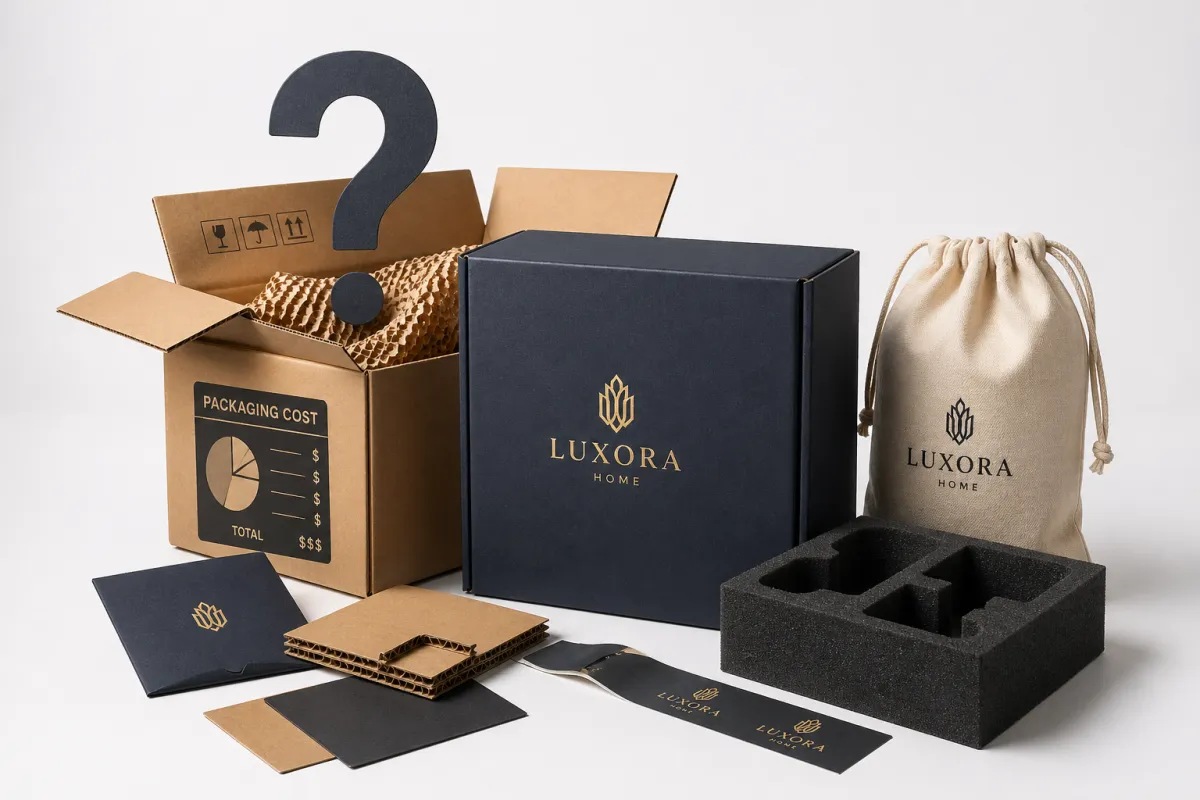
Most first-time buyers assume the logo creates the expense. In practice, decoration is only one part of packaging cost with logo; the bigger shocks usually come from setup, material specification, and order size. A one-color logo on a large run can be extremely efficient, while a simple-looking package on a short run can become expensive because the fixed costs have nowhere to spread out.
Quantity changes the unit economics more than many people expect. Branded packaging almost always gets cheaper per unit as volume rises because plates, dies, setup, prepress, and machine time are amortized across more pieces. That is why packaging cost with logo often has less to do with decoration than with order size. A buyer ordering 500 pieces pays for a lot of fixed work per box. A buyer ordering 5,000 pieces spreads that same work much more thinly.
Another common misconception is that logos add cost in a straight line. They do not. A clean one-color mark on kraft can be modest, while a logo with multiple spot colors, tight registration, foil, or a specialty coating can push packaging cost with logo higher than expected. The structure of the art matters almost as much as the art itself.
Practical packaging does more than market a product. It supports consistency across production runs, helps a product look complete on shelf, and can reduce damage if the format is right-sized and properly engineered. That is one reason I do not treat packaging cost with logo as a pure expense line. It touches product packaging, brand presentation, and shipping performance at the same time.
Good packaging should earn its keep. If the package protects the product, supports the brand, and stays inside a sensible landed cost, the logo is doing more than decoration. That is the standard I would use for packaging cost with logo.
Buyers who get the cleanest results usually define the job clearly. They know the product dimensions, the target quantity, the desired look, and the shipping requirements before asking for a quote. That clarity cuts wasted back-and-forth and makes packaging cost with logo easier to compare on equal terms.
Start with the package job itself rather than the visual concept if you are early in the process. A smart packaging design can keep the same logo and still reduce cost by trimming board usage, simplifying the dieline, or removing unnecessary inserts. That is where packaging cost with logo becomes manageable instead of vague.
There is a small but meaningful trap here: many teams approve artwork before they settle the structure. That usually leads to rework. I prefer the opposite order. Lock the size, pick the material, then let the logo work inside those limits. It is a calmer process, and honestly, it saves everyone from a few headaches.
Packaging formats and materials that change the cost
Format choice drives more of the pricing than many buyers expect. Cartons, mailers, sleeves, bags, tissue, inserts, and labels all behave differently in production, and each one affects packaging cost with logo in its own way. A folding carton for retail packaging is not priced the same way as a corrugated shipper, and printed tissue wrap is a very different job from a rigid presentation box.
Kraft paper is usually the first stop for buyers who want a natural look and a controlled budget. It pairs well with minimalist branding, and in many jobs it keeps packaging cost with logo in a sensible range. SBS paperboard gives a smoother print surface and a brighter retail feel, which can help premium product packaging but may raise the price depending on caliper, coating, and print coverage. Corrugated board is stronger for shipping, though it adds bulk and can change freight costs as well as unit cost.
Plastic films and bags can be economical for some applications, especially when the pack is simple and the print area is small. They show up often in protective inner packaging, multipacks, and lightweight e-commerce applications. Still, the right choice depends on the product, the brand image, and the order size. For some lines, a flexible pack lowers packaging cost with logo; for others, a sturdier paperboard option is worth the extra spend because it holds shape better and presents more cleanly.
Size matters just as much as material. Oversized packaging wastes board, makes storage harder, and can increase shipping cost. Right-sizing is one of the easiest ways to lower packaging cost with logo without sacrificing appearance. It also improves the unboxing experience because the product sits more securely inside the pack instead of rattling around with too much empty space.
Board thickness, flutes, coatings, and closures all shape the result. A thicker board may improve feel and protection, but it also affects cutting, folding, and machine performance. A matte or soft-touch coating can elevate the finish, yet that same step can raise packaging cost with logo if the order is small. Magnetic closures, custom inserts, and window patches also change the equation, especially for gift packaging or higher-end retail packaging.
If you are comparing packaging design options, watch the parts count. Every extra component adds material, labor, and handling. A tidy solution with one well-made outer carton can be more economical than a layered presentation with sleeves, inserts, tissue, and stickers. That does not mean extra elements are wrong. It means they should earn their place in the package instead of inflating packaging cost with logo for decoration alone.
One useful habit is to ask whether the package is serving protection, presentation, or both. If the product already has strong primary packaging, the secondary package can stay simple. If the product is fragile or premium, the outer package may need more structure. Either way, matching the format to the job keeps packaging cost with logo aligned with real requirements instead of assumptions.
For buyers comparing options, our Custom Packaging Products page is a good place to narrow the field before asking for a quote. The more specific you are about format and material, the easier it is to control packaging cost with logo and avoid paying for features you do not need.
| Format | Typical Order Band | Planning Unit Cost | Best Fit | Main Cost Drivers |
|---|---|---|---|---|
| Printed mailer | 500-5,000 pieces | $0.55-$1.80 each | E-commerce, subscription, light goods | Board grade, print coverage, die-cutting |
| Folding carton | 1,000-10,000 pieces | $0.18-$0.95 each | Retail packaging, cosmetics, small goods | Paperboard caliper, coating, fold style |
| Corrugated shipper | 500-5,000 pieces | $0.75-$2.50 each | Shipping, heavier items, protection-first packs | Flute choice, size, print method, strength specs |
| Printed sleeve or label | 1,000-20,000 pieces | $0.04-$0.35 each | Fast brand updates, seasonal promotions | Artwork complexity, adhesive, finishing |
Those ranges are planning numbers, not a quote, and they move with market conditions, freight, and exact specs. Even so, they show the basic pattern behind packaging cost with logo: simpler formats and larger runs tend to improve unit cost, while specialty materials and premium structures push it upward. The buyer's job is to choose the combination that fits the product and the margin.
If sustainability is part of the brief, material selection deserves extra care. Recycled content, FSC-certified paper, and right-sized packaging can support the brand story, but each option should be checked against printability, strength, and customer expectations. I like to verify claims against recognized sources such as FSC for paper sourcing, and I keep an eye on the packaging side of the spec instead of assuming every eco choice is cheaper. Often, it is not. Sometimes it is. That depends on the run length, the substrate, and the finish.
There is also the plain reality of supply. Certain papers and boards fluctuate in price because of pulp availability, energy costs, or regional freight changes. If a quote feels higher than expected, it may not be the printer trying to be clever. The substrate itself may have moved. That is why comparing like for like matters so much.
Print methods and finishes for packaging with a logo
Print method changes both cost and appearance, and it has a direct effect on packaging cost with logo. A one-color flexographic mark on kraft is a very different job from an offset-printed carton with foil and spot UV. The first is built for efficiency and repeat runs. The second is built for sharper detail and a more polished retail look.
Digital printing helps with short runs, variable content, or fast revisions. It often works well when a buyer wants to test the market without committing to a large MOQ. The tradeoff is that the per-unit price may stay higher than plate-based methods at scale, so packaging cost with logo can favor digital at 300 pieces and favor offset or flexo at 5,000 pieces. The right method depends on quantity and artwork, not preference alone.
Flexographic printing is common on corrugated and some flexible substrates. It handles logo work well when the design is clean and the color count stays low. Offset printing is often the better choice for crisp detail on paperboard, especially for Custom Printed Boxes that need a retail-ready finish. Neither method is automatically cheaper in every case. The artwork, substrate, and run length all matter.
Foil stamping, embossing, debossing, and spot UV can add perceived value, but they also add setup and production complexity. Used well, these finishes support package branding and give the product a more finished presence. Used carelessly, they become cosmetic extras that push packaging cost with logo without changing how the customer reads the product. I always ask whether the finish adds clarity, contrast, or tactile value. If the answer is no, I question it.
Artwork complexity is another real factor. Large solid areas, full-bleed backgrounds, tight type, and multiple print stations can raise waste and slow the press. A logo placed with good spacing, clean vector art, and simple color separation usually keeps packaging cost with logo lower than a complicated layout with too many gradients or fine details. Good packaging design is not about stripping the brand down. It is about making the artwork work efficiently on the chosen material.
Registration tolerance matters more than most people realize. The more colors and layers involved, the more attention the printer must give to alignment. That affects consistency, scrap rate, and turnaround time. If a brand can live with one strong ink color and a clear mark, it can often reduce both risk and cost. For many product packaging programs, that is the cleanest path to stable packaging cost with logo.
Some finishes fit premium tiers or limited editions better than mass-market packs. A subscription box may benefit from a single striking detail that lifts the unboxing moment. A shipping carton for a high-volume line may not need that extra spend. The smartest move is to match the finish to customer expectation and product price point. That keeps packaging cost with logo tied to strategy rather than habit.
Durability deserves a direct check against real transit conditions. If the outer pack must survive rough handling, stacking, or long distribution chains, it is worth reviewing standards and test methods from groups such as ISTA. A decorative finish should never compromise basic protection. If a package looks good but fails in transit, the logo is doing the wrong job.
I have also seen brands spend a lot on a premium finish that customers barely notice because the shipping carton arrives dented. That is a hard lesson, but a useful one. If the package must travel far, protection is not the boring part of the spec. It is the part that protects the money.
For buyers who want to keep things clean and efficient, a one-color logo on a well-chosen substrate is often the safest starting point. It keeps packaging cost with logo predictable, lets the brand look intentional, and usually leaves room for future upgrades if the product line grows.
Packaging cost with logo: pricing, MOQ, and unit economics
MOQ is one of the biggest levers in packaging cost with logo. Plates, dies, cutting rules, setup checks, and artwork preparation all carry fixed costs. Once those are spread across a larger run, the unit price usually drops in a noticeable way. That is why a quote for 500 pieces can look dramatically different from a quote for 5,000 pieces, even if the package design is unchanged.
Here is the part many buyers miss: unit price is not the same as landed cost. A low factory price can still become a poor deal if freight is high, storage is awkward, or the order needs to be split into multiple shipments. A true view of packaging cost with logo includes production, freight, packing, and any special handling. If the package takes up less pallet space or ships flat, that can matter almost as much as the print price itself.
The most accurate quotes come from complete information. Dimensions, material, print colors, finish, quantity, delivery location, and timeline all shape packaging cost with logo. If the die line is still moving, the numbers will wobble. If the artwork is not final, the quote may need a cushion. If the shipment is time-sensitive, expedited freight may change the total picture more than the packaging itself.
Small orders usually pay the highest per-unit cost because setup charges do not have much volume behind them. That does not mean small runs are a bad idea. They are useful for market tests, product launches, and seasonal trials. It just means buyers should expect packaging cost with logo to be less efficient at 250 or 500 pieces than at 2,500 or 5,000 pieces. The move is to simplify the spec, not to force a premium build on a tiny run.
At middle volumes, pricing starts to smooth out. A 1,000-piece run may still be expensive compared with a large reorder, but it often gives a useful balance between commitment and efficiency. For many brands, this is the stage where packaging cost with logo becomes manageable enough to support a launch without overextending inventory. If the packaging works well, repeat orders usually improve the economics further because the art and tooling are already in place.
Large orders can be very efficient, but only if storage and sell-through are planned properly. There is no value in a low unit cost if the boxes sit too long in a warehouse or if the design changes before the stock is used. From a cost-control perspective, packaging cost with logo should be measured against the product cycle, not just the invoice. The cheapest unit price is not always the smartest business decision.
Below is a practical way to think about pricing bands. These are not promises, and they should be treated as planning ranges only, but they help explain why buyers see such different numbers for the same idea. The pattern behind packaging cost with logo becomes clearer once you compare the setup burden against the order quantity.
| Quantity | Typical Price Behavior | What Usually Drives It | Buyer Takeaway |
|---|---|---|---|
| 500 pieces | Highest unit cost | Setup charges, short-run efficiency, manual handling | Best for tests, samples, and low-risk launches |
| 1,000 pieces | Moderate to high unit cost | Some setup spread, still limited volume | Often the first practical scale for branded packaging |
| 5,000 pieces | Noticeably lower unit cost | Better amortization of tooling and press time | Good balance for steady-selling product lines |
| 10,000+ pieces | Lowest unit cost in many cases | Scale efficiency, but more inventory risk | Best when demand is stable and specs are locked |
For any quote to be useful, ask the vendor to separate the numbers. Setup, unit price, freight, optional finishes, and tooling should all be visible. That breakdown makes packaging cost with logo easier to compare across suppliers and helps you see where the real savings are. A quote that hides everything in one line is hard to evaluate and even harder to manage later.
Here is a simple quote checklist that saves time on both sides:
- Product dimensions and any clearance needed for inserts or inner packaging.
- Packaging format such as carton, mailer, sleeve, or bag.
- Material preference including kraft, SBS, corrugated, or another stock.
- Print details such as one-color logo, full-color artwork, foil, or spot UV.
- Quantity and whether you expect repeat orders.
- Shipping destination and preferred delivery window.
That list may look basic, but it is exactly what helps keep packaging cost with logo honest and comparable. When the quote is built from real specs, the buyer can make a decision with fewer assumptions and less room for surprise.
If you already know your likely reorder volume, include that too. It helps vendors suggest tooling and print methods that make sense beyond the first run. A quote built for a one-time order is a different animal from a quote built for a repeat program, and the difference can be meaningful.
From quote to delivery: process and timeline
The workflow matters because delays tend to appear in the same places. For packaging cost with logo, the process usually begins with a brief, followed by a dieline review, artwork setup, proof approval, production, finishing, packing, and shipment. Each step is small on its own, but a slow response in one place can push the entire schedule back.
Proof approval is one of the most common bottlenecks. If the design is still changing while the order is already moving through prepress, the job slows down and the cost can rise. The cleanest projects are the ones where dimensions, print colors, and brand assets are locked before production begins. That makes packaging cost with logo easier to hold steady and reduces the chance of rework.
Sample approval is another point worth managing. A printed sample or pre-production proof is often the last chance to catch a mismatch in color, fold, or fit. If the package is complex, this step can save a lot more than it costs. It also gives the buyer a realistic view of how the final pack will look and feel, which makes packaging cost with logo easier to justify internally.
Timeline depends on more than the production floor. Custom tooling, seasonal demand, artwork changes, and shipping method all affect lead time. A straightforward short run might move quickly, while a heavily finished retail box can take longer because it needs more press work and more finishing steps. I usually tell buyers to expect that a clear spec and fast approvals are the easiest ways to protect packaging cost with logo from unnecessary schedule creep.
Lead time can also change with freight. Air shipping is faster, but it raises the total cost. Ocean or ground freight may save money, but only if the calendar allows it. This is where landed cost planning matters. If a package is price-sensitive, the buyer should compare delivery modes early rather than discover later that freight has erased the savings in packaging cost with logo.
For products that must survive distribution and retail handling, the spec should be checked before the order is released. A package that needs to perform well in transport may benefit from stronger board, better folds, or a more secure closure. The basics matter. A print finish cannot compensate for poor construction. That is why packaging cost with logo should always be tied to performance expectations, not just visuals.
Clear files help more than most people think. Vector logos, final copy, proper bleed, and a clean dieline speed up the proofing process and reduce the chance of revision. When the artwork is ready, the vendor can focus on making the package work rather than chasing missing details. In practical terms, that is one of the easiest ways to keep packaging cost with logo from growing because of delays and back-and-forth.
A simple rule works well: the earlier the decisions are locked, the smoother the job runs. That applies to finish selection, insert design, carton dimensions, and shipping plan. Once those pieces are settled, the project stops feeling like a moving target. That is usually when buyers find packaging cost with logo easiest to control.
If you are comparing suppliers, ask for a timeline that includes proofing, production, packing, and freight separately. That makes it easier to see where a delay can actually happen. A quote with no schedule attached is only half a quote.
Why choose the right packaging partner for branded packaging
The right packaging partner should focus on the real details that affect packaging cost with logo: material choice, format fit, print method, and order size. That matters. A seller can promise style, but if the spec does not fit the product or the budget, the project turns into rework. A manufacturing-minded approach helps prevent that.
What buyers usually need is not a glossy sales pitch. They need a clear read on what a package will cost, how it will behave in production, and where the tradeoffs sit. That is the kind of guidance that supports better packaging design decisions and better unit cost control. It also makes reorders simpler, because once the format is dialed in, future packaging cost with logo becomes easier to forecast.
The other advantage is consistency. For Product Packaging That needs to repeat across seasons or SKUs, the package spec should be stable enough to print reliably and strong enough to ship well. That is especially important for Custom Packaging Products that have to look aligned from one production run to the next. A stable spec is one of the quiet ways to keep packaging cost with logo in check over time.
There is also value in practical options. A buyer may start with a simple one-color build, then move to a more finished presentation later if the product line grows. That path reduces risk and keeps the first order manageable. It is the kind of sensible progression I like to see in branded packaging, because it respects both the launch budget and the realities of production.
If you want packaging that protects the product, shows the brand clearly, and stays inside budget, the conversation should begin with specs, not assumptions. Review the available structures on our Custom Packaging Products page, then narrow the field to the format that matches the product. That is the best way to turn packaging cost with logo from a loose idea into a usable plan.
On the supplier side, the best quotes are the boring ones: clear, itemized, and consistent with the brief. That sounds unglamorous, but it is exactly what makes the numbers usable. Pretty decks do not pay invoices.
How do you lower packaging cost with logo without hurting quality?
Start by gathering the basics: product dimensions, target quantity, preferred material, and any must-have finish. Those four items do more to shape packaging cost with logo than most buyers realize. If the packaging must meet a shipping requirement, note that as well, because protection standards may change the board choice or closure style.
Then compare two or three formats using the same logo and the same product. That comparison often reveals where the value sits. A sleeve may be cheaper than a full custom box. A mailer may ship more efficiently than a rigid package. A simple printed carton may beat a heavily finished design on total cost. Those choices are where packaging cost with logo gets practical instead of theoretical.
Ask for a quote that separates setup, unit price, freight, and optional finishes. That breakdown gives you room to make smart tradeoffs. Maybe the foil can wait. Maybe the insert can be simplified. Maybe a one-color print is enough for the first release. The point is not to strip the package bare. The point is to spend where the customer will notice and save where they will not. That is how packaging cost with logo stays aligned with the business goal.
If you are planning for repeat orders, say so early. Reorder planning matters because the first run often carries higher setup costs, while the follow-up run can become much more efficient. That is one of the most useful ways to improve packaging cost with logo without changing the brand look. A good spec today can pay off again later if it is built for repeatability.
For brands that are still testing the market, keep the design clean, the stock standard, and the finish controlled. That combination usually gives the best balance between presentation and expense. Once the product proves itself, there is room to improve the structure or add premium details. It is a lot easier to scale a package up than to recover from a launch that overspent on packaging before demand was proven. That is why I treat packaging cost with logo as a planning tool, not just a line item.
When you are ready, send real specs and ask for a precise quote. The more concrete the brief, the better the answer will be. If the goal is to lower packaging cost with logo without hurting quality, the best move is still the same: compare formats, simplify the artwork, keep the material honest, and choose the package that fits the product rather than the other way around.
A good shortcut is to request pricing at three volumes at once, for example 500, 1,000, and 5,000 units. That reveals where your breakpoints sit and whether a small step up in quantity saves enough to matter. Sometimes it does not. Sometimes it saves a surprising amount. Either way, you will know.
How much does packaging cost with logo for small orders?
Small orders usually carry higher unit costs because setup, tooling, and print preparation are spread across fewer pieces. The fastest way to estimate price is to share dimensions, quantity, material, and print style so the quote reflects your exact use case. If you are testing the market, a simple print layout and standard material are usually the most cost-efficient starting point.
What is the cheapest way to add a logo to packaging?
A single-color print on a standard stock is often the lowest-cost branded option. Keeping the artwork simple and avoiding premium finishes like foil or embossing helps control setup and production costs. Right-sizing the package can save more money than changing the logo treatment itself.
Does a one-color logo lower packaging cost with logo?
Yes, in many cases a one-color logo reduces ink usage, plate complexity, and registration demands. It also tends to work well for kraft and minimalist packaging styles, which can keep the design clean and cost-effective. The exact savings depend on the print method, material, and order quantity.
What details do you need to quote packaging cost with logo accurately?
Provide product dimensions, target quantity, packaging format, material preference, and any finish requirements. Include artwork details such as number of colors, print coverage, and whether you already have a dieline. Share shipping destination and timeline so freight and lead time can be included in the quote.
How can I reduce packaging cost with logo without hurting quality?
Use a standard material, simplify the artwork, and avoid unnecessary finishes unless they support the brand or product protection. Compare multiple formats at the same quantity to see which shape gives the best balance of cost and presentation. Plan for reorders early, because repeat production is often the easiest place to lower unit cost.
What is the most common mistake buyers make?
They ask for a logo quote before they know the package size. That usually leads to a round of revisions and a quote that is harder to trust. Finalize the structure first, then ask for pricing on the exact spec you plan to produce.
Does packaging cost with logo always rise with better looking finishes?
Usually, yes, but not always in a simple straight line. Some finishes increase setup more than material cost, while others change the production speed. A finish should be judged by whether it adds real brand value, not by whether it looks premium in isolation.
Actionable takeaway: lock the product dimensions, pick one material, choose one print method, and request quotes at multiple quantities on the same dieline. That is the cleanest way to see your real packaging cost with logo before you spend a dollar on tooling or production.

