Buyer Fit Snapshot
| Best fit | Packaging Foil Stamping Cost projects where brand print, material claims, artwork control, MOQ, and repeat-order consistency need to be specified before quoting. |
|---|---|
| Quote inputs | Share finished size, material target, print colors, finish, packing count, annual reorder estimate, ship-to region, and any compliance wording. |
| Proofing check | Approve dieline scale, logo placement, barcode or warning zones, color tolerance, closure strength, and carton packing before bulk production. |
| Main risk | Vague material claims, crowded artwork, missing packing details, or unclear freight terms can make a low unit price expensive after revisions. |
Fast answer: Packaging Foil Stamping Cost: Pricing, MOQ, and Value should be specified like a repeatable production item. The safest quote records material, print method, finish, artwork proof, packing count, and reorder notes in one written spec.
Production checks before approval
Compare the actual filled-product size with the drawing, then confirm tolerance on folds, seals, hang holes, label areas, and retail display edges. Reserve space for logos, QR codes, warning copy, and material claims before decorative graphics fill the panel.
Quote comparison points
Review material grade, print process, finish, sampling route, tooling charges, carton quantity, and freight assumptions side by side. A quote is only useful when the supplier can repeat the same color, closure quality, and packing count on the next order.
Packaging Foil Stamping Cost: Pricing, MOQ, and Value rarely comes down to the foil roll alone. The number is usually shaped by setup time, die fabrication, press handling, artwork complexity, and how forgiving the chosen stock is under heat and pressure. Two cartons can share the same dimensions and still land in very different price ranges before freight, inspection, or rush scheduling ever enter the picture.
That matters if your goal is branded packaging that feels polished without blowing past budget. A simple foil logo on a rigid presentation box can be efficient, while a dense panel, a second foil color, or an emboss-and-foil combination can push the unit cost up fast. When people ask about packaging foil stamping cost, the real question is not whether the finish looks premium; it is whether that premium effect earns its place in the production budget.
I have seen teams get fixated on foil color and miss the bigger picture. A clean gold mark on a well-chosen board can look more expensive than a busy, overworked design with three finishes and a long approval chain. That is kind of the whole trick: keep the finish doing real work, not decorative noise.
Packaging Foil Stamping Cost: Why Small Choices Change the Bill
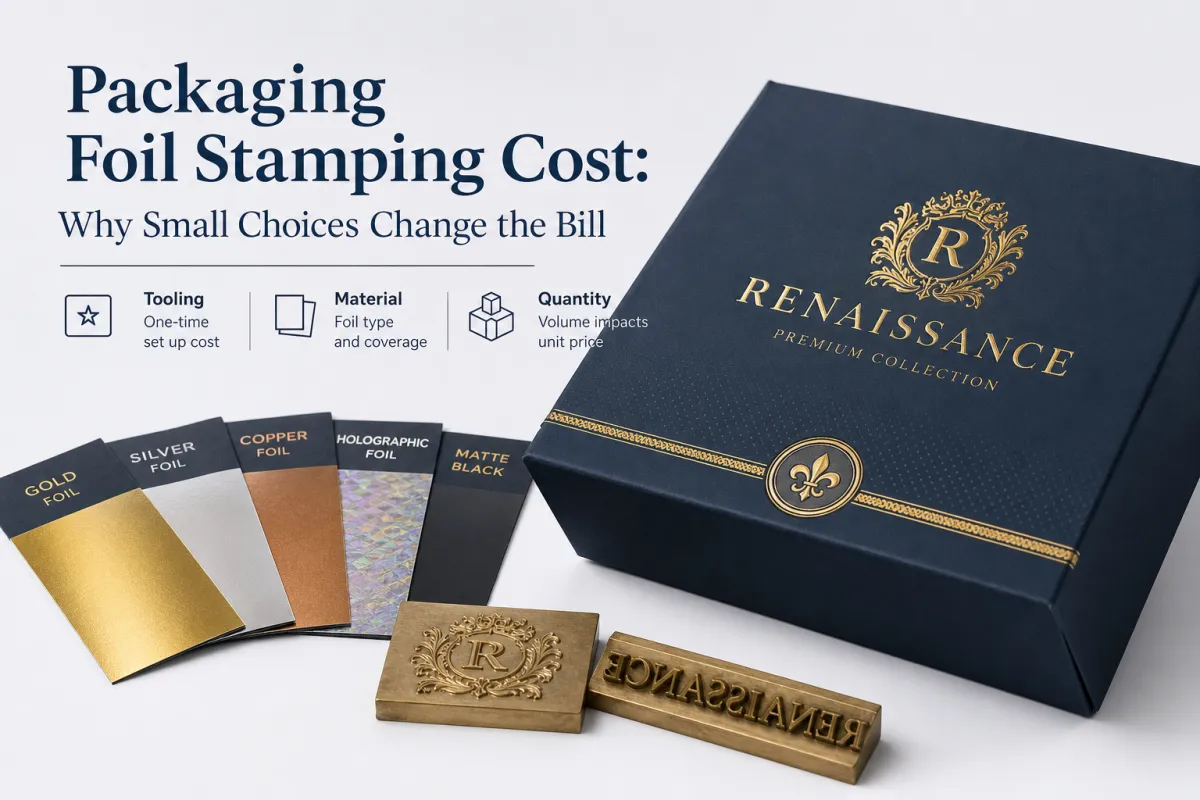
In practice, packaging foil stamping cost is often a setup business first and a material business second. The foil itself is thin and relatively inexpensive compared with the rest of the job. The expensive part is preparing the die, aligning the artwork, setting the press, and getting a clean impression so the finish reads as intentional rather than improvised. On a short run, that setup gets spread across fewer units, so packaging foil stamping cost can feel high even when the stamped area is small.
Consider two cartons with the same size, board, and closure style. One uses a centered gold logo with generous breathing room. The other uses a full-width mark, fine type, and a second foil pass for a product line identifier. The second quote usually lands higher not because gold suddenly became expensive, but because packaging foil stamping cost rises with registration risk, longer press time, and the extra waste that often appears during make-ready. That difference catches many first-time buyers off guard.
Artwork density changes how the press behaves as well. Thin strokes can fill in. Micro-text can blur. Tight alignment between foil and embossing can force more test sheets before the operator approves the run. From a packaging buyer’s point of view, packaging foil stamping cost is the price of controlled repetition. The more exact the repeat needs to be, the more the job behaves like a precision process and less like a decorative add-on.
"The cheapest quote is not the cheapest job if the foil lifts, fills in, or forces a reprint."
Hidden levers show up everywhere in this process, even when they do not appear in a one-line quote. Die size affects tooling. Artwork coverage affects press speed. Substrate compatibility affects waste. A board that is too textured, too absorbent, or too soft under heat may call for extra checks or a different foil formulation. Every one of those factors feeds into packaging foil stamping cost, and every one of them can be managed if they are discussed before production starts.
Clear quote requests make a real difference. Before asking for pricing, gather the artwork file, quantity, stock type, finish, and target delivery date. If the foil color and embossing requirements are already known, include those too. The more specific the input, the cleaner the packaging foil stamping cost estimate will be. For broader Custom Packaging Products, that same discipline improves every print finish you source.
One more practical point: the quote gets better when the brief is honest. If the design is still in flux, say so. If you are comparing a premium shelf box against a shipper that only needs a mark on one panel, say that too. A supplier can only price what they can actually build, and vague inputs tend to create padded estimates. Nobody likes that, and it is avoidable.
Product Details: What You Are Actually Buying in Foil Stamping
Foil stamping uses heat and pressure to transfer a film onto the packaging surface, leaving behind a metallic or pigmented image where the artwork is struck. In practical terms, packaging foil stamping cost covers not just the foil itself, but the tooling, machine time, and setup work required to place that image exactly where the design calls for it.
Most buyers begin with the familiar finishes: gold, silver, holographic, matte metallic, and colored foils. Gold still leads on perceived luxury because it reads as premium across categories, from cosmetics to confectionery. Silver suits technical, modern, or minimal branding. Holographic foil can make product packaging stand out sharply on shelf, yet it is not a neutral decision; it changes the tone of the brand in a very visible way. Specialty finishes can be powerful, but they often add to packaging foil stamping cost because they demand more careful matching and may slow the press.
The substrate matters just as much. Coated paperboard usually gives the cleanest impression. Rigid boxes can take a strong, crisp stamp, especially when the surface wrap is smooth. Kraft stock creates a different look, though uncoated fiber can be less forgiving and may need a test run to avoid patchy coverage. Sleeves, labels, and retail packaging cartons each respond differently to heat and pressure, so a supplier should never treat them as interchangeable.
Foil stamping also pairs well with other finishes. Embossing adds depth. Debossing pushes the mark inward. Spot UV creates contrast. Lamination improves the feel and protects the print layer. Each combination changes the appearance, and each combination changes packaging foil stamping cost. A single finish keeps the job simpler. A layered finish creates a stronger shelf story, but the labor and setup need to be priced honestly. If your line includes a soft-touch wrap, the tactile effect can be memorable, yet the combined process usually needs more attention than a standard gloss-coated box.
Strong vendors help before the first sheet reaches the press. They review the dieline, flag line weights that are too fine, suggest foil styles that suit the stock, and point out where the risk sits. That guidance matters because a small artwork adjustment can save hours of machine time later. In other words, packaging foil stamping cost is not only a price question. It is a design-and-production question that sits right at the center of package branding.
For buyers comparing finishes, the best question is simple: what is the finish doing for the shelf story? Is it signaling premium? Is it helping the logo read from three feet away? Is it supporting the market position of a new line? The answers shape the spec, and the spec shapes packaging foil stamping cost. A clean, high-contrast brand mark may only need a single-pass foil. A showpiece will cost more because the ambition is greater.
There is also a trust issue here. A supplier should be honest about what a finish can and cannot do. Foil does not fix a weak layout, and it does not disguise a bad stock choice. If the board is wrong, the pressure is wrong, or the logo is too delicate for the chosen process, the result will show it. Good production advice saves money because it keeps the finish from fighting the material.
Specifications That Move Packaging Foil Stamping Cost
The fastest way to control packaging foil stamping cost is to know which specifications are pushing the number upward. Artwork size usually comes first. A small logo in the corner costs less to stamp than a wide panel across the lid. Coverage matters because larger areas bring more setup, more inspection, and a greater chance of imperfect fill. Fine detail matters too. If the lines are too thin, the foil can break up or close in during impression.
Line thickness is one of the easiest details to underestimate. A logo that looks crisp on screen may behave poorly on a textured board. Type below a certain size may need to be opened up, and reverse spaces may need more breathing room. That is not a creative flaw; it is a production reality. In many jobs, a few millimeters of design adjustment can reduce packaging foil stamping cost because the operator spends less time chasing registration problems.
Tooling is another major lever. Die type, die size, and die complexity all affect the quote. Smaller dies are generally less expensive. A simple one-color logo may use a straightforward die that sets up quickly. Larger or deeply detailed dies cost more because they take longer to fabricate and may wear differently on the press. For longer runs, some buyers choose a harder die material to hold detail better, while short runs may use a lower-cost option if the design allows it. Those decisions shape packaging foil stamping cost more than foil color alone.
Stock choice can change the entire job. Smooth coated board usually stamps cleanly. Heavy texture can create gaps. Kraft can look striking, but the contrast depends on the foil and the pressure profile. Soft-touch lamination changes the surface feel and can make a metallic logo look richer, though it can also affect adhesion and waste. If the packaging is built on rigid board with a wrap, the result may be excellent, but only if the wrap stock has been chosen with foil in mind. Careful packaging design pays for itself here.
Before quoting, it helps to confirm these items in writing:
- Stamped area in inches or millimeters, including any secondary marks.
- Artwork type, such as a simple logo, a line of type, or a full-panel accent.
- Foil color and finish, including metallic, matte, holographic, or pigmented options.
- Board or wrap stock, with coating type and surface texture.
- Quantity and whether the order has a hard MOQ target.
- Delivery date so the production slot matches the launch plan.
- Combination finishes such as embossing, debossing, or spot UV.
That checklist makes the quote more accurate and usually improves packaging foil stamping cost on the back end. It also lowers the chance that a vendor prices the job conservatively because the brief is incomplete. A buyer who sends a clear spec sheet is more likely to receive a realistic unit cost instead of a padded estimate.
If you are comparing custom printed boxes for a product launch, do not isolate the finish from the structural package. The same foil design may cost less on one board and more on another, even if the box dimensions match. Experienced buyers look at the whole build, not just the art file, because that is where the real cost picture lives.
Another small but useful detail is finish direction. A design that places foil where people actually touch or notice the package tends to deliver more value than one that covers large hidden surfaces. That is a quiet way to manage spend without making the package feel cheap. Good packaging rarely shouts; it just looks right.
Packaging Foil Stamping Cost, Pricing, MOQ, and Unit Cost
Most quotes break into two buckets: one-time setup or tooling charges, and recurring per-unit production cost. That split sits at the heart of packaging foil stamping cost. A job with a modest die fee can still feel expensive when the order is tiny. The same design can look far better on a larger order because the setup cost gets spread across more cartons, which lowers the unit cost in a way buyers can actually measure.
MOQ creates a lot of confusion. Some suppliers set MOQ based on tooling economics. Others set it based on press efficiency or material minimums. In the real world, a low quantity often costs more per box because the operator still spends the same time aligning the die, checking the impression, and approving the proof. That means packaging foil stamping cost does not scale in a straight line. It often drops sharply at first, then levels out.
The table below shows illustrative planning ranges, not a quote. Actual numbers depend on artwork, substrate, region, and production schedule. Even so, the pattern is useful because it shows how packaging foil stamping cost behaves as volume rises.
| Run Size | Typical Setup / Tooling Pattern | Illustrative Unit Cost | Best Fit |
|---|---|---|---|
| 500-1,000 pieces | Higher relative setup share; fast approval needed | $0.30-$0.80 per unit | Samples, launch tests, limited editions |
| 2,500-5,000 pieces | Setup cost starts to spread out | $0.12-$0.35 per unit | Small brand runs, seasonal retail packaging |
| 10,000+ pieces | Better press efficiency if artwork is simple | $0.05-$0.18 per unit | Repeat SKUs, established product packaging |
Those numbers move quickly if the artwork becomes more complicated. A single-color logo on a clean coated board may sit near the lower end. A multi-pass design, especially one that needs tight registration or a second foil color, can land near the top or beyond it. That is why the phrase packaging foil stamping cost should never be treated as a fixed rate. It is a function of spec, quantity, and risk.
Comparison traps show up often. A quote that looks lower may hide differences in freight, inspection, or sample policy. Another vendor may include a stronger proofing process and therefore quote a slightly higher setup line. The smart comparison is apples to apples: identical artwork, identical board, identical quantity, identical shipping terms, and the same finish stack. If any one of those variables changes, packaging foil stamping cost is no longer being compared cleanly.
For buyers deciding between options, the table below is a practical shorthand:
| Option | Cost Pressure | Visual Impact | Typical Risk |
|---|---|---|---|
| Small single-color logo | Lowest | Clean, understated premium | Low, if line weights are healthy |
| Large coverage accent | Medium to high | Strong shelf presence | Higher press time and waste |
| Multi-color or layered foil | Highest | High-impact luxury cue | Registration and scheduling risk |
A buyer can use that grid to decide where the money should go. Sometimes a smaller, sharper stamp looks more expensive than a bigger, noisier one. That is a useful lesson because packaging foil stamping cost is not the same thing as brand value. A disciplined design can look premium without pushing the job into the highest-cost tier.
I also like to remind teams that MOQ is not always the enemy. If the packaging is tied to a launch window, a slightly larger run can lower the unit cost enough to make the finish more practical over the life of the SKU. The trick is to compare the full inventory picture, not just the quote on the first invoice.
Process, Timeline, and Production Steps for Foil Stamping
The production path is straightforward, though every step offers a place where delay can creep in. The work usually starts with the dieline and artwork review. A supplier checks placement, line weights, and the relationship between the foil mark and the rest of the print. If the file is clean, the job moves into proof approval and die fabrication. Once the tooling is ready, press setup begins, followed by test stamping, inspection, and final packing. Each of those steps influences packaging foil stamping cost because each one takes labor and time.
Timeline pressure is common on packaging launches. The delays are often plain rather than dramatic. A client changes the file after proof approval. The quantity changes after tooling is already in motion. The board sample arrives late. The foil color needs a second look. Any of those events can stretch the schedule and make packaging foil stamping cost rise if the job has to be resequenced or rushed.
Simple jobs usually move faster once final files are approved, while multi-step finishes need more lead time. A clean single-foil run may fit into a shorter production window. A job that combines foil stamping with embossing, spot UV, and special lamination usually needs more checking and a wider schedule cushion. If the supplier says the timeline is tight, that is not necessarily a bad sign. It usually means the work is being quoted honestly, with packaging foil stamping cost tied to actual machine time instead of wishful planning.
For buyers protecting a launch date, a few habits help a lot:
- Send the final dieline and artwork together.
- Approve samples quickly and give clear feedback.
- Lock the quantity before the press slot is reserved.
- Confirm the stock, foil color, and finish stack before tooling starts.
- Keep one person responsible for sign-off so decisions do not drift.
Those steps lower the chance of rework and usually keep packaging foil stamping cost inside the range the buyer expected. They also improve communication. When a supplier knows the final quantity and board type, it is easier to size the tooling and set the press efficiently. That matters especially for retail packaging programs, where launch timing and shelf impact are both non-negotiable.
Downstream testing also affects planning. If the box will travel through distribution, shipping testing matters. For ship-ready cartons and e-commerce packaging, the ISTA test families are useful reference points because they reflect the kind of handling packaging will face in the lane. For paper sourcing, FSC guidance matters if chain-of-custody claims are part of the brief. These standards do not set packaging foil stamping cost directly, but they shape the right substrate and finish choices before production starts.
A quick note from the production side: the cleanest jobs almost always come from the clearest handoff. When design, procurement, and production all work from the same approved file, the press room is not guessing. That alone can keep a project from sliding into avoidable waste.
Why Choose Us for Packaging Foil Stamping Cost Control
For Custom Logo Things, the value should be measured by how well the quote reflects the real job. Buyers do not need vague promises. They need a partner who reads the dieline carefully, questions risky artwork, and separates true setup cost from unit cost. That is how packaging foil stamping cost stays transparent, especially on launches where the order is small and the margin is tight.
We believe the strongest vendors act like cost-control partners. They point out when a logo can be simplified without weakening the brand. They warn you when a foil color will perform poorly on a rough stock. They suggest a cleaner stock if the chosen board is likely to create waste. That kind of guidance keeps packaging foil stamping cost from creeping upward after the quote is already approved. It also protects the look of the finished box, which matters just as much as the invoice.
Direct manufacturing coordination helps too. Fewer handoffs usually mean fewer misunderstandings, quicker answers, and tighter control over the job spec. If the team reviewing the order also understands the press setup, the final quote tends to be more grounded. That is a practical benefit, not a marketing line. It shows up in fewer surprise charges, fewer revision loops, and a more predictable unit cost for the buyer.
For brands still building their packaging system, start with the structure first, then fit the foil into the economics. Browse Custom Packaging Products, choose the box style that fits the SKU, and then add the finish that supports the shelf story. That sequence is usually more efficient than forcing a decorative spec onto the wrong structure. It also gives you a better benchmark for packaging foil stamping cost because the base pack is already correct.
If you are preparing a quote request, send the dieline, quantity, stock choice, foil preference, and target ship date together. If there is a second finish in the plan, mention that too. The more complete the brief, the easier it is to compare packaging foil stamping cost across vendors without comparing apples to oranges. For buyers under margin pressure, that clarity is worth more than a flashy estimate.
One more point. A premium finish should support the brand, not punish the margin. That sounds simple, yet many teams still over-specify the first round of packaging and then trim back later. A cleaner path is to set the visual target first, then remove the unnecessary variables. That is how packaging foil stamping cost stays aligned with both branding and commercial goals.
The most useful habit is to treat foil as a specification, not a decoration. Once the design, stock, quantity, and timeline are all on the table, the quote stops feeling mysterious and starts behaving like a planning tool. That is the point where good packaging decisions get a lot easier to make.
Frequently Asked Questions
What drives packaging foil stamping cost the most?
The biggest drivers are tooling, setup, artwork size, coverage, and substrate choice. Small runs usually carry a higher share of fixed costs, so packaging foil stamping cost rises quickly when the quantity is low. Multiple foil colors, tight registration, and specialty stocks can move the quote even more.
How does MOQ affect packaging foil stamping pricing?
MOQ changes pricing because die making, proofing, and press setup are fixed costs. When those costs are spread across more boxes, packaging foil stamping cost drops per unit. Ask whether the minimum is driven by tooling, press efficiency, or material minimums so the number makes sense.
Is foil stamping more expensive than other luxury finishes?
Not always. A simple foil logo can be very competitive, while large coverage or layered work can be expensive. The better comparison is not finish versus finish in isolation, but total look, durability, and run size. That is where packaging foil stamping cost has to be judged alongside embossing, spot UV, or specialty coating.
Can I reduce packaging foil stamping cost without changing the brand look?
Yes. Shrinking the stamped area, removing tiny detail, or using one foil color instead of two can lower waste and setup time. Choosing a compatible stock also helps. In many cases, a supplier can suggest small artwork changes that protect the premium effect while trimming packaging foil stamping cost.
How long does packaging foil stamping production usually take?
Simple jobs can move quickly after artwork and samples are approved, but tooling still needs time to be made. Complex jobs need extra time for registration and finish matching. The safest plan is to approve files early and confirm quantity before production begins so packaging foil stamping cost and timeline stay in sync.
What should I send for the most accurate quote?
Send the dieline, artwork, quantity, stock, foil finish, and target ship date. If you are combining foil with embossing, debossing, or spot UV, include that too. A complete brief gives the supplier enough detail to price the real job instead of guessing, which keeps packaging foil stamping cost honest from the start.
If you are comparing options for a new launch, ask each vendor for the same spec sheet, then compare the packaging foil stamping cost line by line. The right choice is usually the one that protects brand impact, keeps the schedule intact, and preserves unit cost where it matters most. That is the cleanest way to keep the finish premium without turning it into a budget problem.


