Buyer Fit Snapshot
| Best fit | Personalized Craft Beer Label Printing projects where brand print, material claims, artwork control, MOQ, and repeat-order consistency need to be specified before quoting. |
|---|---|
| Quote inputs | Share finished size, material target, print colors, finish, packing count, annual reorder estimate, ship-to region, and any compliance wording. |
| Proofing check | Approve dieline scale, logo placement, barcode or warning zones, color tolerance, closure strength, and carton packing before bulk production. |
| Main risk | Vague material claims, crowded artwork, missing packing details, or unclear freight terms can make a low unit price expensive after revisions. |
Fast answer: Personalized Craft Beer Label Printing: Quote Scope, Sample Proof, MOQ, and Lead Time should be specified like a repeatable production item. The safest quote records material, print method, finish, artwork proof, packing count, and reorder notes in one written spec.
Production checks before approval
Compare the actual filled-product size with the drawing, then confirm tolerance on folds, seals, hang holes, label areas, and retail display edges. Reserve space for logos, QR codes, warning copy, and material claims before decorative graphics fill the panel.
Quote comparison points
Review material grade, print process, finish, sampling route, tooling charges, carton quantity, and freight assumptions side by side. A quote is only useful when the supplier can repeat the same color, closure quality, and packing count on the next order.
Personalized Craft Beer Label Printing: What to Know
Personalized craft beer label printing can look like decoration until you watch shoppers stand in front of a cooler and make a decision in under 10 seconds. I have seen that happen in real taprooms, and it is a little humbling. A label is not just a pretty face; it is a sales tool, a compliance document, and sometimes the only thing separating a quiet launch from a busy one. In a place like Louisville, I once watched two customers compare four cans for maybe 6 seconds before one picked the label with the cleaner hierarchy and the stronger contrast. That was the whole pitch. No talking, no tasting, just a glance and a choice. For 250-piece wedding runs, 500-bottle seasonal releases, or 5,000-unit retail orders, personalized craft beer label printing has to earn attention fast.
What makes personalized craft beer label printing different from a generic beer label is not just the name change. The work is built around a specific batch, audience, event, or container shape, so the label needs to carry the brewery's identity without forcing a full packaging overhaul. I saw this up close with a small brewery in Asheville that needed one label for a 5.8% pumpkin ale and another for a 9.2% holiday stout, both on the same 16-ounce can and the same filling line. The solution was not a bigger budget. It was a better dieline, a cleaner file setup, and a 2 mil white BOPP stock with a permanent acrylic adhesive that held in refrigerated storage at 38 F. Most print problems are not ink problems. They are planning problems, and that is kind of the whole point.
Plenty of breweries lose money in small, quiet ways and never connect the dots. Weeks go into recipe development, 30 minutes go into the proof, then the first shipment lands in cold storage at 34 to 40 F, condensation forms, and the label starts to lift at the corners. I have seen a corner peel so neatly it almost looked intentional, which is a generous way to describe a packaging failure. Personalized craft beer label printing solves more than branding if it is handled correctly: it makes short runs look premium, gives one-off releases a distinct identity, and keeps a brewery from sitting on thousands of unused labels in a warehouse. The practical questions are the right ones: how it works, what it costs, how long it takes, and which material choices survive actual cellar conditions in places like Portland, Manchester, or Columbus.
What Is Personalized Craft Beer Label Printing?
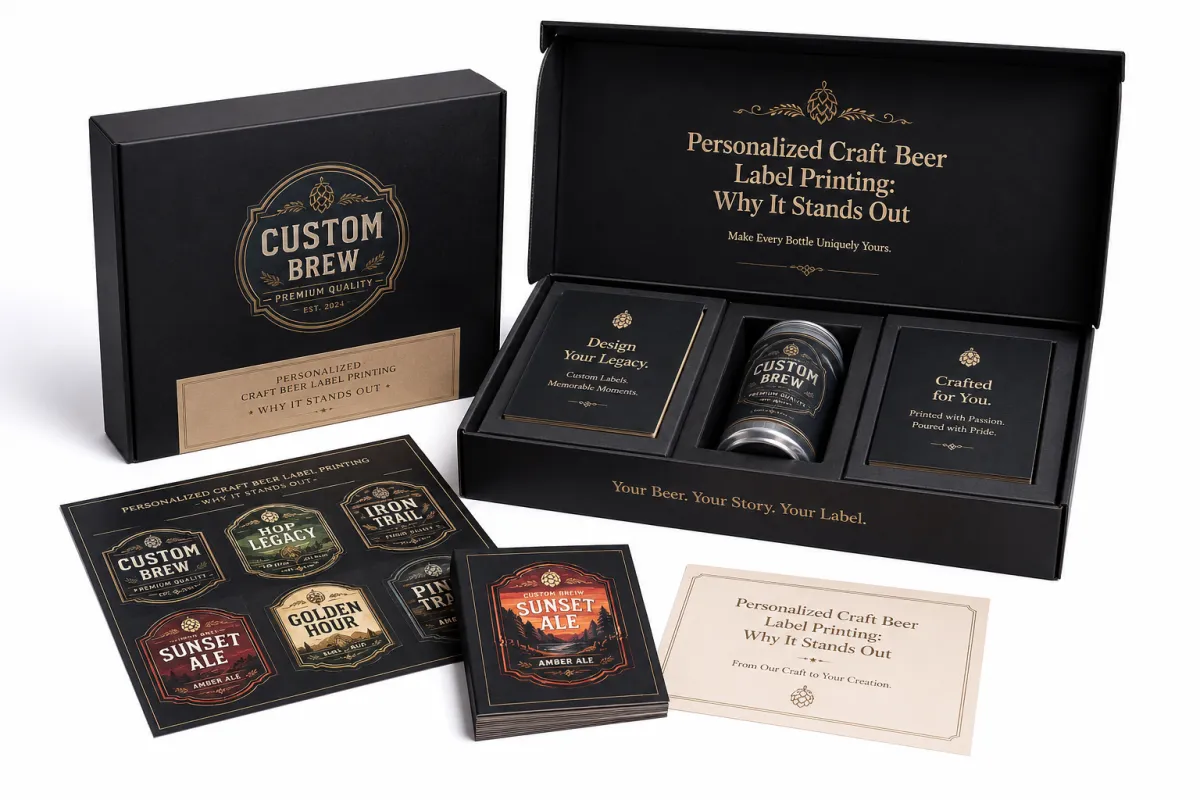
Personalized craft beer label printing is custom beer label printing built around a specific release, audience, or occasion. Instead of using one generic design across every bottle and can, breweries can tailor the name, flavor notes, batch number, finish, and compliance copy to the exact product in front of them. That makes the packaging more useful and more memorable, whether the run is a taproom-only IPA, a wedding favor, or a seasonal stout headed into retail.
The reason this approach matters is simple: beer packaging has to do several jobs at once. It has to sell the beer, carry the brand, survive refrigeration, and stay readable under store lighting. Personalized craft beer label printing lets a brewery keep the core identity intact while changing the details that make one release distinct from another. In a category where a customer may decide in seconds, that flexibility is worth a lot.
There is also a practical manufacturing angle. A brewery might be running 12-ounce bottles in one month and 16-ounce cans the next, then a smaller gift pack for the holidays. Personalized craft beer label printing gives the team room to adapt without rebuilding the whole package every time. That matters when the production calendar is already crowded and nobody wants extra inventory sitting around like a bad idea with a barcode.
Personalized Craft Beer Label Printing: Why It Stands Out
Personalized craft beer label printing stands out because beer buyers rarely read like auditors. They scan like people in motion. A bottle in a cooler gets about 3 to 7 seconds of attention, and the label has to communicate style, freshness, and personality almost instantly. I learned that during a retailer walkthrough in Chicago, where a buyer told me the label with the clearest hierarchy moved faster than the one with the most intricate illustration. That stuck with me. Fancy art is lovely, but if the brand name disappears under it, the label is doing a tiny act of self-sabotage right at the shelf edge where a 24-pack competes with a dozen other options.
It also gives breweries room to tell a sharper story. A generic label can cover an amber ale, but personalized craft beer label printing can separate a 12-ounce taproom-only IPA from a 16-ounce collaboration batch, a wedding pack from a corporate gift set, or a 375 ml bottle from a 500 ml specialty release. The difference is slight on paper and obvious on the shelf. One custom label can make a local brewery look established, while another can make a seasonal release feel collectible. Customers do not always buy the best beer first. They often buy the beer that seems made for them, which is a little irrational and very human.
There is a production advantage too. Personalized craft beer label printing lets a brewery run short quantities without reworking the entire package system. If you need 250 labels for a release party in Denver or 5,000 for a regional taproom rollout out of Ontario, California, the label can be built for that exact use case. I have seen breweries keep the core branding fixed and swap only the color band, flavor name, and legal text while using the same 3 x 4 inch dieline. Design friction dropped, leftover inventory stopped piling up, and the storage closet no longer looked like a museum of obsolete promo ideas. If you have ever found 1,200 outdated labels behind a POS display, you know why that matters.
Where personalized craft beer label printing really earns its keep is perceived value. A bottle with a matte label, tight registration, and a controlled foil accent can feel far more premium than the same beer on a plain stock label. That is not theater. It is packaging psychology, and retailers see the result in movement and repeat orders. A run that costs $0.24 per unit can sometimes support a $1.00 to $1.50 higher shelf price if the presentation signals a limited release, a local collaboration, or a giftable product. Shoppers may not know the print method, but they can feel the difference between a label that reads mass-produced and one that looks tuned for a specific release.
"We thought the beer would sell itself. The label sold the first 300 cases." A taproom manager in Portland said that during a warehouse tasting session, and the sales data backed her up: the cleaner, better-finished label outpaced the plain version by 18 percent on launch weekend and moved through the first 12-case pallet in 2 days.
For breweries balancing creativity and compliance, personalized craft beer label printing is also a useful testing ground. New looks, new hierarchies, and new label shapes can be tested without changing the can or bottle format. That makes it easier to learn what customers respond to before committing to a broader identity refresh. For broader packaging work, the team page for Manufacturing Capabilities is a useful place to map out what can be produced in-house versus what needs specialty finishing. The best branding work usually looks effortless only because someone was obsessing over a dieline at 9:40 p.m. in a prepress room.
There is one more reason it stands out: it can protect a brand from overcommitting too early. A lot of breweries want to test a visual idea before they roll it out across every SKU. Personalized craft beer label printing lets them do that with a limited batch instead of a full rebrand. That is a smarter way to learn. Honestly, it saves a lot of grief.
How Personalized Craft Beer Label Printing Works
The workflow for personalized craft beer label printing is more direct than many first-time buyers expect. It usually begins with a brief: the container type, the label dimensions, the quantity, the finish, the deadline, and any legal copy that must appear on the face or back panel. From there, the printer checks the dieline, confirms the label shape, and requests the artwork files. Once the proof is approved, production starts, followed by finishing, quality control, and shipment. The sequence sounds simple, yet every step matters because a 1 mm shift in placement can interfere with a seam, a curve, or an applicator sensor. One millimeter sounds harmless until it ruins an entire row of labels.
File prep causes more delays than the print run itself. For personalized craft beer label printing, the usual requirements are a vector dieline, bleed on all sides, a safe area that keeps text away from trimming, and any barcode or compliance copy set at a readable size. I watched a client lose 3 business days because the legal text sat 0.08 inches too close to the cut line on a 2.75 x 4.25 inch label. They assumed the printer could move it later. It could not, at least not without changing the layout and rechecking the UPC. Small labels leave little room for error, and that is where many first-time buyers get tripped up. The label might be only a few inches wide, but the decisions packed into it are not small at all.
Print method matters as much as the artwork. Digital printing is usually the best fit for short runs, seasonal SKUs, and variable data because it handles name changes, flavor swaps, and event-specific text without plate changes. Flexographic printing makes more sense as run sizes grow and artwork stays fixed, while offset printing can be useful in certain constructions where fine detail and color control are priorities. Each method has tradeoffs. Digital moves quickly and flexes well. Flexographic printing tends to win on scale. Offset can deliver crisp results, but the setup does not fit every short run. I have a soft spot for digital because it saves so many small launches from becoming expensive archaeology projects later, especially when the order is only 500 labels and the launch is tied to a Saturday event.
Color control deserves more attention than it usually gets. Personalized craft beer label printing often uses CMYK for full-color artwork, then spot color for brand-critical elements such as a red logo or a gold accent. If your brand depends on one exact shade, spot color is often safer than assuming CMYK will land identically every time. I have seen a deep green logo look rich on one proof and muddy on another because the monitor was uncalibrated and the file was converted twice. The print was not wrong. The approval process was loose. And yes, that is the sort of thing that can make a designer stare into the middle distance for 10 minutes while the production manager checks the Pantone guide for the third time.
Finishing changes both the look and the durability of personalized craft beer label printing. Matte creates a softer, more artisanal feel. Gloss raises contrast and shelf pop. Soft-touch can feel expensive, though it is not always the best option for wet handling. Foil accents and spot varnish add contrast and pull the eye to the brand name or flavor callout. If the bottles are headed into cold storage or ice buckets, the adhesive and topcoat matter as much as the art. A 1.2 mil clear BOPP overlaminate paired with a permanent acrylic adhesive will behave very differently from a paper stock with a general-purpose adhesive, especially after 20 minutes in a 32 F cooler. The label has to survive condensation, friction, and temperature swings, not just a polished mockup. A beautiful sample on a dry desk can fool people. A sweating bottle does not.
When people ask how long personalized craft beer label printing takes, I answer with a range, not a promise. Artwork approval may take 2 days or 2 weeks depending on revision cycles. Production typically takes 12 to 15 business days from proof approval for a standard 5,000-piece digital run, while specialty finishing can push that to 18 business days. A rush reorder from a facility in Mississauga or Ontario, California can sometimes move faster than a first run in Shenzhen or Dongguan because the art is already locked and the stock is on hand. The printer can often move faster than the buyer can, which makes approval timing the real bottleneck. A fast print job with a late proof is still a late launch, and a 4 p.m. Friday approval can easily become a Tuesday shipment.
Cost, Pricing, and Minimums to Expect
The cost of personalized craft beer label printing depends on quantity, size, shape complexity, finish, adhesive, and how much the artwork changes between versions. A simple 3 x 4 inch label with standard stock and digital printing may land around $0.15 to $0.22 per unit at 5,000 pieces, especially if the order is printed on 2 mil white BOPP with a matte varnish and a permanent adhesive. Add soft-touch lamination, foil, or a Custom Die Cut, and the price can move closer to $0.42 to $0.85 per unit. Those figures are not universal. They are the kind of starting ranges I use when a buyer wants something useful instead of a vague quote. People love vague quotes until they have to plan a 4,000-bottle release around one.
Minimum order quantities also vary by supplier. A digital label run might start at 250 or 500 pieces, while flexographic printing usually makes more sense at higher volumes because the setup is spread across more units. I have had brewery owners assume they needed 20,000 labels just to test a new canning line design. That is not always true anymore. Short-run personalized craft beer label printing has lowered the barrier for taproom exclusives, special events, and pilot releases, especially when the artwork is already finalized. That flexibility has changed the category more than people realize, and it has made it realistic for a 300-bottle wedding batch to use the same vendor as a 30,000-unit regional release.
The cheapest quote is not always the best value. A low sticker price can hide later costs if the labels wrinkle in refrigeration, peel on wet glass, or miss a compliance requirement and need to be reprinted. I once saw a brewery save $280 on the first purchase and then spend $960 correcting a run that failed in the cooler because the adhesive was spec'd for dry cartons, not condensation-heavy bottles at 36 F. That is not unusual. The label budget should include performance, not just the print invoice. Cheap labels that fail are not cheap. They are just delayed expenses with a better smile.
Premium finishes deserve side-by-side comparison because customers see the finish before they taste the beer. A foil accent or textured topcoat can make a small batch feel collectible, but it should support the brand instead of burying it. One client in hospitality moved a seasonal stout into a gift pack and added a restrained copper accent. The cost increase was $0.07 per unit on a 2,000-piece run, while the perceived value was high enough that the case sold through 9 days faster than the standard version. Personalized craft beer label printing works best when the finish fits the story, not just the budget. A shiny label on the wrong beer can feel like wearing cufflinks to mow the lawn.
| Option | Typical Use | Approx. Unit Cost at 5,000 | Best For | Watch Outs |
|---|---|---|---|---|
| Standard digital label | Taproom releases, pilot batches | $0.15 to $0.22 | Fast turn and variable copy | Less shelf impact than premium finishes |
| Matte with strong adhesive | Cold storage bottles, chilled packs | $0.24 to $0.40 | Condensation resistance and clean look | Can feel understated if the design is too minimal |
| Soft-touch with spot varnish | Gift sets, premium seasonal SKUs | $0.42 to $0.68 | Tactile brand lift and premium feel | May show handling marks if the coating is too soft |
| Foil-accented label | Limited editions, award releases | $0.55 to $0.85 | High shelf impact and collectible look | Needs disciplined layout to avoid looking crowded |
If you want a broader view of label formats, the product page for Custom Labels & Tags is a useful reference point. It is easier to compare a bottle label, a neck tag, and a carton tag side by side than it is to guess from a price sheet alone. In personalized craft beer label printing, that context can save a lot of revision time. I have seen teams talk themselves into the wrong label size simply because they were looking at a static PDF instead of the full packaging family, and the mistake often costs 2 extra proof rounds.
For buyers thinking about sustainability, material choice can affect both cost and perception. Some label stocks are FSC-certified, which matters to certain retail buyers and brand partners. If sustainability claims are part of the brief, it is smart to verify the source of the face stock and adhesive before approval rather than after the labels arrive. That kind of diligence is common in packaging audits, and organizations such as FSC's certification resources are useful when you need to check what the claim actually covers. Personalized craft beer label printing can support those goals, but the paperwork needs to match the promise. Otherwise you get the awkward situation of advertising responsibility with the confidence of a company that forgot to read its own spec sheet.
One more cost detail people miss: reorders. A well-built master file and a stable dieline can cut future expenses because the printer is not rebuilding the job from scratch every time. That is especially useful for breweries that rotate seasonal art but keep the same container. If your packaging changes every few months, the smartest money is usually spent on a structure that can handle the next three versions without extra drama.
Timeline and Production Steps From Proof to Delivery
A realistic schedule for personalized craft beer label printing starts with discovery and ends with shipment, but the middle matters most. The steps usually run brief, artwork submission, prepress review, proof approval, print production, finishing, quality check, and delivery. The path looks linear on paper. In practice, most delays happen in the first half. Missing dimensions, unresolved copy, and late design changes can add more days than the print run itself. I have seen a two-color label that could have moved in a week get pushed out by 11 days because the legal text changed twice after proofing. That sort of delay is remarkably efficient at turning a calm project into a mildly feral one.
The fastest jobs are the ones with final files ready to go. If the dieline is accurate, the copy is approved, and the finish is decided, personalized craft beer label printing can move quickly. If the brewery is still debating whether the cans need a gloss or matte feel, the clock keeps running. A sensible rule is to allow time for one proof review, one revision cycle, and shipping buffer. For an event launch in Atlanta or Milwaukee, I would not count on a label order arriving the day before the pour, even if the production estimate looks short. That last-minute optimism is how people end up pacing around a loading dock with a phone in one hand and a half-finished Excel sheet in the other.
There is a practical reason to build in extra time. Specialty materials, die cuts, and custom coatings can depend on stock availability, and one missing roll can slow the whole order. A small brewery once asked why their label timeline moved from 8 business days to 14. The answer was simple: the selected film stock had to be restocked before print, and they had approved a last-minute change from square corners to a shaped edge. Personalized craft beer label printing is flexible, but it is not magic. If the supply chain wants to be dramatic, it will be dramatic anyway, especially on orders routed through Guangzhou or Xiamen with a trans-Pacific freight window.
One way to keep the timeline under control is to treat label approval like a launch gate. If the art director, compliance reviewer, and production manager all sign off in one pass, the job usually moves smoothly. If each person sends separate edits after the proof goes out, the timeline stretches. I have found that the best teams assign a single approval owner. That one detail can shave 2 to 4 days off the schedule and cut the email chain in half. It also prevents the classic situation where three people approve the same file and then all send different comments the next morning, which I swear should count as a sport.
For shipment planning, think about the finish and the destination together. Labels going to a warm warehouse in Phoenix can tolerate a different window than labels heading straight into a refrigerated distribution chain in Minneapolis. If the labels are traveling to a facility that handles chilled packs or ice-bucket service, the adhesive test should be part of the approval cycle. Personalized craft beer label printing is not finished when the files are approved. It is finished when the labels arrive in a condition that still performs on the line and on the shelf, often after 3,000 miles of transit and one more temperature swing than anyone wanted.
Step-by-Step Guide to Ordering the Right Labels
Start with the container, not the artwork. Measure the bottle, can, or growler carefully, and note seams, curves, and any areas that get wet in refrigeration. A 12-ounce bottle does not behave like a 16-ounce can, and a wraparound label on one container may not fit another without visible distortion. In personalized craft beer label printing, the dieline comes first because it determines how the design can breathe. That sounds obvious, but obvious advice is often the advice people ignore right before a problem appears, usually at 4:55 p.m. on a Thursday.
Next, define the use case. A taproom-only release can prioritize personality and a bolder illustration, while a retail release needs clearer compliance text, stronger contrast, and a barcode that scans under store lighting at 3200K or 4000K. A wedding pack needs a different tone entirely, often with names, date markers, or a short message that makes the bottle feel personal. When I worked with a brewery preparing 300 bottles for a reception in Charleston, the winning design was not the flashiest one. It was the one that balanced a clean monogram with readable flavor text and a simple thank-you line. Personalized craft beer label printing is strongest when it matches the occasion.
Then build the artwork around the label shape. Too many teams design the front panel first and force the legal copy into whatever space is left. That creates cramped layouts, awkward line breaks, and tiny text that can fail retail review. A better method is to map the hierarchy before final art begins: brewery name, beer style, flavor note, compliance copy, and secondary details. If the label has a neck band or a back panel, treat each surface as part of the system, not an afterthought. That is one reason personalized craft beer label printing works so well for breweries with multiple SKUs. The system stays consistent while the details change, and the production team can keep the same 0.125 inch bleed rule across the family.
After that, request a proof or sample. I would not skip this step on any refrigerated product. A flat PDF is useful, but a physical sample tells you more about surface texture, color density, and how the adhesive behaves under real handling. Put the sample under store lighting, mist it with water, and chill it for at least 20 minutes if the beer will live in a cooler. That is a better test than staring at a monitor. If the barcode is part of the label, scan it under the same lighting conditions where it will be used. Personalized craft beer label printing should be judged in real conditions, not just in a color-managed file viewer, and a $12 printed sample can save a $1,200 reprint.
Finally, place the order only when the quantity, version count, storage conditions, and delivery date are locked. That includes asking whether the labels will be hand-applied, machine-applied, or sent through a chilled-pack workflow. Each method affects the ideal stock and adhesive. If you are unsure, ask for a recommendation based on the exact container and storage path. I have seen personalized craft beer label printing orders shift from stressful to manageable once the buyer gave the printer the full story instead of a partial brief. It is amazing how much friction disappears once everyone stops guessing, especially when the destination is a retail chain in Nashville with a fixed reset date.
- Measure the container and confirm the exact label area.
- Define the audience, the release type, and the sales channel.
- Build the artwork hierarchy around the dieline.
- Check color, barcode placement, and compliance copy in a proof.
- Approve only after confirming the storage and application method.
Common Mistakes That Hurt Shelf Appeal and Compliance
The first mistake is choosing a stock that looks good on screen and fails in cold, wet, or high-humidity conditions. Personalized craft beer label printing lives or dies on how the label behaves after the bottle leaves the printer. A stock that curls in a cooler or wrinkles on a condensation-heavy glass is not a creative choice; it is a cost. I saw one taproom launch in Detroit where the label corners lifted before the first case sold. The beer was good. The package looked tired by the second day. The saddest part is that the brand had done the hard part correctly and still got tripped up by the wrapper.
The second mistake is overcrowding. Brewers love awards, tasting notes, ABV details, story copy, and logos, but all of that can turn into visual static if it is squeezed into one front panel. A shopper should be able to identify the beer name from 3 feet away. Everything else is secondary. In personalized craft beer label printing, hierarchy matters more than decoration. If the brand name and beer style fight for attention, the label loses clarity and shelf impact drops. I have had to tell more than one enthusiastic founder that not every sentence deserves a front-row seat, especially when the label face is only 2.5 inches wide.
The third mistake is color mismatch. Approving a file on an uncalibrated monitor is a classic way to end up disappointed. CMYK conversion, paper brightness, coating type, and light source all change the final appearance. If a brand color is critical, test it. I prefer to check one printed sample under warm retail lighting and one under cooler warehouse light because those two settings can tell different stories. Personalized craft beer label printing should be reviewed where the label will actually be seen. A file can look perfect on a laptop and still flop under fluorescent store lighting, which is a very rude surprise, especially if the correction needs a 2-day reprint slot.
The fourth mistake is compliance drift. Alcohol content, net contents, legal copy, and barcode placement all need to be legible and accurate. I have seen labels return from proof with beautiful artwork and unreadable microtype. That is a problem. Retail review, distributor expectations, and internal QA can all slow a launch if the text is too small or the claims are not documented cleanly. If the brewery has multiple legal versions, keep them tracked in one place so version control does not turn into guesswork. Nothing adds unnecessary drama like a proof where nobody can remember which 6.9% ABV belongs to which batch.
The fifth mistake is forgetting the application method. Hand-applied labels, automatic applicators, and chilled-pack workflows each create different demands on tack, liner release, and label stiffness. A label that works perfectly on a flat table may misfeed on a bottling line running 150 bottles per minute. When buyers ignore that detail, they end up troubleshooting on the line instead of shipping product. That is an expensive lesson, and it appears often enough that I now ask about application method before I ask about artwork. Personalized craft beer label printing is not just about how the label looks. It is about how it behaves in the actual process.
For general standards and packaging guidance, the ISTA testing resources are worth a look if the product will be shipped, stacked, or dropped during transit. It is not a label-only issue. A bottle package is a system, and the label needs to survive the same stresses as the carton and the case wrap. That mindset has saved more than one launch from preventable damage. Shipping is part of design, whether people like that fact or not.
Expert Tips for Better Personalized Craft Beer Label Printing
The best labels usually follow one rule: make the brand name easy to find in under 2 seconds. After that, the beer style or flavor should be obvious, and the supporting details should sit quietly underneath. That order is not flashy, but it works. In personalized craft beer label printing, strong hierarchy does more for sales than a crowded page full of flourishes. I have compared two labels for the same beer on a retail shelf in Cincinnati, and the simpler one with better contrast won every time. It was almost boring in how reliably it won, which is exactly why it mattered.
Test the finish on a small batch before you commit to a wide rollout. A matte label can look warm and craft-forward, but in some lighting it can mute the color too much. A gloss finish can sharpen contrast, yet it may feel too commercial if the brewery wants a hand-made impression. Soft-touch feels premium, but it can show scuffs if the bottles are handled often. One brewery I advised used three finishes on 250-label test lots and chose the one they had not favored at first. The surprise was useful. Personalized craft beer label printing rewards testing more than guesswork. I like that because it keeps everyone honest and saves the sort of regret that shows up 6 weeks later on a distributor pallet.
Ask for sample labels that can be chilled, misted, and handled with wet hands. That is the real test. I have seen labels that looked excellent dry and failed in a cooler after 30 minutes at 38 F. A good sample review should also include barcode scanning, because a pretty label that will not scan properly creates a second problem downstream. If your packaging partners are talking about bottle fit, label material, and throughput speed together, you are asking the right questions. If they are only talking about how the mockup looks, I would ask a few more questions before anyone signs anything, especially if the launch is tied to a 1,200-case order.
Think in systems, not one-offs. The strongest personalized craft beer label printing programs use a consistent brand frame with variable elements such as color, illustration, batch number, flavor copy, or event name. That gives the brewery a recognizable family of products without forcing every release to start from scratch. It also helps with speed. Once the master file is built, future updates are usually faster and cheaper because the structure is already solved. This is one of the quiet advantages of disciplined packaging teams: fewer emergencies, fewer file hunts, fewer "who has the latest version?" messages that arrive like tiny acts of chaos, often at 8:12 a.m. on a production day.
Keep a master file and a change log. That sounds dull until you need to reprint 800 labels and nobody remembers which version had the corrected ABV text or the updated weight statement. A clean archive cuts errors and reduces back-and-forth with the printer. It also makes future personalized craft beer label printing jobs easier to quote because the new project can be compared against an existing spec instead of rebuilt from memory. I cannot overstate how much time is wasted when a team treats version control like a suggestion, particularly when the reprint window is only 48 hours before a festival pickup.
If you need to understand the production side before you request a quote, reviewing the team's Manufacturing Capabilities can help you decide whether a job belongs in digital printing, flexographic printing, or a specialty finishing lane. Matching the method to the job is often the difference between a nice-looking label and a label that survives the route to market. That connection between print method and selling context is easy to miss, but once you notice it, you start seeing it everywhere, from a 500-piece taproom release to a 20,000-unit grocery run.
One last tip from the prepress side: do not chase novelty for its own sake. A shaped label or metallic accent can work beautifully, but only if it strengthens the beer's story and the container's shape. If it just adds noise, it is expensive noise. That is where a lot of otherwise smart projects slip.
Next Steps Before You Order Personalized Craft Beer Label Printing
Before you request pricing, put together a one-page brief. Include the container type, exact dimensions, quantity, label version count, finish preference, storage conditions, and target delivery date. If the label will sit in refrigeration or travel long distances, add that too. That one page makes personalized craft beer label printing easier to quote because it removes ambiguity from the conversation. Ambiguity is expensive. Clarity is not, and a printer in Ontario, California or Shenzhen can usually quote faster when the brief has numbers instead of guesses.
Then gather the files that actually matter: the final artwork, the dieline, the approved copy, barcode data, and any compliance language that must stay fixed. If you are still waiting on a logo revision or debating the flavor name, pause the order. The price you get from a printer is only as accurate as the information you provide. I have seen a project swing by a full week simply because the buyer waited to confirm whether the batch name was "Harvest Amber" or "Autumn Amber." Small difference. Real delay. The sort of delay that makes a perfectly reasonable team start speaking in short, tense sentences while the calendar moves toward the event date in 72-hour blocks.
If the labels are going to be refrigerated, shipped, or displayed under harsh retail lighting, ask for a sample check rather than relying on the mockup alone. That extra step is especially useful when you are choosing between a matte stock and a premium film or between spot color and full CMYK. A printed sample can reveal issues that a digital proof hides, and personalized craft beer label printing is one place where tactile reality beats screen optimism every time. The screen is useful, of course. It just should not be allowed to run the whole show, especially when the bottles will sit in a cooler at 34 F and be handled by wet hands.
Compare at least 2 finish options if you are balancing budget against presentation. One may be a standard digital label with a strong adhesive and a clean matte topcoat. The other may be a premium version with foil or spot varnish that gives the bottle more shelf presence. The right choice depends on the moment you want to create. A taproom-only launch has different goals than a holiday gift pack or a retail trial run. Personalized craft beer label printing should support the business goal, not just the art direction. I have a strong opinion here: if the finish does not help the beer sell, it should not be in the budget, even if the sample looks fantastic under studio lights in a 72 F room.
Once you have the brief, the files, the proof plan, and the approval window, place the order and keep the response cycle tight. That is the simplest way to move from concept to production without missed dates or extra rounds of revisions. If you need one last rule of thumb, here it is: the more specific the label brief, the smoother the entire job. That holds true for personalized craft beer label printing whether you are ordering 250 labels for a private dinner in Nashville or 25,000 for a larger rollout across the Midwest. Personalized craft beer label printing works best when the details are locked before production starts.
The clearest takeaway is practical: lock the container specs, the storage conditions, and one approval owner before you place the order, then request a chilled, wet-hand sample instead of relying on a PDF alone. That one habit prevents most of the expensive mistakes that derail personalized craft beer label printing, and it gives the finished label a much better shot at doing its real job on the shelf.
Frequently Asked Questions
How does personalized craft beer label printing differ from standard beer labels?
Personalized craft beer label printing is built around a specific batch, event, audience, or brand story instead of one generic label used everywhere. It often supports variable designs, smaller runs, and faster changes, which is useful for seasonal beers, taproom exclusives, and gift packs. The tradeoff is that each version needs more careful checking for fit, readability, and compliance, especially when the label must match a 12-ounce bottle, a 16-ounce can, or a 375 ml specialty format. In practice, the difference shows up in how much version control and proofing the order requires.
What material works best for personalized craft beer label printing on refrigerated bottles?
A moisture-resistant stock with a strong adhesive is usually the safest choice for chilled bottles, especially if condensation is expected. 2 mil white BOPP and 1.6 mil clear BOPP are both common, and a permanent acrylic adhesive tends to hold better than a general-purpose adhesive once the bottle spends 20 to 30 minutes in a 36 F cooler. Matte, gloss, and film-based options can all work, but the best one depends on whether the label will get wet, be handled often, or sit in storage for a long period. I always recommend a sample that can be chilled and wiped down, because the best-looking dry label is not always the best-performing one.
How long does personalized craft beer label printing usually take?
The timeline usually depends more on proof approval and file readiness than on printing itself. A standard run often takes 12 to 15 business days from proof approval, while specialty finishing or a late artwork change can add 3 to 5 more business days. Simple runs can move quickly once artwork is final, while custom shapes, foil, or revision cycles add extra time. A practical plan includes buffer time for one proof review, one revision cycle, and shipping before the launch or event date, especially if the beer is tied to a fixed release day in a taproom or distributor window.
What should I budget for custom personalized craft beer label printing?
Budget based on quantity, size, finish, adhesive, and whether each label version needs separate setup or artwork changes. At 5,000 pieces, a standard digital label can land around $0.15 to $0.22 per unit, while premium finishes like foil or soft-touch can push the cost closer to $0.55 or more. Short runs can cost more per label, but they often reduce waste and are easier to test for limited releases or new product ideas. The cheapest option is not always the best value if it fails in cold storage or needs to be reprinted after production.
What artwork details are most important for personalized craft beer label printing?
Start with the dieline, then make sure the logo, beer name, flavor text, and legal copy fit inside the safe area with enough breathing room. Use high-resolution files and confirm color expectations before proof approval, especially if the label relies on brand-specific tones. If the bottle or can will be viewed at retail distance, prioritize strong contrast and a clear hierarchy over decorative clutter. A label that reads cleanly at 3 feet is usually more effective than one that looks busy and clever at 10 inches.