Personalized Leather Tote Bags: How to Order the Right Run
Personalized leather tote bags get judged fast. Before anyone opens the bag, they notice the grain, the handle feel, the edge finish, and whether the logo sits like it belongs there or looks pasted on. That is why a good order is never just about size or color. It is about matching the leather, the decoration method, and the construction so the finished tote reads as intentional from the first glance.
From a buyer’s point of view, leather sits in a different category than canvas or polypropylene. It signals premium, but it also exposes weak decisions very clearly. A slightly crooked stamp, loose stitching at the handle, or rough edge paint lowers the perceived value of the whole piece. If the goal is retail presentation, corporate gifting, employee welcome kits, or a limited brand release, the decisions behind the bag matter as much as the artwork itself.
That is the part people miss. A tote does not need to be overdesigned to look expensive. It needs to be consistent. The leather grade, stitching, lining, hardware, and logo method should all point in the same direction. If one detail is trying to be luxury while the rest is quietly budget, the bag gives itself away.
What personalized leather tote bags signal at first glance
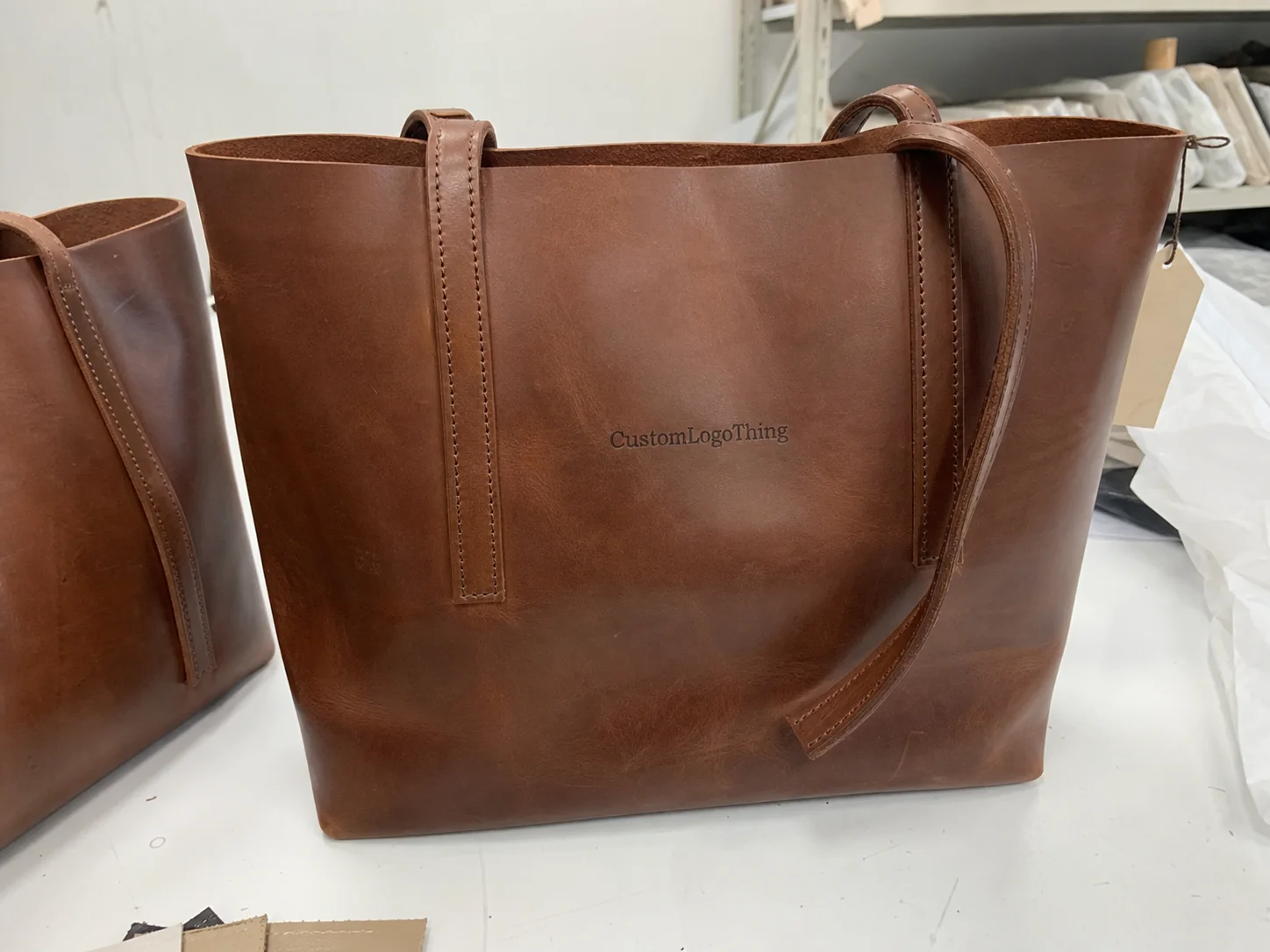
A leather tote is usually read in seconds. People do not measure strap drop or ask about stitch spec before they form an opinion. They notice whether the surface looks rich or plasticky, whether the handles feel firm in the hand, and whether the branding looks subtle or loud. That first impression does most of the work, especially if the bag will be given to executives, sold in a boutique, or packed into a premium gift set.
Leather behaves differently from canvas or woven polypropylene because it carries a memory of every choice. Stitch spacing stands out. Edge paint stands out. Hardware finish stands out. Even the placement of a small logo can shift the whole read from elegant to promotional. The material rewards restraint. A restrained mark on a well-built bag often looks more expensive than a large logo on weaker construction.
The real question is not, “Can we put a logo on it?” The better question is, “What combination of material and decoration will still look polished after the bag has been used?” That means looking at the full package: leather type, reinforcement, lining, closures, logo method, and the way the tote opens and carries weight. A good sample should feel coherent, not like a collection of separate choices.
“If the logo is perfect but the handle feels flimsy, the bag still reads cheap.”
That is why personalized leather tote bags are often chosen for projects where presentation matters more than volume. They give a premium cue, but they also demand discipline. The more refined the appearance you want, the more important it becomes to control the details that do not show up in a flat mockup.
There is also a practical reason to be picky here. Leather is less forgiving than most packaging materials. It can mark during handling, scuff in transit, or show variation from panel to panel. Buyers who only approve a digital proof usually miss the part that matters most: how the finished bag looks under real light, at arm’s length, and after a little handling.
How the bag is built and branded
A tote’s quality starts long before the logo is added. Leather selection, panel cutting, alignment, reinforcement at stress points, and lining choices all affect how the bag will age and how clean the branding will look. If the pattern is off by a few millimeters or the handles are not secured properly, the logo will not save the product. Buyers often focus on decoration first, but construction usually decides whether the finished piece feels premium or merely decorative.
Handle attachment is one of the first things I look at in a sample. It takes load every time the bag is lifted, which means weak stitching or thin reinforcement becomes obvious fast. The same goes for the base. A tote that collapses at the bottom feels less substantial, even if the leather itself is good. A proper base insert or reinforced panel changes how the bag stands, how it packs, and how it holds shape on a shelf.
The common branding methods each create a different effect. Debossing presses the artwork into the leather for a low-profile mark. Embossing raises it. Blind deboss skips color and relies on shadow and texture. Foil stamping adds a metallic finish, which can work well for stronger visual branding but may feel too loud for some corporate use. Laser engraving can be crisp on certain materials, while metal plate application gives a polished look when the design needs a clean external badge. The right choice depends on surface finish, leather thickness, and how visible the brand should be.
| Branding method | Look and feel | Best use case | Watch-outs |
|---|---|---|---|
| Debossing | Subtle, refined, tactile | Executive gifts, retail bags, understated branding | Needs enough surface body for a clean impression |
| Embossing | Raised, more visible | Heritage-style branding, fashion-forward looks | Can feel busy if the logo is too detailed |
| Foil stamping | Bright, high-contrast, premium sheen | Event gifting, retail display, statement branding | Less forgiving on very soft or heavily grained leather |
| Laser engraving | Sharp, precise, modern | Selected leather finishes, minimal artwork | Results vary by coating and grain texture |
| Metal plate | Clean, formal, durable | Luxury-leaning programs, repeat brand use | Adds weight, cost, and another assembly step |
Artwork preparation matters more than many teams expect. A clean vector file, simplified logo geometry, and a realistic size limit keep the mark from distorting near seams, corners, or handles. If the decoration area is too close to a gusset or stitch line, even a good logo can look awkward. Sample approval closes that loop by confirming color, texture, and impression depth before the run is scaled up.
The best production teams also check placement against the bag structure, not just against the artwork file. A centered logo on a flat panel can still land awkwardly if the panel curves once stitched. That is one reason physical samples matter. A digital proof can approve the idea. A sample approves the object.
For broader packaging language and industry references, the association at packaging.org is a useful place to ground terminology in standard practice rather than marketing gloss.
Material, construction, and logo choices that change the result
Leather category is one of the biggest cost and appearance decisions in the whole order. Full-grain has the most natural character and can feel very premium, but it may show marks and variation that some buyers love and others see as inconsistency. Top-grain is usually smoother and more uniform, which makes it a safe choice for brands that want a cleaner, controlled look. Corrected-grain materials can offer a more consistent finish at a lower cost, while vegan alternatives may fit a different budget or sustainability brief if the project does not require real leather.
Thickness and structure matter just as much as the surface. A tote that looks elegant on a table still has to carry a laptop, notebook, water bottle, or daily essentials without folding in on itself. Many stronger designs use reinforced handles, a stabilized base, and a lining that helps the bag keep its shape. Edge painting can create a cleaner, more finished perimeter than raw edges, but it needs careful application or it will chip faster than expected. Interior pockets and magnetic closures add utility, although each extra part increases labor and inspection time.
That labor has a cost. A tote with one main compartment and a simple closure is easy to build and easier to control. Add a zip top, a pocket divider, a phone sleeve, and custom hardware, and the production line slows down. More steps mean more chances for misalignment, loose thread ends, or scratches on metal parts. The bag can still be worth it. It just needs to be priced and scheduled honestly.
Logo size is not just a design choice; it changes the product category. A smaller deboss can read as premium and quiet, which is useful for a gift program or a retail tote that should feel broadly usable. A larger mark can help at events where visibility matters more than subtlety. The decision should follow the brand context, not just a preference in a mockup.
Color and hardware choices can shift the whole result. Dark brown or black leather often hides minor handling marks and can make a blind deboss look clean. Light tan or cream leather shows wear faster but can feel warmer and more open. Brushed nickel, gunmetal, and antique brass each pull the tote toward a different tone, and those details matter if the bag is being positioned as a premium accessory.
Surface finish deserves its own check. A matte leather will usually hold a blind deboss with more restraint. A glossier finish can make foil or metal plate work harder visually, but it can also show fingerprints and scuffs faster. If the bag is intended for daily commuting, that tradeoff matters. If it is a gift, the first impression may matter more than long-term wear.
If sustainability is part of the brief, look for documentation that supports the claim rather than vague language. A supplier who can speak clearly about leather sourcing, coating, and packaging waste reduction usually has a better handle on production control. For packaging and shipping validation, the testing language from ISTA is also worth understanding, especially if the totes will move through retail or fulfillment before they reach the end user.
Cost, pricing, and MOQ: what shapes the quote
Pricing for personalized leather tote bags is driven by a handful of concrete inputs. Leather grade is the first one. Bag size and panel count are next. After that come lining, closure style, hardware, print or embossing method, packaging, and whether the tote needs a custom pattern rather than a stock template. If a buyer wants a custom shape, reinforced base, or special pocket layout, the quote moves quickly because the maker has to set up more tooling and labor time.
MOQ, or minimum order quantity, is where many first-time buyers get surprised. A supplier may be willing to quote a run of 50 or 100 pieces, but the unit cost will usually be much higher because sampling, setup, and pattern preparation are spread across fewer bags. Larger runs reduce the unit price, but only if the specs stay stable. A simple debossed tote at 300 to 500 pieces might fall somewhere around $18-$35 per unit, while a more premium version with better leather, lining, hardware, and gift packaging can move into the $32-$60 range or higher. Those are broad working ranges, not promises, because finish level and order size change the math fast.
- Lower-cost drivers: stock leather, minimal branding, no custom box, simple lining.
- Higher-cost drivers: full-grain leather, custom metal hardware, stitched compartments, premium packaging.
- Common hidden costs: artwork cleanup, extra revisions, sample shipping, and freight choices.
Ask for quotes that separate unit cost, setup, sampling, and shipping. That breakdown is not just bookkeeping. It tells you whether one supplier is actually cheaper or just hiding the cost in a different line. A quote that looks low on paper can turn expensive once extra artwork rounds, special closures, or export freight are added.
Sample costs also deserve a line of sight. A physical prototype may cost anywhere from a modest charge to a few hundred dollars depending on whether a new pattern and custom hardware are involved. That is normal. Sampling is not wasted money if it prevents a full run of bags that miss the target on proportions, handle feel, or logo depth.
There is one more budget trap: packaging. A leather tote can ship in a plain polybag, but that is rarely the right choice for a premium project. Tissue, dust bag, rigid box, or branded sleeve all change material cost and labor. They also change how the product arrives. If the tote is going straight to a retail shelf or a gift recipient, packaging is part of the product, not an afterthought.
Process and timeline from artwork to delivery
The cleanest projects follow a simple path: inquiry, spec review, artwork submission, proof or sample approval, material sourcing, production, inspection, packing, and shipping. That sounds straightforward, but each stage can move the timeline if the input is incomplete. A missing vector file, unclear placement instruction, or undecided leather color can add days before production can even start.
Lead time usually depends on three things at once: material availability, decoration complexity, and the production queue. A small run is not automatically faster than a larger one if the factory has to source a specific leather finish or set up a custom metal plate. As a rough planning range, stock-material totes with simple branding often need about 12-20 business days after proof approval, while custom material or more complex builds can push into 25-40 business days. Sampling adds its own clock, often another 5-10 business days before production begins.
That timeline can stretch if the buyer changes the spec midstream. A logo revision after sample approval may sound small, but it can trigger a new plate, a new test impression, and another check against placement. Likewise, changing leather color late in the process is not just a cosmetic update. It can affect stock availability, finish consistency, and the way the logo reads against the surface.
Most delays happen in the same few places. The logo file needs cleanup. The leather color is still under discussion. A proof gets approved too quickly, then revised after the sample arrives. Or packaging details are left open until the end, which is risky because the insert, wrap, or box can change both appearance and shipping method. I would rather see a buyer make one clear decision early than three “maybe” decisions after production has already started.
Inspection should not be vague. A good quality-control check looks at stitch consistency, handle symmetry, edge finish, logo placement, and hardware alignment. It also checks the bag under real lighting, because a matte finish, a foil stamp, or a dark color can look different on a screen than it does in hand. If the order is going to multiple destinations, final packing should be checked too. A beautiful tote wrapped badly arrives looking less valuable than it is.
Transit testing and packaging decisions matter if the totes will be shipped to stores or fulfillment centers. If the bags are packed tightly, boxed well, and protected against scuffing, they arrive looking like premium goods instead of warehouse goods. That is where the shipping conversation connects to standards, and why many teams pay attention to common transit testing language rather than treating shipping as an afterthought.
One useful reference point is the distribution-testing guidance at ISTA. You do not need to turn a tote order into a lab project, but the idea is simple: packaging should protect appearance, not just prevent breakage.
A practical ordering checklist for a cleaner first sample
Before requesting a quote, define the use case in plain terms. Is the tote for retail shelves, executive gifting, an employee welcome kit, or an event giveaway that still needs to feel premium? That one answer should guide the material, branding style, size, and packaging. Then pin down the budget, desired capacity, delivery deadline, and whether the order needs a subtle or visible logo treatment.
- Gather vector artwork and any Pantone references that matter.
- Confirm the tote dimensions in real use terms, such as laptop carry or daily essentials.
- Choose the decoration method that fits the leather surface, not just the logo concept.
- Ask for a sample or proof and check strap feel, seam alignment, and logo clarity.
- Decide on packaging early if the tote will be displayed or gifted.
Common mistakes show up fast once you have handled enough production runs. A logo that looks great at 1 inch can become clumsy at 4 inches. A very detailed mark can fill in badly on soft grain. A cheaper quote can hide thinner material or weaker edge finishing. And skipping sample review can turn a small issue into a full shipment problem. Buyers sometimes focus too much on the decoration file and not enough on the way the bag is stitched, reinforced, and packed.
Expert fix: keep the logo simpler than you think you need, confirm the sample under real lighting, and ask for production photos before the shipment is released. Those small checks are cheap compared with reworking an order after it lands. If the tote is going into retail, ask for packaging samples too. A decent dust bag, tissue wrap, or rigid box can change the shelf read more than another round of artwork revisions.
Another easy mistake is approving by photo only. Leather has texture, and texture hides problems on camera. A stamp that looks sharp in a proof image can spread slightly once pressed into softer material. A handle that looks straight in a top-down shot can twist once the tote is carried. The sample should be held, filled, and seen from a few angles before sign-off.
One last practical point: compare suppliers on clarity, not just confidence. A manufacturer who can explain leather type, stitching construction, logo depth, minimum quantity, packaging, and transit method in a single response is usually easier to work with than one who answers each question separately and vaguely.
How much do personalized leather tote bags usually cost?
Pricing depends on leather grade, construction, logo method, hardware, and order quantity. Smaller runs usually cost more per bag because setup and sampling are spread across fewer units. Ask for a quote that separates unit price, setup, and shipping so you can compare suppliers fairly.
What logo method looks best on leather tote bags?
Debossing and embossing are popular for a refined, durable look. Laser engraving can work well on selected materials when a sharper mark is needed. The best method depends on leather thickness, grain, and how subtle or bold you want the brand to feel.
How long does a custom leather tote order take?
Timeline depends on sampling, material sourcing, decoration complexity, and the factory schedule. Artwork approval and sample sign-off are common checkpoints that affect delivery dates. Plan extra time if the project uses custom colors, special hardware, or premium packaging.
What leather type should I choose for daily use?
Top-grain or well-finished corrected-grain options are often chosen for a balance of appearance and durability. Full-grain can offer a premium feel but may show natural marks more clearly. Match the leather to the tote’s purpose, such as retail gifting, office carry, or everyday commuting.
Can I order a small batch of personalized leather tote bags?
Yes, but small batches often have a higher unit cost because setup is spread across fewer pieces. Minimum order quantities vary by supplier, material, and decoration method. If you need a small run, ask about simplified branding, stock materials, or sample-to-production pathways.
If the goal is a tote that looks polished on arrival and still holds up in real use, the cleanest path is simple: lock the spec, approve the sample, and confirm the timeline before production starts.