Personalized liquor labels give a standard bottle a specific purpose. That matters for wedding favors, private-label samples, holiday gifts, corporate presentations, and event bottles that need to look deliberate rather than improvised. A handwritten tag can work for one-off use, but once the bottle has to sit on a bar, a table, or a shelf, the label has to do more of the work.
The practical advantage is flexibility. A buyer can keep the same bottle and change the artwork for different occasions, flavors, or clients without committing to custom glass or a full carton program. For buyers comparing label formats, stocks, and finishes, the Custom Labels & Tags category is a useful place to compare constructions and applications.
Good label work is mostly about fit, legibility, and durability. The design can be simple or ornate, but it has to match the bottle shape, survive handling, and keep the key details readable. That is what determines whether the order looks polished or looks rushed.
Why personalized liquor labels stand out on a crowded shelf
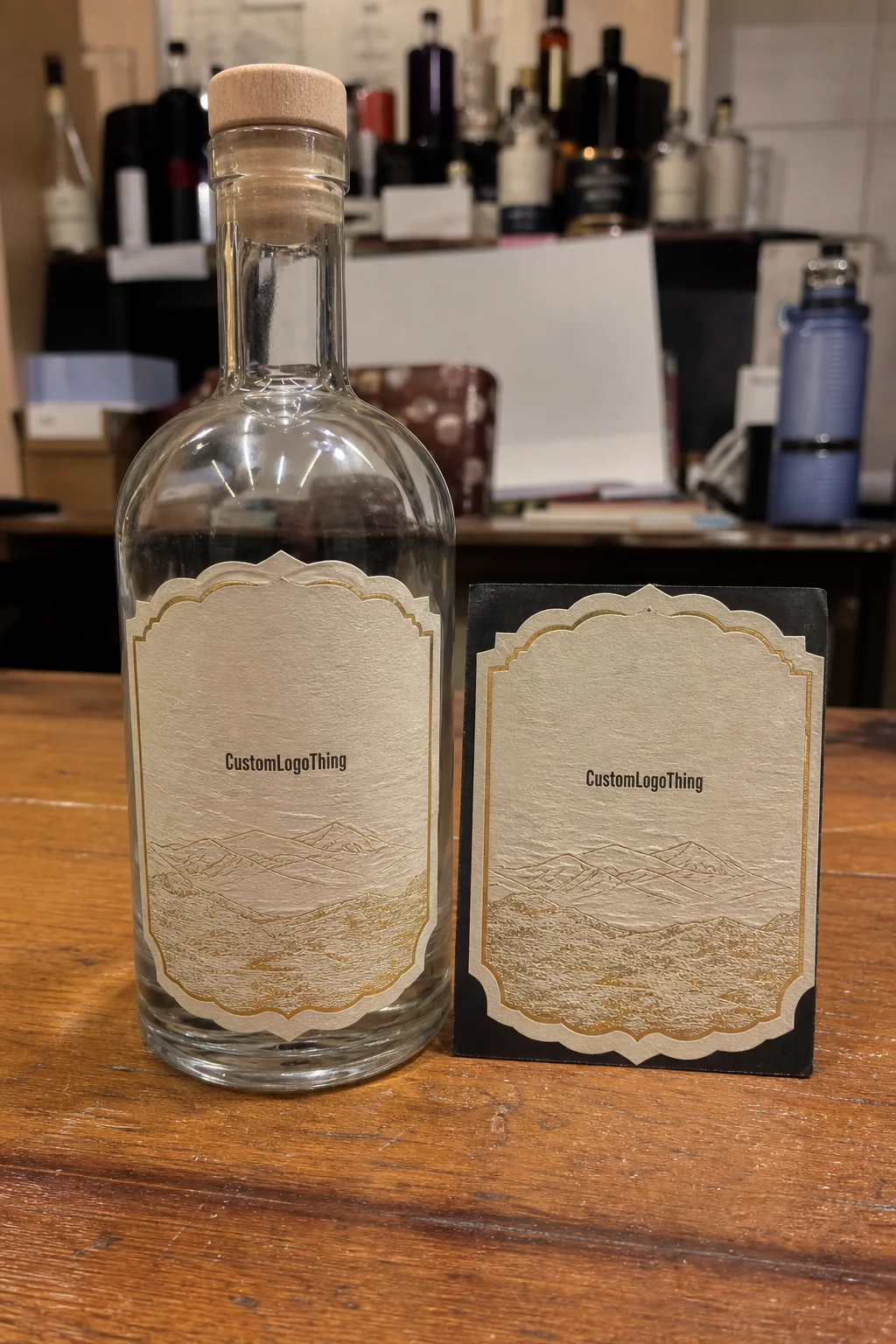
A bottle gets only a few seconds of attention. On a shelf, at an event, or in a gift box, the label has to explain what the bottle is and why it deserves a closer look. Personalized liquor labels work because they make a familiar container feel specific to the occasion.
That specificity matters in different ways. Wedding bottles need names, dates, or table references that feel intentional. Corporate gifts need cleaner branding so they do not look improvised. Private-label samples need a credible front face for review. Seasonal promotions usually need a premium finish without the cost of custom containers.
Labels also give buyers inventory control. The bottle shape can stay the same while artwork changes for different clients or SKUs. That is useful for short runs and event-driven work because it lowers the risk of overcommitting to a specialized package. Changing a label is faster and cheaper than redesigning the bottle.
There is still a limit: the artwork has to fit the container, not just the screen. A label that looks balanced in a file can fail on a curved bottle if it is too wide, too tall, or paired with the wrong adhesive. The best result is usually the one that reads cleanly at arm’s length and stays flat after handling.
A good liquor label does not need to overstate the product. It needs to fit the bottle, read cleanly, and survive handling without lifting, smearing, or curling.
That is why buyers get better outcomes when they treat the label as a packaging decision, not just a graphic file. The bottle, the stock, and the use case all affect the final result.
How the process moves from proof to bottle
The best orders start with measurements. Before artwork is approved, confirm the usable label panel width and height, plus the shoulder shape and any taper that could affect placement. A bottle that looks simple in a photo can create problems once a rectangular label has to follow a curve.
Once the dimensions are known, the workflow is straightforward: send the artwork, review the proof, confirm the stock and finish, approve the final version, then move into printing and finishing. If the project includes multiple names, dates, scents, or SKUs, the proof stage matters even more because one typo can affect a whole batch.
Application is part of the process, not a separate step. Bottles should be clean, dry, and at a stable room temperature before labeling. Cold glass can condense moisture, and even a thin film of water can weaken adhesion. Labels should be pressed on with steady pressure rather than stretched into position. Bubbles, crooked placement, and lifted edges usually come from application, not print quality.
Buyers get more predictable results when they think of the label as a package component. That means asking about stock thickness, adhesive type, bottle surface, and the storage or display environment. Paper, film, and adhesive each behave differently, and a vendor should be able to explain those differences without vague language.
For shipping durability, industry references such as ISTA help frame packaging stress in practical terms. A label can look fine in a proof and still fail if cartons are handled roughly, bottles sweat in transit, or the finish is not suited to the final use. That is a packaging issue, not just a design one.
Cost, pricing, and MOQ factors that change the quote
Pricing for personalized liquor labels usually depends on quantity, size, stock, finish, coverage, and whether the artwork changes from piece to piece. A short run with several versions will cost more per label than a single design at volume because the fixed work does not disappear. The proof still needs review, the press still needs setup, and the material still needs handling whether the order is 100 pieces or 5,000.
Minimum order quantities are usually tied to setup efficiency and waste. Some vendors will take very small orders, but the unit cost rises fast once setup is spread across fewer labels. It is often useful to ask for pricing at several quantities instead of just one, because the jump from 250 to 500 may be modest while 1,000 can lower the unit cost enough to justify a buffer.
| Option | Typical Use | Approx. Unit Cost at 250-500 | Approx. Unit Cost at 1,000-5,000 |
|---|---|---|---|
| Standard paper label, matte finish | Dry, short-term gifting and event bottles | $0.35-$0.75 | $0.12-$0.25 |
| Water-resistant synthetic stock | Chilled bottles, ice buckets, higher handling | $0.55-$1.05 | $0.18-$0.35 |
| Premium finish with soft-touch or foil accent | High-end gifts and shelf presentation | $0.85-$1.50 | $0.30-$0.60 |
Matte, gloss, and specialty finishes are functional choices as much as visual ones. Matte feels restrained and upscale. Gloss adds brightness and contrast. Soft-touch gives a more tactile feel, but it adds cost and is not always the best fit for wet or heavily handled bottles. Foil can elevate the label quickly, but it can also push the budget up faster than expected.
Material choice should follow the use case. Paper labels are usually fine for dry, short-term applications. Synthetic films are better when the bottle will sit in ice, travel to an event, or be handled repeatedly. If sustainability matters, ask whether the stock is FSC-certified or includes recycled content, and confirm that the claim is documented.
A clear quote should separate quantity, material, finish, and any variable-data charges. That makes it easier to compare quotes on the same basis. A matte paper quote is not comparable to a waterproof, foil-accented quote even if the totals are close.
Lead time and turnaround: what affects delivery dates
Lead time is usually driven more by proof approval and file readiness than by print time. If the artwork is final, the bottle dimensions are known, and the stock is available, production can move quickly. If any of those pieces are missing, the schedule slows down immediately.
A realistic timeline often looks like one to two business days for the proof, another day or two for revisions if needed, five to ten business days for production after approval, and shipping on top of that. Once everything is locked, many orders land in a 10-15 business day range. Rush orders are possible in some cases, but only when the files are clean and the specs do not need to be rebuilt midstream.
Seasonality changes the calendar. Holiday orders, wedding season, and event-heavy months fill production schedules fast. Missing information becomes a delay multiplier during those periods because a late measurement or unclear artwork file can push a job back by days.
Sampling can add time, but it often prevents mistakes that are more expensive later. A test label on the actual bottle can show how the stock behaves on the surface, whether the finish reads correctly under the intended lighting, and whether the adhesive holds on chilled glass. For jobs that need to survive transport or retail handling, that check is worth doing before the full run.
It helps to think in sequence: quote, proof, approval, production, ship, receive, apply. That sounds basic, but delays usually come from skipping one step or compressing them too aggressively.
Design, size, and material choices that prevent failed labels
Label size should come from the bottle in hand, not from a guessed template. Measure the flat panel first, then check the shoulder, taper, and curvature. A bottle that narrows quickly may need a shorter label or a split layout so the artwork does not crease or lift at the edges. That is one of the most common failure points on Custom Bottle Labels, and it is easy to avoid when the dimensions are checked early.
The design should respect the shape of the bottle. A tall, narrow bottle usually handles a vertical composition better than a wide one. A short bottle usually needs a simpler layout with less crowding. Fine text should be large enough to stay readable once the label is wrapped and viewed under mixed light. Tiny type, weak contrast, and busy backgrounds are all harder to read on glass than they appear on screen.
Finish and stock should match the environment. Paper stocks are fine for dry events and short display periods. Synthetic stocks hold up better in condensation, coolers, and ice buckets. Textured papers can add a premium feel, but they are not always the right answer if the label will see moisture. Soft-touch finishes feel elegant, although they wear differently than smoother gloss stocks.
Technical production details matter more than most buyers expect. Bleed keeps the edge clean after trimming. Safe area keeps important text away from the cut line. Image resolution affects the sharpness of logos and fine typography. Adhesive strength affects whether the label stays down after the bottle warms up or gets handled repeatedly. A file that looks sharp on a laptop can still print poorly if it is low-resolution or overcompressed.
If the bottle will be chilled, shipped, or handled often, durability should come before decoration. A label that survives the use case is more valuable than a beautiful one that fails on contact with moisture.
Common mistakes that waste money and delay a run
The most expensive mistake is approving the wrong size. Buyers often order before they have the bottle in hand, then discover the label is too tall, too wide, or too close to the shoulder. Once that happens, the options narrow fast: revise the proof, rework the layout, or rerun the job.
Artwork quality is the next problem. Low-resolution logos, compressed images, and thin type can look acceptable in a preview but print badly once scaled to label size. If the bottle is meant to be gifted or displayed close-up, the print quality needs to hold up at close range.
Proof review mistakes are common too. Buyers often focus on the main graphic and skip the exact dimensions, finish callout, or small text. That is where spelling errors, version mismatches, and missing details slip through. A proof is not a rough mockup. It is the last chance to catch problems before production starts.
Application mistakes create another layer of waste. Wet bottles, cold bottles, dusty surfaces, and rushed placement all lead to bubbles, wrinkles, and edge lift. A few test applications on the real bottle usually reveal more than a long email thread. If the bottles will be chilled or transported, test them under those conditions, not just on a desk in a dry room.
Ordering too few labels can be a quiet cost as well. A small buffer helps cover misapplied pieces, last-minute guest changes, or damaged bottles. Reordering a small quantity later is usually more expensive than building a modest overage into the first run.
Next steps for a clean order and first proof
Before sending an order, gather the bottle dimensions, the final quantity, and the artwork files in the best available format. If there are multiple names, dates, or design versions, organize those clearly. That keeps the proof stage focused and reduces the chance that a simple detail gets lost in the back-and-forth.
Ask for a proof that shows exact size callouts, finish notes, and placement on the bottle style if possible. A mockup on the actual container shape is more useful than a flat design alone because it shows whether the artwork feels balanced on the bottle. For recurring work, save the approved specs with the approved art so the next run starts from a known baseline.
Test one label on one actual bottle before approving the full run. Check adhesion, alignment, condensation resistance, and how the finish reads under the lighting where the bottles will be used. Event lighting, retail lighting, and warehouse lighting all reveal different issues. A label that works in one setting may need a small adjustment in another.
Confirm the lead time, the minimum order quantity, and whether a spare-label buffer makes sense for the project. If the bottles have a hard event date, build in transit time and a cushion for corrections. A clean order is not about luck. It is about locking the bottle, the artwork, and the production schedule before the first sheet runs.
That is where personalized liquor labels do their best work: when the container, the design, and the production plan match before production starts.
FAQ
What are personalized liquor labels used for?
They are used to brand or decorate liquor bottles for weddings, gifts, private-label samples, events, and retail presentation. They also help a standard bottle look more premium without changing the bottle itself.
How do I choose the right size for custom liquor bottle labels?
Measure the actual label panel on the bottle and check the curves, shoulders, and taper. The flat area is only part of the story; the shape of the glass determines whether the label sits cleanly or wrinkles at the edges.
Are personalized bottle labels waterproof?
They can be, but only if the stock and adhesive are made for moisture, cold storage, or repeated handling near ice and condensation. For chilled bottles, ask for a construction designed to resist peeling, smudging, and edge lift.
What affects the price of custom liquor labels the most?
Quantity, label size, stock type, finish, and whether the design changes from piece to piece have the biggest effect. Small orders usually cost more per label because setup and proofing get spread across fewer units.
How fast can personalized liquor labels be produced?
Turnaround depends on proof approval, file readiness, material availability, and shipping distance. If the artwork is final and the specs are clear, production moves faster; missing details add delays immediately.