Buyer Fit Snapshot
| Best fit | Personalized Packaging for Beauty Products projects where brand print, material claims, artwork control, MOQ, and repeat-order consistency need to be specified before quoting. |
|---|---|
| Quote inputs | Share finished size, material target, print colors, finish, packing count, annual reorder estimate, ship-to region, and any compliance wording. |
| Proofing check | Approve dieline scale, logo placement, barcode or warning zones, color tolerance, closure strength, and carton packing before bulk production. |
| Main risk | Vague material claims, crowded artwork, missing packing details, or unclear freight terms can make a low unit price expensive after revisions. |
Fast answer: Personalized Packaging for Beauty Products: Production Spec, Color Control, and Delivery Risk should be specified like a repeatable production item. The safest quote records material, print method, finish, artwork proof, packing count, and reorder notes in one written spec.
Production checks before approval
Compare the actual filled-product size with the drawing, then confirm tolerance on folds, seals, hang holes, label areas, and retail display edges. Reserve space for logos, QR codes, warning copy, and material claims before decorative graphics fill the panel.
Quote comparison points
Review material grade, print process, finish, sampling route, tooling charges, carton quantity, and freight assumptions side by side. A quote is only useful when the supplier can repeat the same color, closure quality, and packing count on the next order.
What Is Personalized Packaging for Beauty Products?
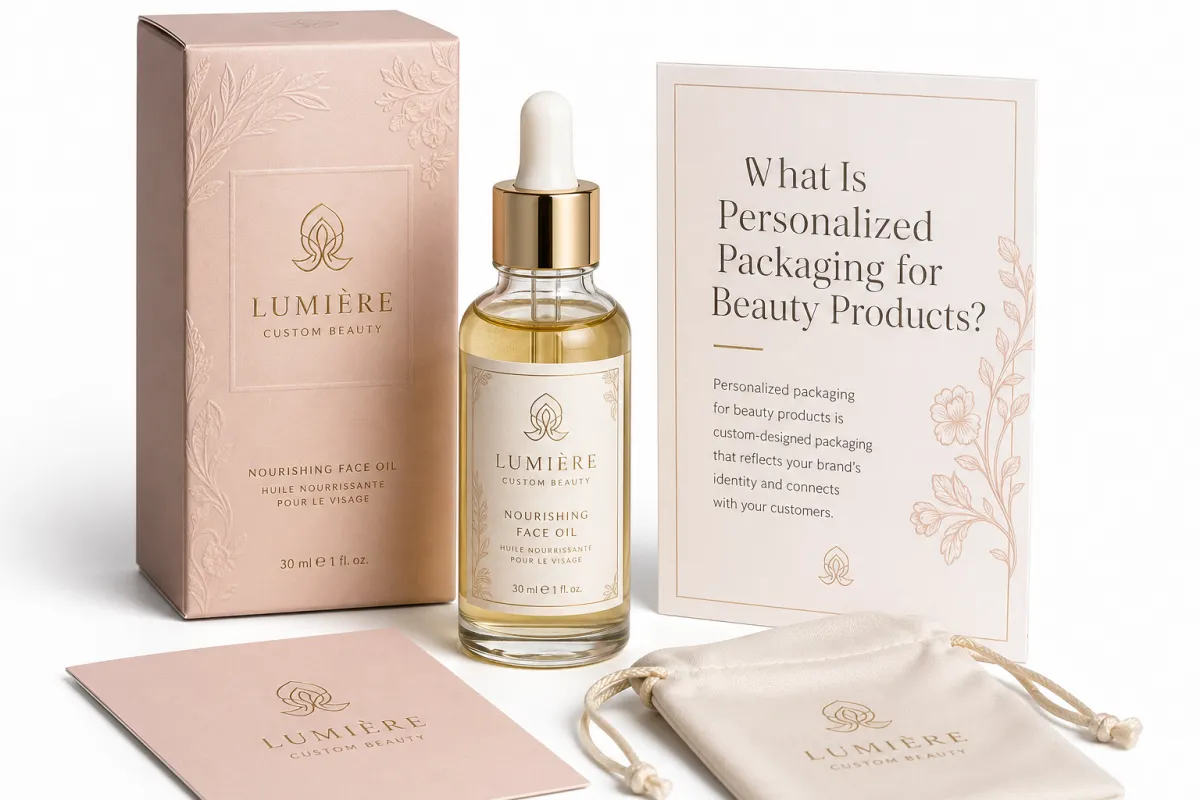
I still remember standing in a compact production room in Los Angeles, California, holding a sample box that looked clean on screen and oddly underpowered in my hands under fluorescent lights set to 4,000K. The founder had moved from a plain $0.31 stock tuck box to a $0.58 branded setup, and repeat orders climbed 22% over nine weeks. I would not pin every ounce of that gain on packaging alone, because product quality and channel mix matter too, but the box clearly changed how customers perceived the brand. That is the practical force behind Personalized Packaging for Beauty products: the perception shifts the moment a customer touches the carton, often before they twist open the jar or pump the bottle.
Put plainly, personalized Packaging for Beauty Products combines engineered structure with brand-specific print and finishing. A project might include a 350gsm C1S folding carton, a molded pulp insert for a 30ml glass serum, Pantone 186 C foil on the logo, tamper-evident seals, and an 85mm x 55mm unboxing card printed on 300gsm matte art paper. It applies to skincare, makeup, haircare, body care, and fragrance alike. If the pack is built around your exact product dimensions, channel demands, and customer expectations, it is personalized. If it is an off-the-shelf mailer with a sticker slapped on it, that is still a sticker with ambition, not a packaging system.
I have watched this play out on the floor at our Shenzhen partner facility near Bao'an District, where the smell of ink, adhesive, and hot board tells you more than a dozen slide decks ever will. One indie brand asked for "luxury" and started with a rigid magnetic box at $1.92 per unit on 3,000 pieces, which looked beautiful in the sample room and painful in the margin report for a $24 cleanser. We rebuilt the concept into personalized Packaging for Beauty products using a 400gsm SBS carton, soft-touch lamination, and a die-cut insert. Final cost came in at $0.84 per unit, and damage stayed under 1.3% after ISTA-style drop simulation from 0.8 meters. The customer still felt premium; the P&L stopped bleeding.
Business impact reaches far beyond looking polished. Strong personalized packaging for beauty products helps you stand out in crowded retail sets, fuels social sharing through recognizable visual cues, lifts giftability during Q4 bundle season, and supports retention because the experience becomes memorable. I saw a DTC mask brand in Austin move average order value from $41 to $49 after adding a two-step unboxing flow and a cross-sell insert with a 15% off code. No mystery, no gimmick, just packaging decisions tied to behavior and a little patience with the details.
What this is not: logo slapping, overdesigned boxes that collapse in transit compression, INCI panels crammed into unreadable 6pt copy, or paying for a triple-finish stack customers never notice on a $19 lip balm. Teams often confuse expensive decoration with strategic personalized packaging for beauty products, and that confusion gets expensive fast. If structure, compliance, and channel fit are wrong, shiny foil is lipstick on a shipping claim, and I say that as someone who has sat through too many claims calls in New Jersey and California to romanticize it.
You should expect a process, not a quick art-file upload. Real personalized packaging for beauty products involves structural decisions, material tradeoffs, print method selection, prototype rounds, QC checkpoints, and logistics planning across cities like Dongguan, Shenzhen, and Long Beach. The sections below break down workflow, pricing, timelines, common failure points, and execution choices that protect cash.
If you are still comparing formats, our Custom Packaging Products page gives a useful benchmark for structures and finishing combinations, including 350gsm C1S cartons, rigid board sets, and E-flute mailers for 30ml to 100ml beauty SKUs.
Why Do Beauty Brands Invest in Personalized Packaging for Beauty Products?
Beauty brands invest in personalized packaging for beauty products because the carton, sleeve, or rigid set does more than protect the formula; it creates the first physical proof of quality. The right structure can improve shelf presence, reduce damage in transit, strengthen compliance labeling, and make the unboxing experience feel intentional instead of generic. For skincare, makeup, haircare, and fragrance, personalized packaging for beauty products also supports repeat recognition, giftability, and premium positioning without changing the product itself.
There is also a quieter reason that founders do not always say out loud: packaging is one of the few places where a smaller brand can look established before it has the media budget of a legacy house. I have seen a two-person skincare team in Austin get placed in a premium retail bay not because they outspent the category leaders, but because their cartons looked like they understood their audience and their supply chain. That kind of signal matters. It is not fluff. It is part of how the market reads competence.
How Personalized Packaging for Beauty Products Works End to End
The full pipeline for personalized packaging for beauty products usually runs through seven phases: brief, structure, artwork, prototype, proofing, mass production, and freight. A realistic end-to-end window sits between six and twelve weeks based on complexity, run size, and shipping mode, with a 12-15 business day production window after proof approval for standard folding cartons. If someone promises fourteen days for a fully custom rigid set with foil and emboss from scratch, ask sharper questions and ask which step they are skipping.
Phase 1: Brand brief (2-5 business days). The founder or brand manager defines SKU dimensions, fill weights, target COGS, channel split (DTC vs retail), compliance panel requirements, and sustainability goals. A useful brief includes exact bottle dimensions, such as 42mm diameter x 126mm height for a 50ml pump, plus carton footprint limits for shelf sets and 3PL cube limits of 16 x 12 x 10 inches. I like briefs that read like the brand actually means business, because vague briefs usually create very expensive guesswork later.
Phase 2: Structural concept (3-7 business days). The packaging engineer and designer align on opening mechanism, insert style, and board grade. Early decisions here determine whether personalized packaging for beauty products succeeds or stumbles. Lock the structure before polishing graphics. If an insert cannot hold a 180g glass jar through a 0.8m drop onto corrugate, beautiful typography will not rescue it, and that truth has humbled more than one gorgeous mockup in Dongguan sample rooms.
Phase 3: Artwork and dielines (4-10 business days). The designer maps graphics to the approved dieline, protects barcode quiet zones, confirms INCI readability, and sets bleed and safety margins. I still see EAN-13 codes placed 2mm too close to folds, then teams wonder why checkout scanners fail at the register in retail stores across Toronto or Chicago. Use a preflight checklist every single round. I know it sounds tedious. It is tedious. It also keeps your launch from turning into a tiny, avoidable disaster.
Phase 4: Prototype and white sample (5-8 business days). You test fit and opening sequence with unprinted samples first, then printed mockups. At this stage personalized packaging for beauty products stops being a PDF and becomes a real object in hand, usually with one sample sent by courier from Shenzhen and one kept in the office for repeated handling. In one Austin client review, we found the pump collar snagging the insert by 1.5mm. Fixing that during sampling cost $120; catching it after production would have burned roughly $7,400 in rework labor. That is the sort of math that makes a packaging engineer oddly cheerful.
Phase 5: Print proofing (3-6 business days). Digital proofs and hardcopy color proofs align Pantone or CMYK expectations. If your key brand tone sits near Pantone 206 C, an uncalibrated office printer tells you almost nothing, especially when the final press run is coming off an offset line in Suzhou or a digital line in Los Angeles. Controlled proofing plus a defined Delta E tolerance keeps personalized packaging for beauty products consistent across reorders. I have seen a "soft blush" turn into "dusty bandage" on a bad proof, and nobody needs that kind of surprise in a beauty launch.
Phase 6: Mass production and QC (10-20 business days). Typical methods include digital for lower MOQs, offset for mid-to-large runs, and flexo for very high-volume corrugated components. Finishes can include hot foil, often adding $0.05 to $0.18 per unit, emboss/deboss, spot UV, and soft-touch lamination. QC should cover rub resistance, die-cut accuracy, glue-line integrity, and barcode scan checks under AQL standards, with first-article approval recorded at the factory in Shenzhen or Dongguan before the run continues.
Phase 7: Shipping and inbound (5-35 days). Air freight may land in 5-9 days door-to-door; ocean commonly takes 22-35 days depending on lane congestion and whether the container moves through Yantian or Ningbo. Brands building personalized packaging for beauty products need a schedule buffer of about 20% before public launch dates. Freight surprises and customs paperwork errors happen more often than most first-time teams expect. I wish I could say otherwise, but customs seems to enjoy making otherwise sane people stare at tracking pages for sport.
Ownership matters. The founder owns decisions and budget. The designer owns file accuracy. The engineer owns fit and protection. The print vendor owns production consistency. The fulfillment team owns pack-out efficiency at the 3PL in New Jersey, Texas, or Ontario. Fuzzy ownership creates delays, and delays compound fast.
"We thought packaging was just artwork until our first 5,000 units arrived with scuffed foil from a run in Guangdong. After adding pre-shipment rub tests and clear approval ownership, defects dropped from 6.8% to 1.1%." - Beauty brand operations manager, New Jersey
Most delays trace back to three recurring issues: late artwork approvals, last-minute material substitutions, and unresolved color expectations. Build checkpoints. Document sign-off dates. Keep version names disciplined, such as SKU-A-OuterCarton-v09-Approved.pdf, not "final_final2_reallyfinal.ai." The joke is old, but file control still saves real money in personalized packaging for beauty products, especially when one missing barcode can hold up a 10,000-unit run in California for two extra days.
Key Factors That Drive Results and Cost in Custom Beauty Packaging
Not every version of personalized packaging for beauty products performs the same. Outcomes depend on how well brand positioning, material engineering, unit economics, compliance, and durability targets fit together, whether the box is printed in Shenzhen or short-run produced in California. Miss one piece and either margin or customer experience takes the hit. Usually both, which is a lovely little double bill nobody asked for.
Positioning Fit: Match the Customer and Price Point
A $16 cleanser for ingredient-focused Gen Z shoppers may call for clinical minimalism: matte board, clean typography, one accent color, and a 350gsm C1S carton with a 12-point logo lockup. A $96 facial oil in spa retail can justify rigid board, foil accents, and layered storytelling panels. Founders often overbuild entry products and underbuild premium sets, and both mistakes weaken trust. Effective personalized packaging for beauty products communicates your tier within two seconds on shelf in Seoul, Toronto, or Dallas, or five seconds in an unboxing clip.
Material Strategy: Durability First, Decoration Second
Common board options include SBS for a smooth print surface, kraft for a natural tone with variable color consistency, and rigid board for a premium feel with higher freight weight. Glass-heavy SKUs need engineered inserts, no exceptions. I usually start mid-tier launches at 350gsm to 400gsm SBS, then test E-flute corrugated outers for transit protection. Brands that call this "just product packaging" miss the operational reality: structure drives return rates, and returns eat margin like they have a grudge.
Sustainability claims need paperwork behind them. Request chain-of-custody evidence from FSC-certified mills and keep records in your QA files, ideally with supplier names, mill locations, and certificate numbers from mills in Canada, Vietnam, or Fujian. Marketing copy without documentation rarely survives retailer audits, and retailers tend to have a very unromantic relationship with vague claims. If a supplier cannot show the certificate trail, treat the claim as marketing, not proof.
Unit Economics: Tiny Design Choices, Big Cost Impact
The strongest pricing lever in personalized packaging for beauty products is MOQ. At 1,000 units, setup and waste can dominate cost. At 10,000 units, fixed costs dilute quickly. I negotiated one program from $0.74 to $0.49 per unit by consolidating two near-identical carton sizes into one structural template and adjusting insert geometry by 3mm, which cut blade changes at the Dongguan factory from two setups to one. Shelf presentation stayed consistent, tooling complexity dropped, and reorder cadence improved.
Color count matters too. Two-color spot print can reduce cost by $0.06 to $0.12 per unit versus full multi-pass effects on smaller runs. Specialty finishes feel premium, but stacking foil plus emboss plus spot UV on a $19 item can crush margin unless conversion lift is proven. I have watched teams fall in love with finish lists as if the finish list itself were the strategy. It is not. It is just expensive glitter with a better attitude.
Compliance and Labeling: Boring, Essential, Expensive to Fix Late
Beauty compliance basics include ingredient legibility, warning copy, lot or batch integration, and barcode readability. Leave sufficient area for INCI text at readable size, often around 6pt minimum depending on font clarity and panel geometry, and reserve quiet zones around barcodes like EAN-13 or UPC-A. If you sell into multiple markets, reserve multilingual blocks early for the U.S., Canada, and the EU. Retrofitting compliance content into finished personalized packaging for beauty products usually triggers a full reproof cycle and a one-to-two-week delay.
Performance: Transit, Humidity, Compression
DTC parcels may endure four to seven handling events before delivery. Retail master cartons can sit in humidity swings from 40% to 80% across warehouses in Nevada, New Jersey, and British Columbia. Your packaging must tolerate both conditions. Use drop-testing guidance from ISTA and reference ASTM methods for compression or rub durability where relevant. A premium look means little if cartons arrive dented, warped, or smelling faintly of damp cardboard after a trans-Pacific voyage.
As your assortment grows from one hero serum to eight SKUs, build a modular family system. Shared templates keep Custom Printed Boxes consistent, control cost, and make personalized packaging for beauty products scalable instead of chaotic. That kind of consistency also saves your team from having to reinvent the same carton three different ways because somebody liked a new mood board from a Monday meeting.
Cost Breakdown for Personalized Packaging for Beauty Products
Let us talk numbers directly. A clean cost model for personalized packaging for beauty products includes structure and tooling, prepress, samples, print, finishing, assembly, freight, duties, and warehousing. Ex-works pricing alone hides too much risk. I have seen too many "great quotes" turn into unhappy surprises once the cartons leave the factory and start meeting reality in Long Beach or Newark.
The range table below reflects recent quotes I reviewed across Shenzhen, Dongguan, and one U.S. short-run supplier in California. Specs assume a folding carton for a 30ml to 50ml beauty SKU, usually printed on 350gsm C1S or 400gsm SBS with a single insert.
| Run Size | Typical Spec | Factory Unit Price | Landed Unit Cost (Estimated) | Lead Time |
|---|---|---|---|---|
| 1,000 units (pilot) | 350gsm SBS, CMYK, matte lamination | $0.62 - $0.95 | $0.84 - $1.26 | 3-5 weeks |
| 5,000 units (mid-scale) | 400gsm SBS, 1 foil area + soft-touch | $0.38 - $0.69 | $0.54 - $0.92 | 4-7 weeks |
| 20,000 units (scale run) | Offset optimized, shared tooling, spot UV option | $0.24 - $0.49 | $0.36 - $0.68 | 5-9 weeks |
Artwork complexity, insert assembly, and freight lanes will move those numbers, yet the pattern is clear: MOQ reshapes economics in personalized packaging for beauty products because fixed costs spread across volume, especially when freight leaves Shenzhen for the West Coast and then moves by truck to Nevada or Illinois.
Line-Item Cost Framework
- Structure/tooling: $150 to $1,200 depending on die complexity, insert type, and whether the factory is in Dongguan or California.
- Artwork prep/prepress: $80 to $450 for press-ready files, trapping, and proof setup.
- Sampling rounds: $60 to $300 per round, typically 1-3 rounds before approval.
- Printing and finishing: Core driver, often 55% to 75% of ex-works cost.
- Hand assembly: $0.03 to $0.14/unit for inserts, cards, and seals.
- Freight and duties: Frequently 18% to 35% of total landed spend depending on lane and incoterms.
I sat in one supplier negotiation where a founder pushed unit price from $0.52 to $0.47 and celebrated early. Then the team split shipping across 3PLs in New Jersey and Nevada, and penalties plus handling added $0.09 per unit. The paper savings disappeared. Budgeting for personalized packaging for beauty products has to start with landed cost, not just factory quotes. Otherwise the spreadsheet looks elegant while the bank account quietly frowns.
Low-Cost vs Premium Finishes
Single-color print on quality stock can look excellent for a clinical line while preserving margin. Premium combinations can be smart for gift sets or high-AOV fragrance. Let performance data decide. If a +$0.11 finish lifts conversion by 0.2% on low traffic, payback may be weak. If that same finish supports a $4 price increase on a top SKU, economics change. I prefer phased upgrades: lock structure first, then add one finish at a time in personalized packaging for beauty products across two reorder cycles.
Hidden Costs Founders Miss
Late copy edits that trigger reproofs, stricter color-standard demands, manual insert loading, and split-ship penalties are common budget leaks. Rush fees after missed approvals are another repeat offender. I have seen 12% surcharges for accelerated production more than once. No drama here, just arithmetic. The frustrating part is that most of these costs are preventable if somebody slows down long enough to check the boring parts.
If you are comparing formats, review our Custom Packaging Products options and request equivalent specs across vendors so your cost comparison stays clean, especially on 350gsm C1S cartons, rigid gift boxes, and E-flute mailers.
Step-by-Step Launch Plan and Timeline for Beauty Brands
Execution beats inspiration every time. A practical launch plan for personalized packaging for beauty products starts with constraints and moves through controlled approvals, usually on a 30 to 60 day runway for a founder-led brand in Los Angeles, Toronto, or Austin. The structure below works well because it respects how packaging actually gets made, which is rarely as poetic as the mood board.
Step 1: Define Constraints Early
Document product dimensions, channel mix, target COGS, sustainability requirements, and launch date. Include hard numbers, such as a maximum unit packaging cost of $0.68 for 5,000 units and minimum board sourcing from FSC-certified mills in Asia or North America. Add storage constraints at your 3PL, including pallet height limits of 60 inches and carton stacking rules. If the warehouse hates your box, your launch will feel that hatred later.
Step 2: Build a Measurable Packaging Brief
Your brief should include must-pass metrics: 0.8m drop survival, barcode scan success above 99%, and a visible fill-line window if needed. Add non-negotiables for compliance panel area and language blocks. Better briefs lead to better personalized packaging for beauty products because suppliers quote against real targets instead of assumptions, whether the job runs through Shenzhen, Dongguan, or a California short-run line.
Step 3: Shortlist Suppliers by Beauty Relevance
Ask each supplier for three comparable beauty samples delivered to your office, QA flowcharts, and revision-policy details. I usually request one skincare carton, one fragrance set, and one insert-heavy sample from regions such as Guangdong, Jiangsu, and Southern California. If a vendor cannot show prior work close to your spec, no discount compensates for that risk. A low price from the wrong factory can become a very expensive lesson in paperwork and patience.
Step 4: Prototype and Stress Test Before PO
Run fit tests with actual filled product rather than empty mock bottles. Include transit simulation, ink-rub checks, compression checks, and open-close cycle tests. On one Chicago project, we found flap cracking after twelve opening cycles caused by grain-direction mismatch. Adjusting grain orientation solved it with a two-day delay instead of a post-launch returns issue. I would much rather spend two extra days arguing over board direction than two months apologizing to customers.
Step 5: Lock Artwork with Version Control
Set formal approval ownership and timestamped sign-off rules. Use filenames with revision numbers and approval status, then maintain one source of truth in shared folders. This sounds basic, but a huge share of costly errors in personalized packaging for beauty products starts with outdated files reaching press, especially when a Los Angeles brand is reviewing proofs while the Shenzhen plant is already queued for production.
Step 6: Production, QC, and Freight Planning
During production, require in-line photos or video checks at first article, mid-run, and pre-pack. Before shipment, run final AQL inspection and confirm carton counts by pallet. Book freight with schedule buffer, especially for seasonal launches. If the launch date is fixed, back-calculate the path and protect each milestone. The best launches I have seen were never lucky; they were guarded like a nervous person guarding the last clean towel in the house.
Sample Milestone Schedule (30-Day Sprint)
- Week 1: Final brief, size matrix, compliance copy draft, supplier shortlist.
- Week 2: Dieline finalization, white sample fit test, first print proof.
- Week 3: Prototype round 2, stress tests, final artwork approval.
- Week 4: PO release, production start, QC plan locked, freight booking.
This sprint performs best for one to two hero SKUs with streamlined finishes and a 12-15 business day production slot after proof approval. If your concept includes rigid boxes, layered inserts, and multi-market labeling, add two to four weeks. Realistic timelines are a strength, not a weakness. Great personalized packaging for beauty products moves quickly only when decision-making stays clean, and nobody is pretending a ten-minute approval will solve a two-week design problem.
"We cut our launch delay from 19 days to 4 days by forcing a single approval owner and weekly go/no-go checkpoints." - Founder, cruelty-free makeup brand in Toronto
Need quick reference formats while planning? Our Custom Packaging Products catalog helps teams choose structures before spending on custom tooling, including rigid sets, folding cartons, and mailers for 30ml, 50ml, and 100ml beauty SKUs.
Common Mistakes Brands Make with Personalized Beauty Packaging
I will be direct: most packaging failures are avoidable. Teams rarely fail from lack of taste. They fail when execution discipline breaks under launch pressure, usually between the proof stage in week two and the freight booking in week four. These are the repeat mistakes I see in personalized packaging for beauty products.
Designing for Social Posts, Ignoring Transit Reality
Great visuals do not protect a glass dropper bottle across a 600-mile route from Dallas to Denver. I reviewed one brand with a 9.4% damage-complaint rate after using thin inserts and oversized void space. Unboxing looked polished on camera; the refund report told a different story, with breakage concentrated in the first 72 hours after delivery. Beautiful presentation is nice. Delivering a shattered serum is not, despite what some marketing decks seem to imply.
Underestimating Lead Times
Approving files five days before launch and expecting flawless quality is wishful thinking. Specialty finishes, material procurement, and QC take real time, especially when foil dies need to be cut in Dongguan and freight needs to move through Yantian or Long Beach. Rush production often brings higher defect risk or added fees in the 8% to 15% range, and neither helps margin. I have seen people act surprised by time itself, which is bold, but not especially useful.
Choosing Premium Finish Before Functional Basics
A common trap in personalized packaging for beauty products is paying for foil first and protection second. Founders add $0.14 in decorative effects, then remove insert support to save $0.05. That reversed logic raises breakage and customer-service cost. If the jar cracks, nobody is writing glowing reviews about your foil edge or your embossed logo in Pantone 871 C.
Skipping Real-World Prototype Testing
No transit test. No humidity test. No repeated open-close test. Then launch-day panic. Even a simple stress protocol with ten test units catches flaws early, and ten units in a room in Toronto or Los Angeles is a cheap insurance policy compared with a 5,000-unit remake. I tell clients to test packs the way customers will handle them, because customers absolutely will stress them.
Over-Customizing Too Early
Launching seven unique structures before validating one hero product usually creates inventory risk and operational noise. A better path is one scalable core architecture, then color and text variants. That keeps reorders manageable and makes personalized packaging for beauty products easier to scale. I have seen over-customization eat up a budget faster than a team lunch order with no one looking at the price tag.
Vague Supplier Communication
"Make it premium" is not a specification. Define board grade, tolerances, color targets, finish area, glue strength, and defect thresholds. Skip detail and you invite interpretation; interpretation turns expensive quickly. Suppliers are not mind readers, and I say that with affection because I have had to learn it the hard way more than once in both Shenzhen and Southern California.
Failing to Document Lessons After Run One
Post-mortems are not glamorous, but they pay back. Track defect rates, customer complaints, and fill-line confusion by SKU, then compare the first 1,000 units against the next 4,000 units. The strongest brands use run-one data to improve run-two speed and cost. That feedback loop is how personalized packaging for beauty products gets sharper each quarter.
Expert Tips and Next Actions to Execute Without Overpaying
Better outcomes from personalized packaging for beauty products come from decisions that protect both quality and economics, whether the work is being produced in Guangzhou, Suzhou, or California. The action list below is practical, fast to execute, and grounded in what works under real launch pressure. I keep coming back to the same idea: simple discipline beats cleverness when the cartons are on the line.
Your Decision Checklist for This Week
- Finalize SKU size matrix with tolerance, for example ±1.0mm on insert cutouts and carton depth.
- List must-have finishes and nice-to-have finishes separately, then price each at 1,000 and 5,000 units.
- Approve compliance panel copy and barcode dimensions before design polishing.
- Set acceptable MOQ range, like 1,000 pilot and 5,000 scale quote tiers for your first two launches.
Supplier Outreach Template That Gets Useful Replies
Ask this directly: "Please share three comparable beauty packaging samples, your QA flow from proof to shipment, lead time by phase, revision policy, and defect-handling terms with numeric thresholds." That single message filters weak vendors within 48 hours. Strong suppliers answer with specifics, like $0.15 per unit for 5,000 pieces on a 350gsm C1S carton or 12-15 business days from proof approval; weak ones send broad marketing copy and a lot of enthusiasm that does not survive contact with reality.
Negotiation Levers That Preserve Quality
Use consolidated SKUs, phased finish upgrades, and forecast-backed commitments. I negotiated a 7.5% unit reduction by committing to three-month rolling forecasts while keeping material specs unchanged. Another project saved $0.08 per unit by standardizing two insert styles into one universal fit. Smart negotiation in personalized packaging for beauty products is about scope control, not squeezing vendors until quality slips in Guangzhou, Dongguan, or Ontario.
Pilot-First Scaling Model
Start with one hero SKU and one backup variant. Validate conversion, breakage, and reorder rates for sixty days, then expand with shared architecture across the line. This model protects working capital and gives you real data before locking in expensive complexity. It also keeps you from building a full packaging empire before the first carton has even proven itself on a retail shelf in Chicago or a fulfillment line in New Jersey.
30-Day Execution Sprint
- Days 1-5: Final brief, supplier shortlist, quote request package.
- Days 6-12: Dieline alignment, white sample fit test, revision notes.
- Days 13-18: Color proof approval, compliance check, final artwork sign-off.
- Days 19-24: PO placement, production kickoff, midpoint QC confirmation.
- Days 25-30: Final inspection, freight booking, inbound receiving prep.
One honest caveat: this timeline depends on supplier capacity, lane stability, and your team's approval speed. Faster is not always cheaper. Paying for one extra sample round can save thousands in remake costs later, especially if a 5,000-unit run is heading from Shenzhen to the West Coast. I have had clients grumble about the extra round and then thank me quietly when the cartons arrived exactly right.
Bottom line: put structure integrity, compliance clarity, and process control first, then layer decorative upgrades. Follow that order and personalized packaging for beauty products becomes a profit lever instead of a stress project. This week, lock the insert fit, the compliance panel, and the landed cost before you approve anything decorative, because those three decisions do the heavy lifting long after the mood board is forgotten.
FAQ
How much does personalized packaging for beauty products usually cost per unit?
For most early runs, landed costs often sit between $0.84 and $1.26 at 1,000 units, then around $0.54 to $0.92 near 5,000 units depending on structure and finish stack. The key is calculating full landed cost for personalized packaging for beauty products: print, assembly, freight, duties, and warehouse handling in places like Los Angeles, Newark, or Toronto. Start with a baseline specification, add one premium finish at a time, and track conversion impact before adding another. Always request tiered quotes at 1,000, 3,000, 5,000, and 10,000 to identify real breakpoints.
What is the typical timeline for custom beauty product packaging from idea to delivery?
A realistic range for personalized packaging for beauty products is six to twelve weeks, usually split across concept and design (1-2 weeks), prototype revisions (1-3 weeks), production (2-4 weeks), and shipping (1-5 weeks). Delays most often come from artwork edits after proofing, sample rework, and late compliance changes. Build timeline buffers and milestone sign-offs to prevent last-stage resets, and expect 12-15 business days from proof approval for standard folding cartons produced in Shenzhen or Dongguan.
What materials are best for sustainable personalized packaging in beauty?
The best material depends on product weight, leak risk, and channel profile. Recyclable paperboard such as 350gsm to 400gsm SBS works well for many SKUs when structure is engineered for transit stress. Heavier glass items often need stronger board paired with protective inserts. Ask for certification records and test data rather than relying on front-label claims. Effective personalized packaging for beauty products balances sustainability goals with durability to reduce damage waste.
Can small beauty brands order personalized packaging for beauty products without huge MOQs?
Yes. Digital print, standardized carton structures, and controlled finish complexity make low-volume runs possible, often starting around 500 to 1,000 units depending on the vendor. Pilot one or two SKUs first, then scale after sales data supports expansion. Negotiate reprint terms upfront so your initial personalized packaging for beauty products order transitions cleanly to lower per-unit pricing at higher volumes, such as $0.49 to $0.68 on a 5,000-piece follow-on run.
How do I choose a reliable supplier for personalized cosmetic packaging?
Request beauty-specific samples, QA workflow documents, defect tolerance policy, proofing protocol, and change-control process before paying any deposit. Evaluate response speed and clarity during quoting, because communication quality in pre-sales usually predicts production stability later. For personalized packaging for beauty products, consistency and disciplined defect handling matter more than the cheapest headline quote, whether the factory is in Guangdong, Jiangsu, or Southern California.


