Buyer Fit Snapshot
| Best fit | Personalized Packaging for Retail Business projects where brand print, material claims, artwork control, MOQ, and repeat-order consistency need to be specified before quoting. |
|---|---|
| Quote inputs | Share finished size, material target, print colors, finish, packing count, annual reorder estimate, ship-to region, and any compliance wording. |
| Proofing check | Approve dieline scale, logo placement, barcode or warning zones, color tolerance, closure strength, and carton packing before bulk production. |
| Main risk | Vague material claims, crowded artwork, missing packing details, or unclear freight terms can make a low unit price expensive after revisions. |
Fast answer: Personalized Packaging for Retail Business: Production Spec, Color Control, and Delivery Risk should be specified like a repeatable production item. The safest quote records material, print method, finish, artwork proof, packing count, and reorder notes in one written spec.
Production checks before approval
Compare the actual filled-product size with the drawing, then confirm tolerance on folds, seals, hang holes, label areas, and retail display edges. Reserve space for logos, QR codes, warning copy, and material claims before decorative graphics fill the panel.
Quote comparison points
Review material grade, print process, finish, sampling route, tooling charges, carton quantity, and freight assumptions side by side. A quote is only useful when the supplier can repeat the same color, closure quality, and packing count on the next order.
Customers judge packaging faster than most retail teams can finish a coffee. With Personalized Packaging for Retail business, the box, sleeve, or mailer is doing selling work before the product is even touched. That first impression can lift perceived value, lower hesitation, and make a brand feel more deliberate. On a shelf or in a shipping lane, personalized packaging for retail business is not decoration. It is part of the product.
The upside is real, but so is the risk. A polished sample can win a room full of approvals and then get expensive once freight, labor, spoilage, and reprints are added to the spreadsheet. I have watched teams fall in love with a render and then discover the insert added twelve seconds per pack on the line. Twelve seconds does not sound like much until you multiply it by a full run.
Smart teams treat personalized Packaging for Retail business as both a branding choice and an operations choice. The right structure protects the item, fits the sales channel, and signals value without creating hidden costs that show up later. Packaging buyers usually start with a blunt question: what does this pack need to do besides look good? Once that answer is clear, the rest becomes easier to scope, price, and launch without so many surprises.
What Does Personalized Packaging for Retail Business Actually Mean?
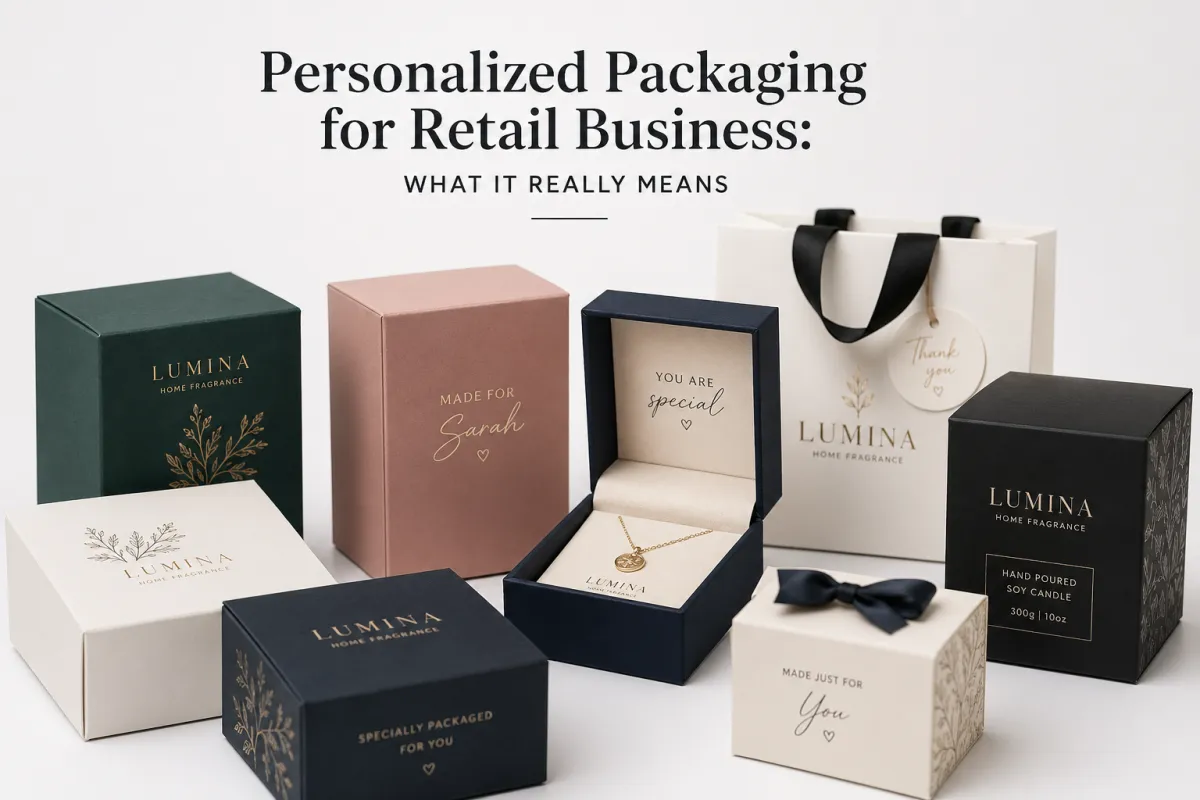
At its simplest, Personalized Packaging for Retail business means packaging built around a specific brand, product line, customer segment, or sales channel instead of a generic stock box. A plain brown shipper can move inventory from point A to point B, but it does very little for shelf appeal, package branding, or product storytelling. A tailored pack, by contrast, can be designed to fit the item closely, protect it during handling, and present it in a way that feels intentional the moment it is seen.
Branding is only one layer. Real personalized Packaging for Retail business may involve structural changes, such as increasing depth for a taller bottle, adding internal supports for fragile components, or choosing a mailer that opens like shelf-ready packaging. It may also include print decisions tied to the buying moment, like a seasonal sleeve, a matte finish for a premium line, or a kraft look for an assortment that should read as natural and restrained. The point is not to customize every millimeter. The point is to make the package carry more of the load for the product.
There is a meaningful difference between a logo on a box and a packaging system built for retail use. A logo and color palette create recognition, but Personalized Packaging for Retail business goes further when it matches the actual channel. That can include inserts that stop movement, labels that change for channel-specific pricing, cartons that stack cleanly on a shelf, or custom printed boxes that carry product details where the buyer can see them right away. In retail, visibility often beats memory.
In practice, retailers use Personalized Packaging for Retail business for four main reasons:
- Perceived value: a tighter, more finished presentation can make a modest item feel more considered.
- Protection: better structure and fit reduce damage from transit, warehousing, and shelf handling.
- Unboxing: the opening moment matters, especially for giftable or repeat-purchase products.
- Channel fit: the same item may need different retail packaging for a store shelf, a subscription box, or an ecommerce shipment.
Personalized Packaging for Retail business can be quiet or highly detailed. Some brands only need a printed sleeve, a branded label, and a stronger carton. Others need a fully engineered pack with inserts, cutouts, coatings, and a precise finish schedule. Neither approach is wrong. The right answer depends on the product, the price point, and the way the customer receives the item. A luxury candle and a budget accessory do not ask for the same visual language.
The biggest mistake is assuming personalization always means expensive. Sometimes the smartest version of personalized packaging for retail business is a small structural tweak and one strong brand element repeated consistently across the line. That kind of restraint often looks more confident than packing every effect into one box. A package can feel premium because it is disciplined, not because it is crowded.
Practical rule: a package should earn its place by fitting the product, supporting the channel, and making the brand easier to trust. If it only looks polished in a render, it is not finished yet.
How Does Personalized Packaging for Retail Business Work?
The workflow for personalized packaging for retail business usually starts with a brief, not a design file. Good packaging teams want product dimensions, product weight, fragility details, shelf requirements, channel goals, and any artwork or legal copy that must appear on pack. With that information, they can begin shaping a structural concept that protects the product and fits the retail path it will travel. A clear brief saves hours later, sometimes days.
From there, packaging engineers translate the product into a dieline. They look at height, width, depth, panel balance, closure style, board strength, and how the box behaves once it is folded and filled. A perfume bottle, a candle, a beauty kit, and a lightweight apparel accessory do not ask for the same structure. Personalized packaging for retail business works best when the box is built around the item rather than forced to adapt after the fact.
After the structure comes the print and finish plan. Digital print is often useful for shorter runs or fast proof cycles. Offset print gives strong detail and color consistency on larger runs. Flexographic print is common on corrugated board, especially when a retail program needs volume efficiency. Then come the decorative decisions: foil stamping, embossing, debossing, soft-touch coating, matte or gloss varnish, spot UV, and specialty windows. Each one changes the look and the cost, so the finish stack should be chosen with a clear purpose instead of a wish list.
Channel differences matter here. Personalized packaging for retail business may need to work as shelf-ready packaging in one context and as shipping-safe packaging in another. A subscription bundle may need an interior presentation that opens neatly after transit, while a seasonal store display may need easier stacking and faster replenishment. The same brand can use different formats as long as the visual system stays consistent. That consistency is what makes a line feel like a line.
Many teams compare options across Custom Packaging Products before they decide which format gives them the best balance of presentation and practicality. That makes sense, because one structure may look cleaner on a shelf while another performs better in fulfillment. The goal is not to pick the prettiest sample; the goal is to choose the option that matches the real business flow, including labor and freight, not just the studio table.
Collaboration usually happens between the retailer, the packaging designer, the supplier, and the operations team. The designer wants the pack to tell the right story. Operations wants it to run quickly on the line. The supplier wants dimensions and artwork that can be produced cleanly. When personalized packaging for retail business is managed well, all four groups agree on the same thing: the pack should look good, fit well, and ship predictably. That alignment is rare enough to matter.
If the box is gonna travel through a parcel network, ask about transit testing early. A supplier may use drop, vibration, or compression checks aligned with ISTA testing standards, especially if the box has to survive handling before it reaches a store or customer. That is not overkill. It is a practical way to cut damage claims and avoid rework later, when the cost of an error is usually higher than the cost of the test.
Cost Factors and Pricing for Personalized Retail Packaging
Cost for personalized packaging for retail business is shaped by more than the printed surface. Material grade, box style, print coverage, finishing options, order quantity, and setup complexity all influence the final number. A simple one-color kraft mailer behaves very differently from a rigid box wrapped in printed paper with foil and embossed details. If a buyer only looks at the unit price, the budget can drift out of focus quickly.
Material choice is usually the first big cost decision. Corrugated board is often the most economical route for shipping-friendly retail packaging, especially when the product needs strength and stacking performance. Paperboard and folding cartons are a common fit for lighter products where shelf presentation matters more than crush resistance. Kraft stocks can support a natural, lower-ink look. Rigid board sits near the premium end because it adds structure, weight, and perceived value. Inserts, whether paperboard, molded pulp, or foam alternatives, also add cost depending on how much support the product needs.
Finishing can change the picture just as much. Soft-touch coating adds a velvety feel, but it also adds a line item. Spot UV can create contrast on logos or patterns, yet it may require extra setup. Foil stamping and embossing give strong shelf impact, but they are best used where the effect has a real branding benefit. Personalized packaging for retail business should make those choices deliberately. Decorative upgrades are not free, and they only pay off if the customer notices them or the product category justifies them.
Minimum order quantity matters too. Lower volumes usually mean a higher per-piece cost because setup, cutting dies, plates, and proofing are spread across fewer units. Larger volumes bring the per-unit price down, although storage and cash flow then become part of the equation. For many retail teams, the sweet spot is not the biggest run possible. It is the run that keeps the line moving without leaving too much obsolete inventory on the shelf later. A warehouse full of old boxes is a slow leak, not a savings.
Here is a practical pricing snapshot for personalized packaging for retail business at a mid-volume level, assuming moderate artwork complexity and standard production setup:
| Format | Typical Material | Best Use | Estimated Unit Range |
|---|---|---|---|
| Folding carton | 18-24 pt SBS or C1S artboard | Light retail items, cosmetics, accessories | $0.18-$0.45 |
| Corrugated mailer | E-flute or B-flute board | Ecommerce, shelf-ready shipping, bundles | $0.65-$1.40 |
| Rigid gift box | 2 mm board wrapped with printed paper | Premium sets, giftable products, launch kits | $2.25-$5.50 |
| Kraft sleeve and tray | Printed kraft sleeve with insert tray | Modular retail lines, natural branding | $0.35-$0.90 |
Those numbers are directional, not universal. A simple two-color retail carton on a clean dieline will usually land lower than a full-coverage box with metallic foil and multiple revision rounds. Personalized packaging for retail business also needs to account for prototype costs, freight, warehousing, and spoilage. A $0.30 box can become a much larger investment once sampling, extra handling, and dead inventory enter the picture. Packaging budgets tend to hide their true shape until the last mile.
Budgeting works better when the team compares landed cost, not just factory cost. That means looking at the printed unit price, the cost of sampling, the freight to the warehouse, the assembly time on the line, and the cost of mistakes. In many cases, a slightly more expensive structure ends up cheaper overall because it reduces damage, shortens packing time, or avoids a separate insert later in the process. That is the kind of tradeoff experienced packaging buyers watch closely.
It also helps to separate must-have finishes from nice-to-have finishes. If the product already has strong color and typography, a matte coating and clean print may be enough. If the line is competing in a premium category, foil or embossing may earn its keep. Personalized packaging for retail business should support the margin, not swallow it. A box is supposed to sell the product, not compete with it financially.
For brands that care about responsible sourcing, material certifications can matter just as much as appearance. If FSC-certified paperboard is part of the goal, ask for chain-of-custody documentation and confirm what part of the structure qualifies. FSC has a clear explanation of certified forest products and sourcing expectations at FSC. That kind of documentation helps keep sustainability claims clean and defensible.
Step-by-Step Process and Timeline for Retail Packaging
The process for personalized packaging for retail business is usually straightforward, but it only stays straightforward if the team respects the sequence. First comes discovery: the product is measured, the channel is defined, and the brand goals are pinned down. Then comes structural design, followed by artwork, proofs, samples, revisions, production, quality checks, and shipping. Skipping a step does not save time. It usually pushes the problem into a more expensive part of the schedule.
A realistic schedule depends on complexity. A simple printed carton with a standard dieline may move from proof approval to production in about 10-15 business days. A custom structure with inserts, premium finishes, or multiple artwork revisions can stretch into 3-5 weeks, sometimes longer if approvals drag or specialty materials need to be sourced. Personalized packaging for retail business should always be planned against the product launch calendar, not against a hope that everything will move quickly by default.
Approval discipline makes a huge difference. If dimensions are wrong, the pack may need to be resized. If color standards are vague, the print may miss the brand expectation. If legal copy is incomplete, the whole job can stall while revisions are sorted out. Clear signoff on size, material, finish, and copy saves time later. That is one of the easiest ways to keep a packaging schedule from slipping.
- Discovery: confirm product dimensions, weight, fragility, and the retail channel.
- Structure: choose the box style, closure, insert strategy, and board grade.
- Artwork: place brand assets, legal copy, barcode areas, and messaging.
- Proofing: review flat proofs for layout, panel sequence, and copy accuracy.
- Sampling: check fit with a physical prototype, especially for inserts and closures.
- Pre-production: confirm finishes, color targets, and packing instructions.
- Production: run the order, inspect samples, and manage quality checks.
- Shipping: book freight with enough cushion for receiving, assembly, and launch prep.
Sample stages deserve more respect than they often get. A flat proof catches spelling, panel placement, and barcode issues. A physical sample checks fit, stiffness, and how the package behaves in hand. A pre-production sample, sometimes called a pre-pro, is the final check before the full run. For personalized packaging for retail business, those samples are not overhead; they are insurance against expensive mistakes.
Retail teams that launch seasonal programs should work backward from the in-store date, not from the print date. If a store rollout starts in six weeks, the packaging cannot show up in the same week and still feel calm. Leave time for warehouse receiving, carton assembly, store set prep, and any reprints that may be needed after final inspection. A cushion of at least one to two weeks is often the difference between a clean launch and a scramble.
If the packaging needs to survive parcel handling before it reaches the shelf, ask for test methods that reflect the real journey. A box may look beautiful on the table, but that means very little if it crushes on a distribution conveyor. Personalized packaging for retail business performs best when print, structure, and testing all point in the same direction.
Common Mistakes Retail Businesses Make With Personalized Packaging
One of the most common mistakes in personalized packaging for retail business is designing for appearance alone. A pack can look elegant on a screen and still be wrong for the product, the line, or the shipping path. If the item rattles inside the box, if the closure is awkward for store staff, or if the carton stacks badly in the warehouse, the pretty design becomes a burden very quickly.
Another mistake is over-customizing every SKU. A retail line with twenty versions does not always need twenty unique box structures. Too much variation creates inventory risk, more artwork files, more sampling, and more chances for mismatch. Standardizing a few dimensions or using a shared packaging family can reduce cost without flattening the brand. That is especially true for personalized packaging for retail business where many items sit in the same category and only differ slightly in size or color.
Budget surprises happen when teams forget to count all the extras. Freight can move the number more than expected. A second or third sample round can add time and money. Finishes that feel small on paper, like soft-touch or foil, can add meaningful cost once the run is scaled. Personalized packaging for retail business should be priced with full visibility, not with a guess pulled from the lowest line item.
Artwork quality is another weak spot. Low-resolution logos, missing dieline checks, unapproved color builds, and vague barcode placement can slow the job or create print inconsistencies. A supplier can only produce clean custom printed boxes if the files are ready for production. Clear specs, organized art files, and a single approved version reduce friction across the whole project.
Here are the mistakes that cause the most trouble on real retail runs:
- Choosing a premium-looking pack that is hard to assemble or stock.
- Ignoring product movement inside the box and relying on appearance alone.
- Ordering too many highly specific sizes when a shared structure would work.
- Leaving freight, prototypes, and warehousing out of the budget.
- Approving art before checking the dieline and copy placement carefully.
- Picking finishes that add cost without adding meaningful shelf impact.
There is also a handling issue that retail teams sometimes miss. If store staff need to open, restock, and align the package during a busy shift, the design has to respect their time. Personalized packaging for retail business is not only about the customer opening experience. It is also about the people who move the product through the system before the customer ever sees it. Retail packaging lives a longer life than the unboxing clip.
For the same reason, a package should not force the line into awkward packing motions. A box that needs too many extra folds or inserts can slow assembly and increase errors. A package that is slightly less dramatic but much easier to run often wins in the real world. That kind of practical thinking is what keeps branded packaging both attractive and profitable.
Expert Tips to Get Better Results From Personalized Packaging
The best advice for personalized packaging for retail business is simple: design around the product first, then layer the brand on top. That order matters. A package that fits the item well will feel more intentional than one that tries to hide a poor structural choice behind color and graphics. Good packaging design starts with the object, then moves to the story, not the other way around.
Test the pack in the same conditions it will face in real life. Put it on a shelf. Stack it. Shake it lightly. Run it through transit vibration if the channel demands it. Hold it in one hand while opening with the other. Those rough checks are often enough to reveal whether the structure and the presentation truly work. Personalized packaging for retail business becomes much stronger when the team sees it under pressure before the full run begins.
One of the best ways to keep a design clean is to use only one or two signature elements. A bold color band, a tactile finish, a custom insert, or a standout closure can do more for recognition than filling every surface. Package branding does not need to shout from every panel. In many retail categories, restraint reads as more premium than excess. The eye notices what is repeated, not what is crammed in.
Standardization helps too. If several products can share the same structural family, the business gains efficiency in tooling, artwork management, and inventory planning. Personalized packaging for retail business does not have to be wildly different for every SKU. A smart platform approach can preserve brand identity while keeping the production path manageable. That is the kind of discipline that turns packaging into a system rather than a series of one-offs.
Ask for production-friendly samples before the final run. A sample that looks good but does not reflect actual board, glue, finish, or print behavior can mislead the team. The more the sample matches the real build, the easier it is to approve with confidence. That is one of the simplest ways to avoid disappointment after the order is already in motion.
I once reviewed a cosmetics launch where the box looked gorgeous, but the insert held the bottle so tightly that the assembly team had to fight every unit. The fix was not glamorous. We loosened the cavity by a few millimeters and changed the board caliper. The package looked almost identical, yet the line ran better immediately. That kind of detail is where experience pays off.
Good packaging rule of thumb: if a finish, insert, or structure does not improve fit, clarity, or perceived value, it probably does not deserve the budget.
Another practical move is to define quality standards early. Set the acceptable color range, board grade, edge tolerance, glue requirements, and pack-out method before production starts. That makes personalized packaging for retail business easier to evaluate and gives the supplier a clear target. A good supplier wants that clarity as much as the buyer does, because vague standards usually become expensive disputes.
For brands building long-term retail packaging systems, it often helps to compare a few options inside Custom Packaging Products before deciding on the final format. That kind of side-by-side review makes it easier to see which structure supports shelf impact, freight efficiency, and assembly speed at the same time. A packaging system that works on paper and in the warehouse is worth more than one that impresses only in a presentation.
Action Plan for Launching Personalized Packaging
If a team wants personalized packaging for retail business to work without drama, the launch plan should stay practical. Start with the product dimensions, the sales channel, the expected order volume, and the budget range. Those four details narrow the field quickly and keep the conversation focused on what the package actually needs to do.
The next move is to choose one priority SKU or one seasonal line. That gives the team a controlled test case before expanding the approach across the entire catalog. A successful pilot teaches more than a stack of opinions. It shows whether the structure fits, whether the artwork reads clearly, and whether the packing process holds up under normal use. Personalized packaging for retail business is easier to scale after one solid proof of concept.
Once the pilot is chosen, gather the brand assets and technical details in one clean brief. Include logos, approved colors, product photos if needed, legal copy, barcode specs, insert requirements, and any special retail display instructions. The fewer the revision cycles, the smoother the path from concept to production. In my experience, a clear brief saves more time than any shortcut in printing ever will.
- Confirm the item: dimensions, weight, fragility, and how it will be displayed.
- Define the channel: shelf, ecommerce, subscription, seasonal promotion, or mixed use.
- Set the budget: include prototypes, freight, warehousing, and spoilage risk.
- Choose the format: folding carton, corrugated mailer, rigid box, sleeve, or insert system.
- Approve the finish stack: print method, coating, and any decorative effects.
- Lock the timeline: leave room for proofing, samples, and launch prep.
Then the final decision points become much easier. Material, print method, finishing, order quantity, and lead time can all be reviewed as a set instead of as isolated choices. That helps stakeholders approve the job faster and with fewer surprises. Personalized packaging for retail business works best when every decision supports the same retail outcome: a product that looks better, ships safer, and reaches the customer with less friction.
Brands that want a practical starting point can compare formats, structures, and finishing levels through Custom Packaging Products and see which direction fits their line before placing a full order. That is often the cleanest path from idea to execution, especially for teams balancing launch timing, inventory flow, and brand perception at the same time.
Handled well, personalized packaging for retail business does more than decorate a shelf. It tightens product fit, lowers damage, supports the line, and gives the customer a more confident first impression. For custom-branded retail lines trying to stand out with purpose, that is where packaging earns its keep. Start with one SKU, test the structure in real handling conditions, and lock the finish only after the pack proves it can survive the shelf, the line, and the truck ride.
FAQ
What is personalized packaging for retail business, in practical terms?
It is packaging tailored to a specific retail brand, product, or channel instead of a generic stock format. It can include custom sizes, printed branding, inserts, sleeves, labels, or upgraded finishes, and the goal is to improve fit, protection, presentation, and customer perception at the point of sale.
How much does personalized packaging for retail business usually cost?
Cost depends on material, size, print coverage, finishing, and quantity. Setup fees and prototypes can matter a lot on smaller runs, while larger volumes usually reduce unit pricing. Freight, warehousing, and spoilage should be included in the total budget, not just the printed box price.
How long does the packaging process take from idea to delivery?
Timelines vary by complexity, but the process usually includes briefing, design, sampling, approval, production, and shipping. Simple packaging can move faster, while custom structural work or premium finishes adds time. Fast approvals and complete product specs are the easiest ways to keep the schedule on track.
What packaging options work best for retail products that ship and display?
Corrugated and paperboard options are common because they balance print quality, protection, and shelf presentation. The best choice depends on weight, fragility, retail display needs, and how the product moves through fulfillment. Shelf-ready and mailer-friendly formats are especially useful when one package must support both shipping and selling.
How do I avoid overpaying for personalized packaging for retail business?
Limit unnecessary finishes, keep structural families consistent, and standardize sizes where possible. Request prototype pricing early so you understand the real cost of fit, print, and assembly before committing. Compare total landed cost, not just unit cost, because freight and handling can change the final number quickly.