Buyer Fit Snapshot
| Best fit | Personalized Packaging Tape for Ecommerce Shipping projects where brand print, material claims, artwork control, MOQ, and repeat-order consistency need to be specified before quoting. |
|---|---|
| Quote inputs | Share finished size, material target, print colors, finish, packing count, annual reorder estimate, ship-to region, and any compliance wording. |
| Proofing check | Approve dieline scale, logo placement, barcode or warning zones, color tolerance, closure strength, and carton packing before bulk production. |
| Main risk | Vague material claims, crowded artwork, missing packing details, or unclear freight terms can make a low unit price expensive after revisions. |
Fast answer: Personalized Packaging Tape for Ecommerce Shipping should be specified like a repeatable production item. The safest quote records material, print method, finish, artwork proof, packing count, and reorder notes in one written spec.
Production checks before approval
Compare the actual filled-product size with the drawing, then confirm tolerance on folds, seals, hang holes, label areas, and retail display edges. Reserve space for logos, QR codes, warning copy, and material claims before decorative graphics fill the panel.
Quote comparison points
Review material grade, print process, finish, sampling route, tooling charges, carton quantity, and freight assumptions side by side. A quote is only useful when the supplier can repeat the same color, closure quality, and packing count on the next order.
Personalized Packaging Tape for ecommerce is often the first branded surface a customer touches, and that tiny moment carries more weight than most teams give it credit for. I have watched buyers remember a parcel months later simply because the tape looked considered, not generic. The box may be corrugated, plain, and forgettable; the seam is where the brand either starts speaking or stays silent.
That matters because ecommerce packaging is not only about containment. It is about recognition, trust, and the quiet proof that someone paid attention. Many DTC teams spend heavily on custom cartons, tissue, and inserts, then close the box with plain tape and lose the visual thread right at the finish line. A strip of Personalized Packaging Tape for ecommerce can pull that thread back together without forcing a full packaging overhaul, and it usually does it at a lower cost than most redesign projects. That is not hype. It is basic packaging math.
Personalized Packaging Tape for Ecommerce: What It Is and Why It Matters
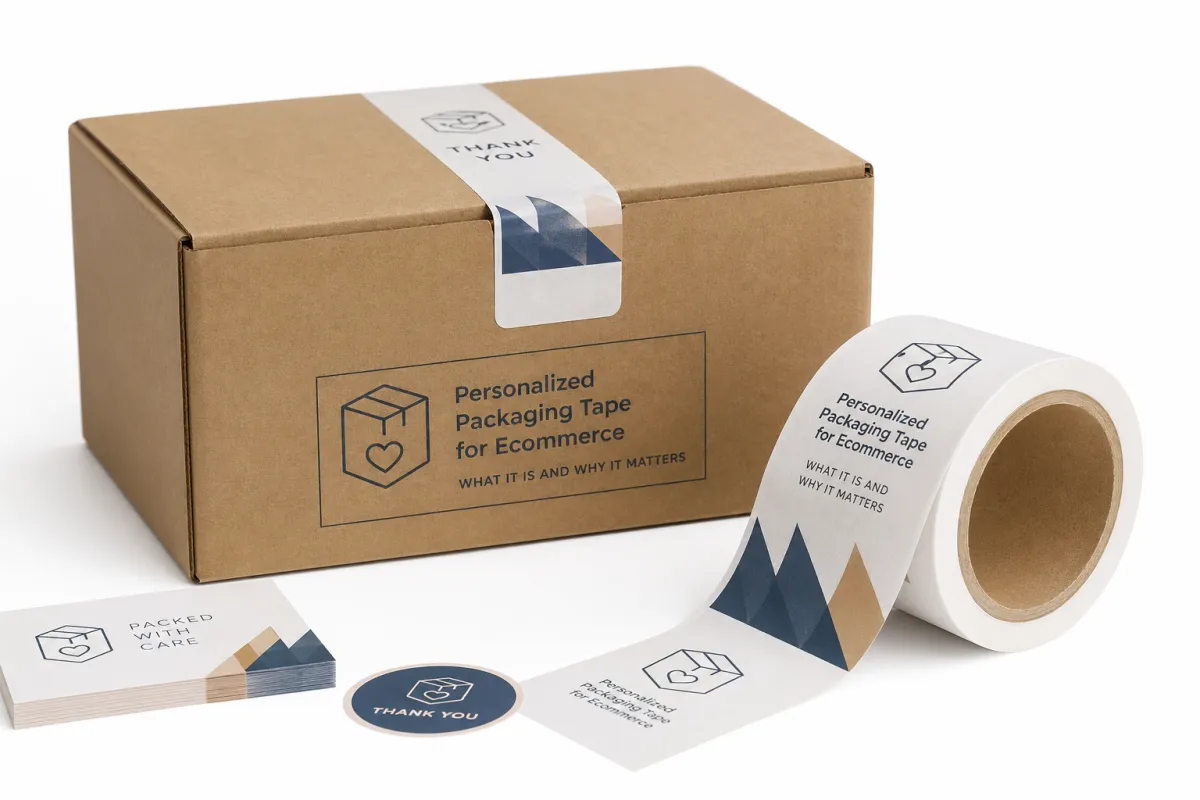
The seam is usually the first branded touchpoint
Packaging has a hierarchy, even if nobody writes it down. Outer carton, then seal, then inserts, then product. In the actual opening sequence, the tape seam is often what a customer sees first and what a warehouse worker touches first. That makes it unusually valuable. A branded seam says the shipment came from a real company with a point of view. A blank strip says the shipment was sealed, sure, but not especially remembered.
That is the practical value of personalized packaging tape for ecommerce. It still behaves like tape. It seals cartons, mailers, and inner boxes. It also works as a visual marker that can be read at a glance. Think of it as a small moving sign that closes the package and advertises the brand in the same pass. I know that sounds simple, because it is. But simple is often what survives daily fulfillment pressure.
There is a second reason this matters: consistency. A buyer may never notice a single printed insert, but they will notice if every outbound package carries the same tape pattern. That repetition builds familiarity. Familiarity, in turn, makes the brand feel established rather than improvised.
What it is, and what it is not
To be clear, personalized packaging tape for ecommerce is printed adhesive tape used to close shipping cartons, mailers, and sometimes secondary packaging. It is useful for branding, parcel identification, and repeat shipments. It is not a fix for weak corrugate, bad void fill, or a carton that should not have been used in the first place. If the box is failing structurally, tape will not rescue it. Tape is a closure and a signal, not a structural bandage.
That distinction sounds obvious until a team buys tape to solve a box problem. I have seen operations try to compensate for loose flaps or poor carton quality with more tape, then wonder why the package still looks messy. The tape can help with appearance and closure integrity, but it cannot change the physics of a weak box. If you need impact resistance, fix the carton spec first.
There is also a strategic choice here. If you are after a premium unboxing effect and already have the volume to support it, Custom Printed Boxes may eventually be the right move. If you want fast deployment, lower upfront spend, and visible branding across a broad SKU set, personalized packaging tape for ecommerce is often the more practical first step. In many programs, tape gets approved before full box printing simply because it is easier to test, easier to store, and easier to switch when the season changes. If you want to compare tape with broader packaging formats, Custom Packaging Products can help you evaluate adjacent options without committing to a full carton redesign.
- Seal integrity still matters more than decoration.
- Brand marks should read clearly from arm's length, not only in a product mockup.
- Tape works best when its color, width, and repeat pattern fit the rest of the packaging system.
A real-world comparison
Picture two identical orders. Same corrugated carton, same product, same shipping lane. One ships with plain brown tape. The other uses a clean branded repeat with the logo and a simple color band. The second package gets noticed more often, photographed more often, and sorted faster in the warehouse because it is easier to identify at a glance. Same protection. Different outcome. That small difference is the point.
In one warehouse audit I reviewed, pick-and-pack teams said branded tape helped them recognize return parcels faster during intake, which shaved a little time off every handling cycle. Not dramatic. Not glamorous. Just enough to matter across thousands of parcels. Small efficiencies add up in ecommerce the way loose change does in a coat pocket: quietly, then all at once.
For brands with repeat orders, that kind of consistency is useful long after the first sale. Packaging presentation keeps doing work after checkout, and buyers do notice that. Several consumer packaging surveys, including long-running work from Dotcom Distribution, have pointed in the same direction: packaging quality influences repeat purchase intent more than executives often expect.
How Does Personalized Packaging Tape for Ecommerce Work in Fulfillment?
From artwork to roll stock, the process is straightforward
The production path is less mysterious than most first-time buyers assume:
- Send artwork with the logo, color values, repeat direction, and spacing rules.
- The supplier checks file format, resolution, print method, and repeat length.
- A proof is prepared, usually digital first, with a physical proof when the job requires it.
- After approval, production begins: printing, coating or laminating if needed, slitting, and roll packing.
- The finished tape is QC-checked, packed, and shipped to the warehouse or 3PL.
- Fulfillment applies it by hand, with a desk dispenser, or through a tape machine.
That is the point where personalized packaging tape for ecommerce becomes operational rather than theoretical. If artwork is late, proofs are unclear, or the roll profile is wrong for the dispenser, the schedule slips. The most common bottleneck is file cleanup, and that is usually preventable if the brand team submits production-ready art instead of a social media graphic and hopes for the best.
Suppliers that make custom shipping tape every day usually move faster because their tooling, color checks, and repeat setup are already dialed in. That does not mean every vendor is equal. It means the vendor with a mature workflow is likely to make fewer avoidable mistakes, and those mistakes are what blow up lead times.
Material choices: film, paper, and adhesive behavior
Most buyers end up choosing between film-based tape, paper-faced tape, and specialty options designed for recycling or premium presentation. Polypropylene is common because it resists moisture and holds up well in busy fulfillment environments. Paper-faced tape can look warmer and more natural, which helps with certain brands, but it can show wear faster if the cartons rub hard in transit. If the package is going through rough handling, the carton itself matters almost as much as the tape.
Adhesive choice is where people get burned. Acrylic adhesives usually age well and perform consistently over time. Rubber-based adhesives can feel tackier out of the gate, but performance may vary more with temperature swings. If your boxes sit in a hot dock, move through a cold truck, or live in a dusty warehouse, you need to ask how the adhesive behaves in that exact setting. Ask for a recommendation tied to your carton and storage conditions, not a sales pitch.
If your goods are chilled, frozen, or staged in cold rooms, ask for low-temperature testing. If your cartons are recycled and rough, test edge adhesion on the real stock, not a pristine sample. I have seen teams approve a tape based on glossy trial boxes and then discover it behaves differently on recycled board. That is not a tape failure. It is a testing failure.
Print limits in real packaging terms
One-color runs are usually cheaper because they are simpler to set up and easier to control. More colors mean more separation work, more chances for registration drift, and a higher risk that fine detail will blur once the tape wraps around a seam. On a carton edge, even a good logo can lose clarity if it relies on thin strokes or tiny text.
That is why a bold two-color repeat often outperforms a more complicated full-color design. For personalized packaging tape for ecommerce, readability is the target. You are buying recognition, not a print specimen. If the logo is instantly identifiable from three feet away, you are doing it right. If someone has to squint at the seam to understand the design, simplify it.
Hand sealing versus machine application
At lower volumes, a hand dispenser can be the most efficient option. It is flexible, cheap to deploy, and easy to train. At higher throughput, machine application usually lowers cost per carton once the line is stable. The catch is compatibility. Not every roll profile feeds every dispenser cleanly, and not every branded tape is built for automatic application.
If you are growing from a few hundred orders a month to several thousand, this is the point to map your application method before you place a large order. A tape that works fine in hand sealing may behave badly on a machine if the core size, roll stiffness, or slit width is off. Ignore that, and your brand looks polished in design review but awkward in the warehouse. Nobody wants that kind of surprise on a Monday morning.
Key Factors That Affect Cost, Quality, and Timeline
What actually drives price
The biggest misconception is that custom tape cost is mostly about printing. Printing matters, but it is only one piece of the puzzle. Width, roll length, substrate, adhesive, number of colors, repeat coverage, and order volume all affect the quote. Freight can change the landed cost more than people expect. Two quotes that look similar on paper can end up miles apart after shipping, tax, and sample charges are added in.
In planning terms, personalized packaging tape for ecommerce often lands in a range that depends on scale rather than a single universal price. For larger runs, I have seen planning estimates cluster around a few tenths of a dollar per seal or carton application, but that number moves with width, coverage, and freight. It is not a magic price and it is not a promise. Treat any quote as a model, not a law of nature.
Breakdown of what you usually pay for
- Setup: plate work, artwork prep, and color management.
- Proofing: digital proofing, sample creation, and revision cycles.
- Production: material, ink, finishing, and slitting.
- Volume pricing: lower unit cost at higher order quantities.
- Freight and receiving: shipping, duties if relevant, and inbound handling.
The quote that looks cheapest is not always the least expensive. A low unit price with high freight, slow proofs, or hidden sample fees can become the most costly option by the time it reaches your dock. Ask for landed cost. Ask for the minimum order quantity. Ask whether customs, taxes, and proof samples are included. If a supplier cannot answer those questions clearly, the comparison is not really apples to apples.
There is also a quality angle here. Sometimes a slightly higher-spec tape reduces waste, mislabeled returns, or rework at the packing station. That is the kind of cost you only notice if you are watching the warehouse closely. In packaging operations, savings often show up in the floor plan before they show up in the invoice.
Timeline: where delays hide
A typical run can take around 10 to 18 business days from file approval to shipment, depending on print complexity and factory load. Simpler one-color runs can move faster if files are ready and the proof is approved quickly. Delays usually happen in the same few places:
- Artwork cleanup and revision loops.
- Proof approval waiting on internal sign-off.
- Production queue spikes around holidays and end-of-month surges.
- Carrier transit time to your warehouse or 3PL.
If your company runs promotions on a fixed cadence, get lead times in writing. Not "usually." Not "around." Get a number tied to a production window. That sounds fussy, maybe even a little annoying, but it saves budget and prevents rushed reorder fees. A vendor who can explain how they handle rush cycles is worth more than a vendor who only talks about shiny samples.
For higher-risk shipping programs, it helps to ask about ASTM D3330 peel testing and ISTA transport profiles. That is not jargon for its own sake. It is a way of checking whether the tape can stay put after real handling, not just under perfect conditions in a sample room.
Custom runs versus stocked alternatives
Stock tape is often the right place to start. It reduces setup friction and lets teams test artwork and adhesion before they commit to a larger run. Once monthly volume becomes predictable, custom tape usually wins because the unit economics improve and the brand becomes more consistent. That is where personalized packaging tape for ecommerce shifts from a branding choice to a planning choice.
There are hidden costs worth watching:
- Storage: long runs can crowd shelves if demand shifts seasonally.
- Waste: poor artwork or wrong roll specs can lead to rejected stock.
- Rush orders: waiting too long often costs more than carrying a small buffer.
“If you cannot explain your lead time risk, you are not managing production; you are hoping the dock stays calm.”
That line has held up in more warehouses than I can count.
One more thing: if your brand makes sustainability claims, verify the substrate, carton stack, and documentation before you print the claim anywhere near the tape. Buyers do ask for proof. A nice green color does not count as evidence, and, honestly, it never did.
Step-by-Step Guide to Ordering Personalized Packaging Tape for Ecommerce
Step 1: run a packaging audit first
Before you start arguing about artwork, audit the actual packaging process. It does not need to be fancy.
- List your top three carton sizes and their share of outbound volume.
- Note the current seal method: hand gun, semi-auto, or full-auto line.
- Record monthly order volume and seasonal spikes.
- Map carrier mix, especially if you ship a blend of ground, air, and international orders.
- Check surface conditions: recycled board, dust, humidity, cold storage, or dry staging.
If you skip this step, you are likely to overbuy or choose the wrong width. If you do it first, your tape spec stops being a guess and starts being a decision. That alone saves money and time.
Step 2: lock the spec before design chatter starts
Width should be decided before everyone starts sending mockups. If your standard box is small and you choose oversized tape, the design looks heavy and wasteful. If the tape is too narrow, the logo looks timid. Common widths are 2 inches for smaller cartons, 3 inches for larger or more premium packs, and 4 inches where the visual impact needs to be obvious from across a packing bench.
Roll length should match your workflow. Shorter rolls can be fine for testing or low-volume hand sealing. Longer rolls make more sense once the line settles and the team wants fewer changeovers. Adhesive choice should reflect the real environment, not the sample room. Recycled cartons in a clean warehouse may behave differently from reused cartons in a dusty one, and that difference is exactly where the best-looking tape can fail if the spec is too casual.
At this point, many teams also decide whether they want a simple repeat mark or a fuller branded pattern. In practice, the simpler version usually ages better because it is easier to print, easier to align, and easier for every shift to apply the same way. That is boring in the best possible sense.
Step 3: prepare artwork like production, not a social post
Keep the master files vector-based and editable. PNGs are fine for previews, but production art should be clean and sharp. Build the repeat to survive seam overlap and minor stretch. Avoid tiny text under 6 pt and thin lines below about 1 mm unless the printer confirms they can hold. If the logo depends on tiny detail, it will probably disappoint on the roll.
Ask for a preflight review if the supplier offers one. Include approved color values and acceptable alternatives if your brand uses a strict palette. Ink drift can happen, especially on narrow substrates. The better the file prep, the fewer proof cycles you burn through. That saves time, and more importantly, it keeps the launch date from slipping because someone wanted a prettier shade of blue at the last minute.
Step 4: review the proof as if it were production
Never approve a proof from a sofa and call it done. Check the tape on an actual carton. Rotate the box. Look at the seam under warehouse lighting. Check the corners. The pretty digital file is only half the story; the other half is how it behaves on corrugated ribs and rounded edges.
These are the questions I would ask before approving a run:
- Can the print be read from arm's length in the warehouse?
- Does the adhesive hold on the exact carton stock we use?
- Will one roll cover the seam consistently across normal box-size variation?
- Does the color stay legible after a few days in transit and storage?
Step 5: pilot first, then scale with data
Run a real test order. Not a handful of boxes for show. A live batch, with actual packing staff and actual packing speed. Pull samples from different shifts. Check seal consistency. Track rework. Measure whether the tape slows operators down or speeds them up because it is easier to place. The numbers do not need to be complex to be useful.
Compare at least two suppliers on the same spec sheet. In my experience, the price spread between two comparable bids often reveals far more than the price itself. It tells you who really understands print, who actually follows a proof process, and who is winging it. If one quote looks too good, ask more questions before you send payment.
Custom Packaging Products are much easier to compare after this kind of pilot, because you are no longer judging tape in the abstract. You are judging it against your own workflow.
Common Mistakes That Make Custom Tape Look Cheap
Too much art, not enough restraint
The fastest way to make good tape look cheap is to cram too much into it. Tiny text, crowded logos, and busy graphics lose clarity on a curved seam. A carton is not a poster wall. It is a moving surface with folds, dust, and a lot of handling. If the design cannot survive that environment, it needs to be simplified.
Gradient-heavy artwork also tends to disappoint. Gradients band easily on narrow rolls and can look muddy once wrapped around corrugate. For personalized packaging tape for ecommerce, bold contrast usually reads as more premium than decorative complexity. The warehouse does not reward cleverness. It rewards clarity.
Adhesive mismatch is the unglamorous failure point
Bad tack is one of the easiest ways to ruin the look and function of branded tape. If it is too weak, edges lift at corners. If it is too aggressive, the tape can tear awkwardly or make the carton look stressed. Most of the complaints I have seen were not about design. They were about choosing the cheapest adhesive without thinking through dust, temperature, and carton condition.
If your boxes are reused, your dock is dusty, or your facility sees temperature swings, ask for a tape spec that matches that environment. A poor adhesive choice can create a wave of rework across thousands of shipments, and then the brand team gets blamed for what was really a materials decision.
Dispenser and machine mismatch
A tape that looks perfect in a sample kit can still fail at the line if the dispenser cannot feed it smoothly. This happens more often than teams admit. If the roll core is wrong, the tape hangs up. If the roll is too stiff, operators slow down. If the roll width does not match the dispenser, efficiency drops immediately. And yes, that usually becomes a warehouse issue before it becomes a branding issue.
Before you sign off, ask for core diameter, slit width, and compatibility notes for your exact dispenser or machine model. If you are running a line, treat this like acceptance testing, not optional QA theater. Otherwise you end up paying for a prettier tape that nobody enjoys using.
Ordering too little or too much
Underbuying causes emergency reorders, rush freight, and stress you do not need. Overbuying creates dead stock and ties up cash in old colors or old campaigns. Both mistakes are common. The better approach is to model three scenarios: normal month, peak month, and a buffer for two promo cycles. That gives you a quantity that is large enough to avoid panic but not so large that the tape becomes a storage problem.
A small overage can be sensible. A warehouse full of obsolete tape is not. If your reorder window is predictable, build one buffer into the plan and stop there. That is usually the sweet spot.
Confusing branding tape with security tape
Personalized packaging tape for ecommerce is not automatically tamper-evident. Some versions can be specified that way, but standard printed tape is mainly for closure and branding. If your security team wants tamper resistance or anti-theft features, that should be a separate decision. Mixing those objectives usually leads to disappointment and a bigger invoice.
Expert Tips for Better Branding and Lower Waste
Build contrast, not visual clutter
Strong packaging design is usually simpler than people think. One clear message, one readable logo, and enough negative space to let the eye rest. On a moving carton, clutter loses. The tape should read quickly in a warehouse aisle and still feel intentional on a doorstep. That means hierarchy matters. So does spacing.
If a design looks uncertain at 100 percent scale, print it at actual width and check it on a real box. That is the only test that counts. I have seen beautiful artwork shrink into visual noise once it hit corrugated board. A monitor can lie. A carton usually does not.
Match tape width to the carton family
Width mismatch is one of those things that people notice immediately, even if they cannot explain why. A narrow tape on a large box feels underpowered. An oversized strip on a small mailer looks clumsy. Build a simple width matrix for your top carton sizes and decide which dimensions deserve 2-inch tape, which deserve 3-inch tape, and which can tolerate a wider profile. Let the box drive the tape, not the other way around.
One
FAQ
What should I verify before ordering Personalized Packaging Tape for Ecommerce Shipping?
Confirm the product size, material, print method, quantity, sample route, packing count, and delivery date. A clear packaging spec is easier to quote, easier to approve, and easier to reorder.
How many samples should I review before bulk production?
At minimum, review one production-grade sample or proof that shows scale, color, logo placement, finish, and packing fit. For high-volume orders, keep the approved sample as the reference standard.
What usually changes the final cost?
Material grade, printing method, finish, tooling, quantity, packing method, revision count, and freight assumptions can all move the final price.
FAQ
What should I verify before ordering Personalized Packaging Tape for Ecommerce Shipping?
Confirm the product size, material, print method, quantity, sample route, packing count, and delivery date. A clear packaging spec is easier to quote, easier to approve, and easier to reorder.
How many samples should I review before bulk production?
At minimum, review one production-grade sample or proof that shows scale, color, logo placement, finish, and packing fit. For high-volume orders, keep the approved sample as the reference standard.
What usually changes the final cost?
Material grade, printing method, finish, tooling, quantity, packing method, revision count, and freight assumptions can all move the final price.

