Pet Treat Poly Mailers MOQ is one of those sourcing terms that sounds tidy until a buyer starts mapping cash flow, warehouse space, and reorder timing onto it. I have watched brands get distracted by a clean-looking minimum, then realize the real cost was hiding in freight, proofing, and dead inventory. The better question is not just how low the pet treat poly mailers MOQ can go, but which order size keeps a launch moving without tying up money in cartons that sit too long.
That matters because packaging is rarely a single-line expense. A quote can look friendly on screen, then grow teeth once setup charges, color matching, and storage enter the picture. In that sense, Pet Treat Poly Mailers MOQ affects landed cost almost as much as film thickness does. Pet brands, private-label treat sellers, and subscription teams all run into the same tension: order too little and the unit price climbs; order too much and the warehouse starts charging rent for the excess. I have seen that happen more than once, and it is never pretty.
Pet treats also sell in bursts. A flavor gets traction on social media, a retailer tests a new line, or a vet recommends a product and demand jumps. Packaging that lands late breaks momentum. Packaging that arrives too early becomes a storage problem. Experienced buyers compare pet treat poly mailers MOQ against launch timing, forecast confidence, and fulfillment capacity instead of chasing the smallest number by default. The best order size is usually the one that makes the next order easier, not the one that wins the first quote.
Why Pet Treat Poly Mailers MOQ Matters for Fast Reorders
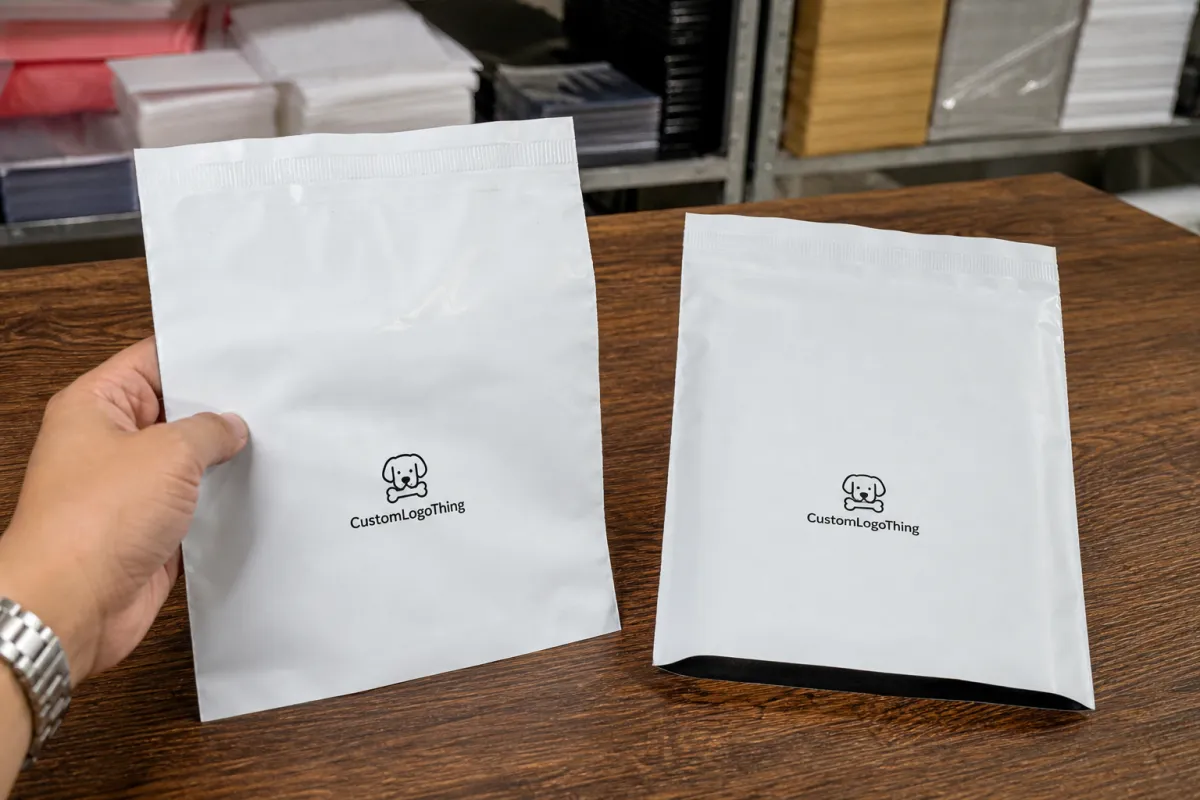
Fast reorders separate packaging that supports growth from packaging that gets in the way. Pet treat poly mailers MOQ shapes how quickly a winning SKU can be replenished, how many versions can be tested, and how much risk sits on the books. A low MOQ can help a brand move quickly, though the per-unit cost often rises because the supplier has to absorb setup and handling across fewer pieces. A higher MOQ may improve pricing, yet it can lock the buyer into a design that no longer fits the market. The useful point sits in the middle, where reorders stay simple and inventory stays sane.
Lead time usually lags demand. Treat sales can jump after a retailer listing, a social post, or a regional promotion. If the mailers are not on hand, the brand may ship in temporary outer packaging or delay fulfillment. Neither option feels good, and customers notice. That is why many teams aim for a pet treat poly mailers MOQ that covers launch volume and the first replenishment cycle. In practical terms, that often means 3,000, 5,000, or 10,000 pieces rather than a run sized only for the first month.
Pet treat poly mailers MOQ also shapes SKU strategy. A separate print run for every flavor, weight, or co-branded version can chew through budget fast. Three flavors and two seasonal designs become six SKUs before the quarter gets settled. One supplier may offer a lower pet treat poly mailers MOQ for a simple one-color pack, while another requires a larger run for full-coverage print. Buyers who understand that relationship can simplify the assortment before it turns expensive.
The cheapest quote rarely becomes the cheapest outcome. A minimum order that is too high creates storage costs and stale inventory. A minimum order that is too low can push unit cost up enough to squeeze margin. That is why pet treat poly mailers MOQ belongs beside expected sell-through, warehousing expense, and SKU lifetime value in the decision sheet. For many pet brands, a slightly higher unit price buys a much healthier reorder cycle. That trade is kinda boring on paper, but it saves headaches later.
Launch volume should match demand evidence
New launches seldom justify a huge packaging commitment. If a treat line has little market history, a smaller pet treat poly mailers MOQ leaves room to adjust size, copy, or artwork after the first sales cycle. Careful teams look at wholesale commitments, direct-to-consumer conversion, and marketplace velocity before placing the order. A run that overshoots demand can leave the company holding inventory that no promotion clears quickly enough.
There is still a floor where tiny runs stop making sense. Below 1,000 pieces, prototype orders and very small releases can work, yet the price per bag often climbs and finishing options can narrow. Many suppliers price pet treat poly mailers MOQ tiers so that 3,000 pieces lands in a better commercial zone than a miniature trial. If the design is simple and the need is urgent, that middle tier is often the practical choice. It is not fancy, but it is usually smart.
Reorder predictability reduces waste
Sound packaging programs do not depend on last-minute heroics. They run on predictable pet treat poly mailers MOQ planning that keeps purchasing and production in step. Reused art files, dielines, and material specs shorten reorders and reduce error rates. Inventory planning gets cleaner. Forecasting gets cleaner. Dead stock shrinks. The benefit is quiet, but it becomes obvious once the first order has actually shipped and the second one is due.
Multi-channel pet brands can also use predictable pet treat poly mailers MOQ planning to support channel-specific packaging. The direct-to-consumer pack may differ from the wholesale pack, yet both can be ordered with discipline. MOQ is not only a factory question. It is a commercial tool that shapes how the business buys, stores, and ships.
What Buyers Get in Pet Treat Poly Mailers
Buyers are not just purchasing a bag. They are buying protection, print area, shelf presence, and a shipping surface that can survive the trip from packing bench to front door. Pet treat poly mailers MOQ often determines which features are available, because smaller runs may limit material choices while larger runs open better print control and finishing options. A strong packaging program begins by defining the job: hold product securely, communicate the brand clearly, and shield contents from dirt, odor, and rough handling.
The strongest pet treat poly mailers MOQ is the one that buys the right mix of utility and visual appeal. A bag that looks premium but splits at the seam fails. A bag that is tough but anonymous misses the branding moment. Pet treat buyers usually need three things: a reliable film structure, decent print fidelity, and a closure that works in everyday packing operations. Those are the value drivers that matter most, and they tend to be the first places where a cheap spec falls apart.
Material structure and product protection
Most pet treat poly mailers use polyethylene film in a mono or co-extruded structure. The exact build depends on product weight, seal strength, and shipping abuse. A 2.5 mil film can work for lightweight dry treats, while heavier or sharper-edged items may need 3 mil or more. Oily, aromatic, or crumbly contents often call for stronger barrier performance or an inner layer that slows odor migration. That does not make the mailer airtight, but it can improve handling and the customer's first impression of freshness.
That matters for pet treat poly mailers MOQ planning because film choice affects cost and lead time. A standard white opaque poly mailer with simple print usually fits a lower MOQ more easily than a custom structure with a specialty finish. If puncture resistance is a concern, ask for tensile and dart impact data. ASTM D882 is commonly used for tensile testing, and ASTM D1709 is a familiar reference for impact resistance. Buyers do not need to become lab technicians, but they do need enough data to judge whether the pack survives ordinary distribution.
Printing and brand impact
Pet packaging has to earn attention fast. A mailer often arrives before the product is seen, so the outer pack becomes the first brand touchpoint. Artwork density, color accuracy, and registration all matter. A one-color logo may be enough for a lean launch, while richer print can create stronger shelf recognition and a more confident unboxing moment. The right pet treat poly mailers MOQ can make those choices realistic instead of theoretical.
Flexographic printing usually suits larger runs, while digital print can work well for shorter runs and versioned artwork. Brands that rotate flavor names, promotional copy, or QR codes often find digital helpful because plate changes are not part of the workflow. The tradeoff is unit price, which tends to rise at low volume. In a typical buying conversation, pet treat poly mailers MOQ and print method are tightly linked. The same design can cost very different amounts depending on whether the run is 2,000 or 12,000 pieces.
Closures, seals, and handling features
Function matters as much as appearance. Most buyers want a clean seal line, a tear-friendly opening, and a closure that helps the customer reseal the package after first use. Some Pet Treat Mailers include a zipper, while others rely on a strong heat seal and a tear notch. If the pack goes through fulfillment channels, the closure has to survive machine handling and compression in transit. That is one place where pet treat poly mailers MOQ becomes a design issue, because added features can move the order into a higher tier.
A supplier that understands pet products will usually ask about oil content, powder migration, and storage conditions. A soft chew with higher fat content behaves differently from a crunchy biscuit. Moisture exposure behaves differently too. Not every package needs a barrier upgrade, but every package needs honest requirements. A mailer used only as transport inside another carton has one set of needs. A retail pack has tighter needs and a more visible finish. That is why the best pet treat poly mailers MOQ discussion starts with use case, not price.
Specifications That Affect Shelf Appeal and Shipping
Specifications are where packaging choices become measurable. Size, film gauge, print coverage, finish, and seal style all shape how the package looks and how it performs. In pet packaging, a pack can fail for surprisingly small reasons: a bag that looks too flimsy, a seam that splits during packing, or a glossy surface that makes artwork harder to read under warehouse lights. Buyers who treat pet treat poly mailers MOQ as a specification question usually get better long-term value than buyers who focus only on unit price.
The most useful rule is simple. Start with the product dimensions, then work outward to shipping conditions and brand presentation. A small treat sample does not need the same bag as a bulk bag of large biscuits. Dense fill requires a seal area strong enough to support the load without stress. A mailer intended for retail hooks needs top structure and print placement that work in that format. Good pet treat poly mailers MOQ planning leaves room for those choices before artwork gets locked.
Gauge and strength
Gauge is not the only measure of quality, but it is one of the fastest ways to compare options. A 2 mil bag may be fine for lightweight direct-mail use, while a 2.75 mil or 3 mil structure can better support heavier treat loads and lower puncture risk. Goods with sharper corners or rigid trays often justify the thicker option even when the cost moves up a little. That trade is usually sensible, because one damaged shipment costs more than the film upgrade.
For pet treat poly mailers MOQ, thickness can also affect supplier willingness to quote a smaller run. Some manufacturers hold lower-MOQ pricing on standard gauge film because it is easier to source and run. A custom gauge may need more lead time or a larger minimum. If the product needs only moderate protection, staying close to a standard structure can keep the pet treat poly mailers MOQ more accessible.
Dimensions and fit
A good mailer fits the product without dead space. Too much room and the package shifts in transit. Too little room and the seal buckles, which weakens the structure and hurts presentation. In subscription box setups, the mailer often has to fit inserts, labels, and secondary packaging. In wholesale or e-commerce, the outer dimensions may need to stay under carrier rate thresholds. Smart pet treat poly mailers MOQ planning starts with size discipline, because each extra inch of film can affect freight and storage.
Buyers should ask for finished dimensions, not only flat dimensions. Gussets, seal allowances, and print bleed all change how the final bag behaves. A screen sample can look generous, then run tight once the product is packed. That is why prototype approval matters. One of the most common mistakes is approving a size that looks fine in theory but causes problems on the line. A modest test order within the pet treat poly mailers MOQ can prevent a bigger error later.
Finish, readability, and shelf presence
Matte and gloss finishes create different buying impressions. Gloss can sharpen color and help the package stand out, while matte can feel more premium and reduce glare under bright lights. The right choice depends on the brand. A rustic treat line may look better on a matte substrate, while a bright, high-energy brand may prefer gloss or a soft-touch effect. Readability still rules. If the ingredients panel, flavor name, or logo disappears at a glance, the package loses commercial value.
One practical tactic is to request print mockups at the same scale as the finished bag. That makes it easier to judge whether the logo clears, whether the copy is legible, and whether the die area feels balanced. A slightly larger pet treat poly mailers MOQ can sometimes justify a more polished print setup, but only if the design uses that extra space well. More packaging real estate helps only when the layout earns it.
Pet Treat Poly Mailers MOQ, Cost, and Unit Price
Cost analysis is where many purchase decisions drift off course. A low quoted price can hide setup charges, freight, plate costs, and reprint risk. A buyer who compares only the unit price may miss the real picture. Pet treat poly mailers MOQ should be read as a total-cost issue: what does the bag cost, what one-time charges apply, how long is the lead time, and how much inventory must sit before cash comes back? That is the commercial lens that matters.
For custom printed pet treat mailers, many buyers see rough price bands like $0.18-$0.28 per unit for 5,000 pieces on a straightforward one- or two-color job, with higher pricing when artwork coverage is dense, the finish is specialty, or the structure is upgraded. Smaller runs can move quickly into the $0.30-$0.60 range or beyond, depending on print method and supplier setup. Those figures are directional, not universal. The point is simple: pet treat poly mailers MOQ directly affects per-unit economics, sometimes more than film thickness does.
Setup charges and artwork preparation
Most suppliers charge for prepress work, plate creation, color separation, and proofing. A very small order may carry a heavier setup burden because fixed costs are spread across fewer units. That is why a tiny pet treat poly mailers MOQ can look attractive until the invoice lands. Buyers should ask for a quote that separates unit cost from one-time charges. Without that split, comparing suppliers gets muddy fast.
Digital print can soften the penalty of shorter runs when the design may change. Flexo can offer better economics when the design is stable and repeat orders are likely. There is no universal answer. Artwork complexity, expected volume, and the need for flexibility all matter. For a brand testing three flavors, the best pet treat poly mailers MOQ may be the one that keeps changeover simple even if the first quote is not the lowest on paper.
Landed cost, freight, and storage
Landed cost includes more than the factory quote. Freight, customs handling, warehousing, pallet storage, and receiving time all change the real cost per pack. Flat-packed poly mailers help, but large minimum runs still occupy space. A careful buyer compares the cost of a bigger pet treat poly mailers MOQ against the carrying cost of inventory that sits for months.
Obsolescence is another hidden line item. If ingredients, claims, or branding change, unused mailers can become unusable. That risk is easy to underestimate. Paying a little more per unit for a lower pet treat poly mailers MOQ can be the smarter move if the market is still being tested. The decision is not only arithmetic. It is strategic.
How to compare quotes correctly
The cleanest way to compare suppliers is a side-by-side sheet with five inputs: MOQ, unit price, setup fee, lead time, and freight assumptions. Add one more column for risk. Does the supplier have the print method you need? Are samples available? Can the same shade be repeated on a reorder? That framework usually beats chasing the lowest starting price. In the pet category, a quote that matches your pet treat poly mailers MOQ target usually wins over one that saves a few cents but creates delays.
Buyers should also ask about the next tier. Sometimes moving from 3,000 to 5,000 pieces drops the unit cost enough to justify the extra inventory. Sometimes the savings are thin. The answer depends on print coverage, supplier efficiency, and package size. A good pet treat poly mailers MOQ decision reflects how the business really sells, not how the spreadsheet wishes it would sell.
| Order Tier | Typical Fit | Common Buying Outcome |
|---|---|---|
| 1,000-2,000 | Sampling, test launch, small regional drop | Higher unit cost, lower risk |
| 3,000-5,000 | Early growth, limited SKU set, first reorder plan | Balanced pet treat poly mailers MOQ for many brands |
| 10,000+ | Stable demand, multiple channels, repeat forecast | Lower unit cost, more inventory exposure |
Process, Timeline, and Production Steps
Production is easier to manage when the path is clear from the beginning. The usual flow moves from brief to artwork, from proof to sample, from approval to production, then to packing and shipment. If one step gets rushed, the rest of the schedule absorbs the strain. That is why pet treat poly mailers MOQ discussions should include timing, not only quantity. A lower minimum can help if it gets the project moving sooner. A higher minimum can work if the business can wait and the pricing rewards the larger run.
A realistic timeline for a custom run is often 12-15 business days after proof approval for straightforward orders, though complex print jobs, specialty finishes, or high-season demand can stretch longer. Freight time sits on top of production time. If the package has to hit a launch date, the buyer should work backward from delivery and leave room for corrections. That planning discipline often separates a clean launch from a scramble. In that sense, pet treat poly mailers MOQ is also a scheduling tool.
Prepress, sampling, and proofing
The first review should inspect more than logo placement. Pantone targets, barcode clarity, copy accuracy, and seal or tear-feature locations all need a check. A proof that looks fine on a laptop may fail in production if text sits too close to trim or if a barcode is too small to scan reliably. Buyers should request a flat proof or mockup that reflects the final cut size. That step matters even more when the pet treat poly mailers MOQ is high enough that rework would be expensive.
If a physical sample is available, use it. Fill it with the intended product weight, close it the way the team will close it, and inspect how it stacks. That real-world check catches mistakes that digital proofing misses. A good supplier welcomes that test because it reduces risk on both sides. In many cases, the most efficient pet treat poly mailers MOQ is the one that includes a proper sample stage before mass production starts.
Production control and quality checks
During production, the supplier should check registration, color consistency, seal integrity, and finished dimensions. Buyers can ask for in-process photos, first-article approval, or finished carton labels if the order is large enough to justify it. Quality control is not glamorous, but it catches small errors early. A slightly misaligned print may pass on a sample and fail on a retail line. The stronger the pet treat poly mailers MOQ plan, the easier it is to define acceptable tolerances before anything ships.
For shipping validation, ISTA 3A or a similar internal drop and compression test is worth requesting if the mailer is carrying value-sensitive product. The package has to survive handling, not merely look good in a photo. Crumbly, oily, or brittle products may need extra compression testing. The goal is direct: make sure the mailer behaves the way the fulfillment team needs it to behave. That level of scrutiny pays off as reorder volume climbs.
Freight, receiving, and storage
Once production is complete, the package still has to arrive in usable condition. Pallet wrapping, carton labeling, moisture protection, and carton count accuracy all matter. If the order is large, ask how the cartons are packed and whether they are marked by SKU, lot, or production date. Those details save time during receiving and help with traceability if a later issue appears.
Storage planning should not be an afterthought. Even flat-packed mailers need dry, stable conditions. Excess heat can affect adhesive performance or film behavior over time. If the order sits inside a broader packaging program, store the cartons so first-in, first-out rotation stays intact. A thoughtful pet treat poly mailers MOQ plan only works if the inventory stays organized after it lands.
Why Choose Us for Custom Pet Treat Poly Mailers
Brands choose a packaging supplier for more than one reason. They want clear quotes, honest tradeoffs, and order sizes that match the business stage. That matters especially for pet treat poly mailers MOQ decisions, where the wrong recommendation can create either waste or missed sales. The best supplier relationship feels practical, not theatrical. It should remove uncertainty, not add to it.
Custom Logo Things helps buyers move from idea to production with fewer false starts because the focus stays on fit, cost clarity, and operational realism. That means helping define the right material, the right print method, and the right order size before the first proof gets approved. In packaging, that kind of discipline matters. A supplier that asks sharp questions usually saves more money than a supplier that says yes to everything. For pet treat poly mailers MOQ, that difference shows up quickly.
Clear guidance on order size
One of the most useful services a supplier can provide is an honest recommendation on quantity. A buyer may want the lowest possible pet treat poly mailers MOQ, but the quote may improve at a slightly higher tier. A good partner explains that tradeoff plainly. If the design is simple, the next tier may reduce the per-unit cost enough to justify the extra inventory. If the design is complex or the product is still under test, a smaller run may be smarter even if the unit cost is higher.
That advice only works when it is grounded in actual production behavior. We look at print method, film structure, and logistics implications before suggesting a path. The goal is not to push volume. The goal is to make sure the pet treat poly mailers MOQ matches the brand's stage and sales profile.
Support for branding and compliance needs
Pet packaging often has to carry ingredients, feeding notes, weight claims, contact information, and sometimes barcode or compliance text. If the pack will sell through retail or marketplace channels, the artwork has to stay legible after print reduction. A supplier that understands those constraints can help avoid expensive redesigns. If the packaging system includes paper cartons or inserts, FSC-certified components may also be worth considering. The point is to build a package that works across the chain, not only in design review.
Verification matters too. A customer should know whether the artwork suits flexo or digital, whether the film gauge supports the fill weight, and whether the requested MOQ is realistic for the chosen build. That is where pet treat poly mailers MOQ support becomes useful. It turns packaging from a guess into a controlled purchase.
Next Steps to Order Pet Treat Poly Mailers
If the goal is to move quickly without making an expensive mistake, the next step is straightforward: define the product, define the order size, and define the print complexity. Those three inputs narrow the options fast. Once the fill weight, target use case, and distribution channel are clear, the pet treat poly mailers MOQ conversation becomes much more precise. Buyers who skip this step often end up revising artwork or changing the spec later, which burns time.
Here is a practical path that works for most teams:
- Confirm the product weight, dimensions, and any odor or oil concerns.
- Decide whether the mailer is for retail display, shipping, or both.
- Choose the print style: simple logo, versioned artwork, or full-coverage branding.
- Ask for two or three pet treat poly mailers MOQ options so you can compare total cost and lead time.
- Request a mockup or sample before approving mass production.
- Plan storage and reorder timing before the goods ship.
One more practical point: packaging should not behave like a one-time buy. A better approach is a repeatable buying pattern. If the first run performs well, the second order should be easier, faster, and simpler to manage because the file prep, dimensions, and supply assumptions are already known. That is where a thoughtful pet treat poly mailers MOQ strategy starts compounding value. Each reorder gets cleaner than the last.
If options are still on the table, start with the use case rather than the quote. A lean launch, a regional test, and a national rollout all justify different pet treat poly mailers MOQ levels. The right answer protects cash, supports the brand, and keeps the line moving. For pet brands, that discipline usually pays back sooner than chasing the lowest sticker price. The smartest pet treat poly mailers MOQ is the one that fits the business you actually have, not the one you hope to have someday.
FAQ
What is a typical MOQ for custom pet treat poly mailers?
A typical pet treat poly mailers MOQ often starts around 3,000 to 5,000 pieces for a standard custom print job, though some suppliers can go lower for simple artwork or digital print. The exact number depends on film type, print method, bag size, and how much setup is required. For a small launch run, ask for multiple tiers so the cost change is visible.
Why does a lower MOQ sometimes cost more per unit?
Fixed setup costs have to be spread across fewer bags. Plate charges, prepress work, proofing, and production changeovers do not shrink just because the order is small. That is why a low pet treat poly mailers MOQ can be useful for testing, but not always the best fit for mature SKUs. The right choice matches product stage and sales pace.
Can pet treat poly mailers be used for retail and shipping?
Yes, though the spec should match the job. A retail-facing pack usually needs stronger print presentation, better readability, and sometimes a resealable closure. A shipping-only mailer may prioritize puncture resistance and low weight. If one pack has to do both, the pet treat poly mailers MOQ decision should account for the extra material or print requirements.
How long does production usually take?
For a straightforward order, production often takes 12-15 business days after proof approval, then freight time is added on top. More complex artwork, special finishes, or tight seasonal demand can extend that. If you are comparing pet treat poly mailers MOQ options, ask how each tier affects lead time. Sometimes the faster path is the cleaner specification, not the biggest order.
What should I ask before placing an order?
Ask for finished size, film thickness, print method, setup charges, lead time, and sample availability. Also ask whether the supplier can repeat the order without reworking the artwork. Those questions help you judge the real value behind the quote. For many buyers, the best pet treat poly mailers MOQ is the one that comes with clear documentation and a straightforward reorder path.

