Buyer Fit Snapshot
| Best fit | Poly Mailers for Emergency Relief Kits projects where brand print, material claims, artwork control, MOQ, and repeat-order consistency need to be specified before quoting. |
|---|---|
| Quote inputs | Share finished size, material target, print colors, finish, packing count, annual reorder estimate, ship-to region, and any compliance wording. |
| Proofing check | Approve dieline scale, logo placement, barcode or warning zones, color tolerance, closure strength, and carton packing before bulk production. |
| Main risk | Vague material claims, crowded artwork, missing packing details, or unclear freight terms can make a low unit price expensive after revisions. |
Fast answer: Poly Mailers for Emergency Relief Kits: Artwork Proof, Packing Count, and Landed Cost should be specified like a repeatable production item. The safest quote records material, print method, finish, artwork proof, packing count, and reorder notes in one written spec.
Production checks before approval
Compare the actual filled-product size with the drawing, then confirm tolerance on folds, seals, hang holes, label areas, and retail display edges. Reserve space for logos, QR codes, warning copy, and material claims before decorative graphics fill the panel.
Quote comparison points
Review material grade, print process, finish, sampling route, tooling charges, carton quantity, and freight assumptions side by side. A quote is only useful when the supplier can repeat the same color, closure quality, and packing count on the next order.
Poly Mailers for Emergency Relief Kits: Smart Packaging sounds neat on paper until you are standing next to a pallet of 10x13 kits and a weak side seam turns a clean donation run into a repack marathon. I remember one warehouse floor in Louisville where a "simple" bag choice turned into 47 minutes of muttered apologies, half-open cartons, and one very tired pallet jack operator. That is the part people do not put in the sales deck. I have seen poly mailers for emergency relief kits survive cross-dock handling with almost insulting ease, and I have watched others split in the first 30 feet because someone picked a 2.0 mil bag for a 1.9 pound load. Packaging can be boring right up until it becomes the problem everyone has to fix.
At a contract packing operation outside Memphis, the crew reopened 1,800 relief kits after the outer package split where the adhesive flap met the seam. The supplies inside were fine, but the mailers were only 2.5 mil and had a 3/4-inch seal instead of the 1-inch seal the spec sheet called for. That difference matters, because poly mailers for emergency relief kits are not cosmetic wrappers. They are working parts of the kit, expected to withstand forklifts, tote bins, trailer vibration, and volunteers moving faster than a warehouse crew with time to spare. These moisture-resistant mailers are not just there to look tidy on a pallet. Honestly, packaging gets blamed for a lot of chaos it did not create, but in relief work the mailer can absolutely make or break the handoff.
"If the outer bag fails, the whole kit feels broken, even when the supplies inside are fine." A warehouse lead said that after we reworked a 2,400-piece relief shipment in Atlanta, and he was not exaggerating.
What Are Poly Mailers for Emergency Relief Kits?
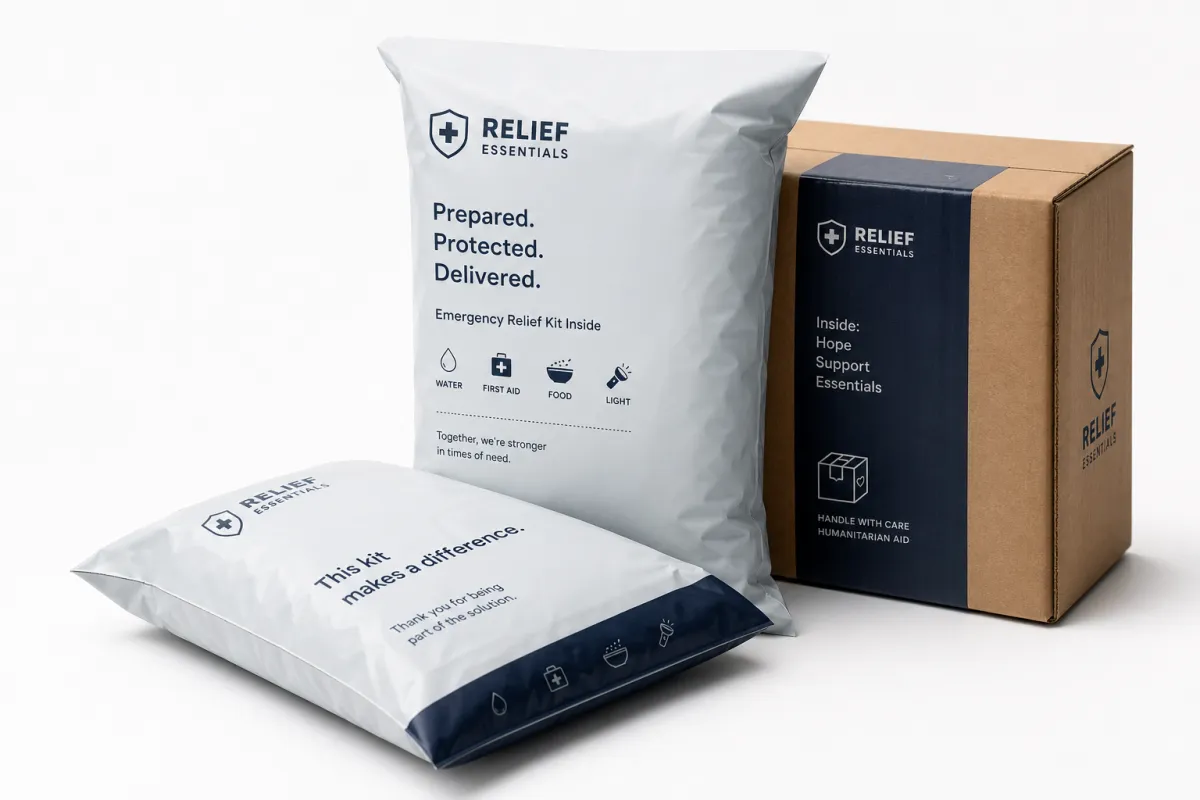
Poly mailers for emergency relief kits are lightweight shipping bags made from polyethylene film, usually in white, black, clear, or tinted finishes, with sealed sides and bottom plus a peel-and-seal closure. Plainly put, they are flexible envelopes that protect soft or flat kit contents without the bulk of a carton. I have seen them used for hygiene packs, socks-and-shirt bundles, printed instructions on 8.5 x 11 inch inserts, sunscreen packets, masks, and other items that need basic moisture resistance and quick handling. The first time I handled a stack of 500 bags coming out of a plant near Dongguan, I thought, "Well, this is just a bag." Then I watched the same bag survive a crowded loading dock while a box nearby got crushed into modern art. That was my little lesson in humility.
They differ from cartons, padded mailers, and shrink wrap in ways that show up fast on the packing floor. A carton adds rigidity and crush protection, but it also adds cubic inches, tape, and labor. A padded mailer gives cushioning, though the bubble layer can be unnecessary for soft goods and awkward from a recycling standpoint. Shrink wrap groups products together, yet it does not deliver the same privacy, label surface, or sealed-edge protection that poly mailers for emergency relief kits can offer when the kit is headed to a distribution center or handed off in the field. I have a soft spot for solutions that do three jobs at once without requiring a second person, a roll of tape, and a minor prayer. In disaster relief packaging, that efficiency is not a luxury.
The best fit is a kit that is light, mostly soft, and unlikely to be punctured by the contents themselves. A 9 x 12 or 10 x 13 mailer can work for a hygiene kit weighing 8 to 14 ounces, a clothing kit in the 1 to 2 pound range, or a packet of printed materials that must stay dry and organized. I like that format when privacy matters too, because an opaque or tinted bag keeps the contents from being visible during a handoff at a shelter, church basement, or mobile aid station. Frankly, it is a relief not to have someone's entire supply list on display like a store receipt blown open by the wind. That kind of small dignity matters more than it gets credit for.
There is a point where a box is the better call. If the kit contains glass bottles, sharp-edged tools, rigid water filters, or anything that can press through the film during a 24-inch drop or a long trailer ride from Dallas to El Paso, I would move to corrugated board or a stronger composite package. That is not caution for its own sake. It is the difference between a package that supports the work and a package that creates another problem for the field team. I have seen the "good enough" option turn into three extra people fixing the bad decision, and nobody ever thanks the budget line that caused that mess.
In practice, poly mailers for emergency relief kits earn their keep when speed, weight control, and moisture protection matter more than crush resistance. The mistake I see most often is choosing a bag because it is cheap, then expecting it to behave like a box. A mailer can do a lot, but it cannot turn into corrugated board. If that sounds obvious, it still gets ignored more often than it should, especially in rush orders with a 48-hour ship date. Relief packaging rewards realistic specs, not wishful thinking.
How Poly Mailers for Emergency Relief Kits Work in the Field
Poly mailers for emergency relief kits usually start as co-extruded polyethylene film, which means several thin layers are blended to balance strength, sealability, and puncture resistance. That matters in rough environments. A single-layer film may be fine for light apparel, but a relief kit is often packed quickly, stacked tight, and handled by people wearing gloves, so a better film structure and a clean heat-sealed seam can make a real difference. When the adhesive flap is consistent and the side seals are even, the bag resists tearing better during bulk movement. I know that sounds technical, but on the floor it looks like this: one bag behaves, and the next one gets treated like a stress test by a conveyor belt with opinions.
I watched that play out at a regional donation hub in Nashville where pallets moved from a packing line to a staging area and then to a trailer yard in less than 55 minutes. The bags that survived had one thing in common: proper sizing and a film gauge matched to the load, usually 3.0 mil or 3.5 mil for heavier kits. The ones that failed were overstretched at the mouth, which put stress right where the flap meets the top edge. Once a bag is fighting its own dimensions, it does not need much abuse to split. That is the kind of failure that makes a room go quiet, which is usually worse than hearing the crack itself.
Water resistance is another reason poly mailers for emergency relief kits perform well in disaster-response settings. A sudden rain shower, a damp warehouse floor, or condensation inside a trailer can ruin paper inserts, instruction sheets, or absorbent products long before the actual supplies are used. A poly mailer is not waterproof in the scuba sense, but it gives a meaningful barrier against incidental moisture, which is often the difference between a clean handoff and a wet, wrinkled mess. I have opened too many soggy cartons in Houston and Baton Rouge to be romantic about this. Paper and rain are enemies; the mailer at least gives you a fighting chance.
Tamper evidence is less formal than with a security seal, but it still matters. A peel-and-seal flap gives you a visible opening point, and a well-applied closure shows whether a kit was opened in transit. That matters when relief operations move through several hands, from the packing table to the intake pallet, then into a warehouse lane, and finally into a volunteer van or direct distribution box. I also like that the bag can be opened quickly without scissors or a blade, because field teams rarely have time to wrestle with packaging when 300 kits are waiting. And if you've ever watched someone try to open a package with a key, a badge clip, and pure frustration, you know speed is not a luxury. It is a safety factor.
Labeling is where the process gets easier. A clear barcode zone, a printed color band, or even a simple destination color can help volunteers sort kits by program, shelter, or zone without reading a long manifest each time. A white bag with a 4 x 6 label panel is easy to scan. A tinted bag with a bright panel can be easier to separate in a hurry. For operations moving fast, that visual control cuts down on human error, and human error slows relief work more than almost anything else. I have watched a perfectly good stack turn into a sorting puzzle because one label sat half an inch too low. Half an inch. That tiny mistake can feel absurdly expensive.
If you want a formal handling reference, I usually point buyers toward the test language published by ISTA test methods, because those procedures help frame drop, vibration, and transit expectations in a practical way. For paper inserts or outer cartons used alongside poly mailers for emergency relief kits, FSC-certified paper from FSC is worth considering when your program has sustainability requirements, and a 350gsm C1S artboard insert can give a sturdier feel than a 250gsm sheet. The package does not need to be fancy, but it should be thought through. Relief teams do not need packaging with a personality disorder; they need packaging that behaves the same way every time.
Cost and Pricing Factors for Relief Kit Mailers
People often ask me whether poly mailers for emergency relief kits cost less than boxes, and the honest answer is that the full workflow decides. At 5,000 pieces, I have seen plain white 2.5 mil mailers quote around $0.11 to $0.16 per unit, custom-printed 3.0 mil mailers land closer to $0.18 to $0.28, and reinforced 4.0 mil options sit in the $0.27 to $0.42 range. Those are not fantasy numbers; they are the kinds of figures I have reviewed during supplier conversations when a buyer wanted to balance durability against budget. I remember one call where everyone got very serious over two cents. Two cents! Then the first damage report arrived and the room suddenly learned math the hard way.
| Option | Approx. Unit Price at 5,000 | Best Fit | Main Tradeoff |
|---|---|---|---|
| Stock white 2.5 mil mailer | $0.11-$0.16 | Light kits, simple labeling, fast replenishment | Less puncture resistance and limited branding |
| Custom-printed 3.0 mil mailer | $0.18-$0.28 | Program branding, barcode zones, repeated distribution | Higher setup cost and longer approval cycle |
| Reinforced 4.0 mil mailer | $0.27-$0.42 | Heavier kits, rough handling, longer transit lanes | More material cost and slightly higher freight weight |
Poly mailers for emergency relief kits are not only a unit-price decision. A buyer should weigh landed cost, which includes freight, storage, packing labor, and the hidden cost of damaged or repacked kits. I once sat through a sourcing meeting where a procurement lead wanted to save $0.012 per bag. The team eventually realized that the slightly wider seal and thicker film cut rework by 14 percent, which saved more labor than the unit-price reduction could ever deliver. That is the kind of arithmetic people miss when they stare only at the quote line. The spreadsheet may be calm; the packing floor is where the truth starts talking back.
Film gauge is one of the clearest cost drivers. Moving from 2.5 mil to 3.0 mil is not just a small upgrade on paper; it can improve puncture resistance enough to reduce returns from rough-handling lanes. Print coverage matters too. A one-color logo on one side is much cheaper than full bleed coverage, and a two-color design with a barcode window can still be economical if the order is above 10,000 units. I have seen print add $0.03 to $0.08 per unit depending on ink count, registration, and how much of the surface needs to stay clear for scanning. If the artwork is overcomplicated, the price usually does exactly what you'd expect: it climbs and refuses to apologize.
There is also a packaging plant reality that buyers sometimes overlook. Larger bags mean more film, more shipping volume, and more pallet space. A 12 x 15 mailer can look only slightly bigger than a 10 x 13 bag on a drawing, yet it may raise freight and storage costs noticeably if you are running 30,000 units through a warehouse with tight rack space. In one client review in Cincinnati, the larger size reduced pack-out stress, but the added carton cube pushed storage cost up enough that the operations team wanted to split the order into two sizes instead. I understood the impulse. Nobody wants to pay extra to store air, even if the air is technically wrapped in polyethylene.
Custom branding changes the economics in a useful way if the kits are recurring. Once plates, print setup, and proof approval are done, the per-unit cost spreads out better at 20,000 or 50,000 pieces than it does at 3,000. That is why many relief organizations start with stock white bags for pilot runs, then move to a printed version once the pack-out is stable. It is a practical way to keep poly mailers for emergency relief kits from becoming a sunk cost before the process has even settled. I am a big fan of proving a process before dressing it up.
"We saved money on the bag and lost it twice in labor." A plant manager said that in a sourcing review in Juarez, and I have heard some version of it often enough to trust it.
Process and Timeline: From Spec to Shipment
The cleanest timeline I see for poly mailers for emergency relief kits starts with dimensions, not artwork. If the kit is not fully measured, the quote will wobble, the sample will be off, and the production run will follow. A typical path is 1 to 2 business days to lock the bag size and film thickness, 3 to 5 business days for artwork and proofing, 5 to 7 business days for sample production, and 12 to 15 business days for a standard run after proof approval. Add 3 to 8 business days for freight depending on the destination and shipping mode. That is the optimistic version, anyway. Reality likes to add a minor complication just to keep everyone awake.
Delays usually show up in the same places every time. Artwork is not final, so the proof cycles back. A barcode sits too close to a seam, so the label panel has to move. The kit dimensions are written as the contents size instead of the packed size, which means the first sample is too tight by a quarter inch at the mouth. I have seen a two-week schedule slip because someone forgot to account for a folded instruction card that added 0.18 inches to the final bundle height. A tiny card, a huge headache. Packaging is very much that kind of business.
For ongoing relief programs, buffer stock is not optional. I usually recommend enough on-hand inventory to cover at least one full production lead time, which can mean 3,000 to 5,000 units for a small program or 10,000 to 20,000 for a more active one. That cushion protects you when a flood, storm, or transport delay suddenly accelerates demand. If the next shipment of poly mailers for emergency relief kits is waiting on a fresh print run, the packing table will feel it immediately. I have watched teams improvise with whatever bag was on hand, and that usually ends with someone saying "we'll fix it later," which is office code for "we will all regret this later."
Rush orders are possible, but they change the rules. Stock white or stock clear bags can sometimes ship in 48 to 72 hours if the warehouse has them on the shelf. Custom-printed mailers usually need more time because the printer has to stage the film, confirm color, and inspect the register. A small 1-color run might still move fast, but once you ask for special ink, a custom logo, or an unusual size, the process becomes a production schedule instead of a stock item pull. That is not a problem, just the reality of how packaging plants run in places like Ningbo, Shenzhen, or Ho Chi Minh City. My advice: do not expect a factory to read your mind faster than you can answer an email.
At a converter facility in Shenzhen, I watched a line pause for nearly an hour because the buyer had approved the logo but not the barcode box placement. That sounds small until 20,000 bags are sitting in queue and the operator cannot print without the final mark. For poly mailers for emergency relief kits, speed comes from decisions being made early, not from asking the plant to recover lost time later. I have a certain sympathy for the operator who just wants a clean proof and a lunch break.
How Do You Specify the Right Poly Mailers for Emergency Relief Kits?
Specifying poly mailers for emergency relief kits gets easier if you break it into the physical job the package has to do. I always start with the contents. Measure the thickest item, the widest folded item, and the tallest fully packed bundle, not the loose components on a table. A hygiene kit with a 6-ounce bottle, a folded towel, a card insert, and a zip pouch can gain nearly half an inch once everything is packed together, and that extra height is what decides whether the seal looks relaxed or strained. I learned that the unglamorous way, by measuring the "before" and then getting politely corrected by the "after."
-
Measure the packed kit, not the parts. If the finished bundle is 9.25 inches by 11.5 inches by 1.75 inches, do not size the bag to the loose components. Leave enough room for a clean closure line and for staff to slide the kit in without pinching the film. I have seen a 9 x 12 bag fail only because the kit was packed on a humid day in Orlando and the towel inside puffed up by a quarter inch. The bag was innocent; the atmosphere was the troublemaker.
-
Choose the film thickness based on abuse, not wishful thinking. For light, flat kits, 2.5 mil can be enough. For heavier or rougher handling, 3.0 mil or 3.5 mil is usually the safer call. If the contents have any sharp corners, I push buyers to ask for puncture data and a sample test. Poly mailers for emergency relief kits should not be sized like apparel bags if they are carrying dense items like batteries, razors, or hard plastic parts. Hope is not a film specification.
-
Pick the seal style that matches your packing speed. A peel-and-seal flap is common because it is fast and consistent. A wider adhesive strip, often around 1 inch, gives more forgiveness for variable pack-out pressure. If volunteers are sealing hundreds of kits per hour, a clear peel strip with a good release liner is worth the small added cost because it reduces mistakes and finger fatigue. I have seen otherwise calm people become surprisingly theatrical when an adhesive liner sticks to itself.
-
Decide on clear, tinted, or printed film before you finalize labels. Clear film helps with visual checks, tinted film improves privacy, and printed film supports branding plus instructions. I usually tell buyers to map the label panel first. If the barcode is going to live in a 4 x 6 window, keep that area unprinted or use a low-gloss finish so scanners do not struggle with reflection. A glossy panel may look nice in a mock-up and act like a tiny mirror in the warehouse. Not ideal.
-
Test the real workflow, not just the drawing. Pack 10 samples, shake them, stack them five high, and open one with gloved hands. Then move a case across a table, onto a pallet, and through a mock handoff. If the bag buckles, catches on the seam, or hides the label behind a fold, fix the spec before ordering 25,000 pieces. That one pilot run will tell you more than a clean PDF ever will. I would trust the sample room over a polished email every time.
If you are building a broader sourcing plan, our Custom Packaging Products page is a useful starting point, and the dedicated Custom Poly Mailers page gives a clearer look at formats that can be adapted to relief work. I like to keep those two pages handy during early spec meetings because they help teams compare sizes, closures, and print options without getting lost in jargon. There is enough jargon in packaging already; nobody needs a second layer of it.
One practical trick matters more than people expect: put the label panel on the same face every time. In a relief packing room, consistency beats cleverness. If the barcode is always 1.5 inches from the top edge and the destination color band is always across the front, volunteers can work faster and mistakes drop. That small discipline makes poly mailers for emergency relief kits much easier to manage at scale. A little structure saves a lot of "where does this go?" conversations.
Common Mistakes with Poly Mailers for Emergency Relief Kits
The most common error I see with poly mailers for emergency relief kits is simple undersizing. A bag that is even half an inch too short at the mouth can force the seal to close under tension, and tension is what tears film in bulk handling. I remember one order in Charlotte where a team saved a few cents by choosing a smaller format, then spent two full shifts reworking kits because the adhesive flap could not be laid down without wrinkling the top edge. That kind of saving does not survive the floor. It evaporates the moment the packing table gets busy.
-
Buying on unit price alone. A $0.12 bag can be more expensive than a $0.18 bag if the cheaper option creates a 20-second rework on every packed unit or raises damage by 8 percent during transit.
-
Overstuffing the film. If the contents push the side seals outward, the mailer becomes a stretched membrane instead of a protective envelope. That is especially risky with a 2.0 or 2.5 mil film.
-
Ignoring closure strength. A weak adhesive strip may hold in a cool warehouse but fail in a warm trailer or after repeated handling. I prefer a closure that can survive at least a few test openings and still show clear bond quality on the second seal.
-
Skipping label planning and lot tracking. If the bags do not carry a clear destination code, lot number, or pack date, the relief team loses traceability the first time a shipment is split across two vans. That turns a simple inventory count into guesswork.
Here is the part most people miss: the failure mode is often not dramatic. It is a small seam split, a label that peels in humidity, or a closure that opens just enough to spill paper inserts. I have seen that happen with poly mailers for emergency relief kits in hot warehouses in Phoenix and cold warehouses in Minneapolis, and the temperature swing alone was enough to show who had ordered a proper film spec and who had not. If you want consistency, ask for basic test data such as tensile strength, seal strength, and puncture resistance, then run a 20-piece pilot with the actual contents. That tiny pilot saves a lot more time than fixing 20,000 pieces after the fact.
"The cheapest bag became the most expensive line item once we counted the repack time." That was the clearest lesson from a supplier review I joined in southern China, and it still holds up in every plant I walk.
Another problem is inconsistent pack-out instructions. If one shift folds the instruction sheet in thirds and the next shift folds it in quarters, the packed height changes enough to alter the seal stress. That sounds small, but in a 15,000-piece order it can create a real split in performance. Good relief packaging is not just the bag; it is the bag plus the way people fill it. I wish more teams would write that sentence on the whiteboard before the first pallet hits the floor.
Expert Tips and Next Steps for Reliable Relief Packaging
My first tip is to build a one-page spec sheet before you request quotes for poly mailers for emergency relief kits. Include the packed dimensions, film thickness, seal style, print colors, barcode location, handling conditions, and whether the kit needs privacy or moisture resistance. That one page keeps suppliers from guessing, and guessing is expensive when a package has to work in a real warehouse at 7:30 a.m. on a Monday in St. Louis. I have rarely met a supplier who complained about clear instructions; I have met plenty who suffered because they were missing them.
Second, use color coding if your program has more than one kit type. A blue band for hygiene, a green band for clothing, and a gray bag for printed instructions can cut sorting time by several seconds per unit, which becomes significant across 3,000 or 30,000 kits. I have watched volunteers move twice as fast when the outer packaging made the category obvious at a glance. For poly mailers for emergency relief kits, that visual cue is often the difference between calm flow and a bottleneck at the table. Nobody wants a room full of people staring at a pile of identical-looking bags and arguing about whether they are reading the right label.
Third, request samples and run a small pilot in the real packing room. Do not rely on a mock-up alone. Stack the filled mailers, slide them into totes, open one with gloves, scan the barcode under the lighting you actually use, and check whether the adhesive still grabs after a short wait. I like to see at least one sample left overnight in a humid room and another in a cooler storage area, because those two environments can expose seal and label problems before they reach a field distribution. A sample that behaves in a perfect office is nice; a sample that behaves in a hot room full of volunteers is useful.
Fourth, compare suppliers on landed cost and service, not just the quoted bag price. If one vendor offers $0.02 less per unit but needs an extra week for proofing and cannot match the barcode layout you need, the savings disappear fast. A clean supplier relationship should include proof turnaround, clear freight terms, and a realistic answer about what happens if an order needs a 2,000-piece top-up. That is how you keep poly mailers for emergency relief kits predictable instead of improvised. I would rather work with the supplier who answers directly than the one who smiles through a vague promise and disappears when the truck is late.
My honest opinion: the best relief packaging looks almost boring because it works without drama. The bag fits, the seal holds, the label scans, and the team keeps moving. That is the real job. If you build the spec carefully, poly mailers for emergency relief kits can protect the contents, reduce shipping cost, and help a relief operation move from intake to delivery with fewer interruptions. For custom logo projects, I would start with a tight spec, a sample run, and a practical comparison of Custom Packaging Products against your current format before committing to a larger order. Fancy is optional. Reliable is not. And if the first pilot tells you the bag is too tight, fix it before the truck rolls. That is the takeaway I would act on myself.
FAQ
Are poly mailers for emergency relief kits strong enough for hygiene and food items?
Yes, they can be, if the kit is non-fragile, properly sized, and matched to a film gauge that fits the actual weight and handling conditions. For hygiene packs with soft goods and sealed packets, poly mailers for emergency relief kits are often a good fit, especially when you add inner pouches or secondary wrapping for moisture-sensitive items. I would still run sample packs and simple drop tests before approving a full run, ideally using a 2.5 mil or 3.0 mil film and a 24-inch drop standard. One failed sample is a lot cheaper than discovering the weakness after the truck leaves.
What size should poly mailers for emergency relief kits be?
Start with the thickest finished kit, not the flat contents. If the packed bundle is 10.5 inches by 13 inches by 1.5 inches, choose a bag that leaves room for a clean adhesive seal and a readable label zone. The goal is for poly mailers for emergency relief kits to close without stress, because a tight bag creates the same kind of failure I see on crowded packing tables: wrinkling, seam strain, and inconsistent sealing. I tend to leave a bit more breathing room than teams expect, because packaging under pressure rarely rewards optimism.
How do I compare the cost of poly mailers versus boxes for relief kits?
Compare more than the unit price. A bag might be cheaper on paper, but you still need to include freight cube, storage space, packing labor, and the cost of damaged or repacked kits. Poly mailers for emergency relief kits usually win when the contents are light, soft, and moisture-sensitive, while boxes may cost less in labor if the kit needs rigid protection or a more formal stack pattern. I have seen both work; the trick is matching the package to the job instead of trying to force the job into the package.
How long does it take to produce custom poly mailers for emergency relief kits?
Timeline depends on whether you are ordering stock or custom printed material. A stock format can sometimes move in 2 to 4 business days if the warehouse has inventory, while a custom order may take 12 to 15 business days after proof approval, plus freight. With poly mailers for emergency relief kits, artwork signoff, sample review, and ship planning usually affect the schedule more than the actual production run. The fastest project I ever saw had one thing in common: every decision was made before the printer got involved.
What mistakes should I avoid when ordering poly mailers for emergency relief kits?
Do not choose the thinnest film just to lower unit cost. Do not ignore seal strength, label space, or the real size of the packed kit. Do not skip a pilot run, because a small issue on the table can become a major problem once poly mailers for emergency relief kits are being packed by several people at once. I would also avoid changing the size late in the process, because even a quarter-inch shift can affect the seal and the scan area. Late changes are the packaging equivalent of moving the goalposts and then acting surprised when everybody stumbles.
For relief teams, the smartest packaging choice is rarely the flashiest one. It is the option that survives the trip, fits the workflow, and keeps the contents clean, dry, and easy to hand off. If you remember that, poly mailers for emergency relief kits become less of a commodity item and more of a practical part of the response system, which is exactly how I like to see them used. The best packaging disappears into the work, and the next decision should be simple: measure the finished kit, choose the film grade for the roughest part of the journey, and pilot 10 to 20 units before you place the full order.