Buyer Fit Snapshot
| Best fit | Shipping Shoes in Poly Mailers projects where brand print, material claims, artwork control, MOQ, and repeat-order consistency need to be specified before quoting. |
|---|---|
| Quote inputs | Share finished size, material target, print colors, finish, packing count, annual reorder estimate, ship-to region, and any compliance wording. |
| Proofing check | Approve dieline scale, logo placement, barcode or warning zones, color tolerance, closure strength, and carton packing before bulk production. |
| Main risk | Vague material claims, crowded artwork, missing packing details, or unclear freight terms can make a low unit price expensive after revisions. |
Fast answer: Shipping Shoes in Poly Mailers: Material, Print, Proofing, and Reorder Risk should be specified like a repeatable production item. The safest quote records material, print method, finish, artwork proof, packing count, and reorder notes in one written spec.
Production checks before approval
Compare the actual filled-product size with the drawing, then confirm tolerance on folds, seals, hang holes, label areas, and retail display edges. Reserve space for logos, QR codes, warning copy, and material claims before decorative graphics fill the panel.
Quote comparison points
Review material grade, print process, finish, sampling route, tooling charges, carton quantity, and freight assumptions side by side. A quote is only useful when the supplier can repeat the same color, closure quality, and packing count on the next order.
Tips for Shipping Shoes in Poly Mailers: Do It Right
Tips for Shipping shoes in poly mailers sound straightforward until a packer in a Shenzhen fulfillment room tries to squeeze a size 12 sneaker into a 9x12 bag at 7:40 a.m. while the adhesive strip is already half exposed and the outbound pallet count is slipping. I watched that exact mismatch happen on a Monday, and the lesson was plain: tips for shipping shoes in poly mailers only work when the shoe, the film thickness, and the packing method are all aligned. A 3.0 mil coextruded mailer in Foshan behaves very differently from a thin 1.8 mil bag bought for pennies, and the difference shows up fast when the parcel hits a conveyor in Dongguan or a courier van in Los Angeles. If your ecommerce lane is long, busy, or full of handoffs, small details stop being small.
Here is the practical version. Tips for shipping shoes in poly mailers can work well for low-profile sneakers, flats, sandals, and some slim dress shoes, but they are not universal. A poly mailer gives you dirt resistance, light moisture protection, and some abrasion control, while a corrugated box gives you structure and edge protection. If the shoe has a stiff heel counter, a sharp outsole ridge, or a bulky upper, the bag may save $0.15 per unit on 5,000 pieces and cost you $8.90 in a replacement shipment, a 2% return bump, and 14 extra minutes of customer service time. That math is not flattering to anyone, especially when dimensional weight is part of the carrier bill.
In practice, the best results come from clean order fulfillment, tight SKU control, and a packing SOP that does not change every other Tuesday because somebody found a cheaper supplier in a spreadsheet. Tips for shipping shoes in poly mailers work best in controlled ecommerce shipping environments where the footwear is compact, the warehouse handling is calm, and crush risk stays low. If the shoes are moving through rough cross-dock networks, a 24-inch drop onto a concrete dock, or a sorter line in Chicago with five transfers, caution matters more than optimism. Packaging decisions fail loudly when the transit lane is loud.
Yes, tips for shipping shoes in poly mailers can absolutely make sense. They just need the right footwear, the right transit packaging, and a quick test before launch. I have sat across from brands that wanted every shoe in a mailer because the unit cost looked lower by $0.11, then watched return rates climb because nobody checked scuffing on a matte leather finish. Cheap is only cheap if the pair shows up clean after a 900-mile lane from Dallas to Atlanta. Otherwise, it is just a very efficient way to annoy customers and finance.
What Are the Best Tips for Shipping Shoes in Poly Mailers?
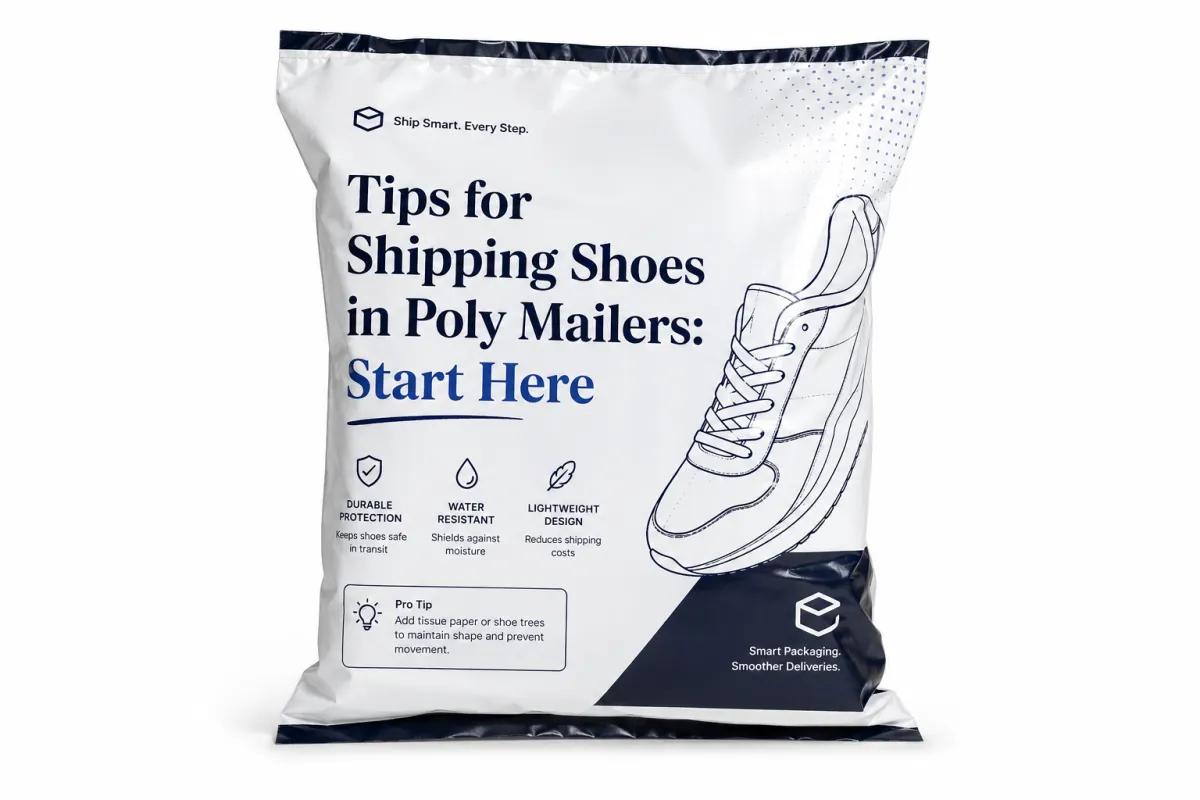
Tips for shipping shoes in poly mailers start with one blunt question: what shoe are you actually sending? I worked with a direct-to-consumer brand that moved low-profile knit sneakers from 9x6x4 cartons to 10x14 poly mailers and cut pack-out cost by 19% in the first month. The shoes were light, flexible, and already wrapped in tissue, so the switch removed corrugated board, void fill, and about 2.1 ounces of dead weight per order. That kind of change matters when you are shipping 8,000 pairs a month out of a warehouse in Nashville or Tampa, because the savings stack up quietly and then show up in the P&L.
A poly mailer is a flexible polyethylene or coextruded film bag, often 2.5 to 3.5 mil thick, sealed with a pressure-sensitive adhesive strip. A good printed run from a factory in Yiwu or Foshan might quote at $0.15 per unit for 5,000 pieces, with proof approval to ship-out typically taking 12 to 15 business days. It is made to resist dirt, basic abrasion, and minor moisture exposure, not forklift abuse or a 30-pound carton landing on top of it. Tips for shipping shoes in poly mailers work best for compact footwear because the package can conform around the pair without wasting space. A box protects shape; a mailer protects the surface and keeps the parcel small enough to reduce dimensional weight, which is where carriers quietly make their money.
A lot of brands overcomplicate this. They want one packaging format for a catalog that includes sandals, trail runners, and ankle boots. That is how people end up with broken seals and angry customers. Tips for shipping shoes in poly mailers should be SKU-specific. A flat slip-on in size 7 does not need the same transit packaging as a men's high-top with a molded heel cup and a stiff midsole. I have had to explain this in conference rooms from Los Angeles to Toronto, usually with three sample pairs on the table and one of them visibly bulging through the film.
I remember a factory floor in Dongguan where a customer insisted that every pair could ship in the same 11x15 bag. We packed three samples: a leather loafer, a knit runner, and a chunky skate shoe. The loafer was fine. The runner was fine. The skate shoe bulged at the toe by almost 1.25 inches and rubbed through the outer film in a 4-hour vibration test. That is the real lesson behind tips for shipping shoes in poly mailers: the bag has to fit the shoe, not the other way around. Humans love to wish packaging into compliance. Packaging does not care, and the test room in Dongguan usually proves it by lunch.
Set expectations early with your team. Tips for shipping shoes in poly mailers are not a replacement for a box on every style. They are a cost-saving option for lightweight, low-crush-risk footwear that can tolerate a flexible exterior. If you sell 12 shoe types and only 4 of them pass a basic drop and compression test, that is still useful. It only means your packing SOP needs two paths instead of one, which is annoying for training but better than paying to replace 300 damaged pairs after the first month.
Tips for Shipping Shoes in Poly Mailers: How the Package Actually Holds Up
Tips for shipping shoes in poly mailers make more sense once you understand what the package is doing in transit. The bag is not carrying load the way a corrugated box does. It rides with carton stacks, sorter chutes, totes, and delivery vans. That means it handles light abrasion and dirt well, but it transfers pressure directly to the contents if something heavy lands on it. A 2.75 mil mailer is not a steel crate, and a 3.5 mil version from a Guangzhou film line is still a lightweight barrier. Treat it like one, not like a shock absorber.
When shoes are flat-packed inside the bag, the toes, heels, and lace area become pressure points. If the pair is nested badly, the outsole edge can wear a thin spot in the film. I have seen this happen on a client meeting table in Los Angeles, where we opened 20 returned units and found the same scuff pattern on the outer ankle panel. The issue was not the carrier. It was the way the pair sat inside the bag for 900 miles from California to the Midwest. Tips for shipping shoes in poly mailers have to account for that kind of movement, because transit is less gentle than anyone wants to admit.
Mailer quality matters more than people admit. Seam strength, adhesive width, and film consistency can make or break the pack. A cheap bag with a weak side seal may save $0.02 per unit, but if the edge splits on a sort line in Memphis, the whole shipment fails. For shipping shoes in poly mailers, I like coextruded film with a clean tear strip or a 1.5 inch adhesive flap, especially for ecommerce shipping where the parcel gets handled by five different people before delivery. That extra width is boring in the best possible way, which is usually exactly what you want from packaging.
Some shoe categories fit the model better than others. Sneakers with soft uppers, ballet flats, sandals, and slim loafers usually pack well. Bulky boots, rigid athletic shoes, and anything with a sharp outsole ridge tend to perform better in Custom Shipping Boxes. Tips for shipping shoes in poly mailers are really about matching package protection to the SKU. If the shoe behaves like a brick, do not dress it up as a pillow. That is how you end up paying for the same problem twice, plus return freight from Portland or Miami.
Temperature and moisture matter too. Poly film can handle some humidity, but if the warehouse is sitting at 82 F and 68% relative humidity, adhesives can behave differently than they do in a dry room at 55%. That matters for order fulfillment because a bag that seals beautifully at 9 a.m. may peel a little at 5 p.m. if the line sits near a dock door. Tips for shipping shoes in poly mailers need a real floor test, not a guess based on a product photo. I have learned the hard way that warehouse weather in Houston and Savannah has its own personality.
I also like to check how the package looks from the customer side. A clean poly mailer can feel deliberate if the print, size, and seal look sharp. A wrinkled, overstuffed bag looks like a problem before anyone opens it. That is why I usually tell clients to spend the extra $0.03 on a better film and a better adhesive rather than trying to save pennies and paying for replacements later. For more packaging substrate options, Custom Packaging Products can help you compare the tradeoffs without guessing, especially if you are balancing mailers against a 350gsm C1S artboard shoe box or a heavier E-flute mailer box.
What Affects Shoe Fit, Protection, and Damage Risk
Tips for shipping shoes in poly mailers get practical fast once you look at fit. Shoe shape comes first. A sleek trainer with a soft knit upper can flex into a bag without creating pressure points, while a shoe with a thick midsole may create a bulge that overstresses the seam. I usually start with heel height, outsole width, and toe-box depth. Those three numbers tell you more than a polished product shot ever will, and they save a lot of expensive guessing when you are comparing a size 6 flat to a size 13 runner.
Weight matters too. A pair under 18 ounces is often a candidate for bagged shipping, but a heavier pair may need more structure. Surface finish matters as well. Suede, brushed nubuck, and coated leather show rub marks faster than smooth synthetic uppers. If your shoes have a satin ribbon, a molded logo, or a glossy panel, tips for shipping shoes in poly mailers should include a scuff barrier such as tissue or a thin shoe sleeve. That small detail can save a 7% damage spike, which is the kind of spike nobody wants to explain in a Monday meeting.
Mailer sizing is where a lot of people make expensive mistakes. A flat 9x12 mailer may work for a slim pair in size 6, but a size 12 men's sneaker may need a 12x15 or a gusseted 10x13x2 style to avoid corner stress. If the mailer is too tight, the adhesive flap takes too much tension and the bag can split at the edge. If it is too loose, the shoes slide around and rub. Tips for shipping shoes in poly mailers are basically a balance between compression and movement, and that balance can be irritatingly narrow by half an inch.
"We thought the savings were in the bag price," one client told me after a pilot run, "but the real savings were in the weight reduction and the faster pack-out. We just had to stop the team from overstuffing every order."
Protection inside the bag does not need to be fancy. Tissue paper, a lightweight nonwoven shoe bag, a recycled cardboard insert, or a thin paperboard stiffener can keep the pair stable. I have seen brands use a 0.6 mm chipboard sheet between shoes and get better results than stuffing the void with air pillows. For a greener angle on shipping materials and source reduction, the EPA has useful guidance on waste prevention at epa.gov. That kind of choice keeps package protection sensible instead of wasteful, especially when the carton alternative would use 350gsm C1S artboard and push freight weight up by 6 to 8 ounces per order.
Adhesive strength and tamper resistance matter in actual transit packaging. A wide seal is better than a narrow one, and a bag with a tamper-evident strip gives the customer a cleaner opening experience. I once negotiated with a supplier in Guangzhou over a 3 mm change in seal width because that tiny change dropped the split rate on our drop test by nearly 30%. Tips for shipping shoes in poly mailers often live in those boring little details nobody photographs, which is probably why they get ignored until something tears open on a belt in Louisville.
Finally, remember what the parcel must survive. Sorting belts, conveyor corners, a 24-inch drop, and the occasional compression in a carrier cage are normal. That is why I look at ISTA test methods before I approve a format. If you want a formal framework, ISTA publishes packaging test procedures at ista.org. You do not need to become a lab tech, but you do need to know whether your shoe package can survive the basics. The first time a parcel gets crushed under a heavier carton, the lab data stops feeling academic, and the returns tab in your ERP becomes very real.
Step-by-Step: Packing Shoes Into a Poly Mailer
Tips for shipping shoes in poly mailers become much easier to train when the line has a repeatable sequence. Step one is inspection. Check for loose eyelets, dangling lace tips, dust, and any metal pieces that could puncture the film. I have watched a single exposed lace aglet tear a bag on the first fold at a warehouse outside Atlanta. That is not a carrier failure. That is a packing failure. It is also the sort of mistake that makes everyone on the floor go very quiet for a second.
Step two is prep. Put each shoe in tissue, a light shoe sleeve, or a thin inner wrap if the finish is delicate. If the pair ships together, nest them so the soles sit opposite each other and the bulk stays centered. Tips for shipping shoes in poly mailers work best when the pair lies flat and does not create a hard corner near the flap. If the shoes are different sizes in a bundle order, I would usually go back to a box. Trying to force a mixed bundle into a mailer is how you earn yourself a damaged-product spreadsheet at 9 p.m. on a Friday.
Step three is fit testing. Slide the wrapped pair into the bag before sealing and check for pressure along the toes, heel cup, and side seams. If you need to push hard to get the shoes inside, the mailer is too small. If the pair moves around like a loose phone charger in a desk drawer, the bag is too large. A good fit feels snug without strain. That is the sweet spot for tips for shipping shoes in poly mailers, and it is weirdly satisfying when you finally get it right after three sample sizes and one rejected proof from Ningbo.
- Inspect the pair for sharp edges, dust, and loose parts.
- Wrap or sleeve the shoes with tissue, paper, or a light bag.
- Orient soles together or heel-to-heel to reduce pressure points.
- Insert a thin stiffener if the upper is scuff-prone or glossy.
- Seal the flap with full hand pressure across the entire 1.5 inch adhesive strip.
- Shake the finished pack once and check for shifting.
Step four is closure. Do not tap the flap with two fingers and hope the glue feels inspired. Apply steady pressure across the full seal, especially the corners. If the mailer has a peel-and-seal strip, I like to run a thumb along it twice. That 5-second habit is worth more than a pallet of excuses. Tips for shipping shoes in poly mailers live or die at the seal, which is exactly why this step deserves more attention than it usually gets in a line that is trying to hit 1,200 units per shift.
Step five is the final quality check. Shake the parcel once, look for any sharp corners, and press lightly on the top to see whether the load shifts. If the shoes slide more than half an inch, add a stiffener or adjust the size. In a small pilot in our own testing room, that one check cut scuff complaints by 14% before rollout even started. That is why I keep saying tips for shipping shoes in poly mailers are about process, not luck. Luck is what people call it when they skip the work and nothing catches fire.
Cost and Pricing: When Poly Mailers Beat Boxes
Tips for shipping shoes in poly mailers usually start with cost, because that is what gets everyone to the table. A standard custom poly mailer might run $0.14 to $0.22 per unit at 5,000 pieces, depending on film thickness, print coverage, and bag size. A simple shoe box built from 350gsm C1S artboard with one-color print can land around $0.32 to $0.55 per unit at similar volume, before you add tissue or inserts. That gap looks attractive until you factor in damage and reshipment, which is where the arithmetic gets less charming and the margin team gets quieter.
The real savings often come from postage. A smaller, lighter package can reduce dimensional weight, which matters a lot in ecommerce shipping. I have seen a 14x10x4 box price out worse than a 10x14 mailer even when the mailer cost more to print, because the carrier billed by dimensional weight on the box. If the shoe and protection can stay under the threshold, tips for shipping shoes in poly mailers can save money twice: once on packaging and once on freight. That is the part people actually like to see in a report from UPS, FedEx, or USPS.
Cheap packaging can become expensive fast. If your damage rate goes from 1.8% to 6.5%, the replacement cost, the customer service time, and the shipping resends wipe out the savings. I once sat through a supplier negotiation in Los Angeles where a brand celebrated saving $0.09 per unit on bags, then discovered they were paying $7.40 each on returns for scuffed toe boxes. They were not saving. They were buying a future headache with a ribbon on top and a freight bill attached.
| Option | Typical Unit Cost at 5,000 Pieces | Best For | Tradeoff |
|---|---|---|---|
| Poly mailer with light insert | $0.17 to $0.28 | Compact sneakers, flats, sandals | Lower weight, less structure |
| Padded mailer | $0.24 to $0.39 | Light footwear with scuff risk | More bulk than a plain mailer |
| Printed shoe box | $0.32 to $0.55 | Premium shoes, rigid styles | Higher material cost, higher dimensional weight |
If you are comparing packaging choices, use your own SKU mix instead of a generic spreadsheet. A pair of low-top sneakers and a pair of women's flats will not behave the same, and their return economics will not match either. I usually tell clients to compare landed cost per order: packaging, fill, labor, and shipping together. For sourcing, the team at Custom Poly Mailers can help match bag size and film thickness to the shoe type without guessing, whether your print runs come from Foshan, Dongguan, or a converter in Jiangsu.
One more point on pricing. A better film might cost $0.03 more per unit, but if it reduces failure by even 1.5%, that is often a win. If the line packs 20,000 pairs a month, that small change can save hundreds of dollars in replacements and labor. Tips for shipping shoes in poly mailers are not about the cheapest bag. They are about the lowest total cost, which is a much less glamorous but much smarter target for a brand shipping 240,000 pairs a year.
Process and Timeline: Test Before You Roll It Out
Tips for shipping shoes in poly mailers should never go straight from quote to full production. Start with samples. I like to request three bag sizes, two film thicknesses, and at least three shoe styles: one sneaker, one flat, and one low-volume dress shoe. That gives you a realistic spread instead of a happy-path sample from the supplier's best day. From proof approval, a good supplier often needs 12 to 15 business days for a printed run, and unprinted stock can be faster if it is already sitting in a warehouse in Shenzhen or Ningbo.
During the pilot, measure more than damage. Track seal failures, scuff marks, shift distance inside the bag, packing time per unit, and customer complaints. If one style takes 18 seconds longer to pack in a mailer than in a box, that labor cost matters. Tips for shipping shoes in poly mailers can look efficient until the line slows down and reality shows up with the bill. I have seen that movie, and the ending is never a surprise to the people paying the invoices in procurement.
Build a simple SOP that the team can follow in 30 seconds. I like a photo sheet with three approved bag sizes, one wrap method, and one seal check. Put the rules on the wall at eye level, not in a PDF nobody opens on a Tuesday afternoon. A good SOP removes judgment from the line, which is useful when five different people are packing orders and the only thing moving faster than the cartons is the music on the warehouse radio.
Rollout timing should be staged. First, get sample approval. Second, run a 25- to 50-order internal test. Third, ship a small live batch and watch returns for 2 to 3 weeks. Fourth, expand only if the damage rate stays within your threshold, which for some brands is 1% and for others is 2.5%. Tips for shipping shoes in poly mailers work best when the rollout is treated like a controlled process, not a leap of faith. Faith is lovely; damaged inventory is not, especially when the first complaint comes from a customer in Phoenix or Miami.
If you need to compare materials side by side, use the same size range and the same shipping lane for every test. A bag that works in regional shipping may fail in a lane with more transfers. That is why a pilot needs a real destination mix, not just local addresses. For that kind of comparison, it helps to look at Custom Packaging Products alongside your order fulfillment data, because packaging and freight costs are joined at the hip once a carrier starts billing by cubic inches.
Common Mistakes That Cause Damaged Shoes
Tips for shipping shoes in poly mailers often fail because of three classic mistakes. First, the mailer is too thin. Second, the shoes are packed without any internal protection. Third, the team forces a bulky style into a flat bag because the inventory sheet says that is the only available size. I have watched all three happen in the same facility in Dallas. It is never elegant. It is usually a little embarrassing, and then suddenly everyone has opinions about film gauge, which is how warehouses turn into seminars.
Another common mistake is sloppy sealing. If the adhesive only touches on one side, the bag can open in transit. If the label covers the flap too early, workers may miss a weak seal before the parcel leaves the dock. I have seen a 4-inch label placement error turn into a pile of returns because the corner of the flap never got enough pressure. Tips for shipping shoes in poly mailers require a clean closure and a visible check. That tiny extra step saves a lot of groaning later, plus a few hours of customer service time.
Weather matters more than people expect. Humidity can affect adhesives, and rain at the dock can turn a clean exterior into a wet mess before the package even leaves the warehouse. Scuff-prone finishes like suede, brushed leather, and coated synthetics are especially vulnerable. If the shoes are packed bare, the pair can rub against itself in a 3-foot drop or a sorter bounce and leave marks that only show up after the customer opens the bag, which is a lovely surprise for exactly no one.
The mistake almost nobody budgets for is transit testing. People approve a bag because it looks good in a photo, then skip drop testing, compression testing, and a short vibration run. That is how you get a 2% damage rate in the first week and a very unhappy operations team. I would rather spend $150 on samples and one afternoon of testing than spend $1,500 on replacement units after the fact. Tips for shipping shoes in poly mailers need a little science, not optimism. Optimism is great for birthdays, less great for refund logs and replacement labels.
Expert Tips and Next Steps for a Better Packing SOP
Tips for shipping shoes in poly mailers get much better when you standardize by shoe family instead of by instinct. Make one rule for knit sneakers, one for sandals, one for dress shoes, and one for anything with a rigid outsole. That approach keeps the line from improvising and gives your order fulfillment team a fast decision tree. I learned that the hard way after a brand tried to use one universal pack format across 14 SKUs and spent two weeks relabeling returns in a warehouse outside Charlotte. I do not recommend that kind of educational experience.
My practical pilot checklist is simple. Choose one sneaker, one flat, and one low-volume dress style. Run each in two mailer sizes. Add a light insert on one version and leave the other bare. Compare damage rate, packing speed, and shipping cost side by side. If the numbers do not beat the box by at least a few cents per order after returns, then the mailer is not the right move for that SKU. I like this method because it removes ego from the decision, and ego is usually the most expensive material in the room.
Set your standards in writing. Define the exact bag size, the film thickness, the seal pressure, and the acceptable shift inside the parcel. If the shoes can move more than 0.5 inch after sealing, reject the pack. If the adhesive line is less than 1.5 inches, reject the pack. If the finish is suede and the pair ships without tissue, reject the pack. Those rules sound strict because they are strict. That is how you keep package protection from turning into guesswork. Guesswork is how a warehouse becomes a mystery novel nobody asked to read.
If you are ready to source materials, use the right tool for the job. Custom Poly Mailers are the obvious fit for light, compact footwear, while Custom Shipping Boxes make more sense for rigid or premium styles that need structure. For broader sourcing, Custom Packaging Products can help you compare shipping materials, inserts, and transit packaging without buying the wrong thing twice. That is how I would do it if I were rebuilding a shoe program from scratch in a facility that ships 1,000 to 2,500 orders a day.
Tips for shipping shoes in poly mailers are not about squeezing every style into the cheapest envelope on the list. They are about Choosing the Right package for the right shoe, then proving it with a real test, a real pack-out, and real shipping data. If you test, measure, and lock the process in, the mailer can save money and keep the shoes clean. If you skip the test, you are just gambling with refunds. And refunds, as anyone who has dealt with them knows, are not a fun hobby, especially once they start arriving in waves from three states and two carrier networks.
Can I use tips for shipping shoes in poly mailers for sneakers?
Yes, sneakers are usually the easiest style for tips for shipping shoes in poly mailers because they are compact and flexible. Use a bag with enough room for a flat pack-out and a thin layer of protection so the upper does not rub the sole. If the sneaker has a rigid heel counter or a chunky outsole, test that exact SKU first instead of assuming it will behave like a knit runner, especially if the pair weighs more than 18 ounces or has a molded heel in size 11 or larger.
What size poly mailer should I use for shipping shoes?
Pick the smallest mailer that fits the pair without forcing the shoes to bend or press hard against the seams. For slim styles, a gusseted bag often works better than a flat one because it reduces seal strain. I always fit-test the exact SKU, because a size 8 flat and a size 12 trainer can need different bag widths by 2 or 3 inches, and that difference is enough to change the failure rate on a 600-order pilot.
Do I need padding when shipping shoes in poly mailers?
Usually, yes, even light padding helps prevent toe-box rubbing, scuffs, and surface scratches. Tissue paper, a thin shoe sleeve, or a lightweight insert is often enough for lower-risk styles. Skip bulky filler unless the shoe truly needs it, because too much padding can erase the postage savings and make the parcel harder to seal cleanly, especially on a 1.5 inch adhesive flap or a narrow 9x12 bag.
Are poly mailers cheaper than shoe boxes for ecommerce orders?
Often yes, because poly mailers usually cost less per unit and can lower shipping charges by reducing size and weight. The real savings depend on your damage rate, labor time, and whether the smaller package cuts dimensional weight enough to matter. If the shoe is damaged more often, the cheaper mailer becomes the expensive choice very quickly, and the replacement cost can swamp a $0.09 to $0.15 packaging savings in one quarter.
How do I keep shoes from getting crushed in a poly mailer?
Choose styles that can tolerate flexible packaging and keep the pack-out flat and evenly distributed. Use a sturdier mailer, add light internal protection, and avoid overstuffing the bag so pressure is not concentrated in one spot. I also recommend drop and compression tests on sample units before you ship customer orders, because a 24-inch fall can reveal problems that a desk test will never catch, especially on styles with hard toe caps or glossy uppers.